SCORAM: Oblivious RAM for Secure Computation
∗Xiao Shaun Wang
University of Maryland [email protected]
Yan Huang
Indiana University Bloomington [email protected]
T-H. Hubert Chan
University of Hong Kong [email protected]
abhi shelat
University of Virginia [email protected]
Elaine Shi
University of Maryland [email protected]
ABSTRACT
Oblivious RAMs (ORAMs) have traditionally been mea-sured by theirbandwidth overhead and client storage. We observe that when using ORAMs to build secure
computa-tion protocols for RAM programs, thesize of the ORAM
circuits is more relevant to the performance.
We therefore embark on a study of thecircuit-complexity
of several recently proposed ORAM constructions. Our care-ful implementation and experiments show that asymptotic analysis is not indicative of the true performance of ORAM in secure computation protocols with practical data sizes.
We then presentscoram, a heuristiccompact ORAM de-sign optimized for secure computation protocols. Our new design is almost 10x smaller in circuit size and also faster than all other designs we have tested for realistic settings (i.e., memory sizes between 4MB and 2GB, constrained by 2−80 failure probability).
scorammakes it feasible to per-form secure computations on gigabyte-sized data sets.
Categories and Subject Descriptors
C.2.0 [Computer-Communication Networks]:
General-security and protection
Keywords
Oblivious RAM; Secure Computation
1.
INTRODUCTION
Secure two-party computation allows Alice, who holds pri-vate inputxand Bob, who holds private inputy, to jointly
∗
This research is partially funded by the National Science Foundation under grants CNS-1314857 and 0845811, a Sloan Research Fellowship, Google Faculty Research Awards, a grant from Amazon AWS, a grant from Hong Kong RGC under the contract HKU719312E, as well as DARPA and AFRL under contracts 11-C-0080 and FA8750-14-C-0057. The views and conclusions contained in this document are those of the authors and should not be interpreted as representing the funding agencies.
Permission to make digital or hard copies of all or part of this work for personal or classroom use is granted without fee provided that copies are not made or distributed for profit or commercial advantage and that copies bear this notice and the full citation on the first page. Copyrights for components of this work owned by others than the author(s) must be honored. Abstracting with credit is permitted. To copy otherwise, or republish, to post on servers or to redistribute to lists, requires prior specific permission and/or a fee. Request permissions from [email protected].
CCS’14,November 3–7, 2014, Scottsdale, Arizona, USA.
Copyright is held by the owner/author(s). Publication rights licensed to ACM. ACM 978-1-4503-2957-6/14/11 ...$15.00.
http://dx.doi.org/10.1145/2660267.2660365 .
compute f(x, y) without revealing any information other than the outputf(x, y) . All known efficient constructions of such generic cryptographic protocols require anoblivious
representation of the function f to ensure that the control flow of the algorithm does not depend on its input and there-fore leak partial information. The standard approach to creating an oblivious representation is to generate a boolean circuit from the description off. This strategy is employed by dozens of prior works [1, 17, 19, 20, 22, 27, 28, 34] on secure computation.
When f is given as a RAM (Random Access Memory
model) program, transformingf into a binary circuit may be problematic. A naive transformation replaces each in-dexed access to memory with a scan of the entire memory in order to keep the index hidden. To overcome this issue,
Gordon et al. [15] used an Oblivious RAM (ORAM) data
structure proposed first by Goldreich [10] to compile RAM programs into secure computation protocols.
Intuitively, ORAM is a technique to transform a mem-ory access (with secretindexi) into a sequence of memory accesses (whose indices are revealed to the adversary but
appear independent of the secret value i). ORAM
tech-niques have been widely studied in other contexts [2–4, 10, 12–14, 21, 31–33, 35, 39, 42–44]. However, the goals of these prior works were (1) reducing the bandwidth overhead be-tween the client and server; (2) reducing theclient storage; and (3) reducing the server’s overall memory overhead. Re-markably, state of the art approaches to ORAM design limit the overhead in all three aspects to various combinations of
O(logc(n)) wherec∈ {0,1,2,3}.
ORAM Circuit Size Circuit Size (gates) Number of Inputs
(Asymptotic Bounds) N= 220 N= 229 N= 220 N= 229
Linear Scan ORAM O(DN) 142.6M ≈82678.1M 33.5M 17180.0M
LO ORAM O((D+CPRF)logN)
CLP ORAM (w/ oblivious queue) O(log4
N+Dlog2
N)ω(1)
CLP ORAM (w/o oblivious queue) O(log5
N+Dlog3
N)ω(1) 29.4M 121.8M 0.6M 2.1M
Binary Tree ORAM O(log4N+Dlog2N)ω(1) 38.5M 127.7M 7.0M 24.2M
Naive Path ORAM O(log4N+Dlog2N)ω(1) 56.2M 163.1M 0.1M 0.3M
Path-SC ORAM O˜(log3
N+DlogN)ω(1) 37.2M 111.7M 0.1M 0.3M
scoram N/A (heuristic) 4.6M 13.0M 0.3M 0.9M
Table 1: Performance metrics for different ORAM schemes for secure computation. N is the number of blocks
in the ORAM,D is number of bits in each block (i.e., the payload bit length), CP RF is the circuit complexity of a PRF function, and the security parameter is set to beO(logN)ω(1). We use the notationg(N) =O(f(N))ω(1) to denote that for anyα(N) =ω(1), it holds thatg(N) =O(f(N)α(N)). The notation ˜Ohides log logN factors. All concrete measurements are forD= 32 bits with failure probability set to 2−80 and include all levels of recursion for recursive ORAM constructions.
The circuit size reports all gates, and the number of inputs defines cost of input preprocessing, e.g., OT. For CLP ORAM, a
O(logN) oblivious queue [29] can lower the asymptotic bound but will introduce a larger circuit size in practice than trivial oblivious queue because of the small queue size. Details can be found in Section 2.2.
to dramatic improvements for certain secure computation problems. This work tackles the problem of finding very ef-ficient ORAM constructions to enable secure computation on giga-byte sized datasets.
1.1
Contribution
We embark on a comprehensive study of practical secure computation ORAM techniques. We do so via both theo-retical analysis of several metrics used to judge ORAMs and experiments performed on optimized implementations of 4 state-of-the-art ORAM schemes. We report a new heuris-tic ORAM design that outperforms all other ORAMs we considered.
Our first observation is that traditional measures of ORAM schemes do not properly indicate the ORAM performance in secure computation setting. Previously, ORAM was primar-ily considered in storage outsourcing [12, 37, 38], and secure processor execution [5, 26] settings. Thus, ORAM construc-tions were mainly evaluated by thebandwidth overhead (i.e., the number of data blocks retrieved per memory query).
Since the client-side computational logic needs to process secret values (e.g., the original index), their cost cannot be ignored as in traditional ORAMs designed merely for
out-sourcing storage. On the contrary, the overhead due to
securely computing the client-side ORAM logic can easily dominate the overall cost in both bandwidth and CPU cy-cles. Therefore, the circuit complexity of the ORAM al-gorithm plays a critical role in evaluating the efficiency of ORAM schemes used in secure computation. Note that cir-cuit size of ORAM also plays a significant role in Garbled RAMs and other related techniques [7–9, 24, 25].
Re-evaluate and improve existing ORAMs. We con-duct a systematic evaluation of several state-of-the-art ORAM schemes (e.g., Binary Tree ORAM [35], Path ORAM [39], CLP ORAM [3]) in the secure computation setting. Table 1 reports both the theoretical and concrete complexity of these existing ORAM schemes.
We find that, asymptotically speaking, the Binary Tree
ORAM by Shi et al. [35] performs the same as a naively
implemented Path ORAM [39], although Path ORAM is
asymptotically faster in the data outsourcing scenario. In fact, due to the circuit size, Path ORAM is significantly slower for practical parameter settings. Next, we derive Path-SC ORAM, an optimized construction of Path ORAM that isO(logn) faster than its naive implementation. How-ever, because of the 3 oblivious sorts (resulting in a large constant factor in practice), its performance in practical pa-rameter settings is still inferior to those theoretically slower schemes such as Binary Tree ORAM [35] and CLP ORAM [3].
A new ORAM scheme. While we do not present an
asymptotically more efficient ORAM, we propose a scheme that isempiricallythe most efficient. We argue that within polylogNcomplexity ranges, optimizing for asymptotic per-formance can be misguided. For conceivable data sizes (220∼
240 blocks), log
N is typically 20 to 40, and can be easily dominated by even moderate constants (e.g. 100). Sim-ilar observations of asymptotics vs. practical performance are not uncommon, e.g. by Stefanov et al. in constructing small-domain PRPs [36].
Our new ORAM scheme,scoram, is almost10xsmaller
in circuit size than the best previous one derived from a tranditional ORAM protocol. It is significantly faster than all existing ORAM constructions in secure computation set-ting. Further, this new scheme can also be used to build ef-ficient oblivious data structures [41] for secure computation. Our implementation of scoramwill be available online at http://www.oblivm.com.
1.2
Related Work
Gordon et al.[15] studied the feasibility of constructing sublinear-time secure computation protocols. They showed generically how any function f(·,·) that can be computed
in time t and space s in the RAM model can be securely
computed by a protocol that requires amortized timeO(t· poly log(s)). They reported an implementation of Binary Tree ORAM; using security parameter less than 20, and
N = 220, their ORAM scheme requires roughly 6.6M
non-free gates and 16M total gates; while our best scheme configured at a much higher security parameter results a cir-cuit approximately 1/3 of theirs . See Section 6 for details. Gentry et al. [6] optimized the binary tree ORAM for secure computation, reducing the tree height using larger buckets. We do not include the scheme in Table 1 because their scheme is subsumed both asymptotically and empir-ically by Path ORAM [39]. This observed can be verified with a simple back-of-the-envelope calculation: Their evic-tion algorithm is similar to Path ORAM’s, except that they directly compute where a block should be dropped along the path — closest to the leaf respecting invariant. Naively implementing their eviction would result inO(A2) overhead whereA is the total number of blocks on the path, i.e., A = (bucket size)*(path length). Notice that Path ORAM also has O(A2) overhead for a naive eviction circuit, but
Path ORAM’sA value is both asymptotically and
empiri-cally smaller than that of Gentry et al. In both schemes, we can have an asymptotically smaller eviction circuit with oblivious sorting, but as we show, oblivious sorting intro-duces a large constant such that the practical performance is worse than that of the original binary-tree ORAM.
Keller and Scholl [18] implemented secure oblivious data structures using both the Binary Tree ORAM [35] and a vari-ation of Path ORAM [39]. However, from their result, the variation does not perform better than Binary Tree ORAM even with small security parameters. In contrast,scoram outperforms Binary Tree ORAM by 7x even with large se-curity parameter(80).
Lu and Ostrovksy [23] proposed asymptotically the best ORAM in the literature. Their 2-server design can perform a sequence ofnreads or writes withO(logn)amortized over-head per access while using O(n) storage for the servers
and O(1) client memory. As these parameters meet the
lower-bound for the performance of a single-server ORAM, it appears to be a perfect candidate for ORAM in secure computation. Unfortunately, there are two serious practical bottlenecks to the implementation of LO ORAM.
To understand the first issue, recall that the LO ORAM was built upon the KLO ORAM [21] which was further built upon1the map-reduce based cuckoo-hashing ORAM of
Goodrich and Mitzenmacher [12]. In order to read or write at indexx, the scheme iteratively queries a hierarchy of hash tablesHk, Hk+1, . . . , HLwith eitherxor a dummy address
tdepending on whetherxhas been found or not. The se-curity relies on issuing the dummy query oncex has been found in order to maintain the invariant that every lookup is unique (i.e, there is never a lookup for the same address
xat any two levels in the hierarchy). This means that read queries requireseveral sequential executions of separate se-cure computation protocols; in contrast, tree-based ORAM designs require only 1 secure computation protocol to be run per read/write operation.
The second serious problem is a large overhead constant for cuckoo hashing. All cuckoo-hashing based ORAMs de-pend on a lemma proven by Goodrich and Mitzenmacher [12] which bounds the collision rate of a cuckoo-hashing struc-ture via a combinatorial analysis of a graphGthat is based on the cuckoo-hashing function. This lemma requires the cuckoo hash table size to be at least Ω(log7(
N)); this
tech-1
KLO pointed out a subtle security issue that affects almost all cuckoo-basing based ORAM schemes, and explain how to fix it.
nique therefore only starts to beat the Linear Scan ORAM whenN >237.
2.
BACKGROUND: TREE-BASED ORAMS
Notation. We useN to denote the number of (real) data blocks in ORAM, D to denote the bit-length of a block in
ORAM, Z to denote the capacity of each bucket in the
ORAM tree, and λ to denote the ORAM’s statistical
se-curity parameter. When discussing binary trees of depthL
in this paper, we say theleavesare at level 0 and the root is at levelL−1. Although unconventional, this simplifies the description of our algorithms.
2.1
Tree-based ORAM Construction
Shiet al.[35] proposed a new binary-tree based framework for constructing a class of ORAM schemes. Many recent ef-ficient ORAM schemes [3,35,39] extend this construction, so we briefly review this framework below. The key difference between the schemes is the choice ofeviction strategy.
Data organization. The server organizesN blocks into a binary tree of heightL= logN; each node of the tree is a
bucket containingZ blocks of the form:
{idx||label||data},
whereidxis the index of a block, e.g., the (logical) address of desired block;labelis a leaf identifier specifying the path on which the block resides; and datais the payload of the block.
The client stores a position map, mapping memory ad-dresses toleaf labels. Position map storage can be reduced toO(1) by recursively storing the position map in a smaller ORAM (see [35] for details). These leaf labels are assigned randomly and are reassigned as blocks are accessed. If we label the leaves from 0 toN−1, then each label is associated with a path from the root to the corresponding leaf.
Tree-based ORAMs maintain theinvariantthat a block marked
labelresides either on the path leading to the corresponding leaf node specified bylabelor in the stash.
Operations. Tree-based ORAM support three operations. Among these, the Eviction algorithm is the key difference between schemes.
• ReadAndRemove: Given an indexidx, the client looks up its label from the position map, and fetches all blocks on the path leading tolabel. The client finds the blockidx(due to the main invariant) and removes it from the path.
• Add: The retrieved block is potentially updated, reen-crypted and written back.
• Eviction: Percolate blocks towards leaves such that no bucket will overflow except with negligible probability. Various ORAMs use different eviction schemes which we explain below.
eviction strategy applies to a single ORAM (i.e., not taking into consideration the recursion, which applies equally to all tree-based strategies).
2.2
Various Eviction Strategies
Original binary-tree ORAM.The original Binary Tree ORAM scheme [35] adopts random eviction: with every data access, pick two random buckets from each level, and evict one block from each selected bucket by placing the block into the correct child node (subject to the invariant). Shi
et al. show that this eviction strategy requires a bucket size ofO(logN)ω(1) to avoid overflow except with negligible probability.
Path ORAM.Path ORAM adopts a greedy eviction strat-egy that works with a stash maintained in client storage. Blocks on the pathP are first unioned with the stash. Each block in this set is then placed as close as possible to its desti-nation leaf in pathPsubject to the path invariant. Stefanov
et al.[39] show that this aggressive eviction strategy works with a bucket size of 4.
CLP ORAM. In CLP ORAM [3], internal nodes of the binary tree containO(log logN) blocks per bucket, and the stash is replaced by a queue of lengthω(log2
N) that requires add, pop and find operations. The eviction strategy works as follows: in each level pick the “deepest” block on the eviction path and push it to the next level. If blocks in a bucket trigger a certain property, a special overflow procedure will be called, which will add a block in the current bucket to the queue. However, the fact that every level can overflow makes the worst case running time much worse then average case: the overflow procedure needs to be called logNtimes in the worst case. An asymptotically better oblivious queue [29] can be used for CLP ORAM, however, linear scan performs better in practice because the size of queue is small.
2.3
ORAM for Secure Computation
Unlike the traditional ORAM scenario, in the Ostrovsky-Shoup framework, both the server memory and the client storage of the ORAM are secret-shared between the par-ties2. Eachinstruction of a RAM program consists of an
address to read from memory, an operation to perform, and an address to write back to memory. These three steps are accomplished via a secure computation protocol between the parties that takes as input (a) secret shares of the memory, (b) secret shares of the ORAM client state, (c) and secret shares of the program state.
In the RAM-model secure computation framework, both the program logic and memory operations are implemented over secure computation. The cost of memory operations can be significant since evaluating ORAM over secure com-putation is expensive. For tree-based ORAM schemes, typ-ically, the eviction procedure can account for the majority of the cost. In the next section, we start with implementing Naive Path ORAM in circuit.
3.
PATH-SC ORAM
We first investigate Path ORAM since it has the smallest empirical bandwidth overhead among all tree-based ORAMs. Naturally a good question is whether we can implement Path
2
We note that Gordonet al. propose an asymmetric division of the server and client state to enable one party in the secure computation protocol to have a sublinear number of input bits.
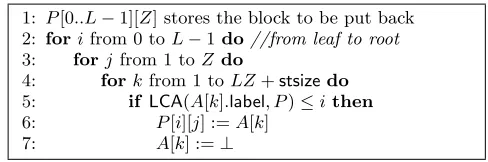
1: P[0..L−1][Z] stores the block to be put back 2: forifrom 0 toL−1do//from leaf to root
3: forjfrom 1 toZ do
4: forkfrom 1 toLZ+stsizedo
5: if LCA(A[k].label, P)≤ithen
6: P[i][j] :=A[k]
7: A[k] :=⊥
Figure 1:Naive oblivious algorithm for Path ORAM’s
Eviction. VariableAdenotes a buffer created by concatenat-ing the stash and the pathPread in Path ORAM. This algo-rithm writes as many blocks back toP as possible, packing them as close to the leaf as possible.
ORAM with a small circuit as well. SinceReadAndRemove
andAddalgorithm are trivial to turn intoO(DlogN)ω (1)-sized circuits, we focus our discussion on how to implement Path ORAM’s eviction algorithm in circuit.
Expressing circuits. In the remainder of the paper, we will need to describe circuit constructions. Since oblivious algorithms with constant client memory size can be easily transformed into circuits preserving complexity, we hence-forth equate the notions ofoblivious algorithmsandcircuits, and describe circuits using oblivious algorithms.
Notations. Suppose each ofp1 andp2 represents a leaf or
a root-to-leaf path. We useLCA(p1, p2) to denote the level
of the lowest common ancestor of the leaves, or equivalently the node where the two paths diverge when traversing from the root. In the remainder of the paper, we sometimesuse the notationlabeland a pathpinterchangeably, since a path
pis defined by thelabelof a leaf node. When we sort lexi-cographically according to a key pair (key1,key2), we mean first sort according tokey1, and if there is a tie onkey1, then
we sort according tokey2.
LetAdenote a buffer created by concatenating the stash
with a path p(the data read path) in Path ORAM. Path
ORAM’s eviction writes as many blocks fromAtopas pos-sible and packs them as close to the leaf as pospos-sible.
NaiveO(Dlog2
N)eviction circuit. A naive way to turn Path ORAM’s eviction algorithm into a circuit would result in aO(Dlog2
N)ω(1)-sized circuit. We describe this naive method in Figure 1.
3.1
A New
O˜(DlogN)Eviction Circuit
The rearrangement problem. Path ORAM’s eviction can be recast as a rearrangement problem: we would like to obliviously rearrange the entries inA(by pairwise swapping) with respect to the following conditions:
1. The blocks in A[1...LZ] will be written back to the pathP, where the block ati=kZ+j(wherek=bi−1
Z c and 1≤j≤Z) will go to bucketk. We require that for eachi, ifA[i] is a real block, thenLCA(A[i].label, P)≤
k. If less thanZ real blocks are assigned to a bucket, dummy blocks will be added to that bucket.
2. For the real blocks that cannot be written in the path, they will be stored inA[LZ+1...LZ+stsize]. Hence, if
A[LZ+stsize+ 1] contains a real block, this indicates stash overflow.
evic-1. Initialization. For eachi∈ {1,2, . . . , LZ}: letA[i].bucket:=LCA(A[i].label, P), letA[i].dummydenote whetherA[i] is a dummy block.
2. O-sort: real before dummy. Oblivious sort based on the keybucket. After sorting, all real blocks come first, in bucketascending order.
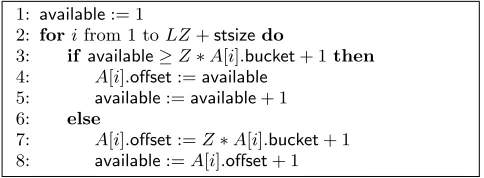
3. Scan A to compute the final offset (from leaf ) for each block.We give the algorithm to calculateoffsetfrom bucketin Figure 4.
4. Append dummy. AppendLZdummy blocks at the end whoseoffsetare 1, . . . , LZ, respectively.
5. O-sort: reorder based on offset. Oblivious sortAbyoffset(where blocks withoffset=⊥are put at the end). 6. Suppress unnecessary dummy. ScanA to “eliminate”unnecessarydummy blocks. A dummy block is considered
unnecessaryif it is preceded by a real block with the sameoffset value. We “eliminate” this dummy block by setting itsoffsetto “⊥”.
7. O-sort: fall into place. SortAbyoffsetso that unnecessary dummys are moved to the endA.
Figure 2: Eviction algorithm of Path-SC ORAM.
tion algorithm) to each entryA[i]. buckettakes values from {0, . . . , L−1} ∪ {⊥}. For a dummy block,bucketis set to ⊥. For a real block, bucket := LCA(label, P), where label denotes the leaf label of the block. In other words,bucket is the lowest level (i.e., closest to leaf) where the block is allowed to reside on the path P. Recall that we assume bucket= 0 refers to the leaf level whilebucket=L−1 refers to the root level.offsettakes values from{1, . . . , LZ} ∪ {⊥}. dummyindicates if a block is dummy.
The improved eviction algorithm is described in Figure 2. At the end of the algorithm, the firstZ blocks ofAcan go to the leaf, path, and the nextZblocks should go to leaf but one level, and so forth. The idea of using oblivious sorting to design efficient oblivious algorithms is also used in other scenarios [30].
In Appendix A, we also consider how to construct a low-depth circuit for our new eviction algorithm.
Examples. The most sophisticated part of the algorithm is Step 3 in Figure 2, i.e., computing the offset of blocks. This part of the algorithm is further explained in Figure 4. Below we give an example of this step. Assume thatZ = 3. Then, a sequence ofbucketvalues [0 0 0 0 1] should result inoffset values [1 2 3 4 5]. Additionally, bucket values [0 1 1 1 1] should result inoffsetvalues [1 4 5 6 7].
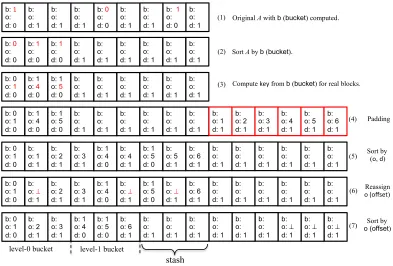
An example of the full eviction circuit is given in Figure 3.
1: available:= 1
2: forifrom 1 toLZ+stsizedo
3: if available≥Z∗A[i].bucket+ 1then 4: A[i].offset:=available
5: available:=available+ 1
6: else
7: A[i].offset:=Z∗A[i].bucket+ 1 8: available:=A[i].offset+ 1
Figure 4: Computingoffset frombucket.
Theorem 1. The Path-SC ORAM withEvictiondescribed above can be fully implemented (i.e., including all the recur-sive ORAMs used to store the position map) inO˜(log3
N+
DlogN) boolean gates.
Proof. The circuit to implement the data level ORAM requiresO(DlogNlog logN) gates due to the oblivious sort-ing operations in Figure 2. For recursion levels, we use
O(logN) for each block, and withO(logN) levels of recur-sion, the total circuit size for position map recursion levels
is O(log3
Nlog logN). Therefore, the total circuit size for all levels is ˜O(log3
N+DlogN).
Findings. We implement our Path-SC ORAM and com-pare its empirical performance with that of the Binary Tree ORAM and CLP ORAM. While Path-SC ORAM is asymp-totically superior to both Binary Tree ORAM and CLP ORAM in terms of circuit size, for practical ranges of N, empirical results suggest that both the Binary Tree ORAM and CLP ORAM perform better. Detailed empirical results are presented in Section 6.
Upon closer examination, we realize that Path-SC ORAM requires 3 oblivious sorts in its circuit construction, which leads to a very large constant. This motivated our search for a scheme that could avoid sorts altogether.
4.
A HEURISTIC ORAM
We devise a heuristic ORAM scheme calledscoram
op-timized for empirical performance (as opposed to asymp-totical performance). Our key idea is to have an effective eviction algorithm that can be implemented in small circuit. In this section, we focus on presentation of the algorithm, leaving optimal parameter choices to the next section.
4.1
SCORAM
Ourscoram is another tree-based ORAM with a novel Eviction algorithm. Overall, Eviction will performflush() (Algorithm 1) αtimes. In our implementation, we choose
α = 4 which we determine to be the optimal choice (see
Section 5 for more details). Below we explain the intuition.
Greedy push pass (lines 7 to 10) We opt for a greedy push pass similar to that of the CLP ORAM, but avoid their
bucket overflowshandling strategy. First, a random path is selected for eviction with every data access. Next, for each bucket from root to the leaf-1 level on the selected path: pick a block that can be evicted deepest along this path, and push it to the child bucket if there is room.
evic-b: 1
o: d: 0
b: o: d: 1 b: o: d: 1 b: o: d: 1
b: 0
o: d: 0 b: o: d: 1 b: o: d: 1
b: 1
o: d: 0
b: o: d: 1 (1)
b: 0
o: d: 0
b: 1
o: d: 0
b: 1
o: d: 0 b: o: d: 1 b: o: d: 1 b: o: d: 1 b: o: d: 1 b: o: d: 1 b: o: d: 1 (2) b: 0 o: 1
d: 0 b: 1 o: 4
d: 0 b: 1 o: 5
d: 0 b: o: d: 1 b: o: d: 1 b: o: d: 1 b: o: d: 1 b: o: d: 1 b: o: d: 1 (3) b: 0 o: 1 d: 0 b: 1 o: 4 d: 0 b: 1 o: 5 d: 0 b: o: d: 1 b: o: d: 1 b: o: d: 1 b: o: d: 1 b: o: d: 1 b: o: d: 1 b: o: 1 d: 1 b: o: 2 d: 1 b: o: 3 d: 1 b: o: 4 d: 1 b: o: 5 d: 1 b: o: 6 d: 1 (4) b: 0 o: 1 d: 0 b: o: 1 d: 1 b: o: 2 d: 1 b: o: 3 d: 1 b: 1 o: 4 d: 0 b: o: 4 d: 1 b: 1 o: 5 d: 0 b: o: 5 d: 1 b: o: 6 d: 1 b: o: d: 1 b: o: d: 1 b: o: d: 1 b: o: d: 1 b: o: d: 1 b: o: d: 1 (5) b: 0 o: 1 d: 0 b: o: ⊥
d: 1 b: o: 2 d: 1 b: o: 3 d: 1 b: 1 o: 4 d: 0 b: o: ⊥
d: 1 b: 1 o: 5 d: 0
b: o: ⊥
d: 1 b: o: 6 d: 1 b: o: d: 1 b: o: d: 1 b: o: d: 1 b: o: d: 1 b: o: d: 1 b: o: d: 1 (6) b: 0 o: 1 d: 0 b: o: 2 d: 1 b: o: 3 d: 1 b: 1 o: 4 d: 0 b: 1 o: 5 d: 0 b: o: 6 d: 1 b: o: d: 1 b: o: d: 1 b: o: d: 1 b: o: d: 1 b: o: d: 1 b: o: d: 1 b: o: ⊥ d: 1
b: o: ⊥ d: 1
b: o: ⊥ d: 1
(7)
level-0 bucket level-1 bucket
Original A with b (bucket)computed.
Sort A by b (bucket).
Compute key from b (bucket) for real blocks.
Padding
Sort by (o, d)
Reassign o (offset)
Sort by
o (offset)
stash
Figure 3: A toy example of Path-SC ORAM eviction algorithm. Here we assumeL= 2, Z= 3 andstsize= 3. bstands
for thebucketfield whilektheoffsetfield. d=1indicates dummy blocks, where the contents of other fields are not applicable.
Algorithm 1flush()
1: path:=UniformRandom(0, ..., N−1)
2: bucket[0, ..., L−1] := array of buckets from leaf to root 3: B1:= the block in the stash with smallestLCA(path, B.label).
4: forifrom 0 toL−1do (from leaf to root)
5: if bucket[i] is not full andLCA(path, B.label)≤iandB1 has not been added alreadythen
6: AddB1 tobucket[i].
7: forifromL−1 to 1do (from root to leaf )
8: B2:= the block inbucket[i] with smallestLCA(path, B2.label).
9: if bucket[i−1] is not full andLCA(path, B2.label)< ithen
10: MoveB2 frombucket[i] tobucket[i−1].
tion paths because we cannot reveal where the actual over-flows happen; (3) updating the (recursively stored) position map is also very expensive. Although some of the above overflow handling logic can be implemented asymptotically better using oblivious sorting, this actually worsens the em-pirical overhead due to the large constant factor associated with oblivious sorting.
In contrast, inscoram, a block will only be evicted if the child bucket is not full. Unfortunately, such a “greedy push pass” alone would make the eviction less effective, as it is more likely for a bucket to be full and the stash could grow unduly large. This motivates our idea of compensating with a “reverse dropping pass”.
Reverse dropping pass (lines 3 to 6).Pick a block from stash that can be pushed deepest along the path, then put it into the bucket as deep along the path as possible. This can be implemented by scanning the eviction path in reverse order from leaf to root and placing the block into the first non-full bucket that satisfies the block’s path-invariant.
Security. Security of the scheme follows as per all other tree-based ORAMs; the server’s view observes accesses along random paths.
5.
OPTIMIZATIONS
Our optimizations largely fall into two categories: (1) de-termining the best parameters for scoram (Section 5.1); (2) improving the circuit design for frequently used logic components (Section 5.2).
In general, ORAM schemes have several decisive parame-ters including bucket size, stash size (if it uses a stash) and recursion factor. Depending on the specific eviction algo-rithms employed, there are additional parameters describ-ing the eviction process. For example, inscoram, we useα to denote the number times to callflush. These parameters are subtly inter-related. For instance, a larger bucket size allows for smallerαand smaller stash at the same security parameter.
16 18 20 22 24 Security Parameter
10 20 30 40 50
Stash
Size
logN=10 logN=14 logN=18 logN=22
Figure 5: Stash size of scoram grows linearly with
security parameter. Z= 6 andα= 4.
We now systematically explore this parameter space to determine heuristically good choices forscoram.
Methodology. Some of our optimizations rely on simula-tions to count, for any particular ORAM setup, the number of ORAM failures (for estimating the security guarantee) and the total number of encryptions per memory access. We use simulations because all of the proofs that upper-bound the failure probabilities are too conservative in their approximations.
For each ORAM, we first run 16 million ORAM accesses to warm up the ORAM, such that it enters a steady state, we then start collecting numbers to determine the security parameters associated with this setup (including e.g., vari-ous bucket and stash sizes). Since the time average is equal to ensemble average for regenerative processes [16], we sim-ulate each ORAM setup for a single long run of 1 billion accesses to estimate the security parameter (instead of mul-tiple runs). This allows us to estimate ORAM parameters that achieve up to 2−80 security. A similar approach was
suggested by Stefanovet al.[39].
Number of flushes and bucket size. We have run simu-lations of our new ORAM that indicate a good choice ofα
is 4.
After α is fixed, we consider two strategies to configure bucket size: 1) a uniform bucket size everywhere; and 2) varying bucket sizes across levels. For the former, we empir-ically determine an optimal bucket size of 6. However, we observe that, in scoram, buckets at the middle and lower part of the path tend to be more congested. This motivates us to redistribute the bucket size across levels. For example, for a binary tree of 21 levels, we find that increasing the bucket size by 1 for the first 10 buckets from root and de-creasing the bucket size by 1 for the last 10 bucket at leaf is a better distribution than evenly distributing buckets. As-suming 80-bit security, varying the bucket size in this way allows us to reduce the stash size from 66 to 50, resulting in a circuit of size of 4,094,832 gates versus 4,562,988 for the version ofscoramreported in Table 1, i.e., roughly a 10% reduction.
Stash size. We plot the stash size versus security param-eters with different logN in Figure 5. Each point (x, y) on the curve should be read as “with a stash size of more than
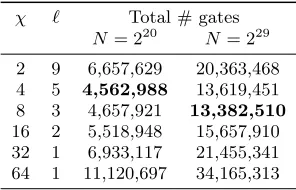
χ ` Total # gates
N= 220 N= 229
2 9 6,657,629 20,363,468
4 5 4,562,988 13,619,451
8 3 4,657,921 13,382,510
16 2 5,518,948 15,657,910
32 1 6,933,117 21,455,341
64 1 11,120,697 34,165,313
Table 2: How to pick χand the recursion level. This
table shows how we concretely optimize recursion parame-ters needed to implement the position maps inscoram. χ
describes how many addresses are packed into each block, and`describes the number of recursive steps before we use the linear-scan ORAM as the base case.
y, ORAM failures were observed 2−x fraction of the time”. the stash size grows linearly with security parameters, sug-gesting the failure probability decreases exponentially with the stash size. Note that unlike the Path-SC ORAM, the stash size is super-linear in logN.
Recursion factor. Here we study the choices needed to re-cursively implement the position-map in all tree-based ORAM designs. We formulate the choice as an optimization prob-lem as follows.
As before, letN denote the number of blocks (and thus the size of the position map),Ddenote the number of bit per blocks, and for our given scheme, letf(N, D) =O(DlogeN)ω(1) denote the the circuit size for one ORAM access excluding
the cost of the position map lookup. LetLS(N, D) denote the circuit size of the linear scan ORAM.
In our top-level ORAM, we haveD0= 32. When
imple-menting the position map recursively with another ORAM, we must select the number of labels,χ, to pack into a block and the number of times, `, to do recursion before finally using the linear scan ORAM as the base case. Note, the ORAM for theithrecursive level hasNi=χNi blocks of size
Di=χlogNi−1. Thus, the total cost with recursion is
` X
i=0
f(Ni, Di) +LS(N`+1, D`+1)
For example, whenN = 220,
χ= 8 and`= 3, we have
total cost: f(220,32)+f(217,160)+f(214,136)+f(211,112)+
LS(28
,88). Since we can empirically determine f for any parameter setting, we can thus minimize the total cost. In our case, we limit χ to a power of 2 and use the same χ
at each recursive level. See Table 2 for the results of this optimization. WhenN = 220, we use
χ= 4 and`= 5, and whenN = 229, we use
χ= 8 and`= 3.
5.2
Circuit-Level Optimizations
We make several circuit-level optimizations to reduce the total number of gates and number of non-free gates. The latter (i.e., non-free gates) is a metric specific to certain backends such as garbled circuits [45] and GMW [11].
Backend-independent optimizations. A frequently-used logic is to determine if a block is dummy. We add a single bit fieldisDummyto each block indicating whether the block isdummy. This simple trick reduces the circuit size to
gate. In addition, an important side benefit is that it en-ables efficient oblivious removal of a block from the bucket. We only need to set theisDummyfield instead of resetting all bits of a block.
Backend-dependent optimizations. Some secure com-putation protocols such as the garbled circuit and the GMW protocol support almost-free XOR gates. We make several circuit level optimizations exploiting this opportunity.
A common operation in some Eviction algorithms (e.g.,
CLP ORAM, scoram) is to compute the block among a
given bucket of Z blocks {b1, . . . , bZ} that can be pushed deepest along the pathP without violating the path invari-ant. Intuitively, we can calculateLCA(bi.label, P) for every
i, which involves counting number of zeros of (bi.label⊕P). Since eachlabelhas logNbits, counting the number of lead-ing zeros for every label requires O(logNlog logN) AND gates and computing the maximum for allZ blocks requires
O(Zlog logN) AND gates. Therefore, it uses a total of
O(ZlogNlog logN)ANDgates.
In our implementation, we use a circuit of sizeO(ZlogN) to compute exactly this function: (1) compute label0i =
bi.label⊕P.(More zeros inlabel0means deeper). (2) inlabel0, set all bits lower than the most significant 1 bit to 1. (3) find the block with smallestlabel0, which corresponds to the deepest block. This works because alabel0 is smaller after processed by (2) if and only if it has more zeros.
6.
PERFORMANCE EVALUATION
6.1
Methodology and Metrics
Our evaluation focuses on the following types of metrics: 1. Cryptographic backend independent metrics, such as
gate count. This characterizes the performance of a ORAM when used in secure computation in general, relatively independent of the cryptographic backends. 2. Cryptographic backend dependentmetrics, such as the number of encryptions, non-free gates, and bandwidth. These metrics characterize the performance of an ORAM scheme with a semi-honest Garbled Circuit backend in a manner that is independent of the specific hardware configuration or implementation artifacts.
3. Implementation and machine dependentmetrics, such as runtime and breakdown of runtime. We will de-scribe our specific hardware configuration and the spe-cific Garbled Circuit implementation as the context of our results. We also discuss the interpretation of these results and project the performance had the experi-ments been run on a different hardware configuration or with a more optimized Garbled Circuit implemen-tation.
6.2
Performance Comparison
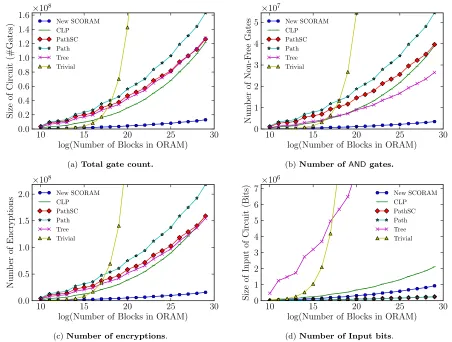
We reevaluate the state-of-the-art ORAMs over secure computation, and compare their performance with our sco-ram. The metrics we considered include total gate count (Figure 6a), non-free gate count (Figure 6b), number of AES encryptions (Figure 6c), and input size of circuit (Figure 6d).
Table 3 summarizes the margin by which our scoram
outperforms existing schemes. In particular, we show that across all metrics, we achieve 7.6×to 9.8×performance im-provements comparing to the respective second best ones.
As mentioned earlier, even though Path-SC ORAM is asymptotically better than Binary Tree ORAM, for
prac-10 12 14 16 18
log( Number of blocks ) 0
10 20 30 40 50 60
Amoun
t
of
Data
T
ransferred
/
MB Security Parameter = 60
Security Parameter = 80 Security Parameter = 128
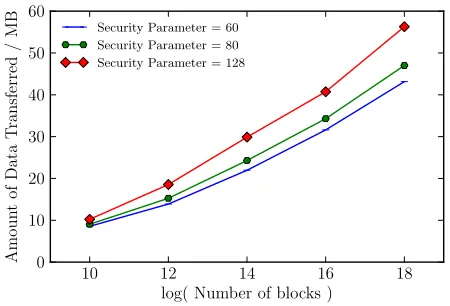
Figure 8: The amount of data transferred per access
for scoram. Payload bitlength is 32 bit, 80-bit security parameter.
tical ranges ofN, Binary Tree ORAM outperforms Path-SC ORAM due to lower constants in the asymptotic bound. This is shown in Figure 6.
The most popular ORAM scheme used previously is
Bi-nary Tree ORAM.scoram is 7 times smaller and requires
27x fewer inputs. Note that each input bit involves an obliv-ious transfer, which, even with OT extension, incurs 2 en-cryptions. For the sake of reproducibility, we report all pa-rameter settings that we used to run our experiments in Table 4 in the Appendix.
6.3
Performance Profiling for SCORAM
We further investigate the performance breakdown of sco-ramscheme. Specifically, the cost can be broken down into I/O overhead and computation overhead.
Our machine/implementation-dependent measurements are taken on a single server (Intel Xeon 2.13G Hz) running the circuit generator and evaluator as two independent processes (communicating through Socket). The memory usage ranges from 4–12 GB for both processes depending on the data size.
Interpreting the measurements. First, our implemen-tation does not currently exploit AES-NI instructions to speed-up garbling. We expect a noticeable speedup for the computation time when hardware AES is implemented.
Second, the Garbled Circuit backend we used is a Java-based implementation. Therefore, our timing measurements are subject to the artifacts of the Java-based implemen-tation. There are two main sources of artifacts, memory garbage collector and I/O synchronization. In Figure 7, we note that a substantial portion of the time is due to I/O. Since the experiments is run on the same machine where network bandwidth is not a bottleneck, we infer majority of the I/O time we recorded are due to I/O synchronization. Note that for the circuit generator, we observe the computa-tion time spent on OT and garbling is roughly the same. On the circuit evaluator side, the portion of I/O cost is larger because the evaluator indeed has less computational work to do (thanks to the garbled row reduction technique) while being stuck more often waiting for the generator.
pa-10 15 20 25 30 log(Number of Blocks in ORAM) 0.0
0.2 0.4 0.6 0.8 1.0 1.2 1.4 1.6
Size
of
Circuit
(#Gates)
×108
New SCORAM CLP PathSC Path Tree Trivial
(a)Total gate count.
10 15 20 25 30
log(Number of Blocks in ORAM) 0
1 2 3 4 5
Num
b
er
of
Non-F
ree
Gates
×107
New SCORAM CLP PathSC Path Tree Trivial
(b)Number of ANDgates.
10 15 20 25 30
log(Number of Blocks in ORAM) 0.0
0.5 1.0 1.5 2.0
Num
b
er
of
Encryptions
×108
New SCORAM CLP PathSC Path Tree Trivial
(c)Number of encryptions.
10 15 20 25 30
log(Number of Blocks in ORAM) 0
1 2 3 4 5 6 7
Size
of
Input
of
Circuit
(Bits)
×106
New SCORAM CLP PathSC Path Tree Trivial
(d)Number of Input bits.
Figure 6: Comparison of various ORAMs. Payload bitlength = 32 bits, security parameter = 80.
rameters. Note that the bandwidth overhead is proportional to the total number of non-free gates in our garbled cir-cuit system. The non-free-gate counts (Figure 6b) correlates with growth in the bandwidth.
Comparison with existing implementations. We are aware of two other ORAM implementations over secure
com-putation. Gordon et al. [15] report on an ORAM with
N = 220 and
D = 512 with secure parameter less than
20. The paper does not clearly report the bucket size they use, but we assume the bucket size is 40 based on our in-terpretation of their paper. Their ORAM requires 11.9M gates and takes approximately 50 seconds for one operation. In contrast, our best implementation for their parameters requires 3,743,213 total gates, and our implementation at significantly higher security parameters(80) runs in under 30 seconds. Further, Gordonet al. reported a break-even point with the trivial Linear Scan ORAM at 216 blocks with 512
bits per block and security parameter less than 20. In com-parison, we achieve a break-even point at 214 blocks with
32 bits per block, with a much higher security parameter of 80. Note that typically, bigger blocks would reduce the break-even point because meta-data operations that are in-dependent of block size can be amortized to more bits per block.
The second implementation is by Keller and Scholl [18]. Their implementation was based on the SPDZ protocol,
run-ning in thepreprocessingmodel. Their flagship scheme was based on Path ORAM, with heuristic modifications. How-ever, their result shows that their new Path ORAM variant is worse than Binary Tree ORAM, while our implementa-tion is much better than Binary Tree ORAM. We expect that scoram would also outperform Binary Tree ORAM when implemented over SPDZ.
6.4
End-to-End Applications
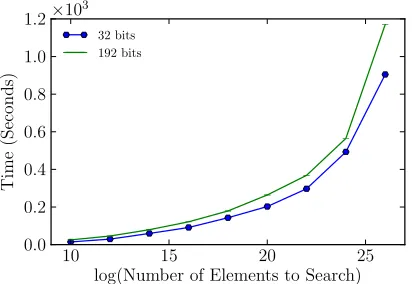
In this section, we show the performance ofscoramwhen used in practical applications. We assume Alice holds a sorted array and Bob holds queries. They would like to re-peatedly search for some element over the sorted array with-out revealing any information except the result. The array is put into an ORAM in a one-time offline setup phase, and henceforth the parties will securely evaluate binary searches on multiple queries. Whenever the binary search program accesses a cell of the array, an ORAM access is called. In Figure 9, we show the clock time to do a binary search with different data size and payload size. The evaluation here reports the online cost of performing the searches, not counting the offline ORAM setup phase.
Metric Second best Performance gain of scoram N = 220 N= 229
Gate Count CLP ORAM 6.7X 9.4X
Non-Free Gates Binary Tree ORAM 7.6X 7.6X
Number of Encryptions CLP ORAM 7.2X −
Binary Tree ORAM − 9.8X
Table 3: Performance comparison of scoram over the second best candidates. (Data payload: 32 bits. Security
parameter: = 80). Considering the number of encryptions, the second best is the CLP ORAM whenN= 220, and the Binary
Tree ORAM whenN = 229.
10 12 14 16 18 20 22 24 26 log(Number of Blocks in ORAM) 0
5 10 15 20 25 30
Time
/
seconds
Computation for Garbling Computation for OT I/O for Garbling I/O for OT
(a) Breakdown for the Garbled Circuitgenerator.
10 12 14 16 18 20 22 24 26 log(Number of Blocks in ORAM) 0
5 10 15 20 25 30
Time
/
seconds
Computation for Garbling Computation for OT I/O for Garbling I/O for OT
(b) Breakdown for the Garbled Circuitevaluator.
Figure 7: Cost breakdown ofscoram. (Data payload: 32-bit, Security parameter: 80-bit)
10 15 20 25
log(Number of Elements to Search) 0.0
0.2 0.4 0.6 0.8 1.0 1.2
Time
(Seconds)
×103 32 bits 192 bits
Figure 9: Time to do a binary search over scoramin
secure computation. The result is shown with 80 bits security.
security parameter of 80 and 512 bits payload, our imple-mentation is about 16x times faster than that by Gordonet al.[15]. Specifically, our SCORAM has about 8x times fewer ANDgates; and our garbled circuit backend (including hard-ware configuration) is about 2x faster than Gordonet al.’s backend implementation and hardware.
7.
CONCLUSION
As an enabling primitive of RAM-based secure tion, the construction of efficient ORAM for secure
computa-tion is of great importance. We are the first ones to observe that ORAM for secure computation requires a different met-ric than popular existing metmet-rics for ORAM. We perform a thorough re-evaluation of state-of-the-art ORAM schemes based on a new circuit complexity metric. Further, we pro-posed a new, heuristic scheme called scoram, that empiri-cally reduces the circuit size by 8X-10X compared with all existing ORAMs. scoramcode will be released in the near future on our project webpagehttp://www.oblivm.com.
Sincescoramdoes not provide a theoretical bound for its circuit size, this work leaves open the intriguing question of how to construct a scheme that is both practically efficient, and has rigorous theoretical bounds. scoramhas inspired a subsequent work called Circuit ORAM [40], which not only answers this open question in the positive, but also as a by-product, partially addresses a long-standing open question by showing that certain stronger interpretations of the Goldreich-Ostrovsky ORAM lower bound [10] are tight.
8.
REFERENCES
[1] A. Ben-David, N. Nisan, and B. Pinkas. FairplayMP: A System for Secure Multi-party Computation. In
ACM Conference on Computer and Communications Security, 2008.
[2] D. Boneh, D. Mazieres, and R. A. Popa. Remote oblivious storage: Making oblivious RAM practical. http://dspace.mit.edu/bitstream/handle/1721.1/ 62006/MIT-CSAIL-TR-2011-018.pdf, 2011.
[3] K.-M. Chung, Z. Liu, and R. Pass. Statistically-secure oram with ˜O(log2n) overhead.arXiv preprint
arXiv:1307.3699, 2013.
[4] I. Damg˚ard, S. Meldgaard, and J. B. Nielsen. Perfectly secure oblivious RAM without random oracles. In
TCC, 2011.
[5] C. W. Fletcher, M. v. Dijk, and S. Devadas. A secure processor architecture for encrypted computation on untrusted programs. InSTC, 2012.
[6] C. Gentry, K. A. Goldman, S. Halevi, C. S. Jutla, M. Raykova, and D. Wichs. Optimizing ORAM and using it efficiently for secure computation. InPrivacy Enhancing Technologies Symposium (PETS), 2013. [7] C. Gentry, S. Halevi, S. Lu, R. Ostrovsky,
M. Raykova, and D. Wichs. Garbled ram revisited. In P. Nguyen and E. Oswald, editors,Advances in Cryptology - EUROCRYPT 2014, volume 8441 of
Lecture Notes in Computer Science, pages 405–422. Springer Berlin Heidelberg, 2014.
[8] C. Gentry, S. Halevi, M. Raykova, and D. Wichs. Garbled ram revisited, part i. Cryptology ePrint Archive, Report 2014/082, 2014.
http://eprint.iacr.org/.
[9] C. Gentry, S. Halevi, M. Raykova, and D. Wichs.
Outsourcing private ram computation.IACR
Cryptology ePrint Archive, 2014:148, 2014.
[10] O. Goldreich. Towards a theory of software protection and simulation by oblivious RAMs. InSTOC, 1987. [11] O. Goldreich, S. Micali, and A. Wigderson. How to
play any mental game. InACM symposium on Theory
of computing (STOC), 1987.
[12] M. T. Goodrich and M. Mitzenmacher.
Privacy-preserving access of outsourced data via oblivious RAM simulation. InICALP, 2011. [13] M. T. Goodrich, M. Mitzenmacher, O. Ohrimenko,
and R. Tamassia. Oblivious RAM simulation with efficient worst-case access overhead. InCCSW, 2011. [14] M. T. Goodrich, M. Mitzenmacher, O. Ohrimenko,
and R. Tamassia. Privacy-preserving group data access via stateless oblivious RAM simulation. In
SODA, 2012.
[15] S. D. Gordon, J. Katz, V. Kolesnikov, F. Krell, T. Malkin, M. Raykova, and Y. Vahlis. Secure two-party computation in sublinear (amortized) time. InCCS, pages 513–524, 2012.
[16] M. Harchol-Balter.Performance Modeling and Design of Computer Systems: Queueing Theory in Action. Performance Modeling and Design of Computer Systems: Queueing Theory in Action. Cambridge University Press, 2013.
[17] Y. Huang, D. Evans, J. Katz, and L. Malka. Faster Secure Two-Party Computation Using Garbled Circuits. InUSENIX Security Symposium, 2011.
[18] M. Keller and P. Scholl. Efficient, oblivious data structures for mpc. Cryptology ePrint Archive, Report 2014/137, 2014.http://eprint.iacr.org/.
[19] B. Kreuter, B. Mood, A. Shelat, and K. Butler. PCF: A Portable Circuit Format for Scalable Two-Party
Secure Computation. InUSENIX Security
Symposium, 2013.
[20] B. Kreuter, A. Shelat, and C. hao Shen. Billion-Gate Secure Computation with Malicious Adversaries. In
USENIX Security Symposium, 2012.
[21] E. Kushilevitz, S. Lu, and R. Ostrovsky. On the (in)security of hash-based oblivious RAM and a new balancing scheme. InSODA, 2012.
[22] C. Liu, Y. Huang, E. Shi, J. Katz, and M. Hicks. Automating efficient ram-model secure computation.
IEEE S & P, 2014.
[23] S. Lu and R. Ostrovsky. Distributed oblivious ram for secure two-party computation. InProceedings of the 10th Theory of Cryptography Conference on Theory of Cryptography, TCC’13, pages 377–396, Berlin, Heidelberg, 2013. Springer-Verlag.
[24] S. Lu and R. Ostrovsky. How to garble ram programs. InEUROCRYPT, pages 719–734, 2013.
[25] S. Lu and R. Ostrovsky. Garbled ram revisited, part ii. Cryptology ePrint Archive, Report 2014/083, 2014. http://eprint.iacr.org/.
[26] M. Maas, E. Love, E. Stefanov, M. Tiwari, E. Shi, K. Asanovic, J. Kubiatowicz, and D. Song. Phantom: Practical oblivious computation in a secure processor. InCCS, 2013.
[27] P. MacKenzie, A. Oprea, and M. Reiter. Automatic
Generation of Two-party Computations. InACM
Conference on Computer and Communications Security, 2003.
[28] D. Malkhi, N. Nisan, B. Pinkas, and Y. Sella. Fairplay: A secure two-party computation system. In
USENIX Security, 2004.
[29] J. C. Mitchell and J. Zimmerman. Data-Oblivious Data Structures. InSTACS 2014, pages 554–565, 2014. [30] V. Nikolaenko, S. Ioannidis, U. Weinsberg, M. Joye,
N. Taft, and D. Boneh. Privacy-preserving matrix factorization. InCCS, pages 801–812, 2013. [31] R. Ostrovsky. Efficient computation on oblivious
RAMs. InSTOC, 1990.
[32] R. Ostrovsky and V. Shoup. Private information storage (extended abstract). InSTOC, 1997.
[33] B. Pinkas and T. Reinman. Oblivious RAM revisited. InCRYPTO, 2010.
[34] A. Rastogi, M. A. Hammer, and M. Hicks. Wysteria: A programming language for generic, mixed-mode multiparty computations.IEEE S & P, 2014. [35] E. Shi, T.-H. H. Chan, E. Stefanov, and M. Li.
Oblivious RAM withO((logN)3) worst-case cost. In
ASIACRYPT, 2011.
[36] E. Stefanov and E. Shi. Fastprp: Fast pseudo-random permutations for small domains. Cryptology ePrint Archive, 2012.http://eprint.iacr.org/.
[38] E. Stefanov and E. Shi. Oblivistore: High performance oblivious cloud storage. InIEEE Symposium on Security and Privacy (S & P), 2013.
[39] E. Stefanov, M. van Dijk, E. Shi, C. Fletcher, L. Ren, X. Yu, and S. Devadas. Path ORAM: an extremely simple oblivious ram protocol. InIn CCS, 2013. [40] X. S. Wang, T.-H. H. Chan, and E. Shi. Circuit oram:
On tightness of the goldreich-ostrovsky lower bound. Cryptology ePrint Archive, Report 2014/672, 2014. http://eprint.iacr.org/.
[41] X. S. Wang, K. Nayak, C. Liu, T.-H. H. Chan, E. Shi, E. Stefanov, and Y. Huang. Oblivious data structures. InCCS, 2014.
[42] P. Williams and R. Sion. Usable PIR. InNDSS, 2008. [43] P. Williams and R. Sion. Round-optimal access
privacy on outsourced storage. InCCS, 2012. [44] P. Williams, R. Sion, and B. Carbunar. Building
castles out of mud: Practical access pattern privacy and correctness on untrusted storage. InCCS, 2008. [45] A. C.-C. Yao. How to generate and exchange secrets.
InFOCS, 1986.
APPENDIX
A.
A LOGARITHMIC DEPTH CIRCUIT
We describe how to construct a low-depth circuit for Path-SC ORAM. The main steps of the algorithm are:
1. Setting temporary offset fields. As described be-fore, we first sort the arrayAobliviously according to the fieldbucket. For each entryA[i], if it is a dummy block, set its field A[i].offset := ⊥. Otherwise, for 1≤i≤LZ, setA[i].offset:=Z·A[i].bucket+ 1; recall that our final goal is to rearrange blocks such that the entryA[i] should go to bucket bi−1
Z c, and so theoffset value is the smallest index at which the block can re-side in A. For LZ+ 1 ≤i ≤ LZ+stsize, the block
A[i] cannot be written back in the pathP, and we set
A[i].offset :=st. Setting the offset fields takes circuit of sizeO(S) and depthO(1). For sorting the key val-ues, we use the natural order for positive integersZ+,
and use the conventionZ+<st<⊥. Observe that for
stsize+LZ+ 1≤i≤stsize+ 2LZ,A[i] must contain a dummy block.
2. Determining finaloffsetof real blocks.The blocks that are going to be written back in the path P can come from onlyA[1..LZ], which is sorted according to the fieldoffset, that currently indicates the lowest index at which the block can reside inA. The purpose of this step is to update the offset field to the final position of each real block within A before being written back to the pathP. This can be achieved by linear scan as described in Figure 4 in Section 3.1. However, a naive implementation will incur a circuit depth of Θ(LZ). We shall describe a more careful implementation using divide and conquer with circuit depth ofO(logLZ). A naive way to implement linear scan will incur a circuit depth of Θ(LZ) = Θ(logN). We shall describe a more care-ful implementation such that the circuit depth is dominated by that for oblivious sorting. Recall the input of the prob-lem is an array A[1. . . m] that is sorted according to the offsetfield, which indicates the smallest integer that can be received by the entry. The problem is equivalent to
increas-ing the offset field of each entry as little as possible such that the array A is still sorted according to offset and no two entries have the sameoffsetvalue.
The high level idea is to use divide and conquer. The standard procedure is to first solve the problem recursively onA[1..j] andA[j+1..m], wherej=bm
2c. Observe that the
offset fields of entries inA[1..j] do not have to be changed, and in order to achieveO(1) circuit depth, we need to update the entriesA[j+ 1..m] in parallel.
Observe that at this point, the next available integer for
A[j+ 1] isp:=A[j].offset+ 1. Hence,r:= max{p−A[j+ 1].offset,0} is the amount that we need to increase A[j+ 1].offset. The issue is whether we are able to deduce the increment readily for entriesA[i], for allj+ 1≤i≤m.
For such an i, observe that ri := (A[i].offset−A[j+ 1].offset)−(i−j−1) is the number of integers in [A[j+ 1].offset..A[i].offset] that have not been assigned to any en-try. Hence, the amount we need to increase A[i].offset is max{r−ri,0}. Hence, this step can be done in parallel for
all j+ 1 ≤ i ≤ m. The whole procedure is achieved by
callingUpdateOffset(A[1..m]), whose pseudocode is given in Algorithm 2. A standard analysis shows that this leads to a circuit of sizeO(mlogm) and depthO(logm).
Algorithm 2UpdateOffset(A[a..b]) 1: if a=bthen return;
2: j:=ba+b
2 c;
3: UpdateOffset(A[a..j]); 4: UpdateOffset(A[j+ 1..b]);
5: r:= max{A[j].offset+ 1−A[j+ 1].offset,0}; 6: s:=A[j+ 1].offset;
7: forifromj+ 1 tobinparallel do 8: A[i].offset:=A[i].offset+
max{r−(A[i].offset−s) + (i−j−1),0}; 9: return;
B.
A DESCRIPTION OF ALL EXPERIMENTS
Figure 4 includes detailed parameters used in this paper in order to facilitate reproducible experiments.
ORAM design N Other Parameters Gates Inputs
Z Stash, Evict,` (M) (M)
Binary Tree ORAM 220 120 N/A,2, 4 38.5 7.0
229 120 N/A,2, 8 127.7 24.2
CLP ORAM 220 4 120,2, 4 29.4 0.7
229 4 144,2, 8 121.8 2.1
Naive Path ORAM 220 4 89,1, 4 56.2 0.1
229 4 89,1, 8 163.1 0.3
Path-SC ORAM 220 4 89,1, 4 37.2 0.1
229 4 89,1, 8 111.7 0.3
scoram 220 6 88,4, 4 4.4 0.3
229 6 141,4,8 13.0 0.9
Table 4: A listing of all parameters used in our
ex-periments. The parameters are set to achieve statistical security of 2−80. Gates and Inputs are obtained with