R E S E A R C H
Open Access
Iterative technique for coupled integral
boundary value problem of non-integer
order differential equations
Yongjin Li
1,2*, Kamal Shah
1,2and Rahmat Ali Khan
1,2*Correspondence:
1Department of Mathematics, Sun
Yat-Sen University, Guangzhou, P.R. China
2Department of Mathematics, University of Malakand, Dir (Lower), KPK, Pakistan
Abstract
This article is concerned to the investigation of extremal solutions for a system of fractional order differential equations with coupled integral boundary value problem. In initial stage, we establish a comparison result and then using the iterative
technique of monotone type together with the procedure of extremal solutions, we develop sufficient conditions to obtain the solutions for the considered fractional differential system. Moreover, the investigated results are also justified by providing suitable examples.
MSC: 34A08; 35A11; 34G10; 34G20
Keywords: coupled system; coupled integral boundary conditions; fractional derivative; monotone iterative technique; extremal system of solutions
1 Introduction
The aims and objectives of this manuscript is to establish conditions to obtain the solu-tions for the system of arbitrary order differential equasolu-tions (FDEs) with coupled integral boundary conditions given by
⎧ ⎪ ⎨ ⎪ ⎩
–cDαw(t) =(t,w(t),z(t)); t∈(, ); <α≤,
–cDβz(t) =(t,w(t),z(t)); t∈(, ); <β≤,
w() =z() = , w() =z(t)φ(t)dt, z() =w(t)ϕ(t)dt.
()
The functionsφ,ϕ∈L[, ] are non-negative and nondecreasing on [, ], while,:
[, ]×[,∞)×[,∞)→[,∞) are nonlinear continuous functions.cDstands for the
Caputo fractional order derivative.
Differential equations of arbitrary order and their systems are the valuable tools for describing many physical, biological, psychological phenomena more accurately as com-pared to classical differential equations. Moreover, many problems related to engineering and applied science can also be described accurately by using fractional differential equa-tions. Besides, applications of fractional differential equations (FDEs) are also found in the field of computer networking, electro chemistry, viscoelasticity, control theory, aero-dynamics, electrodynamics of complex medium, polymer rheology and image and signal processing phenomenonetc. (see [–]). Therefore, considerable attention was paid to
study the field devoted to differential equations of fractional order. In last few decades, boundary value problems of differential equations of fractional order were greatly studied by many researchers for the existence of solutions (see [–] and the references therein). This is due to the fact that boundary value problems have significant applications in ap-plied sciences. The aforesaid area is well explored and plenty of research work is available on it. Another important class of differential equations is in the field of system of differen-tial equations with coupled boundary conditions. It has been found that differendifferen-tial system with coupled boundary conditions mostly occur in investigation concerned with mathe-matical physics, mathemathe-matical biology, biochemical system, biomedical engineering and so on (see [, ]). Therefore, this field very recently attracted the attention of researchers towards itself.
The monotone iterative technique coupled with the method of upper and lower solu-tions is a powerful scheme applied to approximate solusolu-tions to differential equasolu-tions of arbitrary order as well as classical order and their systems. The aforesaid techniques were used in some articles to develop conditions for existence of iterative solutions for ordi-nary and fractional order differential equations (FDES) (see [–]). There is no need of special restrictions for the utility and importance of the technique. In the mentioned tech-nique, upper and lower solutions are used as initial iterations and monotonic sequences are developed from the corresponding linear differential equations/system which con-verge monotonically to their corresponding extremal solutions. By using the aforesaid technique to establish the necessary and sufficient conditions for the existence of itera-tive solutions to a system of coupled boundary conditions, one needs proper differential inequalities as comparison results. Monotone iterative techniques to develop conditions for extremal solutions to coupled boundary value problems are very rarely studied and very few articles are devoted to this. For instance, Asif and Khan [] studied the coupled system with four point coupled boundary conditions for the positive solutions given by
–w(t) =(t,w(t),z(t)), –z(t) =(t,w(t),z(t)); t∈(, ),
w() = , w() =αz(ξ), z() = , z() =βw(η), ()
whereξ,η∈(, ), <αβξ η< ,,: [, ]×[,∞)×[,∞)→[,∞) are continuous and the system become singular att= andt= . The above system (), was extended to fractional order under the same coupled boundary conditions by Cui and Zou [], as given by
–cDαw(t) =(t,w(t),z(t)), –cDβz(t) =(t,w(t),z(t)); t∈(, ),
w() = , w() =αz(ξ), z() = , z() =βw(η), ()
whereξ,η∈(, ), <αβξ η< ,,: [, ]×[,∞)×[,∞)→[,∞) are continuous and the system become singular att= andt= . Recently, Shahet al.[], studied the following coupled system with coupled m-point boundary condition for upper and lower solutions:
cDαw(t) +(t,w(t),z(t)) = , cDβz(t) +(t,w(t),z(t)) = ; t∈(, ),
where <α,β ≤, ηi,ξi(i= , , . . . ,m– )∈(, ), m–
i= δiηi < , m–
i= γiξi < and ,: (, )×R→R are given continuous functions andcDis stand for the Caputo’s
fractional order derivative of orderα,β, respectively. Similarly Cui and Zou [], studied the following coupled system with coupled integral boundary conditions:
w(t) +(t,w(t),z(t)) = , z(t) +(t,w(t),z(t)) = ; t∈(, ),
w() = , w() =z(t)dA(t), z() = , z() =w(t)dB(t), () whereA,Bare right continuous on [, ) and left continuous att= and nondecreasing on [, ],A() =B() = ,μ(s)dA(s),μ(s)dB(s) denote Riemann-Stieljes integral of
μwith respect toA,B, respectively. Cui and Sun [], studied a boundary value problem with coupled integral boundary conditions and developed some useful results.
Motivated by the above work, we establish fractional differential inequalities as a com-parison result to study the coupled system (). By using the monotone iterative technique coupled with the method of upper and lower solutions, we develop conditions for ex-tremal solutions for the system (). We also derive the corresponding convergent mono-tone sequences for the lower and upper solutions. Finally, we also developed conditions for uniqueness of the positive solution for the considered coupled system with coupled integral boundary conditions. Further, we provide examples to justify the main results.
2 Preliminaries
Here, we recall some fundamental notions and results of the fractional calculus and func-tional analysis which are found in [–].
Definition . Letα> andw: [a, +∞)→R. Then the Riemann-Liouville arbitrary or-der integral ofh(t) is given by
Iα a+w(t) =
(α)
t
a
(t–s)α–w(s)ds,
whereα∈R+and ‘’ is a Gamma function provided that the integral at the right side is
pointwise defined on (,∞).
Definition . The fractional order derivative in the Caputo sense of a functionwon the interval [a,b] is given by
cDα a+w(t) =
(n–α)
t
a
(t–s)n–α–w(n)(s)ds,
wheren= [α] + and [α] represents the integer part ofα, provided that the integral on the right side is point wise defined on (,∞).
Lemma . The unique solution of fractional differential equationcDαw(t) = ,for w∈
C(, )∩L(, )is provided by
IαcDα
w(t)=w(t) +
n–
k=
Cktk,
Let
λ=
tφ(t)dt, λ=
tϕ(t)dt, λ= –λλ, E=C[, ].
We need the following assumption throughout in this paper:
(A) λ> and <λ,λ< .
Definition . (w,z)∈E×Eis called the lower system of solutions of the fractional dif-ferential system (), if
⎧ ⎪ ⎨ ⎪ ⎩
cDαw(t) +(t,w(t),z(t))≥; t∈(, ), <α≤, cDβz(t) +(t,w(t),z(t))≥; t∈(, ), <β≤,
w()≤, z()≤, w()≤z(t)φ(t)dt, z()≤w(t)ϕ(t)dt. Similarly (w,z)∈E×Eis called an upper system of solutions for the fractional differential system (), if
cDαw(t) +(t,w(t),z(t))≤, cDβz(t) +(t,w(t),z(t))≤; t∈(, ),
w()≥, z()≥, w()≥z(t)φ(t)dt, z()≥w(t)ϕ(t)dt. Assume that
w(t)≤w(t), z(t)≤z(t), t∈[, ]. ()
We define the ordered sector as
S= [w,w]×[z,z] =(w,z)∈E×E: (w,z)≤(w,z)≤(w,z). ()
We recall the following lemma.
Lemma .([]) Let w∈E, <α≤,attain its minimum at t∈(, ),then cDα
w(t)≥
( –α)
(α– )t–αw() –w(t)
–t–αw(), for all <α≤. ()
ThencDαw(t
)≥,for all <α≤.
Lemma .([]) Assume that w∈E, <α≤,attains its minimum at t∈(, )and if
w()≤.ThencDαw(t
)≥,for all <α≤.
We extend this inequity for our coupled system () in the following theorem.
Theorem . Let –λ> , –λ> hold and assume that w,z∈E,(t,w,z),(t,w,z)∈
C([, ]×R)such that(t,w,z) < ,(t,w,z) < for all t∈(, ).If w(t),z(t)satisfy the
following inequalities:
cDαw(t) +(t,w,z)≤, cDβz(t) +(t,w,z)≤; t∈(, ), <α,β≤,
w()≥, z()≥, w()≥z(t)φ(t)dt, z()≥w(t)ϕ(t)dt, ()
Proof Assume that the conclusion is not true, thenw(t) andz(t) have absolute minima at sometwithw(t) < andz(t) < . Ift∈(, ), thenw(t) = ,z(t) = . Therefore, we
prove that
cDα
w(t)≥, cDβw(t)≥.
In view of Lemma ., we have
cDαw(t )≥
( –α)
(α– )t–α
w() –w(t)
–t–α w()
, for all <α≤,
cDβ
z(t)≥
( –β)
(β– )t–β
z() –z(t)
–t–βz()
, for all <β≤.
()
Sincew(t)≤w(),z(t)≤z(),t> , andw()≤,z()≤, by Lemma ., from the
first inequality of () and boundary conditionw()≥, we have
( –α)
(α– )t–αw() –w(t)
–t–αw() ≥ t–α
( –α)
(α– )w() –w()–tw()
≥ t–α ( –α)
–tw()
≥, asw()≤.
ThuscDαw(t
)≥ and in a similar way we can prove thatcDβz(t)≥.
Ifw() > andz() > , then by similar way as in [], we can obtain the same results by using Lemma .. Hence in both cases, we concluded thatw(t)≥ andz(t)≥ for all
t∈[, ].
We need the following assumptions:
(A) The nonlinear function(t,w,z)is strictly decreasing inw;
(A) the nonlinear function(t,w,z)is strictly decreasing inz.
Lemma . Under the assumptions(A)-(A),let(w,z)and(w,z)be ordered lower and
upper solutions such that(t,w,z)is strictly decreasing with respect to w and(t,w,z)is strictly deceasing with respect to z.Then
(w,z)≤(w,z), for t∈[, ].
Proof In view of the definition of the lower and upper solutions, we have
cDαw(t) +(t,w(t),z(t))≥, cDβz(t) +(t,w,z)≥; t∈(, ),
w()≤, z()≤, w()≤z(t)φ(t)dt, z()≤w(t)ϕ(t)dt, () and
cDαw(t) +(t,w(t),z(t))≤, cDβz(t) +(t,w,z)≤; t∈(, ),
From () and (), we have
cDα(w–w) +t,w(t),z(t)–t,w(t),z(t)≤, cDβ(z–z) +t,w(t),z(t)–t,w(t),z(t)≤.
Using the mean value theorem and takingu=w–w,v=z–z, we have
cDα
u+∂
∂w(ξ)≤, whereξ=δw+ ( –δ)w,ξ∈[, ],
cDβ
v+∂
∂z(η)≤, whereη=δw+ ( –δ)w,η∈[, ], u()≥, v()≥, u()≥
v(t)φ(t)dt, v()≥
u(t)ϕ(t)dt.
Since,are strictly decreasing with respect tow,z, respectively,
∂ ∂w(ξ) < ,
∂ ∂z(η) < .
Hence in view of Theorem ., we haveu≥,v≥. Thereforew≥wandz≥zimply
that (w,z)≤(w,z).
Lety(t),x(t)∈C[, ], then we shall consider the linear fractional differential system with coupled integral boundary conditions given by
–cDαw(t) =y(t), –cDβz(t) =x(t); t∈[, ],
w() =z() = , w() =z(t)φ(t)dt, z() =w(t)ϕ(t)dt. ()
3 Main results
This part of the manuscript is devoted to the main results. We obtained an equivalent system of Hammerstein integral equations to our system of coupled integral boundary conditions.
Theorem . Under the assumption(A),if(w,z)∈E×Eis a system of solutions of the
coupled system()if and only if(w,z)∈E×E is a system of solutions of the following coupled system of Hammerstein integral equations namely:
w(t) =G(t,s)y(s)ds+
G(t,s)x(s)ds,
z(t) =G(t,s)x(s)ds+
G(t,s)y(s)ds,
()
where
G(t,s) =
tλ λ
φ(x)K(s,v)dv+K(t,s), G=
t
λ
φ(v)K(s,v)dv,
G(t,s) =
tλ λ
ϕ(v)K(s,v)dv+K(t,s), G=
t
λ
andKi(t,s),i= , ,are Green’s functions given in()and(),respectively,
Proof ApplyingIα,Iβon both sides of the coupled system of the FDE ()
correspond-ing to the boundary conditionsw() =z() =w() =z() = , the coupled system () is equivalent to the following system of integral equations:
w(t) =tw() +
By simple calculation from (), we have
Using () in () and () in (), we get
which is equivalent to the system ().
For the converse, let (w,z)∈E×E is a system of solutions of integral equations (), then upon fractional differentiation of corresponding order of () yield
–cDαw(t) =y(t), –cDβz(t) =x(t).
Further, using the factKi(,s) =Ki(,s) = (i= , ), fors∈[, ]. Hence we getw() =
z() = . Moreover, on simple computations, one can easily verify that
w() =
In view of Theorem . and by means of monotone iterative technique, we derive our main result concerning the existence of a system of solutions of the considered system (). For ordered lower and upper solutions (w,z) and (w,z), respectively, we have defined the setS in (). Further under the assumptions (A) and (A), let ∂∂w(t,ξ,z), ∂∂z(t,w,η) be bounded
below, that is, there exist constantsc,dsuch that
–c≤∂
∂w(t,ξ,z) < , –d≤
∂
∂z(t,w,η) < , for allξ,η∈[, ]. ()
In the following theorem, we construct monotone sequences which describe lower and upper solutions of BVP ().
Theorem . Assume the hypotheses(A)-(A)together with the initial approximation
(w(),z())and(w
,z)of the ordered lower and upper system of solutions for the coupled
and
⎧ ⎪ ⎪ ⎪ ⎨ ⎪ ⎪ ⎪ ⎩
–cDαw
n(t) +cwn=cwn–+(t,wn–(t),zn–(t)); t∈(, ),
–cDβz
n(t) +dzn=dzn–+(t,wn–(t),zn–(t)); t∈(, ),
wn() =w()n ()≥wn–(), wn() =w()n ()≥wn–(),
zn() =z()n ()≥zn–(), zn() =z()n ()≥zn–().
()
Then we have
(i) The sequence(w(n),z(n)),n≥,is an increasing sequence of lower solutions of BVP();
(ii) the sequence(wn,zn),n≥is a decreasing sequence of upper solutions of BVP().
Further
(iii) (w(n),w(n))≤(w
n,zn),for alln≥.
Proof To prove (i), we need to show that
(a) w(n)–w(n–)≥, andz(n)–z(n–)≥, for eachn≥;
(b) (w(n),z(n))is a lower solution for eachn≥.
Thanks to induction, takingn= , from (), we have
⎧ ⎪ ⎪ ⎪ ⎨ ⎪ ⎪ ⎪ ⎩
–cDαw()+cw()=cw()+(t,w(),z()); t∈(, ),
–cDβz()+dz()=dz()+(t,w(),z()); t∈(, ),
w()() =w()
≥w()(), w()() =w ()
()≥w()(),
z()() =z() ≥z()(), z()() =z() ()≥z()().
()
Since (w(),z()) is a lower solution,
cDαw()+(t,w(),z())≥,
cDβz()+(t,w(),z())≥. ()
Adding the corresponding equations of the system () and (), we get
cDα(w()–w()) –c(w()–w())≤,
cDβ(z()–z()) –d(z()–z())≤. ()
Usingu=w()–w(),v=z()–z(). Then (u,v) satisfies
cDαu–cu≤, cDβv–dv≤,
u()≥, v()≥, u()≥, v()≥. () Since c< , d< by using Theorem ., we have u≥, v≥. Therefore we have (w(),z())≤(w(),z()). Hence the result is true forn= .
Let the result be true form≤nand we will derive the result form=n+ . From the system (), we have
–cDαw(n+)–w(n)+cw(n+)–w(n)
=cw(n)–w(n–)+t,w(n),z(n)–t,w(n–),z(n–), –cDβz(n+)–z(n)+dz(n+)–z(n)
=dz(n)–z(n–)+t,w(n),z(n)–t,w(n–),z(n–).
Useu= (w(n+)–w(n)),v= (z(n+)–z(n)) and apply the mean value theorem together with
(w(n–),w(n–))≤(w(n),w(n)). We have cDα
u–cu≤, cDβv–cv≤. () Hence in view of Theorem .,u≥,v≥, which yield (w(n),z(n))≤(w(n+),z(n+)). Thus
the result is proved form=n+ and, therefore, we have
w(n–),z(n–)≤w(n),z(n), for eachn≥. This proves (a).
To derive (b), upon subtracting(t,w(n),z(n)) from the first equation and(t,w(n),z(n))
from the second equation of the system () and rearranging the terms and applying the mean value theorem, we arrive at
cDαw(n)(t) +t,w(n)(t),z(n)(t)≥; t∈(, ),
cDβz(n)(t) +t,w(n)(t),z(n)(t)≥; t∈(, ). ()
Therefore (w(n),z(n)) for eachn≥ is a lower solution of BVP () which proves (b).
The proof of (ii) is similar to the proof of (i).
By (i) and (ii) (w(n),z(n)) and (wn,zn) are lower and upper solutions of BVP (). Therefore
in view of Theorem ., (iii) immediately follows.
Theorem . Under the assumptions(A), (A)and condition (), let(w(n),z(n))and
(w(n),z(n))be lower and upper solutions of BVP()as defined in Theorem..Then the
sequences(w(n),z(n))and(w
(n),z(n)),n≥,converge uniformly to(w∗,z∗)and(w∗,z∗),
re-spectively,with(w∗,z∗)≤(w∗,z∗).
Proof The sequenceun= (w(n),z(n)) is monotonically increasing and bounded above by
(w,z). The bounded monotonic increasing sequence shows convergence to its least
up-per bound, say (w∗,z∗). Along the same lines the sequencevn= (wn,zn) is monotonically
decreasing and bounded below by (w(),z()), thus it is convergent to its greatest lower bound say (w∗,z∗). The sequencesun andvn are continuous functions defined on the
compact square [, ]×[, ]. Thus the convergence is uniform. Further, in view of Theo-rem .,un≤vnfor eachn≥, so
u∗=n→∞lim un≤n→∞lim vn=v∗. Theorem . Under the assumptions(A), (A),BVP()has at most one solution.
Proof Let (w,z) and (w,z) be two solutions of the coupled system (), then we have cDαw
(t) +
t,w(t),z(t)
= ; t∈(, ), <α≤,
cDβ
z(t) +
t,w(t),z(t)
= ; t∈(, ), <β≤,
w() =z() = , w() =
z(t)φ(t)dt, z() =
w(t)ϕ(t)dt,
and
cDα
w(t) +
t,w(t),z(t)
= ; t∈(, ), <α≤,
cDβ
z(t) +
t,w(t),z(t)
= ; t∈(, ), <β≤,
w() =z() = , w() =
z(t)φ(t)dt, z() =
w(t)ϕ(t)dt.
()
Upon subtracting the first equation of () from the first equation of () and similarly the second equation of () from the second equation of (), we have
cDα(w
–w) +(t,w,z) –(t,w,z) = ; t∈(, ), cDβ(z
–z) +(t,w,z) –(t,w,z) = ; t∈(, ).
()
Usingu=w–w,v=z–zand applying the mean value theorem, we get
cDα
u+u∂
∂w(ξ) = , whereξ∈[, ],
cDβ
v+v∂
∂z(η) = , whereη∈[, ],
()
with u() =v() = and u() =v(t)φ(t)dt, v() =u(t)ϕ(t)dt. By Theorem ., we haveu≥,v≥. Also the system () is satisfied by using –u, –v, therefore again by Theorem ., we have –u≥, –v≥. Thusu= , v= , which implies thatw =w,
z=z. Hence (w,z) = (w,z). Thus the coupled system () has at most one solution. 4 Examples
Example Consider the following coupled system of coupled integral boundary values problem:
⎧ ⎪ ⎨ ⎪ ⎩
cDw(t) –w(t) +z(t) + = ; t∈(, ), cDz(t) +w(t) –z(t) + = ; t∈(, ),
w() =z() = , w() =tz(t)dt, z() =tw(t)dt.
()
From the above system (), we see
t,w(t),z(t)= –w(t) +z(t) + , t,w(t),z(t)=w(t) –z(t) + . () Hereφ(t) =t,ϕ(t) =t. Alsoλ=λ=,λ=. Take (, ) = (w(),z()) and (, ) = (w,z) as
the initial approximation of the system of lower and upper solutions, respectively. Further, the function(t,w,z) is strictly decreasing with
–≤∂(t,w,z)
∂w = –w
<
and(t,w,z) is strictly decreasing with
–≤∂(t,w,z)
∂z = –z
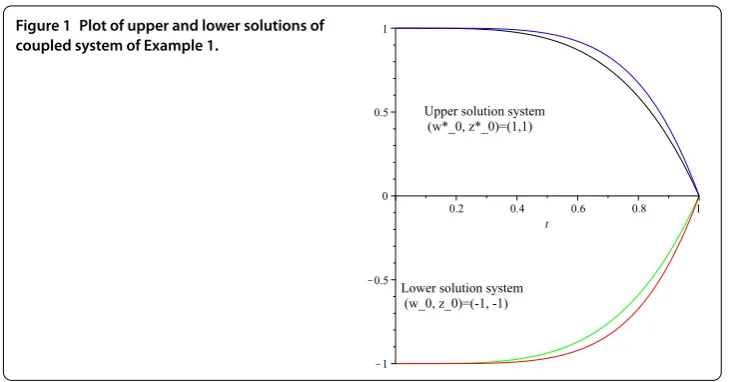
Figure 1 Plot of upper and lower solutions of coupled system of Example 1.
for all (w,z)∈[w(),z()]×[w,z]. Here the constantsc, dof the procedure are c= ,
d= . Thus (, ) and (, ) are the initial approximations of the lower and upper solutions, respectively, for the coupled system (). In Figure , we have ploted upper and lower solutions for the given system ().
Example For more explanation, we give another example of FDEs subject to the coupled
integral boundary conditions:
⎧ ⎪ ⎨ ⎪ ⎩
cDw(t) –w(t)exp(w(t)) +z(t) = ; t∈(, ), cDz(t) +w(t) –z(t)exp(z(t)) = ; t∈(, ),
w() =z() = , w() =tz(t)dt, z() = t
w(t)dt.
()
From the above system (), we see
t,w(t),z(t)= –w(t)expw(t)+z(t), t,w(t),z(t)=w(t) –z(t)expz(t). ()
Here
φ(t) =t, ϕ(t) =t, also λ=λ=
, λ=
.
Take (, ) = (w(),z()) and (, ) = (w
,z) as the initial approximation of the lower and
upper solutions, respectively. Then from (), we see that the function(t,w,z) is strictly decreasing with
–exp()≤∂(t,w,z)
∂w = –exp(w)(w+ ) <
and(t,w,z) is strictly decreasing with
–exp()≤∂(t,w,z)
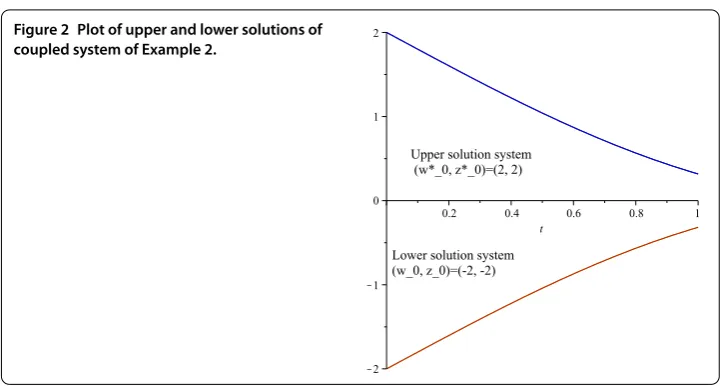
Figure 2 Plot of upper and lower solutions of coupled system of Example 2.
for all (w,z)∈[w(),z()]×[w
,z]. Here the constants c, dof the method are c=d=
exp(). Thus (, ) and (, ) are the initial approximations of the lower and upper solu-tions, respectively, for the coupled system (). Further, in Figure , we have ploted upper and lower solutions for the system ().
5 Conclusion
By the use of a monotone iterative technique, we successfully developed a scheme for or-der upper and lower solutions to the coupled system of highly nonlinear fractional oror-der differential equations with coupled integral boundary conditions. We have introduced an algorithm to construct a convergent increasing sequence of lower solutions as well as a convergent decreasing sequence of upper solutions. Further we have proved that the con-structed sequences converge uniformly to the unique solution of the considered problem. Moreover, the results are justified by some suitable numerical examples.
Acknowledgements
We are thankful to the anonymous referees for their useful comments, which completely modified and improved this paper. This work was supported by the National Natural Science Foundation of China (11571378).
Competing interests
It is declared that we have no conflict of interest.
Authors’ contributions
All authors equally contributed to this manuscript and approved the final version.
Publisher’s Note
Springer Nature remains neutral with regard to jurisdictional claims in published maps and institutional affiliations.
Received: 14 March 2017 Accepted: 3 August 2017 References
1. Samko, GS, Kilbas, AA, Marichev, OI: Fractional Integrals and Derivatives: Theory and Applications. Gordon & Breach, Philadelphia (1993)
2. Podlubny, I: Fractional Differential Equations. Mathematics in Science and Engineering, vol. 198. Academic Press, New York (1999)
3. Hilfer, R: Applications of Fractional Calculus in Physics. World Scientific, Singapore (2000)
4. Pedersen, M, Lin, Z: Blow-up analysis for a system of heat equations coupled through a nonlinear boundary condition. Appl. Math. Lett.14(3), 171-176 (2011)
6. Khan, RA, Shah, K: Existence and uniqueness of solutions to fractional order multi-point boundary value problems. Commun. Appl. Anal.19, 515-526 (2015)
7. Benchohra, M, Graef, JR, Hamani, S: Existence results for boundary value problems with nonlinear fractional differential equations. Appl. Anal.87, 851-863 (2008)
8. Wang, J, Xiang, H, Liu, Z: Positive solution to nonzero boundary values problem for a coupled system of nonlinear fractional differential equations. Int. J. Differ. Equ.2010, 1 (2010)
9. Yang, W: Positive solution to nonzero boundary values problem for a coupled system of nonlinear fractional differential equations. Comput. Math. Appl.63, 288-297 (2012)
10. Meehan, M, O’Regan, D: Multiple nonnegative solutions of nonlinear integral equations on compact and semi-infinite intervals. Appl. Anal.74, 413-427 (2000)
11. Liu, X, Jia, M: Multiple solutions for fractional differential equations with nonlinear boundary conditions. Comput. Math. Appl.59, 2880-2886 (2010)
12. Nanware, JA, Dhaigude, DB: Existence and uniqueness of solution for fractional differential equation with integral boundary conditions. J. Nonlinear Sci. Appl.7, 246-254 (2014)
13. Leung, A: A semilinear reaction diffusion prey-predator system with nonlinear coupled boundary conditions: equilibrium and stability. Indiana Univ. Math. J.31, 223-241 (1982)
14. Kaur, A, Takhar, PS, Smith, DM, Mann, JE, Brashears, MM: Fractional differential equations based modeling of microbial survival and growth curves: model development and experimental validation. J. Food Sci.73(8), E403-E414 (2008) 15. Al-Refai, M: On the fractional derivatives at extreme points. Electron. J. Qual. Theory Differ. Equ.2012, Article ID 55
(2012)
16. Wang, W, Agarwal, RP, Cabada, A: Existence results and the monotone iterative technique for systems of nonlinear fractional differential equations. Appl. Math. Lett.25(6), 1019-1024 (2012)
17. Lin, L, Liu, X, Fang, H: Method of upper and lower solutions for fractional differential equations. Electron. J. Qual. Theory Differ. Equ.2012, Article ID 100 (2012)
18. McRae, FA: Monotone iterative technique and existence results for fractional differential equations. Nonlinear Anal., Theory Methods Appl.71, 6093-6096 (2009)
19. Shah, K, Khan, RA: Iterative scheme for a coupled system of fractional-order differential equations with three-point boundary conditions. Math. Methods Appl. Sci. (2016). doi:10.1002/mma.4122
20. Infante, G, Webb, JRL: Nonlinear nonlocal boundary value problems and perturbed Hammerstein integral equations. Proc. Edinb. Math. Soc.49, 637-656 (2006)
21. Ladde, GS, Lakshmikantham, V, Vatsala, AS: Monotone Iterative Techniques for Nonlinear Differential Equations. Pitman, Boston (1985)
22. Asif, NA, Khan, RA: Singular system with four point coupled boundary conditions. J. Math. Anal. Appl.386, 848-861 (2012)
23. Cui, Y, Zou, Y: Existence results and the monotone iterative technique for nonlinear fractional differential systems with coupled four-point boundary value problems. Abstr. Appl. Anal.2014, Article ID 242591 (2014)
24. Shah, K, Khalil, H, Khan, RA: Upper and lower solutions to a coupled system of nonlinear fractional differential equations. Prog. Fract. Differ. Appl.2(1), 31-39 (2016)
25. Cui, Y, Zou, Y: Monotone method for differential system with coupled integral boundary value problems. Bound. Value Probl.2013, Article ID 245 (2013)
26. Cui, Y, Sun, J: On existence of positive solutions of coupled integral boundary value problems for a nonlinear singular superlinear differential system. Electron. J. Qual. Theory Differ. Equ.2012, Article ID 41 (2012)
27. Miller, KS, Ross, B: An Introduction to the Fractional Calculus and Fractional Differential Equations. Wiley, New York (1993)
28. Wang, G: Monotone iterative technique for boundary value problems of a nonlinear fractional differential equation with deviating arguments. J. Comput. Appl. Math.236(9), 2425-2430 (2012)
29. Jia, M, Liu, X: Multiplicity of solutions for integral boundary value problems of fractional differential equations with upper and lower solutions. Appl. Math. Comput.232, 313-323 (2014)
30. Al-Refai, M: Basic results on nonlinear eigen value problems of fractional order. Electron. J. Qual. Theory Differ. Equ.