R E S E A R C H
Open Access
Energy-efficient power control for
contention-based synchronization in OFDMA systems with
discrete powers and limited feedback
Giacomo Bacci
1,2*, Luca Sanguinetti
2, Marco Luise
2and Harold Vincent Poor
1Abstract
This work derives a distributed and iterative algorithm by which mobile terminals can selfishly control their transmit powers during the synchronization procedure specified by the IEEE 802.16 m and the 3GPP long-term evolution standards for orthogonal frequency-division multiple-access technologies. The proposed solution aims at maximizing the energy efficiency of the network and is derived on the basis of a finite noncooperative game in which the players have discrete action sets of transmit powers. The set of Nash equilibria of the game is investigated, and a distributed power control algorithm is proposed to achieve synchronization in an energy-efficient manner under the assumption that the feedback from the base station is limited. Numerical results show that the proposed solution improves the energy efficiency as well as the timing estimation accuracy of the network compared to existing alternatives while requiring a reasonable amount of information to be exchanged on the return channel.
1 Introduction
The issue of energy efficiency has attracted considerable interest in the information and telecommunication tech-nology community during the last decade, as witnessed by the extensive literature available on this subject (see, for example, [1] and references therein). Among oth-ers, a challenge that lies in this paradigm is to prolong the battery life of mobile terminals based on orthogo-nal frequency-division multiple-access (OFDMA) tech-nologies such as those operating according to the IEEE 802.16 m [2] and the 3GPP long-term evolution (LTE) [3] standards. The first operation that must be accom-plished by any terminal when joining the network is achieving correct synchronization with its serving base station (BS). This procedure is called initial ranging in IEEE 802.16 m [2] and random access in LTE [3]. It relies on a contention-based approach taking place over a speci-fied set of subcarriers, which are used by each terminal to notify its entry request by transmitting a packet consisting of a randomly chosen code. Code identification as well as
*Correspondence: [email protected]
1Department of Electrical Engineering, Princeton University, Olden Street, Princeton, NJ 08544, USA
2Dip. Ingegneria dell’Informazione, University of Pisa, Via Caruso, Pisa 56126, Italy
multiuser timing estimation are the main tasks of the BS during this procedure. These problems have received sig-nificant attention in the past few years, and some solutions are currently available in the literature (see, for example, [4-7] and references therein). All the aforementioned works assume to increase the transmit power upon suc-cessful synchronization without taking into account any energy efficiency issue. This is motivated by the fact that the energy efficiency problem in OFDMA-based tech-nologies has been mainly analyzed for the data transmis-sion phase (see [8] and [9] and references therein). A first attempt to reduce the power consumption during the ini-tial synchronization phase can be found in [10], in which a low-complexity and iterative algorithm is proposed to allow each synchronization terminal (ST) and the BS to locally choose the transmit power and the detection strat-egy, respectively. The goal is to obtain a good trade-off between detection capabilities and power consumption while satisfying quality-of-service (QoS) requirements given in terms of timing estimation error and probabil-ity of false code lock. The proposed solution is based on a noncooperative game-theoretic formulation, and it is shown to provide significant gains in terms of reduced synchronization time and parameter estimation accuracy
compared to existing alternatives based on a determinis-tic increase of the transmit power. Although interesting from a theoretical point of view, the analysis provided in [10] is not suited for practical applications since it relies on the assumption of a continuous set of transmit pow-ers. Moreover, comparisons with existing alternatives are carried out assuming that STs have perfect knowledge of the signal-to-interference-plus-noise ratio (SINR) mea-sured at the BS. A similar game-theoretic line of reason-ing has been recently used for achievreason-ing synchronization in code-division multiple-access networks operating in a flat-fading scenario [11,12] and in a frequency-selective one [13].
Motivated by the above considerations, in this work we return to the problem discussed in [10] and extend both the power allocation approach and the numeri-cal analysis as follows. We first assume that a finite set of transmit powers is available at each terminal. Com-pared to [10], this more application-oriented assumption changes completely the nature of the energy-efficient opti-mization problem, as the tool of finite noncooperative game theory is used to find its solution [14]. The set of Nash equilibria of the game is investigated and compared to that of the continuous-power noncooperative game discussed in [10]. The theoretical analysis of the finite game is adopted to derive an iterative and distributed power allocation algorithm for achieving synchronization under the assumption of alimited feedbackfrom the BS. Numerical results are used to compare the performance of the proposed solution with that achieved by exist-ing alternatives based on a deterministic increase of the transmit power (with and without contention resolution methods). It turns out that the proposed solution provides benefits in terms of energy efficiency and parameter esti-mation accuracy, using a reasonable amount of feedback resources.
The remainder of this paper is structured as follows.a Section 2 describes the system model and introduces the problem. Section 3 formulates the game and investigates its equilibria. The analysis is used in Section 4 to derive an iterative and distributed synchronization algorithm whose performance is assessed by means of numerical results. Finally, Section 5 concludes the paper and discusses the applicability of this technique to current wireless standards.
2 System model and problem formulation 2.1 System model
We consider the uplink of an OFDMA-based system employing N subcarriers with index set {0, 1,. . .,N − 1}. To avoid aliasing problems, 2Nv null subcarriers are placed at the spectrum edges. The remaining N −2Nv subcarriers are grouped into synchronization subcarriers and data subcarriers. The former are used by the STs
entering the network through acontention-based synchro-nization procedure, while the latter are assigned to mobile terminals for data transmission and channel estimation. We denote by K the number of STs and assume that the synchronization subcarriers are divided intoM sub-bands, each composed of a set ofV adjacent subcarriers, which is called atile. We denote byc =[c(0),c(1),. . .,
c(MV−1)] the code chosen by theth ST and callθthe
timing offset of the th ST (normalized to the sampling periodTs).
As in [10], we consider a quasi-synchronous system in which no interblock interference is present at the BS receiver, and we neglect any residual carrier frequency offset.bMoreover, we assume that the channel frequency response is nearly flat over each tile and independent across tiles. In addition, users other than those perform-ing synchronization have been successfully synchronized to the BS so that they do not generate significant interfer-ence. Under the above assumptions, theV- dimensional vector X(m) containing the mth-tile discrete Fourier transform outputs at the BS can be written as
X(m)=
where p denotes the transmit power of the kth ST,
C(m)= diag{c(mV),. . .,c(mV+V −1)}, the vector
a(θ)is given by
a(θ)=[1,e−j2π θ/N,. . .,e−j2π(V−1)θ/N]T (2)
andn(m) is the additive white Gaussian noise (AWGN) with zero mean and covariance matrixσn2IV.
As mentioned above, the main tasks of the BS during the synchronization procedure are code detection and timing offset estimation. This is achieved by exploiting the obser-vation vectors{X(m);m=0, 1,. . .,M−1}. Following [10], the kth code ck is declared as detected if the following generalized likelihood ratio test (GLRT) is satisfied:
k(θˆk)
M−1
m=0X(m)2
≥λ (3)
where the threshold λ is a design parameter chosen so as to achieve a desired probability of false alarmfa, and
(θˆk)is given by
In the above equation, θˆk is the maximum likelihood estimate ofθk, given by [10]
ˆ
θk =arg max 0≤ ˜θk≤θ
with θ being the (normalized) round trip propagation delay for a user located at the cell boundary [15].
2.2 Problem formulation
Without loss of generality, we focus on thekth ST and rewrite the right-hand side of (1) as
X(m)=√pkCk(m)a(θk)Hk(m)+wk(m) (6)
accounts for the contribution of the other STs plus ther-mal noise. To make the problem tractable, we model the channel frequency responsesH(m)form=0, 1,. . .,M−
1 experienced by theth user across tiles as independent Gaussian random variables with zero means and pow-ers |H(m)|2. In these circumstances, the vector wk =
nel power gain across the tiles. To proceed further, we let p =[p1,p2,. . .,pK]T and denote by γk the SINR of
Following [10], the energy-efficient optimization problem can be mathematically formalized for all STsk ∈ K =
{1,. . .,K}as
where Pk denotes the set of transmit powers and T is the duration of the cyclically extended OFDMA block, whereasMSE(θˆk)=E{| ˆθk−θk|2}is the mean-square error (MSE) of the timing estimateθˆk, andMSEθ is the network
QoS requirement in terms of maximum timing estimation MSE. In addition,d,k(γk)represents the probability of correct detection of codeckgiven by [10]
d,k(γk)=I(1+γk)(1−λ)
1+(1−λ)γk
[M(V−1),M] (13)
whereIx[·,·] is the incomplete beta function [16]. Unlike [10], we assume that the power strategy setPkis finite and given by
where the number of power levelsQkis computed as
Qk =1+
pk |dB−pk |dB
k|dB (15)
with k > 1 being the quantization step, and p k and pk denoting the minimum and maximum power levels, respectively, wherepk is assumed to be sufficiently large [17].c From (14) and (15), it follows that πk(1) = p
SettingPkas specified in (14) allows us to meet the tech-nical requirements of practical systems in which transmit powers are usually equally spaced on a logarithmic scale to reduce the complexity of the front-end architecture and to increase the efficiency of power amplifiers (see, for example, the specifications provided by the IEEE 802.16 m and 3GPP LTE standards in [2] and [3], respectively). For simplicity, in all subsequent derivations, we assume that
k = ,pk = p, andpk = pfor allk ∈ K. This also implies thatQk =Q.
As mentioned previously, the aim of this work is to solve (11) taking into account the discrete nature of the power strategy sets{Pk}. In the sequel, this is achieved by resorting to the analytical tools of finite game theory [14].
3 Game formulation and analysis
Using the results illustrated in [10], it follows that the MSE in (12) can be met provided that
pk ≥
γreq νk(p\k)
(16)
is the power strategy subset that allows the kth ST to meet the MSE constraint in (11). For notational simplic-ity, in all subsequent derivations, we omit the functional dependence ofAkonp\k.
The power allocation problem in (18) can be formulated as a generalizedd noncooperative game with complete information [14], denoted byG =[K,{Ak},{uk}]. In par-ticular,K= {1, 2,. . .,K}is the player set,Akis the action set of thekth player, anduk is its payoff (utility) function given by
uk(p)=
d,k(γk)
pkT
(20)
which depends on the power allocationpthroughγkas in (9). The discrete nature ofAk placesGinto the category of finite generalized noncooperative games. As mentioned previously, this is much different from [10], in which the continuousnature of the action sets allows us to formal-ize the optimization problem as an infinite generalized noncooperative gameGc.
3.1 Analysis of the equilibria
The existence and uniqueness of the generalized Nash equilibria (GNE) ofG are studied in the following. The analysis is conducted only for pure (i.e., deterministic) strategies. This choice is motivated by the fact that, in compact strategy spaces,mixed(i.e., statistical) strategies are generally less attractive due to (a) implementation dif-ficulties in wireless communications systems [17], as they require the presence of an arbitrator in the network to properly coordinate the players, and (b) Pareto inferior-ity [14] of any mixed-strategy profiles to pure-strategy profiles [18] that reduces the total utility of the network.
To proceed further, we recall that a vector p =
p1,p2,. . .,pKT is a pure-strategy GNE ofG if, for any pure-strategy GNE is to make use of the concept ofbest response[14]. In particular, we have that a vectorp is a GNE if each elementpkis the best responserk(p\k)to the powersp
\kchosen by the other players, withrk(p\k)being the solution of the following problem:
rk(p\k)=arg max
in which we have used (20), and we have explicitly writ-ten the functional dependence of the detection probability
d,konp˜kandp\kthroughγkin (9). Theorem 1. Let us define the SINRγas
γ=max(γreq,γ )˜ (23)
withγ˜being the solution of
∂d,k(γ )
Then, the gameGadmits pure-strategy GNE provided that
γ(K−1) <V. (25)
The proof can be found in Appendix 1.
Theorem 2. If condition(25)is satisfied, then the cardi-nality of the setEof pure GNE forGis such that
|E| ≥1. (26)
The proof can be found in Appendix 2.
Theorem 1 provides asufficientcondition for the set of GNE not to be empty,eand Theorem 2 states that the GNE is not necessarily unique. This means that the unique-ness property proven in [10] forGcno longer holds forG. In other words, quantizing the set of actions makes the gameGlose the uniqueness property for the GNE. In this context, it is interesting to show the following result.
Theorem 3. Among allp ∈E, the smallestfGNEp
The proof can be found in Appendix 3.
The above result states thatpis the best GNE in terms of social welfare (joint optimization) or, equivalently, it is the most efficient GNE in a social sense [19]. Note that this does not amount to saying thatpis the socially optimum solution of (11), as noncooperative equilibria are known to be generally inefficient [19]. Improving the equilibrium efficiency is out of the scope of this paper and is left as a future work.
3.2 Numerical analysis
Unlike the unique GNE ofGcin [10], the multiple equilib-ria ofGcannot be expressed in a closed form as a function of the network parameters because of the ‘arg max’ opera-tor in (22). A numerical analysis is thus conducted to make comparisons and to evaluate the impact of the discretiza-tion of the acdiscretiza-tion sets. To this aim, we concentrate on the optimal (in a social sense)p and resort to the exhaus-tive search method described in [20] to solve (27). The numerical results are averaged over 20, 000 independent realizations of a network with the following parameters: Ts = 89.28ns,N = 1, 024,M = 4,V = 36,fa = 10−5, and MSEθ = 324, which yield ρ = 128, λ = 0.12,
randomly chosen from a uniform distribution in [R/10,R] withRbeing the cell radius. The channel power gains are normalized to a distanceR/2 and are modeled using the 6-tap ITU modified vehicular-A model [21] with a path loss exponentς =2.
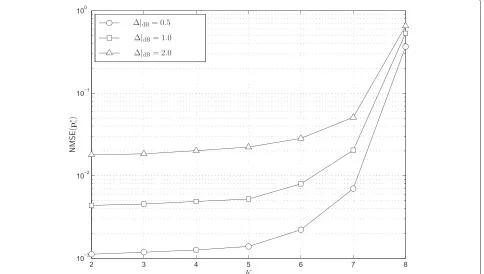
Figure 1 reports the normalized MSE defined as NMSE(p
c) = E{pc − p2/pc2} as a function of K for different quantization steps, where p
c is the unique GNE of Gc. The maximum number of STs is fixed to 1 + V/γ = 8. Observe that the condition K ≤ 8 is required to meet (25). In addition, it represents a necessary and sufficient condition for the existence of the unique GNE pc [10]. As expected, NMSE(pc)
decreases asbecomes smaller since the discrete action sets Ak in G tend to better approximate the continu-ous ones in Gc. As can be seen,NMSE(pc) increases as K increases, meaning that the difference betweenp2 andpc2becomes larger as the number of STs increases. In particular, we see that NMSE(pc) is almost constant up to K = 4, whereas it rapidly increases for larger values.
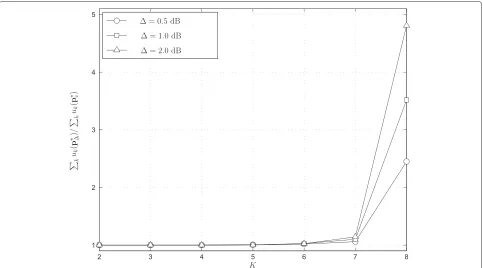
To evaluate the impact of this difference on the system performance in terms of social welfare, Figure 2 reports the experimental kuk(p)/
kuk(pc) as a function of K in the same operating conditions of Figure 1. As seen, the ratiokuk(p)/
kuk(pc)is approximately 1 for K ≤ 6 while it increases for larger values of K. A
similar behavior (not shown for the sake of brevity) is observed if the user-basis ratiouk(p)/uk(pc)is consid-ered. From these results, it follows that limiting the STs to use a discrete set of strategiesAk increases the global system performance rather than introducing a detrimen-tal effect. This phenomenon is known as a Braess-type paradoxg [22], and it has already been observed in other different contexts (such as routing in [23,24] and wire-less communications in [25,26]). Roughly speaking, the Braess-type paradox occurs because the average number of GNEs increases when K becomes larger. For exam-ple, when |dB= 1, the numerical results indicate that the average number of GNE forK = {2, 3, 4, 5, 6, 7, 8}is {1.0, 1.1, 1.2, 1.3, 1.7, 2.7, 20.9}, respectively. As mentioned before, the latter are found by solving (27) for each net-work realization by means of the exhaustive search proce-dure illustrated in [20].
4 Energy-efficient distributed synchronization In what follows, we first show how to exploit the GNE analysis provided so far to derive a practical power control algorithm for achieving synchronization in a distributed manner. The performance of the provided solution is then investigated by means of numerical results.
4.1 Implementation of the algorithm
We begin by observing the following result.
Figure 2Normalized social welfare increase ofp
with respect top
cas a function ofK.
Corollary 1. If the powers of all active STs are initial-ized to the lowest levels p, an iterative algorithm operating
according to the best response dynamics given in (22)
converges topunder the hypothesis(25).
Proof. Since the best response dynamics reported in (22) possesses theascending property [27] (see Appendix 1), using [28] the thesis follows.
Denote bypk[n] the transmit power of thekth ST at the nth iteration step. Using Corollary 1, it follows that an iter-ative algorithm operating according to the best response dynamics in (22):
pk[n+1]=arg max ˜ pk∈Ak
d,kνk(p\k[n])p˜k
˜
pkT
(28)
converges to the most socially efficient GNEpifpk[0]= pfork=1, 2,. . .,K.
Note that the computation of pk[n + 1] in (28) requires knowledge ofνk(p\k[n]). Using (9), it follows that
νk(p\k[n])can be obtained as
νk(p\k[n])=
γk[n] pk[n]
(29)
whereγk[n] is STk’s SINR measured at the BS at time step n. Whilepk[n] is locally available at the transmitter,γk[n]
can only be estimated at the BS and sent to thekth ST on a downlink control channel. Following [10], an unbiased estimateγˆk[n] ofγk[n] can be computed as
ˆ
γk[n]= Vk(θˆk)− M−1
m=0X(m)2 M−1
m=0X(m)2−k(θˆk)
. (30)
To reduce the amount of information to be exchanged, we assume the quantityγˆk[n] to be quantized on a logarith-mic scale using a uniformB-bit quantizer. This produces
μk[n]|dB=γ |dB·bk[n] (31) where
bk[n]= ⎢ ⎢ ⎢ ⎢
⎣ ˆ
γk[n]γγ−γ
dB
γ |dB
⎤ ⎥ ⎥ ⎥ ⎥
(32)
and
γ |dB=
γ |dB−γ |dB
2B−1 (33)
Replacingγk[n] withμk[n] into (29) and substituting the result into (28), we eventually obtain
pk[n+1]=arg max
Recalling (31), it follows that its evaluation at the ST side requires only the knowledge ofbk[n].
Algorithm 1Discrete and limited feedback best response synchronization algorithm (DLF-BRSA)
a. Initialization: each STk=1, 2,. . .,K
a1. initializes the transmit powerpk[0]to the lowest power valuep;
a2. setsn=0.
b. Iterative algorithm: at each step n, each ST k
b1. receives on a common downlink channel the result of the GLRT (3) for codeckand the integerbk[n]computed through (30)–(33); b2. if the GLRT for codeckis verified and
μk[n]> γreq, exits the algorithm (i.e., STk is
successfully associated to the BS), otherwise goes to the next step;
b3. adjusts its transmit power according to (34); b4. updatesn=n+1.
Collecting all the above facts together leads to the energy-efficient synchronization algorithm illustrated in Algorithm 1, which allows each ST to operate in a com-plete distributed manner without any knowledge of other users’ power allocation strategies (as if in a single-user scenario).
Observe that Algorithm 1 is reminiscent of the best response synchronization algorithm (BRSA) illustrated in [10], except for the discrete action sets and the limited feedback from the BS, which makes it more suited for a practical implementation. In the sequel, we call the iter-ative procedure described in Algorithm 1 as discrete and limited feedback best response synchronization algorithm (DLF-BRSA).
Remark 1.An iterative algorithm using (28) as the
power update criterion usingγk[n],pk[0]= pfor all STs k, without the exit condition on the GLRT converges to p
, as confirmed by Corollary 1. However, for a
practi-cal implementation, Algorithm 1 introduces (a) estimated SINRsγˆk[n], (b) limited feedback bk[n], and (c) the exit condition on the GLRT (step b2). These modifications affect the performance of the algorithm, and their impact will be studied in Section 4.2. Note that the minimum power initialization (step a2) is expedient to avoid the
maximum power constraint pk to be violated for some stepsnof the algorithm.
Remark 2.It is worth observing that, in their most
basic forms, iterative algorithms based on best response dynamics require a significant amount of information to be locally available at the player (transmitter) [29]. For example, they usually require knowledge of the number of players and of the actions played by all the other play-ers. To overcome this problem, other algorithms based on reinforcement learning techniques have been adopted in the literature [29]. The main advantage of these solu-tions is that they do require each player to know only its corresponding utility. Although based on best response dynamics, DLF-BRSA possesses most of the advantages shown by other reinforcement learning-based algorithms, as it allows each ST to operate in a distributed and iter-ative way requiring only knowledge of its own estimated SINR, as illustrated in Algorithm 1 by means of simulation results.
Remark 3.Most of the computational complexity of
DLF-BRSA is represented by the exhaustive search in (34), which must be performed at each iteration step n over the Qdiscrete power levels of the set Ak. In those applications characterized by large values ofQ, this may represent an implementation impairment. In such cases, one may resort to the supermodularity properties of the utility functionuk(see Appendices 1 and 2) and reduce the search complexity looking only at the values ofp˜k ∈Akin the neighborhood ofpk[n].
4.2 Simulation results
Numerical simulations are now used to assess the per-formance of DLF-BRSA and to make comparisons with existing alternatives. As in Section 3.2, the numerical anal-ysis is conducted by averaging over 20, 000 independent realizations of a network whose parameters are fixed as follows: Ts = 89.28 ns, N = 1, 024,M = 4,V = 36,
fa = 10−5, andMSEθ = 324, which yield ρ = 128,
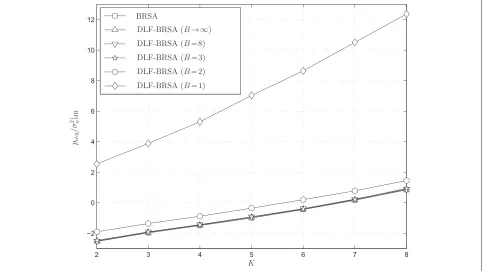
Figure 3 reports the average normalized power expen-diture pavg/σn2 (in dB) required by ST 1 when using DLF-BRSA, from the time it accesses the network until it successfully completes the synchronization procedure. The numerical results are plotted as functions of K for B = {1, 2, 3, 8}. The results obtained with DLF-BRSA whenB → ∞(i.e., with continuous SINR feedback) are used as a benchmark. Comparisons are also made with the BRSA illustrated in [10] in which the action sets are con-tinuous and perfect knowledge of the estimated SINRs is available at the STs. The results of Figure 3 indicate that the quantization of the SINRs has only a marginal effect on the performance of DLF-BRSA. In fact, it has practi-cally the same performance for B = 3, 8 andB → ∞, whereas a significant degradation is observed only for B = 1. We argue that the quantization of the estimated SINRs marginally impacts the system performance since it is basically perceived at the STs as an additional estimation error introduced by the BS (which, on the other hand, can actually exploit real-valued estimation methods). Based on the above results, in all subsequent simulations, we set B = 3. From (33), recalling that γ |dB= −8 and
γ |dB= +16, we haveγ |dB=3.43.
To evaluate the impact of the discretization of the action sets, we now compare the performance of BRSA with that of DLF-BRSA. From Figure 3, it follows that they do per-form identically when the DLF-BRSA usesB ≥ 3. This seems to contradict the numerical results of Figure 2, discussed at the end of Section 3.2, which show that
discretizing the set of strategies is beneficial for individ-ual (and, consequently, global) performance. On the basis of the analysis of Section 3.2, the DLF-BRSA is expected to outperform the BRSA. The motivation behind this con-tradictory result can be understood by recalling that the considered ST takes part in the synchronization proce-dure as long as it is not correctly detected by the BS. As a consequence, what really impacts on the performance of DLF-BRSA and BRSA is its power evolution from the time it enters the network (n=0) to the time stepnexitin which the exit conditions (detailed in step b2 of DLF-BRSA) are satisfied.
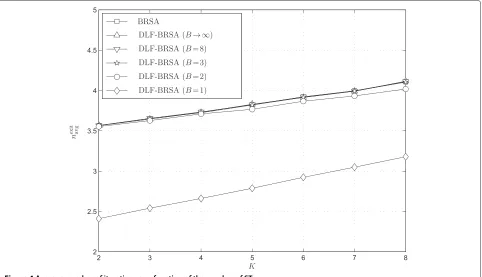
To this aim, Figure 4 reports the average number of iterations nexitavg as a function of K, which turns out to be the same for the both the BRSA and the DLF-BRSA (with B ≥ 3) with good approximation. Interestingly, numerical simulations confirm that, when 0 ≤n≤ nexit, the difference between the power updates across the two schemes is negligible. On the contrary, the performance measured in Figure 2 corresponds to that achieved by the BRSA and the DLF-BRSA schemes without the exit conditions listed in step b2 (as the GNE, computed in Section 3.2 through an exhaustive search [20], can also be achieved using the best response dynamics described in Section 4), whose convergence time is usually much higher thannexit. This is the reason why the performance in terms of total energy expenditure reported in Figure 3 is similar in the two cases. On the basis of the above results, we can conclude that DFL-BRSA yields the same
Figure 4Average number of iterations as a function of the number of STs.
performance of BRSA. However, this is achieved while (a) reducing the complexity of the user terminals (thanks to the discretization of the power amplifier) and (b) requiring a limited amount of feedback from the BS (thanks to the finite number of bits Bused to send the estimated SINRs).
The performance of DLF-BRSA is now compared with those achieved by two alternative solutions based on a deterministic increase of the transmit power: the deter-ministic synchronization algorithm (DSA), in which the update rule is pk[n+1] |dB= pk[n] |dB + |dB, and the binary exponential backoff DSA (BEB-DSA), in which pk[n+ne] |dB= pk[n] |dB + |dB, whereneis an expo-nentially distributed backoff counter (see [10] for more details). In all subsequent simulations, we set |dB= 1 andpk[0]=pfork=1, 2,. . .,K.
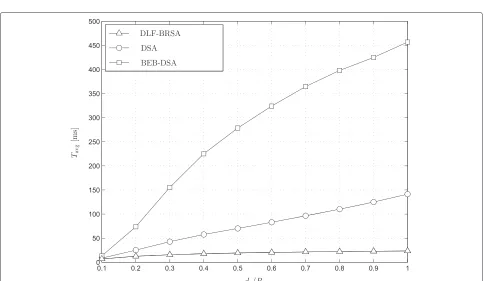
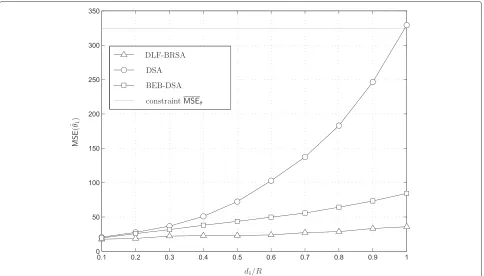
Figure 5 shows pavg/σn2 for all investigated solutions as a function of the normalized distance d1/R when K = 5, and Figure 6 illustrates the average time Tavg needed to complete the synchronization procedure in the same operating conditions. In particular, Tavg is com-puted as Tavg = Tf ·nexitavg, where Tf = 5 ms accounts for the time interval (frame time) between two suc-cessive synchronization attempts. In addition, Figure 7 shows the MSE of the timing estimate θˆ1 in the same simulation setup of Figures 5 and 6. From the results of Figure 5, it follows that DLF-BRSA provides roughly the same power consumption of BEB-DSA, which is
significantly lower than that needed by DSA. However, the results of Figure 6 show that the time required by DLF-BRSA to achieve synchronization is much shorter than that needed by DSA and BEB-DSA, especially when d1/Rincreases. In addition, Figure 7 shows that the esti-mation accuracy with DLF-BRSA is higher than that with both DSA and BEB-DSA. Note also that simulation results (not reported here for the sake of brevity) show that the performance of the DLF-BRSA does not change as a function ofpk provided thatpk σn2, whereas the aver-age synchronization time achieved by the deterministic increase techniques (especially the DSA) increases aspk increases. This is due to the fact that in this case collid-ing users transmit at comparable power levels for a longer time.
Figure 5Average power consumption as a function of the normalized distance.
Figure 7Average timing MSE as a function of the normalized distance.
Collecting all the above facts together, we may con-clude that DLF-BRSA provides better results in terms of energy efficiencyandparameter estimation accuracy, also providing some performance that slightly depends on the transmitter-receiver distance. This is achieved at the price of a slight increase of information to be fed back over the control channel. In particular, the amount of information to be exchanged during each frame and for eachc ∈ C
is the following: 1 bit to broadcast the outcome of the GLRT andB = 3 bits to transmit the quantized SINRs. This means that a total of 4|C| bits per frame time Tf is required by DLF-BRSA, which corresponds to a feed-back rate on the order of a few tens of kilobits per second, given that|C|is usually on the order of tens to hundreds (e.g., see [2,3]).
5 Conclusion
In this work, we have formalized the power allocation problem for energy-efficient contention-based synchro-nization in OFDMA-based networks as a finite con-strained noncooperative game. The generalized Nash equilibria have been analytically studied and numerically evaluated. The above results have been used to derive a distributed and iterative energy-efficient power con-trol algorithm with discrete powers and limited feed-back. The performance of the above solution has been evaluated and compared with alternatives by means of
numerical simulations. Using realistic system parame-ters and widely agreed-upon channel models, we have shown that the proposed solution incurs only a negligible degradation with respect to the scheme illustrated in [10], while a significant gain is achieved with respect to deterministic-based power allocation approaches (both with and without contention resolution methods). The derived technique requires a feedback on the down-link on the order of a few tens of kilobits per sec-ond, which can be easily accommodated in current IEEE 802.16 m [2] and LTE [3] standards. Since the proposed solution shows a (much) faster synchroniza-tion time than deterministic methods, it can be used to further increase the energy efficiency of mobile terminals by reducing the frequency of periodic rang-ing procedures, which are currently used by 4G com-munication systems to meet the transmission latency requirements.
Endnotes
aThe following notation is used throughout the paper.
and Hermitian transposition, respectively;·for the Euclidean norm of the enclosed vector;x to roundxto the nearest integer towards zero;xto roundxto the nearest integer;x|dB=10 log10x; and finally,
[x]ba=max(a, min(x,b)).
bThis assumption is reasonable as long as downlink
estimation errors are within a few percents of the subcarrier spacing and low mobility applications are considered [2].
cIn practice, it suffices thatp
kis at least a couple of orders of magnitude larger than the AWGN powerσn2, which is normally verified in all communication standards.
dThe game is generalized sinceA
kdepends on the other STs’ powerp\k(see, for example, [14] and [30] for more details).
ePlease note that, following the steps reported in
Appendix 1, the maximum power constraint is active when deriving (25).
fThe smallest vector in a set of vectors refers to the
component-wise comparison between vectors in that set. For example, for any two vectorsx,y∈Rn,x<yif and only ifxi<yifor alli=1, 2,. . .,n.
gBraess’s paradox states that adding extra strategies to
a network when the entities operate selfishly can, in some cases, reduce the overall performance. This is because the Nash equilibrium of such system is not necessarily optimal. In the problem at hand, this means that relying on continuous power sets does not necessarily bring benefits to the synchronization procedure due to the inefficiency of the unique Nash equilibrium of the continuous-power game.
Appendices Appendix 1
Proof of Theorem 1
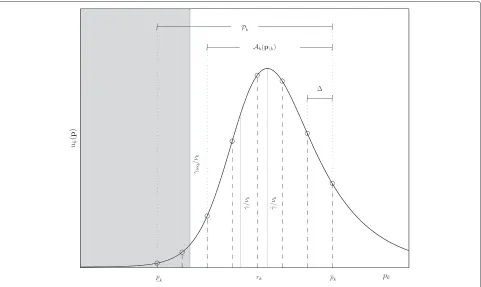
Figure 8 shows a pictorial representation of the typical shape of the utilityuk(p)as a function of the powerpk =
πk(q)for a fixed interferencep\k(all quantities are on a log-arithmic scale, although the subscript ‘dB’ is suppressed for the sake of presentation). The relevant points of the utility function in terms of SINR, scaled by the quan-tityνk(p\k), are also reported: in addition toγreqandγ˜, defined in (17) and (24), respectively, Figure 8 also shows the inflection pointγ˙, γ <˙ γ˜ ≤ γ, such thatd,k(γk)
is strictly convex for γk < γ˙ and strictly concave for
γk > γ˙. It is worth observing thatγ˙ is easily found from (13). Although Figure 8 depicts the case γreq < γ˜, the considerations drawn in the following apply in the case
γreq ≥ ˜γ as well. Circular markers reportuk([πk(q),p\k]) forq = 1,. . .,Q(in this example,Q = 8). Note that the best response map defined in (22) may yield rk(p\k) <
γ/νk(p\k), as occurs in this example.
A GNE in the gameG exists provided that the K sets
Ak(p\k) ⊆ Pk,k ∈ K, are nonempty, which translates, using (19), into ensuring that there exists at least a power levelπk(q) ∈ Pk such thatπk(q) ≥ γreq/νk(p\k) for allk. Sinceγreq≤γby hypothesis, it is sufficient to show that
γ/νk(p\k)≤rk(p\k) =pk ≤pkfor allk∈K. By follow-ing the same steps as in [11], we can derive the sufficient condition (25), which becomes also necessary in the case
γ =γreq. Note that, unlike [11], here we cannot derive a necessary condition that holds for anyγ > γ˜ req, because of the inequalityγ/νk(p\k) ≤ rk(p\k)that is originated from using a finite set, and hence, GNE might exist even though (25) is not fulfilled. This is also in accordance to what is highlighted in (22), as an equilibrium can exist even ifp
k< γ/νk(p\k), provided thatγ> γreq.
To proceed further with the proof of existence, it is useful to introduce the following definition:
Definition 1([27]).A best responserk(p\k)possesses theascending propertyifrk(p\k) ≤ rk(p\k)for allk ∈ K whenp\k=p\kis such thatp≤p∀=k.
To show that the best response (22) is ascending, let us define rk = rk(p\k), rk = rk(p\k), νk = νk(p\k), and
νk =νk(p\k)for notational convenience. Note that assum-ingp\k =p\kwithp ≤p∀=kimplies thatνk > νk. Let us consider two different cases:
Figure 8Utility as a function of the transmit power for a fixed interferencep\k.
pk ≥ ˙pk, where the vectorp˙ =[p˙1,. . .,p˙K]T is the min-imum component-wise power allocation such thatγk =
νk(p˙\k)p˙k ≥ ˙γ for allp˙k, withγ <˙ γ˜ defined above. In other words, the equilibrium points ofG(if any) are equal to the equilibria of a modified (generalized) game, which differs fromGas now the strategy space is the subset ofPk such that any vector allocationpis such thatpk ≥ ˙pk, and hence,γk ≥ ˙γ. To conclude the proof, let us introduce the following definition:
Definition 2 ([14,31]).A game is supermodular if uk(p)has increasing differences inp=[pk,p\k], i.e., if
uk(p)−uk([pk,p\k])≥uk([pk,p\k])−uk(p) (35)
for allpandpsuch that, for allk,pk ≤pk, andp ≤ p
for all=k.
To prove that the utility uk(p), which is twice dif-ferentiable, satisfies (35), we can show, using [31], that it possesses the necessary and sufficient condition
∂2uk(p)/∂p∂pk ≥ 0 for any two componentsp = pk. Using (20), we can easily derive
∂2uk(p)
∂p∂pk = −
α
Vαk ·
d,k(γk)γk2−2f(γk)
p4k ≥0 (36)
where the inequality follows from the fact thatd,k(γk)=
∂2d,k(γk)/∂γk2 ≤ 0 for γ˙ ≤ γk ≤ ˜γ and f(γk) = γk · ∂d,k(γk)/∂γk − d,k(γk) > 0 for γk ≤ ˜γ (see [10,11] for further details). Proving the property of super-modularity concludes the proof, as supermodular games admit pure-strategy equilibria [14]. As a consequence, the original game G has pure-strategy GNE, under the sufficient condition (25).
Appendix 2
Proof of Theorem 2
To show that the GNE of the game G is not necessar-ily unique, we use a counterexample. Let us focus on one GNEp, whose existence is ensured by Theorem 1, and let us suppose thatpis such that p
k ≤ γ/(νk
√
), where
νk =νk(p\k)is obtained using the vectorp\k=psuch that all components are scaled by the quantization step, i.e.,pk =p
k. Under this hypothesis,pis also a GNE of
G, i.e.,rk(p\k)=pk∀k∈K.
To show this property, let us note first thatνk < νk < νk/, where νk = νk(p\k). Hence, if p
k ≤ γ/(νk) is the best responsepk = rk(p\k), it implies thatpk =
p
k ≤ γ/νk is alsopk = rk(p\k), as|pk −γ/νk| <
|pk−γ/νk|anduk([pk,p\k])is an increasing function of pk. Ifγ/(νk) < pk ≤ γ/(νk
√
γ√/νk, i.e.,pk =pkis greater than the point of max-This is the reason why the number of GNE increases as K increases. However, such condition is not necessary, and other GNE might exist, e.g., vectorspin which some elements arepk =p
The authors declare that they have no competing interests.
Acknowledgements
The research leading to these results has received funding from the People Programme (Marie Curie Actions) of the European Union’s Seventh Framework Programme (FP7/2007-2013) under REA grant agreement
no. PIOF-GA-2011-302520 GRAND-CRU (Game-theoretic Resource Allocation for wireless Networks based on Distributed and Cooperative Relaying Units).
Received: 11 March 2013 Accepted: 8 July 2013 Published: 17 July 2013
References
1. H Zhang, A Gladisch, M Pickavet, Z Tao, W Mohr, Energy efficiency in communications. IEEE Commun. Mag.48(11), 48–49 (2010)
2. IEEE 80216 Broadband Wireless Access Working Group,IEEE Standard for Local and Metropolitan Area Networks - Part 16: Air Interface for Broadband Wireless Access Systems - Amendment 3: Advanced Air Interface. Tech. Rep. IEEE 802.16m-2011(IEEE Computer Society, Washington, 2011)
3. 3GPP Technical Specification Group,LTE; Evolved Universal Terrestrial Radio Access (E-UTRA); Physical Channels and Modulation (Release 10). Tech. Rep. 3GPP TS 36.211 v. 10.4.0(European Telecommunications Standards Institute, Sophia Antipolis, 2011)
4. X Fu, Y Li, H Minn, A new ranging method for OFDMA systems. IEEE Trans. Commun.6(2), 659–669 (2007)
5. M Ruan, M Reed, Z Shi, Successive multiuser detection and interference cancelation for contention based OFDMA ranging channel. IEEE Trans. Wireless Commun.9(2), 481–487 (2010)
6. L Sanguinetti, M Morelli, An initial ranging scheme for the IEEE 802.16 OFDMA uplink. IEEE Trans. Wireless Commun.11(9), 3204–3215 (2012) 7. L Sanguinetti, M Morelli, L Marchetti, A random access algorithm for LTE
systems. Trans. Emerging Telecommun. Technol.24, 49–58 (2013)
8. G Miao, N Himayat, G Li, S Talwar, Distributed interference-aware energy-efficient power optimization. IEEE Trans. Wireless Commun.10(4), 1323–1333 (2011)
9. S Buzzi, G Colavolpe, D Saturnino, A Zappone, Potential games for energy-efficient power control and subcarrier allocation in uplink multicell OFDMA systems. IEEE J. Sel. Topics Signal Process.6(2), 89–103 (2012) 10. G Bacci, L Sanguinetti, M Luise, HV Poor, A game-theoretic approach for
energy-efficient contention-based synchronization in OFDMA systems. IEEE Trans. Signal Process.61(5), 1258–1271 (2013)
11. G Bacci, M Luise, A game-theoretic perspective on code synchronization for CDMA wireless systems. IEEE J. Sel. Areas Commun.30, 107–118 (2012) 12. G Bacci, M Luise, A pre-Bayesian game for CDMA power control during
network association. IEEE J. Sel. Topics Signal Process.6(2), 76–88 (2012) 13. G Bacci, Energy-efficient power control for CDMA code acquisition over frequency-selective channels. IEEE Commun. Lett.16(3), 364–367 (2012) 14. D Fudenberg, J Tirole,Game Theory(MIT Press, Cambridge, 1991) 15. M Morelli, Timing and frequency synchronization for the uplink of an
OFDMA system. IEEE Trans. Commun.52(2), 296–306 (2004) 16. M Abramowitz, IA Stegun,Handbook of Mathematical Functions(Dover,
New York, 1965)
17. S Lasaulce, H Tembine,Game Theory and Learning in Wireless Networks: Fundamentals and Applications(Academic, Oxford, 2011)
18. M Félegyházi, Non-cooperative behavior in wireless networks. PhD thesis, École Polytechnique Fédérale de Lausanne (EFPL), (2007)
19. S Lasaulce, M Debbah, E Altman, Methodologies for analyzing equilibria in wireless games. IEEE Signal Process. Mag.26(5), 41–52 (2009) 20. H Peyton Young,Strategic Learning and its Limits(Oxford University Press,
Oxford, 2004)
21. ITU Radiocommunication Sector (ITU-R),Guidelines for Evaluation of Radio Transmission Technologies for IMT-2000. Recommendation ITU-R M.1225
(International Telecommunication Union, Geneva, 1997) 22. SM Perlaza, Game theoretic approaches to spectrum sharing in
decentralized self-configuring networks. PhD thesis, École Nationale Supérieure des Télécommunications, 2011
23. T Roughgarden,Selfish Routing and the Price of Anarchy(MIT Press, Cambridge, 2005)
24. E Altman, T Boulogne, R El Azouzi, T Jimenez, L Wynter, A survey on networking games in telecommunications. Comput. Oper. Res.33(2), 286–311 (2006)
25. E Altman, V Kamble, H Kameda, A Braess type paradox in power control over interference channels, inProc. Int. Symp. Modeling and Optimization in Mobile, Ad Hoc, and Wireless Networks,Berlin, 1–3 Apr 2008
26. L Rose, SM Perlaza, M Debbah, On the Nash equilibria in decentralized parallel interference channels, inProc. IEEE Int. Conf. Commun.,Kyoto, 5–9 June 2011
27. E Altman, Z Altman, S-modular games and power control in wireless networks. IEEE Trans. Autom. Control48(5), 839–842 (2003)
28. RD Yates, A framework for uplink power control in cellular radio systems. IEEE J. Sel. Areas Commun.13(9), 1341–1347 (1995)
29. L Rose, SM Perlaza, S Lasaulce, M Debbah, Learning equilibria with partial information in decentralized wireless networks. IEEE Commun. Mag. 49(8), 136–142 (2011)
30. F Facchinei, C Kanzow, Generalized Nash equilibrium problems. Q. J. Oper. Res.5(3), 173–210 (2007)
31. DM Topkis, Equilibrium points in nonzero-sum n-person submodular games. SIAM J. Control Optimization.17(6), 773–787 (1979)
doi:10.1186/1687-1499-2013-192