R E S E A R C H
Open Access
Resource allocation for maximizing outage
throughput in OFDMA systems with finite-rate
feedback
Bo Wu
1, Lin Bai
2, Chen Chen
1*and Jinho Choi
3Abstract
Previous works on orthogonal frequency division multiple access (OFDMA) systems with quantized channel state information (CSI) were mainly based on suboptimal quantization methods. In this paper, we consider the performance limit of OFDMA systems with quantized CSI over independent Rayleigh fading channels using the rate-distortion theory. First, we establish a lower bound on the capacity of the feedback channel and build the test channel that achieves this lower bound. Then, with the derived test channel, we characterize the system
performance with the outage throughput and formulate the outage throughput maximization problem with quantized channel state information (CSI). To solve this problem in low complexity, we develop a suboptimal algorithm that performs resource allocation in two steps: subcarrier allocation and power allocation. Using this approach, we can numerically evaluate the outage throughput in terms of feedback rate. Numerical results show that this suboptimal algorithm can provide a near optimal performance (with a performance loss of less than 5%) and the outage throughput with a limited feedback rate can be close to that with perfect CSI.
Keywords:Orthogonal frequency division multiple access (OFDMA), limited feedback, quantized channel informa-tion, rate-distorinforma-tion, resource allocainforma-tion, two-step suboptimal algorithm
1 Introduction
Orthogonal frequency division multiplexing (OFDM) is a promising technique for the next-generation wireless communication systems. OFDM divides the frequency-selective fading channel into N orthogonal flat-fading subcarriers to provide a high data rate. Orthogonal fre-quency division multiple access (OFDMA) adds multiple access to OFDM by allowing a number of users to use different subcarriers. One aim of the OFDMA technique is to find an optimal allocation of resources to users using channel adaptive techniques [1]. It implies that the channel state information (CSI) of users should be known to the base station (BS). However, in the fre-quency division duplexing (FDD-) OFDMA systems, the BS only obtains the quantized CSI. For downlink trans-missions, the BS requires the CSI with the minimum distortion to maximize the transmission rate; for the
feedback channel, given a feedback rate constraint, the minimum distortion of the downlink CSI can be charac-terized by the rate-distortion theory [2]. Thus, the maxi-mum throughput of the OFDMA systems will be achieved, if the feedback CSI is optimized in terms of the rate-distortion function (RDF) [2]. However, existing research works, such as [3-5], mainly focused on simple but suboptimal quantization methods, and did not shown the best performance of OFDMA systems.
In this paper, we focus on the performance limit of the OFDMA system with finite feedback rate. As typi-cally done in the literature (e.g., [3-5]), we assume inde-pendent Rayleigh downlink channels over subcarriers, i. e., the channel power gain |H|2 on each subcarrier is exponentially distributed. We use the RDF to character-ize the lower bound on the required feedback channel’s capacity for a given mean quantization error under OFDMA downlink channels [2]. The author in [6] investigated the optimal encoding of the exponential inter-arrival time of a Poisson process. The RDF of the exponentially distributed time was evaluated with a
* Correspondence: [email protected]
1
School of Electronics Engineering and Computer Science, Peking University, Beijing, China
Full list of author information is available at the end of the article
distortion equal to the absolute error between the quan-tized arrival time and the actual arrival time. This approach, however, does not result in closed-form results. Here, we consider the alternative approach where the quantized channel gain is less than or equal to the actual channel gain. This constraint applies to the situation in which the truncation quantization method is employed, and enables us to derive the analytical expression for RDF. Once the relation between the dis-tortion (mean magnitude error associated with channel quantization) and rate (capacity of feedback channel) has been established, the resource allocation problem with quantized CSI can be formulated under feedback capacity constraints.
We introduce the outage throughput as the perfor-mance measure for the downlink throughput. Here, we define the outage throughput as the maximum expected rate of information delivered to users in non-outage states, where the data rate is lower than the channel capacity. Clearly, the definition of outage throughput is different from that of the ergodic throughput, which is defined as a long-term achievable throughput averaged over all fading blocks [7]. The performance measure of the ergodic throughput is suitable for applications insensitive to delay, but not suitable for delay-sensitive applications. For the latter ones, the outage probability has been considered as a valid performance measure [8-10]. It is desirable to minimize the outage probability for the given quantized CSI. However, low outage prob-ability results in low throughput. There exists a tradeoff between minimizing the outage probability and maxi-mizing the throughput. Outage throughput, which can be regarded as a measure of the expected reliably decodable rate at the user side, provides this tradeoff between transmission rate and outage probability [11,12].
We investigate the resource allocation problem to maximize the outage throughput. We show that the algorithm that achieves the optimum could have an exponential time complexity. Thus, to reduce the com-plexity, we propose a suboptimal algorithm that sepa-rates the resource allocation into two steps: subcarrier allocation and power allocation. This suboptimal approach has a linear complexity in the number of users and subcarriers and achieves optimality gaps of less than 5%. With the suboptimal approach, the achieved throughput in the rate-distortion limit is more than twice of the throughput achieved under the threshold-based quantization approach, when the feedback rate is low.
Notations: Bold letters denote vectors and matrices, and BT denotes the transpose ofB. Also, E[·] denotes the statistical expectation, and in particular, EX[·]
denotes that with respect toX.
1.1 Overview
We continue the introduction with a brief review of related work in Section 1.2. Section 2 outlines the downlink channel model and derives the RDF for the downlink CSI. Section 3 presents the expression of out-age throughput, formulates the outout-age throughput maxi-mization problem with quantized CSI, and proposes the resource allocation algorithm that achieves a suboptimal solution. Numerical results are given in Section 4 to illustrate the performance of the outage throughput using the proposed algorithm. Conclusions are drawn in Section 5.
1.2 Related work
In practice, it is difficult for the transmitter to obtain perfect CSI due to feedback delay (for both FDD and time division duplexing (TDD)), channel estimation error (for both FDD and TDD), and quantization error (for FDD) [13]. The impact of imperfect CSI for OFDM systems has been an active research area in recent years. The effect of feedback delay was addressed in [14]. The author considered a minimum square error channel pre-diction scheme to overcome the detrimental effect of feedback delay and proposed resource allocation algo-rithms to maximize the downlink throughput. The works in [15-17] focused on the imperfect CSI resulting from channel estimation error and proposed power loading algorithms for the single user OFDM system. Resource allocation with quantized CSI was investigated in [3-5]. The authors in [3] assumed uniform power dis-tribution over subcarriers and derived closed-form expressions for the downlink throughput. In [4,5], the design parameters related to imperfect CSI, such as quantization levels and the feedback period, were opti-mized to reduce the feedback overhead with a guaran-teed system performance for OFDMA systems. However, most previous research works, such as [3-5], were based on suboptimal quantization method. Recently, the authors in [18] proposed OFDMA throughput maximization algorithm under the assump-tion that quantizaassump-tion for CSI feedback is optimized in terms of the rate-distortion theory point of view. In [18], the feedback of CSI is assumed to be the Gaussian
channel gain H. However, in resource allocation for
OFDMA systems, we only need the real value of |H|2 instead of the complex value of H. Thus, it could be more efficient to feed back |H|2 thanHto minimize the CSI feedback rate. In this paper, we consider the quanti-zation of |H|2.
appropriate to characterize the downlink throughput for real-time applications [8]. In this work, we discuss the outage throughput maximization with imperfect CSI.
2 System model
We consider a one-cell OFDMA system withN
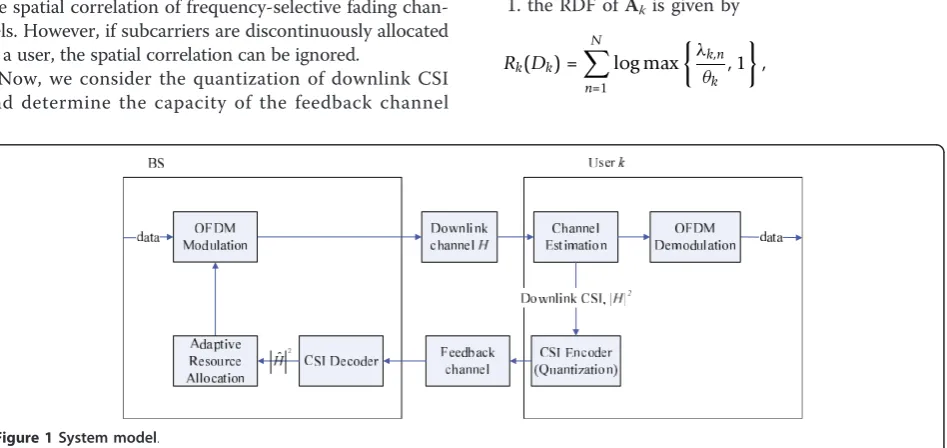
subcar-riers (or orthogonal channels) that will be shared byK users. The system model is depicted in Figure 1. We assume that each subcarrier is assigned to one user exclusively and the system employs FDD. It is assumed that each user perfectly estimates the CSI of the down-link channel (from the BS to the user), which is simply referred to as downlink CSI in this paper. Each user quantizes his/her estimated downlink CSI and sends it (actually an index of quantized downlink CSI) to the BS through a dedicated feedback channel. The BS receives the downlink CSI from all users and utilizes this infor-mation to assign subcarriers to users and adjust transmit power for each subcarrier.
Denote byHk, nthe channel gain of user kat
subcar-riern. Throughout the paper, we assume that the chan-nel gains are independent over subcarriers and the probability density function of the channel power gain ak, n= |Hk, n|2is given by
f(x=αk,n) = 1 λk,n
e
− x
λk,nu(x), (1)
whereu(·) denotes the unit step function, andlk, n=E
[ak, n]. Here, the channel power gainak, nis exponentially
distributed,ak, n~ exp(lk, n), where exp(m) denotes the
exponential distribution with meanm. Due to the assump-tion of independent channels, we may not be able to take the spatial correlation of frequency-selective fading chan-nels. However, if subcarriers are discontinuously allocated to a user, the spatial correlation can be ignored.
Now, we consider the quantization of downlink CSI and determine the capacity of the feedback channel
required to deliver the quantized CSI using the rate-dis-tortion theory. From this, we can characterize the mini-mum distortion of the quantized CSI for a given capacity of the feedback channel.
User kdescribes his/her knowledge of downlink CSI
Ak= (ak,1, ...,ak, N )Tby an indexIkand feeds the index
Ik back to the BS. The BS reproduces
ˆ
Ak= (αˆk,1, . . .,αˆk,N)T from the index Ik, where αˆk,nis the quantized description ofak, n. The quantized power
gainαˆk,nis assumed to be not greater than the actual power gainαk,n,αˆk,n≤αk,n.
To measure the accuracy of the quantized CSI, we introduce the distortion measure function with the mag-nitude error criterion:
d(Ak,Aˆk) = N
n=1
|αk,n− ˆαk,n|.
Then, we can define the information RDF ofAkas
Rk(Dk) = inf E[d(Ak,Aˆk)]≤Dk,αˆk,n≤αk,n
I(Ak;Aˆk),
whereDkdenotes the upper bound of the mean
quan-tization error and I(·;·)denotes the mutual information. By the rate-distortion theory [2], this RDF gives a mini-mum number of bits for the index Ik that can describe
the channel power gainAkwithout exceeding the mean
quantization error Dk. The RDF of Ak is given by the
following theorem:
Theorem 1. Let Ak = (ak,1, ..., ak, N )T be a vector
source with uncorrelated components that are exponen-tially distributed given by Equation 1. Then,
1. the RDF ofAkis given by
Rk(Dk) = N
n=1
log max λ
k,n θk
, 1
,
whereθkis chosen such that
Dk= N
n=1
min{θk,λk,n};
2. the test channel that achieves the RDF is given by
Ak=Aˆk+Zk,
where Zk= (zk,1, ..., zk, N) is independent of Aˆkand has uncorrelated components with Zk, n~ exp (min
{θk,lk, n}).
Proof: See Appendix Appendix 1.
Remark1. In downlink throughput maximization with
imperfect CSI, we require the probability density func-tion of the actual power gain condifunc-tioned on the quan-tized power gain. By the second part of Theorem 1, for a givenαˆk,n, the probability density function of ak, nis
f(αk,n| ˆαk,n) = 1 νk,n
e
−αk,n− ˆαk,n
νk,n u(αk,n− ˆαk,n), (2)
where vk, n = min {θk, lk, n}. Here, the variable vk, n
can be regarded as the mean quantization error for the channel power gainak, n.
Remark2. There are two special cases. By settingθk=
0, from Theorem 1, we have Dk= 0, Rk(Dk)=+∞ and
zk, n= 0. In this case, the CSI is perfectly known to the
BS. On the other hand, by setting θk = +∞, we have
Dk=Nn=1λk,nand Rk(Dk) = 0, which implies that no
CSI is fed back to the BS.
3 Outage throughput maximization with quantized CSI
3.1 Problem formulation
For a given capacity of the feedback channel, we have characterized the distortion in Section 2. With the quantized downlink CSI, the resource allocation can be carried out for a given performance measure. From this, we can formulate the resource allocation with capacity constraints of the feedback channels. Toward this end, in this subsection, we introduce the outage throughput as the performance measure.
Given the quantized CSI, the outage probability on the n-th subcarrier to thek-th user is defined as
Pkout,n(γn,αˆk,n,R) = Pr(log(1 +αk,nγn)<R| ˆαk,n), (3) wheregnis the input signal error ratio (SNR) of the n
-th subcarrier and R is the transmission rate. From
Equation 3, the maximum transmission rateRthat can maintain the outage probability εis
R(γn,αˆk,n,ε) = log(1 +γnF−αk1,n| ˆαk,n(ε)),
where Fαk,n| ˆαk,n(x) = Pr(αk,n<x| ˆαk,n). Thus, the expected rate of information successfully decoded at userkon subcarriernis
Tko,n(γn,αˆk,n,ε) = (1−ε)R(γn,αˆk,n,ε)
= (1−ε) log(1 +γnFα−k1,n| ˆαk,n(ε)). It is possible to maximizeTko,nby choosingε,
Tko,n(γn,αˆk,n) = max
ε T
o
k,n(γn,αˆk,n,ε). (4)
Here, the throughput To
k,n(γn,αˆk,n)is termed as the outage throughput. Settingx=Fα−1
k,n| ˆαk,n(ε), we obtain
Tko,n(γn,αˆk,n) = max
x log(1 +xγn) Pr(αk,n≥x| ˆαk,n) = max
x T o
k,n(γn,αˆk,n,x),
(5)
where To
k,n(γn,αˆk,n,x) = log(1 +xγn) Pr(αk,n≥x| ˆαk,n). Substituting Equation 2 yields
Tko,n(γn,αˆk,n,x)
= e− x− ˆαk,n
νk,n log(1 +xγn)x>αˆk,n log(1 +xγn) 0≤x≤ ˆαk,n
(6)
The optimal xthat maximizesTo
k,n(γn,αˆk,n,x)is given by the following theorem:
Theorem 2. There exists a unique globally optimal x
that maximizes To
k,n(γn,αˆk,n,x)in Equation 6, which is given by
x∗= max
ˆ
αk,n,
eW(γnνk,n)−1 γn
, (7)
whereW(x) is the Lambert-Wfunction, which is the solution to the equationW(x)eW(x)=x.
ProofSee Appendix Appendix B.
Thus, for each given transmit power gn, quantized
power gainαˆk,nand quantization errorvk, n, we can
eval-uate the outage throughput of thek-th user on then-th subcarrier Tko,n(γn,αˆk,n)in Equation 5 by Theorem 2. The overall outage throughput conditioned on the quan-tized CSI Aˆ is represented as
To(Aˆ) = K
k=1
N
n=1
whererk, nis the subcarrier allocation indicator: if the
n-th subcarrier is assigned to thek-th user, thenrk, n=
1; otherwiserk, n= 0. Here, the BS decides gnandrk, n
with the knowledge of quantized CSI Aˆ. To emphasize this, we denote the input SNR and the allocation indica-tor as functions of Aˆ byγ(Aˆ)and ρk,n(Aˆ), respectively. The average outage throughput is thus given by
To=EAˆ[T
Now, we can formulate the outage throughput maxi-mization under feedback capacity constraints:
maxρ
where the first constraint is the feedback capacity con-straint, the second constraint ensures that each subcar-rier is assigned to one user exclusively, and the third constraint is for total transmit power, denoted bygT.
By Theorem 1, for each Rk (Dk), there exists a test
channel that achieves Rk (Dk). Thus, maximizing the
downlink throughput under feedback capacity con-straints is equivalent to maximizing the downlink throughput under the corresponding test channel. It can also be observed that to maximize T°, we can maximize the conditional outage throughputTo(Aˆ)for each reali-zation of Aˆ under the conditional probability density function f(αk,n| ˆαk,n)given in Equation 2. That is,
To make the problem in Equation 10 tractable, we consider a suboptimal solution by breaking the pro-blem into two steps: subcarrier allocation and power allocation. In the first step, subcarriers are assigned to users under the assumption that the transmit power is identical over all subcarriers; in the second step, power is loaded on the subcarriers assigned in the first step.
3.2 Subcarrier allocation
Under the assumption of gn= gT/N, the optimization
problem in Equation 10 reduces to
maxρk,n
It implies that the subcarriers should be assigned based on the following criterion:
ρk,n=
1 if k= arg maxkTok,n(γT/N,αˆk,n), 0 otherwise .
The above criterion requires to evaluateKN values of the rate given in Equation 5. However, we can simplify this criterion in the case where on subcarrier n, the mean quantization error vk, n is identical among all
usersk. We state the following theorem:
Theorem 3. For any given vk, n,, the throughput
To
k,n(γn,αˆk,n) defined Equation 5 is monotonically increasing inαˆk,n∈(0, +∞)ifTok,n(γn,αˆk,n,x)in Equation 5 is monotonically increasing inαˆk,n∈(0, +∞).
Proof By assumption, we have
To 6 is monotonically increasing inαˆk,n. Thus, by Theorem 3, in the case of vk’, n =vk, n for k≠ k’, the subcarrier
When a tie occurs, we can select users in random fashion.
3.3 Power allocation
Denote byknthe selected user on then-th subcarrier, i.
e., kn= arg maxkrk, n. Given the subcarrier allocation,
The dual problem is
min
μ≥0g(μ), (13)
where
g(μ) = max γ1,...,γN
n
Tkon,n(γn,αˆkn,n)−μ
n
γn−γT
=
n max
γn
(Tkon,n(γn,αˆkn,n)−μγn) +μγT,
whereμis the Lagrangian multiplier of the first con-straint in Equation 12. Givenμ, the optimal power allo-cation on then-th subcarrier is
γn= arg max
γ T
o
kn,n(γ,αˆkn,n)−μγ. (14) We can use a derivative-free line search method, such as the golden section method to find thegnfor a given
Lagrangian multiplierμ[19].
The Lagrangian dual problem 13 has been shown to
be a convex optimization problem in μ[20]. Thus, we
can use the bisection method to find the optimal global multiplierμ[19]. The bisection method requires to eval-uate the first derivative of g(μ)with respect to μ. Although g(μ)is not continuously differentiable due to the max function, we can use the subgradient instead [21],
∂g(μ) ∂μ =γT−
n γn,
wheregnis obtained from Equation 14.
Using the dual optimization approach, it is possible that the final power allocation γn∗ may not satisfy
nγn∗≤γT. We can multiply the final power allocation on each subcarrierγn∗by a constantγT/nγn∗to arrive a feasible solution.
Complexity: in the first step, assigning subcarriers requires to find the maximumTo
k,n(γT/N,αˆk,n)amongK users for each subcarriern, and thereby, the complexity of subcarrier allocation is O(KN). In the power alloca-tion, in each iteration for μin Equation 13, we need to
compute Npower allocation values given by Equation
14. Each power allocation value requires a search rou-tine, which is assumed to converge within Igiterations.
Assuming thatIμiterations are required to find the opti-mal μ, the overall complexity of the suboptimal algo-rithm is O(KN+IμIgN). Ignoring the constantsIμ and Ig, the complexity is justO(KN).
4 Numerical results
We present several numerical results to demonstrate the performance of OFDMA systems using the proposed algorithms. We assume an OFDMA system with the
average channel power gain E[ak, n] = 1. Furthermore,
the feedback capacities of all users are assumed to be identical. That is,CK=CK’for allk≠k’. By Theorem 1,
it implies that the mean quantization errors of all users on each subcarriernare identical,vk, n=vk’, n
First, for the problem 10, we compare the proposed suboptimal algorithm with a full-searching algorithm. This full-searching algorithm considers all possible sub-carrier allocations, and for each subsub-carrier allocation, it assigns transmit power based on the dual optimization approach as proposed in Section 3.3 without projecting the final power allocation back to the feasible region. Thus, this algorithm gives an upper bound on the opti-mal solution to the problem in 10 [20].
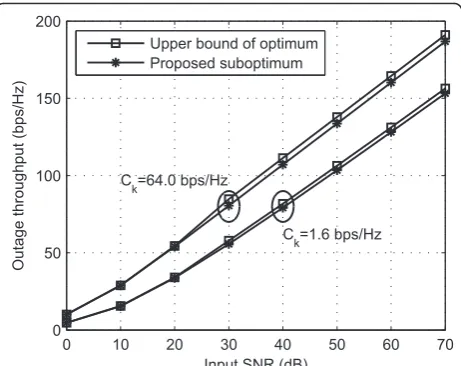
Figure 2 plots both the suboptimal results and the upper bound of the optimal results for an OFDMA sys-tem with N= 8 subcarriers andK= 2 users. In Figure 2, as the capacity of the feedback channel increases from Ck = 1.6 bps/Hz to Ck = 64 bps/Hz, the
perfor-mance gap between the suboptimum and the upper bound of the optimum gets larger. However, in both scenarios, the difference between the optimum and sub-optimum is within 5%.
Next, we consider an OFDMA system withN= 1,024
subcarriers and K= 8 users. We compare the outage
throughput achieved in the rate-distortion limit using the proposed suboptimal algorithm with the threshold-based quantization method considered in [4,22]. In the threshold-based quantization method, the channel power gain ak, non each subcarrier nof each userkis
quantized in intervals withW= 2NQthresholds Tq withq = 0, ...,W, whereT0 = 0,TW = +∞, and NQis the
num-ber of quantization bits per subcarrier. Here, we assume that all users have identical NQon all subcarriers. The
0 10 20 30 40 50 60 70 0
50 100 150 200
Input SNR (dB)
Outage throughput (bps/Hz)
Ck=1.6 bps/Hz Ck=64.0 bps/Hz
Upper bound of optimum Proposed suboptimum
thresholdsTq forq= 1, ...,W- 1 are determined by
par-titioning the probability density function ofak, ninto W
equiprobable intervals. It implies that Tq =F-1(q/W),
where F(·)is the cumulative density function (cdf) of ak,
n. The decoded channel power gain at the BS side is
assumed to be
ˆ
αk,n=Tq, forTq ≤ αk,n < Tq+1. (15)
Then, the BS assigns subcarriers and transmit power with the knowledge of the power gainαˆk,n: the user with the highest power gainαˆk,nis chosen on each subcarrier, and the transmit power on each subcarrier is deter-mined using the water-filling method [23]. This method gives the maximum throughput whenαk,n=αˆk,n[23].
Figure 3 shows the rate-distortion curves for the two schemes. In this figure, for a wide range of the average distortion, the required capacity of the feedback channel in the rate-distortion limit is about 50-80% of the threshold-based quantization scheme. However, when the capacity of the feedback channel is zero (no CSI is fed back to the BS), both schemes result in the average distortion ofNE[ak, n] = 1,024.
Figure 4 depicts the outage throughput in terms of the capacity of the feedback channel. When no CSI is available at the BS, according to Sections 3.2 and 3.3, the proposed scheme tends to assign subcarriers
ran-domly to users and allocate equal transmit power gn
on each subcarriern. In this case, the outage through-put is N max x log(1+xgT/N)Pr(ak, n ≥ x). For the
threshold-based method, since the decoded power gain
ˆ
αk,nis equal to the knowledge of the lower bound on the actual power gain as given by Equation 15, the BS can only set αˆk,n= 0. In this case, no signal is
trans-mitted on subcarriers. At Ck < 400 bps/Hz, the
achieved outage throughput in the rate-distortion limit is more than twice of the threshold-based method. The difference between the two schemes decreases for lar-ger capacity of the feedback channel. When the feed-back channel’s capacity of each user reaches 6,144 bps/ Hz, the throughput is saturated regardless of any type of the schemes (could happen when the perfect CSI is available at the BS). It can also be noted that at gT/N=
30 dB and Ck = 1,024 bps/Hz, the performance gap
between the outage throughput in the rate-distortion limit and that in the perfect CSI case is within 6%. Thus, it implies that with limited feedback rate, the system performance can be close to that of the perfect CSI one.
5 Conclusions
In this paper, we investigated the outage throughput maximization for an OFDMA system with finite feed-back rate over independent Rayleigh fading channels. First, we derived the RDF for the downlink CSI. This RDF gives a lower bound on the capacity of the feed-back channel according to the rate-distortion theory. Meanwhile, we obtained the test channel that achieves this RDF. The derived test channel enabled us to formu-late the resource allocation problem that maximizes the outage throughput with capacity constraints of feedback channels. For this problem, we proposed a low-complex-ity suboptimal algorithm. This algorithm divides the problem into two subproblems, namely subcarrier and power allocation problems. Through numerical results, we found that the proposed suboptimal algorithm has performance close to the optimum. We also observed that the outage throughput in the rate-distortion limit outperforms that with the threshold-based quantization
0 128 256 384 512 640 768 896 1024 1152
1024 2048 3072 4096 5120 6144
Average distortion D
Feedback rate R(D) (bits)
Proposed scheme
Thresholdíbased scheme
Figure 3 RDF (capacity of feedback channel) versus mean quantization error.
1024 2048 3072 4096 5120 6144
0 2000 4000 6000 8000 10000 12000
Feedback channel’s capacity per user (bps/Hz)
Outage throughput (bps/Hz)
γT/N=10 dB γT/N=30 dB
Proposed scheme Thresholdíbased scheme
method, and with limited feedback rate, the system per-formance can be close to that with perfect CSI.
Appendix A Proof of Theorem 1
First, we show that the exponential distribution maxi-mizes the entropy over all distributions with non-nega-tive support.
Lemma 1. Let the non-negative random variable x
have the meanE[x] = m. Then, the differential entropy ofxis upper bounded byh(x)≤log(xe¯ ), and the equality is achieved iff x is exponentially distributed,x~exp(m).
Proof Letf(x) be the probability density function of a
non-negative random variable x satisfying
+∞
0 xf(x)dx=m. Lety be an exponentially distributed
random variable with the Probability Density Functiong (y) = exp (-y/m)/m. Then,
where (Appendix A.1a) follows from
+∞
0 g(y)y dy=
+∞
0 f(y)y dy, and (Appendix A.1b)
fol-lows from the concavity of the function log.
Then, we derive the RDF for an one-dimensional exponentially distributed sourcex ~exp(m).
Lemma2. Define the RDF of an exponentially
distrib-uted sourcex ~exp(m) as
R(D) = inf
E[x−ˆx]≤D,xˆ≤xI(x;xˆ),
where xˆ is the quantized description ofx. Then, the RDF is given by
R(D) = log max{m D, 1},
and the test channel that achieves this RDF is
x=xˆ+z,
wherezis independent ofxˆwithz ~exp(min{D, m}). ProofIn the case D>m, the quantizer need not trans-mit any information since the the decoded information can be chosen as
where (Appendix A.2a) follows from the fact that con-ditioning reduces entropy, and (Appendix A.2b) follows from Lemma 1. The equality in (Appendix A.2a) is achieved iff z=x− ˆx independent of xˆ, and the equality in (Appendix A.2b) is achieved iffz ~exp(D).
Now, we are able to prove Theorem 1.
Proof[Proof of Theorem 1] We have
I(Ak;Aˆk) = h(Ak)−h(Ak| ˆAk) from the fact that the components of Akare
uncorre-lated, (Appendix A.3b) from the fact that conditioning reduces entropy, and (Appendix A.3c) follows from Lemma 2. The equality (Appendix A.3c) is achieved iff αk,n=αˆk,n+zk,nwithzk, n~ exp(min{lk, n,Dk, n}) is
inde-pendent ofαˆk,n, and the equality in (Appendix A.3b) is achieved iff f(Ak| ˆAk) =Nn=1f(αk,n| ˆαk,n). From this, it also implies thatZk = (zk,1, ..., zk, N)Thas uncorrelated
components.
The problem of finding the RDF ofAknow reduces to
minDk,n
The Lagrangian of the problem is
whereμis the Lagrangian multiplier. We can find the optimal Dk, nthat minimizesL by differentiatingLwith
respect toDk, n, Thus, we conclude the optimalDk, nis
Dk,n= min{θ,λk,n},
whereθ= log e/μ.. Recalling the constraint∑nDk, n=
Dk, we obtain the result of the Theorem 1.
Appendix B Proof of Theorem 2 ProofFirst, we show that lnTo
k,n(γn,αˆk,n,x)in Equation 6 gn≥ 0 [[20], p.86]. Since non-negative weighted sum
and pointwise infimum preserve the concavity [[20], Section 3.2], lnTo uniquexthat maximizesTo
k,n(γn,αˆk,n,x).
This work has been supported by the China Postdoctoral Science Foundation and the China National 973 project under the grant No. 2009CB320403.
Author details
1
School of Electronics Engineering and Computer Science, Peking University, Beijing, China2School of Electronic and Information Engineering, Beihang
University, Beijing, China3School of Engineering, Swansea University,
Swansea, UK
Competing interests
The authors declare that they have no competing interests.
Received: 6 October 2010 Accepted: 9 August 2011 Published: 9 August 2011
References
1. CY Wong, R Cheng, K Lataief, R Murch, Multiuser OFDM with adaptive subcarrier, bit, and power allocation. IEEE J Select Areas Commun.17(10), 1747–1758 (1999). doi:10.1109/49.793310
2. T Berger,Rate Distortion Theory: A Mathematical Basis for Data Compression
(Prentice-Hall Englewood Cliffs, New Jersey, USA, 1971)
3. A Kuehne, A Klein, Adaptive subcarrier allocation with imperfect channel knowledge versus diversity techniques in a multi-user OFDM-system, in
Proceedings of the IEEE PIMRC‘07, 1–5 (2007)
4. R Agarwal, V Majjigi, Z Han, R Vannithamby, J Cioffi, Low complexity resource allocation with opportunistic feedback over downlink OFDMA networks. IEEE J Select Areas Commun.26(8), 1462–1472 (2008) 5. J Chen, RA Berry, ML Honig, Performance of limited feedback schemes for
downlink OFDMA with finite coherence time, inProceedings of the IEEE ISIT ‘07, 2751–2755 (2007)
6. I Rubin, Information rates and data-compression schemes for poisson processes. IEEE Trans Inform Theory.20(2), 200–210 (1974). doi:10.1109/ TIT.1974.1055195
7. AJ Goldsmith, PP Varaiya, Capacity of fading channels with channel side information. IEEE Trans Inform Theory.43(6), 1986–1992 (1997). doi:10.1109/ 18.641562
8. I Bettesh, S Shamai, Outages, expected rates and delays in multiple-users fading channels. inProceedings of the Conference on Information Science and Systems,1(2000)
9. E Biglieri, J Proakis, S Shamai, Fading channels: information-theoretic and communications aspects. IEEE Trans Inform Theory.44(6), 2619–2692 (1998). doi:10.1109/18.720551
10. T Cover, Broadcast channels. IEEE Trans Inform Theory.18(1), 2–14 (1972). doi:10.1109/TIT.1972.1054727
11. T Kim, M Skoglund, On the expected rate of slowly fading channels with quantized side information. IEEE Trans Commun.55(4), 820–829 (2007) 12. M Effros, A Goldsmith, Capacity definitions and coding strategies for
general channels with receiver side information, inProceedings of the IEEE ISIT‘98, 39 (Aug 1998)
13. Y Isukapalli, R Annavajjala, B Rao, Performance analysis of transmit beamforming for miso systems with imperfect feedback. IEEE Trans Commun.57(1), 222–231 (2009)
14. IC Wong, B Evans, Optimal resource allocation in the OFDMA downlink with imperfect channel knowledge. IEEE Trans Commun.57(1), 232–241 (2009)
15. Y Yao, G Giannakis, Rate-maximizing power allocation in OFDM based on partial channel knowledge. IEEE Trans Wireless Commun.4(3), 1073–1083 (2005)
16. C Sukumar, R Merched, A Eltawil, Joint power loading of data and pilots in OFDM using imperfect channel state information at the transmitter. in
Proceedings of the IEEE Globecom‘08, 1–5 (2008)
17. E Choi, W Choi, J Andrews, B Womack, Power loading using order mapping in OFDM systems with limited feedback. IEEE Signal Process Lett.15, 545–548 (2008)
18. C Chen, L Bai, B Wu, J Choi, Downlink throughput maximization for OFDMA systems with feedback channel capacity constraints. IEEE Trans Signal Process.59(1), 441–446 (2011)
19. WH Press, BP Flannery, SA Teukolsky, WT Vetterling,Numerical Recipes in C: The Art of Scientific Programming(Cambridge University Press, Cambridge, England, 1992)
20. S Boyd, L Vandenberghe,Convex Optimization(Cambridge University Press, Cambridge, England, 2004)
21. DP Bertsekas,Nonlinear Programming, 2nd edn. (Athena Scientific, Belmont, USA, 2004)
23. J Jang, KB Lee, Transmit power adaptation for multiuser OFDM systems. IEEE J Select Areas Commun.21(2), 171–178 (2003). doi:10.1109/ JSAC.2002.807348
doi:10.1186/1687-1499-2011-56
Cite this article as:Wuet al.:Resource allocation for maximizing outage throughput in OFDMA systems with finite-rate feedback.EURASIP Journal on Wireless Communications and Networking20112011:56.
Submit your manuscript to a
journal and benefi t from:
7Convenient online submission
7Rigorous peer review
7Immediate publication on acceptance
7Open access: articles freely available online
7High visibility within the fi eld
7Retaining the copyright to your article