Volume 2009, Article ID 839424,13pages doi:10.1155/2009/839424
Research Article
Spreading Code Assignment Strategies for MIMO-CDMA Systems
Operating in Frequency-Selective Channels
Claude D’Amours
1and Adel Omar Dahmane
21School of Information Technology and Engineering, University of Ottawa, 550 Cumberland Avenue, Ottawa, ON, Canada K1N 6N5 2Department of Electrical and Computer Engineering, Universit´e du Quebec `a Trois-Rivi`eres, 3351 boul. des Forges,
Trois-Rivi`eres, QC, Canada G9A 5H7
Correspondence should be addressed to Claude D’Amours,[email protected]
Received 13 August 2009; Revised 10 November 2009; Accepted 25 December 2009
Recommended by Ibrahim Develi
Code Division Multiple Access (CDMA) and multiple input multiple output- (MIMO-) CDMA systems suffer from multiple access interference (MAI) which limits the spectral efficiency of these systems. By making these systems more power efficient, we can increase the overall spectral efficiency. This can be achieved through the use of improved modulation and coding techniques. Conventional MIMO-CDMA systems use fixed spreading code assignments. By strategically selecting the spreading codes as a function of the data to be transmitted, we can achieve coding gain and introduce additional degrees of freedom in the decision variables at the output of the matched filters. In this paper, we examine the bit error rate performance of parity bit-selected spreading and permutation spreading under different wireless channel conditions. A suboptimal detection technique based on maximum likelihood detection is proposed for these systems operating in frequency selective channels. Simulation results demonstrate that these code assignment techniques provide an improvement in performance in terms of bit error rate (BER) while providing increased spectral efficiency compared to the conventional system. Moreover, the proposed strategies are more robust to channel estimation errors as well as spatial correlation.
Copyright © 2009 C. D’Amours and A. O. Dahmane. This is an open access article distributed under the Creative Commons Attribution License, which permits unrestricted use, distribution, and reproduction in any medium, provided the original work is properly cited.
1. Introduction
The object of much research in wireless communications is to enable high and variable data rates to users to support the growing number of applications that involve the transfer of data [1]. Code Division Multiple Access (CDMA) systems employ spread spectrum (SS) technology and were developed for second and third generation (2G, 3G) wireless communications. For example, IS-95 and Wideband CDMA (WCDMA) systems are based on direct sequence SS techniques.
Multiple access interference (MAI) is present in CDMA systems due to the nonzero cross-correlation between the different users’ spreading codes [2]. The MAI that each user’s signal creates in all other users’ signals results in increased bit error rate (BER). The overall system capacity is determined by the number of simultaneous transmitters that can be supported before the BER increases to an unacceptable
level [3]. Much research presented in the literature has concentrated on making systems more power efficient as a means to increase the overall spectral efficiency of the CDMA system [4–7]. Other techniques, such as multiuser detection, have also been considered to increase the capacity of CDMA systems [2,8–10].
Multiple input multiple output (MIMO) systems employ multiple antennas at the transmitter and receiver. This is done to increase the capacity of systems through the inherent spatial multiplexing [11] that can be obtained by using multiple transmit and receive antennas as well as receive diversity that comes from having multiple receive antennas. Coding can also be achieved by the transmit diversity that can be obtained by sending multiple copies of data over different transmit antennas [12,13].
and data transmission speed [14–22]. This is achievable by exploiting the spatial diversity made possible by multiple antennas at the transmitter and the receiver, allowing more degrees of freedom when the transfer functions between different transmit and receive antenna pairs are sufficiently uncorrelated. The inherent beamforming capabilities of the receive antenna array also make MIMO-CDMA systems more robust to multiple access interference (MAI) than their single input single output (SISO) DS-CDMA counterparts. Currently, MIMO-CDMA is considered for many beyond 3G (B3G) applications [22].
Like CDMA systems, MIMO-CDMA systems encounter MAI as well as self interference (SI) due to the fact that autocorrelation and cross correlation properties of the employed spreading codes are not perfect [23]. MAI is the interference caused by other users who are simultaneously accessing the channel, while SI is the interference that the desired user’s substreams cause to one another, due to spreading codes that are not orthogonal or by the loss of code orthogonality caused by frequency-selective fading. The effect that MAI and SI have on the BER performance of a sys-tem is determined by the kind of spreading codes employed (orthogonal or quasiorthogonal codes) and the frequency selective nature of the wireless channels [2]. As such, MAI and SI limit the performance and capacity of conventional MIMO-CDMA systems. To mitigate the interference, several multiuser detection (MUD) techniques have been proposed to improve the performance of the conventional rake receiver [16,20,24–27]. However, complexity represents one of the major issues impeding the widespread use of MUD receivers [27] and some alternative techniques need to be used to improve MIMO-CDMA systems.
In CDMA systems, spreading codes are assigned to different users to enable them to meet certain quality of service (QoS) requirements, such as data rate and band-width, [1]. Dynamic code assignment strategies are used to maximize system throughput by assigning codes to different users based on their cross-correlation properties [1,28,29]. These assignment strategies are centralized. In conventional MIMO-CDMA systems, unique codes are assigned per user [16–19] or per antenna [20]. Although the latter code assignment strategy requires the use of more spreading codes in the overall system, doing so improves the overall bit error rate (BER) performance. Indeed, the substreams can be differentiated by their codes as well as the spatial diversity. In this paper, we consider a code assignment strategy that allows the selected code(s) to impart some information to the receiver about the message that it carries. This selection is made by the transmitter, which selects a code from a set of codes that have been assigned to it. By allowing the selected spreading code to impart some redundant information about the message that is being carried, a coding gain is obtained. This coding gain can be traded offagainst increased system capacity. We compare our findings to the best existing conventional MIMO-CDMA system, which is one that assigns different codes to each antenna as well as to each user.
Spreading code assignment strategies in DS-CDMA systems and in particular for MIMO-CDMA systems play an
important role in defining their overall performance [30,31]. Unlike centralized spreading code assignment strategies, a user is assigned a set of mutually orthogonal spreading codes and the transmitter decides which code or codes to be used based on the data that is to be transmitted. In [30], for the first time, parity bit-selected spreading has been proposed where the code assignment in single input single output (SISO) DS-CDMA systems is determined by the transmitted bits. The code is drawn from a set of mutually orthogonal codes. In [31], parity bit-selected spreading has been extended to MIMO systems. In this same paper, a new technique named permutation spreading has also been proposed to improve the performance of the system while using the same number of spreading codes per user. Performance improvements can be briefly explained by the fact that in case of conventional MIMO-CDMA, if bits b1, b2, b3, and b4 are transmitted from different
antennas, correctly determiningb1,b2, andb3will not help
to determine b4. However, in case of parity bit-selected
spreading or permutation spreading, correctly detection of 3 or even 2 of the bits will exactly determine the other bits. Therefore, bits that encounter poor channel conditions can be recovered by the other bits. Thus, a coding gain similar to Space Time Block Code (STBC) is obtained without the need to retransmit bits from different antennas.
All results presented in these two papers considered frequency nonselective channels. In [30, 31], simulation results demonstrated superior bit error rate (BER) perfor-mance when compared to the conventional system. The use of these spreading assignment techniques in frequency-selective channels is challenging since the dispersive nature of the channel deorthogonalizes the spreading codes that are assigned to a user.
In this paper, we propose a suboptimal detection strategy based on the maximum likelihood detector for parity bit-selected and permutation spreading strategies for MIMO-CDMA systems operating in frequency selective channels without any antenna selection strategy. The detection tech-nique takes the loss of orthogonality of the different codes into account but treats all other users as noise. Therefore no attempt is made by the receiver to null out the interferers, as in beamforming systems. We also propose to study the detection stage of the different spreading strategies depending on the correlation properties of the spreading codes employed. Moreover, we will study the robustness of these detectors in presence of channel estimation errors and spatial correlation.
detection of different spreading strategies is presented in
Section 3. InSection 4, some simulation results are presented for single user and multiuser environments. Finally, some conclusions and future work are provided inSection 5.
2. MIMO-CDMA System Operating in
Frequency-Selective Fading
Let us consider the K userNt×Nr MIMO-CDMA uplink
system model of [31], employing binary phase shift keying (BPSK) modulation withNttransmit antennas for each user
andNr receive antennas at the base station.Figure 1shows
a MIMO-CDMA system operating in frequency-selective fading channels andTable 1provides a list of symbols used throughout the paper. As shown in Figure 1, the data of each user converted intoNtparallel streams. Each stream is
to be transmitted by one ofNt transmitting antennas. The
substream to be transmitted on antennaiof userkon time interval n is spread by a spreading code vector w(kn,i). The spreading code vector is of dimensionNc×1:
wk(n,i)=wk(n,i)(1) wk(n,i)(2) · · · wk(n,i)(Nc) T
, (1)
where Nc is the spreading factor and the subscript T
represents the transpose operator.Nc =Ts/Tc is an integer
number where Ts is the symbol period and Tc is the chip
period. The spreading code vector is selected from a set of
Nspreading vectors{ck,1, ck,2, . . ., ck,N} ∈Ck.
The wireless media is considered to be a discrete-time baseband channel model with chip-spaced channel taps. We assume block fading chip-spaced channels perfectly known by the receiver. Thus, assuming that each transmit antenna to receive antenna link hasLresolvable multipath components, the sampled channel response from the transmit antennaito the receive antennajof userkis given by theL×1 vector:
hj,i,k=
h(0)j,i,k h(1)j,i,k · · · h(jL,i−,k1)T. (2)
Assuming that the maximum channel delay is less than the one signaling interval, the received signal at antennajis
r(jn)= K
k=1
Nt
i=1
S(kn,i)hj,i,kbk(n,i)
+
K
k=1
Nt
i=1
Sp(kn,i)hj,i,kb(kn,i−1)
+
K
k=1
Nt
i=1
Sn(kn,i)hj,i,kbk(n,i+1)+n
(n)
j .
(3)
Due to the frequency selective nature of the channels, intersymbol interference (ISI) is present in the received signal. This is shown in (3), where the second term is the ISI caused by the data from the previous signaling interval
Table1: List of symbols used throughout the paper.
Symbols Definition
K Number of users
Nt Number of transmit antennas
Nr Number of receive antennas
k Index for user of interest
i Index of transmitting antenna
n Time interval
wk,i(n) Nc×1 spreading code vector for userkused for antennaiat time intervaln
Nc Spreading factor ()T Transpose operator
Ts Symbol period
Tc Chip period
N Number of spreading vectors per user
Ck Set ofNspreading vectors for userk
j Index of receiving antenna
hj,i,k
L×1 chip-spaced sampled channel response between antennaiof userkand receiving antennaj
L Number of Resolvable multipath components
b(n)k,i Data transmitted by antennaiof userkat instant
n
S(n)k,i,Sp (n) k,i,Sn
(n) k,i
(Nc+L−1)×LSpreading matrices for antennai of userkat instantn
n(n)j (receiving antennaNc+L−1)×1 complex Gaussian noise vector atj
σ2
n Gaussian noise variance
r(n)j (Nc+L−1)×1 received vector at antennaj
y(n)j,i,k
L×1 vector of correlators at receiving antennaj matched to spreading code vector for userkused for antennaiat time intervaln
Rk,i(n) L×Lautocorrelation matrix
nj(n)
L×1 despread complex Gaussian noise + SI + MAI
SI(n)j,i,k
L×1 self interference seen by the substream transmitted by antennaiof userkat receiving antennajand instantn
MAI(n)j,i,k
L×1 multiple access interference seen by the substream transmitted by antennaiof userkat receiving antennajand instantn
b(n)i,k
Estimated data transmitted by antennaiof userk at instantn
M Set of all possible message vectors
Mm Coset numberm
W
Bank of correlators for receiving antenna 1 Bank of correlators matched toc1,1
Correlator matched toc1,1
Correlator matched toc1,1
Correlator matched toc1,1 Tc
Bank of correlators matched tocK,N .
. .
Bank of correlators for receiving antenna
Nr
Figure1:KuserNt×NrMIMO-CDMA uplink system operating in frequency selective channels.
while the third term represents the ISI caused by the data on the next signaling interval. This is also shown inFigure 1. It is worth noting that the received vector per antenna has (Nc+L−1) elements which contain sufficient statistics for These equations are easily derived fromFigure 1. It is worth noting here that when the maximum channel delay is greater than the length of the spreading codes (which we assume is equal to one signaling interval in our paper), the model is easily extended by incorporating new matrices to take into account the additional ISI caused by symbols that are more than one signaling interval away from the desired signaling interval.
Moreover, the presented model is valid in synchronous and asynchronous MIMO-CDMA channels. Indeed, every SISO-CDMA channel has L different taps. The model is asynchronous if we impose that the first few paths of the
interfering users have zero gain:
Spk(n,i)
3. Single User Detection and
Spreading Strategies
Regardless of the spreading strategy employed, single user detection in this paper requires a bank of correlators matched to the spreading sequences employed by the transmitter. SinceNdifferent spreading codes are assigned per user (and since there is uncertainty at the receiver to which code or codes have been used), we needNr×N×L×Kcorrelators
as illustrated inFigure 1.
3.1. Conventional MIMO-CDMA System. In conventional MIMO-CDMA, each user can use the same code for all transmitting antennas or one code per transmitting antenna. In our case, we use the latter technique. Hence, wk(n,i) = ck,i. In our paper, we consider a system where the mobiles
each use Nt transmit antennas, and thereforeN = Nt. For
each transmit antenna, we apply a correlator matched to the signature used by the transmitting antenna. Considering antenna i of user k as our substream of interest, we can rearrange (3) as
We can now apply the bank of correlators matched to the code used by antennaiof userkat the receiving antenna j:
y(jn,i),k=Sk(n,i)Hr(jn)=
where the superscriptH represents the conjugate transpose of a matrix. From (7) and (8), we can write
is the autocorrelation matrix and nj(n) encompasses the
despread complex Gaussian noise, the self interference (SI), and multiple access interference (MAI). It is given by
nj(n)=SI(jn,i),k+ MAI(jn,i),k+Sk(n,i)Hn(jn), (11)
where the SI is seen by the substream transmitted by antenna
iof userkat the receiving antenna j:
SI(jn,i),k=
and the corresponding MAI:
In single user detection of conventional MIMO-CDMA system, the detection block uses only the correlators corre-sponding to the substream of interest while considering the SI and MAI as white noise. In this case, the detector is able to estimate the substream of interest by applying maximal ratio combining (MRC) to (9) for all receiving antennas. Therefore,b(i,nk)can be estimated by the following equation:
b(i,nk)=sgn ⎛ ⎝Nr
j=1
hj,i H
y(jn,i),k
⎞
⎠. (14)
3.2. Parity Bit-Selected Spreading System. In parity bit-selected spreading, the data on different antennas is spread by a single spreading waveform that is selected based on the parity bits that are generated when a message is encoded using a systematic linear block code [31]. For each user withNt transmit antennas, the setMof all possible message
vectors has 2Nt different elements. The different messages
that produce the all zero parity vector form subset ofMthat is closed under modulo-2 addition. We denote this subset as
M1. If we select an elemente∈Msuch thate /∈M1and add
modulo-2 to all elements inM1, the resulting set is called
a coset ofM1. Messages from distinct cosets ofM1produce
unique parity bit vectors when being input to the parity bit calculator. In parity bit-selected spreading, each of the cosets is assigned one of theNspreading codes. For example, if user
khas 4 transmitting antennas, the setMhas 16 elements. If each user is assignedN = 8 spreading codes, then we can partition M into 8 cosets as follows: M1 = {0000, 1111},
M2 = {0001, 1110},. . ., andM8 = {0111, 1000}. Each of
these cosets is assigned one of theNspreading waveforms; therefore if the word to be transmitted ism(m)∈M
m, then all
transmitting antennas will use the spreading code assigned to cosetMm. The same spreading code is used on each transmit
antenna. Hencewk(n,1) = · · · =wk(n,N)t =ck,m. In this case, (3)
can be written as
r(jn)= K
k=1
S(kn)
Nt
i=1
hj,i,kb(kn,i)+ K
k=1
Sp(kn)
Nt
i=1
hj,i,kb(kn,i−1)
+
K
k=1
Sn(kn) Nt
i=1
hj,i,kb(kn,i+1)+n
(n)
j .
(15)
Indeed, for each user, the code matrices are the same for all transmitting antennas. Hence, they no longer depend on the indexi.
In this paper, we consider a MIMO-CDMA system employingNt =2, 3, or 4 transmit antennas. In each case,
we chooseN =2Nt−1; therefore all cosets are made up of 2
message vectors. This is not necessarily the optimum choice forN. In the two transmit antenna case,N = 2 andM1 =
{00, 11}, and M2 = {01, 10}. If the message m(m) comes
fromM1,ck,1is used to spread the output of both antennas,
otherwiseck,2is used.
From the detector’s perspective, since we do not have prior knowledge of which codes have been used by each user, we need to apply a bank of correlators for each possible code
(Figure 1). For eachw(kn,1)= · · · =wk(n,N)t =ck,m, we construct
S(kn,i,m)using (4). Since all transmit antennas from the same user use the same code at instantn, allS(kn,i,m)are the same. In this case, we can use
S(kn,1,m)= · · · =S(kn,N,mt)=S(kn,m). (16)
We will then be able to compute the corresponding correlator outputs:
y(jn,k,m)=Sk(n,m)Hr(jn). (17)
The detection strategy in case of parity bit-selected spreading is different from the conventional MIMO system. Indeed, for each userk, we must detect theNt×1 vector
b(kn)=b(kn,1),b (n)
k,2,. . .,b (n)
k,Nt T
(18)
of bits transmitted by all its antennas at instantnsince the choice of spreading code depends upon the value of this vector.
Using the same development in previous section, we can rewrite (17) using (16) as follows:
y(jn,k,m)=Sk(n,m)HS(kn)
Nt
i=1
hj,i,kb(kn,i)+n
(n)
j , (19)
wherenj(n)represents the despread noise, the MAI, and part of SI. Indeed,y(jn,k,m)gathers part of the SI since we need the information from all transmitting antennas of the user of interest.
Equation (19) can be rewritten as
y(jn,k,m)=R(kn,m)
Nt
i=1
hj,ib(kn,i)+n
(n)
j , (20)
where
Rk(n,m)=Sk(n,m)HS(kn) (21)
is the correlation matrix between the codes used by userk. It is worth noting here that whenS(kn,m)=S(kn), the correlation matrix has important diagonal elements. However, it will not be diagonal because of cross-correlation due to the multipath effect. This is true even with perfectly orthogonal codes. WhenS(kn,m)=/S(kn), the diagonal elements are zeros (case of orthogonal codes) while off-diagonal elements are nonzero.
metric. Therefore, the estimated data is determined using the
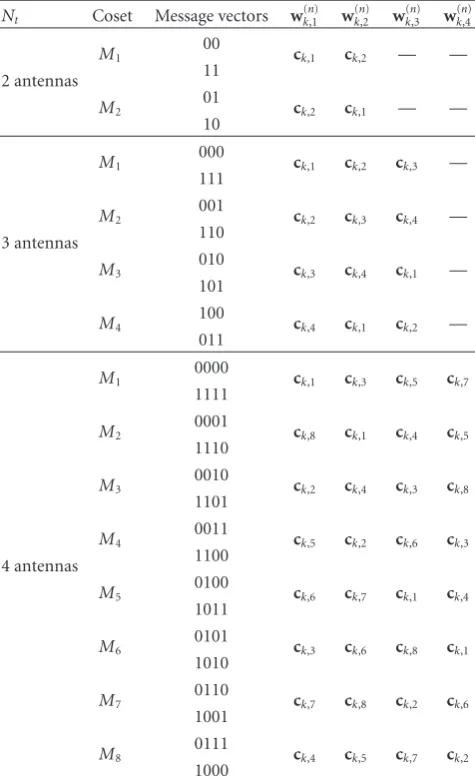
3.3. Permutation Spreading System. In contrast to the parity bit-selected spreading technique, the permutation spread-ing technique allocates different spreading codes to each transmit antenna. When permutation spreading is used, depending on which coset the message comes from, a unique permutation of the spreading codes assigned to the user is employed. Each permutation employsNtof theNspreading
waveforms and we attempt to minimize the number of spreading codes that each permutation has in common. Furthermore, if a spreading waveform is used by antennaiof userkin one permutation, it cannot be used by antennaiin any other permutation for this same user. The design of the different spreading permutations is based ont-designs [32] which are used in permutation modulation schemes [33,34].
Table 2lists the spreading permutations when userkhas 2, 3, and 4 transmitting antennas.
From the detector’s perspective, as for the case of parity bit-selected spreading, we do not have prior knowledge of which codes have been used by each user. However, we know that we have to pickNt different codes from the setCkofN
different codes for userk. Hence, we need to apply a bank of correlators for each possible code assignment:
y(jn,k,m)= we notice that depending on the message vector, we can buildS(kn,i,m)using the corresponding spreading code for each antenna.
Equation (24) can be rewritten as
y(jn,k,m)=
Table2: Spreading permutations for MIMO-CDMA system using permutation spreading technique.
is the correlation matrix of the code employed to spread the message sent by antennaiof userkand one of theNpossible codes available for userk. In case of orthogonal normalized spreading codes, the correlation matrix is an identity matrix whenSk(n,i,m) = S(kn,i). Otherwise, the correlation matrix is a nonzero matrix with zeros in its diagonal.
For the same reasons as the parity bit-selected spreading system, a suboptimal detector is proposed. The estimated data is determined using the following decision rule:
where y(kn) is a vector containing a concatenation of all
10−6 10−5 10−4 10−3 10−2 10−1 100
BER
0 2 4 6 8 10 12 14 16 18 20
Eb/N0(dB) 1×1 ConvSS-U1-AWGN 2×1 ConvSS-U1 2×1 ParBit-U1 2×1 Permut-U1 2×4 ConvSS-U1
2×4 ParBit-U1 2×4 Permut-U1 2×4 ConvSS-U10 2×4 ParBit-U10 2×4 Permut-U10 Figure 2: Performance comparison of three different MIMO-CDMA systems in frequency nonselective channels using Hadamard codes of length 32 where each user has 2 transmit antennas.
4. Simulation Results
In this section, we present the simulation results of spreading code assignment strategies presented in this paper. Among the parameters that can influence the performance of these schemes, we have
(i) number of transmitting antennas,
(ii) number of receiving antennas,
(iii) frequency selectivity of the channels,
(iv) spreading code cross-correlation properties,
(v) nonperfect channel estimation
(vi) space correlation.
We will study the effect of all these parameters in the following four subsections. Performance of each system is presented in terms of raw bit error rate (BER) before decoding for differentEb/N0using synthetic data. Quasistatic
channels are used throughout the simulations. We consider both the frequency nonselective and frequency selective fading case. For the frequency selective case, we consider a channel with 6 resolvable paths. We assume that the channel gains on each resolvable path are independent of those on the other paths and that all have equal variance.
In all simulation results, the following notations have been adopted:
(i)A×B: MIMO system withAtransmit andBreceive antennas (e.g., 2 × 4: 2 transmit and 4 receive antennas),
10−6 10−5 10−4 10−3 10−2 10−1 100
BER
0 2 4 6 8 10 12 14 16 18 20
Eb/N0(dB) 1×1 ConvSS-U1-AWGN 3×1 ConvSS-U1 3×1 ParBit-U1 3×1 Permut-U1 3×3 ConvSS-U1
3×3 ParBit-U1 3×3 Permut-U1 3×3 ConvSS-U8 3×3 ParBit-U8 3×3 Permut-U8 Figure 3: Performance comparison of three different MIMO-CDMA systems in frequency nonselective channels using Hadamard codes of length 32 where each user has 3 transmit antennas.
(ii)UA:Ausers are active in a cell (e.g., U1: 1 active user and U10: 10 active users),
(iii) ConvSS: conventional code assignment,
(iv) ParBit: parity bit selected spreading strategy,
(v) Permut: permutation spreading code strategy,
(vi) AWGN: additive white Gaussian noise channel.
10−6 10−5 10−4 10−3 10−2 10−1 100
BER
0 2 4 6 8 10 12 14 16 18 20
Eb/N0(dB) 1×1 ConvSS-U1-AWGN 4×1 ConvSS-U1 4×1 ParBit-U1 4×1 Permut-U1 4×4 ConvSS-U1
4×4 ParBit-U1 4×4 Permut-U1 4×4 ConvSS-U4 4×4 ParBit-U4 4×4 Permut-U4 Figure 4: Performance comparison of three different MIMO-CDMA systems in frequency nonselective channels using Hadamard codes of length 32 where each user has 4 transmit antennas.
Since the single user AWGN case has the same curve for all three figures, we can observe the increase of robustness of the proposed scheme when increasing the number of trans-mitting antennas. This is quite expected since the number of spreading codes per user increases. Hence, systems with more transmit antennas at the receiver for the proposed schemes have more degrees of freedom (more code diversity) leading to improved BER performance compared to the conventional system.
4.2. Spreading Codes and Frequency Selectivity. Hadamard codes are well suited to establish the performance of CDMA systems in frequency nonselective channels and multiuser environments. However, in frequency selective channels, the orthogonality between the different codes in a user’s set is lost and cross-correlation properties of the codes employed become very important. Two families of codes are compared in this subsection: Hadamard and Gold codes. Here we are interested in the frequency selective case. We assume that all fading gains are to be uncorrelated and that the receiver estimates all channel gains perfectly.
Figure 5shows the BER performance when Hadamard
(length 32) is used in a three transmit antenna system.
Figure 6shows the BER performance when Hadamard codes
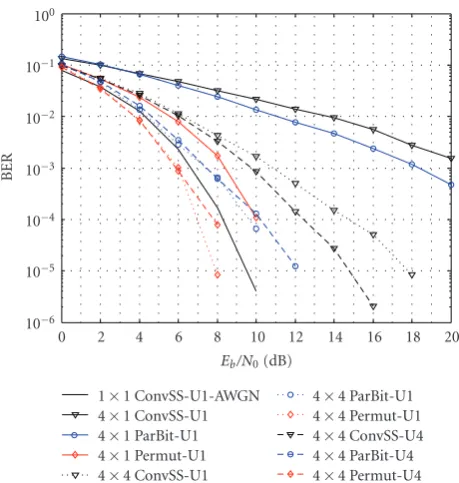
are replaced by Gold codes (length 31). The performance in both figures is given for one and three antenna receivers. Comparing the results of Figures5and6, we see that, under the same conditions, Gold codes are better suited in the case of frequency selective channels due to their better cross-correlation properties [15, 35]. These results are further confirmed by Figures7and8when 4 transmit antennas are
10−6 10−5 10−4 10−3 10−2 10−1 100
BER
0 2 4 6 8 10 12 14 16 18 20
Eb/N0(dB) 1×1 ConvSS-U1-AWGN 3×1 ConvSS-U1 3×1 ParBit-U1 3×1 Permut-U1 3×3 ConvSS-U1
3×3 ParBit-U1 3×3 Permut-U1 3×3 ConvSS-U8 3×3 ParBit-U8 3×3 Permut-U8 Figure 5: Performance comparison of three different MIMO-CDMA systems in frequency selective channels with 6 resolvable paths using Hadamard codes of length 32 where each user has 3 transmit antennas.
10−6 10−5 10−4 10−3 10−2 10−1 100
BER
0 2 4 6 8 10 12 14 16 18 20
Eb/N0(dB) 1×1 ConvSS-U1-AWGN 3×1 ConvSS-U1 3×1 ParBit-U1 3×1 Permut-U1 3×3 ConvSS-U1
3×3 ParBit-U1 3×3 Permut-U1 3×3 ConvSS-U8 3×3 ParBit-U8 3×3 Permut-U8 Figure 6: Performance comparison of three different MIMO-CDMA systems in frequency selective channels with 6 resolvable paths using Gold codes of length 31 where each user has 3 transmit antennas.
10−6 10−5 10−4 10−3 10−2 10−1 100
BER
0 2 4 6 8 10 12 14 16 18 20
Eb/N0(dB) 1×1 ConvSS-U1-AWGN 4×1 ConvSS-U1 4×1 ParBit-U1 4×1 Permut-U1 4×4 ConvSS-U1
4×4 ParBit-U1 4×4 Permut-U1 4×4 ConvSS-U4 4×4 ParBit-U4 4×4 Permut-U4 Figure 7: Performance comparison of three different MIMO-CDMA systems in frequency selective channels with 6 resolvable paths using Hadamard codes of length 32 where each user has 4 transmit antennas.
To overcome this drawback, we propose an alternative way to assign codes by assigning each user the same set of Hadamard codes as well as a unique scrambling code. This is similar to the way codes assigned in third generation wideband CDMA systems [36]. Indeed, the latter uses OVSF (Orthogonal Variable Spreading Factor) codes to spread users’ data and one scrambling code per user to distinguish them.Figure 9shows the BER performance of the different MIMO-CDMA systems that assign all users the same set of Hadamard sequence along with a unique scrambling code operating in a 4 × 4 MIMO frequency selective channel. We assume a spreading factor of 32. Here we notice that the number of users is not limited to 4 even though the spreading factor is 32. Therefore, the number of available codes does not become a limiting factor, which is the same as for conventional WCDMA systems.
In perfect channel conditions (perfectly estimated and uncorrelated), there is little or no advantage to using the permutation spreading strategy over the parity bit-selected spreading strategy. However, this will not be the case under non ideal conditions, which will be shown in the upcoming sections.
4.3. Channel Estimation Errors. Here we present the BER performance of the 3 techniques with channel uncertainties. Channel estimation errors are introduced within the channel gains as random values with fixed variances.Figure 10shows the BER performance of the 4 ×4 MIMO systems with uncorrelated channels when channel estimation errors are present at the receiver. The estimation error is measured in normalized mean square error (NMSE). We consider
esti-10−6 10−5 10−4 10−3 10−2 10−1 100
BER
0 2 4 6 8 10 12 14 16 18 20
Eb/N0(dB) 1×1 ConvSS-U1-AWGN 4×1 ConvSS-U1 4×1 ParBit-U1 4×1 Permut-U1 4×4 ConvSS-U1
4×4 ParBit-U1 4×4 Permut-U1 4×4 ConvSS-U4 4×4 ParBit-U4 4×4 Permut-U4 Figure 8: Performance comparison of three different MIMO-CDMA systems in frequency selective channels with 6 resolvable paths using Gold codes of length 31 where each user has 4 transmit antennas.
mation errors with NMSE of 0 (perfect estimation), 10, and 30 percent. From Figure 10, we note that the permutation spreading strategy is more robust to channel estimation errors when compared to parity bit-selected spreading. Indeed, both techniques present almost the same result when the receiver has perfect channel estimates. However, the parity bit-selected spreading strategy registers a performance loss up to 0.7 dB at a BER of 10−3when the channel estimates
have a normalized mean square error (NMSE) of 30%. When compared to the conventional system, both proposed strategies are more robust to channel estimation errors as the conventional system suffers a higher power loss at a BER of 10−3when channel estimation errors are present.
4.4. MIMO Channel Correlations due to Antenna Spacing.
In this subsection, spatial correlation, due to inadequate antenna spacing, effects are analyzed. EachNt×NrMIMO
correlated channel tap is generated as follows [37]:
vecH(l)=R1/2vecH(wl)
, (28)
whereH(wl)is the spatially whiteNt×NrMIMO channel for
tapl,R is theNtNr ×NtNr covariance matrix, and vec(A)
stacks the matrixAinto a vector columnwise. In our case,R
10−6 10−5 10−4 10−3 10−2 10−1 100
BER
0 2 4 6 8 10 12 14 16 18 20
Eb/N0(dB) 1×1 ConvSS-U1-AWGN 4×4 ConvSS-U1 4×4 ParBit-U1 4×4 Permut-U1 4×4 ConvSS-U4
4×4 ParBit-U4 4×4 Permut-U4 4×4 ConvSS-U6 4×4 ParBit-U6 4×4 Permut-U6 Figure 9: Performance comparison of three different MIMO-CDMA systems in frequency selective channels with 6 resolvable paths using a mix of Hadamard codes of length 32 for spreading and scrambling codes to distinguish between users.
10−6 10−5 10−4 10−3 10−2 10−1 100
BER
0 2 4 6 8 10 12 14 16 18 20
Eb/N0(dB) ConvSS-perfect
ParBit-perfect Permut-perfect ConvSS-10% ParBit-10%
Permut-10% ConvSS-30% ParBit-30% Permut-30%
Figure10: Effect of channel estimation errors on BER performance of 4×4 MIMO systems with 4 users in frequency selective channels (6 taps) and Gold codes of length 31.
4 active users, Gold spreading sequences of length 31, and three values forα: 0, 0.4, and 0.6. Under these conditions, the BER performance of the different spreading allocation techniques is given inFigure 11.
10−6 10−5 10−4 10−3 10−2 10−1 100
BER
0 2 4 6 8 10 12 14 16 18 20
Eb/N0(dB) ConvSS-uncorr
ParBit-uncorr Permut-uncorr ConvSS-corr 0.4 ParBit-corr 0.4
Permut-corr 0.4 ConvSS-corr 0.6 ParBit-corr 0.6 Permut-corr 0.6 Figure11: Effect of spatial correlation on BER performance o 4×4 MIMO systems with 4 users in frequency selective channels (6 taps) and Gold codes of length 31.
As the channel correlation increases, the parity bit-selected spreading technique suffers the most. Indeed, its performance relies on the degree of separation than can be achieved among users and antennas. As seen in Figure 11, when the correlation increases, the parity bit-selected spread-ing strategy loses some degrees of freedom. Even though the permutation spreading is also affected, the power loss due to correlation effects at a BER of 10−3 is less than that
of both the parity bit-selected spreading technique and the conventional system. Indeed, at this target BER, permutation spreading strategy shows 2 dB improvement over the parity bit-selected strategy and a 3.5 dB improvement compared to the conventional technique when the spatial correlation coef-ficient is 0.4. Moreover, the permutation spreading strategy is the only technique that was capable of achieving a BER of 10−3when the spatial correlation coefficient is as high as 0.6.
5. Conclusion
References
[1] I. Koutsopoulos, U. C. Kozat, and L. Tassiulas, “Dynamic resource allocation in deterministic-code CDMA systems with multi-rate provisioning,” IEEE Transactions on Mobile Computing, vol. 5, no. 12, pp. 1780–1792, 2006.
[2] S. Verd `u,Multiuser Detection, Cambridge University Press, Cambridge, UK, 1998.
[3] A. J. Viterbi, “When not to spread spectrum—a sequel,”IEEE Communications Magazine, vol. 23, no. 4, pp. 12–17, 1985. [4] C. D’Amours, M. Moher, and A. Yongacoglu, “Comparison
of pilot symbol-assisted and differentially detected bpsk for ds-cdma systems employing rake receivers in rayleigh fading channels,”IEEE Transactions on Vehicular Technology, vol. 47, no. 4, pp. 1258–1267, 1998.
[5] D. Haccoun, S. Lefrancois, and E. Mehn, “An analysis of the CDMA capacity using a combination of low rate convolu-tional codes and PN sequence,” in Proceedings of the IEEE Canadian Conference on Electrical and Computer Engineering (CCECE ’96), vol. 1, pp. 32–35, May 1996.
[6] Y. F. M. Wong and K. B. Letaief, “Concatenated coding for DS/CDMA transmission in wireless communications,”IEEE Transactions on Communications, vol. 48, no. 12, pp. 1965– 1969, 2000.
[7] R. D. Cideciyan, E. Eleftheriou, and M. Rupf, “Concatenated reed-solomon/convolutional coding for data transmission in CDMA-based cellular systems,”IEEE Transactions on Commu-nications, vol. 45, no. 10, pp. 1291–1303, 1997.
[8] Z. Guo and K. B. Letaief, “Performance of multiuser detection in multirate DS-CDMA systems,”IEEE Transactions on Com-munications, vol. 51, no. 12, pp. 1979–1983, 2003.
[9] A. Duel-Hallen, J. Holtzman, and Z. Zvonar, “Multiuser detection for CDMA systems,”IEEE Personal Communications, vol. 2, no. 2, pp. 46–58, 1995.
[10] C. D’Amours, “A reduced-complexity multistage detection algorithm for DS-CDMA systems in AWGN channels,” Cana-dian Journal of Electrical and Computer Engineering, vol. 28, no. 3-4, pp. 131–137, 2003.
[11] G. J. Foschini, G. D. Golden, R. A. Valenzuela, and P. W. Wolniansky, “Simplified processing for high spectral efficiency wireless communication employing multi-element arrays,” IEEE Journal on Selected Areas in Communications, vol. 17, no. 11, pp. 1841–1852, 1999.
[12] S. M. Alamouti, “A simple transmit diversity technique for wireless communications,”IEEE Journal on Selected Areas in Communications, vol. 16, no. 8, pp. 1451–1458, 1998. [13] A. Maaref and S. Aissa, “Performance analysis of
orthog-onal space-time block codes in spatially correlated MIMO Nakagami fading channels,” IEEE Transactions on Wireless Communications, vol. 5, no. 4, pp. 807–817, 2006.
[14] D. Tse and P. Viswanath,Fundamentals of Wireless Communi-cations, Cambridge University Press, Cambridge, UK, 2005. [15] J. G. Proakis and M. Salehi,Digital Communications,
McGraw-Hill, Boston, Mass, USA, 5th edition, 2008.
[16] S. Sfar and K. Ben Letaief, “Group ordered successive inter-ference cancellation for multiuser detection in MIMO CDMA systems,” inProceedings of the IEEE Wireless Communication and Networking Conference (WCNC ’03), pp. 888–893, New Orleans, Calif, USA, April 2003.
[17] K. Deng, Q. Yin, L. Ding, and Z. Zhao, “Blind channel esti-mator for V-BLAST coded DS-CDMA system in frequency-selective fading environment,” in Proceedings of 58th IEEE Vehicular Technology Conference (VTC ’03), vol. 1, pp. 458– 462, Orlando, Fla, USA, October 2003.
[18] S. Sfar and K. B. Letaief, “Layered group detection for multiuser MIMO wireless CDMA systems,”IEEE Transactions on Wireless Communications, vol. 5, no. 9, pp. 2305–2311, 2006.
[19] S.-M. Tseng, “Sequential detection for multiuser MIMO CDMA systems with single spreading code per user,”IEEE Transactions on Wireless Communications, vol. 8, no. 7, pp. 3492–3497, 2009.
[20] W. Choi and J. G. Andrews, “Spatial multiplexing in cellular MIMO-CDMA systems with linear receivers: outage probabil-ity and capacprobabil-ity,”IEEE Transactions on Wireless Communica-tions, vol. 6, no. 7, pp. 2612–2621, 2007.
[21] M. Dohler, S. McLaughlin, D. Laurenson, M. Beach, C. M. Tan, and A. H. Aghvami, “Implementable wireless access for B3G networks—part I: MIMO channel measurement, analysis, and modeling,”IEEE Communications Magazine, vol. 45, no. 3, pp. 85–92, 2007.
[22] M. Dohler, S. McLaughlin, and A. H. Aghvami, “Imple-mentable wireless access for B3G networks—part II: MIMO receiver architectures,”IEEE Communications Magazine, vol. 45, no. 3, pp. 93–97, 2007.
[23] G. N. Karystinos and D. A. Pados, “New bounds on the total squared correlation and optimum design of DS-CDMA binary signature sets,”IEEE Transactions on Communications, vol. 51, no. 1, pp. 48–51, 2003.
[24] C. Khirallah, P. Coulton, H. Rashvand, and N. Zein, “Multi-user MIMO CDMA systems using complete complementary sequences,”IEE Proceedings. Communications, vol. 153, no. 4, pp. 533–540, 2006.
[25] S. Sfar, R. D. Murch, and K. B. Letaief, “Layered space-time multiuser detection over wireless uplink systems,”IEEE Transactions on Wireless Communications, vol. 2, no. 4, pp. 653–658, 2003.
[26] P. Rao and V. K. Prabhu, “A successive interference can-cellation multiuser detector for MIMO CDMA systems,” in Proceedings of the 58th IEEE Vehicular Technology Conference (VTC ’03), vol. 2, pp. 1075–1079, Orlando, Fla, USA, October 2003.
[27] J. G. Andrews, “Interference cancellation for cellular systems: a contemporary overview,”IEEE Wireless Communications, vol. 12, no. 2, pp. 19–29, 2005.
[28] U. C. Kozat, I. Koutsopoulos, and L. Tassiulas, “Dynamic code assignment and spreading gain adaptation for synchronous CDMA wireless networks,” inProceedings of the International Symposium on Spread Spectrum Techniques and Applications (ISSSTA ’02), pp. 592–597, Prague, Czech Republic, Septem-ber 2002.
[29] P. Viswanath, V. Anantharam, and D. N. C. Tse, “Optimal sequences, power control, and user capacity of synchronous CDMA systems with linear MMSE multiuser receivers,”IEEE Transactions on Information Theory, vol. 45, no. 6, pp. 1968– 1983, 1999.
[30] C. D’Amours, “Parity bit selected spreading sequences: a block coding approach to spread spectrum,”IEEE Communications Letters, vol. 9, no. 1, pp. 16–18, 2005.
[31] C. D’Amours and J.-Y. Chouinard, “Parity bit selected and per-mutation spreading for CDMA/MIMO systems in frequency-nonselective Rayleigh fading channels,” inProceedings of IEEE Vehicular Technology Conference (VTC ’07), pp. 1475–1479, 2007.
[32] F. J. MacWilliams and N. J. A. Sloane,The Theory of Error-Correcting Codes, North-Holland, New York, NY, USA, 1977. [33] D. Slepian, “Permutation modulation,” Proceedings of the
[34] C. D’Amours and A. Yongac¸oglu, “Hybrid DS/FH-CDMA system employing MT-FSK modulation for mobile radio,” in Proceedings of the IEEE International Symposium on Personal, Indoor and Mobile Radio Communications (PIMRC ’95), vol. 1, pp. 164–168, Toronto, Canada, September 1995.
[35] S. Haykin and M. Moher,Modern Wireless Communications, Prentice Hall, Upper Saddle River, NJ, USA, 2004.
[36] H. Holma and A. Toskala,WCDMA for UMTS, John Wiley & Sons, New York, NY, USA, 2nd edition, 2002.