Volume 2010, Article ID 625414,12pages doi:10.1155/2010/625414
Research Article
Planning of Efficient Wireless Access with IEEE 802.16 for
Connecting Home Network to the Internet
Pichet Ritthisoonthorn,
1Kazi M. Ahmed,
1and Donyaprueth Krairit
21School of Engineering and Technology, Asian Institute of Technology (AIT), P.O. Box 4, Klong Luang, Pathumthani 12120, Thailand 2School of Management, Asian Institute of Technology (AIT), P.O. Box 4, Klong Luang, Pathumthani 12120, Thailand
Correspondence should be addressed to Pichet Ritthisoonthorn,[email protected]
Received 11 June 2009; Revised 10 January 2010; Accepted 19 February 2010
Academic Editor: M´airt´ın O’Droma
Copyright © 2010 Pichet Ritthisoonthorn et al. This is an open access article distributed under the Creative Commons Attribution License, which permits unrestricted use, distribution, and reproduction in any medium, provided the original work is properly cited.
The emergence of IEEE802.16 wireless standard technology (WiMAX) has significantly increased the choice to operators for the provisioning of wireless broadband access network. WiMAX is being deployed to compliment with xDSL in underserved or lack of the broadband network area, in both developed and developing countries. Many incumbent operators in developing countries are considering the deployment of WiMAX as part of their broadband access strategy. This paper presents an efficient and simple method for planning of broadband fixed wireless access (BFWA) with IEEE802.16 standard to support home connection to Internet. The study formulates the framework for planning both coverage and capacity designs. The relationship between coverage area and access rate from subscriber in each environment area is presented. The study also presents the throughput and channel capacity of IEEE802.16 in different access rates. An extensive analysis is performed and the results are applied to the real case study to demonstrate the practicality of using IEEE 802.16 for connecting home to Internet. Using empirical data and original subscriber traffic from measurement, it is shown that the BFWA with IEEE802.16 standard is a capacity limited system. The capacity of IEEE802.16 is related to different factors including frequency bandwidth, spectrum allocation, estimation of traffic per subscriber, and choice of adaptive modulation from subscriber terminal. The wireless access methods and procedures evolved in this research work and set out in this paper are shown to be well suited for planning BFWA system based on IEEE802.16 which supports broadband home to Internet connections.
1. Introduction
The appearance of advanced digital technologies and the proliferation of smart appliances in home including the availability of low cost communication technology have significantly increased the need of an efficient home network. A home network interconnects several consumer electronic (CE) products and systems for information access and control. Contents which are accessed through these products by homeowner may come from many sources of CEs such as digital audio-video (A/V) inside home and external sources like streaming video over the Internet network. Thus, a smart home network definitely requires a connection with other networks in order to access contents and information over the Internet network. It is implied that a future home network requires higher bandwidth for sending, for example,
real time VoIP and streaming video applications between smart CEs. For this reason, a future smart home is inevitably heading to support broadband services.
the cable. The bandwidth limitation of xDSL causes the growth rate of wired broadband technologies to decrease in many countries due to the strong growth in fiber-to-the-home (FTTH) and wireless access technologies. FTTH technology is the most innovative technology which can provide a limitless bandwidth per subscriber at a distance up to 20 kilometers. This technology is very suitable but the fundamental problems are the installation cost of fiber and the CPE cost, which is much higher than the cost of DSL modem. As a consequence, broadband wireless technologies are gradually replacing wired technologies [1].
Two wireless broadband technologies under Interna-tional Mobile Telecommunications 2000 (IMT-2000) are wideband code division multiple access (WCDMA) and cdma2000. WCDMA uses DSSS (direct sequence spread spectrum) to spread the signal over a 5 MHz spectrum and provides data rate of 384 kbps, and up to 2 Mbps. cdma2000 evolutions for data handling capabilities have come in the form of cdma2000-3x. cdma2000-3x can provide data rate of 2–4 Mbps. In 2007, the International Telecommunication Union (ITU) approved the inclusion of orthogonal frequency division multiple access (OFDMA) technology in IMT-2000 set of standards [2]. After the inclusion of OFDMA-based technology, IEEE802.16, which also uses OFDMA technology, becomes more competitive with 3G cellular technologies. IEEE802.16, also known as WiMAX (Worldwide Interoperability for Microwave Access) as defined by the WiMAX forum, is getting attention in developed and developing countries for broadband access due to low cost, rapid deployment, and advanced features of OFDMA technology. As a result, numerous operators, espe-cially in developing countries are considering IEEE802.16 to compliment and compete with ADSL in areas that are underserved or lacking in broadband service. Sooner or later, IEEE802.16 will become a realistic broadband fixed wireless access (BFWA) system. Nonetheless, the analysis of cost efficiency for BFWA system is not clarified. Such dubiety can be found in system cost structure of broadband wireless access given that the system cost of broadband wireless access is directly proportional to the user data rate, or equivalently, the cost per transmitted [3]. The relationship between system cost and user data rate drives a great challenge to operators in attempting to provide an affordable price broadband wireless access network. In short, network planner devotes to optimize an efficient network planning with the target on lowering the system cost for broadband wireless access network.
Lowering the cost of broadband wireless access derives from many alternatives, for example, sharing network infrastructure, lowering the complexity of equipment and technologies [4]. For sharing network infrastructure, it is too ideal to implement in the competitive market. Hence, the practical approach has to rely on efficient planning.
There have been quite a few works involving the planning issues of IEEE802.16, as deployed in developed countries. For examples, the work in [5–7] dealt with broadband wireless access network without any specific detail design. In the previous works, network scales mainly derived from market assumptions and traffic demand solely obtained from
estimations. In addition, there is hardly any work combining network planning and cost issues together for IEEE802.16 as a BFWA system. For realizing future large scale access network in specific area, especially for high-speed Internet access in urban area as well as for bridging the digital divide in a developing country, no work is available. In order to address these deficiencies, we present an efficient planning method of BFWA systems with IEEE802.16 standard as a future BFWA for connecting smart home network to the Internet. In this research, an efficient network planning of BFWA system is proposed for lowering the cost of wireless access network. We choose IEEE802.16 standard as a selected technology since it has a high potential for BFWA system. We have developed the planning model using common spreadsheet program to estimate path loss and channel throughput of IEEE802.16. A spreadsheet program provides a simple method of trying different parameter values to determine their effect on network scale. Together with traffic demand from our measurements in the real network, we capture the number of access points for dimension purpose. Finally, the model is validated by applying to the Bangkok area, the capital of Thailand, as a real case under study.
The remainders of this work are described as follows. In Section 2, we briefly explain the network infrastructure and the operation principle of BFWA systems based on IEEE802.16 standard. Then we discuss the BFWA network planning inSection 3. InSection 4, we present the key results from analysis and extend results to the case study. Finally, conclusion is presented inSection 5.
2. Wireless Access and IEEE 802.16 Standard
Traditionally, the most difficult segment of the network to be built and the least effective cost to be maintained have proven to be the access network regardless of a developing or a devel-oped economy. Nevertheless, the availability of broadband wireless technologies has the possibility to lower the cost and fast deployment while providing higher bandwidth than traditional copper cable. The following subsections provide some groundwork of network infrastructure, alternative broadband access technologies, role of BFWA system and technical standard of IEEE802.16.
Service
provider Transportnetwork Networkoperator
Access
network End user
Home
network CEs Figure1: Telecommunication network infrastructure for offering service.
home network is likely to be composed of wireless networks with different data rates, link characteristics, and access protocols.Figure 1depicts the telecommunication networks infrastructures required to fulfill the service deployment.
2.2. Alternative Broadband Access Technologies. In general broadband access technologies can be classified into two groups: wired technologies or wireless technologies [1]. Wired technologies rely on a direct physical connection to the subscriber’s residence. Many broadband technologies such as DSL and FTTH have evolved to use an existing infrastructure of subscriber connection as the medium for communications. Wireless broadband technologies refer to the communication using radio link as a medium to transmit signals between sites and an end-user receiver. Wireless broadband access technologies are proliferating such as WCDMA, cdma2000, IEEE802.11 or Wi-Fi, and IEEE802.16 or WiMAX. The main broadband access technologies are detailed in the followings [11].
2.2.1. Digital Subscriber Line. DSL is a copper-based broad-band technology for the local loop that relies on digital tech-nology. There are different DSL technologies, for example, ADSL, VDSL, and ADSL2+. Data rates depend on versions of DSL, quality of cable, amount of cross talk in the line and cable length. For example, ADSL downlink data rate is 6.3 Mbps for the loop length of 3.6 km, and is 1.5 Mbps for the loop length of 5.4 km. Uplink data rate is 640 kbps.
2.2.2. Fiber to the Home. FTTH is the fiber-based technology providing more bandwidth per subscriber. FTTH can deliver data streams of up to 1 Gbps and operate at a distance of up to 20 kilometers. Although this technology is developing rapidly, yet installation cost for fiber and CPE cost of receiver are prohibitively high.
2.2.3. Wireless Fidelity (Wi-Fi). Wi-Fi has been widely deployed and popular among hot spots. Currently, Wi-Fi platforms include 802.11a, 802.11b, and 802.11g. Maximum possible distance from the access point is roughly 100 meters for indoor and 300 meters for outdoor environment.
2.2.4. WiMAX. WiMAX is the most challenging
technol-ogy emerging recently for both high density metropolitan and remote areas network applications. WiMAX platforms include IEEE802.16d or fixed-WiMAX and IEEE802.16e or mobile-WiMAX. The WiMAX is designed to provide a communication path between a subscriber site and a core network. At each access point, WiMAX technology could be added on to increase mobility of users.
2.2.5.3G Cellular. 3G technologies use cellular networks to enable Internet connection from mobile phones. In order to support 3G systems, infrastructure changes, for example, new base station add-on and software upgrade, will be required on the existing cellular networks, as well as new handsets. The maximum data rate for WCDMA provides data rate of 384 kbps and up to 2 Mbps while cdma2000 can provide data rate 2–4 Mbps.
The technical comparison of broadband technologies is provided inTable 1. The table indicates that each technology has its own merits and demerits. The wired broadband technologies operating over existing copper are bandwidth limited except FTTH, which has unlimited bandwidth but it is very costly of deployment. On the other hand, wireless broadband technologies are bandwidth limited, but the amount of available radio spectrum band is wide. The comparison between 3G technologies and IEEE802.16 shows that 3G technologies use soft handoff for voice, but this advantage disappears for data-centric applications. These advantages are not sufficient to overcome the advantages of OFDMA-based technology like IEEE802.16. As data traffic continues to grow, there will be an increasing need to offload data from 3G to OFDMA-based network optimized for data. IEEE802.16 is an excellent complement to other wires technologies, for example, Wi-Fi or WCDMA. The decision of ITU to incorporate OFDMA technology to IMT2000 is an evidence toward the further adapting of IEEE802.16. However, the maturity of IEEE802.16 is yet to be developed and expected to take some more time [2].
The market efficiency of IEEE802.16 compares to other technologies, especially 3G, indicates that the deployment of IEEE802.16 in developed countries involves very high invest-ment. This is due to the deployment of DSL and 3G tech-nologies are matured in developed countries. IEEE802.16, as a new technology, has a lot of uncertainties. The detailed comparisons of market efficiency IEEE802.16 is provided in [12].
The market analysis indicates that IEEE802.16 has poten-tial for the broadband service provisioning. In developed countries, the value proposition of IEEE802.16 mainly concentrates on extending the coverage of Wi-Fi and can be deployed as a complement service to 3G networks. In developing countries, IEEE802.16 is well-suited for the areas that are underserved or lacking in broadband service. The value proposition of IEEE802.16 in developing countries is to provide an economical, flexible, and fast deployed solution to improve the Internet access. The detailed comparisons of market potential and benefit between IEEE802.16 and other technologies are provided in [13].
Table1: Comparison of alternative broadband access technologies.
Technology
Bandwidth Capacity
(max)
Coverage (max) Pros Cons
Wired
ADSL 6.3 Mbps 3.6 km Uses existing copper line Limited bandwidth
ADSL2+ 26 Mbps 0.3 km Uses existing copper line Bandwidth is limited by distance
VDSL 52 Mbps 0.3 km Uses existing copper line Requires fiber feeder
FTTH 1 Gbps 20 km Bandwidth growth through
WDM possible Requires new fiber plant
Wireless
3G (WCDMA& cdma2000) 2–4 Mbps Wide area Use some existing cellular network
Costly spectrum expenditure
Wi-Fi 54 Mbps 100 m Uses unlicensed spectrum Security issue
WiMAX 75 Mbps 50 km (LOS)
8 km (NOLS) Uses NLOS Self installation
Cell sized is limited in NLOS
connections to public or private core networks. In the ITU-R Recommendation F.1399-1 (5/2001), WAS is classified into three categories [14]. The first category, mobile wireless access (MWA), is described as a wireless access application in which the location of the subscriber terminal (ST) is mobile. The second category, nomadic wireless access (NWA), is a wireless access application in which the location of the ST may be in different places but it must be stationary while in use. The last category, fixed wireless access (FWA), is a wireless access application in which location of the ST, and the network access point (AP) to be connected to the ST are fixed.
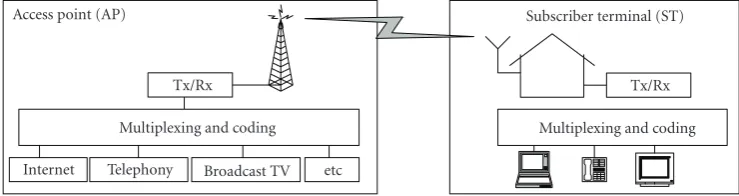
BFWA systems are considered as the real competitor to wired broadband technology. BFWA can reach those users outside the geographical or financial scope of DSL or cable, and can offer more capacity. Advantages of using BFWA for broadband access over wired alternatives include better handling of multicasting service, and the potential for flexible and rapid deployment [15].Figure 2depicts the architecture of BFWA system for connecting home access point.
2.4. IEEE802.16Standard for BFWA System. The IEEE802.16 family of standards promises to deliver high data rate over large areas to a large number of users in near future. The first standard, completed in 2001 and finalized in 2004, defines the air interface and medium access control (MAC) protocol for IEEE802.16. The IEEE802.16 standard defines two layers: MAC protocol and physical layer (PHY) [16].
The IEEE802.16 MAC protocol is designed for point to multipoint broadband wireless access applications. It addresses the need for very high bit rates, both uplink and downlink. Access and bandwidth allocation algorithms accommodate hundreds of terminals per channel, with terminals that may be shared by multiple end users. The services required by these end users are varied in their nature and include legacy time division multiplex (TDM) voice and data, IP connectivity, and packetized VoIP. To support this
variety of services, the IEEE802.16 MAC accommodates both continuous and bursty traffic. The IEEE802.16 access system provides more efficiency when presented with multiple connections per terminal, multiple QoS levels per terminal, and a large number of statistically multiplexed users. Along with the fundamental task of allocating bandwidth and transporting data, the MAC includes a privacy sublayer that provides authentication of network access and connection establishment to avoid theft of service, and it provides key exchange and encryption for data privacy [17].
Air interface for IEEE802.16 was designed to operate into two frequency ranges: 10–60 GHz and 2–11 GHz. In the design of the PHY specification for 10–66 GHz, line of sight (LOS) propagation is deemed as a practical neces-sity. With this condition assumed, single-carrier modu-lation is selected, and the air interface is designated as “WirelessMAN-SC.” [18].
The 2–11 GHz bands, both licensed and license-exempted, are addressed in IEEE802.16a. Design of the 2–11 GHz physical layer is driven by the need for NLOS operation. Because residential applications are expected, rooftops may be too low for a clear sight line to an AP antenna, possibly due to obstruction by trees. Therefore, significant multipath propagation must be expected [19].
3. BFWA Network Planning
Access point (AP)
Tx/Rx Multiplexing and coding Internet Telephony Broadcast TV etc
Subscriber terminal (ST)
Tx/Rx Multiplexing and coding
Figure2: BFWA system providing a mix of service to home network.
The number of access points requirements is dimensioned to the following model [20]:
NAP=max{NAP-co,NAP-ca}, (1)
whereNAP-co is the number of AP acquired from coverage planning, and NAP-ca is the number of AP derived from capacity planning.
3.1. Coverage Planning. The primary objective of coverage planning is to estimate the needed number of APs to fulfill the coverage of all subscribers in a given service area. Coverage planning of BFWA network requires the knowledge of radio propagation model for predicting the losses between transmitters and receivers path. The path loss represents the combined effects on signal attenuation due to the free space loss, reflection, diffraction and scattering, and so forth. The propagation of radio frequency depends on the physical environment, therefore, we have to define the service area and select appropriate radio propagation model to predict the path loss. The accuracy of path loss prediction can greatly affect the estimated cell range, which in turn determines the number of AP needed to achieve a coverage area in the network. There are many radio propagation models used to predict the path loss in wireless network. The classifications and characteristics of radio propagation models are empirical, deterministic and stochastic model, which are detailed in [21,22].
Among those mentioned models, empirical models are most appropriate for dimensioning wireless network since it is simple and sufficiently accurate in the limited knowledge of environment data. HATA model, COST-231 HATA (one of the European Science Foundation “COop-eration in the field of Science and Technology research” Actions;http://www.cost.esf.org/), and the Stanford Univer-sity Interim (SUI) are example of empirical models [21–
23]. All these models predict the mean path loss as function of various parameters, for example, distance and antenna height. We select propagation loss models based on the study in [23], and apply to this study which is summarized in
Table 2.
3.1.1. Link Budget. The link budget is a tabulation of all gains and losses in the link that are added in order to deliver the mean signal level at the receiver. The term link budget is often used to indicate the allowance path loss, which in turn
Table2: Propagation loss models parameter.
Environment Path loss model AP antenna height (m)
Urban ECC-33 30
Suburban IEEE 802.16 (SUI-B) 40
Rural IEEE 802.16 (SUI-C) 60
is used to determine the cell range of AP. The formulas are necessary to calculate the values in the link budget which use basic mathematical functions and are very straightforward to implement in commonly available spreadsheet program. A simple link budget calculation model implemented in this study is depicted inTable 3.
3.1.2. Cell Range Estimation. The next step of coverage plan-ning is to estimate the cell range and cell coverage area. The cell range can be calculated using predefined propagation loss models inTable 2. The propagation loss models describe the average signal propagation in that environment, and convert the maximum allowanced propagation loss in dB to the maximum cell range in distance. By applying AP antenna height designated inTable 2, ST antenna height of 6 meters, and carried frequency of 3.5 GHz, the closed form for prediction of the allowance path loss in urban, suburban and rural are given by (2), respectively.
LUrban=132.64 +
29.83 + 4.78 log(d)log(d),
LSuburban=121.22 + 41.67 log(d),
LRural=111.57 + 36.33 log(d),
(2)
wheredis the distance between transmitter and receiver in kilometer.
By assuming the cell shape as hexagonal, the area covered by a single cell is given by [24]
Acell=2.6d2. (3)
In this study the cell range is calculated for the downlink, which is expected to support much higher data rates than the uplink. Therefore, this link will limit the coverage range.
Table3: Link budget calculation model.
User data rate in kbps 1.024
Required Eb/No 9.3
System element Unit Uplink Downlink Formula
Transmitter ST AP
Maximum Tx power in Watt Watt 0.25 1.58
Maximum Tx power in dBm dBm 23.98 31.99 A
Cable loss & Insertion loss dB 0.00 3.30 B
Antenna Tx gain dBi 2.00 18.00 C
EIRP dBm 25.98 46.69 D=A−B + C
Receiver AP ST
Thermal noise density dBm/Hz −174.00 −174.00 E
Receiver noise figure dB 5.00 5.00 F
Receiver noise density dBm/Hz −169.00 169.00 G=E + F
Receiver noise power dBm −103.16 −103.16 H=G + 10 log(3840000)
Interference margin dB 3.00 3.00 I
Receiver interference power dBm −103.18 −103.18 J=10 log(10∧(H + I)/10−10∧(H/10)) Total effective noise + interference dBm −100.16 −100.16 K=10 log(10∧(h/10 + 10∧(J/10))
Processing gain dB 5.74 5.74 L=10 log(3840/user data rate)
Required Eb/No dB 9.30 9.30 M
Receiver sensitivity level dBm −96.60 −96.60 N=M−L + K
Antenna Rx gain dBi 18.00 0.00 O
Cable loss dB 2.00 0.00 P
Fading margin dB 4.00 0.00 Q
Maximum allowable path loss dB 134.58 143.28 R=D−N + O−P−Q
for a given service area. The number of AP based on coverage design is obtained from the following equation
NAP-co=Aservice
Acell
, (4)
whereAserviceis a given service area.
3.2. Capacity Planning. The main purpose of capacity plan-ning is to estimate the needed number of APs to fulfill the traffic demands of subscribers in a given service area. BFWA systems are often deployed in point to multipoint cellular fashion where a single AP provides wireless coverage to a collection of STs within coverage area.
3.2.1. Channel Throughput Estimation. The channel
throughput (T) is defined as the aggregate cell payload, that is, the peak useful data rate. The useful data rate is shared between all active users who are connected to the same AP. The aggregate cell payload for IEEE802.16 is given by [25]
T= 6
7
k·2m·B c
(2m+ 1)
·Rc, (5)
wherekis the bits per symbol for the modulation being used,
m is the cyclic prefix, m = {2, 3, 4, 5}, Bc is the channel
width of IEEE802.16, and Rc is the overall code rate for
the modulation being used in ST. Table 4 shows bit per symbol and overall code rate in different types of modulation schemes [24].
Table4: Bit per symbol and overall code rate.
Modulation type Bit per symbol,k Overall code rate,Rc
BPSK 1/2 1 1/2
QPSK 1/2 2 1/2
QPSK 3/4 2 3/4
16 QAM 1/2 4 1/2
16 QAM 3/4 4 3/4
64 QAM 2/3 6 2/3
64 QAM 3/4 6 3/4
Investigation of the channel throughput of IEEE802.16 BFWA system deals with the complex parameters of OFDM technology and adaptive modulation. For the sake of sim-plicity, we implement throughput calculation model by a convenient way using common spreadsheet program. The implementation of channel throughput calculation model is depicted inTable 5. The first nine rows represent the input values for calculation and the last two rows represent the result output from the model.
Spectrum efficiency (SE) is the ratio of channel through-put and bandwidth of channel, SE=T/Bcwhich is given by
[2]
SE=6
7
k·
2m
(2m+ 1)
Table5: Channel throughput calculation model.
Item Value Descriptions
Input data
Channel size in MHz 14 Channel width (1.75, 3.5, 7 or 14)
Cyclic exponent∗ 5 Repeat symbol fraction (2–5)
BPSK-1/2 5
Distribution of modulation in ST (%)
QPSK-1/2 2.5
QPSK-3/4 2.5
16QAM-1/2 25
16QAM-3/4 25
64QAM-2/3 20
64QAM-3/4 20
Checksum 100
Output data
n 1.14 Sampling factor in constant value
Fs 16.00 Sampling frequency in MHz
f 62.51 Spacing of subcarrier in MHz
Tb 16.00 Inverse of subcarrier spacing inμsec
Ts 16.00 Symbol time inμsec
T 34.53 Channel Throughput in Mbps
SE 2.47 Spectrum efficiency in b/s/Hz
Note:∗Cyclic exponent is a dimensionless unit.
14 7
3.5 1.75
Channel width (MHz)
T3 at high speed access scenario
T2 at medium speed access scenario
T1 at low speed access scenario 0
5 10 15 20 25 30 35 40 45
Channel
thr
oug
h
put
(Mb/s)
Figure 3: Channel throughput and channel size for each access scenario.
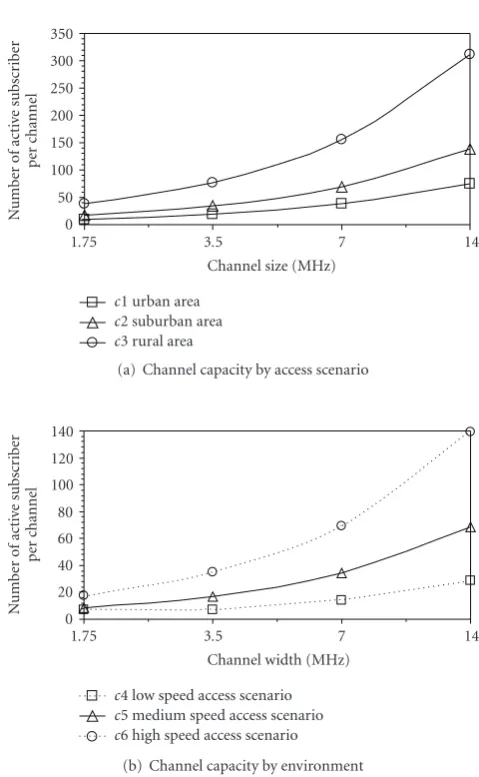
3.2.2. Channel Capacity Estimation. Once we determine the radio spectrum and the RF channel size, the next important step of capacity planning is to determine the channel capacity of IEEE802.16. The channel capacity is the active number of subscribers in a single channel. The maximum number of subscribers that can be supported by a channel is given by
c= T Rd
, (7)
whereRdis a peak traffic demand per user in kb/s.
3.2.3. Number of AP Acquired from Capacity Design. The
number of AP is derived from the ratio of the expected
number of subscribers in the service area to the maximum number of subscribers supported by single AP, and given by
NAP-ca= Nservice
c , (8)
whereNserviceis the number of users to be serviced.
By the substitution of (7) into (8), the required number of AP for capacity design is obtained by
NAP-ca=
Rd
T
Nservice. (9)
4. Results
In this section, we investigate the system planning of BFWA based on IEEE802.16 standard using calculation models from previous section. We extend our study by applying results from analysis to the case study. The case study is within the area of Bangkok Metropolitan Administration (BMA), Thailand.
4.1. Key Input for Analysis
Table6: Design parameters.
Parameters Value
Frequency range (GHz) 3.5
Channel width (MHz) 1.75, 3.5, 7.0, and 14 Maximum transmit power (W) 3.2 Micro cell AP antenna height (m) 40 Macro cell AP antenna height (m) 60 Subscriber terminal antenna height (m) 6
9.6
Figure 4: Relation of path loss and cell range of each path loss model.
products existing in the market. Table 6 shows the system parameters of IEEE802.16 as BFWA system.
4.1.2. Modulation Distribution Assumption. In the principle of adaptive modulation, the type of modulation being used by ST strongly depends on the signal-to-noise ratio at the receiver end. The signal-to-noise ratio relates to the distance between transmitter and receiver. Normally, the main purpose of engineering design is to install the AP at the location where the number of subscribers is maximum. Practically, not all subscribers are covered by single AP. We, therefore, need to assume the location of subscribers relating to AP. The criterion for assumption is the subscribers who are close to AP receives more signal-to-noise ratio than distant subscribers. Under such a situation, ST selects a higher bit per symbol modulation scheme. Based on such criterion, we assume the location of subscribers to the AP through the distribution of modulation scheme being used in ST. The assumption of modulation distribution implies the subscriber data rates access to the network. We define the subscriber data access into three scenarios. The first scenario is the low speed data rate, where modulation scheme being used in ST is dominated by BPSK. This scenario describes the subscriber who is far from AP. The second is the medium speed, where modulation scheme in ST is moderated. The last scenario is the high speed data rate, where 64-QAM is a dominant modulation scheme in ST. This scenario describes the subscriber who is close to AP.Table 7 shows the assumption of modulation distribution in ST. We will use medium speed data rate as a baseline case for future comparison and analysis.
A2 suburban area
A3 rural area
(a) Cell area in different types of environment area
14 7
3.5 1.75
Channel width (MHz)
A4 low speed access scenario
A5 medium speed access scenario
A6 high speed access scenario 0
(b) Cell area in different access scenarios
Figure5: Relation of coverage area of single cell to access rate and type of environment areas.
Table 7: Assumption of modulation distribution in subscriber terminal.
Access scenario BPSK QPSK 16-QAM 64-QAM
Low Speed 0.8 0.1 0.05 0.05
Medium Speed 0.01 0.48 0.5 0.01
High Speed 0.01 0.05 0.1 0.84
4.1.3. Traffic Estimation per Subscriber. The next step of the capacity planning is to determine the traffic demand of each subscriber. Generally, planners use statistical model for dimensioning access network. Contradictory with other works, in this research we use the empirical data measuring from subscriber traffic of operational network [26], as shown inTable 8.
Table8: Traffic per subscriber.
Urban 360.73 596.94 292.5 397.23
Suburban 56.4 322.21 73 107.94
Rural 85.03 144.1 12.63 75.36
Table9: Throughput and path loss for different channel sizes.
Channel width
Table10: Cell Range and Path Loss of Medium Access.
Channel
1.75 133.39 600 1,300 2,400
3.5 130.98 500 1,100 2,000
7.0 127.97 350 900 1,700
14.0 124.88 300 700 1,400
model of Table 5. Figure 3 demonstrates the results of channel throughput. The results show that RF channels with higher channel width increase the channel throughput. RF channel throughput also depends on the speed of data access from subscriber. The channel throughput that configures as high speed access has more channel throughput than a lower access. The description of a high access data rate contributes to RF channel throughput is mainly from the overhead information contained in the radio packet between ST and AP.
4.2.1. Channel Throughput. SeeFigure 3.
4.2.2. Cell Range. The cell range can be estimated by insert-ing the channel throughput into the link budget calculation model inTable 3. We obtain the maximum allowance path loss between AP and ST. Table 9 shows the results of maximum allowance path loss in a variety of channel width. We select the empirical radio path loss models inTable 2
for prediction of the path loss between AP and ST. Equations (2) are used for converting the path loss into distance.
Figure 4shows the results of maximum path loss predicted by each model plotted against distance. The results of cell range of particular channel width for medium access scenario estimated by (2) are shown inTable 10. The results indicate that cell size of remote open area is bigger than the cell size of urban dense area.
14
c2 suburban area
c3 rural area
(a) Channel capacity by access scenario
14 7
3.5 1.75
Channel width (MHz)
c4 low speed access scenario
c5 medium speed access scenario
c6 high speed access scenario 0
(b) Channel capacity by environment
Figure 6: Channel Capacity of IEEE802.16 by access rate and environment area.
4.2.3. Cell Coverage and Access Scenario. We assume the cell as hexagonal shape, where coverage area of single cell is obtained by (3).Figure 5shows the relationship of cell area and channel width in different of environment (a), and access speed scenario (b).
Agriculture living area Less dense living area Middle dense living area
High dense living area Business area N
Figure7: Land used map of Bangkok City.
4.3. Case Study. It is interesting to know how IEEE802.16 as a BFWA technology qualifies through our simple model analysis, especially in a developing country like Thailand. We address the benefits from IEEE802.16 standard to a large scale BFWA system by applying the results from analysis to the potential service area in Bangkok. The results of this research may be applicable to other similar cities in developing countries.
4.3.1. Service Area Information. Bangkok, the capital of Thailand, comprises of 50 districts and is the growth pole of the whole kingdom with total area of 1,568.74 square kilometers. The urbanized area is about 178.82 square kilometers or only 11.38 percents of total area. The rest of 35.32 percent and 53.30 percent are suburban area, and rural area, respectively.Figure 7 shows the GIS-based land use map of Bangkok. The detail demographic information of Bangkok is found in [27,28]. The population of Bangkok is now more than 10 million including daily commuters. As a megacity, Bangkok is administered by a local government called Bangkok Metropolitan Administration (BMA). Based on the demographic data, we define the area of BMA into three environment, as shown inTable 11.
4.3.2. Results of Case Study. At present, the network architec-ture of the WiMAX in Bangkok has not yet been finalized. Thus, we use a generic architecture of WiMAX networks, as a typical architecture for designing the BFWA network and apply it to all local exchanges within Bangkok. Results
Table11: Demographic information of bangkok.
Environment
Definition criterion (household/km2)
BMA area (km2)
BMA household density (household/km2) Urban More than 3,000 178.52 4,312 Suburban 1,000–2,999 554.07 2,174 Rural Less than 1,000 836.15 714
of applying the previous analysis to the case study indicate the number of APs to fulfill both coverage and capacity. The results, in Figure 8, show that the total number of AP is increasing at the higher channel width. This is due to the fact that the cell range of a higher channel throughput of high channel width has a limit.
On the other hand, results from capacity planning indicate that the required number of AP is opposite from that in coverage planning. The number of AP required for achieving traffic demand of capacity planning is decreasing at AP configured as a higher channel width. The number of AP increases in both area and access scenario, as depicted in
Figure 9. This is due to the fact that the higher throughput channel has the high capacity of AP.
14
(a) Coverage-based number of AP by access scenarios
14
(b) Coverage-based number of AP by environment area Figure8: Number of AP from coverage planning.
According to (1), the number of AP required is dominated by capacity planning.
5. Conclusion
Planning the capacity of traditional wired networks is intuitively obvious because each active subscriber requires fixed dedicated bandwidth and the capacity is simply the number of subscribers that the channel can support. In a wireless channel, the situation is considerably more complex than wired network. Since the channel is not necessarily for fixed size but can vary with time as environment condition change. This is particularly relevant in adaptive modulation. The IEEE802.16 wireless channel can be configured in a number of different ways depending on operator prefer-ence, regulatory constraints, and performance requirements. Many of these configurations choice affect the channel capac-ity, often in nonobvious ways. Accurate capacity analysis therefore presupposes detailed specification of the number and type of the data traffic sharing the channel. How capacity of IEEE802.16 standard, therefore, depends on
14
(a) Number of AP needed by area
14
(b) Number of AP by access scenario
Figure9: Number of AP needed from capacity planning.
14
Figure10: Coverage design versus capacity design.
subscriber estimations and of subscriber terminal’s adaptive modulation choices and potential.
The research demonstrates the feasibility of designing BFWA system with IEEE802.16 standard for connecting a future smart home to the Internet. Through the case study, the results from study present the feasibility of having a large scale BFWA system in providing wireless Internet access. The results of planning, indicated by the number of AP, of BFWA system is dominated by capacity planning. It shows that BFWA with IEEE802.16 standard is a capacity-limited system.
Acknowledgment
This work was supported in part by the TOT Public Com-pany Limited, Thailand.
References
[1] M. K. Shahid, T. Shoulian, and A. Shan, “Mobile broadband: comparison of mobile WiMAX and cellular 3G/3G+ technolo-gies,”Information Technology Journal, vol. 7, no. 4, pp. 570– 579, 2008.
[2] A. Yarali, S. Rahman, and B. Mbula, “WiMAX: the innovative broadband wireless access technology,”Journal of Communi-cations, vol. 3, no. 2, pp. 53–63, 2008.
[3] J. Zander, “Affordable multiservice wireless network-research challenge for the next decade,” in Proceeding of the IEEE International Symposium on Personal, Indoor Mobile Radio Communications (PIMRC ’02), vol. 1, pp. 1–4, September 2002.
[4] P. Ritthisoonthorn, K. M. Ahmed, and D. Krairit, “Cost effective broadband fixed wireless access: opportunity for developing country,” inProceedings of the 2nd International Conference on Testbeds and Research Infrastructures for the Development of Networks and Communities (TridentCom ’06), pp. 140–145, March 2006.
[5] K. Wanichkorn and K. Sirbu, “The role of fixed wireless access network in the deployment of broadband service and compe-tition in local telecommunications markets,” Department of Engineering and Public Policy, Carnegie Mellon University4, Pittsburgh, Pa, USA, 2003.
[6] M. Zhang and R. S. Wolff, “Crossing the digital divide: cost-effective broadband wireless access for rural and remote areas,”
IEEE Communications Magazine, vol. 42, no. 2, pp. 99–105, 2004.
[7] J. Wang, “Will WiMAX+WLAN constitute a substitute to 3G?—a techno-economic case study,” Department of Signals, Sensors and Systems, KTH Royal Institute of Technology, Stockholm, Sweden, 2004.
[8] T. Smura,Digital Pictures, Plenum Press, New York, NY, USA, 2nd edition, 1995.
[9] B. Rose, “Home networks: a standards perspective,” IEEE Communications Magazine, vol. 39, no. 12, pp. 78–85, 2001. [10] B.-N. Park, W. Lee, S. Ahn, and S. Ahn, “QoS-driven wireless
broadband home networking based on multihop wireless mesh networks,”IEEE Transactions on Consumer Electronics, vol. 52, no. 4, pp. 1220–1228, 2006.
[11] S. Raman and M. Pipatanasomporn, “Alternate technologies for telecommunications and Internet access: remote loca-tions,” inProceeding of the 3rd Mediterranean Conference and
Exhibition on Power Generation, Transmission, Distribution and Energy Conversion, Athens, Greece, November 2002. [12] B. Lannoo, S. Verbrugge, J. Van Ooteghem, et al., “Business
scenarios for a WiMAX deployment in belgium,” inProceeding of the IEEE Mobile WiMAX Symposium Conference, pp. 132– 137, March 2007.
[13] L. Bai,Analysis of the market for WiMAX service, M.S. thesis, Center for information and communication technologies, Technology University of Denmark, Lyngby, Denmark, May 2007.
[14] http://www.itu.int/.
[15] A. Ghosh, D. R. Wolter, J. G. Andrews, and R. Chen, “Broad-band wireless access with WiMax/802.16: current performance benchmarks, and future potential,” IEEE Communications Magazine, vol. 43, no. 2, pp. 129–136, 2005.
[16] S. Redana and M. Lott, “Performance analysis of IEEE 802.16a in mesh operation mode,” inProceeding of the IST Summit, June 2004.
[17] C. Eklund, R. B. Marks, K. L. Stanwood, and S. Wang, “IEEE standard 802.16: a technical overview of the wirelessMANTM air interface for broadband wireless access,”IEEE Communi-cations Magazine, vol. 40, no. 6, pp. 97–107, 2002.
[18] D. Gesbert, L. Haumonte, H. Bolcskei, R. Krishnamoorthy, and A. J. Paulraj, “Technologies and performance for non-line-of-sight broadband wirless access networks,”IEEE Com-munications Magazine, vol. 40, no. 4, pp. 86–95, 2002. [19] I. Koffman and V. Roman, “Broadband wireless access
solutions based on OFDM access in IEEE 802.16,” IEEE Communications Magazine, vol. 40, no. 4, pp. 96–103, 2002. [20] K. Johansson, A. Furusk¨ar, P. Karlsson, and J. Zander,
“Rela-tion between base sta“Rela-tion characteristics and cost structure in cellular systems,” in Proceeding of the IEEE International Symposium on Personal, Indoor Mobile Radio Communications (PIMRC ’04), vol. 4, pp. 2627–2631, September 2004. [21] H. R. Anderson,Fixed Broadband Wireless System Design, John
Wiley & Sons, 2003.
[22] G. Plitsis, “Coverage prediction of new elements of systems beyond 3G: the IEEE 802.16 system as a case study,” in
Proceeding of the IEEE Vehicular Technology Conference (VTC ’03), vol. 4, pp. 2292–2296, October 2003.
[23] V. S. Abhayawardhana, I. J. Wassellt, D. Crosby, M. P. Sellars, and M. G. Brown, “Comparison of empirical propagation path loss models for fixed wireless access systems,” inProceeding of the IEEE Vehicular Technology Conference (VTC ’05), vol. 1, no. 1, pp. 73–77, May 2005.
[24] M. J. Nawrocki, M. Dohler, and A. Hamid Aghvami, Under-standing UMTS Radio Network, John Wiley & Sons, 2006. [25] P. Ritthisoonthorn, “Telecommunication Program,” Internal
Project Report, Asian Institute of Technology, November 2007. [26] P. Ritthisoonthorn, K. M. Ahmed, and D. Krairit, “User behavior and Internet access network performance in a broadband environment,” in Proceeding of the International MultiConference of Engineers and Computer Scientist (IMECS ’07), March 2007.
[27] The Bangkok Metropolitan Administration, “Bangkok over-view,”http://city.bangkok.go.th/en/dc-overview.php. [28] “The Bangkok GIS information,” http://www.bangkokgis.