© 2014, IJCSMC All Rights Reserved
627
Available Online at www.ijcsmc.comInternational Journal of Computer Science and Mobile Computing
A Monthly Journal of Computer Science and Information Technology
ISSN 2320–088X
IJCSMC, Vol. 3, Issue. 9, September 2014, pg.627 – 632
RESEARCH ARTICLE
Comparative Analysis: Energy Efficient Multipath
Routing in Wireless Sensor Network
Neha Mishra
1, Ajay Kumar
21
Department of CSE, JECRC University, JAIPUR
2
Department of CSE, JECRC University, JAIPUR
1
[email protected],
2[email protected]
Abstract: In recent years Wireless Sensor Networks, turn into a famous area of research and development due to the advancement of tiny, cheap, disposable and self-contained battery powered computers, known as sensor nodes or “motes”, which can accept input from an attached sensor, process this input data and transmit the results wirelessly to the transit network. One critical concern when scheming wireless sensor network is the routing protocol that makes the best use of the extremely fixed resource presented by WSN, especially the energy bounded. This paper includes the different energy efficient protocols in WSN.
Keywords: Energy efficient, ECMP, Multipath Routing, MCMP, Wireless Sensor Network (WSN), REAR
I. INTRODUCTION
Sensing and intercommunication engross energy, therefore judicious power management and arrangement can effectively enhance operational time. A Wireless Sensor Network (WSN) is an assemblage of wireless sensor nodes forming a short-lived network out the corporation of any established infrastructure or centralized administration. Wireless sensor networks consist of limited battery powered devices with limited energy resources.
© 2014, IJCSMC All Rights Reserved
628
route reply message. Route Request message is transmitted when a node enters in the network to execute the neighbor discovery process during the network startup and also to establish a route to the destination and Route Reply message is initiated when the given source node is reached and to create an new entry in the local neighbor table. Classical Multipath routing has been explored for two reasons. The first is Load Balancing: Traffic between the source and destination is split across multiple (partially or fully) paths. The second use of multipath routing is to increase the probability of reliable data delivery. In these approaches multiple copies of the data are sent along different paths allowing for resilience to failure of a certain number of paths.
II. MULTIPATH ROUTING PROTOCOLS
The multipath routing technique which has demonstrated its efficiency to improve wireless sensor performance is efficiently used to find alternate paths between sources and sink. This approach is considered as one of the existing solutions to cope with the limitations of routing [3]. In this section, the aid and aspects of multipath routing will be discussed:
A.Benefits of Multipath Routing
Reliability and Fault-Tolerance: The original idea behind using multipath routing approach in WSN was to provide path resilience (against node or link failures) and reliable data transmission. In fault tolerance domain, whenever a sensor node cannot forward its data packets towards the sink, it can benefit from the availability of alternative paths to salvage its data packets from node or link failures.
Load Balancing: As traffic distribution is not equal in all links in a network, spreading the traffic along multiple routes can alleviate congestion and bottlenecks in some links.
QoS Improvement: To improve QoS, network throughput, end-to-end latency and data delivery ratio are important objectives in designing multipath routing protocols for different types of networks.
Reduced Delay: As the backup routes are identified during route discovery, the delay is minimized in multipath routing.
Bandwidth Aggregation: Splitting data to the same destination into multiple streams while every packet is routed through a different path, the effective bandwidth can be aggregated. This is particularly beneficial when a node has multiple low bandwidth links but it requires a bandwidth that is greater than the one which an individual link can provide.
B.Aspects of a Multipath Routing Protocol
Three elements of multipath routing include path discovery, traffic distribution, and path maintenance which are explained below.
Path Discovery: Multi-hop data forwarding techniques are commonly performed for data transmission in wireless sensor networks, the main task of the route discovery process is to determine a set of intermediate nodes that are selected to construct several paths from source to sink node.
Disjoint Multipath Routing: In sensor-disjoint path routing, the primary path is available whereas the alternate paths are less desirable as they have longer latency. The disjoint makes those alternate paths independent of the primary path. Thus, if a failure occurs on the primary path, it remains local and does not affect any of those alternate paths.[5]
© 2014, IJCSMC All Rights Reserved
629
Traffic Distribution: In spite of path discovery of multiple paths issue, another important issue is traffic distribution. Multipath routing algorithms that optimally split traffic into a given set of paths investigated in the context of flow control .It is worth noting that the selection of the routing paths is another major design consideration that has a drastic effect on the resulting performance.[4]
Number of Paths: A protocol can use a single path and keep the rest as backups, or it can utilize multiple paths in a round-robin fashion, with only one path sending at a time.
Allocation Granularity: The traffic allocation strategy that is used deals with how the data is distributed amongst the paths. The choice of allocation granularity, which is important in traffic allocation, specifies the smallest unit of information allocated to each path.[6]
Path Maintenance: In multipath routing, the process of route discovery can be done when one of the routes fails or it may occur after all of the routes fail. Waiting for all routes to fail before performing a route discovery would result in a dela y before new routes are available. It should be noted that initiating the process of route discovery can make high overheads whenever one of the routes fails.[10]
III. ENERGY-EFFICIENT
The goal of Energy Aware Routing (EAR) protocol is to select the best path so that the total energy consumed by the network is minimized. A serious drawback of the minimum energy routing is that nodes will have a wide difference in energy consumption. Nodes on the minimum energy paths will quickly drain out while the other nodes remain intact. This will result in the early death of some nodes. Another objective of the EAR is to maximize the system lifetime, which is defined as the duration when the system starts to work till any node runs out of energy, or till a certain number of nodes run out of energy, or till the network is partitioned, etc., [ 11].
A. Energy-Efficient Multipath Routing Protocol
This protocol is a distributed, scalable, and localized multipath search protocol to discover multiple node-disjoint paths between the sink and source nodes and also a load balancing algorithm to distribute the traffic over the multiple paths discovered. [12] Since the path construction algorithm of AODVM depends on overhearing neighboring node’s transmission which requires the receiving node to maintain its receiving state, this makes it contrary to the scope of the energy-efficient MAC.
B. Maximally Radio-Disjoint Multipath Routing (MR2)
The main objective of this routing is to provide necessary bandwidth to multimedia applications through non interfering (radio disjoint) paths while increasing the network lifetime. To achieve two fold goals, an incremental approach should be adopted where only one path is built at once for a given session. Additional paths are built when required, typically in case of path congestion or lack of bandwidth. When a given path is selected to be used, all nodes interfering with it are put in a passive state. Passive nodes do not further take part in the routing process so they could not be used to form a new path that consequently will not interfere with previously built ones. Moreover, passive nodes can be put in sleep or idle modes, thus allowing for energy saving and hence increasing the network lifetime [10].
C. Energy-Efficient and Collision-Aware Multipath Routing Protocol (EECA)
© 2014, IJCSMC All Rights Reserved
630
scheme in terms of the average packet delivery ratio, the average end-to-end delay, the average residual energy, and the number of nodes alive [14].
D. Low-Interference Energy-Efficient Multipath Routing Protocol (LIEMRO)
This protocol is mainly designed to improve packet delivery ratio, lifetime, and latency, through discovering multiple interference-minimized node disjoint paths between source node and sink node. In addition, LIEMRO includes a load balancing algorithm to distribute source node’s traffic over multiple paths based on the relative quality of each path. It consists of a multipath routing protocol and a load balancing algorithm. In this approach, a set of node-disjoint interference-minimized paths are established from the source to the sink, while these paths impose minimum interference over each other (to minimize route coupling effect). Moreover, extra routes are only established if they don’t decrease data reception rate at the sink node.[12]
E. Energy Efficient Adaptive Multipath Routing
In this protocol, the continuous use of the minimum energy path deprives the nodes energy quickly and it takes time to determine an alternate path increase. Multipath routing schemes distribute traffic among the sink, while they impose minimum interference over each other (to minimize route coupling effect). Moreover, extra routes are only established if they don’t decrease data reception rate at the sink node. [11]
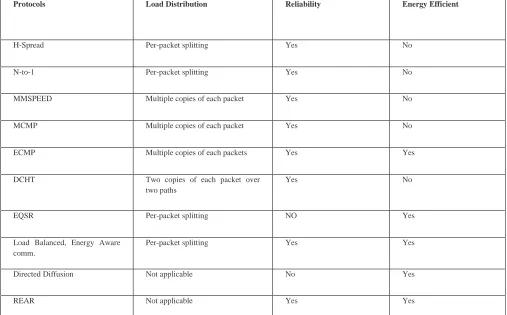
Protocols Load Distribution Reliability Energy Efficient
H-Spread Per-packet splitting Yes No
N-to-1 Per-packet splitting Yes No
MMSPEED Multiple copies of each packet Yes No
MCMP Multiple copies of each packet Yes No
ECMP Multiple copies of each packets Yes Yes
DCHT Two copies of each packet over
two paths
Yes No
EQSR Per-packet splitting NO Yes
Load Balanced, Energy Aware comm.
Per-packet splitting Yes Yes
Directed Diffusion Not applicable No Yes
REAR Not applicable Yes Yes
© 2014, IJCSMC All Rights Reserved
631
IV. COMPARISON OF SINGLE AND MULTIPATH ROUTING PROTOCOL
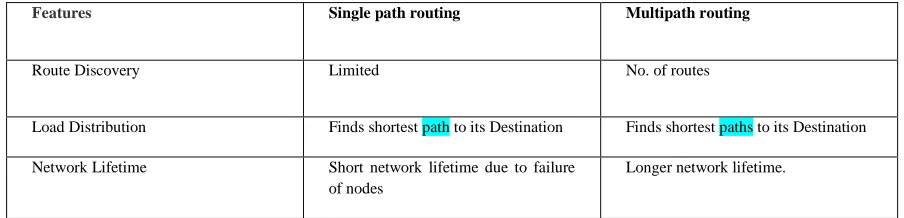
In single path new route discovery process is initiated, which increases energy consumption. Node failure also cause packets to be dropped and may cause a delay in delivering the data to the sink, thus the real-time requirements of the multimedia applications are not met. Multi-path routing increases the number of possible routes and through this it increases the robustness and throughput of the transmissions. Multipath routing is commercial for heavy load scenario than single path. Multipath routing is mainly used either for load balancing or for reliability. Load balancing can be achieved by balancing energy utilization among the nodes improving network lifetime.
Features Single path routing Multipath routing
Route Discovery Limited No. of routes
Load Distribution Finds shortest path to its Destination Finds shortest paths to its Destination Network Lifetime Short network lifetime due to failure
of nodes
Longer network lifetime.
Table. II. Single path Vs. multipath routing protocol
V. CONCLUSION
Multipath routing is one of the powerful methods to enhance the holding power of network and yield of sources under heavy traffic conditions. This paper presents a thorough analysis of multipath routing protocols in wireless sensor networks. Due to the bounded capacity of a multi-hop path and the high dynamics of wireless links, single-path routing approach is unable to provide adequate high data rate transmission in wireless sensor networks. In this research paper, we have drawn attention to the main advantages of using multipath routing approach to fulfill the performance requirements of different applications. This paper also introduces a comparison on the multipath routing protocols designed for wireless sensor networks.
REFERENCES
[1]. Muruganathan, S.D. ; Ma, D.C.F. ; Bhasin, R.I., “A centralized energy-efficient routing protocol for wireless sensor networks”
[2]. Nidal Nasser, , Yunfeng Chen , “SEEM: Secure and energy-efficient multipath routing protocol for wireless sensor networks”. [3]. Zijian Wang ; Bulut, E. ; Szymanski, B.K.,“Energy Efficient Collision Aware Multipath Routing for Wireless Sensor Networks”
[4]. C. Neves Fonseca, “Multipath Routing for Wireless Mesh Networks”, (2010).
[5]. R. Banner and A. Orda, “Multipath Routing Algorithms for Congestion Minimization”, IEEE/ACM transactions on networking, (2007).
[6]. S. Kumar Singh, M. P. Singh and D. K. Singh, “Routing Protocols in Wireless Sensor Networks–A Survey”, International Journal of Computer Science & Engineering Survey (IJCSES), (2010).
[7]. Y. Ming Lu and V. W. S. Wong, “An energy-efficient multipath routing protocol for wireless sensor networks”, International journal of communication systems, (2007), pp. 747-766.
© 2014, IJCSMC All Rights Reserved
632
[9]. P. Hurni and T. Braun, “Energy-Efficient Multi-Path Routing in Wireless Sensor Networks”.[10]. M. Maimour, “Maximally Radio-Disjoint Multipath Routing for Wireless Multimedia Sensor Networks”, (2008)
[11]. Z. Wang, E. Bulut and B. K. Szymanski, “Energy Efficient Collision Aware Multipath Routing for Wireless Sensor Networks”, (2008).
[12]. M. Radi, B. Dezfouli, S. Abd Razak and Kamalrulnizam Abu Bakar, “LIEMRO: A Low-Interference Energy-Efficient Multipath Routing Protocol for Improving QoS in Event-Based Wireless Sensor Networks”, International Conference on Sensor Technologies and Applications, (2010).
[13]. A. Premita and M. Katiyar, “A Review on Power Efficient Energy- Aware Routing Protocol for Wireless Sensor Networks”, International Journal of Engineering Research & Technology (IJERT), (2012).