204 |
P a g e
www.ijarse.com
METHOD OF ENHANCING THE PERFORMANCE OF
SOLAR STILL: A REVIEW
Vishakha N. Sakhare
1, R. S. Shelke
21
Student, M.Tech (Heat Power engineering),
2Assistant Professor, Mechanical Engineering Dept.
G.H. Raisoni College of Engineering, Nagpur-16, Maharashtra, (India)
ABSTRACT
The available fresh water resources on the earth are limited. About 79% of water available on the earth is salty, only one percent is fresh and the rest 20% is brackish. the drinking water which are in the small quantity, Desalination of brackish or saline water is a good method to obtain fresh water with help of renewable sources of energy it convert the sea water into a drinking water with the investing the small quantity of the cost. Distillation play an important role and solar distillation is easily can be done. where the passive distillation give the low output for that purpose, here used the active distillation system with cheaper external material to increase the output. In this article have a detailed review of different studies on active solar distillation system over the years. This review would also throw light on the scope for further research and recommendations in active solar distillation system.
Keywords:
Black Granite Gravel, Double Basin Solar Still, Distillate Output.I. INTRODUCTION
In many areas of the world the provision of fresh water is gradually becoming a more important issue. large amount
of water on the earth are only oceans source. and since they contain high levels of salt, desalination of the water is
necessary. one of humankind‟s most primitive forms of water treatment are desalination and it is still a popular
treatment solution throughout the world today.
In natural desalination process solar radiation is absorbed by the sea and causes water to evaporate. The evaporated
water vapour rises above the earth‟s surface and moved with the help of wind. when this water vapour cools down to
its dew point temperature, condensation get started and the fresh water comes down in the form of rain. The basic
process is responsible for the hydrological cycle. The same principle is used in all man-made distillation systems
using alternate sources of heating and cooling.
The rapid increasing need for energy and environ-mental concerns has focused much attention on renew-able energy
resources. The use of solar energy is more economical than the use of fossil fuel in remote areas having low
population densities, low rain fall and abundant available solar energy. A simple solar still can easily produce the
water needed for drinking and cooking for households without access to potable water. Also dis-tilled water can be
used for industrial purpose as it is cleaner. It is a simple technology which can be operated by non-skilled workers.
205 |
P a g e
www.ijarse.com
Solar still is such a device, which is used in desalination. Solar still is of two types namely passive solar still and
active solar still. Generally, in a passive solar still employs only solar radiation help to evaporate water for the
production of distillate output, whereas, in a active solar still requires the addition of some external mechanical
source in the form of collector with solar energy. Hence, efficiency as well as distillate output of active solar still is
better as compared to passive solar still.
II. THE SOLAR DISTILLATION SYSTEM ARE MAINLY CLASSIFIED AS
1. Passive solar still
2. Active solar still
There are numerous parameters which affecting the performance of the solar still such as water depth in the solar
basin, material which is selected for the basin, velocity of wind, solar radiation, ambient temperature and angle of
inclination. a solar still productivity will be determined by the temperature difference betweeninner surface glass
cover and the water in the basin. In a passive solar still, the solar radiation is received directly by the basin water and
this is the only source of energy for raise the water temperature and consequently, the evaporation leads to a lower
productivity. This is the main drawback of a passive solar still. In order to overcome the problem of passive solar
still, there are many active solar still have been developed.an extra thermal energy was supplying to the basin with
an external mode to enhance the evaporation rate of water and in turn improve its productivity.
III.APPLICATION OF SOLAR STILL
Solar still can be used in many areas such as the following specific areas:
Industries
Hospital and dispen
saries
Garages and automobile workshop Telephone exchange
Laboratory use Marshy and costal area For industrial processes
Radiator and battery maintenance For battery maintenance
IV. REVIEW OF WORK CARRIED OUT
Rai et al.[1]they experimentally studied the various modes of operations with a single basin solar still of Area
1mx1m, coupled with flat plate collector of angle 450. From their study they found that, with the salt concentration
206 |
P a g e
www.ijarse.com
of evaporation in a basin. One of the best performance in a single basin still is that a single basin solar still coupled
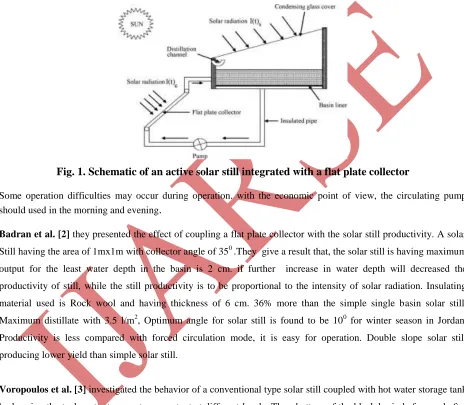
with a flat plate collector having forced circulation in fig 1. with flow rate 1.15 kg/min, in fig 1. and over the basin
water blackened jute cloth floating and a small quantity of black dye was used in the water. With material of FRP is
used. they concluded that 50% more than the thermosyphon mode. And also found that, distillation rate was
increased by 30% when a small quantity of black dye is adding to the water. 120% more than the simple single basin
solar still. Electricity is used to run the pump
.
Fig. 1. Schematic of an active solar still integrated with a flat plate collector
Some operation difficulties may occur during operation. with the economic point of view, the circulating pump
should used in the morning and evening
.
Badran et al. [2] they presented the effect of coupling a flat plate collector with the solar still productivity. A solar
Still having the area of 1mx1m with collector angle of 350 .They give a result that, the solar still is having maximum
output for the least water depth in the basin is 2 cm. if further increase in water depth will decreased the
productivity of still, while the still productivity is to be proportional to the intensity of solar radiation. Insulating
material used is Rock wool and having thickness of 6 cm. 36% more than the simple single basin solar still.
Maximum distillate with 3.5 l/m2, Optimum angle for solar still is found to be 100 for winter season in Jordan.
Productivity is less compared with forced circulation mode, it is easy for operation. Double slope solar still
producing lower yield than simple solar still.
Voropoulos et al. [3] investigated the behavior of a conventional type solar still coupled with hot water storage tank
by keeping the tank water temperature constant at different levels. The bottom of the black basin before and after
modification has an areaof12.5m2, which is parametrically insulated and is made of aluminum. A water storage tank
is integrated below the solar still. The tank is made of aluminum, insulated exactly the same way as the basin of the
still at the bottom and sides, whereas the height of the tank is 30cm, resulting in at an k volume of 3.75m3. Heating
of the tank water is done through a fin-and-tube heat exchanger placed inside the tank, using an electric heater. The
heating installation is equipped with a temperature regulating device to keep the tank water temperature almost
207 |
P a g e
www.ijarse.com
for several days by keeping the tank water temperature at different levels, such as700C, 600C, 500C and400 C. The
experimental work was carried out in day as well as in night session.
Sanjay Kumar et al.[4
]
they had studied the performance of single solar still and double effect of active solardistillation having an area of 1mx1m, with and without water flow over the glass cover with anangle of 150.They
had study and shows that, an active solar still with water flow arrangements over the glass cover produces maximum
amount of distillate output. The solar still operating with a double effect mode did not increase the daily output of
still significantly because of the difficulties found in, maintaining low and uniform flow rates over the glass cover
10ml/min. collector length is of 1m, with a collector angle of 450 and having a flow rate with 40ml/min, two glasses
maintaining a gap was that of 20 cm apart and using a pump having 0.2HP. An average of 7.5 l/day of distilled water
was obtained in the active mode with water flow arrangement. an operation and maintenance was difficult. In a
active and passive types of still without an arrangements of water flow in a system, an average output was 2.2 and
3.9 l/day. Its an operation and maintenance is difficult. Double effect mode did not iincrease the daily output
significantly because of difficulties in maintaining reasonably low and uniform flow rates over the glass cover.
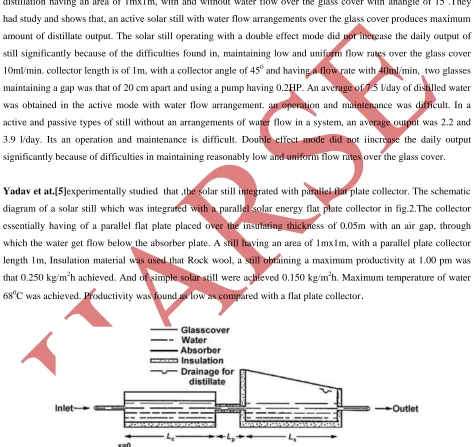
Yadav et at.[5]experimentally studied that ,the solar still integrated with parallel flat plate collector. The schematic
diagram of a solar still which was integrated with a parallel solar energy flat plate collector in fig.2.The collector
essentially having of a parallel flat plate placed over the insulating thickness of 0.05m with an air gap, through
which the water get flow below the absorber plate. A still having an area of 1mx1m, with a parallel plate collector
length 1m, Insulation material was used that Rock wool, a still obtaining a maximum productivity at 1.00 pm was
that 0.250 kg/m2h achieved. And of simple solar still were achieved 0.150 kg/m2h. Maximum temperature of water
680C was achieved. Productivity was found as low as compared with a flat plate collector
.
Fig. 2. Schematic diagram of a solar still integrated with a parallel flat plate water collector
Ahmed et al. [6]they had a designed, fabricated and tested the multistage evacuated solar still system which having
of three stages on the top of each other, and that still are carefully insulated from the outside environment with the
208 |
P a g e
www.ijarse.com
stages were placed on top of each other and a better sealing was maintained between the each stages to prevent
vapour leakage from the contact surfaces. A thick insulating material was also used to minimise heat losses from the
still to the surrounding. A solar collector was used to provide heat to the system with the lower stage, which was
maintained ata pressure lower than that of a atmospheric pressure by means of a heat exchanger. A solar still
operated vacuum pump was used to evacuate the noncondensable gases from the stages. into every stage from the
tank which was located at the top of the third stage. Vapour get generated in the lower stage, condenses on the
bottom.
Velmurugan et al. [7] experimentally investigated the possibility of enhancing the productivity of the solar stills by
connecting a mini solar pond, stepped solar still and a single basin solar still in series. Pebbles, baffle plates, fins and
sponges are used in the stepped solar still for productivity augmentation. They concluded that, maximum
productivity of 78% occurred when fins and sponges were used in the stepped solar still and also found that the
productivity during night also improved when pebbles were used in the solar stills.
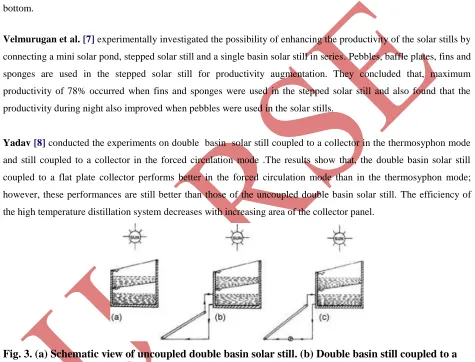
Yadav [8] conducted the experiments on double basin solar still coupled to a collector in the thermosyphon mode
and still coupled to a collector in the forced circulation mode .The results show that, the double basin solar still
coupled to a flat plate collector performs better in the forced circulation mode than in the thermosyphon mode;
however, these performances are still better than those of the uncoupled double basin solar still. The efficiency of
the high temperature distillation system decreases with increasing area of the collector panel.
Fig. 3. (a) Schematic view of uncoupled double basin solar still. (b) Double basin still coupled to a
collector in the thermosyphon mode. (c) Double basin still coupled to a collector in the forced
circulation mode
Kiatsiriroat et al. [9] analysed the multiple effect of vertical solar still coupled with flat plate solar collector. With
area of 1.52mx0.9m.The schematic sketch is shown in Fig. The distillation unit consists of „n‟ parallel vertical
plates. The first plate is insulated on its front side and the last plate is exposed to ambient. Each plate in the
209 |
P a g e
www.ijarse.com
Fig.4. Schematic sketch of the multiple effects still with a flat plate collector
The cloth is extended into a feed through along the upper edge of each plate. Feed water in the through is then drawn
onto the plate surface by capillary. Excess water moves down the plate and is conducted out of the still. The last
plate is cooled by air or water. The authors found that, the distillation output increases slightly when the plate
number is over 5, and it increased by about 34% and 15% when the evaporating plate numbers are 1 and 6,
respectively. Collector area of 1.4m2, Collector angle of 150.The numbers of evaporative plates are optimized as 5for
the water flow rate is 50 kg/h. Only few researches have been reported and concluded that. The average distillate
water production of 5 kg/m2 day was obtained by using 5 numbers of evaporative plates.
Mitesh Patel et al [10]The solar still basin area of 1 m2 is to be tested with different surface coatings/materials and
take performance variation with different sensible heat storage materials black, blue and red dye used inside the
brackish water. The test results are to be compared with literature and with & without absorber media inside the still
with different heat and mass transfer coefficients like evaporative, radiative and convective heat transfer. When it is
kept in sunlight temperature inside the evacuated glass tube is more than 800C. The experimental set up was
analyzed by with and without dyes. It has been seen that output with black dye is higher compare to other dyes,
while output was lower without dye.
210 |
P a g e
www.ijarse.com
V CONCLUSION
The
solar energy in desalination process is one of the bestapplications for renewable energy. Solar still had
become more popular. From the above study concluded that the solar still is good for purification.
In thisreview, various techniques of enhancing the performances of solar still are explained. Various authors mainly
concluded that by using flate plate collector an addition device to the still, enhances output rate.
In a active system
the increasing the basin no will help in increasing the distillated output of the still, without the external
source is provided to it. External source lead to more cost of the still. Some more factor are there which
affect the output of solar still, such as the intensity of sun, latitude, absorbing material, number of basin
attach to the solar still. north-south direction. productivity of the still increases with the intensity of solar
radiation and the temperature of feed water. if the no of basin increase then the output will increase of
solar still.
REFERENCES
[1] Rai SN, Tiwari GN. “Single basin solar still coupled with flat plate collector”. Energy Conversion and
Management 1983;23(3):145–9.
[2] Rai SN, Dutt DK, Tiwari GN. “Some experimental studies of single basin solar still”. Energy Conversion and
Management.1990; 30(2):149–53.
[3] Tiwari GN, Dhiman NK. “Performance study of a high temperature distillation system”. Energy Conversion and
Management 1991;32(3):283–91.
[4] Kumar Sanjeev, Tiwari GN.“Optimization of collector and basin areas for a higher yield for active solar stills”.
Desalination 1998; 116:1–9.
[5] Kumar Sanjeev, Tiwari GN, Singh HN. “Annual performance of an active solar distillation system”.
Desalination 2000;127:79–88.
[6] Tiwari GN, Shukla SK, Singh IP. “Computer modelling of passive/active solar stills by using inner glass
temperature.” Desalination 2003;154:171–85.
[7] Singh HN, Tiwari GN. “Monthly performance of passive and active solar stills for different Indian climatic
condition.” Desalination 2004;168:145–50.
[8] Tripathi Rajesh, Tiwari GN. “Effect of water depth on internal heat and mass transfer for active solar
distillation.” Desalination 2005;173:187–200.
[9] Dimri Vimal, Sarkar Bikash, Singh Usha, Tiwari GN. “Effect of condensing covermaterial on yield of an active
solar still: an experimental validation.” Desalination2008;227: 178–89.
[10] Tiwari GN, Vimal Dimri, Arvind Chel. “Parametric study of an active and passive solar distillation
211 |
P a g e
www.ijarse.com
[11] Lawrence SA, Tiwari GN. “Theoretical evaluation of solar distillation under natural circulation with heat
exchanger.” Energy Conversion and Management1990; 30 (3):205–13.
[12] Yadav YP. “Analytical performance of a solar still integrated with a flat platesolar collector: thermosiphon
mode.” Energy Conversion and Management1991; 31(3):255–63.
[13] Yadav YP. “Transient performance of a high temperature solar distillation System”. Desalination 1993;91:145–
53.
[14] Tiris C, Tiris M, Erdalli Y, Sohmen M. “Experimental studies on a solar stillcoupled with a flat plate collector
and a single basin still.” Energy Conversion and Management 1998;39(8):853–6.
[15] Ali A Badran, Ahmad A Al-Hallaq, Imad A, Eyal Salman, Mohammad Z Odat. “A solar still augmented with a