Cryptanalyses of Branching Program
Obfuscations over GGH13 Multilinear Map
from the NTRU Problem
Jung Hee Cheon, Minki Hhan, Jiseung Kim, Changmin Lee Seoul National University, Republic of Korea
Abstract. In this paper, we propose cryptanalyses of all existing indis-tinguishability obfuscation (iO) candidates based on branching programs (BP) over GGH13 multilinear map for all recommended parameter set-tings. To achieve this, we introduce two novel techniques,program con-vertingusing NTRU-solver andmatrix zeroizing, which can be applied to a wide range of obfuscation constructions and BPs compared to previous attacks. We then prove that, for the suggested parameters, the existing general-purpose BP obfuscations over GGH13 do not have the desired security. Especially, the first candidate indistinguishability obfuscation with input-unpartitionable branching programs (FOCS 2013) and the recent BP obfuscation (TCC 2016) are not secure against our attack when they use the GGH13 with recommended parameters. Previously, there has been no known polynomial time attack for these cases. Our attack shows that the lattice dimension of GGH13 must be set much larger than previous thought in order to maintain security. More precisely, the underlying lattice dimension of GGH13 should be set to n= ˜Θ(κ2λ) to rule out attacks from the subfield algorithm for NTRU whereκis the multilinearity level andλthe security parameter. Keywords:Obfuscations, multilinear maps, graded encoding schemes, NTRU.
1
Introduction
Constructing a general-purpose program obfuscation has been a long stand-ing coveted open problem [8, 9] in spite of their fruitful applications. At FOCS 2013, Garg et al.suggested the first plausible candidate general-purpose indis-tinguishability obfuscation (GGHRSW) [23] using branching program (BP) rep-resentation of functions [10]. This first candidate of iO has ignited the various subsequent studies [3, 5–7, 15, 24, 30, 32, 34] on obfuscations, all of which stand on the cryptographic multilinear maps.
Recently several works try to overcome this gap [6,24,29]. In particular, Garg et al.proved the security of the slightly modified first candidateiOconstruction (GMMSSZ) under the weak multilinear map model of GGH13, which captures all existing polynomial time attacks on BP obfuscations over GGH13 multilinear map [24]. Despite the provable security under these models, the practical security of obfuscations over GGH13 is still in dubious nature.
Direct attack to GGH13.As a direct method of analyzing obfuscations over GGH13, we may consider attacks on the GGH13 encoding scheme. The latent hardness problems of GGH13 are the (overstretched) NTRU problem and the short generator of principal ideal generator problem (SPIP).
The subfield attacks, proposed by Albrecht et al. and Cheon et al. inde-pendently [1, 18], are the most notable algorithms to solve the NTRU problem. These attacks shows that the underlying NTRU problem of GGH13-based ob-fuscation is solved in polynomial time whenever the multilinear levelκis larger than the security parameter λ. By combining this with the algorithms to solve SPIP [12–14, 20], GGH13 is broken in classical subexponential time on security parameterλfor the instantiations in [2, 27] or quantum polynomial time. This work shows that the parameters of GGH13 should be set to prevent either the algorithms for NTRU or PIP.1
Attacks on BP Obfuscations over GGH13. For obfuscations over GGH13 multilinear map, several cryptanalyses have also been suggested. The annihila-tion attack introduced by Miles et al. [31] showed that some constructions of single/dual input BP obfuscations [3, 6, 7, 30] do not have the desired security when they are used for general-purpose and implemented with GGH13. The authors presented a very simple example of BPs which are threatened by anni-hilation attacks. Soon after, Apon et al.[4] extended the range of annihilation attacks to BPs generated by Barrington’s theorem [10] which is the fundamental method to transformN C1circuits into bounded width BPs.
Chen et al. [16] presented another attack on BP obfuscation over GGH13 multilinear map. They showed that there exist two functionally equivalent pro-grams with a special property called input-partitionable, and their obfuscated programs by GGHRSW can be efficiently distinguished.
Limitations of Previous Works.Despite the diverse attacks on BP obfusca-tions over GGH13 multilinear map, GGHRSW remains secure against all known PPT attack when it only takesinput-unpartitionableBPs as input, such as BPs generated by Barrington’s theorem. Meanwhile, there is no known polynomial time attack for multi-input branching program obfuscations including GMMSSZ. We also remark that the direct approach [1], with the current best algorithm to solve SPIP [13, 20], has the classical exponential running time with respect to security parameter λ when the dimension n of the base number field satisfies
n=Ω(λ2).
Our Contribution. We present distinguishing attacks on candidates BP iO
over GGH13 multilinear map based on the algorithm to solve the NTRU prob-lem. With the novel two techniques, program converting and matrix zeroizing attack, we show that existing general-purpose BP obfuscations cannot achieve the desired security when the obfuscations use GGH13 with proposed parameters in [2,22,27]. In other words, there are two functionally equivalent BPs with same length such that their obfuscations obtained by an existing BP obfuscations over GGH13 can be distinguished in polynomial time for the suggested parameters.
Our attack is applicable to wide range of obfuscations and BPs compared to the previous attacks. In particular, we show that multi-input BP obfuscations such as GMMSSZ construction are insecure in the NTRU-solvable parameter regime. Further, we show that the first candidate indistinguishability obfusca-tion GGHRSW based on GGH13 with current parameters also does not have the desired security even if it only obfuscates input-unpartitionable BPs including branching programs generated by Barrington’s theorem. Although a new prop-erty of BPs calledlinear relationally inequivalenceis exploited in our attack, we show that various pairs of BPs satisfy this property.
As a result, we show that the BP obfuscations based on GGH13 multilinear map with suggested parameters are broken using the algorithm for NTRU solely. Therefore the underlying lattice dimension n of GGH13 should be set to n =
˜
Θ(κ2λ) to maintain 2λsecurity of obfuscation schemes. This implies theiObased on GGH13 is even much inefficient than the previous results [1, 28].
1.1 Technical Overview
Here we briefly show how our attack is applied to simplified GGHRSW.
Simplified GGHRSW Obfuscation. Let P = {Mi,b ∈ Zd×d}b∈{0,1},1≤i≤` be a set of matrices corresponding to a single input BP such that
P(x) := (
0 ifQ`
i=1Mi,xi =Id
1 ifQ`
i=1Mi,xi 6=Id,
wherexiis thei-th bit ofx. The obfuscator randomizes the given BP over several steps.
1. Sample random and independent scalars {αi,b, α0i,b}b∈{0,1},1≤i≤` such that Q`
i=1αi,xi =
Q`
i=1α0i,xi for allx∈ {0,1}
`.2
2. Sample bookend vectors{s,t,s0,t0} such thats·t=s0·t0. 3. Sample invertible matrices {Ki,K0i∈Zd×d}0≤i≤` and set
R0=s·K−01, R
0
0=s0·K0− 1 0
Ri,b=αi,b·Ki−1·Mi,b·K−i1, R 0 i,b=α
0 i,b·K
0
i−1·Id·K0−i 1
R`+1=K`·t, R0`+1=K0`·t0.
2
In fact αi,b = α0i,b should holds in this simplified setting, but we do not use this
For the sake of simplicity, we writeR0,b,R`+1,b,R00,b, andR 0
`+1,bto denoteR0,
R`+1, R00, andR0`+1, respectively. The randomized BP can then maintain the
same functionality as the following evaluation, where x0, x`+1 are 0.
P(x) = (
0 ifQ`+1
i=0Ri,xi−
Q`+1
i=0R0i,xi= 0
1 ifQ`+1
i=0Ri,xi−
Q`+1 i=0R
0 i,xi6= 0.
As a final step, each entry of the Ri and R0i is encoded through the GGH13 multilinear map. Let R = Z[X]/hXn+ 1i. The plaintext space and encoding
space of GGH13 multilinear map is specified by Rg =R/hgi with some small
element g∈ R andRq =R/hqiwith some large integerq∈Z, respectively. In
GGH13 multilinear map, a random and invertible element z ∈ Rq is sampled. Then the encoding ofmis of the formenc(m) = [(r·g+m)/z]q for some small random element r ∈ R. The smallness of g and r implies that the size of the numerator is quite smaller thanq. We writeenc(Ri,b) to denote the matrix whose entries are encoding of entries of Ri,b.
Then, in the case ofP(x) = 0, evaluation of the encoded BP over inputx
can be computed as follows: `+1
Y
i=0
enc(Ri,xi)−
`+1
Y
i=0
enc(R0i,xi) =he·g
z`+2
i q
where the term eis the small noise element of R. If it is evaluated for another inputx, the numerator of the evaluated value cannot be a multiple ofg.
In order to check whether the numerator of the evaluation value of the en-coded BP is a zero or not, the GGH13 multilinear map provide a zerotesting parameterpzt= [(h·z`+2)/g]q for some elementh∈ Rof size≈
√
q. More pre-cisely, when the pzt is multiplied by the evaluated value, it is of the formh·r0 and its size is much smaller thanqif the numerator is a multiple ofg. Otherwise it is a large value. Hence, one can publicly test that whether the plaintext of the encoding is zero or not and an encoded BP give the same functionality with the original BP by employing the zerotesting parameterpzt.
In summary, the GGHRSW obfuscator outputs the following set as an ob-fuscated BP.
{enc(Ri,b),enc(R0i,b),pzt}
Goal of Cryptanalysis on Simplified GGHRSW Obfuscation. The sim-plified GGHRSW obfuscation given above is called indistinguishability obfusca-tion if the following statement holds: For every two BPs P0 = {M0
i,b}, and
P1={M1
i,b} with the same size and the same functionality and randomly cho-sen c∈ {0,1}, any PPT adversary cannot recoverc from the given obfuscated program{enc(Rc
i,b),enc(R0ci,b),pzt}.
Program Converting Technique In the first step, we remove the modulusq
using the algorithm for NTRU. The (1,1) and (1,2) components of theenc(R1,1)
are of the form [(r1,1·g+m1,1)/z]q and [(r1,2·g+m1,2)/z]q, respectively. The ratio [(r1,1·g+m1,1)/(r1,2·g+m1,2)]q of two encodings can be understood as an instance of the NTRU problem.
By solving the NTRU problem, we can obtain multiples of the denominator and numerator
β·(r1,1·g+m1,1,r1,2·g+m1,2)∈ R2
for some small element β ∈ R. Further, dividing β·(r1,1·g +m1,1) by a
[(r1,1·g+m1,1)/z]q, we can compute [β·z]q. By multiplying this value to all entries of enc(Ri,b) and enc(R0i,b), we replace 1/z with a small elementβ. The obtained entries are of the formβ·(rj,k·g+mj,k), which can be understood as an element defined inR, notRq due to its small size. We denote these new BP matrices with entries inRby{Di,b}and{D0i,b}, respectively.
Next we consider an inputxsuch that P(x) = 0.3 The corresponding com-putation of matricesRis zero, thus the following equation holds overRfor such input.
`+1
Y
i=0
Di,xi−
`+1
Y
i=0
D0i,xi=e·g·β
`+2
Hence, the term is a multiple ofg. Using the same procedure for other zeros of
P, one can recover several multiples ofgand then we can recover a basis of ideal
hgiusing lattice algorithms.
Then we can do a plain-like procedure using the above results. More precisely, the following equations hold.
EvalD(x) :=
`+1
Y
i=0
Di,xi =
`+1
Y
i=0
αi,xi·s·
` Y
i=1
Mci,xi·t (mod g)
Eval0D(x) := `+1
Y
i=0
D0i,xi=
`+1
Y
i=0 α0i,x
i·s
0· ` Y
i=1
Id·t0 (modg)
Removing Scalars. In the above step, we removed the modulus q using the solutions of the NTRU problem and obtained matrices {Di,b,D0i,b} and a basis of ideal hgi. We now remove the effects of scalars α. EvalD(x) andEvalD0 (x)
share the same scalarQ`+1 i=0αi,xi =
Q`+1 i=0α
0
i,xi due to its definition. Thus, we can
compute
EvalD(x)/Eval0D(x) = 1/(s0·t0)· s·
` Y
i=1
Mci,x
i·t
!
(modg).
We note that these values EvalD(x)/Eval0D(x) all share the same scalar
1/(s0·t0) (modg). 3
Matrix Zeroizing Attack. At last we introduce the matrix zeroizing attack. We denoteEvalM0(x) andEval]D(x) asQ`i=1M0i,x
i andEvalD(x)/Eval
0
D(x),
respectively.
Then, for several EvalM0(xj) for 1 ≤ j ≤ τ, we can find a vector q =
(q1,· · ·, qτ) such thatP τ
j=1qj·EvalM0(xj) =0d, where0d is a zero matrix. If
c= 1 so that the obfuscated BP is derived fromP0, the following equation also holds.
τ X
j=1
cj·Eval]D(xj) =0d (modg)
Otherwise, it would not be zero (modg).
As a result, we can distinguish two obfuscated program efficiently when we know corresponding branching programs. We remark that the matrix zeroizing attack and removing scalars step are slightly different for the other BP obfusca-tions.
Organization.In Section 2, we introduce the indistinguishability obfuscation, matrix branching program and GGH13 multilinear map. In Section 3, we show main results of our cryptanalyses on BP obfuscations over GGH13 multilinear map. We describe the attackable BP obfuscation Model over GGH13 throughout the Section 4. In addition, we present the algorithm called program converting technique in Section 5. We last propose the matrix zeroizing attack in Section 6.
2
Preliminaries
Notations.The set{1,· · · , n}is denoted by [n] for a positive integern. The set of integers modulopis denoted byZp:=Z/pZ. All elements inZpare considered as integers in (−p/2, p/2]. We use the bold letters to denote matrices, vectors and elements of ring. Fora=a0+· · ·+an−1·Xn−1∈ R=Z[X]/hXn+ 1i, the
size ofa means the Euclidean norm of the coefficient vector (a0,· · ·, an−1). We
denote (j, k)-th entry of matrixM byM[j, k].
2.1 Matrix Branching Program
A branching program consists of several matrix chains and input functions with indices of input bit. To evaluate a matrix branching program, we multiply all matrices and output 0 or 1 depending on whether the product of the matrices is the same as a given matrix or not. We briefly review matrix branching programs.
Definition 1 (w-ary Matrix Branching Programs). LetA0 be ad1×d`+1
Zdi×di+1}
i∈[`],b∈{0,1}w. It has a domain for evaluations {0,1}N, and evaluation
of BP atx= (xv)
v∈[w] is computed by
BP(x) =BP(inpµ)µ∈[w],M(x) =
0 ifQ`
i=1Mi,(xµinp
µ(i))µ∈[w] =A0
1 ifQ`
i=1Mi,(xµinp
µ(i))µ∈[w] 6=A0
.
When wis set to 1 and ≥2, the matrix branching program is called a single-input and a multi-single-input matrix branching program, respectively. Throughout this paper, a matrixA0is used as the zero matrix0or the identity matrixIdif
di=dfor alli. Moreover, we simplify the notation (xµinp
µ(i))µ∈[w] asxinp(i).
Barrington proved all boolean functions can be expressed in the form of matrix branching program with bounded width [10]. The first candidate for
iO[23] and following obfuscations [7, 15, 30, 32] exploit Barrington’s theorem to transform circuits into BPs.
We also note that there are other methods to convert circuits into branching programs. Ben-Or and Cleve proved that the similar result to Barrington’s the-orem for arithmetic circuits [11]. Follow-up studies such as [3, 6] suggest more efficient methods for transformation. Their methods bypass the Barrington’s the-orem and make a circuit into a branching program directly. However, they still preserve the length of program, in other words, the length of branching program is equal to or larger than the size of circuit (number of gates).
We assume a mild condition on the branching programs: The length of branching program is Ω(N) for the number of input bits N. This is plausible since all input bits may affect the program, and the existing methods give much longer lengths. On the other hand, we do not restrict that the width/properties of the matrices in branching programs and the input function (such as single or dual input).
2.2 Indistinguishability Obfuscation
Definition 2 (Indistinguishability Obfuscation (iO)). A PPT algorithm iO is an indistinguishability obfuscation for a circuit class C if the following conditions are satisfied:
– For all security parametersλ ∈N, for all circuitsC ∈ C, for all inputsx,
the following probability holds:
Pr [C0(x) =C(x) :C0←iO(λ, C)] = 1.
– For any PPT distinguisherD, there exists a negligible functionαsatisfying the following statement: For all security parameters λ∈N and all pairs of
circuitsC0,C1∈ C,C0(x) =C1(x)for all inputsx implies
|Pr [D(iO(λ, C0)) = 1]−Pr [D(iO(λ, C1)) = 1]| ≤α(λ).
2.3 GGH13 Multilinear Map
Garget al.suggest a candidate of multilinear map based on ideal lattice [22]. It is used to realize the indistinguishable obfuscation [23]. In this section, we briefly describe the GGH13 multilinear map. For more details, we recommend readers to refer [22]. Any parameters of multilinear maps are induced by the multilinearity parameterκand the security parametersλ. For the sake of simplicity, we denote the multilinear maps which has the previous mentioned parameter as (κ, λ)-GGH multilinear map.
The multilinear map is sometimes called the graded encoding scheme.i.e.,
All encodings of message have corresponding levels. Letgbe a secret element in
R=Z[X]/hXn+ 1iandqa large integer. Then, the message space and encoding space are set byM=R/hgiandRq =R/hqi, respectively. In order to represent a level of encodings, the set of secret invertible elementsL={zi}1≤i≤κ⊂ Rq is chosen. We call a subset of Llevel setand elements inLlevel parameters.
For a small messagem∈ M, level-L(⊂L) encoding ofm is:
encL(m) =
r·g+m Q
i∈Lzi
q
,
wherer∈ Ris a small random element. We callencL(m),enc{zi}(m) a top-level
and level 1 encoding ofm, respectively. In addition, for a matrixM, we denote a matrix whose entries are level-L encodings of corresponding entries of M by encL(M).
The arithmetic operations between encodings are defined as follows: encL(m1) +encL(m2) =encL(m1+m2),
encL1(m1)·encL2(m2) =encL1tL2(m1·m2).
Additionally, the (κ, λ)-GGH scheme provides a zerotesting parameter which can be used to determine whether a hidden message of a top-level encoding is zero or not. The zerotesting parameterpztis of the form:
pzt=
h·
Q i∈Lzi
g
q
,
where h is an O(√q)-size element of R. Given a top-level encoding of zero encL(0) = [r·g/Q
i∈Lzi]q, a zerotesting value is:
[pzt·encL(0)]q =
h·
Q i∈Lzi
g ·
r·g
Q i∈Lzi
q
= [h·r]q =h·r∈ R.
We remark that a zerotesting value for a top-level encoding of nonzero gives an element of the form [h·(r+m·g−1)]
– logq= ˜Θ(κ·logn)
– n= ˜Θ(κ·λδ) for constantsδ,
– M = ˜O(nΘ(1))
Here M is the size bound of numerators r·g+m of level 1 encodings.4 We
note that the suggested parameters in [2, 27] choose δ = = 1, which enables the subexponential attack with respect toλfor smallκ[1, 13]. Whenδ≥2, all known direct attacks on GGH13 multilinear map require exponential time for classical adversary.
3
Main Theorem
In this section, we present the results from our attacks. We denote the obfus-cation within our attack range as the attackable obfuscation, which is formally defined by the attackable modelin the next section. The attackable obfuscation model encompasses all suggested BP obfuscations based on GGH13 multilinear map.
Proposition 1 (Universality of the Attackable Model) BP obfuscations [3, 6, 7, 23, 24, 30, 32] satisfy all the constraints of the attackable model.5
As a result, we obtain the following main theorem.
Theorem 1. Let O be an attackable obfuscator,κ, λ be the multilinearity level and the security parameter of underlying GGH13 multilinear map. Suppose that the modulusq, dimension n, size boundM of numerators of level 1 encoding of underlying GGH13 satisfylogq= ˜Θ(κ·logn), M = ˜O(nΘ(1)). Then the following
propositions hold:
1. Forn= ˜Θ(κ·λδ)for a constantδas in [2,22,27], there exist two functionally equivalent branching programs with Ω(λδ)-length such that their obfuscated programs byOcan be distinguished with high probability in polynomial time with respect toλ.
2. Moreover, for new parameter constraintsn= ˜Θ(κ·λδ)for constants <2, δ, there exist two functionally equivalent branching programs withΩ(λδ/(2−e))
-length such that their obfuscated programs by O can be distinguished with high probability in polynomial time with respect toλ.
The main theorem is proven by combiningconverting program techniqueand matrix zeroizing attack which are described in Section 5, 6. The bottleneck of the attack is the algorithm for NTRU, which is exploited in the middle step of converting technique; the other process can be done in polynomial time, while the time complexity to solve the NTRU problem relies on the parameters. The detailed analysis for the time complexity will be discussed in Section 5.3.
4 The coefficients of random values are usually sampled from the Gaussian distribu-tion. This do not hurt the result of this paper because the coefficients are bounded with overwhelming probability.
5
4
Attackable BP Obfuscations
In this section, we present a new BP obfuscation model which is attackable by our attack,the attackable model. We call a BP obfuscation captured by our model anattackable BP obfuscation.
The attackable model is composed of two steps; for a given BP, randomize BP, and encode randomized BPs by GGH13 multilinear map. More precisely, for a given branching programBP of the form
P =
Mi,b∈Zdi×di+1
i∈[`],b∈{0,1}w,
we randomize P by several methods satisfying Definition 3 which will be de-scribed later. And then we encode each entries of randomized matrices and outputs the obfuscated program as the set
O(P) =nSe,Se 0
∈ Rd0×(d1+e1)
q
o
∪n{Mfi,b,Mf 0 i,b∈ R
(di+ei)×(di+1+ei+1)
q }i∈[`],b∈{0,1}w,
o
∪nTe,Te 0
∈ R(d`+1+e`+1)×d`+2
q
o
and the public parameters of GGH13 multilinear map. S,T denote bookend matrices, and matrices with apostrophe mean the matrices of dummy program. In the attackable model, we specify the following property instead of establishing how to evaluate the program exactly. To evaluate the input value, a new function
Eval f
M :{0,1}
N → Rd0×d`+2
q is computed as follows:
Eval f
M(x) =Se· ` Y
i=1
f
Mi,xinp(i)·Te−Se
0
·
` Y
i=1
f
M0i,x
inp(i)·Te
0
∈ Rd0×d`+2
q .
Proposition 2 (Evaluation of Obfuscation) For a programP and program
O(P) obfuscated by the attackable model, the evaluation of O(P) at a root x
of P yields a top-level GGH13 encoding of zero in specific entry of the matrix
Eval f
M(x).In other words, there are two integersu, v such thatEvalMf(x)[u, v]
is an encoding of zero at levelL for every inputxsatisfying P(x) = 0.
In the rest of this section, we explain specified descriptions of the attackable model in Section 4.1 and 4.2, and present a constraint of BPs to execute our attack in Section 4.3.
4.1 Randomization for Attackable Obfuscation Model
Definition 3 (Attackable Conditions for Randomization).For a branch-ing program P =
Mi,b ∈Zdi×di+1
i∈[`],b∈{0,1}w, the attackable randomized
branching program is the set
Rand(P) =nRS,R0S ∈Zd0×(d1+e1)
o
∪n{Ri,b,R0i,b∈Z
(di+ei)×(di+1+ei+1)}
i∈[`],b∈{0,1}w,
o
∪nRT,R0T ∈Z(d`+1+e`+1)×d`+2
o
satisfying the following properties, whered0, d`+2, ei’s are integers.
1. There exist matricesS0,S00∈Zd0×d1,T0,T00∈Zd`×d`+1 and scalarsαS,α0S, αT,α0T, {αi,b,α0i,b}i∈[`],b∈{0,1}w such that the following equations hold for all
{bi ∈ {0,1}w}i∈[`]:
RS· ` Y
i=1
Ri,bi·RT =αS·
` Y
i=1
αi,bi·αT · S0·
` Y
i=1
Mi,bi·T0
!
,
R0S·
` Y
i=1
R0i,bi·R0T =α0S·
` Y
i=1
α0i,bi·α0T · S00·
` Y
i=1
M0i,bi·T00
!
.
2. The evaluation of randomized program is done by checking whether the fixed entries ofRP(x) :=RS·Q`
i=1Ri,xinp(i)·RT−R
0
S·
Q`
i=1R0i,xinp(i)·R
0
T are zero or
not. Especially, there are two integers u, v such thatP(x) = 0⇒RP(x)[u, v] = 0.
Matrices with apostrophe are calleddummy matrices,RS,RS0 ,RT,R0T bookend
matrices (vectors), and α’s bundling scalars. When some elements ofRand(P) (or bundling scalars) are trivial elements, we say that there is no such element.
4.2 Encoding by Multilinear Map
After the randomization, we encode the randomized matrix branching program by GGH13 multilinear map. We stress that wedo not encode dummy/bookend matrices if there are no dummy/bookends, respectively.
For each randomized matrices,Ri,b,R0i,b and randomized bookend matrices RS,R0S,RT,R0T, we obtain the encoded matrices encLi,b(Ri,b) whose entries are encoding of corresponding entries of randomized matrixRi,b. For brevity we
write Mfi,b to denote encLi,b(Ri,b), and the other matrices Mf 0
i,b, Se, Se 0
, Te,Te 0
are defined in similar manner.
Two conditions should hold in the attackable model
1. the evaluation of valid input is top-level, in other words, for all input x,
∪`
i=1Li,xinp(i)
∪LS∪LT =LwhereLdenotes top-level set,
2. the sizes of set L’s are all similar, that is, there is a constant C such that
In practice, the level L’s is determined by the straddling set systemintroduced in [7, 30], and these constructions satisfy our conditions. Using the condition 1 and Definition 3, Proposition 2 can be easily verified. We also note that the condition 2 implies`=Θ(κ), whereκis the level of underlying multilinear map.
4.3 Linear Relationally Inequivalent Branching Programs
At last, we explain the condition,linear relationally inequivalence, for branching programs of attackable BP obfuscation. This condition is used at the last section, but we note that there are several linear relationally inequivalence BPs as stated in Proposition 3.
To define the linear relationally inequivalence, we consider evaluations of invalid inputs of branching program and denote Q`
i=1Mi,bi by M(b) for b=
(b1,· · · ,b`). We define linear relations of two BPs and the linear relationally inequivalenceof BPs as
Definition 4 (Linear Relations of Branching Program).For a given branch-ing program
PM =
Mi,b∈Zdi×di+1 i∈[`],b∈{0,1}w,
the set of linear relations of PM is
LM :=
(qb)b∈{0,1}w×` :
X
b∈{0,1}w×`
qb·M(b) =0d1×d`+1
Definition 5 (Linear Relationally Inequivalence).We say that two branch-ing programsPM andPN with the same length are linear relationally
inequiva-lent ifLM 6=LN.
The set of linear relations of a given BP is easily computed by computing the kernel, considering BP matrices as vectors. It is clear that LM is a lattice. We
note that the set of linear relations of BP is not determined by the functionality of BP, and indeed it seems that they are irrelevant.
Further, one can observe that ifPM, PN are linear relationally inequivalent
BPs, then so do two extended BPsPM0 , PN0 which are obtained by concatenating some other (functionally equivalent) BPs on the right (or left) ofPM, PN.
There-fore we can show that there exist arbitrary large two functionally equivalent BPs which are linear relationally inequivalent.
We conclude this section by presenting a proposition that shows concrete examples of linear relationally inequivalent BPs, which are placed in Appendix C.
Proposition 3 There are two functionally equivalent, but linear relationally in-equivalent branching programs. Especially, there are examples satisfying the lin-ear relationally inequivalence which are
1) generated by Barrington’s theorem and input-unpartitionable or
5
Program Converting Technique
In this section, we describe the program converting technique, which remove the hindrance of modulusq andg. We first define new notionY program (of P)if all entries of branching program matrices corresponding a program P are in a spaceY while preserving many properties. For example, the obfuscated program
O(P) isRq program. Suppose that the obfuscated programO(P) of programP is given.
We will convert given obfuscated programO(P) intoRandR/hgiprogram using the algorithm to solve the NTRU problem, especiallysubfield attacks[1,18] which solves the problem with large modulusq.
Proposition 4 ([1, 17, 18, 26]) Let q be a large integer, na power of two, M
a constant much smaller than q, R = Z[X]/hXn+ 1i and Rq = R/qR. For a given [f1/f2]q ∈ Rq for f1,f2 ∈ R with size smaller than M, there is an
algorithm to compute(c·f2,c·f1)∈ R2such that sizes ofc,c·f1andc·f2are
much smaller thanqin time2O(β)·poly(n)for a constantβsatisfyingβ/logβ=
Θ(nlogM/log2q).
We note that the similar results hold for other non-cyclotomic ring [17,26] or for
f1,f2from certain distribution [1]. Throughout in this paper, we only consider
the bounded coefficientf1f2in cyclotomic ring for brevity.
For given obfuscated program inRq, we first make the NTRU instances and solve the problem, and then convert to R program by some computations on obfuscated matrices. This procedure replaces the level parameterziwith a small elementci. TheRprogram preserves same functionality with theRq program. Subsequently, we convert this Rprogram toR/hgiprogram by recovering the idealhgi.
5.1 Converting to R Program
In order to remove the modulus q, we employ the algorithm for solving NTRU problem. LetMfi,b be the obfuscated matrix ofRi,b. Then, each (j, k)-th entries
of obfuscated matrixMfi,b is of the form
dj,k,b=
rj,k,b·g+aj,k,b zi
q
,
where aj,k,b is the (j, k)-th entry of the matrix Ri,b and rj,k,b ∈ R are
ran-dom small elements. Consider an element v = [d1,1,0/d1,2,0]q = [(r1,1,0·g+
a1,1,0)/(r1,2,0·g+a1,2,0)]q. Then,v is the instance of the NTRU problem since the size of denominator and numerator of v is much smaller than q in the pa-rameter setup of GGH13 multilinear map.
Applying Proposition 4 to an instancev, one can find a pair (ci·(r1,1,0·g+
a1,1,0), ci·(r1,2,0·g+a1,2,0))∈ R2 with relatively smallci∈ R. Further, for any element dj,k,b∈Mfi,b, we can remove the modulusqby computing
because of the small size ofci. Consequently, one can obtain a new matrixDi,b
overRwhose (j, k)-th entry isci·(rj,k,0·g+aj,k,0).
Similarly, a new dummy matrixD0
i,b overRcan be obtained becauseMf 0 i,b
shares the level parameter zi with Mfi,b by multiplying ci·(rj,k,0·g+aj,k,0)
to [d0j,k,b/d1,1,0]q whered0j,k,b is a (j, k)-th entry ofSe 0
i,b. We easily observe that
2·2w matricesDi,b andD0i,b share the parameterci. For all matricesMfi,b and Mf
0
i,b with i∈[`] and b∈ {0,1}
w, we can obtain new matrices Di,b and D0i,b over R. In the case of bookend matrices Se and
e
T, they are converted into matrices over R with small constants cS and cT, respectively. Note that this step runs in polynomial time ifκis large [1,17,18,26]. Detailed analysis of this part is discussed in Section 5.3.
Therefore, we can convertRq-programO(P) into a new program,R-program of P:
R(P) ={DS,DT,D0S,D0T,{Di,b,D0i,b}i∈[`],b∈{0,1}w}.
Note that the matrixDi,b ofR(P) is of the formci·Ri,b (modhgi) inR/hgi.
Dummy and bookend matrices satisfies similar relations. We denoteci·αi,b
and ci·α0i,b byρi,b,ρ0i,b for simplicity. The properties of Definition 3 is
natu-rally extended to the following. The proposition 5 means an evaluation ofR(P) preserves the functionality up to constant on the valid inputx.
Proposition 5 (Evaluation ofR and R/hgiBranching Program) For aR
program given in this section, the following propositions holds:
1. The higher dimension embedding matrices U’s are eliminated in the product of randomized matrix branching program, that is, there are matrices S0,S00 ∈
Zd0×d1,T0,T00∈Zd`+1×d`+2 such that the following equations hold for all input x:
DS·
` Y
i=1
Di,bi·DT =ρS·
` Y
i=1
ρi,bi·ρT · S0·
` Y
i=1
Mi,bi·T0
!
(mod hgi),
D0S·
` Y
i=1
D0i,bi·D0T =ρ0S·
` Y
i=1
ρ0i,bi·ρ0T · S00·
` Y
i=1
M0i,bi·T00
!
(mod hgi).
2. The evaluation of R program is done by checking whether the fixed entries of EvalD(x) :=DS·Q`i=1Di,xinp(i)·DT−D
0
S·Q`i=1D0i,xinp(i)·D
0
T is
mul-tiple of g or not. Especially, there are two integersu, v such that P(x) = 0 ⇒
EvalD(x)[u, v] = 0 (modhgi)
5.2 Recovering hgi and Converting to R/hgiProgram
program has the same functionality up to constant. However, existing attacks with input partitionable assumption and our cryptanalysis cannot be applied to a BP program for an ‘evasive function’ since it does not output multiples ofg. It consists of following two steps:
Finding a multiple ofg.This step is done by computingEvalD at the zeros
of program P. We compute EvalD(x) for R program R(P) at x satisfying
P(x) = 0. Then, Proposition 5 implies that EvalD(x)[u, v] is a multiple ofg.
More precisely,EvalD(x)[u, v] is of the form
cS·cT·
` Y
i=1
ci·a·g
whenpzt·Eval
f
M(x)[u, v] =a·h (mod q) for somea∈ Rsuch thatka·hk2 is
less than q3/4.
This procedure outputs the value which is not only multiple ofgbut alsoci’s. However, we can generate several different Rprogram fromO(P) for different solutions of Proposition 4. We assume that the multiples ofg from differentR
program are independent multiples ofg, with the randomized lattice reduction algorithm as in [21].
Computing Hermite Normal Form ofhgi.For given several random multi-plesfi·gofg, we can recover a basis ofhgiby computing sum of sufficiently many idealhf·girepresented by a lattice with basis{f·g,f·g·X,· · · ,f·g·Xn−1}
or computing the Hermite Normal Form of union of their generating sets by applying the lemma [1, Lemma 1].
Both computations are done in polynomial time inλandκ, since the evalua-tions and computing the Hermite normal form has a polynomial time complexity. Eventually, we recover the basis of ideal latticehgiand we can efficiently compute the arithmetics inR/hgi. In other words, we get aR/hgiprogram correspond-ing to O(P) (or P), whose properties are characterized by Proposition 5. For convenience, we abuse the notation; from now,R(P) is theR/hgiprogram and
DS,DT andDi,bfor alli∈[`],b∈ {0,1}w are matrices overR/hgi.
5.3 Analysis of the Converting Technique
We discuss the time complexity of our program converting technique. The pro-gram converting consists of converting toRprogram, evaluating ofRprogram, computing a Hermite Normal Form of an ideal lattice hgi. The last two steps take polynomial time complexity, so the total cost is dominated by the first step. More precisely, solving the NTRU problem for each encoded matrix is the dominant part of the program converting.
Suppose that an obfuscated branching program O(P) over (κ, λ)-GGH13 multilinear map is given. As we written in Section 2.3, for constants δ, e and security parameterλ, multilinearity levelκ,n,M, and logqare set to be ˜Θ(κe·
λδ), nΘ(1), and ˜Θ(κ·logn), respectively. Proposition 4 implies that one can
convert the program in 2O(β)·poly(λ, κ) time for logββ =Θ(nloglog2Mq ) = ˜Θ
λδ κ2−e
. Therefore, the program converting technique is done in polynomial time for
κ = ˜Ω(λδ/(2−e)). Alternatively, the program converting technique is done in
polynomial time for obfuscated programs with length`= ˜Ω(λδ/(2−e)).
We note that choosing largento make the subfield attack work in exponential time rules out our attack as well. More concretly, if one choosesn= ˜Θ(κ2λ) then
the underlying NTRU problem is hard enough to block known subexponential time attacks.
6
Matrix Zeroizing Attack
In this section, we present a distinguishing attack onRprograms to complete our cryptanalysis of attackable BP obfuscation model. We note that we can evaluate the Rprogram at invalid inputs, or mixed input, since the multilinearity level which was the obstacle of mixed inputs is removed in the previous step. We recall thatM(b) denotes Q`
i=1Mi,bi forb= (b1,· · · ,b`) and the set of linear
relations
LM =
(qb)b∈{0,1}w×` :
X
b∈{0,1}w×`
qb·M(b) =0d1×d`+1
which was defined in Section 4.3. We also recall that the two programM and
N are linear relationally inequivalent ifLM 6=LN.
For two functionally equivalent but linear relationally inequivalent BPsPM
andPN, we will zeroize theRprogram corresponding toPM by exploiting the
linear relation, whereas R program corresponding to PN would not be a zero
matrix. The result of the matrix zeroizing attack is as follows.
Proposition 6 (Matrix Zeroizing Attack) For functionally equivalent but linear relationally inequivalent branching programs PM, PN, there is a PPT
algorithm which can distinguish between two R programs R(PM) and R(PN)
obtained by the method in Section 5 with non-negligible probability.
Now we explain how to distinguish twoRprograms using linear relationally inequivalence. Despite the absence of multilinearity level, we still have obsta-cles to directly exploit linear relationally inequivalence: scalar bundlings. To ex-plain the main idea of the attack, we assume that, for the time being, all scalar bundling are trivial in the obtained program in Section 5. We later explain how to deal the scalar bundlings.
Suppose that two BPsPM, PN and anRprogram
are given. Our goal is to determineX =N orX =M. We can compute a linear relation (qb) which is an element ofLM\LN in polynomial time6by computing
a basis of kernel, and solve the membership problems of lattice for each vector in the basis. Then the following equation holds
X
b∈{0,1}w×`
qb·DS·
` Y
i=1
Di,bi·DT
!
= X
b∈{0,1}w×`
qb·S0·
` Y
i=1
Mi,bi·T0
!
=S0·
X
b∈{0,1}w×`
qb·
` Y
i=1
Mi,bi
!
·T0 =S0·0d1×d`+1·T0=0d0×d`+2 (modhgi)
when X =M whereas this is not hold when X =N. Therefore, the matrix zeroizing attack works when the scalar bundlings are all trivial.
When the scalar bundlings are not trivial, we can do the similar computation after recovering ratios of bundling scalars. Assume that we know ρi,u/ρi,v for
every 1≤i≤` andu,v∈ {0,1}w. Consequently, forr(b) :=Q
i∈[`]ρi,bi where
b= (b1,· · ·,b`), we can compute r(b)/r(c) forb,c∈ {0,1}w×` by multiplying ratios of bundling scalars. Then, we can calculate
X
b∈{0,1}w×`
qb· r(0)
r(b) ·DS· ` Y
i=1
Di,bi·DT
!
= X
b∈{0,1}w×`
qb·ρS·r(0)·ρT ·S0·
` Y
i=1
Mi,bi·T0
!
=ρS·r(0)·ρT·S0·
X
b∈{0,1}w×`
qb·
` Y
i=1
Mi,bi
!
·T0 (mod hgi),
which is a zero matrix if and only ifX=M.
Accordingly, we should remove the scalar bundlings or recover ratios of scalar bundlings to execute the matrix zeroizing attack. In the rest of this section, we show how to recover or remove (ratios of) scalar bundlings in several cases. In Section 6.2, we explain how to recover all ratios in general cases by complex techniques.
6.1 Existing BP Obfuscations
In this section, we show how to apply the matrix zeroizing attack on two re-markable obfuscations, GGHRSW and GMMSSZ. The other examples on obfus-cations [6, 32] are placed in Appendix B.
6 The dimension of (q
b)b∈{0,1}w×` is 2w×`, which is exponentially large. However, we
GGHRSW. As the first case, we consider the first BP obfuscation, GGHRSW, which has the identity dummy program. We note that the attack for this case works for the attackable BP obfuscations with fixed dummy program as well. For this case, a constraint on the bundling scalarsαx=α0xfor every inputxis given whereαx=αS·Q`
i=1αi,xinp(i)·αT, α
0
x=α0S·
Q` i=1α
0
i,xinp(i)·α
0
T. Suppose
Rprogram ofP is given by
R(P) ={DS,DT,DS0,DT0,{Di,b,D0i,b}i∈[`],b∈{0,1}w}.
By Proposition 5, the following equations hold
DS·
` Y
i=1
Di,xinp(i)·DT =ρS·
` Y
i=1
ρi,xinp(i)·ρT · S0·
` Y
i=1
Mi,xinp(i)·T0
!
modhgi,
D0S·
` Y
i=1
D0i,x
inp(i)·D
0
T =ρ0S·
` Y
i=1
ρ0i,x
inp(i)·ρ
0
T · S00·
` Y
i=1
M0i,x
inp(i)·T
0
0
!
modhgi.
Here we assume that each M0i,x
inp(i) are identity matrices. Now we consider
the two quantity of evaluations P lainD(x) := DS ·Q
`
i=1Di,xinp(i) ·DT and
DummyD(x) :=D0S·Q
`
i=1D0i,xinp(i)·D
0
T.
According to the condition of scalar bundlings, ρS ·Q`
i=1ρi,xinp(i) ·ρT = ρ0
S·
Q`
i=1ρ0i,xinp(i)·ρ
0
T since the valuec’s are shared for plain and dummy program.
It is possible to remove scalar bundlings by dividingP lainD(x) byDummyD(x).
In other words, we can getd·S0·Q
`
i=1Mi,xinp(i)·T0for some fixeddfrom the
above division. Since we know all M’s, the matrix zeroizing attack works well for the computed quantities.
We remark that the previous analysis [16] analyzed the first candidateiO[23]. Whereas the work in [16] heavily relies on the input partitionable property of the single input branching program, our algorithm do not need this property. Moreover, our algorithm can be applied to dual input branching program, so this attack can be applied to wider range of branching programs.
GMMSSZ. Most notable result for BP obfuscation, GMMSSZ, is suggested by Garget al.in TCC 2016 [24]. The authors claim the security of their construc-tion against all known attack. Nevertheless, the matrix zeroizing attack can be applied to their obfuscation.
GMMSSZ obfuscates low-rank matrix branching program, which is evalu-ated by checking whether the product M0 ·Qi∈[`]Mi,bi · M`+1 is zero or
not. There are two distinctive property of the obfuscation; the uniform ran-dom higher dimension embedding and given bookend vectors as inputs. Let
M0 = (β1,· · · , βd1),M`+1 = (γ1,· · ·, γd`+1)
T are the given bookend vectors. The bookend vectors are also extended asH0= (M0||0),H`+1= (M`+1||U`+1)T
for randomly chosen U`+1 in the higher dimension embedding step to remove
of this obfuscation are square, we do not restrict the shape of matrices in this section.
For the evaluation, one computeMf0·Qi∈[`]Mfi,bi·Mf`+1, which is
corre-sponding to
DS·
` Y
i=1
Di,bi·DT =ρS·
` Y
i=1
ρi,bi·ρT · M0·
` Y
i=1
Mi,bi·M`+!
!
(modhgi)
in R program by Proposition 5. Since we know allM’s, we can compute the ratios of scalar bundlings by
ρj,bj/ρj,b0j =
DS·Qi∈[`]Di,bi·DT/M0
Q
i∈[`]Mi,bi·M`+1
DS·Qi∈[`]Di,b0
i·DT/M0
Q
i∈[`]Mi,b0
i·M`+1
forb,b0which are same at all butj-th bit. Therefore, the matrix zeroizing attack well works for the construction of [24]. We remark that this method works for unknownbookend matrices with more complicated technique, see Section 6.2.
6.2 Attackable BP Obfuscation, General Case
Now we consider the attackable BP obfuscations in general. We note that an attackable obfuscation without bookends can be considered as the obfuscation with bookends by re-naming the matrices. For example, if we name DS :=
D1,0=ρ1,0·D1, then we can regard thatDS is a left bookend matrix andρ1,0
the corresponding scalar bundling.
The case of obfuscation with bookend matrices is most complex, and requires complicated technique. We will recover the bookend matrices up to constant multiplication, and proceed the algorithm similar to the case of [24].
Recovering the Bookends For the sake of simplicity, we only consider the case of bookend vectors. To tackle constructions using bookend matrices, it is suffice to consider a fixed (u, v)-entry of output matrix given in Proposition 2.
If the obfuscation has bookend vectors, then the evaluation ofRprogram is computed by
DS·
` Y
i=1
Di,bi·DT =ρS·
` Y
i=1
ρi,bi·ρT · S0·
` Y
i=1
Mi,bi·T0
!
(mod hgi)
for some vectorsS0∈(R/hgi)1×d1 andT0∈(R/hgi)d`+1×1. LetS0= (β1,· · · ,
βd1),T0= (γ1,· · ·,γd`+1) and the evaluation DS·
Q`
i=1Di,bi·DT is denoted
byEvalD(b1,· · ·,b`).
Our idea is removingρ’s to make equations over S0,T0. Letbi,t ∈ {0,1}w for 1≤i ≤` and t ∈ {0,1} and t= (t1,· · · , t`)∈ {0,1}w. Then the following two values share the sameρ’s, precisely (ρSρT)2·Q
i∈[`]ρi,bi,0ρi,bi,1:
We denoteS0·Q
`
i=1Mi,bi ·T0 by EqnM(b1,· · ·,b`). Then, by the above
relations, we get a equation forβ1,· · ·,βd1,γ1,· · ·,γd`+1:
EqnM(b1,0,· · ·,b`,0)·EqnM(b1,1,· · · ,b`,1) EvalD(b1,0,· · ·,b`,0)·EvalD(b1,1,· · ·,b`,1)
= EqnM(b1,t1,· · ·,b`,t`)·EqnM(b1,1−t1,· · ·,b`,1−t`)
EvalD(b1,t1,· · ·,b`,t`)·EvalD(b1,1−t1,· · ·,b`,1−t`)
.
Both side of the equation is homogeneous polynomial of degree 4. If we sub-stitute each degree 4 monomials by another variables, this equation become a homogeneous linear equation of new variables. The number of new variable is
O(d2 1d2`+1).
Now we assume that we can obtain sufficient number of linearly independent equations generated by the explained way. Then, since the system of linear equa-tions can be solved in O(M3) time by Gaussian elimination for the number of
variable M, we can find all ratios of degree 4 monomials.7 In other words, we
can computeδβ1,· · · ,δβd1,δγ1,· · ·,δγd`+1 for some constantδ.
Matrix Zeroizing Attack The remaining part of the attack is exactly same with the attack on GMMSSZ. Precisely, we can recover the ratios of scalar bundlings by computing
ρj,bj/ρj,b0j =
DS·Q
i∈[`]Di,bi·DT/S0
Q
i∈[`]Mi,bi·T0
DS·Q
i∈[`]Di,b0
i·DT/S0
Q
i∈[`]Mi,b0
i·T0
forb,b0 which are same at all butj-th bits. We note that we do not know exact values of S0,T0, but we recovered δS0,δT0 in the above step. Thus we can
computeρj,bj/ρj,b0j by
DS·Qi∈[`]Di,bi·DT/(δS0)
Q
i∈[`]Mi,bi·(δT0)
DS·Qi∈[`]Di,b0
i·DT/(δS0)
Q
i∈[`]Mi,b0
i·(δT0)
.
Therefore the matrix zeroizing attack can be applied to the attackable BP ob-fuscations, which include all existing BP obfuscations over GGH13.
Acknowledgement
We sincerely thank the anonymous reviewers of Crypto 2018 for their fruitful comments. This work was supported by Institute for Information & commu-nication Technology Promotion (IITP) grant funded by the Korea government (No. 2016-6-00598, The mathematical structure of functional encryption and its analysis) and was based upon work supported by the ARO and DARPA under Contract No.W911NF-15-C-0227.
7
References
1. Martin Albrecht, Shi Bai, and L´eo Ducas. A subfield lattice attack on overstretched ntru assumptions. In Annual Cryptology Conference, pages 153–178. Springer, 2016.
2. Martin R Albrecht, Catalin Cocis, Fabien Laguillaumie, and Adeline Langlois. Implementing candidate graded encoding schemes from ideal lattices. InAsiacrypt 2015, volume 9453. Springer, 2015.
3. Prabhanjan Ananth, Divya Gupta, Yuval Ishai, and Amit Sahai. Optimizing obfus-cation: Avoiding barrington’s theorem. InProceedings of the 2014 ACM SIGSAC Conference on Computer and Communications Security, pages 646–658. ACM, 2014.
4. Daniel Apon, Nico D¨ottling, Sanjam Garg, and Pratyay Mukherjee. Cryptanalysis of indistinguishability obfuscations of circuits over ggh13. InLIPIcs-Leibniz Inter-national Proceedings in Informatics, volume 80. Schloss Dagstuhl-Leibniz-Zentrum fuer Informatik, 2017.
5. Benny Applebaum and Zvika Brakerski. Obfuscating circuits via composite-order graded encoding. InTheory of Cryptography Conference, pages 528–556. Springer, 2015.
6. Saikrishna Badrinarayanan, Eric Miles, Amit Sahai, and Mark Zhandry. Post-zeroizing obfuscation: New mathematical tools, and the case of evasive circuits. In
Annual International Conference on the Theory and Applications of Cryptographic Techniques, pages 764–791. Springer, 2016.
7. Boaz Barak, Sanjam Garg, Yael Tauman Kalai, Omer Paneth, and Amit Sahai. Protecting obfuscation against algebraic attacks. InAnnual International Confer-ence on the Theory and Applications of Cryptographic Techniques, pages 221–238. Springer, 2014.
8. Boaz Barak, Oded Goldreich, Rusell Impagliazzo, Steven Rudich, Amit Sahai, Salil Vadhan, and Ke Yang. On the (im) possibility of obfuscating programs. InAnnual International Cryptology Conference, pages 1–18. Springer, 2001.
9. Boaz Barak, Oded Goldreich, Russell Impagliazzo, Steven Rudich, Amit Sahai, Salil Vadhan, and Ke Yang. On the (im) possibility of obfuscating programs.
Journal of the ACM (JACM), 59(2):6, 2012.
10. David A Barrington. Bounded-width polynomial-size branching programs recog-nize exactly those languages in nc 1. InProceedings of the eighteenth annual ACM symposium on Theory of computing, pages 1–5. ACM, 1986.
11. Michael Ben-Or and Richard Cleve. Computing algebraic formulas using a constant number of registers. InProceedings of the 20th Annual ACM Symposium on Theory of Computing, pages 254–257, 1988.
12. Jean-Fran¸cois Biasse. Subexponential time relations in the class group of large degree number fields. Adv. in Math. of Comm., 8(4):407–425, 2014.
13. Jean-Fran¸cois Biasse, Thomas Espitau, Pierre-Alain Fouque, Alexandre G´elin, and Paul Kirchner. Computing generator in cyclotomic integer rings. InAnnual Inter-national Conference on the Theory and Applications of Cryptographic Techniques, pages 60–88. Springer, 2017.
15. Zvika Brakerski and Guy N Rothblum. Virtual black-box obfuscation for all circuits via generic graded encoding. InTheory of Cryptography Conference, pages 1–25. Springer, 2014.
16. Yilei Chen, Craig Gentry, and Shai Halevi. Cryptanalyses of candidate branch-ing program obfuscators. InAnnual International Conference on the Theory and Applications of Cryptographic Techniques, pages 278–307. Springer, 2017. 17. Jung Hee Cheon, Minki Hhan, and Changmin Lee. Cryptanalysis of the
over-stretched NTRU problem for general modulus polynomial.IACR Cryptology ePrint Archive, 2017:484, 2017.
18. Jung Hee Cheon, Jinhyuck Jeong, and Changmin Lee. An algorithm for NTRU problems and cryptanalysis of the GGH multilinear map without a low-level en-coding of zero. LMS Journal of Computation and Mathematics, 19(A):255–266, 2016.
19. Jean-S´ebastien Coron, Tancrede Lepoint, and Mehdi Tibouchi. Practical multi-linear maps over the integers. In Advances in Cryptology–CRYPTO 2013, pages 476–493. Springer, 2013.
20. Ronald Cramer, L´eo Ducas, Chris Peikert, and Oded Regev. Recovering short generators of principal ideals in cyclotomic rings. InAnnual International Confer-ence on the Theory and Applications of Cryptographic Techniques, pages 559–585. Springer, 2016.
21. Nicolas Gama and Phong Nguyen. Predicting lattice reduction. Advances in Cryptology–EUROCRYPT 2008, pages 31–51, 2008.
22. Sanjam Garg, Craig Gentry, and Shai Halevi. Candidate multilinear maps from ideal lattices. InEurocrypt, volume 7881, pages 1–17. Springer, 2013.
23. Sanjam Garg, Craig Gentry, Shai Halevi, Mariana Raykova, Amit Sahai, and Brent Waters. Candidate indistinguishability obfuscation and functional encryption for all circuits. InProceedings of the 2013 IEEE 54th Annual Symposium on Founda-tions of Computer Science, pages 40–49. IEEE Computer Society, 2013.
24. Sanjam Garg, Eric Miles, Pratyay Mukherjee, Amit Sahai, Akshayaram Srinivasan, and Mark Zhandry. Secure obfuscation in a weak multilinear map model. InTheory of Cryptography Conference, pages 241–268. Springer, 2016.
25. Craig Gentry, Sergey Gorbunov, and Shai Halevi. Graph-induced multilinear maps from lattices. InTheory of Cryptography, pages 498–527. Springer, 2015.
26. Paul Kirchner and Pierre-Alain Fouque. Revisiting lattice attacks on overstretched ntru parameters. InAnnual International Conference on the Theory and Applica-tions of Cryptographic Techniques, pages 3–26. Springer, 2017.
27. Adeline Langlois, Damien Stehl´e, and Ron Steinfeld. Gghlite: More efficient multi-linear maps from ideal lattices. InAnnual International Conference on the Theory and Applications of Cryptographic Techniques, pages 239–256. Springer, 2014. 28. Kevin Lewi, Alex J Malozemoff, Daniel Apon, Brent Carmer, Adam Foltzer, Daniel
Wagner, David W Archer, Dan Boneh, Jonathan Katz, and Mariana Raykova. 5gen: A framework for prototyping applications using multilinear maps and matrix branching programs. In Proceedings of the 2016 ACM SIGSAC Conference on Computer and Communications Security, pages 981–992. ACM, 2016.
29. Fermi Ma and Mark Zhandry. The mmap strikes back: Obfuscation and new multilinear maps immune to clt13 zeroizing attacks. Cryptology ePrint Archive, Report 2017/946, 2017. https://eprint.iacr.org/2017/946.
31. Eric Miles, Amit Sahai, and Mark Zhandry. Annihilation attacks for multilinear maps: Cryptanalysis of indistinguishability obfuscation over ggh13. In Annual Cryptology Conference, pages 629–658. Springer, 2016.
32. Rafael Pass, Karn Seth, and Sidharth Telang. Indistinguishability obfuscation from semantically-secure multilinear encodings. InInternational Cryptology Conference, pages 500–517. Springer, 2014.
33. Amit Sahai and Mark Zhandry. Obfuscating low-rank matrix branching programs.
IACR Cryptology ePrint Archive, 2014:773, 2014.
34. Joe Zimmerman. How to obfuscate programs directly. In Annual International Conference on the Theory and Applications of Cryptographic Techniques, pages 439–467. Springer, 2015.
A
Extended Attackable BP Obfuscation Model
In this section we introduce an extended model of attackable BP obfuscation by our attack. The extended attackable BP obfuscation is modified in the ran-domization step to embraces the obfuscation in [15]. The definition of extended attackable conditions for randomization is as follows, which is similar to Defini-tion 3:
Definition 6 (Extended Attackable Conditions for Randomization).
For a branching program P =
Mi,b∈Zdi×di+1 i∈[`],b∈{0,1}w, the extended
at-tackable randomized branching program is the set
Rand(P) =
Ri,b,R0i,b∈Z
di×di+1
i∈[`],b∈{0,1}w
∪
RS,R0S ∈Zd0×d1,RT,R0T ∈Z
d`+1×d`+2
∪
auxJ,b,aux0J,b J⊂[N],b∈{0,1}w×|J|
satisfying the following properties, whered0, d`+2, ei’s are integers.
1. There exist matricesS0,S00∈Zd0×d1,T0,T00∈Zd`×d`+1 and scalarsαS,α0S, αT,α0T, {αi,b,α0i,b}i∈[`],b∈{0,1}w such that the following equations hold for all
{bi ∈ {0,1}w}i∈[`]:
RS· ` Y
i=1
Ri,bi·RT =αS·
` Y
i=1
αi,bi·αT · S0·
` Y
i=1
Mi,bi·T0
!
,
R0S·
` Y
i=1
R0i,bi·R0T =α0S·
` Y
i=1
α0i,bi·α0T · S00·
` Y
i=1
M0i,bi·T00
!
.
2. The evaluation of randomized program is done by checking whether the fixed entries of
RP(x) = Y J⊂[N]
auxJ,x|J·RS·
` Y
i=1
Ri,xinp(i)·RT−
Y
J⊂[N]
aux0J,x|J·R
0
S·
` Y
i=1
R0i,x
inp(i)·R
0
T
is zero or not. Especially, there are two integers u, v such that P(x) = 0 ⇒
After randomizing matrices, we encode every entries and scalars ofRand(P) separately by GGH13 multilinear map with respect to the level corresponding to the first index of elements. We denoteenc(auxJ,a) byauxgJ,afor eachJ ⊂[N] anda∈ {0,1}w×|J|.
We note thataux’s were not discussed in the main body of our paper. How-ever, our program converting technique is applied with small modification for auxiliary scalars as well. More precisely, for each gauxJ,a,gauxJ,b, we compute
h=gauxJ,a/auxJ,g band solve the NTRU problem for the instanceh. Then we ob-taincJ·(auxJ,a+ra·g) for smallcJ. For an auxiliary scalarauxJ,g ccorresponding toJ, we computecJ·(auxJ,c+rc·g) =cJ·(auxJ,a+ra·g)·gauxJ,c/gauxJ,a. We can recover dummy auxiliaries as well.
From this calculation,Rprogram is obtained for extended model. the other step such as recovering the idealhgiand the matrix zeroizing attack work cor-rectly as well.
B
Examples of Matrix Zeroizing Attack
Obfuscation in [32]. In this section, we prove that obfuscation in [32] can-not be iO for general-purpose. This scheme is characterized by several special randomizations; converting to merged branching program which consists of per-mutation matrices, and choose the right bookend vector T = e1 and no left
bookend vector, and then choose identity Kilian matrixK0=I at the first left
position. It implies that, by Proposition 5, the evaluation of the program is of the form:
` Y
i=1
Di,bi·DT =ρT ·
` Y
i=1
ρi,bi·
` Y
i=1
Mi,bi·e1=ρT ·
` Y
i=1
ρi,bi·ek (modhgi),
wherekis an integer computed byM’s. Therefore, we can computeρT·Q
` i=1ρi,bi
from the computed value. As a next step, we recover ratios of scalar bundlings
ρj,bj/ρj,b0j for b,b
0 which satisfies b
i =b0i for all i∈[`] exceptj by computing the ratioρT·Q`
i=1ρi,bi/ρT·
Q` i=1ρi,b0
i. Finally, we can run the matrix zeroizing
attack.
Obfuscation in [6]. Badrinarayananet al.suggest a construction for obfusca-tion based on branching program, especially for evasive functions [6].8. In this
section, we prove that obfuscation of Badrinarayananet al.cannot be a general-purposeiO. This construction is for low-rank branching program, thus it do not have dummy matrices and also does not apply higher dimension embeddings.
and last matrices. The first and last Kilian matrices are given as follows:
K0=diag(β1,· · ·, βd1),K
−1
`+1=diag(γ1,· · ·, γd`+1),
whereβu, γv are randomly chosen scalars.
To evaluate the obfuscated program, we seeQ` i=1Mfi,bi
[u, v] for someu, v. This is corresponding to the following value, which is computed by Proposition 5,
Y
i∈[`]
Di,bi
[u, v] =βu·γv· Y
i∈[`]
ρi,bi·
Y
i∈[`]
Mi,bi
[u, v] (modhgi)
since S0,T0 are exactly K0,K−`+11. We then can recover the ratio of scalar
bundlings by computingQ
i∈[`]Di,bi[u, v]/
Q
i∈[`]Di,b0
i[u, v] forb,b
0which satis-fiesbi=b0i for alli∈[`] exceptj. Since we computed ratios of scalar bundlings
ρj,bj/ρj,b0j, we can run the matrix zeroizing attack.
C
Examples of Linear Relationally Inequivalent BPs
We exhibit two examples of two functionally equivalent but linear relationally inequivalent branching programs here. This examples also certify Proposition 3. The first simple example from nondeterministic finite automata is read-once BPs, and the second example comes from Barrington’s theorem and thus input-unpartitionable.
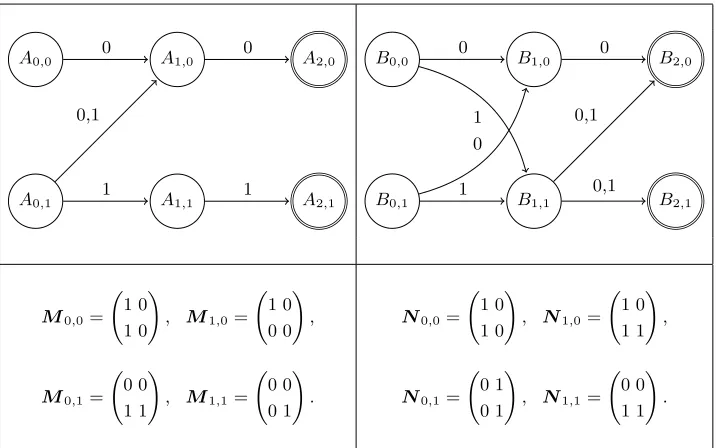
C.1 Read-once BPs from NFA
Two read-once BPs in Table 1 are from non-deterministic finite automata and linear relationally inequivalent.
These two BPs are the point function which output 1 only for input 01, but they are linear relationally inequivalent. For example,
M0,1·M1,0−M0,1·M1,16=0,
N0,1·N1,0−N0,1·N1,1=0.
We note that the matrixMi,bis the adjacent matrix between{Ai,c}c∈{0,1} and
{Ai+1,c}c∈{0,1}, andN’s are defined similarly.
C.2 Input-unpartionable BPs from Barrington’s Theorem
In the case of Barrington’s theorem, the linear relationally inequivalent matrix BPs are more complex. We consider the following two functionally equivalent circuits:
A0,0
A0,1
A1,0
A1,1
A2,0
A2,1 0
0,1
1
0
1
B0,0
B0,1
B1,0
B1,1
B2,0
B2,1 0 1 0 1 0 0,1 0,1
M0,0= 1 0 1 0
!
, M1,0= 1 0 0 0
!
, N0,0= 1 0 1 0
!
, N1,0= 1 0 1 1
!
,
M0,1= 0 0 1 1
!
, M1,1= 0 0 0 1
!
. N0,1= 0 1 0 1
!
, N1,1= 0 0 1 1
!
.
Table 1.BPs from NFA
We transform two circuits into the following BPs by Barrington theorem as follow9:
PC0 = 0: αρ βρ α
−1
ρ βρ−1 e βδ e βδ−1 · · · 1: e e e e αδ e α−δ1 e · · ·
PC1 = 0: e βρ e β
−1
ρ αδ βδ α−δ1 β −1
δ · · · 1: αρ e α−ρ1 e e e e e · · ·
input bits 1 2 1 2 1 3 1 3 · · ·
whereτσdenotesστ σ−1for permutationsτ, σ∈S5. In the matrix representation, the permutationsα, β, γ, ρ, δ are of the form
α=
0 1 0 0 0 0 0 1 0 0 0 0 0 1 0 0 0 0 0 1 1 0 0 0 0
, β=
0 0 1 0 0 1 0 0 0 0 0 0 0 0 1 0 1 0 0 0 0 0 0 1 0
, γ=
0 0 1 0 0 0 0 0 0 1 0 1 0 0 0 1 0 0 0 0 0 0 0 1 0
, ρ=
1 0 0 0 0 0 0 1 0 0 0 1 0 0 0 0 0 0 0 1 0 0 0 1 0
, δ=
1 0 0 0 0 0 0 0 1 0 0 0 1 0 0 0 0 0 0 1 0 1 0 0 0
.
We note that two functionally equivalent branching programsPC0 andPC1
are clearly input-unpartitionable. Now if we consider two (invalid) inputs x= 9
0110110111111111 andy= 1111101011111111. These yield, for example,PC0(x) =
αρ·e·e·βρ−1·αδ·e·e·e· · · ·=αρ·βρ−1·αδ =β. The terms in the right· · · are canceled. Then the equation
PC0(x)−PC0(y) = 0,
PC1(x)−PC1(y)6= 0
hold. Thus two branching programsPC0 andPC1 are functionally equivalent but