International Journal of Advance Research In Science And Engineering http://www.ijarse.com
IJARSE, Vol. No.4, Issue 05, May 2015 ISSN-2319-8354(E)
AN OVERVIEW ON COMPUTER SUPPORTED
COLLABORATIVE LEARNING IN TEXTILE TESTING
Ghada Ahmad Mohamad
Dept. of Spinning Weaving and Knitting ,Faculty of Applied Arts - Helwan University, Egypt
ABSTRACT
Computer Supported Collaborative Learning is becoming an increasingly common and accepted form of
learning as the introduction of Information Communication Technologies (ICT) makes the possibilities of
Communicating across distances of space and time. It encourages a more flexible learner centric approach and
provides opportunities for learning anywhere and anytime. Therefore, today, there are many private and public,
non-profit and for-profit institutions worldwide education courses from the most basic instruction through to the
highest levels of degree and doctoral programs. The aim of this paper is to present a review of computer
supported collaborative learning in textile testing . The report represent 3 examples from college of Textiles at
North Carolina State University , School of Design at the University of Leeds , Association of Textile , Apparel
& Material Professionals .
Keywords: Computer Supported Collaborative Learning , Textile Testing
I. INTRODUCTION
Computer-supported collaborative learning (CSCL) is a pedagogical approach wherein learning takes place via social interaction using a computer or through the Internet. This kind of learning is characterized by the sharing and construction of knowledge among participants using technology as their primary means of communication or as a common resource.[1]The textile industry is becoming an increasingly competitive environment. Differentiating products by quality is particularly important. Testing can be performed both to improve product quality and achieve compliance to international, regional or retailer specific standards.
One of the biggest challenges nowadays is to establish new forms of participation, achievement and development of people and organizations as well as learning and returning to individual ownership of the act of learning . For such, has greatly contributed the recent and innovative way of organizing the training, called e-Learning - distance learning through Internet - which has proved efficient implementation in various public and in different areas.
II. ZEIS TEXTILE EXTENSION EDUCATION FOR ECONOMIC DEVELOPMENT
CENTER [2]
291 |
P a g e
2.1 Fundamentals of Textile Testing course
The Textile Testing web-based education course was developed by North Carolina State University College of Textiles in response to the demands of industry and academic institutions worldwide. It’s a valuable resource for anyone who deals with technical quality issues of textile products or who would benefit from a working knowledge of textile testing. This eLearning course details a comprehensive range of test methods with application to textile fibers, yarns, fabrics, and garments.
2.2 Features of Fundamentals of Textile Testing
Course
A valuable resource to anyone who deals in with technical quality issues of textile products or who would benefit from a working knowledge of textile testing
Emphasizes the relationships between product structure and test results
Details a comprehensive range of test methods with application to textile fibers, yarns, fabrics and garments Presents information on professional standards organizations, published test methods and basic statistics Contains illustrations, detailed photographs and simulation videos
Available online 24 hours a day; access anywhere internet is available
2.3 Topics of Fundamentals of Textile Testingcourse
Textile Testing Overview
Basic Statistical Applications to Testing Textile Testing: Fibers
Textile Testing: Yarns
Textile Testing: Fabric Construction Textile Testing: Fabric Appearance Textile Testing: Fabric Performance Woven Fabric Analysis
Knit Fabric Analysis
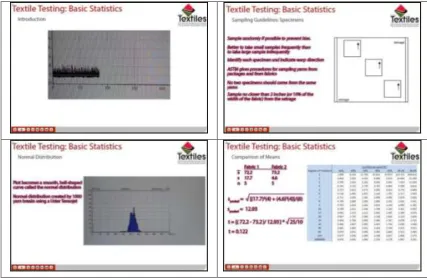
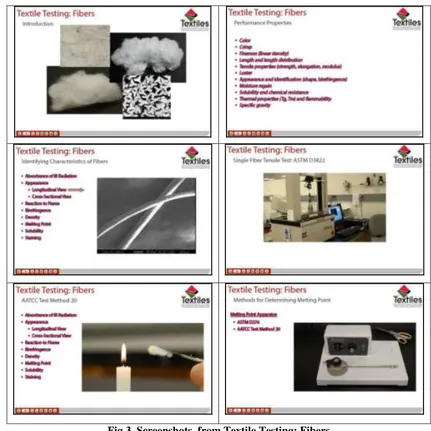
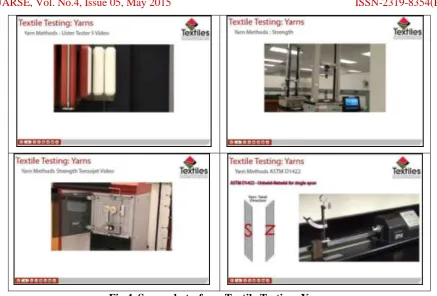
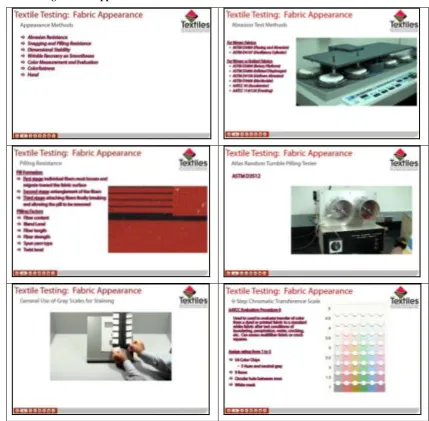
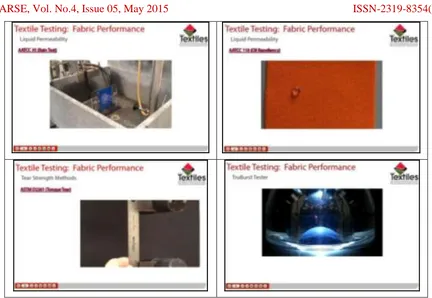
Figures ( 1 – 7 ) are screenshots from Topics of Fundamentals of Textile Testingcourse
International Journal of Advance Research In Science And Engineering http://www.ijarse.com
IJARSE, Vol. No.4, Issue 05, May 2015 ISSN-2319-8354(E)
Fig 1.
Screenshots from Textile Testing Overview
Basic Statistical Applications to Testing
293 |
P a g e
Textile Testing: FibersFig 3.
Screenshots from Textile Testing: Fibers
International Journal of Advance Research In Science And Engineering http://www.ijarse.com
IJARSE, Vol. No.4, Issue 05, May 2015 ISSN-2319-8354(E)
Fig 4.
Screenshots from Textile Testing: Yarns
Textile Testing: Fabric Construction
295 |
P a g e
Textile Testing: Fabric AppearanceFig 6.Screenshots from Textile Testing: Fabric Appearance
International Journal of Advance Research In Science And Engineering http://www.ijarse.com
IJARSE, Vol. No.4, Issue 05, May 2015 ISSN-2319-8354(E)
Fig 7.Screenshots from Textile Testing: Fabric Performance
III. TEXTILES AND APPAREL E-LEARNING CENTRE [3]
The Textiles and Apparel e-learning centre is owned by Media Innovations. The company was established in 2003 and, in addition to textiles educational modules, produces self-help training and diagnostic software for medical applications.
The Textiles and Apparel e-learning centre was created to deliver and market "Introduction to Textiles" a suite of computer based learning modules. These modules were originally developed for undergraduateand postgraduate students studying at the University of Leeds to enable them to study concepts that are often difficult to explain in a lecture, at their own pace and time
The development work was pioneered in 1994 by Dr Simon Harlock and his colleagues in the then, Department of Texile Industries, now the School of Design, at the University of Leeds.
3.1 Textile Testing 2.0 Module
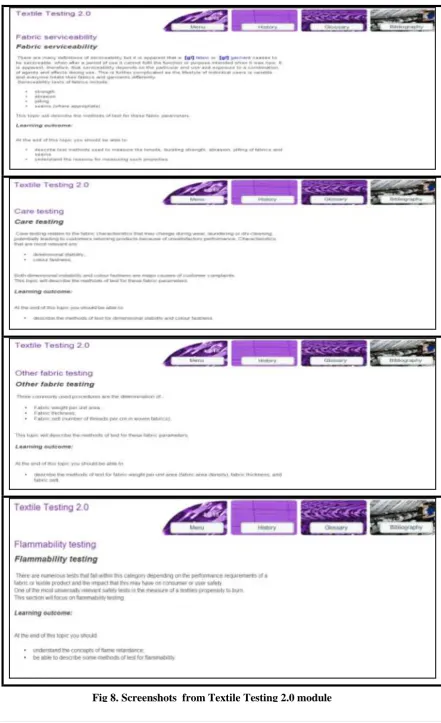
Textile Testing 2.0' is intended to provide fundamental underpinning knowledge on textile testing. It is complementary to the elementary introduction to the Physical Testing and Quality Assurance 1.0 module in Introduction to Textiles in that it covers similar basic concepts but this module provides significantly more detailed information about test methods used.
297 |
P a g e
3.2 Beneficiaries of Textile Testing 2.0 Module
Textile trainees and students
Non-textile professionals who are now working in the industry
Textile staff who have not completed formal training
Textile and apparel specialists who wish to broaden their knowledge
3.3 Features
of
Textile Testing 2.0 Module
All video and animation sequences have pause and rewind functionality
Learning material is linked to a glossary of terms
Tests are available at the end of each completed section
The content may studied systematically or browsed for specific information
3.4 Benefits
of
Textile Testing 2.0 Module
Provides comprehensive knowledge on the principles and methods used in textile testing on an industrial
scale
Provides learning "on demand" at a convenient time and place
International Journal of Advance Research In Science And Engineering http://www.ijarse.com
International Journal of Advance Research In Science And Engineering http://www.ijarse.com
IJARSE, Vol. No.4, Issue 05, May 2015 ISSN-2319-8354(E)
301 |
P a g e
IV. ASSOCIATION OF TEXTILE , APPAREL & MATERIAL PROFESSIONALS TEST
METHOD ONLINE TRAINING[4]
AATCC is offering a series of online training videos designed to explain and demonstrate the more commonly used AATCC Test Methods and Evaluation Procedures. This training promotes consistent and accurate testing and evaluation of textile materials throughout the industry by offering step-by-step instruction of AATCC test methods and demonstrating correct techniques for performing the methods.
4.1 Features of AATCC Test Method Online Training
• Visual demonstrations • 4 separate training modules
• 11 test methods & 6 evaluation procedures • Text & audio narration
• Step-by-step instruction
• Demonstrations of correct techniques
4.2 Benefits of AATCC Test Method Online Training
Practical knowledge for the workplace
Learn from the comfort of your office, home, or anywhere internet access is available Learn at your own pace
No travel expense
Zero nights away from home
View & pay for only the modules you need
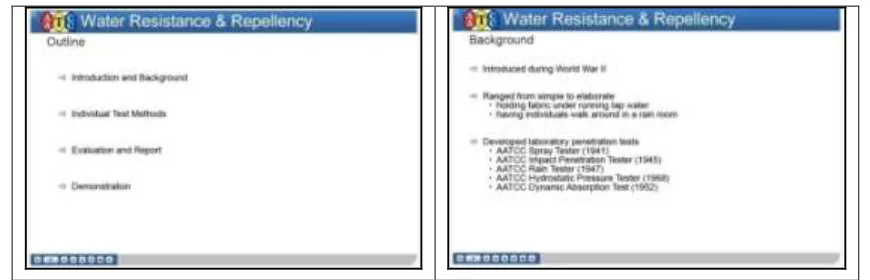
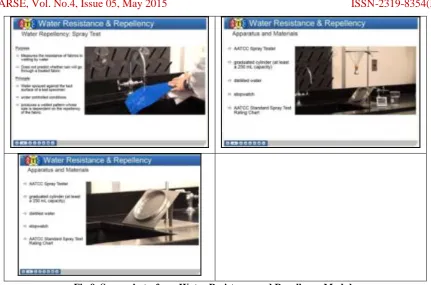
4.3 Water Resistance and RepellencyModule Descriptions
Water Repellency: Spray Test (TM 22) Water Resistance: Rain Test (TM 35)
Water Resistance: Impact Penetration Test (TM 42)
Water Repellency: Tumble Jar Dynamic Absorption Test (TM 70) Water Resistance: Hydrostatic Pressure Test (TM 127)
International Journal of Advance Research In Science And Engineering http://www.ijarse.com
IJARSE, Vol. No.4, Issue 05, May 2015 ISSN-2319-8354(E)
Fig 9.Screenshots from Water Resistance and Repellency Module
V. SUMMARY AND CONCLUSION
There is no doubt that computer supported collaborative learningoffers many benefits in terms of providing cost-effectiveeducation and training that suits both the time conscious needs of the learner and theemployer when used to support training in the workplace. However it is also clear that,whilst it is very good in presenting factual and visual descriptive information and, as alearning portal, can provide ready access to other sources of information, it needs to becomplemented by other modes of delivery. Therefore a blended learning approach isadvocated incorporating: E-learning, Video delivery, Classroom, Books, Synchronousand asynchronous communication .The aim of such an approach is to utilize the most appropriate learning tool for thetype of knowledge and information to be imparted. This paper has presented an overview of Computer Supported Collaborative Learning in textile testingby representing 3 examples from college of Textiles at North Carolina State University , School of Design at the University of Leeds , Association of Textile , Apparel & Material Professionals .
It is essential therefore, that computer supported collaborative learningtools, such as those in the presented examples, are developed if the workforce is to be recruited, educated and trained to the level required to enable companies , universities, mills …etc to compete globally.
VI. REFERENCES
[1] Stahl, G., Koschmann, T., &Suthers, D. (2006). Computer-supported collaborative learning: An historical perspective. In R. K. Sawyer (Ed.), Cambridge handbook of the learning sciences (pp. 409-426). Cambridge, UK: Cambridge University Press.