Presented at: VicWater Annual Conference: Looking beyond… New technology, new capabilities, new processes, new challenges, Geelong, Victoria, 28th-29th September 2006
Water use and re-use in processing horticultural produce
Graham Thorpe
Institute for Sustainability and Innovation
School of Architectural, Civil and Mechanical Engineering Victoria University, PO Box 14428
Melbourne, Australia 8001
Summary
The farmgate value of fruit and vegetables grown in Victoria is about $1 billion per year and a further $417 million value is added as a result of processing. The shelf life of horticultural produce can be extended by cooling it as soon after harvest as possible. A convenient way of cooling fruit and vegetables is to spray them with chilled water in devices known as hydrocoolers. However, to conserve water and energy the water must be recirculated around the system and the water contacting the produce is mandated to be potable. As a result, an effective water treatment system must be incorporated into hydrocoolers, and it is noted that a program of testing the water must be implemented. It is also reported how engineering science can be used to improve the design of hydrocoolers.
Introduction
At first sight the nexus between the scarcity of water and the value of horticultural production in Victoria seems paradoxical. As water is becoming scarcer the value of horticultural production is increasing. This is because the use of water is being transferred from activities that yield low financial returns to those that yield higher returns. In 2001 the farmgate value of fruit and vegetable production in Victoria was $1 billion, and processing resulted in a further $417 million of value adding (DPI, 2005). Food exports from Victoria grew three-fold between 1992 and 2002.
Consumers are implored to eat more fresh fruit and vegetables. However, the consumption of uncooked food carries a danger that it may be a vector for dangerous human pathogens. As a result it must be handled from field to plate in as hygienic a manner as possible. Consumers are also becoming more discriminatory with regard to quality, and produce destined for export must remain fresh for prolonged periods. One way of ensuring that some kinds of fruits and vegetables, such as apples, peaches, cherries, asparagus, broccoli and so on are washed and cooled is to treat them in a hydrocooler. Such devices consist of sprays through which refrigerated water is delivered on to the produce. To save water and energy the chilled water should be circulated around the system, and it must be potable before it can be sprayed on the produce.
270,000 tonnes per year, use over 1 GL of water each year for washing. Hydrocoolers can be used for the dual purpose of washing and cooling and there is clearly a need to recycle water.
Water contacting unprocessed produce must be potable
The Department of Agriculture, Fisheries and Forestry – Australia (AFFA, 2001) states that the water used for the final wash steps, as may occur during hydrocooling, must be potable. This is echoed by the Victorian Government Department of Human Services (2005) that points out that food laws require that food processors use potable water. A definition of potability is not given but it is clear that when owners of food businesses harvest water, as operators of hydrocoolers often do, they incur several risks.
Perhaps the most definitive set of rules for ensuring the potability of water in Australia is provided by the Australian Drinking Water Guidelines (ADWG, 2004). The Guidelines have been designed specifically for water distribution systems that vary in size from less than 1000 consumers to over 100,000 consumers. Managers of these networks are likely to have access to reasonably significant funding and expertise. These resources and expertise are unlikely to be available to operators of hydrocoolers and this represents a risk.
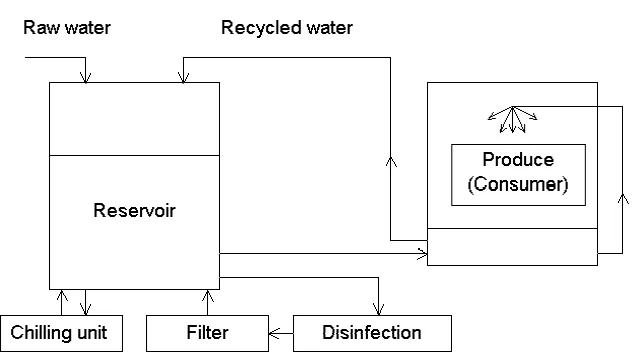
In this work it is suggested that the ADWG can be applied to hydrocooling by thinking of a hydrocooler as a water distribution system as illustrated in Figure 1. This is far from being a perfect analogue but one can equate the various components of a hydrocooler as elements of a water supply as follows:
Supply of raw water - The supply of raw water to a hydrocooler may be likened to that of water obtained from a catchment or a river in a supply system to a small township. In the case of a hydrocooler the raw water supply may be potable water from the mains, bore water, river water and so on.
Reservoir - The storage tank in the hydrocooler represents the local reservoir in a small community water supply.
Chemical treatment plant – the filtration and chemical treatment system in a hydrocooler plays the role of a chemical treatment plant in a water supply system
Consumer - The produce being cooled represents the ‘consumer’ that must be supplied with potable water.
Recycling facility – The water recirculated around a hydrocooler may be likened to a water re-cycling facility that may not yet have many analogues in town water supplies.
The ADWG (2004) suggest that the philosophy of monitoring the potability of water supplies to small townships, and by extension to hydrocoolers, is driven by the idea that it is more effective to test frequently for a small number of narrowly defined indicators rather than a broad spectrum of contaminants that are unlikely to be problematical. The ADGW (2004) suggest that the following be monitored frequently:
• Indicator micro-organisms
• pH
• Turbidity
Figure 1. A schematic diagram of a hydrocooler that represents the components as elements of a water supply system
The oxidation-reduction potential is often used to measure the concentrations of disinfectants in water recycled around hydrocoolers, and this acts as a surrogate indicator of micro-organisms. The pH of the water is also monitored, and there is need for disinfectant residuals to be measured. Schwartz et al. (2000) have observed an association between the turbidity and drinking water and gastrointestinal illnesses and it is essential that the turbidity of wash water meet the ADWG (2004).
A multidisciplinary approach to the re-use of water – a rôle for engineering science
The design of horticultural equipment has been governed largely by experience and empiricism. Much research has focused on ensuring that sanitizing agents are efficacious in disinfecting horticultural produce.
the produce that occur in hydrocoolers to be predicted. Thorpe (in press) has used these correlations to formulate a mathematical model of the behaviour of hydrocoolers. His model demonstrates that the mass weighted average temperature, rather than the core temperature of horticultural produce can be used to increase the throughput of hydrocoolers Thorpe (in press) also demonstrates that the rate of cooling is ultimately limited by thermal conduction in the produce. It is demonstrated that the depth of the bed of produce does not have a strong effect on the cooling rate of produce furthest from the water-inlet. This implies that hydrocoolers can be made to occupy little floor space. However, the load on the water-chilling unit is likely to increase with the increasing depth of the bed.
Conclusions
This paper has highlighted the fact that there is strong pressure to re-use water in the horticultural industry, but high levels of potability and environmental standards must be met. It is further shown that the principles of engineering science can be used to better design and operate horticultural processing plant such as hydrocoolers.
References
ACIAR (2004) Reducing spoilage and contamination risks of fresh vegetables in China and Australia (ACIAR project PHT/1999/081) reported in
http://www.linkingfarmerswithmarkets.net/
ADWG (2004) Australian Drinking Water Guidelines, National Health and Medical Research Council, Australian Government, Canberra, Australia
AFFA (2001) Guidelines for on-farm food safety for fresh produce, Department of Agriculture, Food and Fisheries – Australia, Australian Government, Canberra
DPI (2005) Priorities for action: Victoria’s horticultural industries 2005-2008. The Victorian Government Department of Primary Industries, Melbourne, June 2005.
Kaviany, M. (1999) Principles of heat transfer in porous media, Second Edition, (Second Printing), Springer-Verlag, New York.
Larachi, F., Alix, C., Grandjean, B. P. A. and Bernis, A. (2003) Nu/Sh correlation for particle-liquid heat and mass transfer coefficients in trickle beds based on Péclet similarity. Chem. Eng. Res. Dev. (Trans IChemE part A), 81, pp 689-694.
Larachi, F., Belfares, L. and Grandjean, B. P. A. (2001) Prediction of liquid-solid wetting efficiency in trickle flow reactors. Int. Comm. Heat and Mass Transfer, 28, pp 595-603.
Larachi, F., Belfares, L., Iluta, I. and Grandjean, B. P. A. (2004) Liquid hold-up correlations for trickle beds without gas flow. Chem. Engng and Processing, 43, pp 85-90.
Saez, A. E., Carbonell, R. G. and Levec, J. (1986) The hydrodynamics of trickling flow in packed beds, Part I: Conduit models. AIChEJ, 31, pp 52-62.
Thorpe, G. R. (in press). Towards a semi-continuum approach to the design of hydrocoolers for horticultural produce, Ecological Modelling.