University of South Carolina
Scholar Commons
Theses and Dissertations
2017
The Political Suppression of the Saxophone and its
Subsequent Pedagogical Development in Select
Non-Democratic Countries
Sheldon Jerome Johnson Jr.
University of South Carolina
Follow this and additional works at:https://scholarcommons.sc.edu/etd Part of theMusic Performance Commons
This Open Access Dissertation is brought to you by Scholar Commons. It has been accepted for inclusion in Theses and Dissertations by an authorized administrator of Scholar Commons. For more information, please [email protected].
Recommended Citation
The Political Suppression of the Saxophone and its Subsequent Pedagogical Development in Select Non-Democratic Countries
by
Sheldon Jerome Johnson Jr. Bachelor of Music Northwestern University, 2009
Master of Music
Bowling Green State University, 2011
________________________________________________________________________ Submitted in Partial Fulfillment of the Requirements
for the Degree of Doctor of Musical Arts in Music Performance
School of Music University of South Carolina
2017 Accepted by:
Clifford Leaman, Major Professor Rebecca Nagel, Committee Member
Joseph Eller, Committee Member Greg Stuart, Committee Member
ii
iii
Dedication
iv
Acknowledgements
I am forever indebted to my father for inspiring me to play the saxophone; to my mother for all of her love and support through the years; to my grandmother Florella Johnson who has always nurtured my intellectual curiosity; to my grandmother Lucy Young who has tirelessly encouraged me to pursue my dreams and who has believed in me every step along the way; to Sue Richardson and Carlton Wilkes for helping me find my musical voice; to the memory of Bob LeFever who introduced me to classical saxophone and helped start me on my current musical path; to Dr. Frederick L. Hemke
for teaching me how to do more than “push the buttons;” to Dr. John Sampen for
v
Abstract
Almost universally, the saxophone struggled to gain acceptance in the early years following its invention; however, the obstacles faced were much more arduous in some places than others. The saxophone faced many serious impediments to acceptance, especially in the non-democratic 20th-century countries of China and the
vi
Table of Contents
DEDICATION ... iii
ACKNOWLEDGEMENTS ... iv
ABSTRACT ... v
CHAPTER 1: INTRODUCTION ... 1
PURPOSE OF THE STUDY ... 3
NEED FOR THE STUDY ... 4
LIMITATIONS OF THE STUDY ... 4
RELATED LITERATURE ... 5
DESIGN AND PROCEDURES ... 11
CHAPTER 2: THE HISTORY OF THE SAXOPHONE AND SAXOPHONE PEDAGOGY IN CHINA ... 12
WESTERN MUSIC IN CHINA ... 12
CLASSICAL SAXOPHONE COMES TO CHINA ... 14
YUSHENG LI: CHINA’S FIRST SAXOPHONE PROFESSOR ... 16
XIN GAO: CHINA’S FIRST CLASSICAL SAXOPHONE STUDENT ... 18
HANTAO LI: INHERITING A LEGACY ... 20
vii
CHAPTER 3: THE HISTORY OF THE SAXOPHONE AND SAXOPHONE PEDAGOGY IN THE
FORMER SOVIET UNION ... 26
THE SAXOPHONE AND JAZZ IN POST-REVOLUTIONARY RUSSIA ... 26
THE SAXOPHONE AND JAZZ FOLLOWING THE SECOND WORLD WAR ... 29
CLASSICAL SAXOPHONE COMES TO THE SOVIET UNION ... 30
EARLY SOVIET SAXOPHONE PEDAGOGY ... 32
LATER SOVIET/RUSSIAN PEDAGOGY AND PEDAGOGUES ... 33
THE FUTURE OF THE RUSSIAN SAXOPHONE SCHOOL ... 37
CHAPTER 4: CONCLUSION ... 40
BIBLIOGRAPHY ... 42
APPENDIX A: XIN GAO INTERVIEW ON THE HISTORY OF CHINESE SAXOPHONE PEDAGOGY ... 45
APPENDIX B: HANTAO LI INTERVIEW ON THE HISTORY OF CHINESE SAXOPHONE PEDAGOGY ... 55
APPENDIX C: RECITAL PROGRAMS ... 76
1
Chapter 1
Introduction
The struggle of the saxophone to gain acceptance and recognition in the classical music world has always been an uphill battle. This struggle, coupled with the political climates of countries like the Soviet Union, Nazi Germany, and even China in the middle of the twentieth century made its acceptance even less likely. The prohibition of the saxophone was explicit in some cases and implicit in others. At one time, two of the important Soviet Publications Pravda and Isvestiia carried out a public dispute over the legitimacy of jazz as an appropriate musical medium, muddying the waters for citizens with any interest in the Western art form.1 Following the Second World War the word
“jazz” alone, which would certainly have been associated with the saxophone, was illegal to say in public in the Soviet Union.2 In addition to helping to shape the trajectory
of the saxophone’s history in general, conditions like these also affected the
saxophone’s role in western art music. As is often the case, the relative importance of something to a society can be estimated by the pedagogical emphasis placed on it in institutions of higher learning. As a result of these strictures, the use of saxophone by composers and its adoption by conservatories was limited. Compared to other Western
1 Stacy Maugans, The History of Saxophone and Saxophone Music in St. Petersburg, Russia (Indiana
University, 2000), 12.
2
countries under different political circumstances, the saxophone gained acceptance relatively late. Invented in the early 1840s by Belgian instrument maker Adolphe Sax, saxophone classes appeared shortly thereafter at the Paris Conservatory, taught by the inventor himself. Similarly, classes in the United States in music schools such as the New England Conservatory and the Grand Conservatory existed in the early 1880s.3
Conversely, such classes were not taught in the Soviet Union until after 1970; and it was not until the late 1990s that formal saxophone classes appeared in Chinese conservatories.4
Despite such hindrances, many of these countries have emerged recently as significant contributors to the wealth of saxophone pedagogy and repertoire; however, at present relatively little is known about the forces (people, events, etc.) that brought
about the shift in policy and attitude directed towards Adolphe Sax’s oft-maligned creation. There are far too many instances of triumph over adversity in the saxophone’s
relatively short history to detail them all, but it is the intent of this research to bring to light some of the characters that have helped and continue to help the saxophone in its pursuit of gaining an even larger foothold in the course of musical history in countries where its acceptance was limited by governmental control.
3 Joseph McNeill Murphy, “Early Saxophone Instruction in American Educational Institutions” (D.M.A.,
Northwestern University, 1994), v,
http://search.proquest.com.pallas2.tcl.sc.edu/pqdtft/docview/304143564/abstract/E88512C6011C4623P Q/1?accountid=13965.
3
Purpose of the Study
This research project will explore the ways in which the political environments of various mid-twentieth century nations affected the saxophone’s history and its place in
the evolving landscape of the western art music tradition. Secondly, it will identify the catalysts for change from formal prohibition of the instrument to a level of acceptance that has become a staple in many music conservatories around the globe. In only a few short decades several countries that formerly prohibited the instrument have now begun producing first rate performers and teachers who have won international competitions and who occupy prestigious positions at institutions around the world.
Sergey Kolosov’s first prize at the 2006 Adolphe Sax Competition in Dinant, Belgium
shocked many in attendance. Previously, the majority of winners had not only been from France, but had often been students at the esteemed Paris Conservatory. Even
with the United States’ comparatively well-developed saxophone pedagogy, only once has an American even made it to the third and final round of the competition, when Otis Murphy placed second. For a Russian player to win was a major step forward for the
saxophone community there. Following Kolesov’s win in 2006, two Russian
saxophonists made the final round, finishing second and sixth respectively in the 2010 competition, and in 2014 another Russian, Nikita Zimin won first prize, further
illustrating the country’s continuing ascent in the saxophone world.5
5 “Competition - Adolphe Sax,” accessed March 27, 2017, http://sax.dinant.be/en/competition; “DINANT
4
The chief goal of this study will be to identify the links between the modern day state of saxophone instruction in these various countries and the influences, whether foreign, domestic, or some combination that helped to efface the obstacles that had previously stood in the way of serious pedagogical establishment.
Need for the Study
Although not exhaustive, there is plentiful research on the suppression of the saxophone throughout its history. Naturally, through the course of their research, scholars have touched on the early development of saxophone instruction; but in most cases these discussions are limited to a few pages within a chapter; and much of the research is outdated at this point and in need of follow up research to bridge the gap. As yet, a thorough study on the impact of the political abuses leveled against the saxophone on the development of pedagogy has not been undertaken. Despite the ascent of the saxophone and competent performers in these countries, the parties and forces responsible for the development of saxophone pedagogy in the wake of governmental censure are largely unknown in the West.
Limitations of the Study
5
Related Literature
Since its first appearance on the musical scene in the mid-19th century, the
misfortunes of the saxophone have been well documented. From the early abuses
leveled against Mr. Sax, to the instrument’s mistreatment as a result of its close association with jazz in the 20th century, the scholarship in this area is robust. As it
pertains strictly to the effects of these misfortunes on the development of pedagogy, the subject is broached only tangentially, and in limited scope in a few theses and dissertations. Because of this limited scope of the research, coupled with its out datedness (most of this research was performed 20 or more years ago) make the need for further scholarship even more pressing and necessary. Furthermore, the lion’s share
of this research as it relates specifically to the saxophone, its suppression, and subsequent pedagogical development has focused on the Soviet Union and its well-documented eschewal of all things associated with Western culture, specifically that of the United States.
Written in 1979, Christopher Ford’s thesis “The State of Concert Saxophone
Pedagogy, Performance, and Composition in the Soviet Union” provides a valuable,
although limited view into the then budding potential of the saxophone following
Joseph Stalin’s death in 1953 and the loosening of the strictures inherent in the socialist
realist and Zhdanovistic policies.6 Also useful is Mr. Ford’s descriptions of some of the
earliest people and events that most likely first exposed Soviet citizens to classical saxophone as a solo instrument. In chapter one of his thesis, Ford briefly chronicles the
6
University of Michigan’s 1961 tour of the Soviet Union and American saxophonist
Donald Sinta’s very successful performances of Paul Creston’s Concerto for Alto
Saxophone and band.7 In addition to the brief, yet important exposure to the American
classical saxophone, Ford also touches on the substantial impact that French saxophonist Jean-Marie Londeix would later have, closer to the time of the relaxation of
Soviet policies responsible for the saxophone’s relative absence in the Soviet musical
scene up to that point.8 Through his visit and performances early in the 1970s, Londeix
would forge an important relationship with Russian composer Edison Denisov that
would begin paving the way for the saxophone’s legitimization in the Soviet Union.9
In addition to highlighting some of the early western influences on the
development of the saxophone pedagogy, Ford’s document is also useful in that it
makes the connection between the western influences, particularly Londeix’s, that laid a
large part of the foundation for the early Russian school of saxophone playing and the start of formal saxophone instruction in the Soviet Union, beginning at the Moscow Conservatory in the early 1970s.10 Despite Londeix’s large influence and early visibility
in the fledgling saxophone school, the connection between the early days and the contemporary saxophone pedagogical culture is less documented and in need of further study.
7 Ibid., 8. 8 Ibid.
9 Ibid., 4; Edison Denisov, “SaxAme: Letters: Denisov,” accessed April 30, 2014,
http://www.saxame.org/letters/denisov/denisov1.html.
7
As a result of research projects such as Mr. Ford’s, and because of the
subsequent popularity gained by Edison Denisov’s Sonate for Alto Saxophone and Piano
dedicated to Jean-Marie Londeix, the special relationship forged between Messrs. Londeix and Denisov has been well-documented. At least in its early stages, the beginnings of saxophone pedagogy in Russia owed much to the exposure to the
instrument and its peculiar abilities during Londeix’s tour in the 1970s.11 The specifics of
this importance as it relates to the early relationship between Denisov and Londeix and the development of the now canonized sonata are preserved online in the form of letters between composer and performer. In these correspondences Londeix urges Denisov to write for the saxophone and apprises him of some of the techniques possible on the saxophone that were largely unknown in the Soviet Union up to that point.12
Although not a saxophonist himself, because of his stature in the Soviet Union,
Denisov’s style and choice to make use of some of the saxophone’s more avant-garde techniques would inspire future composers and contribute to the development of a particularly Russian style of saxophone playing and composition.
A more recent, but still dated exploration of the saxophone in Russia is Stacy
Maugans’ 2000 dissertation The History of Saxophone and Saxophone Music in St.
Petersburg, Russia. It is useful for its description of the state of the saxophone during the 1990s in St. Petersburg. As one of the main cultural hotspots in Russia, the
saxophone’s plight there was likely indicative of the trajectory of its pedagogical
11 Ibid.
8
development elsewhere in the country. In her dissertation Maugans describes the struggle of the saxophone to remain afloat in post-Soviet St. Petersburg during the 1990s, not because of a heavy handed governmental regime as had been the case earlier, but because of serious economic concerns.13 The elimination of instruction at
the St. Petersburg Conservatory, the uncertainty of future instruction, as well as the alternate paths available to would-be saxophonists are all well-chronicled in the Maugans document.14 Dr. Maugans also explores the trajectory of a saxophonist’s
journey as a player from an elementary school beginner to full professor in the Russian educational system.15
Richard Ingham’s 1998 Cambridge Companion to the Saxophone represents a seminal work on the many different aspects of the instrument’s history, pedagogical,
and mechanical developments. In spite of its relative silence on the pedagogy of saxophone in China or Russia, Ingham’s compendium is a valuable resource because of
its listing of the most prominent contemporary (as of its 1998 publishing date) concert saxophonists in various countries around the world, even those countries not often associated with the instrument. Conspicuously absent from this list is China; however, a couple of pedagogues and performers from Russia are listed, potentially providing a useful jumping off point for further research of important people in the instruction of saxophone in these countries.16 Furthermore, in their joint chapter in the book, French
13 Maugans, The History of Saxophone and Saxophone Music in St. Petersburg, Russia, 33. 14 Ibid., 32–37.
15 Ibid., 35–36.
16 Richard Ingham, ed., The Cambridge Companion to the Saxophone, Cambridge Companions to Music
9
saxophonists Claude Delangle and Jean-Denis Michat provide examples not only of the same aforementioned saxophonists in various countries, but also of their relationships with different composers around the world. In addition to providing an interesting insight into the specific cultural leanings of these saxophone communities, it may be possible in the future to glean information about potential connections between a certain type of repertory and specific teaching climates in these different places.17
Even absent the suppression that the saxophone has faced in some places around the world in the 20th century, the emergence of the saxophone as a serious
instrument to be considered alongside other more established orchestral instruments has been a challenge in what one might consider a normal situation. Excepting the city ordinances mandating a curfew for jazz saxophonists in places like Kansas City during
the rise of jazz, the saxophone’s plight in the United States in comparison to some other
parts of the world has been relatively unfettered, at least as far as governmental censure is concerned.18 Even so, an understanding of the struggles of the saxophone, its
pedagogical development, and the place of the American saxophone school within the global saxophone community during the middle to late 20th century will be invaluable to
the researcher trying to similarly place the divergent saxophone cultures elsewhere. In his 1994 dissertation, Early Saxophone Instruction in American Educational Institutions, saxophonist and pedagogue Joseph Murphy details not only the history of the saxophone in American universities and conservatories, but also its link to the original
17 Ibid., 162–63.
18 Michael Segell, The Devil’s Horn: The Story of the Saxophone, from Noisy Novelty to King of Cool (New
10
French school of saxophone playing.19 Murphy’s document will more than likely prove
to be an invaluable benchmark resource providing details against which to compare the findings in the research of other countries.
A more recent publication that makes an attempt to cover the entirety of the
saxophone’s history is Michael Segell’s 2005 book The Devil’s Horn. Subtitled, “The
Story of the Saxophone, From Noisy Novelty to the King of Cool” the book covers the saxophone’s journey from invention to modern day, but with an emphasis on the
struggle of the instrument to gain acceptance not only in non-democratic political environments, but elsewhere as well. Similar to Dr. Murphy’s dissertation, Segell’s book provides several disparate narratives of the saxophone’s development and provides a
larger context in which to view the similarities and differences in the ways the saxophone has been treated societally. In the 11th chapter he describes the degree to
which Hitler and Goebbels despised any artistic expression with roots in the West, the saxophone undoubtedly included.20 Similarly, the rocky, unpredictable relationship
between the saxophone and the Soviet government under Stalin is explored. The periodic loosening of strictures concerning the instrument followed shortly thereafter by the inevitable round up and exile or execution of saxophonists was par for the course for much of the Soviet era.21
Although the need for further research on the development of saxophone pedagogy in Soviet Russia becomes evident in the reading of related extant materials,
19 Murphy, “Early Saxophone Instruction in American Educational Institutions,” 136. 20 Segell, The Devil’s Horn, 224.
11
information on the saxophone’s early development and pedagogy in China is, at least in
American institutions, absent from literature on saxophone. However, the late appearance of the saxophone classes in the conservatories is evidence of much needed research in that area and the connections with English speaking Chinese saxophone teachers of people like Dr. Clifford Leaman at the University of South Carolina and Dr. John Sampen of Bowling Green State University are promising avenues through which to explore the maturation process of saxophone pedagogy in China.
Design and Procedures
The final document representing the study will be made up of four chapters, a bibliography, and appendices including transcripts of interviews conducted with people knowledgeable about the subject matter for the purposes of this research project. The first chapter will contain an introduction, the purpose for the study, need for the study, the limitations of the study, a review of related literature, and the design and procedures for the resultant research document. The second chapter will explore the
saxophone’s history in China and its progress towards acceptance under Communist rule in the 20 and 21st centuries with a spotlight on and profiles of individuals closely
12
Chapter 2
The History of the Saxophone and Saxophone Pedagogy in China
Western Music in China
The introduction of the saxophone to the Chinese people aligns closely with the serious introduction of Western culture and influence to China. In this case, the obscurity of, and hesitance to embrace the saxophone as a viable means of musical expression coincides largely with the Chinese government’s penchant and long-standing tendency towards skepticism, if not outright hostility towards Western culture prior to the turn of the 20th century.22 Interestingly, despite these impediments, there is
evidence to suggest the existence of an ancient Chinese musical system comparable to that of the West, a system based on octaves divided into semitones rather than the now traditional pentatonic scale. Some documentation also suggests that earlier exposure to Western musical traditions (around 1400) may have influenced the development of traditional Chinese music.23 However, throughout the 19th-century and the early part of
the 20th, practically speaking, Chinese culture existed independent of the West. Mostly owing to its robust cultural conventions and a strong sense of national
13
pride, Western culture had been seen as mostly irrelevant up until that point.24 The
Qing Dynasty was generally hostile to most European cultural conventions. Following the overthrow of the Qing Dynasty, the Republic of China took its place. During these contentious years of the early 20th century, the saxophone made its first appearances of
any importance in some of the military bands of rival military factions.25 However, it
would be the prominence of the saxophone in the dance hall bands of the larger, more cosmopolitan cities that really brought the saxophone into the consciousness of the Chinese people. It would be some time before the saxophone as a classical instrument would find its place in Chinese society. The saxophone, as featured in the dance hall bands of cities such as Shanghai, featured the instrument as a medium for pop music and jazz.26 During this time, because of its association with the capitalist West, the
saxophone was viewed unfavorably by the Chinese government.27
Despite the governmental impediments to significant embrace of European artistic culture that had existed during the Qing Dynasty, a limited, yet meaningful exchange with the West can be seen in the earlier acceptance of the symphony orchestra. In approximately 1879, the first Western orchestra began to develop in China, illustrating, at the very least, a curiosity and complexity of thought surrounding the restricted and complicated relationship that China had with the West.28 Despite the
24 Ibid., 20–22.
25 Yusheng Li, “The Saxophone In China,” Saxophone Journal 24, no. 3 (February 2000): 57. 26 Ibid.
27 John Robert Brown, “A View From China,” accessed February 4, 2017,
http://www.john-robert-brown.com/yusheng-li.htm.
14
growing prevalence of this curiosity, the study of Western music or instruments had the potential to be a very dangerous undertaking.29 Moving forward, the collective attitude
of the Chinese people, as well as its government, to the West remained convoluted, with many fits and starts between outright rejection and acceptance along the way. Furthermore, the relationship between the arts and government remained a close one, with the arts seen by the higher-ups as a vehicle for governmental rather than personal expression.30 Not until the aftermath of the tumultuous Cultural Revolution in the
1970s, with the country’s more permanent openness to all things Western, would the climate be ripe for the saxophone to be accepted as a classical instrument.31
Classical Saxophone Comes to China
In the years following the end of the Cultural Revolution in the late 1970s, despite the seismic shift that had occurred societally, the common view of the saxophone, among those who knew anything about it, remained virtually unchanged. Unlike the instruments of the Western orchestra, the saxophone was still seen as a lesser instrument, fit to play only popular music or jazz. This perception of the instrument would persist; however, during the 1980s, with the now more open attitude
toward the West, the instrument’s popularity increased due to renewed interest in
dance hall bands and jazz music.32 In addition to the re-emergence of the dance hall
29 Hantao Li and Sheldon Johnson, Interview on the History of Chinese Saxophone Pedagogy 2, November
10, 2006.
30 Richard King et al., eds., Art in Turmoil: The Chinese Cultural Revolution, 1966-76, Contemporary
Chinese Studies (Vancouver: UBC Press, 2010), 5.
15
bands, the popularity of the saxophone soared when the country was introduced to the music of Kenny G.33
This confluence of factors led to the saxophone becoming not only a popular instrument to listen to, but also a popular instrument for children and amateur musicians to learn how to play.34 This increasing popularity of the saxophone also
allowed people to begin questioning the range of stylistic potential of which the instrument might be capable. Although the classical saxophone was virtually unknown in the country at the time, some saxophone enthusiasts with professional musical training, began to suspect that the saxophone might be well-suited to a wide range of musical styles. With cultural contact becoming more common between the People’s
Republic of China and western countries, it would not be long before such imaginings would be proven correct.35 In 1990, the Chinese government invited Canadian concert
saxophonist Paul Brodie to Beijing to give recitals and masterclasses. For many of those
in attendance, Paul Brodie’s talks and performances sparked an interest in the potential
of the saxophone as a high-brow, Western classical instrument. Two years later, in 1992, Brodie returned to China, this time to Chengdu and, in a very real sense, this trip to China was the catalyst for the development of a Chinese classical saxophone tradition.36 During this second trip, Yusheng Li, a professor in the Sichuan
33 Li and Johnson, Interview on the History of Chinese Saxophone Pedagogy 2. 34 Ibid.; Li, “The Saxophone In China,” 57–58.
16
Conservatory’s Chinese Instrument Department and self-taught amateur saxophonist, made arrangements to study with Brodie in Canada.37
Yusheng Li: China’s First Saxophone Professor
Saxophonist Yusheng Li was born in Chonqin and became involved in music at
the age of ten. Li’s first instrument of choice was a traditional Chinese bamboo flute, an instrument that remained popular in China until the Cultural Revolution.38 Yusheng Li
continued his musical activities into adulthood and received his musical education at Sichuan Conservatory where he currently serves as professor of saxophone.39 Having
come of age prior to the Cultural Revolution, however, Li’s career as a saxophonist
developed later in his life. As a student at Sichuan Conservatory of Music, Li majored in Chinese traditional instruments, specializing in the suona, a Chinese bamboo flute.40 Li
graduated in 1982 and served as a professor in the Chinese Instrument Department for nearly a decade before turning his focus to the saxophone.41
During the 1980s, while teaching at the conservatory, Li became interested in the saxophone. Inspired by the popularity of dance hall bands as well as the tremendously popular music of Kenny G, Yusheng Li began to teach himself how to play the saxophone.42 According to his son, Hantao Li, Professor Li spent hours at home
37 Liu, “Yusheng Li,” 27. 38 Ibid., 26.
39 Admin, “Li Yusheng (China),” Clasax, May 12, 2011,
http://www.clasax.org/festival-2011/international/li-yusheng/.
40 Li and Johnson, Interview on the History of Chinese Saxophone Pedagogy 2. 41 Liu, “Yusheng Li,” 27.
17
teaching himself how to play the saxophone.43 In spite of the dearth of information
about classical saxophone, and the common understanding that the instrument could only be used for popular music and jazz, as a musician, Li naturally sensed that it could play more serious concert music. This sense was confirmed when, in 1990, Yusheng Li made the long, two-day trip by train to hear Paul Brodie perform in Beijing.44
Following Paul Brodie’s second trip to China in 1992, Yusheng Li was able to
make arrangements to study with Brodie in Canada. In 1993, Li traveled to Canada and began his first formal saxophone study at the Royal Academy of Toronto.45 Li completed
his program in 1996, with the title Fellow of the Royal Saxophone Performer, making him the first Chinese musician to do so.46
After completing the performer’s certificate program in Toronto, Yusheng Li
returned to China in 1996. During his time away, Sichuan Conservatory held his position as professor. Shortly after his return, Li began to suggest that the conservatory allow him to start a saxophone program. From the beginning, this proposition was a difficult one due to the ingrained preconceptions about the saxophone as only an instrument for popular music. Perhaps serendipitously, his return coincided with a time in which the conservatory began to seriously consider creating a more robust department devoted to the study of Western music and instruments. Although there were many people
knowledgeable and capable of teaching Western instruments, Yusheng’s time abroad,
43 Ibid.
44 Ibid.; Liu, “Yusheng Li,” 27.
18
studying with a Western teacher made him an outlier. During this time, most people who studied Western instruments did so on their own and without formal training. Although initially met with much resistance, and having had to demonstrate through several performances the saxophone’s merits as a classical instrument, the
administrators eventually relented, and, in 1997 allowed him to move to the
department of orchestral instruments to establish China’s first conservatory program for
classical saxophone. In the beginning, the program was small, starting with only three students; nevertheless, since then the program has grown markedly, with on average, more than fifty students. Li still teaches at the conservatory, but now with several assistant professors who assist him with the considerable teaching duties.47
Xin Gao: China’s First Classical Saxophone Student
Dr. Xin Gao began his musical studies when he was eight years old, and like his
future teacher Yusheng Li, Gao’s first musical instrument was not the saxophone — it was the clarinet. Possibly due to the changing culture surrounding the study of Western instruments in China, when Xin Gao began studying the clarinet he did so with a private teacher; and, at thirteen years old, when he made the switch to saxophone, he did so with the guidance of newly minted saxophone professor Yusheng Li. Although the creation of a saxophone program at Sichuan had been sanctioned by the administrators, in the early stages, Li had to create the demand for students by any means necessary. In this case, it meant convincing a talented young clarinetist to switch to the saxophone.
At the age of thirteen, Gao auditioned for the Sichuan Conservatory’s pre-college
19
program as a clarinetist. After being admitted and receiving one of the three scholarships for tuition remittance, he found out that two of the three scholarships had been given to clarinetists and that the school preferred that these types of awards be distributed more evenly among the different instrumental programs. It was at that time that Yusheng Li offered him the opportunity to learn a different instrument and to take part in the newly formed saxophone class. According to Gao, he knew almost nothing about the saxophone, but was attracted to its visual appeal. Despite his lack of knowledge, Gao and his family decided that it was a gamble worth taking, and in 1997
he became Yusheng Li’s first saxophone student at Sichuan Conservatory.48
During this period, finding a quality saxophone to play could prove to be a formidable challenge. Fortunately, Gao was able to purchase a quality Japanese instrument (a Yamaha 62) to begin his studies as a saxophonist. The options available to most Chinese saxophone students at the time consisted of student model Yamaha instruments or saxophones made by Chinese manufacturers that tended to be inferior in quality. In the intervening years, this has become less of an issue as the ubiquity of
the saxophone has increased and China’s openness to the West has become more
pronounced.49
Xin Gao completed his pre-collegiate studies at Sichuan Conservatory as well as one year of undergraduate studies. Following his initial year of collegiate study, he, like his teacher, traveled to the United States to study, where he enrolled at Duquesne
48 Xin Gao and Sheldon Johnson, Interview on the History of Chinese Saxophone Pedagogy 1, September
20, 2016.
20
University to study with renowned tenor saxophonist and pedagogue, James Houlik. Since coming to the United States, Xin Gao has completed his musical studies, earning a
bachelor’s and master’s degree from Duquesne University (with an intervening year of study with Connie Frigo at the University of Tennessee). Recently, he completed his Doctor of Musical Arts degree at the University of North Carolina at Greensboro under the mentorship of Dr. Steven Stusek. Dr. Xin Gao currently serves as the adjunct saxophone professor at East Tennessee State University and as saxophone instructor at The Music Academy of North Carolina.50
Hantao Li: Inheriting A Legacy
Hantao Li was born in 1984 to a musical family and is the son of China’s first
saxophone professor, Yusheng Li. Before following in his father’s footsteps as a
saxophonist, Hantao began his musical studies on the clarinet and piano. At the age of ten, Hantao began playing the saxophone, taking lessons with his father. Like many young Chinese saxophonists, Hantao’s first saxophone was a used, Chinese-made instrument purchased by his father. Named after a famous Chinese musician and conservatory in China, the Xing Hai brand according to Hantao, no longer makes saxophones, but at the time was a less expensive alternative to the well-known foreign saxophone brands. Purchased for two-hundred yuan (approximately thirty USD in
today’s money), a large sum in China at the time, the instrument was in very poor
condition when it was purchased in the 1990s. Fortunately, while studying in Canada,
50 Ibid.; “Xin Gao,” accessed February 13, 2017,
21
Hantao’s father had also learned enough about instrument repair, to make the Xing Hai
saxophone serviceable. While in middle school, Hantao upgraded to an intermediate level saxophone; a Yamaha 32 that his father purchased for two-thousand dollars (USD). Mr. Li currently performs on a Selmer Series III saxophone that was purchased for him prior to beginning his collegiate musical studies, a testament to the commitment of
Chinese parents to their children’s educational development, especially considering
China’s one-child policy.51
Unlike many Chinese students—including Xin Gao—who are seriously interested in musical studies, Hantao did not enroll in any conservatory-affiliated programs prior to starting college; instead, electing to pursue a more traditional academic course of study in middle and high school prior to university. During his final year of high school, Li
auditioned for and was admitted to the Sichuan Conservatory’s saxophone studio where
he completed his bachelor’s degree.52
Following the completion of his studies at Sichuan Conservatory, Hantao
traveled to the United States to continue his musical training; completing a performer’s
certificate program at Bowling Green State University with Dr. John Sampen and a
master’s degree at Ithaca College with Dr. Steven Mauk. Mr. Li is currently completing his Doctor of Musical Arts degree at the University of Iowa with Dr. Kenneth Tse, and
22
also holds a faculty position at Sichuan Conservatory where he intends to return following the completion of his studies in the United States.53
The Development of Chinese Saxophone Pedagogy
Although the French school of saxophone pedagogy has left its fingerprints on many saxophone traditions around the world, in the beginning, it was the North American saxophone tradition that left its distinct and lasting mark in China. Owing largely to the visits of Canadian saxophonist Paul Brodie, the literature and pedagogical methods used by teachers like Yusheng Li skewed heavily towards the American school.54 Early on, American standards such as sonatas by Paul Creston and Bernhard
Heiden along with methods by Larry Teal formed the canon of materials used in Sichuan Conservatory. Eventually, standard pieces by Jacques Ibert, Alexander Glazunov, and methods by Marcel Mule and others made their way into the catalogue of frequently taught pieces. Slower still, has been the adoption of avant-garde and contemporary music into the teaching tradition. Though closely associated with the saxophone in other countries, only in the past decade has a sincere interest to explore this kind of music developed, along with an audience interested in listening.55
Although initially inspired by the American school of saxophone playing, in practice the Chinese saxophone pedagogical culture has become suffused with aspects of Chinese culture that are not as standard in the American style of teaching. Both Xin and Hantao have observed in their experiences that the relationship between teacher
53 Ibid. 54 Ibid.
23
and student is balanced differently in China than in the United States. Although the teacher is viewed as a significant authority in America, Chinese cultural norms dictate that the teacher is beyond reproach and the absolute authority figure in situations of conflict or differences of opinion. Both men report that the primacy of technical mastery over interpretation and musical expression is another issue that separates the two pedagogical cultures.
Furthermore, as the Chinese saxophone tradition has developed over the past twenty years, divergent schools of thought and methodology within the Chinese tradition have inevitably emerged. This is particularly illustrated in the advice that Chinese teachers give their students about study abroad, with some viewing the French tradition as the primary and superior one, while others prefer to send their students to the United States. Teachers like Yusheng Li tend to send their students to the United States because of the abundance of degree-granting institutions, while teachers like Manlong Li (who founded the saxophone program at the Central Conservatory shortly after Yusheng Li established his) favor sending their students to European countries, in particular, France. According to Hantao Li, both viewpoints have their merits, but students who study in France specifically, often face more difficulties upon returning to China since few institutions are able to grant diplomas that are accepted in China.56
In the two decades since the establishment of the saxophone as an instrument worthy of serious study, many strides have been made and there is significant cause to be optimistic about the future of saxophone pedagogy in China. In the years following
24
the introduction of saxophone classes at Sichuan Conservatory, others have followed suit, augmenting the educational options for young, aspiring Chinese saxophonists. In addition to many conservatories now offering a classical saxophone major, many now offer jazz as well since Xiaolu Zhang established the first jazz major at the Shanghai Conservatory.57 China’s relative openness to the West has allowed for a broad range of
cross-cultural exchange between many different countries and teaching traditions, making the current Chinese school much less myopic than it was just ten years ago. In the fall of 2016, the process for establishing a nationwide professional saxophone
association was initiated with the first meeting of what was dubbed the “Chinese
College and Conservatory Saxophone Symposium,” in order to better coordinate the
development of the Chinese tradition going forward. Due to the rapid development and
maturation of the country’s pedagogical tradition, as well as the popularity of the
instrument, both Hantao Li and Xin Gao envision China as one of the next big centers not only for aspiring Chinese saxophonists to study, but for students from the West as well. Considering the sizable saxophone classes at conservatories like Sichuan as well as the fast-paced development of a venerable tradition, the groundwork is quickly being laid to make such a future possible.58
57 Ibid.
58 Gao and Johnson, Interview on the History of Chinese Saxophone Pedagogy 1; Li and Johnson, Interview
25
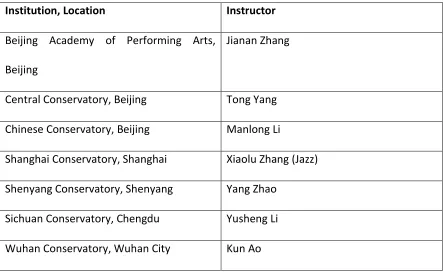
Table 2.1 Notable Current Chinese Saxophone Teachers59
Institution, Location Instructor
Beijing Academy of Performing Arts, Beijing
Jianan Zhang
Central Conservatory, Beijing Tong Yang Chinese Conservatory, Beijing Manlong Li
Shanghai Conservatory, Shanghai Xiaolu Zhang (Jazz) Shenyang Conservatory, Shenyang Yang Zhao
Sichuan Conservatory, Chengdu Yusheng Li Wuhan Conservatory, Wuhan City Kun Ao
59 Xin Gao, “Interview Transcript and Consent Form - [email protected] - Gmail,” accessed
26
Chapter 3
The History of the Saxophone and Saxophone Pedagogy in the Former
Soviet Union
The Saxophone and Jazz in Post-Revolutionary Russia
The history of the saxophone and its pedagogy in the former Soviet Union has a long arc; and, in hindsight, hints of its plight were evident by the end of the Great War. As has been the case in many countries, the history of the saxophone is inextricably bound up with the history of jazz in the Soviet Union. The long and rocky road towards acceptance, with stretches of formal rejection began in the years following the Bolshevik Revolution that roiled Russia in October of 1917.60 Though the United States
and Russia had both been a part of the coalition aimed at defeating the Central Powers in World War I, the relationship between the two countries became increasingly knotty
in the years after the war’s end. This complication of the relationship stemmed in large
part from the divergent nature of the two revolutions that were occurring inside each
nation’s borders. In Russia, an all-encompassing top-down socio-political revolution continued to unfold, while in the United States,a popular revolution from the bottom
60 S. Frederick Starr, Red and Hot: The Fate of Jazz in the Soviet Union, 1917-1980, First Edition edition
27
up was emerging, due in large part to the explosion in popularity of a new musical art form, jazz.61
That jazz and the eventual proletarian dictatorship in Russia would ultimately prove to be strange bedfellows can be gleaned from the diametrically opposed aims of each. The oft-touted American spirit of individual liberty and expression is at the very
heart of jazz’s nature. With its heavy reliance on solos and improvisation, the individualistic nature of jazz placed it in stark opposition to the desire of the ruling Bolshevik party to cultivate a strictly proletarian culture suited to the masses that would emancipate it from the whims of public taste.62 About the early reception of jazz,
scholar S. Frederick Starr says,
To performers and audience alike, the glory or baseness of jazz at its inception was its raucousness and utter indifference to the niceties of nineteenth-century musical etiquette. This was a music in which horn players deliberately bent notes off pitch, in which drummers played at once whole sets of noisemakers including cymbals and Chinese tom-toms, in which the newly popular slide trombone was permitted to smear notes together in guttural glissandos, and in which—and this was the worst of all—that obnoxiously nasal misfit, the saxophone, was actually received as an equal partner.63
For better or for worse, that the saxophone was so closely linked with the freedom of personal expression embodied by jazz only solidified the fact that the reception of each would be closely linked with that of the other. Despite these differences, the new
American art form initially showed some promise in Russia, with the government’s
28
ruling party being largely split over how to interpret and propagandize the music.64 The
initial party responses to jazz in the 1920s were formed from afar, based on recordings rather than live performances with the American art form posing only a distant threat. However, just a few years later in 1925, the decadent Western music had become popular with the metropolitan elite in larger Soviet cities.65
The ambivalence of Soviet authorities was short-lived following Joseph Stalin’s
rise to power in the early 1920s; and, during the Cultural Revolution that ensued shortly thereafter, the official positions on jazz, and in turn, the saxophone quickly soured. Now more explicit than the efforts immediately following the 1917 revolution, under Stalin the suppression of popular art forms and those associated with them was much more explicit, and the Commissariat of Public Enlightenment and the Association of Proletarian Musicians performed their duties in a more heavy-handed manner than the earlier Artistic Control Commission. Although initially unsuccessful, in 1929 proletarian radicals launched a campaign to rid the Soviet Union of the saxophone, but in 1949 such
a campaign proved successful and remained until after Stalin’s death in 1953.66
Curiously though, even in the face of the emerging hostility toward the saxophone that began in the late 1920s, it was during this time that the saxophone was used as an orchestral instrument in the music of Prokofiev and Shostakovich. Though acceptance was tepid at times, perhaps it was the subordinate function of the instrument in these
64 Ibid., 40. 65 Ibid., 17, 53.
66 Stacy Maugans, “The History of the Saxophone in St. Petersburg, Russia,” The Saxophone Symposium 26
29
two works that made its use tolerable.67 As was typical of the times however, neither
acceptance nor rejection persisted indefinitely; and, during the purges of the 1930s,
Prokofiev’s Lieutenant Kijé was banned due to its use of saxophone.68 Similarly, jazz was
often derided as decadent and Western by important figures, while at other times being held up as the embodiment of proletarian ideals. The unsteady position of the government with regard to jazz, and by extension, the saxophone, made artistic life for individuals involved in such pursuits impossible to navigate at times. Furthermore, although the saxophone was often tolerated, finding an instrument could be a very difficult feat. According to one saxophonist at this time, there were only three saxophonists in all of Moscow in 1931.69
The Saxophone and Jazz Following the Second World War
In the years following the Second World War, a second round of censure proved to be more effective than the first. Using the cultural litmus test of kul’turnost, the
official measure of suitability of all things cultural, jazz and its associates were found wanting.70 Furthermore, with the Soviet rendering dzhaz (for jazz) having been
rendered illegal to say in public, in 1949 the most complete repudiation of the saxophone was launched when all state-employed saxophonists were summoned with their instruments to the office of the State Variety Music Agency where their saxophones were confiscated and their identification cards amended to portray them as
67 Ford, The State of Concert Saxophone Pedagogy, Performance, and Composition in the Soviet Union, 25;
Maugans, “The History of the Saxophone in St. Petersburg, Russia,” 56.
68 Maugans, “The History of the Saxophone in St. Petersburg, Russia,” 63.
69 Ibid., 57; Starr, Red and Hot, 42; Ford, The State of Concert Saxophone Pedagogy, Performance, and Composition in the Soviet Union, 5.
30
performers of various other instruments and expunging any record of them ever having been employed as saxophonists.71 Fortunately, this government sanction of jazz and
jazz-related elements was relatively short-lived, and likely due to the death of Joseph Stalin in 1953. Following a period of timid uncertainty, jazz began to re-emerge in the
years following Stalin’s death; and, in 1956 the Soviet government was forced to
officially revisit and revise its prohibition against it paving the way for future developments, including those not related to jazz.72
Classical Saxophone Comes to the Soviet Union
Great orchestral works including the saxophone by composers such as Prokofiev notwithstanding, the saxophone as a serious concert instrument was virtually unknown in the Soviet Union in the years immediately following World War II. Similar to the importation from the West that would occur in China several years later, it would take trips by two Western saxophonists to convert the Soviet musical world into believers. The first occurred in 1961 when the University of Michigan Symphonic Band staged a tour of the USSR. During the tour, Soviet audiences perhaps for the first time, heard classical saxophone when University of Michigan saxophone student Donald Sinta
performed Paul Creston’s Concerto for Alto Saxophone and Band.73 Although these
initial hearings did not result in an immediate establishment of a distinctly Soviet classical saxophone tradition, given the length of the tour, the numerous cities visited,
71 Starr, Red and Hot, 215–16. 72 Ibid., 235, 248, 259.
31
and the generally positive reception of these concerts it is likely that Sinta’s playing
planted a seed that would blossom several years later.74
In 1970 the seeds planted by Donald Sinta’s performances came to fruition when
French Saxophonist Jean-Marie Londeix, summoned by the composer Dmitri Kabalevsky, came to present concerts in the USSR. This second exposure to Western classical saxophone playing proved to be an important event in the history of the Russian classical saxophone tradition.75 Londeix’s tour of the USSR piqued the interests of
composers and performers alike. The immediate aftermath of his performances inspired the composition of new Soviet works for the saxophone, including Edison
Denisov’s canonic staple Sonate for Alto Saxophone and Piano and sparked a lasting collaboration between Londeix and the famed Russian avant-garde composer. Furthermore, in the period following the performances, tangible efforts to create a significant Soviet school of classical saxophone playing were launched.76 Initiated
primarily by clarinetists and amateur saxophone players, classes for saxophone began to appear in Soviet conservatories. In 1970, clarinetist Lev Mikhailov established his saxophone class at the Moscow Conservatory, marking the first of its kind in the country. Shortly thereafter, Margarita Shaposhnikova established a class at the Gnesin Institute also in Moscow. Saxophone classes in various other conservatories in
74 “UM School of Music, Theatre & Dance - 1961 Russian Tour Band,” accessed March 1, 2017,
http://www.music.umich.edu/1961symphonybandtour/index.html; Ford, The State of Concert Saxophone Pedagogy, Performance, and Composition in the Soviet Union, 8.
75 Ford, The State of Concert Saxophone Pedagogy, Performance, and Composition in the Soviet Union, 6–
7.
32
Novosibirsk, Khabarovsk, and Saratov were also started, but the first two proved to be the most influential.77
Early Soviet Saxophone Pedagogy
Though Londeix’s trip to the USSR marked an important turning point for the saxophone in the country, including increased access to extant Western pedagogical materials, the relative isolation of the Soviet Union during the Cold War, combined with the scarcity of Western materials highlighted the dearth of Soviet teaching materials for
the saxophone. In the ensuing years, the country’s fledgling saxophone instructors
would begin to create a repository of Soviet pedagogical materials with pioneers such as Lev Mikhailov and Aleksandr Rivchun leading the way. These various materials targeted players of all ability levels with topics covered ranging from basic music theory to the specifics of saxophone fingerings, articulations, ornamentations, and others. The most important of these is perhaps Lev Mikhailov’s Shkola igry na saksofone (School of Saxophone Playing).78
Despite its having been initially inspired by the French school of saxophone playing, in the years following the establishment of prominent saxophone classes in Moscow by Mikhailov and Shaposhnikova respectively, the Soviet style of playing appears to have begun to develop largely separate from significant Western influence. In the early days, the Soviet classical saxophone sound as described by Christopher Ford
77 Maugans, “The History of the Saxophone in St. Petersburg, Russia,” 67; Ford, The State of Concert Saxophone Pedagogy, Performance, and Composition in the Soviet Union, 10.
78 Ford, The State of Concert Saxophone Pedagogy, Performance, and Composition in the Soviet Union, 10–
33
was typically much brighter than that of French saxophonists, with vibrato used much more sparingly. This difference of sonic conception can also be heard in the early Soviet saxophone quartet aesthetic. Compared to the soprano saxophone-centric sound that was typical of French quartets such as the Marcel Mule Quartet, early Soviet quartets like the Moscow Saxophone Quartet tended towards a more egalitarian use of the four voices.79 Although the relative independence of Russian pedagogy has persisted to a
degree, due to globalization and increased—though still limited—interaction with the West, the general Russian style of classical saxophone playing is no longer as obviously divergent from an aesthetic point of view than that of the French and other international schools of playing.
Later Soviet/Russian Pedagogy and Pedagogues
Margarita Shaposhnikova
In the years following the establishment of the first saxophone classes in the Soviet Union, it would be the second class, established by Margarita Shaposhnikova that would have the greatest influence both locally and globally on the direction and perception of the Russian classical saxophone school. Beginning in the late 1970s,
Shaposhnikova’s students from the Gnesin Academy began to make their mark on the
Soviet musical scene by becoming perennial prizewinners at national competitions such
79 Ford, The State of Concert Saxophone Pedagogy, Performance, and Composition in the Soviet Union, 16–
34
as the All-Union Woodwind Competition, and later, the All-Russian Woodwind competition.80
Like most early Soviet saxophone instructors, Ms. Shaposhnikova is a primarily self-taught saxophonist. She received her musical training as a clarinetist studying at the Saratov Musical College and Gnesin Academy where she currently teaches.81
Although relatively unknown in the West, through the successes of her students in international competitions recently, she has begun to elevate the presence of the Russian school of saxophone playing on the international stage. According to her most famous former student Sergey Kolesov, the pedagogy of Margarita Shaposhnikova is intentionally eclectic and tailored to the needs of individual students. The core of the
saxophone class’ curriculum is made up of original works for saxophone by French,
American, and Russian composers as well as transcriptions from the repertoire of orchestral instruments. Although Ms. Shaposhnikova tirelessly and deftly works with her students on the technical minutiae of saxophone playing, curiously downplayed in her pedagogical approach are method books of any kind, despite having written one herself.82 Instead, students of Ms. Shaposhnikova focus primarily on the varied solo
repertoire. Where appropriate, Ms. Shaposhnikova favors a multi-disciplinary approach, deferring to experts in other musical areas to help her students achieve the best possible results. The success of her approach is evidenced by the fact that two of the
80 Maugans, “The History of the Saxophone in St. Petersburg, Russia,” 70.
81 Sergey Kolesov and Jonathan Kammer, Interview on the History of Russian Saxophone Pedagogy, 2016;
“Margarita Shaposhnikova | Saint Petersburg Music House,” accessed February 28, 2017, http://eng.spdm.ru/margarita-shaposhnikova.
35
last three first prizewinners at the Adolphe Sax Competition in Dinant, Belgium—Sergey Kolesov and Nikita Zimin respectively—have been students of hers at Gnesin Academy.83
First on the International Stage: Sergey Kolesov
Originally from Vologda Oblast, Sergey Kolesov began playing the saxophone at the age of thirteen. Having previously finished musical college (middle school) as a violinist, switching to the saxophone was not his idea, but that of the director of the musical school at which he had studied. Although initially reluctant, Sergey began studying the saxophone with a local teacher named Sergey Kuznetsov who introduced him to various musical styles beyond the classical music he had studied as a violinist; and, he quickly realized that he wanted to make a career for himself as a saxophone player. Though the instrument was becoming more popular amongst young students,
finding an instrument was often still a challenge. Sergey’s first instrument was a Czech tenor saxophone made by Amati and the only one available for purchase in his hometown. In these first years as a saxophonist, Sergey studied and played both jazz and classical music, uncertain of how he viewed his musical future as a saxophonist.84
It was while listening to a recording of Margarita Shaposhnikova playing Russian
composer Mikhail Gottlieb’s concerto for saxophone that Sergey was inspired to
dedicate himself to becoming a first-class concert saxophonist; and, a few years later he
83 “Biography | Nikita Zimin,” accessed March 3, 2017, http://nikita-zimin.com/biography-2/; “Biography
Sergey Kolesov,” accessed March 3, 2017, http://www.sergeykolesov.com/en/; “Margarita Shaposhnikova | Saint Petersburg Music House.”
36
would have the opportunity to enter the Gnesin Academy to study with Ms. Shaposhnikova who accepts a maximum of two students each year.85
According to Kolesov, the opportunity to study with Shaposhnikova was a particularly fortuitous occurrence in his educational career. When he entered Gnesin Academy he was quite confident in his musical abilities, but less so about his technical prowess on the saxophone, crediting his time studying with her to helping him to develop into the eminently capable performer that he is, culminating with his 2006 victory at the Adolphe Sax Competition.86
In the years since his grand-prix win in Dinant, Kolesov has gone on to win several other international competitions and to make a name for himself as both a performer and pedagogue, continuously raising the profile of the Russian classical saxophone school. At present, he teaches in Moscow at the state university helping to develop the next generation of young Russian saxophone talent. As a teacher, Kolesov has inherited many of Shaposhnikova’s pedagogical sensibilities, shying away from many
of the pedantic teaching materials that are commonplace in other saxophone traditions, but he has also crafted a personal style of teaching that is more reflective of his own personality. Kolesov prefers a more psychological approach; his is a holistic
methodology that seeks to address the entirety of the student’s musical journey. About
his own teaching Kolesov says
for this moment in my life, I am not paying too much attention to the technical
skills. Of course, yes, but not like Margarita Shaposhnikova because she’s really
37
very scrupulous. To work with a person, with a personality is very interesting. To see the music that he or she prefers to play, how the music develops their personality. That is very important for me. And also, of course I give some technical secrets, but for me the psychological moments are the most interesting
for me. And it’s a powerful skill as a teacher.87
In this way, he hopes to address the issue of emphasis on technical perfection over musicality and expression that he sees as being too prevalent in other national saxophone traditions.88
The Future of the Russian Saxophone School
Russian saxophone playing of late has taken on a decidedly more cosmopolitan character compared with its early beginnings. This is especially true with young players such as Nikita Zimin and Evgeny Novikov, who pursued studies in Europe after their formative years in Russia.89 These developments notwithstanding, the Russian school at
present is still ostensibly more insular than that of countries who developed a saxophone tradition relatively late, including China. Additionally, compared to other countries with a robust tradition, the avant-garde works that have become synonymous with the saxophone elsewhere have not yet found a consistent place with performers or audiences in Russia.90
Looking forward, people like Kolesov have good reason to be optimistic about the future of the Russian saxophone tradition. According to him, many of the young students in Russia, including his own, are already playing at a higher level than he and
87 Ibid. 88 Ibid.
89 “Biography | Nikita Zimin”; “Keuris Quartet,” KEURIS QUARTET, accessed March 4, 2017,
http://www.keurisquartet.com/about.
38
his peers did at the same age, which according to him is a sign of the fine pedagogical activity in his country.91
39
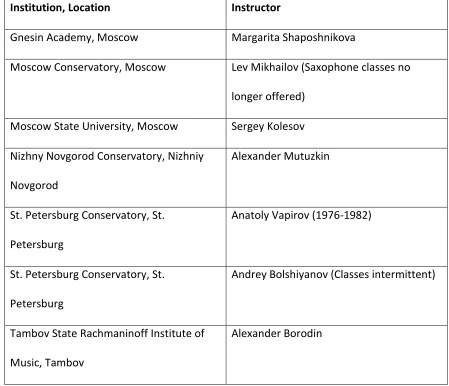
Table 3.1 Notable Current and Former Soviet/Russian Saxophone Teachers92
Institution, Location Instructor
Gnesin Academy, Moscow Margarita Shaposhnikova
Moscow Conservatory, Moscow Lev Mikhailov (Saxophone classes no longer offered)
Moscow State University, Moscow Sergey Kolesov Nizhny Novgorod Conservatory, Nizhniy
Novgorod
Alexander Mutuzkin
St. Petersburg Conservatory, St. Petersburg
Anatoly Vapirov (1976-1982)
St. Petersburg Conservatory, St. Petersburg
Andrey Bolshiyanov (Classes intermittent)
Tambov State Rachmaninoff Institute of Music, Tambov
Alexander Borodin
92 Ibid.; “International Jazz Festival-Summer Varna,” accessed March 3, 2017,
http://www.vsjfbg.com/vapirov-800x600_E.htm; “Andrey Bolshiyanov | Saint Petersburg Music House,” accessed March 1, 2017, http://eng.spdm.ru/andrey-bolshiyanov; Maugans, “The History of the
Saxophone in St. Petersburg, Russia,” 71; “Бородин А.Н.,” accessed March 3, 2017,