International Journal of COPD 2017:12 2239–2256
International Journal of COPD
Dovepress
submit your manuscript | www.dovepress.com 2239
R e v I e w open access to scientific and medical research
Open Access Full Text Article
Prognostic variables and scores identifying the
end of life in COPD: a systematic review
Laura-Jane e Smith1
elizabeth Moore1
Ifrah Ali1
Liam Smeeth2
Patrick Stone3
Jennifer K Quint1,2
1Department of Respiratory epidemiology, Occupational Medicine and Public Health, Imperial College London, 2Department of epidemiology and Population Health, London School of Hygiene and Tropical Medicine, London, 3Marie Curie Palliative Care Research Unit, University College London, UK
Introduction: COPD is a major cause of mortality, and the unpredictable trajectory of the disease can bring challenges to end-of-life care. We aimed to investigate known prognostic variables and scores that predict prognosis in COPD in a systematic literature review, specifically including variables that contribute to risk assessment of patients for death within 12 months.
Methods: We conducted a systematic review on prognostic variables, multivariate score or models for COPD. Ovid MEDLINE, EMBASE, the Cochrane database, Cochrane CENTRAL, DARE and CINAHL were searched up to May 1, 2016.
Results: A total of 5,276 abstracts were screened, leading to 516 full-text reviews, and 10 met the inclusion criteria. No multivariable indices were developed with the specific aim of predict-ing all-cause mortality in stable COPD within 12 months. Only nine indices were identified from four studies, which had been validated for this time period. Tools developed using expert knowledge were also identified, including the Gold Standards Framework Prognostic Indicator Guidance, the RADboud Indicators of Palliative Care Needs, the Supportive and Palliative Care Indicators Tool and the Necesidades Paliativas program tool.
Conclusion: A number of variables contributing to the prediction of all-cause mortality in COPD were identified. However, there are very few studies that are designed to assess, or report, the prediction of mortality at or less than 12 months. The quality of evidence remains low, such that no single variable or multivariable score can currently be recommended.
Keywords: COPD, palliative care, end of life
Introduction
COPD is a major cause of morbidity and mortality and an important public health
challenge.1–3 Prevalence is increasing globally, and according to projections COPD
not only is the third leading cause of death but also will be the seventh leading cause
of disability-adjusted life years (DALYs) lost worldwide by 2030.4
Systematic identification of patients approaching the “end of life” is a key
recom-mendation of the end-of-life care strategy.5 The unpredictable disease trajectory of
COPD6 makes this difficult, compounded by the fact that there is no “gold standard”
method for predicting prognosis in COPD and no clear guidance on how to identify factors that may assist prognostication in the last year of life. Easily measurable physiological parameters and traditional measures of disease severity, such as forced expiratory volume in 1 second (FEV1) or Global Initiative for Chronic Obstructive Lung Disease (GOLD) stage 4 (a severity of airflow obstruction [FEV1 less than 30% predicted]), do not correlate well with mortality in individuals.7,8 There are
grow-ing calls from patients, health care professionals and policy makers for better tools
for prognostication,9 particularly since clinicians’ predictions of survival are often
inaccurate.10,11 Improvement in accuracy of prognostic tools has been identified as a
Correspondence: Jennifer K Quint Department of Respiratory epidemiology, Occupational Medicine and Public Health, Imperial College London, G48 emmanuel Kaye Building, Manresa Road, London Sw3 6LR, UK
Tel +44 20 7594 8821 email [email protected]
Journal name: International Journal of COPD Article Designation: Review
Year: 2017 Volume: 12
Running head verso: Smith et al
Running head recto: Prognostic variables in identifying end of life in COPD DOI: http://dx.doi.org/10.2147/COPD.S137868
International Journal of Chronic Obstructive Pulmonary Disease downloaded from https://www.dovepress.com/ by 118.70.13.36 on 22-Aug-2020
For personal use only.
Number of times this article has been viewed
This article was published in the following Dove Press journal: International Journal of COPD
Dovepress Smith et al
research priority.12 Although there are debates as to whether
prognosis is the best way to identify patients who should be offered a palliative care approach, systematic identification of those likely to be nearing the end of life could form an important part of a strategy to close the gap between need
and receipt of a palliative approach to care,13–17 and may be
an important way to help clinicians overcome “prognostic paralysis.”18
Survival time, advance care planning and patient–provider communication are among some of the 12 key variables
pro-posed to determine the quality of end-of-life care.19
Informa-tion needs are noted to be frequently unmet for patients with COPD, their families and carers. Prognostic information could support shared decision-making, aid estimation of health care utilization and identify groups who would benefit from specific interventions as recommended in national and international guidelines.20,21
A number of variables have been identified which are useful in making predictions about prognosis in COPD and scores that combine a number of variables have been devel-oped, in recognition of the fact that COPD is a multisystem
disease.22 However, many of these have been developed to
estimate long-term prognosis over many years. Prognostic factors that are useful in predicting 10- or 5-year prognosis may not be the most relevant factors to predict which patients are at greatest risk of death within the next year. Since policy literature consistently states that the last year of life is the time during which proactive identification of patients should occur, it is important to understand what tools and variables may aid clinicians in prognostic prediction over this time period.
Therefore, our objective was to investigate known prog-nostic variables and scores that predict prognosis in COPD in a systematic literature review, specifically including variables that contribute to risk assessment of patients for death within 12 months.
Methods
Study design
This was a systematic review. We aimed to investigate known prognostic variables and scores that predict prognosis in COPD, specifically those variables that contribute to risk assessment of patients in the community (ie, not hospital-ized) for death within 12 months. We sought in particular to identify variables and tools that could be used in primary care at an “annual review” or stable COPD visit. No ethical approval was required, since this study is a synthesis of published studies.
The details of the protocol including the search terms used and all inclusion and exclusion criteria have been registered and
published23 and can be found at
www.crd.york.ac.uk/PROS-PERO (registration number CRD42016033866). We included
studies of adults 35 years old with stable COPD with the
out-come of interest of all-cause mortality. We excluded studies of patients with alpha-1-antitrypsin deficiency, or those who had undergone lung transplantation, lung volume reduction surgery or comparative interventional bronchoscopic procedures; studies in which COPD was a covariate, or in which people with COPD formed a subgroup and no separate reporting was available; studies in which prognostic variables were recorded at the time of an exacerbation or hospitalization (as they may not be relevant at a stable visit); studies that investigated prog-nostic markers not typically available in routine clinical care (eg, biomarkers in development or invasive investigations) and studies in which the only exposure was occupational or environmental (eg, air pollution).
We searched Ovid MEDLINE, EMBASE, the Cochrane database of systematic reviews, Cochrane CENTRAL, DARE and CINAHL up to December 30, 2015, and updated the search on May 1, 2016. We used medical subject head-ing and text words related to COPD, and broad strategies to identify prognostic studies and prognostic markers, focused on advanced disease and the end of life. We supplemented our search from other sources including reference lists of included studies, index-related articles on PubMed, and exist-ing relevant reviews, as well as Google Scholar and ProQuest. For any prognostic indices identified, we performed forward and backward citation tracking to identify derivation and
validation studies.24 The search strategy with selected terms
was described in the previously published protocol.23
Selection of studies and extraction
of data
Prognostic studies are more challenging to identify in the literature than diagnostic or treatment studies, so a broad search strategy was used. There was often insufficient infor-mation in the abstract to determine whether the study was appropriate for inclusion and a large number of full texts were screened. Two authors screened the titles and abstracts of all literature retrieved by the initial search against inclusion and exclusion criteria and selected articles for full-text review.
All data were downloaded to Zotero25 for data management.
Two authors reviewed all full-text articles. Differences of opinion were resolved by consensus or by arbitration by a third reviewer. Two reviewers extracted data independently using a prespecified data extraction tool, including details of the
International Journal of Chronic Obstructive Pulmonary Disease downloaded from https://www.dovepress.com/ by 118.70.13.36 on 22-Aug-2020
Dovepress Prognostic variables in identifying end of life in COPD
study setting, study design, population, diagnostic criteria for COPD, method of measurement of each prognostic variable, outcome definition and funding source. The tool also included fields relevant to multivariate models based on the Critical Appraisal and Data Extraction for Systematic Reviews of
Prediction Modelling Studies (CHARMS) checklist26 such as
modeling method, handling of predictors, method for selec-tion of predictors, shrinkage of predictor weights, univariate and multivariate associations, model performance and evalu-ation. This was piloted on the first five full-text reviews to ensure standardized use of the tool. A Preferred Reporting Items for Systematic Review and Meta-analysis Protocols
(PRISMA-P)27 flow diagram was constructed.
Quality assessment
Two reviewers assessed the quality and risk of bias of eli-gible studies based on prespecified domains. An approach
based on the Quality in Prognostic Studies (QUIPS) tool,28
specifically designed for prognostic reviews, was used. We considered questions under six domains: study participation and attrition, prognostic factor measurement, outcome mea-surement, confounding measurement and account, analysis and reporting, and others.
Data synthesis
A narrative synthesis of all identified evidence was com-pleted. We summarized the range of outcome predictors that have been studied to date for the outcome of all-cause
mortality within 12 months in COPD. Hazard ratios and odds ratios were extracted with 95% confidence interval (CI) where possible but were often not reported. With regard to composite scores, we assessed the quality of model building, the methods used to internally and externally validate the score and to what degree clinical utility and impact had been assessed. C-statistics with 95% CIs and measures of calibra-tion including calibracalibra-tion plots and the Hosmer–Lemeshow test were extracted where possible.
We planned to assess the strength of evidence for each prognostic variable or score included based on Grading of Recommendations Assessment, Development and Evaluation
(GRADE) evidence profiles.29 However, since the studies were
so heterogeneous and there was such a paucity of evidence for any single variable or score, this was not possible.
Results
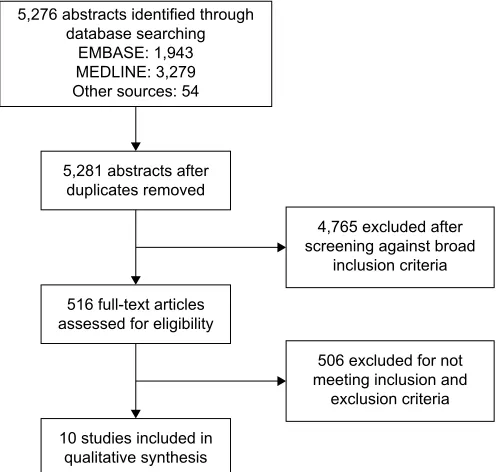
A total of 5,276 abstracts were screened, leading to 516 full-text reviews. Despite these large numbers, only 10 met full inclusion and exclusion criteria (PRISMA diagram, Figure 1). A large number of studies were excluded as they were conducted in hospitalized patients, or in subsets of patients with COPD such as those who had undergone surgery or who were on long-term oxygen and were therefore not representative of patients in the community with stable COPD. A significant number of studies included patients with COPD but did not report any associations between variables and mortality separately so could not be included.
IXOOWH[WDUWLFOHV DVVHVVHGIRUHOLJLELOLW\
VWXGLHVLQFOXGHGLQ TXDOLWDWLYHV\QWKHVLV DEVWUDFWVDIWHU GXSOLFDWHVUHPRYHG
H[FOXGHGDIWHU VFUHHQLQJDJDLQVWEURDG
LQFOXVLRQFULWHULD
H[FOXGHGIRUQRW PHHWLQJLQFOXVLRQDQG
H[FOXVLRQFULWHULD DEVWUDFWVLGHQWLILHGWKURXJK
GDWDEDVHVHDUFKLQJ (0%$6( 0('/,1( 2WKHUVRXUFHV
Figure 1 Screening process.
International Journal of Chronic Obstructive Pulmonary Disease downloaded from https://www.dovepress.com/ by 118.70.13.36 on 22-Aug-2020
Dovepress Smith et al
A large number of studies were excluded as, although they investigated prognostic variables or scores in COPD, they
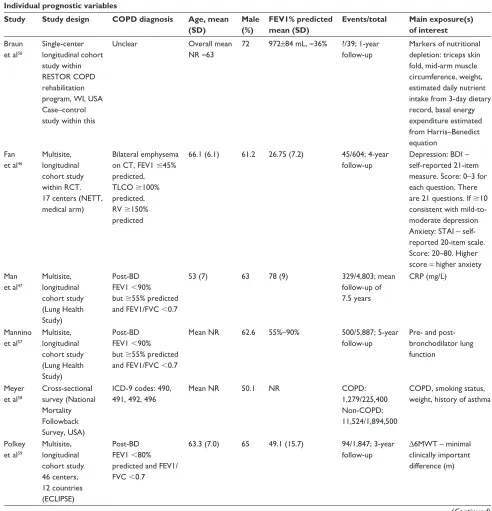
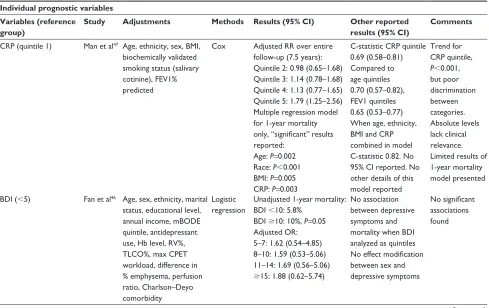
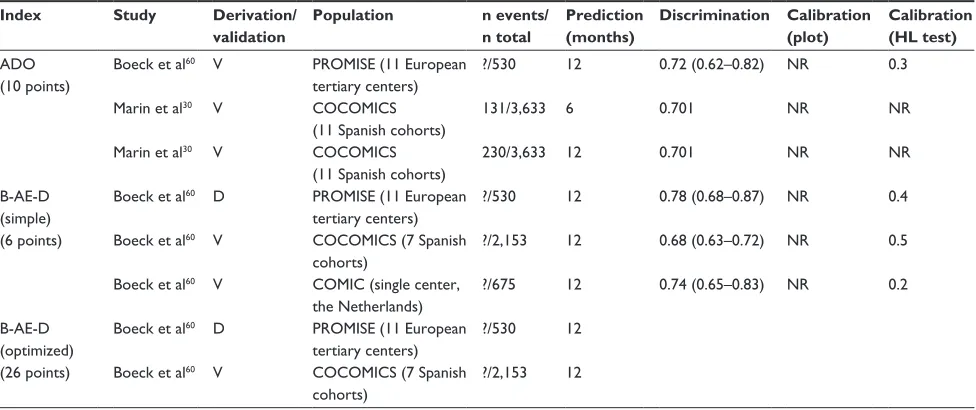
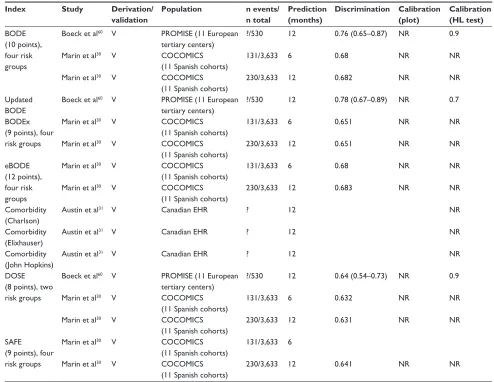
did not report outcomes 12 months. Table 1 describes the
studies that investigated individual and multivariable prog-nostic variables for the prediction of mortality in stable
COPD 12 months. Tables 2 and 3, respectively, describe
the individual and multivariable prognostic indices predictive
of mortality 12 months.
Multivariable indices and scores predicting
all-cause mortality
12 months
No studies reported multivariable indices developed with the specific aim of predicting all-cause mortality in people with stable COPD within 12 months of death. Only nine indices (six of which were truly multivariable, and three of which were comorbidity indices) were identified that had been used for this 1-year time period. Only in the case of the B-AE-D
Table 1 Predictors of mortality in stable COPD 12 months
Individual prognostic variables
Study Study design COPD diagnosis Age, mean (SD)
Male (%)
FEV1% predicted mean (SD)
Events/total Main exposure(s) of interest Braun
et al56
Single-center longitudinal cohort study within ReSTOR COPD rehabilitation program, wI, USA Case–control study within this
Unclear Overall mean
NR ≈63
72 972±84 mL, ≈36% ?/39; 1-year follow-up
Markers of nutritional depletion: triceps skin fold, mid-arm muscle circumference, weight, estimated daily nutrient intake from 3-day dietary record, basal energy expenditure estimated from Harris–Benedict equation
Fan et al46
Multisite, longitudinal cohort study within RCT. 17 centers (NeTT, medical arm)
Bilateral emphysema on CT, Fev1 45% predicted, TLCO 100% predicted, Rv 150% predicted
66.1 (6.1) 61.2 26.75 (7.2) 45/604; 4-year follow-up
Depression: BDI – self-reported 21-item measure. Score: 0–3 for each question. There are 21 questions. If 10 consistent with mild-to-moderate depression Anxiety: STAI – self-reported 20-item scale. Score: 20–80. Higher score = higher anxiety Man
et al47
Multisite, longitudinal cohort study (Lung Health Study)
Post-BD Fev1 90% but 55% predicted and Fev1/FvC 0.7
53 (7) 63 78 (9) 329/4,803; mean
follow-up of 7.5 years
CRP (mg/L)
Mannino et al57
Multisite, longitudinal cohort study (Lung Health Study)
Post-BD Fev1 90% but 55% predicted and Fev1/FvC 0.7
Mean NR 62.6 55%–90% 500/5,887; 5-year
follow-up
Pre- and post-bronchodilator lung function
Meyer et al58
Cross-sectional survey (National Mortality Followback Survey, USA)
ICD-9 codes: 490, 491, 492, 496
Mean NR 50.1 NR COPD:
1,279/225,400 Non-COPD: 11,524/1,894,500
COPD, smoking status, weight, history of asthma
Polkey et al59
Multisite, longitudinal cohort study. 46 centers, 12 countries (eCLIPSe)
Post-BD Fev1 80% predicted and Fev1/ FvC 0.7
63.3 (7.0) 65 49.1 (15.7) 94/1,847; 3-year follow-up
Δ6MwT – minimal clinically important difference (m)
(Continued)
International Journal of Chronic Obstructive Pulmonary Disease downloaded from https://www.dovepress.com/ by 118.70.13.36 on 22-Aug-2020
Dovepress Prognostic variables in identifying end of life in COPD
Table 1 (Continued)
Multivariable prognostic indices
Study Study design COPD diagnosis Age, mean (SD)
Male (%)
FEV1% Events/total Prognostic indices derived/validated Austin
et al31
Multisite, longitudinal cohort study within eHR, ON, Canada
ICD-9 codes: 491, 492, 496
ICD-10 codes: J41, J42, J43, J44
66 (median) 49 NR 14,124/638,926
(but 50% validation); 1-year follow-up
elixhauser Comorbidity Index, Charlson Comorbidity Index, John Hopkin’s Comorbidity Index
Boeck et al60
Longitudinal observational cohort
Smoking history, spirometry
67 (10) 70 49 (17) 54/460; 2-year
follow-up
ADO, B-Ae-D, updated BODe, DOSe
Marin et al30
Pooled individual patient data of observational longitudinal cohort studies
Spirometry 66.4 (9.7) 93.3 53.8 (19.4) 1,245/3,633;
10-year follow-up
ADO, BODe, BODex, eBODe, DOSe, SAFe
Martinez et al61
Multisite, longitudinal cohort study within RCT. 17 centers (NeTT, medical arm)
Bilateral emphysema on CT, Fev1 45% predicted, TLCO 100% predicted, Rv 150% predicted
66.1 (6.1) 61.2 26.75 (7.2) 203/610; 4.5-year follow-up
ΔmBODe
Notes: ADO: age, dyspnea and obstruction; B-AE-D: BMI (B), severe AECOPD frequency (AE), mMRC dyspnea severity (D); BODE: BMI, airflow Obstruction, Dyspnea, and exercise; DOSe: dyspnea, obstruction, smoking, exacerbation. ? represents unknown event number.
Abbreviations: AeCOPD, acute exacerbation of COPD; BD, bronchodilator; BDI, Beck Depression Inventory; BMI, body mass index; CRP, C-reactive protein; CT,
computed tomography; eBODe, exacerbations BODe; BODex, BODeexercise capacity; eHR, electronic health records; Fev1, forced expiratory volume in 1 second; FvC, forced vital capacity; ICD-9, International Classification of Disease, ninth edition; 6MWT, 6-minute walk test; mMRC, modified Medical Research Council; mBODE, modified BODe; NeTT, National emphysema Treatment Trial; NR, not reported; RCT, randomized controlled trial; Rv, residual volume; SAFe, obstruction, exercise, quality of life and exacerbations; STAI, State Trait Anxiety Inventory; TLCO, gas transfer for carbon monoxide.
Table 2 Individual prognostic variables identified predictive of mortality 12 months in stable COPD
Individual prognostic variables Variables (reference
group)
Study Adjustments Methods Results (95% CI) Other reported results (95% CI)
Comments
CRP (quintile 1) Man et al47 Age, ethnicity, sex, BMI, biochemically validated smoking status (salivary cotinine), Fev1% predicted
Cox Adjusted RR over entire follow-up (7.5 years): Quintile 2: 0.98 (0.65–1.68) Quintile 3: 1.14 (0.78–1.68) Quintile 4: 1.13 (0.77–1.65) Quintile 5: 1.79 (1.25–2.56) Multiple regression model for 1-year mortality
only, “significant” results
reported: Age: P=0.002 Race: P0.001 BMI: P=0.005 CRP: P=0.003
C-statistic CRP quintile 0.69 (0.58–0.81) Compared to age quintiles 0.70 (0.57–0.82), Fev1 quintiles 0.65 (0.53–0.77) when age, ethnicity, BMI and CRP combined in model C-statistic 0.82. No 95% CI reported. No other details of this model reported
Trend for CRP quintile, P0.001, but poor discrimination between categories. Absolute levels lack clinical relevance. Limited results of 1-year mortality model presented
BDI (5) Fan et al46 Age, sex, ethnicity, marital status, educational level, annual income, mBODe quintile, antidepressant use, Hb level, Rv%, TLCO%, max CPeT workload, difference in % emphysema, perfusion ratio, Charlson–Deyo comorbidity
Logistic regression
Unadjusted 1-year mortality: BDI 10: 5.8%
BDI 10: 10%, P=0.05 Adjusted OR: 5–7: 1.62 (0.54–4.85) 8–10: 1.59 (0.53–5.06) 11–14: 1.69 (0.56–5.06) 15: 1.88 (0.62–5.74)
No association between depressive symptoms and mortality when BDI analyzed as quintiles
No effect modification
between sex and depressive symptoms
No significant
associations found
(Continued)
International Journal of Chronic Obstructive Pulmonary Disease downloaded from https://www.dovepress.com/ by 118.70.13.36 on 22-Aug-2020
Dovepress Smith et al
Table 2 (Continued)
Individual prognostic variables Variables (reference
group)
Study Adjustments Methods Results (95% CI) Other reported results (95% CI)
Comments
STAI (state or trait) Fan et al46 Univariate analysis only presented
Logistic regression
No association found STAI state per 5-point change OR 0.96, P=0.6 STAI trait per 5-point OR 1.00, P=0.97 No adjusted analysis presented
None No significant
associations found
Smoking status (never smoker)
Meyer et al58
Age group, sex Current smoker: OR 6.5
(4.3–9.9)
Former smoker: OR 3.7 (2.5–5.3)
weight (overweight) Meyer et al58
Age group, sex Underweight: OR 4.5
(2.8–7.2)
Correct weight: OR 1.6 (1.1–2.2)
History of asthma (no history of asthma)
Meyer et al58
Age group, sex OR 5.0 (3.2–7.8)
Markers of nutritional depletion
Braun et al56
Age, sex (matching) Group means only
Unable to extract any meaningful results
Methods and reporting inadequate Longitudinal measurement of individual prognostic variables
Change in mBODe over 6 months
Martinez et al61
Sex, ethnicity, baseline age, baseline mBODe
Decrease: 1 point decreased mortality risk: HR 0.57 (0.41–0.78, P0.001) Increase: 1 point increased mortality risk: HR 2.35 (1.71–3.23, P0.001)
C-statistic mBODe 0.68
Compared to Fev1 0.62, 6MwD 0.64, UCSD SOBQ 0.64. No 95% CI reported
Although multivariate
model, “change”
in score treated as individual prognostic variable 6MwD reduction 30 m
over 12 months
Polkey et al59
None (accuracy not improved when % predicted used)
HR 1.93 (1.29–2.90, P=0.001)
Note: BODE: BMI, airflow Obstruction, Dyspnea, and Exercise.
Abbreviations: BDI, Beck Depression Inventory; BMI, body mass index; CI, confidence interval; CPET, cardiopulmonary exercise testing; CRP, C-reactive protein; FEV1, forced expiratory volume in 1 second; Hb, hemoglobin; HR, hazard ratio; 6MWD, 6-minute walk distance; mBODE, modified BODE; OR, odds ratio; RR, risk ratio; RV, residual volume; STAI, State Trait Anxiety Inventory; TLCO, gas transfer for carbon monoxide; UCSD SOBQ, University of California San Diego shortness of breath questionnaire.
Table 3 Multivariable prognostic indices identified predicting mortality 12 months in stable COPD
Index Study Derivation/
validation
Population n events/ n total
Prediction (months)
Discrimination Calibration (plot)
Calibration (HL test) ADO
(10 points)
Boeck et al60 v PROMISe (11 european tertiary centers)
?/530 12 0.72 (0.62–0.82) NR 0.3
Marin et al30 v COCOMICS
(11 Spanish cohorts)
131/3,633 6 0.701 NR NR
Marin et al30 v COCOMICS
(11 Spanish cohorts)
230/3,633 12 0.701 NR NR
B-Ae-D (simple) (6 points)
Boeck et al60 D PROMISe (11 european tertiary centers)
?/530 12 0.78 (0.68–0.87) NR 0.4
Boeck et al60 v COCOMICS (7 Spanish cohorts)
?/2,153 12 0.68 (0.63–0.72) NR 0.5
Boeck et al60 v COMIC (single center, the Netherlands)
?/675 12 0.74 (0.65–0.83) NR 0.2
B-Ae-D (optimized) (26 points)
Boeck et al60 D PROMISe (11 european tertiary centers)
?/530 12
Boeck et al60 v COCOMICS (7 Spanish cohorts)
?/2,153 12
(Continued)
International Journal of Chronic Obstructive Pulmonary Disease downloaded from https://www.dovepress.com/ by 118.70.13.36 on 22-Aug-2020
Dovepress Prognostic variables in identifying end of life in COPD
Table 3 (Continued)
Index Study Derivation/
validation
Population n events/ n total
Prediction (months)
Discrimination Calibration (plot)
Calibration (HL test) BODe
(10 points), four risk groups
Boeck et al60 v PROMISe (11 european tertiary centers)
?/530 12 0.76 (0.65–0.87) NR 0.9
Marin et al30 v COCOMICS
(11 Spanish cohorts)
131/3,633 6 0.68 NR NR
Marin et al30 v COCOMICS
(11 Spanish cohorts)
230/3,633 12 0.682 NR NR
Updated BODe
Boeck et al60 v PROMISe (11 european tertiary centers)
?/530 12 0.78 (0.67–0.89) NR 0.7
BODex (9 points), four risk groups
Marin et al30 v COCOMICS
(11 Spanish cohorts)
131/3,633 6 0.651 NR NR
Marin et al30 v COCOMICS
(11 Spanish cohorts)
230/3,633 12 0.651 NR NR
eBODe (12 points), four risk groups
Marin et al30 v COCOMICS
(11 Spanish cohorts)
131/3,633 6 0.68 NR NR
Marin et al30 v COCOMICS
(11 Spanish cohorts)
230/3,633 12 0.683 NR NR
Comorbidity (Charlson)
Austin et al31 v Canadian eHR ? 12 NR
Comorbidity (elixhauser)
Austin et al31 v Canadian eHR ? 12 NR
Comorbidity (John Hopkins)
Austin et al31 v Canadian eHR ? 12 NR
DOSe (8 points), two risk groups
Boeck et al60 v PROMISe (11 european tertiary centers)
?/530 12 0.64 (0.54–0.73) NR 0.9
Marin et al30 v COCOMICS
(11 Spanish cohorts)
131/3,633 6 0.632 NR NR
Marin et al30 v COCOMICS
(11 Spanish cohorts)
230/3,633 12 0.631 NR NR
SAFe (9 points), four risk groups
Marin et al30 v COCOMICS
(11 Spanish cohorts)
131/3,633 6
Marin et al30 v COCOMICS
(11 Spanish cohorts)
230/3,633 12 0.641 NR NR
Notes: ADO: age, dyspnea and obstruction; B-AE-D: BMI (B), severe AECOPD frequency (AE), mMRC dyspnea severity (D); BODE: BMI, airflow Obstruction, Dyspnea, and exercise; DOSe: dyspnea, obstruction, smoking, exacerbation. ? represents unknown event number.
Abbreviations: AeCOPD, acute exacerbation of COPD; BMI, body mass index; BODex, BODe exercise capacity; eBODe, exacerbations BODe; eHR, electronic health
records; HL, Hosmer-Lemeshow; mMRC, modified Medical Research Council; NR, not reported; SAFE, obstruction, exercise, quality of life and exacerbations.
score (the four parameters being body mass index [BMI] [B], severe acute exacerbation of COPD [AECOPD] frequency [AE], modified Medical Research Council [mMRC] dyspnea severity [D]) was the study from which the score was derived identified. In all other cases, the studies presenting outcome
at 12 months were not the original derivation of that
pre-dictive score, but rather validation studies.
Marin et al30 provided the most information, validating a
number of existing prognostic indices in a large individual
pooled dataset (n=3,633) from multiple cohort studies with
different stages of COPD. All-cause mortality prediction at both 6 and 12 months was assessed (as well as 3, 5 and 10 years, not presented in this article). These included the original BODE index (BMI, airflow Obstruction, Dyspnea and Exercise) and three of its modifications (modified BODE [mBODE], BODE exercise capacity [x] and exacerbations BODE [eBODE]), the SAFE (obstruction, exercise, quality of
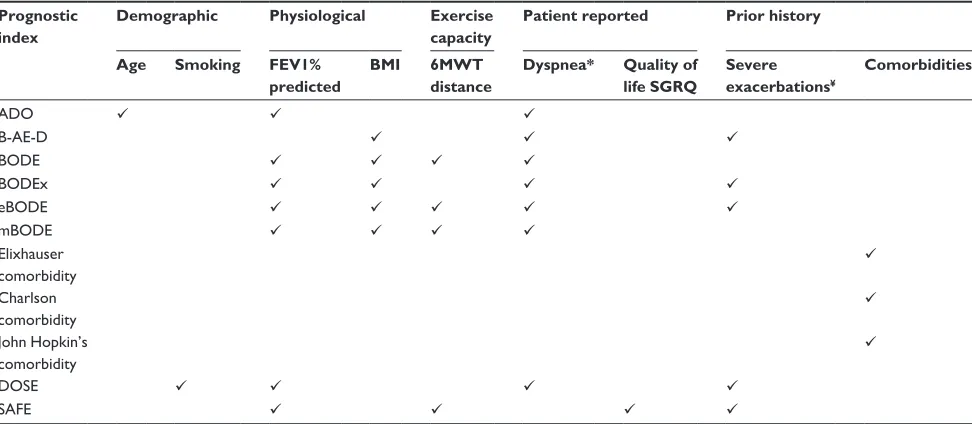
life and exacerbations), ADO (age, dyspnea and obstruction) and DOSE (dyspnea, obstruction, smoking and exacerba-tion) indices (Table 4). These were compared to FEV1. Since the indices share construct variables, they were highly autocorrelated, and unsurprisingly there was little difference in discrimination between similar scores. In this study, the C-statistic for FEV1% predicted at 6 months was 0.657. Over this time period, ADO (C-statistic 0.7015), BODE (C-statistic 0.6808) and eBODE (C-statistic 0.6808) were the best to pre-dict mortality, with DOSE score performing worst (C-statistic 0.632). At 12 months, the C-statistic for FEV1% predicted was 0.656, with ADO the best of the indices tested (C-statistic 0.701). Again DOSE score had the worst discrimination over this time period (C-statistic 0.631). In the Supplementary materials and Tables S1–S4, it was shown that, when adjusted for age, all BODE modifications showed superiority over both BODE and ADO but C-statistics were not individually
International Journal of Chronic Obstructive Pulmonary Disease downloaded from https://www.dovepress.com/ by 118.70.13.36 on 22-Aug-2020
Dovepress Smith et al
Table 4 Shared variables across multivariable indices predicting mortality in COPD 12 months
Prognostic index
Demographic Physiological Exercise capacity
Patient reported Prior history
Age Smoking FEV1% predicted
BMI 6MWT
distance
Dyspnea* Quality of life SGRQ
Severe exacerbations¥
Comorbidities
ADO
B-Ae-D
BODe
BODex
eBODe
mBODe
elixhauser comorbidity
Charlson comorbidity
John Hopkin’s comorbidity
DOSe
SAFe
Notes: *Includes different dyspnea measures: mMRC, Fletcher, and SOBQ. ¥exacerbation history measured over variable time frames, either last 12 or 24 months. ADO:
age, dyspnea, and obstruction; B-AE-D: BMI (B), severe AECOPD frequency (AE), mMRC dyspnea severity (D); BODE: BMI, airflow Obstruction, Dyspnea, and Exercise; DOSe: dyspnea, obstruction, smoking, exacerbation.
Abbreviations: AeCOPD, acute exacerbation of COPD; BMI, body mass index; BODex, BODe exercise capacity; Fev1, forced expiratory volume in 1 second; 6MwT,
6-minute walk test; eBODE, exacerbations BODE; mBODE, modified BODE; mMRC, modified Medical Research Council; SAFE, obstruction, exercise, quality of life and exacerbations; SGRQ, St George’s Respiratory Questionnaire; SOBQ, shortness of breath questionnaire.
reported. No CIs on C-statistics were presented, and there was no assessment of calibration, either by the preferred method of presentation of calibration plots or by calculation of the Hosmer–Lemeshow statistic.
In the study in which the newest index, the B-AE-D index, was developed, a number of existing indices were also tested for the prediction of all-cause mortality at 12 months, includ-ing ADO, BODE and the updated BODE score.
The study by Austin et al31 was quite different from the
oth-ers, using Canadian administrative data to test different comor-bidity classification schemes for predicting all-cause mortality at 12 months. All were shown to have good discrimination and calibration in both incident and prevalent populations, suggest-ing that comorbidity scores are useful in this context. However, without presentation of a sum score or the β coefficients of the regression models, it is not possible to replicate the methods or determine how different comorbidities were weighted, and this finding is therefore of limited application in practice, par-ticularly outside the Canadian health care system.
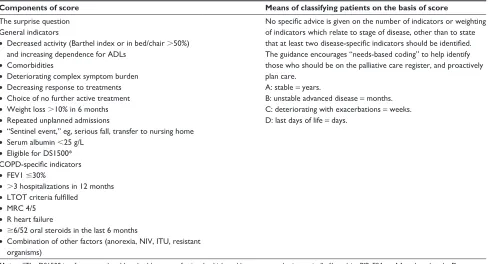
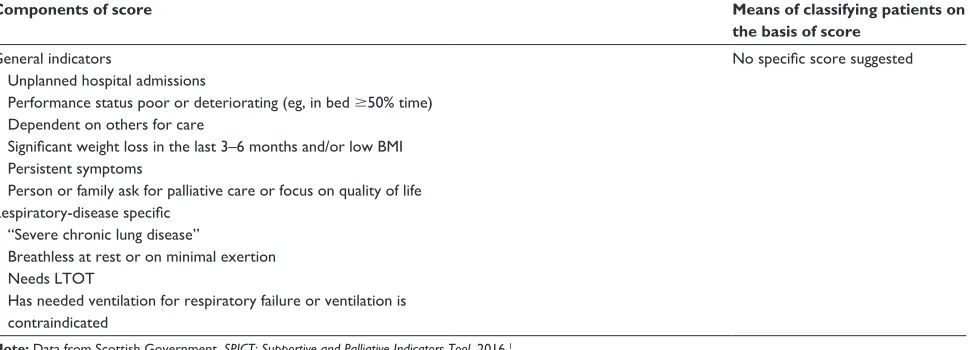
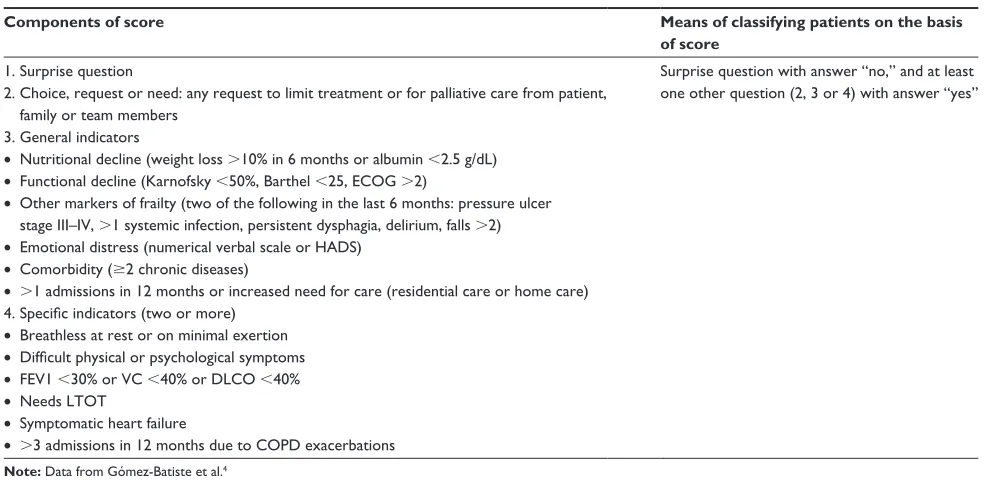
In addition to those multivariable tools derived using statistical methods as discussed earlier, tools developed using expert knowledge were also identified. These draw together not only knowledge from existing studies but also a wealth of clinical experience. A major limitation is that, although a stated aim of several of these tools is to identify those approaching death, the success of these tools in achieving this aim has not been tested. Four tools were identified which
fall into this category for COPD (details of the components of each tool are available in the Supplementary materials and Tables S1–S4): the Gold Standards Framework Prognostic
Indicator Guidance (GSF-PIG),32 the RADboud Indicators
of Palliative Care Needs (RADPAC),33 the Supportive and
Palliative Care Indicators Tool (SPICT)34 and the Necesidades
Paliativas (NECPAL) program tool.35
Table 4 describes the shared variables across multivari-able indices predicting mortality. The fact that many indi-cators are shared among these tools provides evidence of a degree of international consensus about those factors of use in identifying those at risk of death who would benefit from palliative care. However, without evidence of reliable prog-nostic prediction, or other outcomes such as enhanced access to palliative care, it is not possible to confidently recommend any of these tools for use in practice. It is also not possible to compare them with other multivariable tools, developed using statistical methods. It was therefore not possible to include them in the review (further details of tools are given in the Supplementary materials and Tables S1–S4).
Individual variables predicting
1 year
mortality
There was very little evidence for any individual factor in predicting mortality, except in very selected populations (eg, National Emphysema Treatment Trial [NETT]),36 but in this study
there was limited reporting for an outcome of 1-year mortality.
International Journal of Chronic Obstructive Pulmonary Disease downloaded from https://www.dovepress.com/ by 118.70.13.36 on 22-Aug-2020
Dovepress Prognostic variables in identifying end of life in COPD
Impact
No studies were identified as part of the review which assessed the clinical impact of the use of any variable or prognostic index for the identification of patients nearing the end of life. Guidelines on the management of COPD from the British Thoracic Society, European Respiratory Society, American Thoracic Society, Scottish Intercollegiate Guideline Network and GOLD guidelines were also searched to assess the impact of the multivariable scores identified in this review.
The UK National Institute for Health and Care Excellence (NICE) guidelines for COPD recommend that disability in COPD can be poorly reflected by FEV1 alone, and that a more comprehensive assessment includes other known prognostic factors (gas transfer for carbon monoxide [TLCO], breath-lessness on Medical Research Council [MRC] scale, health status, exercise capacity, BMI, partial pressure of oxygen in arterial blood [PaO2] and cor pulmonale) and that the BODE index should be calculated to assess prognosis where its component information is available. These guidelines acknowledge that the additional time and cost of routinely performing 6-minute walk test (6MWT) in all patients may not be justified, particularly in a primary care setting. The BODE index is a routine part of the assessment criteria for lung transplantation for COPD in the UK.
The GOLD guidelines recommend the use of multi-dimensional prognostic indices, but do not specify which
to use, in which circumstances, or settings. GOLD 201137
suggests BODE where 6MWT is available, and BODEx when 6MWT is not available. The Spanish COPD guidelines recommend the use of BODEx for prognostic prediction in COPD, but not for the identification of those in the last year of life specifically.38
Risk of bias
We considered possible spectrum bias39 and the
implica-tions for generalizability of our findings. These findings are summarized in Table 5. Overall, the studies were found to have a moderate risk of bias. The main risk derived from study participants who were not always representative of the general COPD population.
Discussion
This review provides an important summary of what we know about the robustness of available tools to identify those in the last year of life with COPD and shows that more work is needed. A number of variables contributing to the prediction of all-cause mortality in COPD have been identified. Many of the same predictors are combined in different ways in
different multivariable scores, which implies a degree of consensus among investigators as to the important factors. However, there are very few studies that are designed to assess, or which report, the prediction of mortality at or less than 12 months. The quality of evidence remains low, such that no single variable or multivariable score can currently be recommended.
The future brings great challenges for providing high-quality care for the growing population of patients living and dying with COPD, many of whom are cared for in the community. Unless systematic screening of patients with advanced respiratory disease becomes routine, many patients will not realize the benefits of identifying those nearing the end of life.40
Predicting death is a challenge not just for COPD but other conditions such as cardiovascular diseases with pre-dictive models of cardiovascular disease providing similar
C-statistics.41 Clinician predictions of prognosis are
notori-ously inaccurate but prognostication is a core clinical skill that must be both taught better, and supported with better
evidence.42 There may be reluctance to prognosticate in
the absence of an obvious treatment that can be offered. However, there is growing evidence that palliative care interventions improve a number of outcomes in both cancer and non-cancer diagnoses and have even shown a mortality benefit in a randomized controlled trial (RCT) in those
with metastatic non-small cell lung cancer.43 Advance care
planning and holistic palliative care programs with elderly patients, and those with a range of chronic diseases, have shown improvements in concordance with preferred place
of death,44 symptom burden, quality of life and reduced
dis-tress and depression in surviving relatives.45 These studies
began by identifying a population of patients at risk of death, selected due to age, general measures of frailty or dependence or disease-specific measures of severity. We need a robust starting point for such studies in COPD, but as this review shows we do not currently have one.
Methodological limitations
A major limitation is that even those studies that met inclu-sion criteria were in selected populations, such as those
with severe disease in the NETT RCT,46 or those with no
significant comorbidities.47 They are not representative of
the general COPD population, and it is therefore difficult to generalize any conclusions.
In addition, many prognostic indices have been derived in small groups of patients (Supplementary materials and Tables S1–S4). Methods which would maximize power,
International Journal of Chronic Obstructive Pulmonary Disease downloaded from https://www.dovepress.com/ by 118.70.13.36 on 22-Aug-2020
Dovepress Smith et al
Table 5
Risk of bias assessment (included studies)
Study
Participation and attrition Prognostic factor measurement Outcome measurement Confounding measurement
Analysis and reporting
Overall
Braun et al
56
Inadequately described source and sample population. Small sample size Reliance on recall. Missing data and blinding NR. Probable complete case analysis Little detail reported. Inadequate events for number of variables explored No comorbidities recorded. Unclear how confounders other than age and sex accounted for Insufficient data reported. Inadequate statistical approach. Unable to extract relevant data Quality poor. High
risk
of
bias
Fan et al
46
Adequately described but highly selected population, not representative
of
general
COPD population
Measurement appears fine. Missing data and blinding NR. Probable complete case analysis Measurement reliable. But inadequate events for number of variables explored
w
ell recorded, and many
potential confounders included in analysis Analysis and reporting fine. Likely underpowered for this question Quality fine. Moderate-risk bias
Man et al
47
Young cohort, mild disease, few comorbidities (excluded) so not very representative
of
general
COPD population
Measurement appears fine. Missing data and blinding NR. Probable complete case analysis
Measurement reliable. Investigators limited number of covariates, but still danger of inadequate events for number of variables explored, particularly as quintiles
=
additional
parameters estimated
Relevant confounders recorded and adjusted for in model(s) Some aspects of modeling unclear. Stepwise (backward/forward) variable selection on the basis of
P
0.2 univariate,
P
0.1 multivariate. Log
transformation of CRP for some analyses. Little reported on 1-year mortality model –
P
-values
of “significant” results only and C-statistic no CIs Quality moderate. Moderate-risk bias
Mannino et al
57
Source population is adequately described but not a true population- based study. A clinical intervention trial that targeted early COPD Used pre- and post-bronchodilator lung function data to determine whether these measures differ in ability to predict mortality Outcome was all-cause mortality. Measurement reliable. Details on cause of death lacking in results data Adjusted for age, sex race, smoking status, educational level, BMI and randomization, but other confounders such as comorbidities not adjusted for
Analysis and reporting fine
Moderate risk of bias
Meyer et al
58
Limited detail given but fine. Concern regarding reliance on death certificate documentation of COPD as this is known to be
inaccurate
(both
as
cause of death and any mention of COPD)
–
misclassification risk
Death with COPD listed on death certificate ICD-9 codes. Not blinded since relatives asked about smoking and asthma history after death had occurred Age and sex. No treatments recorded. No missing confounder data
Moderate risk of bias
International Journal of Chronic Obstructive Pulmonary Disease downloaded from https://www.dovepress.com/ by 118.70.13.36 on 22-Aug-2020
Dovepress Prognostic variables in identifying end of life in COPD
Polkey et al
59
Described in original study protocol fully, and briefly here No missing data stated (those without two measurements excluded from analysis
– no
imputation
attempted). Blinded for outcome as measured in advance. Do not appear to be blinded to each other, but only really one PF of interest and others covariates All-cause mortality. First hospitalization. Composite of both. Clear definition of exacerbation/ hospitalization too
Treatment not reported, only cardiovascular comorbidity reported. No comments re: missing data. Is a complete case analysis as those without paired 6M
w
D not
included. But data presented both for analyzed group and whole group and no significant difference so bias unlikely. No – results not stratified or adjusted. Hazard ratio reliable Yes – although no adjustments
Moderate risk of bias
Multivariable prognostic indices Study
Participation and attrition
Prognostic factor measurement Outcome measurement Confounding measurement Analysis and reporting
Overall
Austin et al
31
Likely representative. Health care databases so includes all severities, those with comorbidities, women represented. Relies on ICD codes – but previously found to be relatively sensitive/specific. Risk of misclassification. Little detail given about exclusions Comorbidity data relied on databases of hospital discharges and other health care encounters, including billing claims. Possible misclassification bias dependent on quality of coding All-cause mortality: occurrence of death within 365
days of
index date. Fine but some could have been missed due to delays in recording, etc. Probably not significant in this large a population Age and sex. Did not have data on BOD
e components
No CIs on C-statistics presented. No B coefficients presented. Unclear how comorbidities have been weighted Moderate risk
Boeck et al
60
Described in original papers. Some details given in this article. PROMIS
e cohort
not representative – tertiary referral centers.
v
alidation
cohorts more varied but most secondary/tertiary care. Some differences between participants and dropouts (more severe?)
Se
lf-re
po
rt
ed
n
um
be
r
of
exacerbations and severe exacerbations – reliance on r
ec
al
l.
N
in
et
y-ei
gh
t
patients excluded due to miss
in
g
da
ta
(s
om
e
du
e
to
m
iss
in
g
da
ta
a
t b
as
el
in
e)
,
plus 45 excluded due to n
o
1-ye
ar
fo
llo
w
-u
p.
Pa
rt
ic
ip
an
ts
a
lso
e
xc
lu
de
d
fr
om
v
al
id
at
io
n
co
ho
rt
s
if
m
iss
in
g
da
ta
–
n
o
at
te
m
pt
s
at statistical methods, eg, multiple imputation Limited information provided but physician defined cause of death so some clinical
±
record check implied
ethnicity and treatments not recorded. But models tested adding in age, sex, F
ev
1%, smoking
status, 6M
w
D and
made little difference to discrimination. Those with missing data excluded. No imputation. Complete case analysis used – inefficient. Potential bias Missing details in choice of variables – clinical vs statistical methods. Unclear basis on which decisions made. Model building strategy unclear. Seems to be based on clinical conceptual framework, but then Lasso mentioned, but results not reported and unclear whether used Moderate risk
(
Continued
)
International Journal of Chronic Obstructive Pulmonary Disease downloaded from https://www.dovepress.com/ by 118.70.13.36 on 22-Aug-2020
Dovepress Smith et al
Table 5
(
Continued
)
Multivariable prognostic indices Study
Participation and attrition
Prognostic factor measurement Outcome measurement Confounding measurement Analysis and reporting
Overall
Marin et al
30
Predominantly male. All under secondary/ tertiary care. Adequate description of key factors in individual cohorts and overall. Women significantly underrepresented. Inadequate info on loss to follow-up provided but comment that very little long-term follow-up in these cohorts All standard protocols. Limited reliance on recall (required for exacerbations but nothing else and likely to be well remembered as severe only). Cut points driven by indices tested. Blinded for outcome. Not blinded for each other as far as can tell Different cohorts but probably fine
Not necessarily included in analysis – ie, treatments not included. Age a tricky one – included for ADO and in further analysis BODE stratified for age but this was not reported. Difficult to comment due to study design. In some ways does not matter as finding simple model to explain variance. If good discrimination not such an issue which factors/ confounders included Some results thoroughly presented, but some analyses missing, ie, stratification for age – very relevant. Some indices results not reported, eg, mBOD
e,
CPI, SAF
e, HADO,
COPDSS, TARDIS. But in the Supplementary materials, some variables not available so not analyzed
Low risk
Martinez et al
61
Yes described. Representative of this cohort, but not of general COPD population – highly selected. Fine methodologically but not representative of COPD population Yes – factors measured. Cut points based on previous work
Death – little detail provided on how they obtained these data. But cohort, so likely fine Treatment not included as covariate, but “maximal medical treatment” implies triple inhaled therapies, etc. Sex, ethnicity, age and baseline mBOD
e adjusted
for in model Overall: no concerns Clinically based model, no issues
Low risk
Notes:
ADO: age, dyspnea and obstruction; BODE: BMI, airflow Obstruction, Dyspnea, and Exercise.
Abbreviations:
BMI,
body
mass
index;
CI,
confidence
interval;
COPDSS,
COPD
severity
score;
CPI,
COPD
Prognostic
Index;
CRP,
C-reactive
protein;
FEV1,
forced
expiratory
volume
in
1
second;
HADO,
health,
activity,
dyspnea,
obstruction;
ICD-9,
International
Classification
of
Disease,
ninth
edition;
Lasso,
least
absolute
shrinkage
and
selection
operator;
6MWD,
6-minute
walk
distance;
mBODE,
modified
BODE;
NR,
not
reported;
PF,
prognostic
factor;
SAFE,
obstruction, exercise, quality of life and exacerbations; TARDIS, Tayside Allergy and Respiratory Disease Information System.
International Journal of Chronic Obstructive Pulmonary Disease downloaded from https://www.dovepress.com/ by 118.70.13.36 on 22-Aug-2020
Dovepress Prognostic variables in identifying end of life in COPD
such as bootstrapping for internal validation as an alternative to splitting samples into derivation and validation samples, are underused. There was almost no mention of shrinkage or penalized regression methods in the derivation of the identified studies, leading to a high risk of overoptimism, particularly where there are few events in the context of a
large number of potential predictors.48 This is demonstrated
when indices which appeared to perform well in the original study, did not perform well when tested in other popula-tions. Reporting of prognostic studies is of poor quality, making risk of bias assessments challenging. There is a lack of reporting on blinding of variables for each other, on the degree of missing data, on whether model assumptions are met particularly for continuous variables (eg, linear trends), and on methods of predictor selection. Again, this limits confidence in any of the prognostic scores.
A further problem is that prognostic studies have been conducted with many different aims and objectives. A vari-able or index developed to predict future hospitalization may not be optimal to predict mortality. Similarly, an index developed to predict mortality over a 5- or 3-year period may not perform well when used to attempt to predict 1-year
mortality.46 In view of the fact that COPD is a heterogeneous
multisystem disorder, we have perhaps expected too much from any one variable or index. From a methodological point of view, there is no reason to expect a prognostic score developed in one population for one purpose to perform well when applied to another population over a different time period. In contrast to calls for “no more risk scores,” the academic or clinical community perhaps needs to reach a consensus on which indices should be adopted systemati-cally into practice for which purposes, and which questions are as yet unanswered by available tools. The discussion as to whether age should be included in prognostic indices is also relevant here, since if the aim is to derive a prognostic score that can act as a biomarker measured pre and post an intervention we would want it to be sensitive to change in disease-specific factors. However, if the aim is to precisely predict the risk of death for an individual over a relatively short time, then age is likely to be highly relevant. Those prognostic indices that have undergone external validation in various populations, such as BODE, BODEx and ADO, are likely to be of ongoing use in risk stratification. But to identify those likely to be in the last year of life, current tools are inadequate. Of note, no identified tools were developed in a UK population. Of course, all tools must be set within a clinical context in which clinician experience and patient preferences and needs are also integrated.
We recognize that one of the reasons it may be difficult to predict risk of death at 1 year in people with COPD is the fact that they die for multiple different reasons, not just their COPD. Use in clinical practice of scores that predict specific causes of death (eg, cardiovascular risk scores) may ultimately be more useful in certain subgroups of patients but was not the focus of this review.
Future directions
To move forward, for the benefit of patients with COPD, we must continue to build on available evidence, using robust methods for prognostic model development, validation and updating. Although small individual cohort studies may provide data on individual or novel prognostic variables, to develop and validate multivariable tools for use in practice, we must move to the use of large datasets. In addition to pooled individual patient data from trials and observational cohort
studies,30,49 we should seek to use other underexploited data
such as electronic health record databases, particularly as they provide a means of developing and validating prognostic indi-ces in populations of “real-world” patients, and are an efficient and cost-effective use of resources. An optimal risk prediction score to identify community COPD patients at high risk of death within the next year should be simple to use and use readily available risk factors, ideally those that are routinely captured in existing health records. This may include variables identified from existing models such as: FEV1% predicted, age, breathlessness and exacerbation frequency, but may also include other factors identified by consensus by experts, such as comorbidities, use of long-term oxygen therapy (LTOT), prolonged use of oral steroids and measures of frailty.
Incor-poration of the COPD specific comorbidity test score50 may
improve existing indices. A larger number of predictors may be needed, to improve precision in risk estimates. With the use of online calculators, this is feasible. Large datasets also facilitate the development of tools which estimate individual-ized risk prediction, rather than placing patients into broad risk groups. Individualized risk prediction may better support clinical decision-making and shared decision-making.
Prognostic uncertainty and an unpredictable disease trajectory are features in common between advanced COPD and heart disease, but prognostic risk scores are already in widespread use in the cardiology community, in contrast to respiratory medicine. The EFFECT score provides an esti-mate of 30-day and 1-year mortality for those presenting to hospital with heart failure. A recently published Phase II RCT used this tool along with the GRACE score to define a 20% 12-month mortality risk as entry criteria for a trial of future care
International Journal of Chronic Obstructive Pulmonary Disease downloaded from https://www.dovepress.com/ by 118.70.13.36 on 22-Aug-2020
Dovepress Smith et al
planning.51,52 This trial found that using such a risk-threshold
approach was valid as a means of identifying a population of patients at high risk of death or deterioration, with a high burden of comorbidity who may therefore benefit from addi-tional holistic or palliative care. This was despite concerns raised that prognostic estimates should not be the only route to palliative care interventions, and that needs-based assess-ment53 is also key, particularly for those with difficult to treat
symptoms such as breathlessness. Such pathways should work in parallel, with better tools to aid prognostication supporting systematic identification of those who may benefit, particularly
from advance care planning54,55 and other routes to palliative
care services receiving equal support and attention.
Conclusion
Current evidence does not allow clinicians to reliably predict which patients with COPD are approaching end of life, limit-ing ability to provide palliative care services appropriately.
Acknowledgments
This work was supported by the Wellcome Trust (grant number WT107183). The funder provided feedback on the overall research fellowship plan, but had no direct role in the content of the systematic review. PS receives core funding from Marie Curie, but the funder had no direct role in the content of the systematic review.
Author contributions
All authors made substantial contributions to the concep-tion of the study. LJES and IA undertook screening, data extraction and risk of bias assessment. JKQ resolved any differences of opinion. LJES drafted the original manuscript which was reviewed and amended by EM, LS, JKQ and PS leading to revision for important intellectual content. All authors contributed toward data analysis, drafting and criti-cally revising the paper and agree to be accountable for all aspects of the work.
Disclosure
The authors report no conflicts of interest in this work.
References
1. Elkington H, White P, Addington-Hall J, Higgs R, Pettinari C. The last year of life of COPD: a qualitative study of symptoms and services.
Respir Med. 2004;98(5):439–445.
2. Lozano R, Naghavi M, Foreman K, et al. Global and regional mortality from 235 causes of death for 20 age groups in 1990 and 2010: a systematic analysis for the Global Burden of Disease Study 2010. Lancet. 2012; 380(9859):2095–2128.
3. Murray CJ, Lopez AD. Alternative projections of mortality and disability by cause 1990–2020: Global Burden of Disease Study. Lancet. 1997; 24(9064):1498–1504.
4. Global Initative for the Diagnosis, Management, and Prevention of Chronic Obstructive Pulmonary Disease (GOLD) Report; 2015. 5. Department of Health [webpage on the Internet]. End of Life Care
Strategy: Promoting High Quality Care for Adults at the End of Their Life. London: 2008. Available from: https://www.gov.uk/government/ publications/end-of-life-care-strategy-promoting-high-quality-care-for-adults-at-the-end-of-their-life. Accessed June 28, 2016.
6. SA M. Illness trajectories and palliative care. BMJ. 2005;330(7498): 1007–1011.
7. Nishimura K, Izumi T, Tsukino M, Oga T. Dyspnea is a better predic-tor of 5-year survival than airway obstruction in patients with COPD.
Chest. 2002;121(5):1434–1440.
8. Casanova C, Marin JM, Martinez-Gonzalez C, et al. Differential effect of modified medical research council dyspnea, COPD assess-ment test, and clinical COPD questionnaire for symptoms evaluation within the new GOLD staging and mortality in COPD. Chest. 2015; 148(1):159–168.
9. Steinhauser KE, Christakis NA, Clipp EC, McNeilly M, McIntyre L, Tulsky JA. Factors considered important at the end of life by patients, family, physicians, and other care providers. JAMA. 2000; 284(19):2476–2482.
10. Christakis NA, Lamont EB. Extent and determinants of error in doctors’ prognoses in terminally ill patients: prospective cohort study. BMJ. 2000;320:469–473.
11. Lee KL, Pryor DB, Harrell FE Jr, et al. Predicting outcome in coronary disease statistical models versus expert clinicians. Am J Med. 1986;80(4): 553–560.
12. Neuberger J. More Care, Less Pathway – A Review of the Liverpool Care Pathway. London: 2013. Available from: https://www.gov.uk/ government/uploads/system/uploads/attachment_data/file/212450/ Liverpool_Care_Pathway.pdf. Accessed June 28, 2016.
13. Gore JM, Brophy CJ, Greenstone MA. How well do we care for patients with end stage chronic obstructive pulmonary disease (COPD)? A comparison of palliative care and quality of life in COPD and lung cancer. Thorax. 2000;55(12):1000–1006.
14. Crawford E-J, Moudgil H, Srinivasan K, Naicker T, Ahmad N. Coordi-nation of end-of-life care for patients with lung cancer and those with advanced COPD: a letter of response. NPJ Prim Care Respir Med. 2014; 24:14030.
15. Janssen DJ, Engelberg RA, Wouters EFM, Curtis JR. Advance care planning for patients with COPD: past, present and future. Patient Educ Couns. 2012;86(1):19–24.
16. Gott M, Gardiner C, Small N, et al. Barriers to advance care planning in chronic obstructive pulmonary disease. Palliat Med. 2009;23(7): 642–648.
17. Spence A, Hasson F, Waldron M, et al. Active carers: living with chronic obstructive pulmonary disease. Int J Palliat Nurs. 2008;14(8): 368–372.
18. Stewart SMJ. Palliative care for heart failure. BMJ. 2002;325(7370): 915–916.
19. Steinhauser KE. Measuring end-of-life care outcomes prospectively.
J Palliat Med. 2005;8(s1):s30–s41.
20. NICE. Chronic Obstructive Pulmonary Disease in over 16s: Diagnosis and Management. London: NICE; 2015.
21. Celli BR, MacNee W, Agusti A, et al. Standards for the diagnosis and treatment of patients with COPD: a summary of the ATS/ERS position paper. Eur Respir J. 2004;23(6):932–946.
22. van Dijk WD, van den Bemt L, van den Haak-Rongen S, et al. Multidi-mensional prognostic indices for use in COPD patient care. A systematic review. Respir Res. 2011;12:151.
23. Smith LJ, Ali I, Stone P, Smeeth L, Quint JK. Prognostic variables and scores identifying the last year of life in COPD: a systematic review protocol. BMJ Open. 2016;6(9):e011677.
International Journal of Chronic Obstructive Pulmonary Disease downloaded from https://www.dovepress.com/ by 118.70.13.36 on 22-Aug-2020
Dovepress Prognostic variables in identifying end of life in COPD
24. Kuper H, Nicholson A, Hemingway H. Searching for observational studies: what does citation tracking add to PubMed? A case study in depression and coronary heart disease. BMC Med Res Methodol. 2006;6:4. 25. Zotero. 2016. Available from: https://www.zotero.org/. Accessed
June 28, 2016.
26. Moons KGM, de Groot JAH, Bouwmeester W, et al. Critical appraisal and data extraction for systematic reviews of prediction modelling studies: the CHARMS checklist. PLoS One. 2014;11(10):e1001744. 27. Shamseer L, Moher D, Clarke M, et al. Preferred reporting items for
systematic review and meta-analysis protocols (PRISMA-P) 2015: elaboration and explanation. BMJ. 2015;349:g7647.
28. Hayden JA, van der Windt DA, Cartwright JL, Côté P, Bombardier C. Assessing bias in studies of prognostic factors. Ann Intern Med. 2013; 158(4):280–286.
29. Guyatt GH, Oxman AD, Vist GE, et al. GRADE: an emerging consensus on rating quality of evidence and strength of recommendations. BMJ. 2008;336(7650):924–926.
30. Marin JM, Alfageme I, Almagro P, et al. Multicomponent indices to pre-dict survival in COPD: the COCOMICS study. Eur Respir J. 2013;42(2): 323–332.
31. Austin PC, Stanbrook MB, Anderson GM, Newman A, Gershon AS. Comparative ability of comorbidity classification methods for admin-istrative data to predict outcomes in patients with chronic obstructive pulmonary disease. Ann Epidemiol. 2012;22(12):881–887.
32. Gold Standards Framework [homepage on the Internet]. National Gold Standards Framework for End of Life Care. 2017. Available from: http:// www.goldstandardsframework.org.uk/. Accessed June 28, 2016. 33. Thoonsen B, Engels Y, van Rijswijk E, et al. Early identification of
palliative care patients in general practice: development of RADboud indicators for PAlliative Care Needs (RADPAC). Br J Gen Pract. 2012; 62(602):e625–e631.
34. Scottish Government. SPICT: Supportive and Palliative Indicators Tool. 2016. Available from: http://www.gov.scot/resource/doc/924/0111396. pdf. Accessed June 28, 2016.
35. Gómez-Batiste X, Martínez-Muñoz M, Blay C, et al. Identifying patients with chronic conditions in need of palliative care in the general popu-lation: development of the NECPAL tool and preliminary prevalence rates in Catalonia. BMJ Support Palliat Care. 2013;3(3):300–308. 36. Fishman A, Martinez F, Naunheim K, et al. A randomized trial
com-paring lung-volume–reduction surgery with medical therapy for severe emphysema. N Engl J Med. 2003;348(21):2059–2073.
37. Vestbo J, Hurd SS, Agustí AG, et al. Global strategy for the diagnosis, management, and prevention of chronic obstructive pulmonary disease: GOLD executive summary. Am J Respir Crit Care Med. 2013; 187(4):347–365.
38. Golpe R, Mengual-Macenlle N, Martín-Robles I, Sanjuán-López P, Pérez de Llano LA. Prognostic value of multidimensional indices in ambulatory COPD patients. Eur J Intern Med. 2015;26(8):e38–e39. 39. Vandenbroucke JP. Why do the results of randomised and observational
studies differ? BMJ. 2011;343:d7020.
40. BMA. Quality and Outcomes Framework Guidance for GMS Contract 2011/12. London: BMA; 2011.
41. Damen JA, Hooft L, Schuit E, et al. Prediction models for cardiovas-cular disease risk in the general population: systematic review. BMJ. 2016;353(1 pt 2):i2416.
42. Sinclair CT, Glare PA. Palliative medicine review: prognostication.
J Palliat Med. 2008;11(1):84–103.
43. Temel JS, Greer JA, Muzikansky A, et al. Early palliative care for patients with metastatic non–small-cell lung cancer. N Engl J Med. 2010; 363(8):733–742.
44. Detering KM, Hancock AD, Reade MC, Silvester W. The impact of advance care planning on end of life care in elderly patients: randomised controlled trial. BMJ. 2010;340:c1345.
45. Hudson P, Trauer T, Kelly B, et al. Reducing the psychological distress of family caregivers of home based palliative care patients: longer term effects from a randomised controlled trial. Psychooncology. 2015;24(1): 19–24.
46. Fan VS, Ramsey SD, Giardino ND, et al. Sex, depression, and risk of hospitalization and mortality in chronic obstructive pulmonary disease.
Arch Intern Med. 2007;167(21):2345–2353.
47. Man SFP, Connett JE, Anthonisen NR, Wise RA, Tashkin DP, Sin DD. C-reactive protein and mortality in mild to moderate chronic obstructive pulmonary disease. Thorax. 2006;61(10):849–853.
48. Pavlou M, Ambler G, Seaman S, De Iorio M, Omar RZ. Review and evaluation of penalised regression methods for risk prediction in low-dimensional data with few events. Stat Med. 2016;35(7):1159–1177. 49. Altman DG, Trivella M, Pezzella F, Harris AL, Pastorino U. Systematic
review of multiple studies of prognosis: the feasibility of obtaining individual patient data. In: Auget J-L, Balakrishnan N, Mesbah M, Molenberghs G, editors. Advances in Statistical Methods for the Health Sciences. Boston: Birkhäuser; 2007:3–18.
50. Divo M, Cote C, de Torres JP, et al. Comorbidities and risk of mortality in patients with chronic obstructive pulmonary disease. Am J Respir Crit Care Med. 2012;186(2):155–161.
51. Denvir MA, Cudmore S, Highet G, et al. Phase 2 randomised controlled trial and feasibility study of future care planning in patients with advanced heart disease. Sci Rep. 2016;6:24619.
52. Ferrero P, Iacovoni A, D’Elia E, Vaduganathan M, Gavazzi A, Senni M. Prognostic scores in heart failure – critical appraisal and practical use.
Int J Cardiol. 2015;188:1–9.
53. Traue DC, Ross JR. Palliative care in non-malignant diseases. J R Soc Med. 2005;98(11):503–506.
54. Steinhauser KE, Christakis NA, Clipp EC, et al. Preparing for the end of life: preferences of patients, families, physicians, and other care providers. J Pain Symptom Manage. 2001;22(3):727–737.
55. Fallowfield LJ, Jenkins VA, Beveridge HA. Truth may hurt but deceit hurts more: communication in palliative care. Palliat Med. 2002;16(4):297–303.
56. Braun SR, Dixon RM, Keim NL, Luby M, Anderegg A, Shrago ES. Predictive clinical value of nutritional assessment factors in COPD.
Chest. 1984;85(3):353–357.
57. Mannino DM, Diaz-Guzman E, Buist S. Pre- and post-bronchodilator lung function as predictors of mortality in the Lung Health Study. Respir Res. 2011;12(1):136.
58. Meyer PA, Mannino DM, Redd SC, Olson DR. Characteristics of adults dying with COPD. Chest. 2002;122(6):2003–2008.
59. Polkey MI, Spruit MA, Edwards LD, et al. Six-minute-walk test in chronic obstructive pulmonary disease: minimal clinically important dif-ference for death or hospitalization. Am J Respir Crit Care Med. 2013; 187(4):382–386.
60. Boeck L, Soriano JB, Brusse-Keizer M, et al. Prognostic assessment in COPD without lung function: the B-AE-D indices. Eur Respir J. 2016;47(6):1635–1644.
61. Martinez FJ, Han MK, Andrei AC, et al. Longitudinal change in the BODE Index Predicts Mortality in severe emphysema. Am J Respir Crit Care Med. 2008;178(5):491–499.
International Journal of Chronic Obstructive Pulmonary Disease downloaded from https://www.dovepress.com/ by 118.70.13.36 on 22-Aug-2020