Drainage Blocking Detection and Human Body
Identification Using ARM Controller
Chandrika Singh.M
1, KM Saloni Tiwari
2, Nagamani .C
3, Dr C. V Ravishankar
4 4Professor and Head of the Department, Dept. of ECE,
Sambhram Institute of Technology,Bangalore, India
1,2,3
Students of Final year, Dept. of ECE,Sambhram Institute of Technology, Bangalore, India.
Abstract—
Regarding the difficulties in detecting the blocking in the drainage and to identify the human presence in the drainage the proposed method is used. Here the water level sensor is used to detect the increase in the water level, when the drainage gets blocked and it is displayed through the LCD. The blockage may occur due to the presence of wastes such as dry waste, wet waste and presence of human body. The wiper is used to clear the blockage. The wiper pushes all the wastages into the container. Than the segregation takes place. The wet waste is sensed by the humidity sensor than wet waste is segregated. If the drainage gets blocked due to human body presence than image processing is used to identify the human body.Keywords—ARM, Water level sensor, LCD,
Relay, Dc Motor, Humidity Sensor, Image
processing.
I.
INTRODUCTIONMost of the cities adopted the modern drainage system and it is the duty of managing station (Municipal Corporation) to maintain cleanliness of the cities. If the drainage maintenance is not proper the pure water gets contaminate with drainage water and infectious diseases may get spread. The drainage
gets blocked during rainy season, it will create problem for routine life such as traffic may get jammed, the environment becomes dirty, and totally it upsets the public. Suppose if there should be a facility which would be there in Municipal Corporation (managing station) that the officials come to know immediately after blocked drainage in which area and the exact place where it is blocked. So our main objective is detecting the blocking in drainage using water level sensor. If drainage gets blocked and water overflows, it is sensed by the water level sensor, then that sensor sends information to the ARM Controller by displaying in the LCD. If the drainage gets blocked due to presence of human body than image processing is used to identify the human body presence, and this is also displayed through the LCD.
II.
LITERATURE SURVEY
Pearson's correlation coefficient and their energy proportion were extracted and will be used as the clustering features[1]. Finally, the principle component analysis (PCA) was adopted to proceed the dimensionality reduction onto the feature vectors, and the GG (Gath-Geva) algorithm was applied to cluster the feature vectors into classes and to further identify the blocking conditions. The experiment results have suggested that the proposed method is capable of identifying partial blockage conditions of drainage pipeline in different degrees, and presents a certain value for the engineering applications. The acoustic response signal collected from a section of working sewer pipe is decomposed by 3 levels wavelet packet decomposition, and the high-energy wavelet packet nodes are selected to reconstruct the signal to establish feature components. Then the characteristics of wavelet energy entropy, approximate entropy and fractal box dimension of the feature components are extracted respectively, so that the classification feature sets can be constructed [2]. Finally, the particle swarm optimization algorithm is used to optimize the parameters of the SVM classifier to identify the blockage fault signal. The results from the experiments have shown that the method can not only effectively identify the different degrees of blocking failure, but also eliminate the impact of the lateral connection from fault identification [3]. As a result, the accuracy rate of pipeline blockage identification is improved, and the method also provided a research foundation for early fault detection of working pipeline.
Since the data is computed by the computer, many algorithms are developed to detect a face. Some of the key challenges for the process of face detection are discussed. Four general face detection methods that are universally used are elaborated with their
capabilities, advantages and disadvantages. A rapid approach to detect face developed by viola and jones is explained in brief. The 4 main concepts involved in the viola jones method such as haar features, integral image, Adaboost and classifier cascade are demonstrated [4].
After human detection, color and shape information is adopted for human identification. The dominant color feature is to measure the color information from some interesting points within the moving person [5]. The directional swing distance is used to measure the change of body shape while walking. A SVM classifier with these features is trained to recognize persons.
III. OBJECTIVES
The main objective is to detect the blockage in the drainage system.
Segregation of dry waste , wet waste, and human body.
Identifying the human body in drainage system using Image Processing.
Cleaner cities and intelligent management of drainage in the city.
Low-cost and flexible solution for condition monitoring and infrastructure management in the city.
Checking water flow rate continuously, as well as, displaying on the monitor if the water level is exceeding the specified range.
IV
. HARDWARE DESIGN
A. ARM 7 Processor
computers. This approach reduces costs, heat and power use. The low power consumption of ARM Processors made them very popular.
Main features of LPC2148 Microcontroller:
16 bits/32-bit ARM7TDMI-S Microcontroller in a
tiny LQFP64.
8KB to 40 Kb of on chip static RAM and 32kb to
512kb of on-chip flash memory; 128bit wide interface/accelerator enables high speed 60MHz operation.
USB 2.0 Full speed compliant device controller
with 2Kb of endpoint RAM.
LPC2148 provides 10-bit ADC and a total of 6/14 analog inputs, with conversion of time as low as 2.44 ms per channel.
Single 10 bit DAC provides variable analog
output(LPC2148 only).
Low power Real-Time Clock(RTC) with
independent power and 32kHz clock input.
Figure 1: ARM 7 Processor
B. Water level sensor
Water level indicator detect the level of liquids and other fluids and fluidized solids, including slurries, granular materials, and powder that exhibit an upper free surface. Substances that flow become essentially horizontal in their containers (or other physical boundaries) because of gravity whereas most bulk solids pile at an angle of repose to a peak.
Figure2: Water level sensor
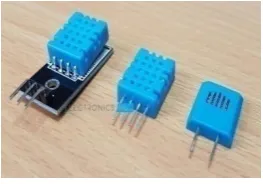
C. Humidity Sensors
Humidity sensor senses, measures and reports both moisture and air temperature.
Figure 3: Humidity Sensor
D. Relay
A relay is an electrically operated switch. Many relays use an electromagnet to mechanically operate a switch, but other operating principles are also used, such as solid state relays. Relays are used where it is necessary to control a circuit by a separate low-power signal, or where several circuits must be controlled by one signal.
E. DC motor
A DC motor is any of a class of rotary electrical
machines that converts direct current electrical energy
into mechanical energy.
Figure 5: DC Motors
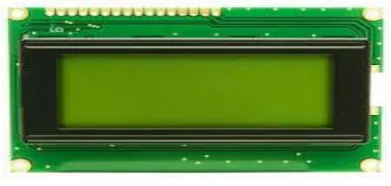
F. LCD
A liquid-crystal display (LCD) is a flat-panel display or other electronically modulated optical device that uses the light-modulating properties of liquid crystals. Liquid crystals do not emit light directly, instead using a backlight or reflector to produce images in colour or monochrome. LCD's are available to display arbitrary images (as in a general-purpose computer display) or fixed images with low information content, which can be displayed or hidden, such as preset words, digits, and seven-segment displays, as in a digital clock.
Figure 6: LCD Display
G. Viola John algorithm
The Viola-Jones algorithm is a widely used
mechanism for object detection. The main property of
this algorithm is that training is slow, but detection is
fast. This algorithm uses Haar basis feature filters, so
it does not use multiplications [4].The efficiency of
the Viola-Jones algorithm can be significantly
increased by first generating the integral image.
H. Image Acquisition
The image Acquisition module uses a low-cost web camera. Web camera is interfaced to process using USB port.
V.SOFTWARE DESIGN
1. MATLAB
MATLAB is a high-performance language for technical computing. It integrates computation, visualization, and programming in an easy-to-use environment where problems and solutions are expressed in familiar mathematical notation. Typical uses include:
Math and computation
Algorithm development
Modeling, simulation, and prototyping
Data analysis, exploration, and visualization
2. KEIL SOFTWARE
3. FLASH MAGIC
Flash Magic is a feature-rich window based tool for the downloading of code into NXP flash microcontrollers. It utilizes features of the microcontrollers called ISP, which allows the transfer of data serially between a PC and the device. Flash magic can erase devices, program them, real data and read and set various configuration information.
Erasing the flash memory
Programming the flash memory
Modifying the Boot Vector and Status Byte
Reading Flash memory
Performing a blank check on a section offlash memory
Reading the signatures bytes
Reading and writing the security bits.
Direct load of new baud rate
Sending commands to place device in Boot loader mode.3.
EMBEDDED C:
When designing software for a smaller embedded system with the 8051, it is very common place to develop the entire product using assembly code. With many projects, this is a feasible approach since the amount of code that must be generated is typically less than 8 Kilo Bytes and is relatively simple in nature.
V1.
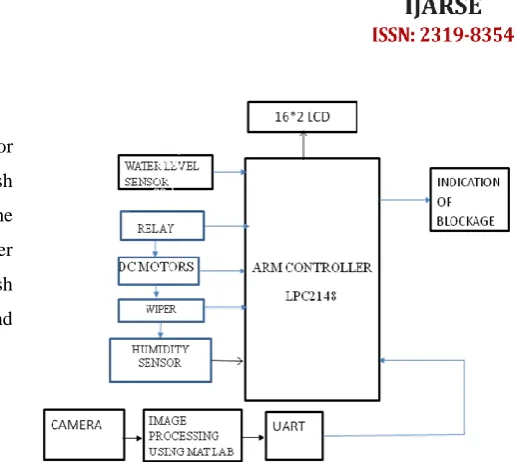
BLOCK DIAGRAM
Figure 7: Block Diagram
VII. WORKING
The water level sensor is used to detect the increase in the water level, when the drainage gets blocked and it is displayed through the LCD. The blockage may occur due to the presence of wastes such as dry waste, wet waste and presence of human body.The ARM Controller will automatically switch on the relay. The relay is controlled by the DC motor. The relay will control the functioning of the wiper. The wiper here are used to clear the blockage occurred inside the drainage. Here we are using 16*2 LCD to display where the blockage has occurred. This is the first part of our project.
VIII. FLOW CHART
no
yes
Yes
Yes
No
No Yes
1X. ADVANTAGES
Problem of blockage in the sewer is removed.
Human effort is reduced and more assurance to the life of sanitary workers.
Avoiding the death of human beings upto maximum level.
Solid waste segregation into degradable, non- degradable and metal waste.
X.APPLICATIONS
Smart city System. Screening of solid waste in pre treatment of waste .
Industrial effluent treatment. River filtration process.
XI. CONCLUSION
Drainage system plays a very important role in big cities where millions of people live. Drainage system is known as the base for land dryness from the excess unused water, rain water and waste water. Drainage conditions should be monitored in order to maintain its proper function. In fact, not all areas have drainage monitoring team. It leads to irregular monitoring of the drainage condition. The irregular monitoring has contribution on the blocking of the drainage that imply to the salutation which trigger flooding in the neighborhood. The problem arises in such drainage lines can cause serious issues to the daily routine of the city. Problems such as blockage due to waste material, sudden increase in the water level as well as various harmful gases can be produces if the proper cleaning actions are not taken time to time. Today’s drainage system is not computerized due to which it is hard to know if blockage is occurring in particular location.
Start
Power up hardware
Display’s on LCD “Drainage blocking detection and human body identification using ARM
Controller”
If blockage
?
Water Level Sensor?
Drainage is clean
Display on LCD “Drainage has blocked”
Wiper clear the blockage and pushes the wastage towards the
container
Wet wastage?
Sensed by humidity Sensor
Human body presence?
REFERENCES
1. Blocking Detection of Underground Drainage Pipe Based on CEEMD and GG Clustering ZHU Xuefeng1,2, FENG Zao1,2, HUANG Guoyong1,21ntermediate Technology Publications, London, 1998.
2. Research on Identifying Drainage Pipeline Blockage based on Multi-Feature FusionJing Yan, Zao Feng , Jiande Wu , Jun MaJournal of instrument and meter, Vol.33, No.8, 1748-1752,2012.t
3. Yusmar Palapa Wijaya, Dini Nurmalasari & Politeknik Caltex Riau, ―Design of Wireless Sensor Network for Drainage Monitoring System‖, Innovative Systems Design and Engineering, vol.5, no.5, 2014.
4. A review on Face Detection and study of Viola Jones method Monali Chaudhari, Shanta sondur, Gauresh Vanjare. International Journal of Computer Trends and Technology (IJCTT) – volume 25 Number 1 – July 2015.