Visualizing electromagnetic vacuum by MRI
Chandrika S Chandrashekar
1, Annadanesh Shellikeri
2, S Chandrashekar
3∗, Erika A Taylor
4, Deanne M Taylor
5,6,7 1. Lincoln High School (class of 2018), 3838 Trojan Trail, Tallahassee, Florida, 32311, USA2. Aeropropulsion, Mechatronics and Energy Center, Florida State University, 2003 Levy Ave., Tallahassee, FL 32310, USA
3. National High Magnetic Field Laboratory (NHMFL) and Florida State University, 1800 E. Paul Dirac Drive, Tallahassee, Florida, 32310, USA 4. Department of Chemistry, Wesleyan University,52 Lawn Ave., Hall-Atwater Labs, Middletown, Connecticut 06459, USA
5. Department of Pediatrics, Perelman School of Medicine, University of Pennsylvania, Philadelphia, Pennsylvania, 19104, USA 6. Department of Biomedical and Health Informatics, The Children’s Hospital of Philadelphia, Philadelphia, PA 19041, USA
7. Department of Genetics, Rutgers University, Piscataway, NJ 08854, USA (∗Corresponding author)
start:20150601posted:20160912rvsn1:20161124rvsn2:20161208
Based upon Maxwell’s equations, it has long been established that oscillating electromagnetic (EM) fields incident upon a metal surface decay exponentially inside the conductor,1–3leading to a vir-tual EM vacuum at sufficient depths. Magnetic resonance imaging (MRI) utilizes radiofrequency (r.f.) EM fields to produce images. Here we present the first visualization of a virtual EM vacuum inside a bulk metal strip by MRI, amongst several novel findings.
We uncover unexpected MRI intensity patterns arising from two orthogonal pairs of faces of a metal strip, and derive formulae for their intensity ratios, revealingdiffering effective elemental volumes (voxels)underneath these faces.
Further, we furnish chemical shift imaging (CSI) results that discriminate different faces (surfaces) of a metal block accord-ing to their distinct nuclear magnetic resonance (NMR) chemical shifts, which holds much promise for monitoring surface chemical reactions noninvasively.
Bulk metals are ubiquitous, and MRI is a premier noninvasive diagnostic tool. Combining the two, the emerging field of bulk metal MRI can be expected to grow in importance. The funda-mental nature of results presented here may impact bulk metal MRI and CSI across many fields.
1. INTRODUCTION
MRI is a household name as a diagnostic tool in the medi-cal field,10, 11with an impressive resume in many other fields,
including the study of materials,12–15corrosion of metals,
mon-itoring batteries and supercapacitors.16, 17
However, historically, MRI of bulk metals has been very rare, limited to specialized cells using r.f. gradients (with limited control),18 instead of the magnetic field gradients employed in conventional MRI. In other studies involving bulk metals, the MRI targeted the surrounding dielectric (electrolyte in elec-trochemical and fuel cells with metallic electrodes, or tissues
with embedded metallic implants).19–30 Notwithstanding, these
studies addressed issues that can cause distortions and limit sensitivity of the MRI images, such as bulk magnetic suscepti-bility (BMS) effects and eddy currents (produced on bulk metal surface due to gradient switching).
The dearth of mainstream bulk metal MRI is rooted in unique challenges posed by the physics of propagation of r.f. EM fields in bulk metals (MRI employs r.f. pulses to generate the MR signal leading to the images). All along, it has been known that the incident r.f. field decays rapidly and exponentially inside the metallic conductor (Fig.1), a phenomenon known as skin effect.1–3 The characteristic length of decay (δ, theskin depth),
typically of the order of several microns (Eq.(S2)), characterizes the limited r.f. penetration into the metal. This in turn, results in attenuated MR signal intensity for bulk metals.4, 19 Turning the
tables, Bhattacharyya et. al.,4exploited the skin effect to sepa-rate and quantify bulk and non-bulk metal NMR signals in Li ion batteries to monitor the growth of dendritic metallic structures. Subsequently, for bulk metal MRI, yet another impediment was correctly diagnosed.5 It was found that the orientation of the bulk metal surface, relative toB1(the r.f. magnetic field), crit-ically affected the outcome. Using optimal alignment of the bulk metal (electrodes), relative toB1, recent studies have suc-cessfully demonstrated and highlighted bulk metal MRI albeit, primarily applied to batteries and electrochemical cells.5–9
Though unanticipated at the time, the recent bulk metal MRI findings eased the implementation of MRI of liquid electrolyte, by helping mitigate adverse effects due to the metal in the vicinity of lithium, zinc and titanium electrodes, yielding fresh insights.7, 8, 31–33Similar benefits may be expected to accrue for MRI based radiology of soft tissues with embedded metallic implants (pacemeakers, prosthetics, dental implants, etc.).
Here, we present several key findings on bulk metal MRI and CSI:
• During a systematic noninvasive thickness measurement of bulk metal strips by MRI7 (section S2), we come across
unexpected regions of intensity, and assign them to two mutually orthogonal pairs of faces of the strip.
• To explain the peculiar ratios of intensities from these dif-ferent regions in bulk metal MRI and CSI, we derive formulae from first principles, unveling a surprising underlying reason: differing effective elemental volumes for these different regions.
• In the process, the images enable a visualization of a virtual EM vacuum inside the bulk metal via anMRI tunnel.
• Additionally, we demonstrate that the bulk metal CSI dis-tinguishes different faces (surfaces) of a metal block according to their distinct NMR chemical shifts.
We attained these by employing three phantoms (samples) P0, P1, P3, depicted schematically in Fig.S1 and described in Methods section 6.1. All phantoms were derived from the same stock of 0.75mmthick lithium (Li) strip. Phantom P3 is a super strip composed of three Li strips pressed together, forming an effectivesingle strip three times thicker than the individual strips in phantoms P0 and P1.
The setup of phantoms, r.f. coil and the gradient assembly ensures that the imaging directionsx, y, zfulfill the condition thatxk ak B1 andz k B0 (the static main magnetic field), with the possibility to reorient the phantom about thex-axis;
a, b, care the three sides of the strips.
Since all MRI and CSI images to follow were acquired with the given phantom’sbcfacesnormal(⊥,perpendicular) toB1, these images bear the imprint of having no contribution from these faces to the magnetic resonance (MR) signal,5–8sinceB1 penetration into the metal is maximal when it isparallel(k) to the metal surface, and minimal when⊥metal surface.1, 5, 6
For details on the MRI experiments, including the nomencla-ture, the reader is referred to Methods section 6.2.
2. MRI
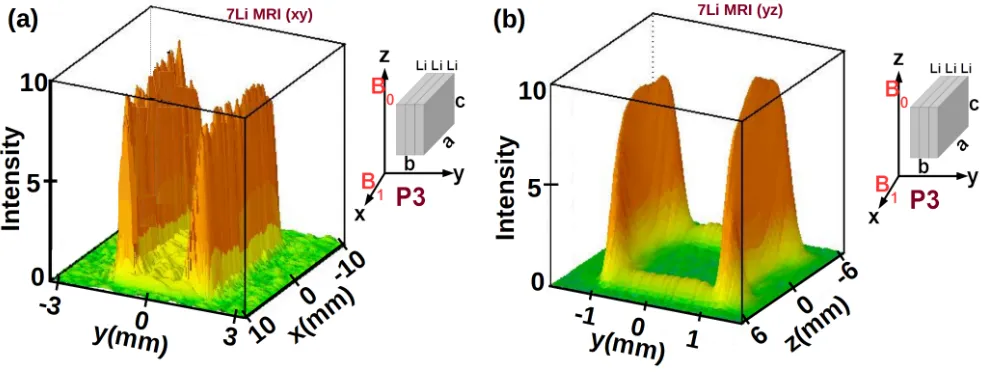
Fig.2 furnishes stackplots (intensity along the vertical axis) of7Li 2d MRI (without slice selection) of phantom P3. Panel
(a) displays MRI(xy). Panel (b) displays MRI(yz).
It is straightforward to infer that thewallsof high intensity regions in either image emanate fromacfaces of the P3 strip,5–7
as we did while measuring the thickness of metal strips (Figs.S2 and S3, section S2). In either image, contributions along the non imaged axis sum up to yield the high intensity walls.
However, the unexpected intensity between the twoacfaces of the super strip, in both the images, is perplexing. The 2d MRI(xy) in Fig.2a exhibits a low intensityplateauspanning the walls. The 2d MRI(yz) in Fig.2b displays low intensityridges bridging the walls.
2.1. Visualizing a virtual eletromagnetic vacuum by MRI
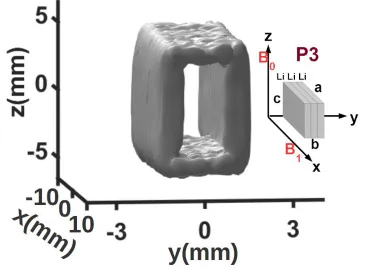
To understand better these unexpected regions of intensity, we acquired7Li 3d MRI(xyz) of phantom P3, shown in Fig.3. In addition to the ac faces (separated along y), the ab faces (separated alongz) are revealed for the first time.
As noted earlier,bcfaces (being⊥toB1) are absent. The hollow region in MRI(xyz) arises from the skin depth phe-nomenon,1–6restricting the EM fields to effectively access only
a limited subsurface underneath theac and ab faces (section S1 and Fig.1). The presence of facesk B1, coupled with the conspicuous absence of faces⊥B1, in combination with the hollow region, imparts the 3d image an appearance of anMRI tunnel, supplying a compelling visualization of a virtual EM vacuumin the interior of a metallic conductor (hitherto depicted only schematically in literature (for e.g. Ref.4)).
With the aid of 3d MRI in Fig.3, the intensity regions in 2d MRI(xy) and 2d MRI(yz) images of Fig.2, can be easily inter-preted as simply regions resulting respectively from projections alongzandxaxes of the 3d image. It is convincingly clear that the intensity betweenacfaces (either the plateau or the ridges), is due to the pair ofabfaces of the superstrip P3.
Yet, the basis for the relative intensity values remains elusive at this stage.
For the 2d MRI(xy) in Fig.2a, it can be argued that, for the
acface the entire length of sidec=7mm(Fig.S1) contributes to the signal, while for theab face, only a subsurface depth
δeff ≈9.49µm contributes (Eq.(S2), Eq.(S7), section S1 and Fig.1). This would lead to a ratio of the corresponding inten-sities,Sac/Sab, to be of the order ofc/(2δeff)≈368(Fig.4a), in obvious and jarring disagreement with the observed ratio (of maxima ofSacandSab) of 6.6.
For the 2d MRI(yz) in Fig.2b, the expected intensity pattern in a stack plot would be one with equal intensities fromaband
acfaces, since they share the same side,a, alongx(non imaged) axis (Fig.4b). This again, is in stark contrast with the observed ratio (of maxima ofSacandSab) of 10.
For the MRI(xyz), naively, uniform intensity would be ex-pected from bothabandacfaces, resulting in a ratio of unity. Instead, the observed ratio (of maxima ofSacandSab) is found to be 3.8.
Thus, the MRI images bear peculiar intensity ratios from comfortably identified (from 3d MRI) regions of the bulk metal. We will return to this topic later.
3. CSI
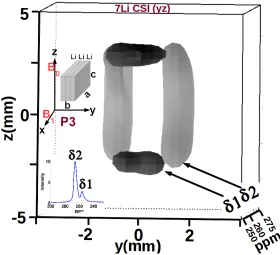
The7Li NMR spectrum of phantom P3 (Fig.5 inset) contains two distinct peaks in the Knight shift region for metallic7Li (see Methods section 6.2), centered atδ1= 256.4 andδ2= 266.3
To gain additional insight as to the spatial distribution of the Li metal species with different NMR shifts, we turn to CSI, which combines an NMR chemical shift (CS) dimension with one or more imaging(I) dimensions.12, 34–36
The 2d CSI(y) shown in Fig.S4 comprises of two bands sep-arated alongy located atδ2, along the CS dimension, while a
low intensity band spans them alongyat a CS ofδ1, strongly
hinting at, the two bands (atδ2) being associated withacfaces.
This observation called for adding an additional imaging di-mension alongz, leading to 3d CSI(yz), which is realized in Fig.5, whereyandzare the imaging dimensions, accompanied by the CS dimension. The bands separated alongz, occur atδ1.
The bands separated alongy, occur atδ2. In conjunction with
the 3d MRI image in Fig.3, it is evident that the pairs of bands atδ1andδ2arise fromabandacfaces respectively, completing
the spatio-chemical assignment.
These assignments readily carry over to 2d CSI(y) in Fig.S4, with the pair of bands atδ2and the low ridge spanning them atδ1,
being respectively identified withacandabfaces. Similarly, in the NMR spectrum, the short and tall peaks respectively atδ1,2
are assigned toabandacfaces, consistent with the reported4, 6 experiments and simulations.
That different types of faces of the bulk metal strip suffer different NMR (Knight) shifts according to their orientations relativetoB0, is consistent with previous observations and sim-ulations,4, 6and has been traced to bulk magnetic susceptibility
(BMS) effect.4–6, 9, 37–39
Interestingly, the 3d CSI sheds new light on previous bulk metal NMR studies. For instance, in an earlier study,4a similar
shift difference between NMR peaks was observed atkand⊥ orientations (relative toB0) of the major faces of a thinner metal strip, by carrying out twoseparateexperiments. Here, phantom P3 furnishes these two orientations in asingleexperiment, via
acandabfaces (Fig.S1). The present work provides physical insight into another previous6observation. It was found that the intensity of NMR peak arising fromabfaces, unlike that from theacfaces, was invariant under rotation aboutzkckB0axis.
Our 3d MRI (Fig.3) and 3d CSI (Fig.5), directly demonstrate that such a rotation leaves the orientation ofB1relative toab face (but not theacface) the same (signal intensity from a given face depends on its orientation relative to B15, 6). Note that the shifts themselves remain unshifted since they depend on the orientation of the faces relative toB0, which does not change under this rotation (acandbcfaces remainkB0, whilstabfaces remain⊥B0).
Thus, bulk metal CSI supplies direct evidence, that the bulk metal chemical (Knight) shifts resulting from BMS are corre-lated with the differing orientations (relative toB0) of different parts of the bulk metal.
Like for MRI, the basis for the ratio of intensities from the
acandabfaces (Sac/Sab≈2.8), is not immediately intuitively obvious and will be explored next.
4. INTENSITY RATIO FORMULAE FOR BULK METAL MRI AND CSI
The peculiar intensity ratios in MRI and CSI, of signalsSab andSac, arising respectively fromabandacfaces of phantom P3 (Fig.2, sections 2 and 3), could be due to gradient switching involved in the MRI experiments (the resultant eddy currents could be different forabandacfaces). However, as shown in section S3, this can be ruled out on the basis of 2d MRI(yz) and MRI(zy) at mutually orthogonal orientations (related by a rotation aboutxkakB1), shown in Fig.S5.
And yet, it is possible to derive, from elementary considera-tions and first principles, and arrive at expressions for theratios of MRI and CSI intensities fromabandacfaces.
For the 2d MRI(xy), in Fig.2a, the signal intensity from the
abfaces can be written as (see Eq.(S8))
Sab(x, y)∝dx dy
Z
dz=dx dy2δeff (1)
withdx dy dz denoting elemental volume of the metal, and
δeffis theeffectivesubsurfacedepththat would account for the
MR signal in theabsenceofB1decay (see Eq.(S7) and Fig.1). Above, the integral overz, is replaced byδeff underneath the
twoabfaces separated alongz.
Similarly, for the signal intensity fromeitherof theacfaces,
Sac(x, y)∝dx dy
Z
dz=dx δeffc (2)
since the subsurface now is⊥y.
Eq.(1) and Eq.(2), reveal differing effective elemental vol-umes(voxels) underneath these faces:
dVeffab=dx dy δeff (3)
dVeffac=dx δeffdz (4)
From Eq.(1) and Eq.(2),
Sac
Sab = c
2∆y (5)
where we have replaceddyby∆y, the resolution alongy kb. Consulting the Methods section 6.2 and Fig.S1,c = 7mm, ∆y=0.25mmand Eq.(5) yields a calculated ratio ofSac/Sab= 14 (as illustrated in Fig.6a), within an order of magnitude of the observed ratio (section 2, Fig.2a) and a 25 fold improvement relative to the expected ratio (Fig.4a).
Continuing in the same vein, for the 2d MRI(yz), in Fig.2b,
Sab(y, z)∝dy dz
Z
dx=a dy δeff (6)
while,
Sac(y, z)∝dy dz
Z
dx=a δeffdz (7)
leading to
Sac
Sab = ∆z
∆y (8)
once again, replacingdy, dzby∆y, ∆z, the respective resolu-tions alongy, z. Using the values of∆y,∆z= 0.0357, 1mm
in Eq.(8), ensues a calculated ratio ofSac/Sab≈28 (as illus-trated in Fig.6b), within an order of magnitude of the observed ratio (section 2, Fig.2b), and 3.5 fold better than the expected ratio (Fig.4b). More importantly, the expected intensity pattern is evenqualitatively (visually) different from the experiment, unlike the derived pattern.
Similarly, for the 2d MRI(zy) in Fig.S5b, of phantom P3 in horizontalorientation, it can be easily shown that,
Sac
Sab = ∆y
∆z (9)
Using the values of∆z,∆y= 0.0357, 1mmin Eq.(9), results in a calculated ratio ofSac/Sab≈28, within an order of mag-nitude of the observed ratio (section S3).
Proceeding along the same lines, for the MRI(xyz) in Fig.3,
Sab(x, y, z)∝dx dy dz=dx dy δeff (10)
while,
Sac(x, y, z)∝dx dy dz=dx δeffdz (11)
As usual by now, replacingdy, dzby∆y, ∆z, the respective resolutions alongy, z, we obtain again Eq.(8). Consulting the Methods section 6.2,∆y,∆z= 0.25, 1mm, respectively. Using these values in Eq.(8) yields a calculated ratio ofSac/Sab= 4, within an order of magnitude of the observed ratio (section 2).
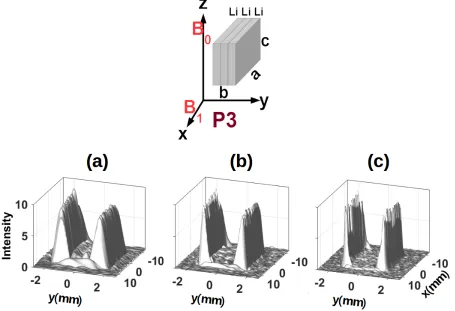
Fig.S7 shows (in stack plot representation, with vertical axis denoting intensity)xyslices (alongz) from the 3d MRI(xyz). The central slice contains no signal between the walls of inten-sity (fromacfaces) as expected. However, the slice from the top
abface exhibits aplateauof intensity between theacfaces, vi-sually demonstrating thatSab6=Sacin the non-hollow regions of the 3d image, in place of the expected uniform intensity.
Similarly, for the 3d CSI(yz) in Fig.5, it can be shown that the ratioSac/Sabis given by Eq.(8), which along with the relevant experimental parameters for this image, yields a calculated value of 2, within an order of magnitude of the observed ratio (of maxima ofSacandSab) of 2.8.
On the other hand, for the 2d CSI(y), in Fig.S4, it can be shown that the ratioSac/Sab is given by Eq.(5), from which we obtain a calculated value of 14, using the experimental pa-rameters in section 6.2. The measured ratio (of maxima ofSac andSab) of 9.5, is again within an order of magnitude of the
calculated value.
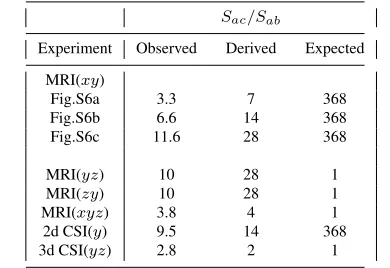
Thus, theSac/Sabratios calculated from Eqs.(5), (8) and (9), agree with the observed values within an order of magnitude for 2d MRI(xy), 2d MRI(yz), 2d MRI(zy), 3d MRI(xyz), 3d CSI(yz) and 2d CSI(y). In fact, discrepancies between observed and derivedSac/Sabratios range only by factors of 0.7 to 2.8 across various MRI and CSI images (see Table.1). More im-portantly, the derived patternsresemble the observed patterns, unlike the expected patterns, which differ even visually from the observed patterns (for e.g., see Figs.2, 4 and 6).
TABLE 1
The observed, derived (from Eqs.(5), (8), (9)), and expected (from skin depth arguments alone) Sac/Sab ratios.
Sac/Sab
Experiment Observed Derived Expected MRI(xy)
Fig.S6a 3.3 7 368 Fig.S6b 6.6 14 368 Fig.S6c 11.6 28 368 MRI(yz) 10 28 1 MRI(zy) 10 28 1 MRI(xyz) 3.8 4 1 2d CSI(y) 9.5 14 368 3d CSI(yz) 2.8 2 1
In summary, the formulae unveil the underlying reason for the significant departure of observedSac/Sabfrom expected values: differing effective elemental volumes underneath these faces, as revealed by Eqs.(3) and (4). The derived patterns bear closer resemblance to experiment, than what is expected from skin depth consideratons alone, or from conventional specifications of the voxel=∆x∆y∆z(see for e.g. Figs.2, 4 and 6).
On a practical note, these formulae can guide experimen-tal strategies to relatively enhance MRI and CSI signals from different regions of the bulk metal.
5. CONCLUSIONS
In conclusion, the unexpected findings presented here may impact bulk metal MRI and CSI studies in general, via fresh insights for data collection, analysis and interpretation. The bulk metal MRI and CSI (correlating different bulk metal sur-faces with distinct chemical shifts) results in this study have the noninvasive diagnostic potential in other fields such as structure of metals and alloys,40, 41 metallurgy (metal fatigue, fracture,
strain),42–44 catalysis,45, 46 bulk metal surface science and
sur-face chemistry,47–49 metallic medical implants, dielectric MRI
in the vicinity of bulk metals etc. (section 1).
ensuring ease of implementation and reproducibility. Thus it is likely to benefit from advances made in the mainstream (medi-cal) MRI field.
6. METHODS 6.1. Phantoms
All phantoms were assembled and sealed in an argon filled glove box. All three phantoms, P0, P1 and P3, shown in Fig.S1 (of dimensionsa×b×c), were derived from a (0.75mmthick) stock Li strip (Alfa Aesar 99.9%). The Li strips were mounted on a 2.3mmthick teflon strip and the resulting sandwich bound together with Kapton tape. Each phantom was placed in a flat bottom glass tube (9.75 mminner diameter (I.D.), 11.5mm
outer diameter (O.D.) and 5cmlong), with the longest side,a, kto the tube axis and to the axis of the home built horizontal loop gap resonator (LGR) r.f. coil (32mmlong, 15mmO.D.), thus guaranteeingB1ka. The phantom containing glass tubes were wrapped with Scotch tape to snugly fit into the r.f. coil.
In Fig.S1,x, y, z specify the imaging (gradient) directions, withzkB0(the main magnetic field). For our horizontal LGR r.f. coil (the MR resonator) and the gradient assembly system,
B1kx, resulting inB1kxka.
• P0: Pair of Li strips separated by a teflon strip; for each Li strip,a×b×c=20 x 0.75 x 7mm3.
• P1: Single Li strip.a×b×c=15 x 0.75 x 7mm3.
• P3: Three Li strips pressed together to yield a single com-posite super strip.a×b×c=15 x 2.25 x 7mm3.
6.2. MRI and CSI
Magnetic resonance experiments were conducted on a
B0=21T magnet (corresponding to 7Li Larmor frequency of
350 MHz) operating under Bruker Avance III system with Top-spin spectrometer control and data acquisition, and equipped with a triple axes (x, y, z) gradient amplifier assembly, using a multinulcear MRI probe (for a triple axes 63mmI.D. gradient stack by Resonance Research Inc.), employing the LGR r.f. coil (resonating at 350 MHz) desribed above.
The MRI and CSI data were acquired using spin-echo imag-ing pulse sequence without slice selection12, 34 (yielding sum
total of signal conributions from the non imaged dimensions). Frequency encoding gradient was employed for the directly de-tected dimension and phase encoding gradients for the indirect dimensions.12, 34 The CSI experiments were carried out with the
NMR chemical shift as the directly detected dimension, with phase encoding gradients along the indirectly detected imaging dimensions. The r.f. pulses were applied at a carrier frequency of 261 ppm (to excite the metallic7Li nuclear spins in the Knight shift region4, 50), typically with a strength of 12.5kHz, with a recycle (relaxation) delay of 0.5 s. The gradient dephasing delay and phase encoding gradient duration were 0.5ms.
Throughout this manuscript, the first axis label (x, y, z) de-scribing an MRI experiment stands for frequency encoding di-mension and the remaining ones correspond to phase econded
dimensions. For e.g., MRI(xyz) implies frequency encoding alongxaxis, and phase encoding along the remaining direc-tions.
Gx, Gy, GzandNx, Ny, Nzdenote respectively the gradient strengths in units ofT /mand number of data points ink-space (∗ denoting complex number of points acquired in quadrature),12, 34 alongx, y, zaxes.Lx, Ly, Lzand∆x,∆y,∆zare respectively the resultant nominal field of view (FOV) and resolution, in units ofmm, alongx, y, zaxes.12, 34
Also,n is the number of transients accumulated for signal averaging andSW is the spectral width (in units ofkHz) for the directly detected dimension in MRI and CSI.
1d MRI(y):
n= 64, SW = 50
Gy = 0.42, Ny∗= 200, Ly= 7.143, ∆y= 0.0357 2d MRI(xy):
n= 32, SW = 100
Gx= 0.24, Nx∗= 200, Lx= 25, ∆x= 0.125
Ly= 10
(1)Gy= 0.12, Ny= 20, ∆y= 0.500(Figs.S2a,S6a) (2)Gy = 0.24, Ny= 40, ∆y= 0.250(Figs.S2b,S3b,2a, S6b) (3)Gy= 0.48, Ny= 80, ∆y= 0.125(Fig.S6c)
2d MRI(yz):
n= 32SW = 50
Gy = 0.42, Ny∗= 200, Ly= 7.143, ∆y= 0.0357
Gz= 0.06, Nz= 16, Lz= 16, ∆z= 1.000 2d MRI(zy):
n= 32, SW = 50
Gz= 0.42, Nz∗= 200, Lz= 7.143, ∆z= 0.0357
Gy = 0.06, Ny = 16, Ly= 16, ∆y= 1.000 MRI(xyz):
n= 16, SW = 100
Gx= 0.24, Nx∗= 200, Lx= 25, ∆x= 0.125
Gy = 0.24, Ny = 40, Ly= 10, ∆y= 0.250
Gz= 0.06, Nz= 16, Lz= 16, ∆z= 1.000 2d CSI(y):
n= 8, SW = 100, number of data points(complex)=1024
Gy = 0.24, Ny = 40, Ly= 10, ∆y= 0.250 3d CSI(yz):
n= 24, SW = 100, number of data points(complex)=1024
Gy = 0.12, Ny = 20, Ly= 10, ∆y= 0.500
Gz= 0.06, Nz= 16, Lz= 16, ∆z= 1.000
the ’value’ (intensity) of a data point by clicking on it, in 1d, 2d and 3d plots).
REFERENCES
1. J. D. Jackson.
Classical Electrodynamics.
(1990), 3rdedition, John Wiley & Sons, Inc.
2. David J. Griffiths.Introduction to Electrodynamics.(1999) 3rdedition,
Pearson Education Inc., Upper Saddle River, New Jersey, 07458, USA. 3. Fawwaz T. Ulaby.Fundamentals of Applied Electromagnetics.(1997),
2001 media edition, Prentice-Hall Inc., Upper Saddle River, New Jersey, 07458, USA.
4. Rangeet Bhattacharyya, Baris Key, Hailong Chen, Adam S. Best, Anthony F. Hollenkamp, Clare P. Grey.
In situ NMR observation of the formation of metallic lithium mi-crostructures in lithium batteries.
Nature Materials, (2010),9, 504-510.
5. S. Chandrashekar, Nicole M. Trease, Hee Jung Chang, Lin-Shu Du, Clare P. Grey and Alexej Jerschow.
7Li MRI of Li batteries reveals location of microstructural lithium.
Nature Materials, (2012),11, 311-315.
6. Andrew J. Ilott, S. Chandrashekar, Andreas Kloeckner, Hee Jung Chang, Nicole M. Trease, Clare P. Grey, Leslie Greengard, Alexej Jerschow.
Visualizing skin effects in conductors with MRI:7Li MRI experiments
and calculations.
J. Magn. Reson., (2014),245, 143-149.
7. Konstantin Romanenko, Maria Forsyth, Luke A. O’Dell.
New opportunities for quantitative and time efficient 3D MRI of liquid and solid electrochemical cell components: Sectoral Fast Spin Echo and SPRITE.
J. Magn. Reson., (2014),248, 96-104. 8. M. M. Britton.
Magnetic resonance imaging of electrochemical cells containing bulk metal.
Chem. Phys. Chem., (2014),15, 1731-1736.
9. Hee Jung Chang, Andrew J. Ilott, Nicole M. Trease, Mohaddese Moham-madi, Alexej Jerschow, and Clare P. Grey.
Correlating microstructural lithium metal growth with electrolyte salt depletion in lithium batteries using7Li MRI.
J. Am. Chem. Soc., (2015),137, 15209-15216. 10. Vincent Perrin.
MRI Techniques.
(John Wiley & Sons, 2013.)
11. Thomas E. Yankeelov, David R. Pickens, Ronald R. Price.
Quantitative MRI in Cancer.
(CRC Press, 2011.) 12. Paul T. Callaghan.
Principles of Nuclear Magnetic Resonance Microscopy.
(2003), Oxford University Press. 13. B. Blumich.
NMR Imaging of Materials.
(Oxford University Press, 2003.)
14. V. S. Bajaj, J. Paulsen, E. Harel and A. Pines.
Zooming in on microscopic flow by remotely detected MRI.
Science, (2010),330, 1078-1081.
15. D. Rugar, H. J. Mamin, M. H. Sherwood, M. Kim, C. T. Rettner, K. Ohno and D. D. Awschalom.
Proton magnetic resonance imaging using a nitrogen-vacancy spin sen-sor.
Nature Nanotechnology, (2015),10, 120-124. 16. A. J. Davenport, M. Forsyth and M. M. Britton.
Visualisation of chemical processes during corrosion of zinc using mag-netic resonance imaging.
Electrochem. Commun., (2010),12, 44-47.
17. Andrew J. Ilott, Nicole M. Trease, Clare P. Grey, and Alexej Jerschow.
Multinuclear in situ magnetic resonance imaging of electrochemical double-layer capacitors.
Nature Communications, (2014), DOI: 10.1038/ncomms5536.
18. R. E. Gerald II, R. J. Klingler, G. Sandi, C. S. Johnson, L. G. Scanlon and J. W. Rathke.
7Li NMR study of intercalated lithium in curved carbon lattices.
J. Power Sources, (2000)89, 237-243.
19. M. Moβle, S-I. Han, W.R. Myers, S-K. Lee, N. Kelso, M. Hatridge, A. Pines, J. Clarke.
SQUID-detected microtesla MRI in the presence of metal.
J. Magn. Reson., (2006),179, 146-151. 20. C. R. Camacho, D. B. Plewes, R. M. Henkelman.
Nonsusceptibility artifacts due to metallic objects in MR-imaging.
J. Magn. Reson. Imaging, (1995),5, 75-88.
21. L. H. Bennett, P. S. Wang, M. J. Donahue.Artifacts in magnetic resonance imaging from metals.J. App. Phys. (1996),79, 4712-4714.
22. R. V. Olsen, P. L. Munk, M. J. Lee, D. L. Janzen, A. L. MacKay, Q. S. Xiang, B. Masri.Metal artifact reduction sequence: Early clinical applications.
Radiographics, (2000),20, 699-712.
23. M. J. Lee, D. L. Janzen, P. L. Munk, A. MacKay, Q-S Xiang, A. McGowan.
Quantitative assessment of an MR technique for reducing metal arti-fact: application to spin-echo imaging in a phantom. Skeletal Radiol, (2001),30, 398-401.
24. A. M. Viano, S. A. Gronemeyer, M. Haliloglu, F. A. Hoffer.Improved MR imaging for patients with metallic implants.Magn. Reson. Imag., (2000),
18, 287-295.
25. F. Shafiei, E. Honda, H. Takahashi, and T. Sasaki.Artifacts from dental casting alloys in magnetic resonance imaging.J. Dent. Res,. (2003),82, 602-606.
26. H. Graf, G. Steidle, P. Martirosian, U. A. Lauer, F. Schick.Effects on MRI due to altered RF polarization near conductive implants or instruments.
Med. Phys., (2006),33, 124-127.
27. K. M. Koch, B. A. Hargreaves, K. Butts Pauly, W. Chen, G. E. Gold, K. F. King.Magnetic resonance imaging near metal implants.J. Magn. Reson. Imaging, (2010),32, 773-778.
28. Joseph F. Zikria, Stephen Machnicki, Eugene Rhim, Tandeep Bhatti, Robert E. Graham. MRI of Patients With Cardiac Pacemakers: A review of the medical literature. American Journal of Roentgenology (2011),196, 390-401.
29. Djaudat Idiyatullin, Curt Corum, Steen Moeller, Hari S. Prasad, Michael Garwood, and Donald R. Nixdorf. Dental MRI: Making the invisible visible.J. Endod. (2011)37, 745-752.
30. Michael Garwood.MRI of fast-relaxing spins.J. Magn. Reson. (2013),
229, 49-54.
31. M. M. Britton, P. M. Bayley, P. C. Howlett, A. J. Davenport, M Forsyth.
In-situ real time visualization of electrochemistry using magnetic reso-nance imaging.J. Phys. Chem. Lett., (2013), 3019-3023.
32. M. Klett, M. Giesecke, A. Nyman, F. Hallberg, K. W. Lindstrom, G. Lind-bergh, I. Furo. Quantifying mass transport during polarization in a li ion battery by in-situ7Li NMR imaging.J. Am. Chem. Soc., (2012),134, 14654-14657.
33. M. Giesecke, S. V. Dvinskikh and I. Furo.Constant-time chemical-shift selective imaging.J. Magn. Reson., (2013),226, 19-21.
34. E. Mark Haacke, Robert E. Brown, Michael R. Thompson and Ramesh Venkatesan.
Magnetic Resonance Imaging:Physical Principles and Sequence Design.
(1999) John Wiley & Sons, Inc.
36. Kirk W. Feindel. Spatially resolved chemical reaction monitoring using magnetic resonance imaging. Magn. Reson. Chem., (2015), doi:10.1002/mrc.4179.
37. R. E. Hoffman.
Measurement of magnetic susceptibility and calculation of shape factor of NMR samples.
J. Magn. Reson. (2006),178, 237-247.
38. Lina Zhou, Michal Leskes, Andrew J. Ilott, N. M. Trease, Clare P. Grey
Paramagnetic electrodes and bulk magnetic susceptibility effects in the in situ NMR studies of batteries: application to Li1.08Mn1.92O4
spinels.
J. Magn. Reson. (2013),234, 44-57.
39. Hee Jung Chang, Nicole M. Trease, Andrew J. Ilott, Dongli Zeng, Lin-Shu Du, Alexej Jerschow, and Clare P. Grey.
Investigating Li microstructure formation on Li anodes for lithium batteries by in situ6Li/7Li NMR and SEM.
J. Phys. Chem. C, (2015),119, 16443-16451. 40. Jose A. Rodriguez, D. Wayne Goodman.
The nature of the metal-metal bond in bimetallic surfaces.
Science (1992)257897-903. 41. C. P. Flynn.
Point defect reactions at surfaces and in bulk metals.
Physical Review B (2005)71085422.
42. L. Gireaud, S. Grugeon, S. Laruelle, B. Yrieix and J. M. Tarascon.
Lithium metal stripping/plating mechanisms studies: A metallurgical approach.
Electrochem. Commun., (2006),8, 1639-1649. 43. B.P.P.A. Gouveia, J.M.C. Rodrigues, P.A.F. Martins.
Fracture predicting in bulk metal forming.
International Journal of Mechanical Sciences (1996)38361-372. 44. M. Mavrikakis, B. Hammer, J. K. Norskov.
Effect of Strain on the Reactivity of Metal Surfaces.
Physical Review Letters (1998)812819-2822. 45. C. J. Zhong et. al.
Nanostructured catalysts in fuel cells.
Nanotechnology, (2010),21, 062001. 46. Fang-Wei Yuan, Hong-Jie Yang, Hsing-Yu Tuan.
Seeded silicon nanowire growth catalyzed by commercially available bulk metals: broad selection of metal catalysts, superior field emission performance, and versatile nanowire/metal architectures.
Journal of Materials Chemistry (2011)2113793-13800.
47. S. Talapatra, S. Kar, S. K. Pal, R. Vajtai, L. Ci, P. Victor, M. M. Shaijumon, S. Kaur, O. Nalamasu and P. M. Ajayan.
Direct growth of aligned carbon nanotubes on bulk metals.
Nature Nanotechnology (2006)1112-116. 48. J. L. Whitten, H. Yang.
Theory of chemisorption and reactions on metal surfaces.
Surface Science Reports (1996)2455-57.
49. Robert G. Greenler.
Infrared Study of Adsorbed Molecules on Metal Surfaces by Reflection Techniques.
The Journal of Chemical Physics (1966)44310-315. 50. A. Abragam.
Principles of nuclear magnetism.
(1961), Oxford University Press, London.
51. D. R. Lide & H. P. R. Frederikse.CRC Handbook of Chemistry and Physics: A Ready-Reference Book of Chemical and Physical Data. 78th edn.(1997), CRC Press.
52. R. R. Ernst, G. Bodenhausen and A. Wokaun.Principles of Nuclear Mag-netic Resonance in One and Two Dimensions.(1987), Oxford University Press.
53. W. M. Saslow. Maxwell’s theory of eddy currents in thin conducting sheets, and applications to electromagnetic shielding and MAGLEV.
Am. J. Phys. (1992),60, 693-711.
54. William Wallace Brey.(2014) Private communication.
55. S. Vashaee, F. Goora, M. M. Britton, B. Newling, B. J. Balcom. Mapping B1-induced eddy current effects near metallic structures in MR images: A comparison of simulation and experiment. J. Magn. Reson. (2015),
250, 17-24.
56. Dye J. Jensen, William W. Brey, Jean L. Delayre, Ponnada A. Narayana. Re-duction of pulsed gradient settling time in the superconducting magnet of a magnetic resonance instrument.Med. Phys., (1987),14, 859.
AUTHOR CONTRIBUTIONS
CSC recognized and analyzed anomaly between observed and expected intensity patterns in the MRI and CSI images, prepared figures, analyzed data, interpreted and discussed results, helped write and proof read manuscript, carried out literature search. AS prepared the phantoms, discussed results, helped write the manuscript.
EAT discussed results, helped write the manuscript. DMT discussed results, helped write the manuscript.
SC conceptualized the project, designed phantoms, designed and conducted experiments, developed analytical tools, orga-nized and analyzed data, interpreted results, derived intensity ratio equations, helped with figures, and wrote the manuscript. All authors reviewed the manuscript.
Additional Information Competing financial interests
FIG. 1. Skin depthδ, andeffectivesubsurface depthδeff.
(a)Exponential decay of magnitude ofB1(y), as a function of the depth from the metal surface (see Eq.(S1) in section S1). (b)Effectivesubsurface depthδeff,withoutB1decay, that would account for the MR signal (see Eq.(S7) in section S1).
FIG. 2. Surprising regions of intensity in bulk metal MRI.
7Li 2d MRI (sans slice selection) stack plots of phantom P3 (Fig.S1 and section 6). Vertical axis denotes intensity, resulting from the sum total of spin density
along non imaged dimension.
(a)2d MRI(xy); same data as in blue, labeled P3, regions of Fig.S3b.
(b)2d MRI(yz).
In either image, there is no contribution from thebcfaces to the MR signal since they are⊥B1(section 1).
In either image, the high intensitywallsare easily associated with theacfaces. (see Figs.S2, S3 and section S2).
FIG. 3. Peering at a virtual electromagnetic vacuum through an MRItunnel.
7Li 3d MRI(xyz) of phantom P3 (Fig.S1). In addition to the already identifiedacfaces in previous images (Figs.2, S2 and S3), theabfaces are revealed for the
first time, accounting for the low intensity regions in Fig.2. Thebcfaces are conspicuous by absence, being⊥B1. The resultingMRI tunnelsupplies a compelling
visual ofpeeringat a virtual EM vacuum in the interior of a metallic conductor (see section 2).
FIG. 4. Expectedrelative intensities in bulk metal MRI.
Illustration ofexpectedrelative intensities from different pairs of faces in bulk metal7Li 2d MRI of phantom P3 as stack plots (intensity along vertical axis):(a)
2d MRI(xy).(b)2d MRI(yz).
In either illustration, there is no contribution from thebcfaces to the MR signal since they are⊥B1(section 1).
For MRI(xy) in panel (a), the expected ratio of signal intensities fromacandabfaces (Sac/Sab≈368) is in obvious disagreement with experiment (Fig.2a).
FIG. 5. Chemical shift imaging of a bulk metal strip.
7Li 3d CSI(yz) of phantom P3: chemical shift,yandzaxes comprise the three dimensions.
Despite being composed ofidenticalLi atoms,7Li NMR spectrum (inset) of phantom P3 exhibits two peaks, instead of theexpectedsingle peak (section 3). Short and tall peaks are centered respectively atδ1= 256.4 andδ2= 266.3 ppm.
In the CSI, bands separated alongz, occur at CSδ1. The bands separated alongy, occur at CSδ2.
In conjunction with the 3d MRI (Fig.3) and P3 schematics (Fig.S1), the pair of bands atδ1are assigned toabfaces, and pair of bands atδ2are assigned toac
faces (thus completing the assignment of both the 2d CSI(y) in Fig.S4, and the NMR spectrum itself).
FIG. 6. Predictedrelative intensities in bulk metal MRI.
Illustration ofpredicted(from the derived formulae) relative intensities from different pairs of faces in bulk metal7Li 2d MRI of phantom P3 as stack plots
(intensity along vertical axis).
(a)2d MRI(xy) based on Eq.(5):Sac/Sab= 14.
(b)2d MRI(yz) based on Eq.(8):Sac/Sab= 28.
In either illustration, there is no contribution from thebcfaces to the MR signal since they are⊥B1(section 1).
SUPPORTING INFORMATION
for
Visualizing electromagnetic vacuum by MRI
Chandrika S Chandrashekar
1, Annadanesh Shellikeri
2, S Chandrashekar
3∗, Erika A Taylor
4, Deanne M Taylor
5,6,7 1. Lincoln High School (class of 2018), 3838 Trojan Trail, Tallahassee, Florida, 32311, USA2. Aeropropulsion, Mechatronics and Energy Center, Florida State University, 2003 Levy Ave., Tallahassee, FL 32310, USA
3. National High Magnetic Field Laboratory (NHMFL) and Florida State University, 1800 E. Paul Dirac Drive, Tallahassee, Florida, 32310, USA 4. Department of Chemistry, Wesleyan University,52 Lawn Ave., Hall-Atwater Labs, Middletown, Connecticut 06459, USA
5. Department of Pediatrics, Perelman School of Medicine, University of Pennsylvania, Philadelphia, Pennsylvania, 19104, USA 6. Department of Biomedical and Health Informatics, The Children’s Hospital of Philadelphia, Philadelphia, PA 19041, USA
7. Department of Genetics, Rutgers University, Piscataway, NJ 08854, USA (∗Corresponding author)
start:20150601posted:20160912rvsn1:20161124rvsn2:20161208
S1. EFFECTIVE SUBSURFACE DEPTH,δEFF
The r.f. EM fields, upon encountering bulk metal, face the phenomenon ofskin effect. Of particular interest to this work, is the fact that the magnitude of the r.f. magnetic field (B1) decays exponentially inside the metal according to1–3
B1(y) =B1(0)e−y/δ (S1)
at a depthybeneath the surface as shown in Fig.1a. The char-acteristic lengthδ(the skin depth), is determined by:
δ=
r
2
µσωr.f. (S2)
where, σ is the conductivity of the conductor (metal), µ, its magnetic permeability, with,
µ=µ0µr; σ= 1/ρ; ωr.f.= 2πνr.f. (S3)
where,ρis the resistivity of the metal,µris the relative magnetic permeability of the metalrelativetoµ0, the free space
permit-tivity, andνr.f.is the (radio) frequency of the applied field. µ0= 4π 10−2mkgA−2s−2.51 For Li, ρ= 92.8 nΩ m, µr=1.4.51 νr.f.= 350 M Hz, is the frequency of the applied r.f. field, set to the resonance (Larmor) frequency for
7Li in a magnetic field of strength 21T. When used in Eq.(S2),
these values yieldδ≈6.9µm.
Consider a face k B1. Using Eq.(S1), the subsurface be-neath this face, per unit surface area, contributes to the signal according to,4
S∝
Z ∞
0
dy sin(θ0e−y/δ) (S4)
where,
θ0≡θ(0) =γB1(0)τ (S5)
is the r.f. flip angle12, 34, 50, 52 at the metal surface (y=0),4 γ, the gyromagnetic ratio for7Li nucleus,τ, the duration of the applied r.f. pulse. Eq.(S4) may be readily recast as:
S∝δ Z θ0
0
dysinc(y)≡δ Si(θ0) (S6)
where, sinc(y) = siny/y. The well known "Sine" integralSi
can be evaluated by numerical integration (for e.g., using the function "sinint" of popular mathematical software MatLab).
In particular, for flip angleθ0=π2,4 using Eq.(S6), the signal
contribution, from the subsurface per unit surface area is
S ∝1.3708δ≡δeff (S7)
where,δeff is theeffectivesubsurface depth contributing to the
signal, in theabsenceof exponential decay ofB1(Fig.1b). We can generalize the proportionality above to an arbitrary elemen-tal surface area (⊥y):
S∝dx dz δeff (S8)
For our case, from Eq.(S7),δeff≈9.49µm(Fig.1b).
S2. METAL STRIP THICKNESS FROM MRI S2.1 Phantom P0 with 2 Li strips
The now familiar5–7 bulk metal two dimensional (2d) MRI(xy), for phantom P0 (Fig.S1) is shown in Fig.S2a. The extent of image intensity bands along the direction of separation
(y), arises from each (b=0.75mmthick) conducting metal strip, and is mainly determined by the image resolution (0.5mm) alongy(Methods section 6.2). It is difficult to deduce the strip thickness accurately (each band yielding 1.8mmfor each strip). The situation is quite different attwicethe resolution along
y, as shown in Fig.S2b. For the higher resolution image, each conducting metal strip gives rise to two bands, from theacfaces kB1, since the magnitudes of strip thickness, skin depth and resolution collude together to resolve the faces of each strip.6, 7
The strip thickness is thrice the resolution and is far greater (79 x) thanδeff (= 9.49µmfor our case, as shown in section S1; the two effective subsurfaces beneath theacfaces are separated by 731µm). The intra strip band separation yields a measured thickness of 0.80 and 0.79mmrespectively for top and bottom strips (a ratio of 0.99). By contrast, for the image in panel (a), the signals from the two faces of a given strip coalesce into a single band due to inadequate resolution.
S2.2 Phantoms P1 and P3
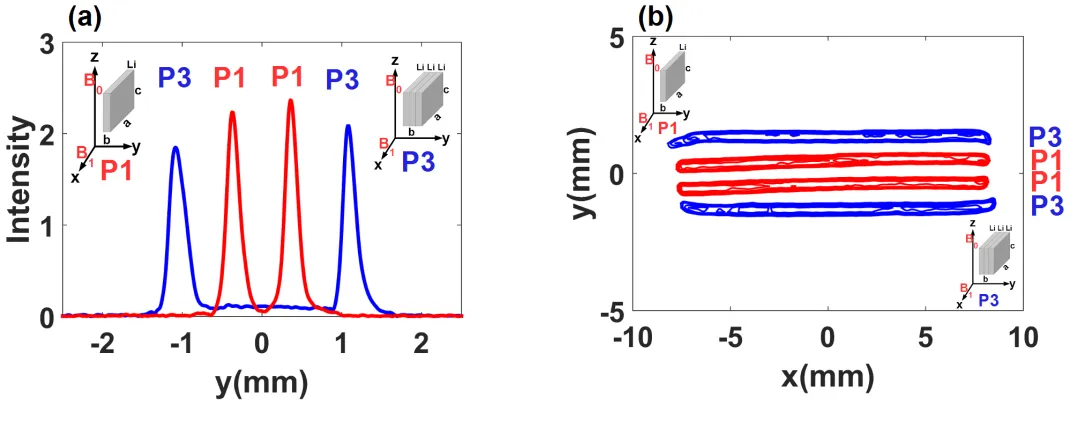
Fig.S3 displays an overlay of 7Li 1d MRI(y) in panel (a), and 2d MRI(xy) in panel (b), from phantoms P1 and P3. The nominal resolutions alongy, for 1d MRI(y) and 2d MRI(xy), are respectively 0.0357 and 0.25mm. Each phantom gives rise to two bands emanating from itspairofacfaces. The separaton (alongy) amongst the intra-strip bands yields the strip thickness. It is evident that the super strip of phantom P3, composed of 3 Li strips pressed together behaves as a single strip. Mere visual inspection of the images, by virtue of the equal spacing between the 4 bands alongy, suggests that P3 is thrice the thickness of P1.
The thickness for P3 and P1 are respectively, 2.163 and 0.73
mmfrom the 1d images, and 2.51 and 0.83mmfrom the 2d images, verifying that P3 is≈3x thicker than P1.
Thus, the drawback of limited r.f. penetration and attenuated signal in bulk metals, due to skin-effect, can be turned into an opportunity to undertake noninvasive thickness measurements.7
S3.PECULIARINTENSITY RATIOS IN BULK METAL MRI AND CSI
In section 4 we proposed that gradient switching during MRI experiments could be responsible for the observed intensity dif-ferences of MRI and CSI signals fromabandacfaces of phan-tom P3. Here we examine this in detail.
Eddy currents,1, 2, 53produced by the gradient switching could
adversely affect the MRI signal7, 12, 34from theabandacfaces
by differing amounts. The transient magnetic fields (kB0) pro-duced during the gradient switching, induce eddy currents in closedloops on a⊥surface, which in turn produce opposing magnetic fields according to Lenz’s Law.1–3It is the induced, in-stead of the instigating, magnetic fields that are of interest, since the eddy currents can persist long after the gradient switching. The induced magnetic fields can alter the precession frequen-cies of the spins in the transverse (⊥toB0) plane leading to
phase variations, diminished signal, and image distortions. The
acface iskto the transient magnetic fields of the gradient, and hence unable to support a closed current loop to exist on its surface,54while theabface can. Thus, in general, theacandab
faces can have different signal intensities.
To test this hypothesis, we compared the7Li 2d MRI(yz) in
vertical (ac k B0, ab ⊥ B0), and the MRI(zy) in horizontal (abkB0,ac⊥B0) orientations, shown in Fig.S5.
In the vertical orientation, signal intensity from theacface should not be affected by the eddy currents while that from the
abface would be. In the horizontal orientation, it would bevice versa.
But, the MRI(yz) in vertical orientation and MRI(zy) in hor-izontal orientation (Fig.S5), show this not to be the case. They were acquired under completely equivalent conditions (Meth-ods section 6.2), resulting in a virtual dead heat regarding the relative intensities from theabandacfaces in these two orien-tations.
(For MRI(yz) the ratio of signal intensities from ac and ab
faces is 10 (section 2), while for MRI(zy) it is 10.1. Also, the corresponding NMR spectra, shown as insets, confirm our as-signments of downfield and upfield peaks respectively to faces kand⊥toB0as described in section 3, and are consistent with the reported experiments and simulations.4, 6)
By the same token, the eddy currents produced by the r.f.B155 would not affectabandacfaces, which are alwaysk B1 for our case (indirectly corroborated by prior studies,4–6, 9, 38, 39that correctly accounted for NMR signal from metal strips). On the other hand, facebc⊥B1, and the resultant eddy current annihi-latesB11, 2and MR signal for this face,5, 6as borne out time and again by the MRI and CSI images throughout this manuscript.
It should be noted that modern gradient systems have built in active shielding technology to largely suppress the formation of eddy currents to mitigate the deleterious effects on the MR signal,12, 34, 56rendering the vertical and horizontal orientations
(Fig.S5) equivalent in this regard.
S4.B1INHOMOGENEITY.
One might ask if the intenstiy differences fromab and ac
subsurfaces in the MRI and CSI images are due to differences in B1 amplitude (B1 inhomogeneity) at the two orthogonal faces.
Consider the 2d MRI(xy) images as a function of resolution in Fig.S6. LetB1xyandBxz
1 denote theB1amplitudes respectively
at theabandacfaces, andf(B1xy)andf(Bxz1 )the correspond-ing functions affectcorrespond-ing the signal intensities from these faces. Assuming equal elemental volumes (voxels) underneath these faces, the intensity ratios for panels-a,b,c, would respectively be,
Sac
Sab =
∆x(∆y/q)c
∆x(∆y/q)c
f(Bxz 1 ) f(B1xy) =
f(Bxz 1 )
since resolution along y increases respectively by factors of 1, 2 and 4, and c is length of the metal strip along z (the spatially unresolved dimension). Eq.(S9) predicts that the ratios are independent of resolutions alongx, y, z, in contradiction to the experiment.
On the other hand, the existence ofB1differences at theab andacfaces should have resulted in differentSac/Sabfor the two images in theequivalenceexperiment in Fig.S5. For the 2d MRI(yz) in vertical orientation in Fig.S5a, the intensity ratio would be,
Sac
Sab =
a∆y∆z
a∆y∆z
f(Bxz 1 ) f(B1xy) =
f(B1xz)
f(B1xy) (S10)
assuming again equal elemental volumes underneath these faces. Also, a is length of the metal strip along x(the spa-tially unresolved dimension). Similarly, for the 2d MRI(yz) in horizontal orientation in Fig.S5b, the intensity ratio would be:
Sac
Sab = f(B
xy 1 ) f(Bxz
1 )
(S11)
Thus, the prediction based onB1inhomogeneity, via Eqs.(S10) and (S11), is again contrary to the observation, since the ra-tio of the intensity rara-tios would be[f(Bxz
1 )/f(B xy
1 )]2(=0.98,
experimentally). This implies, practicallyf(Bxz
1 ) =f(B xy 1 ).
We can also examine if theB1 inhomogeneity could
par-tiallyaccount for the descrepancy between observed and derived
Sac/Sab values. Consider the 2d MRI(yz) in vertical orienta-tion shown in Fig.S5a. The differingB1 amplitudesBxy1 and B1xz respectively at theabandacfaces, should result in corre-sponding effective subsurface depthsδeffxyandδeffxz (see Eqs. (S1)-(S8)), replacing Eq.(8) by
Sac
Sab = ∆z
∆y δeffxz
δeffxy (S12)
Similarly, for the 2d MRI(zy) in horizontal orientation shown in Fig.S5b, Eq.(9) is replaced by
Sac
Sab = ∆y
∆z δeffxy
δeffxz (S13)
But, the experimental setup guarantees that the resolution ratios in both Eq.(S12) and Eq.(S13) is 28. Hence, the ratio of the in-tensity ratios should be[δeffxz/δeffxy]2(=0.98, experimentally),
leading to the conclusion thatB1inhomogeneity does not play a prominent role in this study. (By the numbers: Using the experimental intensity ratio in Eq.(S12),δeffxz/δeffxy= 10/28.
Using this value in Eq.(S13), we see that the intensity ratio should have been 78.4, in contradiction with the experimental value of 10.1, supporting the claim thatB1inhomogeneity does not have an appreciable contribution.)
Thestrongest support yet for this view comes from prior studies,4–6, 9, 38, 39relying on skin depth arguments, that correctly
accounted for the MR signal from metal strips,withoutinvoking
B1inhomogeneity.
Consider for example the formula for bulk metal signal, given by Supplementary Information Eq.(4) of Reference:4
Sbulk= 2S0δeff(ab+bc+ca) (S14)
where,δeffis given by Eq.(S7). IfB1amplitudes were different for different types of faces of the metal strip, Eq.(S14) would be replaced by:
Sbulk= 2S0(ab δeffab+bc δeffbc+ca δeffac) (S15)
accounting for differing effective subsurface depths resulting from differingB1amplitudes at the metal strip surfaces. Since, Eq.(S14) has been established to be correct,4we can conclude from Eq.(S15) that:
δeffab=δeffbc=δeffac≡δeff (S16)
Thus, it is unlikely thatB1inhomogeneity accounts for the in-tensity differences of signals associated with diferent faces of a metal strip.
FIG. S1. Schematics of MRIphantoms.
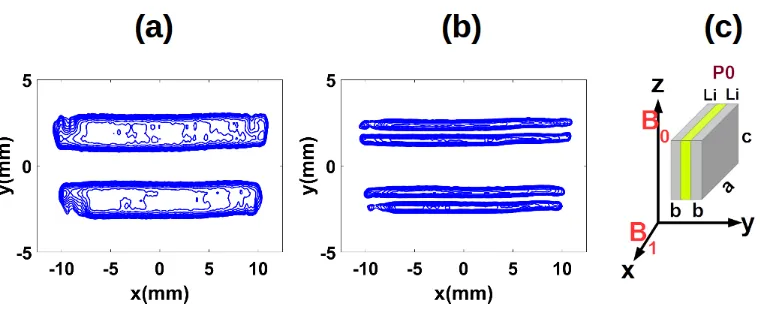
Phantoms comprising of Li strips (of dimensionsa×b×c), derived from a 0.75mmthick stock Li strip. PhantomP0: Pair of Li strips separated by a teflon strip; For each Li strip,a×b×c=20 x 0.75 x 7mm3. PhantomP1: Single Li strip.a×b×c=15 x 0.75 x 7mm3.
PhantomP3: Three Li strips pressed together to yield a single composite super strip.a×b×c=15 x 2.25 x 7mm3.
The static (main) magnetic fieldB0specifies thezdirection. Also,x, y, zdenote the MRI gradient (imaging) directions.
The setup of phantom, r.f. coil and the gradient assembly guarantees thatxk ak B1, with a rotational degree of freedom about thex-axis, to reorient the
phantom. See sections 1 and 6.1.
FIG. S2. Resolution and strip thickness in bulk metal MRI.
7Li 2d MRI(xy) from phantom P0 comprising of two Li strips (separated by a teflon strip) of identical thickness, at (a) 0.5mm(b) 0.25mmresolution, alongy.
For the lower resolution image in panel (a), the extent of image intensity bands alongyis mainly determined by the image resolution. It is difficult to infer the strip thickness with any confidence.
On the other hand, for the higher resolution image in panel (b), each conducting strip gives rise to two bands, from theacfaceskB1; the relative magnitudes of
FIG. S3. Comparing thickness of strips from bulk metal MRI.
Superpositon of7Li MRI from phantoms P1 and P3. (a) 1d MRI(y). The resolution alongy, is 0.0357mm. (b) 2d MRI(xy). The resolution alongy, is 0.250
mm.
x, y, zare the imaging directions (Fig.S1). Each phantom gives rise to two bands emanating from itspairofacfaces. Thickness of a given strip is given by the separation, alongy, between bands arising from it. Mere visual inspection of the panels, by virtue of the equal spacing between the 4 bands along y, suggests that P3 is thrice the thickness of P1. See section S2.2.
FIG. S4. 7Li 2d CSI(y) of phantom P3.
Stack plot representation (intensity along the vertical axis). See also Fig.5 and Fig.S1. Chemical shift along one axis, and image alongy, comprise the 2 dimensions. Alongy, the CS atδ2gives rise to a pair of separated bands, while an extended, low intensity band spanning them is obtained with a CS ofδ1. See
FIG. S5. Bulk metal MRI of phantom P3, at mutually orthogonal orientations.
Comparison of7Li 2d MRI stack plots (vertical axis denotes intensity) of phantom P3 in two different orientations.
(a)2d MRI(yz) invertical orientation.(b)2d MRI(zy) inhorizontal orientation. The corresponding NMR spectra are shown as insets. These images declare a virtualdead heat, between the two orientations, regarding the relative intensities from the two pairs ofacandabfaces.
This puts to rest the possibility that the differences in the intensities from theabandacfaces, arises due to the differing extents to which the eddy currents (arising from the gradient switching in MRI experiments) may affect the signals from theabandacfaces.
See sections 4, 6.2 and S3.
FIG. S6. Resolution, and relative signal intensities fromabandacfaces.
7Li 2d MRI(xy) stack plots (intensity along the vertical axis) of phantom P3, at differing resolutions alongy, providing experimental verification that the ratio of
signals fromacandabfaces, increases with increasing resolution (Eq.(5) in section 4).
FIG. S7. 2d(xy) slices from MRI(xyz) of a bulk metal strip.
Visualization ofSab6=Sac(the signal intensities fromabandacfaces)via2d (xy) slices (alongz) from7Li 3d MRI(xyz), of phantom P3 (Fig.S1).
(a)3d MRI(xyz); same data as in Fig.3.(b)Slice from the topabface.(c)Central slice.
The slices are displayed as stack plots (intensity along vertical axis). In a given slice, intensities at all points (x, y) are for the samezvalue in panel (a). In either slice, thewallsof intensity arise fromacfaces. Theplateauspanning them in panel (b), emanates from the topabface.
See section 4.