ENERGY SAVING SYSTEM USING EMBEDDED
SYSTEM FOR STREET LIGHT CONTROLLER
A.Karthikeyan
1, S.Vigneshwaran
2, A.Santhosh kumar
3,
S.Srikanth
4 1,2,3,4Assistant Professor/ECE, SNS College Of Technology, Coimbatore, (India)
ABSTRACT
To overcome the disadvantage of LDR an astronomical timer is used. The main thought is to save the energy in
twilight mode and to use ILM technology where ILM is an Individual Lightening Monitoring. Due to this energy
can be saved more than existing system. These both technology are more succeeded in real time
I. INTRODUCTION
Street light controller are saving the energy conservation by using timer switch so that more energy can be saved. They come with energy conservation option in twilight mode, staggering or dimming. In this project the street light controllers with an astronomical clock for a particular location (or) a GPS connection to give the best ON-OFF time and energy saving .Transistor is used as a switch to switch ON and OFF the street light automatically .By using this system manual works are reduced. It automatically switches ON lights when the sunlight goes below the visible region of our eyes .It automatically switches OFF lights under illumination by sunlight. The main notification is luminous is noted for public convenience. This is done by astronomical timer. The major advantage in this project is using an astronomical timer so that energy can be saved in twilight mode also.
II. OBJECTIVE
The main objective of this energy saving system is improving energy efficiency, cost effective and saving energy on twilight mode. Luminous should be comfort to public.
III.
BLOCK DIAGRAMIV-HARDWARE REQUIREMENTS
RLC-Remote Load Control
RMC-Relay Modelling Control Relay module
Energy meter
SMPS-switch mode power supply Contactors
Rotary switch
Toroidal transformer MCB
MCB tripper
Input and output connectors Connecting wires
Box
Door temper switch Buzzer
Channel
RLC COMPONENTS:
MC microcontroller IC-PIC- 18F46K22 EPROM-24M02
RS232-MAX 232 (ENERGY METER COMMUNICATION)
RELAY DRIVER-ULN 2003N SIM 900A-MODEM
MOSFET -4437(MODEM on/off) REGULATOR-LM2576
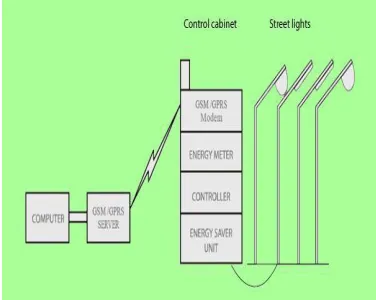
V-PROPOSED SYSTEM
Work in this project is towards the design of a cost effective and energy efficient street light control
system. It automatically switches ON lights when the sunlight goes below the visible region of our
eyes. By using this system energy consumption is also reduced because nowadays the manually
operated street lights are not switched off even the sunlight comes and also switched on earlier before
sunset so this is reduced by using astronomical times clock. By using astronomical timer switch can
reduce the energy conservation by a variations in month for example: In the month of march a
sunlight stays more longer so by using astronomical times switch it can be automatically switch on the
light after the sunset fully this is possible for all the month. A month variation is programmed by this
more energy can be saved than existing system. A GSM system is used for controlling the device and
for regular checking purpose and for informing fault.
VI ASTRONOMICAL TIMER
SWITCH
Time Switches are used to control events with respect to real time clock (RTC) whereas timers are
switch functionality. With the help of Time switches it is possible to switch ON and OFF devices like
lights, heaters, etc automatically at desired time of the day / night thereby giving the advantage of
convenience and reduction in power wastage or substantial energy savings. The need of automation in
street light system is for accurate switching of lights at sunset or twilight sunset and switch OFF at
sunrise or twilight sunrise with energy savings.
PROPOSED SYSTEM
Fig.2 Single phase of street light controller
VII-TWILIGHT
It is observed that there is sample amount of light available even after the sun has set or prior to
sunrise. This period is around 20 minutes on an average during sunset and sunrise. This feature can be
used for more energy savings. The reference time for Astro can be based on either sunrise/sunset or
begin/end twilight. Reference on twilight can harvest maximum natural light throughout the year.
Even 5 min saving due to twilight saves thousands of rupees over a year. Here twilight times are
calculated using astronomical mathematics.
Sunrise Twilight Difference
6:53:00 6:29:00 24
Sunset Twilight Difference
Set (Minutes)
18:13:00 18:36:00 23
VIII-FUNCTIONALITIES OF
PROPOSED SYSTEM
ENERGY SAVING:
Energy Saver guarantees 30% reduction in energy consumption under normal working conditions. It
reduces the power consumption by optimizing the voltage to the lamps. While optimizing voltage,
care is taken to maintain the flux as per ISI standards.
AUTOMATIC SWITCHING:
GPS location based switching of streetlights.
WIRELESS MONITORING &
CONTROL:
State of the art GSM/ GPRS technology is used for monitoring and controlling the street lights.
FEATURES:
• Guaranteed operating efficiency of 97% (higher than industry standards) with the use of
highly efficient Toroidal transformers
• Dynamic Voltage reduction: provides stabilized voltage to the lamps.
• Automatic On/Off based on Sunrise/Sunset or on programmed timings
• Wireless control and monitoring through sophisticated web-based software
• Automatic bypass in case of tripping with manual changeover in case of maintenance or
emergency
• Reduces operational, maintenance and running cost
• Reliable and safe changeover with On-Load tap changing
• Completely remote programmable ON/OFF timings, alert and energy saving settings.
• Instantaneous alerts for critical fault conditions to your mobile phone
• Energy saving reports and lamp failure reports on daily, weekly and monthly basis for single,
multiple or all devices
• Detection of Energy theft or leakage
• Maintains a high power factor of above 0.85
• Guaranteed operating life upto 10 yrs &ISI standard.
• Eco friendly and reduces public inconvenience.
IX-RESULT GRAPH BASED
Fig.3 Result of street light controller based on luminous
X-CONCLUSION
This project describes a new street lighting system which integrates new technologies available on
the market to offer higher efficiency and considerable savings more than existing system The
energy consumed in existing system is 1000amps whereas in proposed system it is reduced to
XI-REFERENCES
[1] Dheeraj sharma, “A Sensor-Less and Energy Efficient Street Light Control System”, (An ISO
3297: 2007 CertifiedOrganization),Vol. 4, Issue 3, March 2015.
[2] Md Shah Fahad1, Md Shafi Anwer2, Md Sajid Reza3, Mr.Shailendra Kumar Mishra4, “
Intelligent Streetlight Energy-Saving System Based On Power Line Communication Technology with RTOS”,2015
[3] M. Shariz Ansari1, Tanmay Srivastava2, Rishabh Saxena2, Saurabh Singh2"GSMBased Street
Light Automation", Vol. 4, Issue5, May 2015
[4] Manuel Burgos Payán, Francisco Javier Correa Moreno and Jesús Manuel Riquelme Santos,
“Improving the Energy Efficiency ofStreet Lighting A Case in the South of Spain ”,
9th International Conference on the European Energy Market EEM, pp. 1-8, 2012.
[5]Po Yen Chen, Yi Hua Liu, Yeu Torng Yau, Hung Chun Lee, “Development of an Energy
Efficient Street Light Driving System”, ICSET
, pp.761-764, 2013
.
AUTHORS PROFILE
Mr.A.KARTHIKEYAN received his B.Tech., degree specialized in ECE in
Bharathiyar College of Technology, Karaikal in the year 2008 under Pondicherry
University, Pondicherry, and M.E., degree in VLSI Design in SNS College of
Technology, Coimbatore in the year 2012 under Anna University, Chennai.
Currently he is pursuing Ph.D. in the area of Wireless Sensor Networks. He is
now working as Assistant Professor in the department of Electronics and Communication
Engineering, SNS College of Technology, Coimbatore, Tamilnadu, India. His area of interest includes
Wireless Sensor Networks, VLSI Design Techniques and Computer networking. He is a Life Member
of the International Society for Research and Development (MISRD), International Association of
Engineers (MIAENG) and International Association of Computer Science and Information
Technology (MIACSIT).
Mr.S.VIGNESHWARAN working as Assistant Professor 1/12/2016 to till date in
the department of ECE at SNS College of Technology, Coimbatore, Received his
M.E. degree in VLSI Design from SNS College of Technology, Coimbatore in
the year 2013, under Anna University, Chennai, and received his B.E. degree in
Engineering and Technology, Pollachi in the year 2009, under Anna University, Chennai,His area of
interest includes Embedded System Design & Low power VLSI Design.
Mr.A.SANTHOSHKUMAR working as Assistant Professor in the department
of ECE at SNS College of Technology, Coimbatore, Received his M.E. degree in
VLSI Design from SNS College of Technology, Coimbatore in the year 2011,
under Anna University, Coimbatore, and received his B.E. degree in ECE from
SNS College of Technology, Coimbatore in the year 2008, under Anna
University, Chennai. His area of interest includes Embedded System Design &
Low power VLSI Design.
Mr.S.SRIKANTH received his B.E. degree in electronics and communication
engineering from S.N.S College Of Technology, Coimbatore. He is currently
pursuing his M.E. degree in VLSI design at Sri Ramakrishna Engineering
College, Coimbatore. His area of interest is VLSI signal processing and