ARTICLES
Ruth Ann Marrie, MD,
PhD
Scott B. Patten, MD,
PhD
Helen Tremlett, PhD
Christina Wolfson, PhD
Sharon Warren, PhD
Lawrence W. Svenson,
PhD
Nathalie Jette, MD, MSc
John Fisk, PhD
For the CIHR Team in
the Epidemiology and
Impact of Comorbidity
on Multiple Sclerosis
Correspondence to Dr. Marrie: [email protected]
Editorial, page 1275
Supplemental data at Neurology.org
Sex differences in comorbidity at diagnosis
of multiple sclerosis
A population-based study
ABSTRACT
Objective:
To determine the prevalence of comorbidity in the multiple sclerosis (MS) population at
the time of MS diagnosis. We also compared the prevalence of comorbidity in the MS population
to that in a matched cohort from the general population.
Methods:
Using population-based administrative health data from 4 Canadian provinces, we
iden-tified 23,382 incident MS cases and 116,638 age-, sex-, and geographically matched controls.
We estimated the prevalence of hypertension, diabetes, hyperlipidemia, heart disease, chronic
lung disease, epilepsy, fibromyalgia, inflammatory bowel disease, depression, anxiety, bipolar
dis-order, and schizophrenia at MS diagnosis using validated case definitions. We compared the
pop-ulations using rate ratios.
Results:
Of the MS cases, 16,803 (71.9%) were female. The most prevalent comorbidity was
depression (19.1%). Compared to the matched population, all comorbidities except
hyperlipide-mia were more common in the MS population. Relative to the matched populations, the
preva-lence of hypertension was 16% higher for women with MS and 48% higher for men with MS,
thus there was a disproportionately higher prevalence of hypertension in men with MS than
women. Men with MS also had a disproportionately higher prevalence than women with MS for
diabetes, epilepsy, depression, and anxiety.
Conclusions:
Comorbidity is more common than expected in MS, even around the time of diagnosis.
The prevalence of psychiatric comorbidity is particularly high and highlights the need for clinical
atten-tion to this issue. The observed sex-specific differences in the burden of comorbidity in MS, which differ
from those in the matched population, warrant further investigation.
Neurology®2016;86:1279–1286GLOSSARY
ALD5affections de longue durée;ICD-95International Classification of Diseases–9;ICD-105International Classification of Diseases–10;MS5multiple sclerosis.
In many chronic diseases, comorbidity is associated with reduced quality of life,
1increased
health care utilization, and increased mortality.
2For example, vascular comorbidity is associated
with more rapid cognitive decline in Alzheimer disease.
3Some studies suggest that in multiple
sclerosis (MS) comorbidity is associated with diagnostic delays and greater disability at MS
diagnosis,
4and increased risks of disability progression.
5However, the epidemiology of
comor-bidity in MS, including sex-specific differences in the incidence or prevalence of comorcomor-bidity,
remains poorly understood.
6As new disease-modifying therapies for MS emerge for which risks of adverse events differ in
the presence of comorbidity,
7it becomes increasingly important to understand the frequency of
From the Departments of Internal Medicine (R.A.M.) and Community Health Sciences (R.A.M.), University of Manitoba; Department of Community Health Sciences (S.B.P., L.W.S., N.J.), Institute for Public Health (N.J.), Department of Clinical Neurosciences (N.J.), and Hotchkiss Brain Institute (N.J.), University of Calgary; Department of Medicine (Neurology) (H.T.), University of British Columbia, Vancouver; Department of Epidemiology and Biostatistics and Occupational Health (C.W.), McGill University, Montreal; Faculty of Rehabilitation Medicine (S.W.) and School of Public Health (L.W.S.), University of Alberta, Edmonton; Surveillance and Assessment (L.W.S.), Alberta Health, Edmonton; and Departments of Psychiatry and Medicine (J.F.), Dalhousie University, Halifax, Canada.
Coinvestigators are listed on theNeurology®Web site at Neurology.org.
Go to Neurology.org for full disclosures. Funding information and disclosures deemed relevant by the authors, if any, are provided at the end of the article. The Article Processing Charge was paid by the Canadian Institutes of Health Research.
comorbidity throughout the disease course,
particularly at clinically relevant time points
such as at diagnosis. Findings regarding the
prevalence of comorbidity at MS diagnosis
conflict.
8,9One self-report study conducted
in the United States found that comorbidity
affected more than 35% of respondents at
diagnosis.
9However, a study in France that
focused on persons with MS onset before age
45 years and used a national disability register
found that only 3% of the MS population had
a comorbidity at diagnosis.
8Using population-based administrative data,
we aimed to determine the prevalence of
comorbidity in the MS population at MS
diag-nosis, and whether this differed by sex. We also
compared the prevalence of comorbidity in the
MS population to that in a matched cohort
from the general population.
METHODS Administrative data. We used administrative health data from 4 Canadian provinces, including British Columbia, Manitoba, Quebec, and Nova Scotia. These provinces were selected based on the feasibility of accessing the necessary administrative data, and include nearly 43% of the Canadian population (http://www. statcan.gc.ca/tables-tableaux/sum-som/l01/cst01/demo02a-eng.htm). All Canadian provinces administer a publicly funded, universally available health care system10and maintain computerized records
related to the provision of these services. These records include a population registry that captures dates of birth, death, and health care coverage; hospital discharge abstracts that capture dates of admission and discharge and discharge diagnoses; and physician visits that capture the date of service and diagnosis.11–13Due to
provincial privacy regulations that prevent individual-level data from leaving the province of origin, analyses were performed in parallel at each site, then the data were aggregated by age and sex groupings.
Standard protocol approvals, registrations, and patient consents. In each province, we obtained ethics approval and provincial approval to access administrative data.
Study populations.In each province, we applied an adminis-trative case definition for MS that had been validated and per-formed similarly in Manitoba and Nova Scotia.14,15 Anyone
aged$20 years with$3 hospital or physician claims for MS (ICD-9/10 codes 340/G35) during the study period was classified as having MS. To identify incident cases of MS, we used a 5-year run-in period; thus if administrative data were available in 1990, the earliest incident cases could be identified in 1995.14,15
We identified a cohort from the general population, matched on sex, year of birth, and region of residence (postal code or first 3 digits of postal code if unable to match on full postal code). Statistical efficiency is optimized at 4 to 6 matched controls; therefore we obtained up to 5 matches for each case after excluding anyone with any diagnostic codes (ICD-9/10) for demye-linating disease: optic neuritis (377.3/H46), acute transverse myelitis (323.82/G37), acute disseminated encephalomyelitis (323/G36.9), demyelinating disease of CNS unspecified (341.9/G37.8), other acute disseminated demyelination (G36), MS (340/G35), or
neuromyelitis optica (341.0/G36.0). For each person with MS, we assigned the date of the first health claim for demyelinating disease as the date of diagnosis, and the same (index) date was assigned to matched controls.
Comorbidities.We selected several comorbidities for study that had been evaluated in earlier studies of comorbidity at diagnosis of MS,8,9and that our prior work had indicated could be
accu-rately identified using administrative case definitions in the MS population.16–19These comorbidities were hypertension,
diabe-tes, hyperlipidemia, heart disease, chronic lung disease, epilepsy, fibromyalgia, inflammatory bowel disease, depression, anxiety, bipolar disorder, and schizophrenia. We did not evaluate cancer because of the expected low prevalence of this condition at MS diagnosis, and due to the need to access provincial cancer regis-tries to optimize identification of cancer. We applied the validated administrative case definitions for comorbidity to the MS and matched control populations in each province (table e-1 on the
Neurology® Web site at Neurology.org). These definitions
specified the number of years of data to be used, the ICD-9/10 codes, and the number of hospital or physician claims required to meet the case definition. For hospital claims, we used all available diagnoses. For physician claims, we had previously established that using all available diagnoses (when available) from physician claims had little influence on the performance of the case definitions,20 and as some provinces only capture one
diagnosis per physician claim, we used only the first listed diagnosis for each physician claim.
Prevalence.As the comorbidities represent chronic conditions, once a person met the case definition for a comorbidity, he or she was considered to be affected in all subsequent years while res-ident in the province.21We determined the crude prevalence of
the comorbidity in the year of MS diagnosis or the index date for matched controls using the midyear population figures from the provincial population registry for denominators in the calcula-tions. To ensure adequate cell sizes and stable estimates, we aggre-gated crude prevalence data across the study period. To facilitate comparisons to the study from France, which restricted its analysis to persons under age 45 years at diagnosis,8we present age-specific rates
for persons aged 20–44, 45–59, and more than 60 years. We also present sex-specific estimates. Cell sizes,5 were suppressed as per the privacy agreements for data access. A matched analysis is not needed for a matched cohort design. Adjustment is not needed to control for confounding due to the matching variables if follow-up time is the same in both cohorts.22Therefore, we compared the MS
and general population cohorts using rate ratios and 95% confidence intervals.22We report the time from comorbidity diagnosis to the
index date using means and standard deviations, as we could not aggregate medians across provinces without individual level data.
Sensitivity analyses.To address the possible effect of increased health care utilization due to unrecognized symptoms of MS before MS diagnosis,23we repeated the analysis in individuals
with an index year$2000 who had 10 years of administrative data before the index year. This allowed us to apply the comor-bidity case definitions 5 years before the index date (as some definitions required 5 years of data to identify a comorbidity, this required 10 years of data). We report findings at the index year and at 5 years before the index year.
Analyses were performed using SAS V9.3 (SAS Institute Inc., Cary, NC).
most prevalent comorbidity overall was depression
(19.1%), followed by hypertension (15.2%) (table 2).
Among psychiatric comorbidities, prevalence varied
somewhat across age groups, but without a consistent
pattern (tables e-2 to e-5). Among physical
comorbid-ities, the prevalence of diabetes, hypertension,
hyperlip-idemia, ischemic heart disease, chronic lung disease,
and epilepsy increased with age (tables e-6 to e-13).
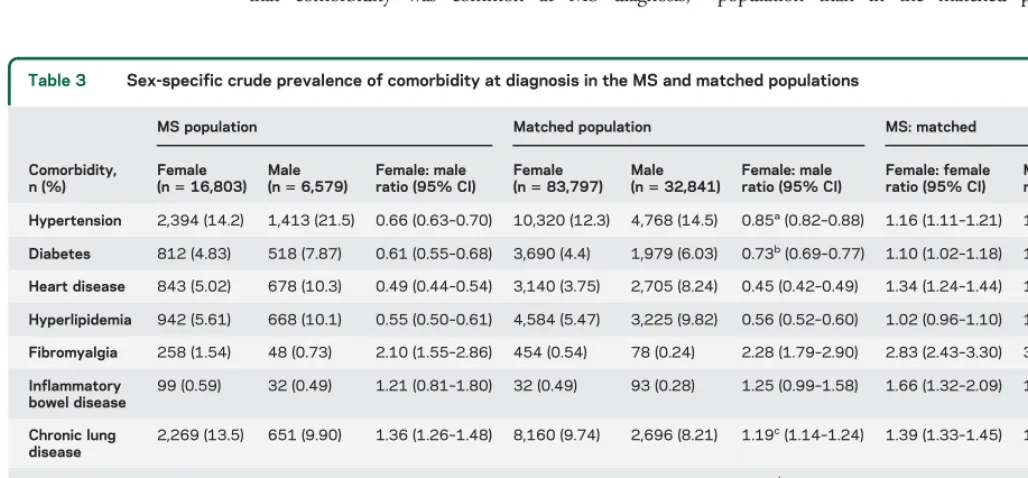
In both populations, depression, anxiety, and bipolar
disorder were more prevalent in women than men, while
schizophrenia was less common in women (table 3).
Among physical comorbidities, fibromyalgia was more
common in women. Inflammatory bowel disease and
chronic lung disease were more common in women but
this did not reach statistical significance for
inflamma-tory bowel disease. All other comorbidities were less
common in women than men.
Comparisons.
Compared to the matched controls, all
psychiatric comorbidities were more common in the
MS population. Similarly, all physical comorbidities
except hyperlipidemia were more common in the
MS population at the index date (table 2). Among
physical comorbidities, those for which rate ratios
were 1.50 or higher included fibromyalgia,
inflamma-tory bowel disease, epilepsy, and bipolar disorder.
The mean years between comorbidity diagnosis and
the index date are shown in table 4.
For some comorbidities, the strengths of the
associ-ations differed by sex or age (tables e-2 to e-13). The
associations between comorbidity and population were
modified by sex for hypertension, diabetes, chronic
lung disease, epilepsy, depression, anxiety, bipolar
dis-order, and schizophrenia (table 3). Among women, the
prevalence of hypertension was 16% higher in the MS
than the matched population. Among men, however,
the prevalence of hypertension was 48% higher in the
MS than in the matched population, indicating a
dis-proportionately higher prevalence of hypertension in
men with MS than women. Findings were similar for
diabetes, epilepsy, depression, and anxiety, with men
again having disproportionately higher prevalence than
women. With respect to chronic lung disease, the
prev-alence was 39% higher among women with MS than
among women without MS, but only 21% higher
among men with MS than men without MS. Thus
there was a disproportionately higher prevalence of
chronic lung disease among women with MS than
men.
For diabetes, the rate ratios comparing the MS and
matched populations were higher among those aged
20
–
44 years than among those aged
$
45 years
(table e-6). We did not identify age group by
popu-lation interactions for the other comorbidities.
Sensitivity analyses.
The prevalence of all comorbidities
was lower in both populations 5 years before MS
diagnosis (index date), but the associations between
population and comorbidity were unchanged (table 5).
DISCUSSION
In this population-based study of
23,382 Canadians with incident MS and 166,638
matches from the general population, we found
that comorbidity was common at MS diagnosis,
particularly depression. The burden of comorbidity
was higher with increasing age at diagnosis, consistent
with known associations of comorbidity with age in
the general population.
24The prevalence of all
psychiatric comorbidities and nearly all physical
comorbidities was more common in the MS
population than in the matched population. The
Table 2 Crude prevalence of comorbidity in the MS population at diagnosis compared to matched controls
Comorbidity MS (n523,382), n (%)
Matches
(n5116,638), n (%) RR (95% CI) pValue
Hypertension 3,547 (15.2) 15,088 (12.9) 1.17 (1.13–1.21) ,0.0001
Diabetes 1,330 (5.69) 5,669 (4.86) 1.17 (1.10–1.24) ,0.0001
Ischemic heart disease 1,521 (6.50) 5,845 (5.01) 1.30 (1.23–1.37) ,0.0001
Hyperlipidemia 1,610 (6.89) 7,810 (6.70) 1.03 (0.98–1.08) 0.99
Fibromyalgia 306 (1.31) 532 (0.46) 2.87 (2.49–3.30) ,0.0001
Inflammatory bowel disease 131 (0.56) 390 (0.30) 1.68 (1.38–2.04) ,0.0001
Chronic lung disease 2,920 (12.1) 10,856 (9.14) 1.34 (1.29–1.39) ,0.0001
Epilepsy 451 (1.93) 1,034 (0.89) 2.18 (1.95–2.43) ,0.0001
Depression 4,464 (19.1) 10,936 (9.38) 2.04 (1.97–2.10) ,0.0001
Anxiety 2,594 (11.1) 8,035 (6.89) 1.61 (1.54–1.68) ,0.0001
Bipolar disorder 736 (3.15) 1,973 (1.69) 1.86 (1.71–2.02) ,0.0001
Schizophrenia 251 (1.07) 947 (0.81) 1.32 (1.15–1.52) ,0.0001
Abbreviations: CI5confidence interval; MS5multiple sclerosis; RR5rate ratio.
Table 3 Sex-specific crude prevalence of comorbidity at diagnosis in the MS and matched populations
Comorbidity, n (%)
MS population Matched population MS: matched
Female (n516,803)
Male (n56,579)
Female: male ratio (95% CI)
Female (n583,797)
Male (n532,841)
Female: male ratio (95% CI)
Female: female ratio (95% CI)
Male: male ratio (95% CI)
Hypertension 2,394 (14.2) 1,413 (21.5) 0.66 (0.63–0.70) 10,320 (12.3) 4,768 (14.5) 0.85a(0.82
–0.88) 1.16 (1.11–1.21) 1.48 (1.40–1.56)
Diabetes 812 (4.83) 518 (7.87) 0.61 (0.55–0.68) 3,690 (4.4) 1,979 (6.03) 0.73b(0.69–0.77) 1.10 (1.02–1.18) 1.31 (1.19–1.43)
Heart disease 843 (5.02) 678 (10.3) 0.49 (0.44–0.54) 3,140 (3.75) 2,705 (8.24) 0.45 (0.42–0.49) 1.34 (1.24–1.44) 1.25 (1.16–1.36)
Hyperlipidemia 942 (5.61) 668 (10.1) 0.55 (0.50–0.61) 4,584 (5.47) 3,225 (9.82) 0.56 (0.52–0.60) 1.02 (0.96–1.10) 1.03 (0.96–1.12)
Fibromyalgia 258 (1.54) 48 (0.73) 2.10 (1.55–2.86) 454 (0.54) 78 (0.24) 2.28 (1.79–2.90) 2.83 (2.43–3.30) 3.07 (2.15–4.40)
Inflammatory bowel disease
99 (0.59) 32 (0.49) 1.21 (0.81–1.80) 32 (0.49) 93 (0.28) 1.25 (0.99–1.58) 1.66 (1.32–2.09) 1.72 (1.15–2.56)
Chronic lung disease
2,269 (13.5) 651 (9.90) 1.36 (1.26–1.48) 8,160 (9.74) 2,696 (8.21) 1.19c(1.14–1.24) 1.39 (1.33–1.45) 1.21 (1.11–1.31)
Epilepsy 331 (1.97) 170 (2.58) 0.76 (0.64–0.92) 735 (0.88) 299 (0.91) 0.96d(0.84
–1.10) 2.25 (1.97–2.55) 2.84 (2.36–3.42)
Depression 2,869 (17.1) 695 (10.6) 1.62 (1.50–1.75) 9,025 (10.8) 1,911 (5.82) 1.85e(1.76–1.94) 1.59 (1.53–1.65) 1.82 (1.67–1.97)
Anxiety 2,060 (12.3) 534 (8.12) 1.51 (1.46–1.56) 6,535 (7.80) 1,500 (4.57) 1.71f(1.53
–1.90) 1.57 (1.50–1.65) 1.78 (1.62–1.95)
Bipolar 591 (3.52) 176 (2.69) 1.31 (1.11–1.55) 1,582 (1.89) 391 (1.19) 1.58 (1.42–1.77) 1.86 (1.70–2.40) 2.25 (1.88–2.68)
Schizophrenia 151 (0.90) 100 (1.52) 0.59 (0.53–0.65) 634 (0.76) 313 (0.95) 0.79g(0.69
–0.91) 1.19 (1.00–1.42) 1.59 (1.28–1.99)
Abbreviations: CI5confidence interval; MS5multiple sclerosis.
ax2for interaction between population and sex550.4,p,0.0001.
bx2for interaction between population and sex58.18,p50.004.
cx2for interaction between population and sex59.03,p50.003.
dx2for interaction between population and sex54.07,p50.04.
ex2for interaction between population and sex58.33,p50.004.
fx2for interaction between population and sex55.07,p50.02.
highest rate ratios observed for physical comorbidities
were seen for fibromyalgia, inflammatory bowel disease,
and epilepsy.
Prior work regarding the prevalence of comorbidity
at MS diagnosis has been limited. Unlike our findings,
a French study based on registrations for 30 chronic
long-term illnesses (affections de longue durée
[ALD]) suggested that only 3% of the MS population
had comorbid conditions at the time of MS diagnosis.
8However, that study was restricted to persons aged
#
45 years, and to conditions that were notified to
the ALD. Therefore, several of the comorbidities we
studied were not captured, and other comorbidities,
such as hypertension and chronic lung disease, had
to be severe in the French study, likely underestimating
their prevalence. Even among individuals with an age
at MS diagnosis
,
45 years, we found that nearly 14%
had depression, 11% had chronic lung disease, and 5%
had hypertension. More in keeping with our findings
are the results of a study of 8,983 American
partici-pants in the North American Research Committee on
Multiple Sclerosis registry.
9That study used a
self-report questionnaire rather than prospectively collected
administrative data, and found that comorbidity was
common at diagnosis, with psychiatric comorbidities
affecting 18% and vascular comorbidities (including
diabetes, hypertension, hyperlipidemia, or ischemic
heart disease) affecting 14.0%.
9A case-control study in California found that
pa-tients with MS were more likely to have been diagnosed
with uveitis and inflammatory bowel disease before MS
diagnosis.
25Studies of comorbidity among prevalent
MS cases are more common and recent systematic
re-views of such studies have suggested that among
indi-viduals with prevalent MS, comorbid depression,
anxiety, bipolar disorder, epilepsy, fibromyalgia,
inflam-matory bowel disease, ischemic heart disease, and
chronic lung disease are more common than expected
in MS.
26–30Among other chronic inflammatory
dis-eases, such as gout, the burden of comorbidities at
diag-nosis is also higher than expected.
31Specifically, in
rheumatoid arthritis, comorbid cardiovascular disease
is more common at diagnosis than expected when
com-pared to the general population.
32The observed sex differences in comorbidity status
are of particular interest. Some were as expected, for
example, depression, anxiety, and fibromyalgia were
Table 4 Mean (SD) delay between comorbidity diagnosis and the index date in the multiple sclerosis (MS) and matched populations
Comorbidity MS population Matched population pValue
Hypertension 6.11 (4.43) 6.21 (4.38) 0.22
Diabetes 6.41 (4.84) 6.48 (4.37) 0.57
Heart disease 5.94 (4.71) 6.33 (4.30) 0.002
Hyperlipidemia 5.81 (4.52) 5.65 (4.36) 0.18
Fibromyalgia 4.56 (3.56) 5.57 (3.97) 0.0003
Inflammatory bowel disease 5.31 (2.62) 6.45 (4.03) 0.0026
Chronic lung disease 7.12 (4.46) 6.90 (4.55) 0.002
Epilepsy 6.22 (4.21) 6.65 (4.06) 0.0006
Depression 6.20 (4.14) 6.24 (4.12) 0.61
Anxiety 5.34 (3.98) 6.06 (4.05) 0.0001
Bipolar 5.61 (4.22) 5.83 (4.06) 0.21
Schizophrenia 6.42 (4.66) 7.09 (4.52) 0.32
Table 5 Crude prevalence of comorbidity in the MS population with an index year of 2000 or later compared to matched controls at diagnosis and 5 years before the diagnosis
Comorbidity
At diagnosis, n (%) 5 years before diagnosis, n (%)
MS (n514,503)
Matches
(n572,199) RR (95% CI)
MS (n514,503)
Matches
(n572,199) RR (95% CI)
Hypertension 2,467 (17.0) 10,337 (14.3) 1.19 (1.14–1.24) 1,544 (10.6) 6,061 (8.4) 1.27 (1.20–1.34)
Diabetes 940 (6.5) 3,961 (5.5) 1.18 (1.10–1.27) 540 (3.7) 2,305 (3.2) 1.17 (1.06–1.28)
Ischemic heart disease 985 (6.4) 3,809 (5.3) 1.29 (1.20–1.38) 577 (4.0) 2,361 (3.3) 1.22 (1.11–1.33)
Hyperlipidemia 1,160 (8.0) 5,583 (7.7) 1.03 (0.97–1.10) 691 (4.8) 3,079 (4.3) 1.12 (1.03–1.21)
Fibromyalgia 225 (1.5) 399 (0.55) 2.81 (2.39–3.30) 97 (0.67) 206 (0.29) 2.34 (1.84–2.98)
Inflammatory bowel disease 83 (0.57) 262 (0.36) 1.58 (1.23–2.02) 57 (0.39) 174 (0.24) 1.63 (1.21–2.20)
Chronic lung disease 2,067 (14.2) 7,543 (10.4) 1.36 (1.30–1.43) 1,456 (10.0) 6,607 (9.1) 1.10 (1.04–1.16)
Epilepsy 292 (2.0) 677 (0.94) 2.15 (1.87–2.46) 186 (1.3) 485 (0.67) 1.91 (1.61–2.26)
Depression 2,556 (17.6) 7,967 (11.0) 1.60 (1.53–1.66) 1,496 (10.3) 4,749 (6.6) 1.57 (1.48–1.66)
Anxiety 1,200 (8.3) 3,846 (5.3) 1.55 (1.46–1.65) 888 (6.1) 3,190 (4.4) 1.39 (1.29–1.49)
Bipolar 681 (4.7) 1,728 (2.4) 1.96 (1.36–1.61) 298 (2.0) 813 (1.1) 1.82 (1.60–2.08)
Schizophrenia 169 (1.2) 603 (0.84) 1.40 (1.18–1.65) 107 (0.74) 339 (0.47) 1.57 (1.27–1.95)
more common among women in both populations,
and ischemic heart disease was more common in
men. However, some of the associations between
study population and comorbidity were modified by
sex in ways that were not anticipated. In particular,
women with MS had a disproportionately higher
prevalence of chronic lung disease than did men with
MS. In contrast, men with MS had a
disproportion-ately higher prevalence of hypertension, diabetes, and
epilepsy and of all of the psychiatric comorbidities
studied (depression, anxiety, bipolar disorder, and
schizophrenia) than did women with MS when
com-pared to the matched population. The reasons for
these findings are uncertain, but sex-based differences
in the association between environmental factors and
disease risk are recognized. For example, recent
stud-ies have suggested that female smokers are biologically
more susceptible to chronic obstructive pulmonary
disease than male smokers,
33possibly due to
hormo-nal effects. Further evaluation of the etiology of these
sex-based differences is needed as these findings have
implications for managing individuals with MS.
The burden of psychiatric comorbidity for both
sexes even at MS diagnosis was striking. While
depression and anxiety are recognized to be common
in established MS, our findings and those of prior
studies collectively indicate that these conditions are
the most or nearly the most common preexisting
co-morbidities at diagnosis, particularly among those
aged 20
–
44 years.
8,9Depression and anxiety adversely
affect health-related quality of life, adherence to
ther-apy, and the risk of hospitalization.
34,35Therefore,
our findings suggest that these comorbidities deserve
particular clinical attention from the time of
diagno-sis, and support the need for studies aimed at
improved diagnosis and management of these
conditions.
Our findings highlight that the burden of
comor-bidity even at diagnosis is important for clinicians to
consider. Clinical trials often exclude individuals with
(severe) comorbidities, such that we do not fully
under-stand the efficacy, safety, or tolerability of
disease-modifying therapies in these individuals. For example,
it has been observed that individuals with migraine
may have more difficulty tolerating one of the most
commonly used disease-modifying treatments for MS
(interferon-
b
) due to worsening headache profiles.
36Some comorbidities are also known to increase the risk
of serious adverse events. For example, diabetes
in-creases the risk of macular edema associated with
fin-golimod, a recently licensed disease-modifying oral
drug for MS.
7Therefore, careful assessment of the
pres-ence of comorbid conditions is needed when
consider-ing such therapies even at the time of diagnosis. Future
studies should consider formally evaluating whether
treatment safety and effectiveness differs among
individuals with the most common comorbidities to
better inform clinical practice.
When compared to age-, sex-, and geographically
matched controls, most of the comorbidities
evalu-ated were more common in the MS population.
The highest rate ratios were observed for
fibromyal-gia, inflammatory bowel disease, and epilepsy. The
presence of one chronic condition may lead to
improved ascertainment of comorbid conditions
due to increased surveillance by clinicians or increased
numbers of contacts with the health care system.
Thus, having these conditions may increase the
like-lihood of getting a diagnosis of MS. Shared genetic or
environmental factors may also account for some of
the associations observed. For example, shared genetic
factors
37are associated with MS and inflammatory
bowel disease. Vitamin D insufficiency is associated
with an increased risk of MS and of ischemic heart
disease and diabetes.
38Future research should seek to
explain the reasons for comorbidity in MS,
recogniz-ing they are likely to differ by comorbidity.
It was not feasible to perform this study in all
Canadian provinces; however, the provinces studied
spanned the country from west to east and included
over 40% of the Canadian population. Since we
included a matched control group in each province,
we also accounted for the major confounders of age,
sex, and region (including regional differences in
health service delivery). Use of administrative data
that are not collected for research purposes is another
limitation but we used case definitions for MS and
comorbidity that we had validated previously in 2
provinces.
15,20We were unable to assess all relevant
comorbidities, including conditions such as cancer,
for which important gaps in the epidemiology
per-sist,
39including the prevalence at MS diagnosis.
However, we assessed the prevalence of multiple
comorbidities and focused on comorbidities that
could be accurately assessed using administrative data,
and that are frequent enough to be relevant at the
population level. The mean age at MS diagnosis
was 44 years, which appears slightly older than
expected; however, we excluded individuals under
age 20 years, which would have led to a higher mean
age at diagnosis. We cannot exclude the possibility
that some of the cases identified were prevalent not
incident. Bias in the age at diagnosis is possible but
previously we showed that age at the time of the
inci-dent MS-related claim is within 1 year of diagnosis
date from medical charts in 67% of cases and within 3
years in 64% of cases.
14Later age at diagnosis may
years before MS is diagnosed and diagnostic delays
have changed over time. Therefore, unrecognized MS
symptoms such as fatigue may lead to increased
health care utilization before MS diagnosis,
23and to
increased or earlier diagnosis of comorbidities;
how-ever, our findings persisted even 5 years before MS
diagnosis. Also, for several conditions, the mean time
from diagnosis to the index date was shorter in the
MS population. Data regarding the clinical
character-istics of the MS participants were lacking such that we
could not evaluate the associations of comorbidity
with MS characteristics such as disability or disease
course; this should be the subject of future research.
Comorbidity is more common than expected in
MS, even around the time of diagnosis. The prevalence
of psychiatric comorbidity is high, indicating the need
for clinical attention to this issue. The observed
sex-specific differences in the burden of comorbidity in
MS, which differ from those in the matched population,
warrant replication and investigation as to etiology.
AUTHOR CONTRIBUTIONS
Ruth Ann Marrie takes responsibility for the integrity of the data and the accuracy of the data analysis. The analysts and principal investigators at each site had full access to the data at each site (British Columbia: Helen Tremlett, Aruni Tennakoon, Stella Leung; Manitoba: Ruth Ann Marrie, Aruni Tennakoon; Quebec: Christina Wolfson, Bin Zhu; Nova Scotia: John Fisk, Yan Wang). Ruth Ann Marrie, John Fisk, Christina Wolfson, Helen Tremlett, and Sharon Warren designed the study and obtained funding. All authors contributed to the interpretation of the data. Ruth Ann Marrie drafted the manuscript. All authors revised the manuscript and approved of the final version to be published.
ACKNOWLEDGMENT
All inferences, opinions, and conclusions drawn in this publication are those of the authors and do not reflect the opinions or policies of the Data Stewards. No official endorsement by Manitoba Health, Population Data BC, the Regie D’Assurance Maladie du Quebec, or The Commission d’Accès à l’Information (CAI) of Quebec is intended or should be inferred. Some data used in this report were made available by Health Data Nova Scotia of Dalhousie University. Although this research is based on data obtained from the Nova Scotia Department of Health and Wellness, the observations and opinions expressed are those of the authors and do not represent those of Health Data Nova Scotia or the Department of Health and Wellness. The authors thank Aruni Tennakoon (University of Manitoba), Bin Zhu (McGill University), Yan Wang (Dalhousie Univer-sity), and Stella Leung (University of Manitoba) for statistical analyses.
STUDY FUNDING
Supported in part by the Canadian Institutes of Health Research (CIBG 101829), the Rx & D Health Research Foundation, a Don Paty Career Development award from the Multiple Sclerosis Society of Canada (to R.A.M.), a Manitoba Research Chair from Research Manitoba (to R.A.M.), and a Canada Research Chair in Neurological Health Services Research (to N.J.). The funding sources had no role in the study design, collection, analysis or interpretation of data, or in the decision to submit the article for publication.
DISCLOSURE
R.A. Marrie receives research funding from Canadian Institutes of Health Research, Research Manitoba, Multiple Sclerosis Society of Canada, Mul-tiple Sclerosis Scientific Foundation, National MulMul-tiple Sclerosis Society, and Rx & D Health Research Foundation, and has conducted clinical trials funded by Sanofi-Aventis. S. Patten has received honoraria for
reviewing investigator-initiated grant applications submitted to Lundbeck and Pfizer and has received speaking honoraria from Teva and Lundbeck. He is the recipient of a salary support award (Senior Health Scholar) from Alberta Innovates, Health Solutions, and receives research funding from the Canadian Institutes for Health Research, Alberta Health Services, and the Alberta Collaborative Research Grants Initiative. H. Tremlett is funded by the Multiple Sclerosis Society of Canada (Don Paty Career Development Award) and is a Michael Smith Foundation for Health Research Scholar and the Canada Research Chair for Neuroepidemiology and Multiple Sclerosis. She has received research support from the National Multiple Sclerosis Society, the Canadian Institutes of Health Research, and the UK MS Trust; and speaker honoraria and/or travel expenses to attend conferences from the Consortium of MS Centres (2013), the National MS Society (2012, 2014), Bayer Pharmaceuticals (2010), Teva Pharmaceuticals (2011), ECTRIMS (2011, 2012, 2013, 2014), UK MS Trust (2011), the Chesapeake Health Education Pro-gram, US Veterans Affairs (2012), Novartis Canada (2012), Biogen Idec (2014), and American Academy of Neurology (2013, 2014, 2015). Unless otherwise stated, all speaker honoraria are either donated to an MS charity or to an unrestricted grant for use by her research group. C. Wolfson receives research funding from the Multiple Sclerosis Society of Canada, Canadian Institutes of Health Research, Canada Foundation for Innovation, and the National Multiple Sclerosis Society. She has received a speaking honorarium from Novartis Pharmaceuticals. S. Warren receives research funding from the CIHR. L. Svenson reports no disclosures relevant to the manuscript. N. Jette receives funding from CIHR, Alberta Health, Alberta Innovates Health Solutions, University of Calgary, and Alberta Health Services. She also holds an operating grant co-funded by the University of Calgary Hotchkiss Brain Institute and Pfizer Canada. J. Fisk receives funding from the Canadian Institutes of Health Research, MS Society of Canada, and National Multiple Sclerosis Society. Go to Neurology.org for full disclosures.
Received May 24, 2015. Accepted in final form November 16, 2015.
REFERENCES
1. Baumeister H, Balke K, Härter M. Psychiatric and somatic comorbidities are negatively associated with quality of life in physically ill patients. J Clin Epidemiol 2005;58: 1090–1100.
2. Braunstein JB, Anderson GF, Gerstenblith G, et al. Non-cardiac comorbidity increases preventable hospitalizations and mortality among Medicare beneficiaries with chronic heart failure. J Am Coll Cardiol 2003;42:1226–1233. 3. Vendrame M, Auerbach S, Loddenkemper T, Kothare S,
Montouris G. Effect of continuous positive airway pressure treatment on seizure control in patients with obstructive sleep apnea and epilepsy. Epilepsia 2011;52:e168–e171. 4. Marrie RA, Horwitz RI, Cutter G, Tyry T,
Campagnolo D, Vollmer T. Comorbidity delays diagnosis and increases disability at diagnosis in MS. Neurology 2009;72:117–124.
5. Marrie RA, Rudick R, Horwitz R, et al. Vascular comor-bidity is associated with more rapid disability progression in multiple sclerosis. Neurology 2010;74:1041–1047. 6. Marrie RA, Reider N, Cohen J, et al. A systematic review
of the incidence and prevalence of comorbidity in multiple sclerosis: overview. Mult Scler 2015;21:263–281. 7. Jain N, Bhatti MT. Fingolimod-associated macular edema:
incidence, detection, and management. Neurology 2012; 78:672–680.
8. Fromont A, Binquet C, Rollot F, et al. Comorbidities at multiple sclerosis diagnosis. J Neurol 2013;260: 2629–2637.
10. Health Information Management Branch. Population Report. Winnipeg, Canada: Manitoba Health and Healthy Living; 2008.
11. British Columbia Ministry of Health [creator]. 2012. Dis-charge Abstract Database (Hospital Separations) [online]. Available at: http://www.popdata.bc.ca/data. Accessed April 1, 2015.
12. British Columbia Ministry of Health [creator]. 2012. Medical Services Plan (MSP) [online]. Available at: http://www.popdata.bc.ca/data. Accessed April 1, 2015. 13. British Columbia Ministry of Health [creator]. 2012.
Consolidation File (MSP Registration & Premium Billing) [online]. Available at: http://www.popdata.bc.ca/data. Ac-cessed April 1, 2015.
14. Marrie RA, Yu N, Blanchard JF, Leung S, Elliott L. The rising prevalence and changing age distribution of multiple sclerosis in Manitoba. Neurology 2010;74:465–471. 15. Marrie RA, Fisk J, Stadnyk K, et al. The incidence and
prevalence of multiple sclerosis in Nova Scotia, Canada. Can J Neurol Sci 2013;40:824–831.
16. Marrie RA, Yu B, Leung S, et al. Rising prevalence of vascular comorbidities in MS: validation of administrative definitions for diabetes, hypertension, hyperlipidemia. Mult Scler 2012;18:1310–1319.
17. Marrie RA, Yu BN, Leung S, et al. The utility of adminis-trative data for surveillance of comorbidity in multiple scle-rosis: a validation study. Neuroepidemiology 2013;40:85–92. 18. Marrie RA, Fisk JD, Yu BN, et al. Mental comorbidity and multiple sclerosis: validating administrative data to support population-based surveillance. BMC Neurol 2013;13:16.
19. Marrie RA, Yu BN, Leung S, et al. Prevalence and inci-dence of ischemic heart disease in multiple sclerosis: a population-based validation study. Mult Scler Relat Dis-ord 2013;2:355–361.
20. Marrie RA, Fisk JD, Stadnyk KJ, et al. Performance of administrative case definitions for comorbidity in multiple sclerosis in Manitoba and Nova Scotia. Chronic Dis Inj Can 2014;34:145–153.
21. National Diabetes Surveillance System. Responding to the Challenge of Diabetes in Canada [online]. 2003. Available at: http://publications.gc.ca/collections/Collection/H39-4-21-2003E.pdf. Accessed January 10, 2006.
22. Rothman KJ, Greenland S, eds. Modern Epidemiology, 2nd ed. Philadelphia: Lippincott Williams & Wilkins; 1998. 23. Marrie RA, Yu N, Wei Y, Elliott L, Blanchard J. High
rates of physician services utilization at least five years before multiple sclerosis diagnosis. Mult Scler 2013;19: 1113–1119.
24. Broemeling A, Watson DE, Prebtani F; on behalf of the Councillors of the Health Outcomes Steering Committee of the Health Council of Canada. Population patterns of chronic health conditions, co-morbidity and health care use in Canada: implications for policy and practice. Healthc Q 2008;11:70–76.
25. Langer-Gould A, Albers K, Van Den Eeden S, Nelson L. Autoimmune diseases prior to the diagnosis of multiple sclerosis: a population-based case-control study. Mult Scler 2010;16:855–861.
26. Marrie RA, Reider N, Cohen J, et al. A systematic review of the incidence and prevalence of autoimmune disease in multiple sclerosis. Mult Scler J 2014;21:282–293. 27. Marrie RA, Reider N, Cohen J, et al. A systematic review
of the incidence and prevalence of cardiac, cerebrovascular and peripheral vascular disease in multiple sclerosis. Mult Scler 2015;21:318–331.
28. Marrie RA, Reider N, Cohen J, et al. The incidence and prevalence of comorbid gastrointestinal, musculoskeletal, ocular, pulmonary, and renal disorders in multiple sclero-sis: a systematic review. Mult Scler 2015;21:332–341. 29. Marrie RA, Reider N, Cohen J, et al. A systematic review
of the incidence and prevalence of sleep disorders and seizure disorders in multiple sclerosis. Mult Scler 2015; 21:342–349.
30. Marrie RA, Reider N, Cohen J, et al. The incidence and prevalence of psychiatric disorders in multiple sclerosis: a systematic review. Mult Scler 2015;21:305–317. 31. Kuo CF, Grainge MJ, Mallen C, Zhang W, Doherty M.
Comorbidities in patients with gout prior to and following diagnosis: case-control study. Ann Rheum Dis 2014;75: 210–217.
32. Kerola AM, Kerola T, Kauppi MJ, et al. Cardiovascular comorbidities antedating the diagnosis of rheumatoid arthritis. Ann Rheum Dis 2013;72:1826–1829. 33. Sin DD, Cohen SB, Day A, Coxson H, Pare PD.
Under-standing the biological differences in susceptibility to chronic obstructive pulmonary disease between men and women. Proc Am Thorac Soc 2007;4:671–674. 34. Benito-Leon J, Morales JM, Rivera-Navarro J.
Health-related quality of life and its relationship to cognitive and emotional functioning in multiple sclerosis patients. Eur J Neurol 2002;9:497–502.
35. Marrie RA, Elliott L, Marriott J, Cossoy M, Tennakoon A, Yu N. Comorbidity increases the risk of hospitalizations in multiple sclerosis. Neurology 2015;84:350–358. 36. Patti F, Nicoletti A, Pappalardo A, et al. Frequency and
severity of headache is worsened by Interferon-btherapy in patients with multiple sclerosis. Acta Neurol Scand 2012;125:91–95.
37. Blanco-Kelly F, Matesanz F, Alcina A, et al. CD40: novel association with Crohn’s disease and replication in multi-ple sclerosis susceptibility. PLoS One 2010;5:e11520. 38. Pludowski P, Holick MF, Pilz S, et al. Vitamin D effects
on musculoskeletal health, immunity, autoimmunity, car-diovascular disease, cancer, fertility, pregnancy, dementia and mortality: a review of recent evidence. Autoimmun Rev 2013;12:976–989.