Surface Rust Detection Using Ultrasonic Waves in a
Cylindrical Geometry by Finite Element Simulation
Qixiang Tang1, Cong Du2, Jie Hu1, Xingwei Wang2and Tzuyang Yu1,*
1 Department of Civil and Environmental Engineering, One University Avenue, Lowell, MA 01854, U.S.A. 2 Department of Electric and Computer Engineering, One University Avenue, Lowell, MA 01854, U.S.A.
* Correspondence: [email protected]; Tel.: +1-978-934-2288
Version July 10, 2018 submitted to Preprints
Abstract: Detection of early stage corrosion on slender steel members is crucial for preventing 1
buckling failures of steel structures. An active photoacoustic fiber optic sensors (FOS) system 2
has been reported for early stage steel corrosion detection of steel plates and rebars using surface 3
ultrasonic waves. The objective of this paper is to investigate the surface corrosion/rust detection 4
problem on steel rods using numerically simulated surface ultrasonic waves. The finite element 5
method (FEM) is applied in simulating the propagation of ultrasonic waves on steel rod models. 6
Transmission mode of damage detection is adopted, in which one source (transmitter) and one sensor 7
(receiver) are considered. In this research, radial displacements at the receiver were simulated and 8
analyzed by short-time Fourier transform (STFT) for detecting, locating, and quantifying a surface 9
rust located between the transmitter and the receiver. From our time domain and frequency domain 10
analyses, it is found that the presence, location, and dimensions (length, width, and depth) of surface 11
rust can be estimated by ultrasonic waves propagating through the surface rust. 12
Keywords: finite element method (FEM); damage detection; surface rust; ultrasonic testing; 13
short-time Fourier transform 14
1. Introduction 15
Slender steel members such as steel rods and bars are widely used structural components in 16
civil infrastructure (e.g., steel truss bridges, temporary support structures, traffic signs). Unlike 17
other construction materials such as Portland cement concrete, steel is vulnerable to corrosion. Steel 18
corrosion can take place when suitable environmental conditions (e.g., temperature, pH, oxygen, 19
moisture, chloride ions) are met. As a result, premature failures of steel structures can occur if one or 20
many critical members is corroded. Corrosion of steel members will reduce the effective cross sectional 21
area of the member by replacing steel (ferrite) with rust (ferrite oxides). Consequently, structural 22
stiffness and bearing capacity of corroded steel members will be reduced. Furthermore, corrosion of 23
steel members can also increase the likelihood of instability (buckling) for slender steel members, due 24
to the change of boundary condition at the support or within each member. 25
Detection of early stage corrosion on slender steel members is crucial for preventing their 26
premature failures. Various nondestructive evaluation/testing (NDE/T) and structural health 27
monitoring (SHM) techniques have been applied to steel structures [1]. Example techniques include 28
visual testing [2], modal analysis [3], Eddy current testing [4], thermal infrared testing [5], and 29
ultrasonic testing [6,7]. Among these techniques, fiber optic sensors (FOS) represent a popular approach 30
for long-term monitoring of steel structures [8,9]. While FOS have been applied to many steel structures 31
in the past, most of the damage detection algorithms are based on passive response of FOS. In other 32
words, either corrosion-induced cracking or loading-induced dynamic response must be generated 33
from monitored steel members such that FOS can passively detect the presence of corrosion. Recently, 34
an active photoacoustic FOS system has been reported for early stage steel corrosion detection of steel 35
plates and rebars [10]. Different from traditional passive FOS techniques, active FOS can generate 36
acoustic/ultrasonic waves to probe monitored steel members for early-stage corrosion detection. 37
2 of 18
Meanwhile, installed FOS allow engineers to assess the conditions (e.g., temperature) of structures 38
without the use of couplant and "adapters" [11–13]. With a minimized size, active FOS can be installed 39
onto irregular/curved surface of structures. 40
In this paper, our objective is to investigate the surface rust detection problem in a cylindrical 41
geometry (slender steel rod) using ultrasonic waves in transmission mode and to develop a surface 42
rust detection algorithm., as a basis for the practical application of an active photoacoustic FOS system. 43
Steel rods are chosen as an example of slender steel members. The finite element method (FEM) is 44
applied in simulating the propagation of ultrasonic waves at 1MHz on steel rod models. Surface rust is 45
simulated by a rectangular prism which is characterized by its location (s3), length (d), width (w), and 46
depth (h). Transmission mode of damage detection is adopted, in which one source (transmitter) and 47
one sensor (receiver) are considered. In this research, radial displacements (u(t)) at the receiver were 48
simulated and analyzed by short-time Fourier transform (STFT) for detecting, locating, and quantifying 49
a surface rust located between the transmitter and the receiver. Time domain and frequency domain 50
analyses are conducted for developing a damage detection algorithm. In what follows, the detail of 51
finite element (FE) simulation is first provided. 52
2. Finite element simulation 53
In the past, FEM had been applied for simulating ultrasonic wave propagation for damage 54
detection [14–16]. Among various signal processing techniques, short-time Fourier transform (STFT) 55
has been demonstrated as an applicable approach for analyzing the transient response of ultrasonic 56
wave propagation in the time-frequency domain [17]. In this research, cylindrical geometry was 57
numerically modeled by six steel rod models (one intact and five corroded) in a commercially 58
available finite element package (ABAQUS 2016) [18]. 705, 600 linear hexahedral elements (C3D8) 59
were used in all six models. Five corroded steel rod models were created by introducing a rectangular 60
prism/anomaly to the surface of intact steel rod model. Transmission mode of damage detection was 61
applied for data collection by using one transmitter (source orT) and one receiver (R) in each model, 62
as shown in Fig.1. Time domain radial displacement (u(t)) at the receiver was collected for all six 63
models. Design of intact and corroded FE models are described in the following sections. 64
2.1. Intact steel rod model 65
An intact steel rod model (denoted by IM) was created by using a cylinder with 12.7-mm diameter 66
(D) and 50-mm length, as shown in Fig.1. Materials properties of steel used in the intact steel rod 67
model was provided in Table1. A transmitter (T) was located at mid-span and a receiver (R) was 68
located 10 mm away fromTalong the longitudinal axis (z-axis) of the model. The distance betweenT 69
andRwas denoted ass1. The intact steel rod model was fixed at both ends. To suppress unnecessary 70
reflections from both ends, ten absorbing layers [19] were used at each end of the model such that 71
ultrasonic waves propagating into the absorbing layers can be damped out. As shown in Fig.2), a 72
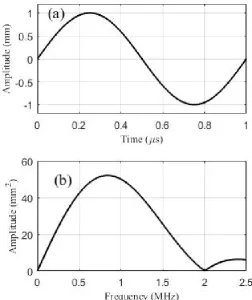
sinusoidal pulse was introduced atT, and time domain radial displacement (u(t)) was collected atR. 73
Table 1.Material’s properties
Material Density (kg/m3) Young’s Modulus (MPa) Poisson’s Ratio
Steel 7,850 210,000 0.3
Rust 2,610 500 0.3
2.2. Corroded steel rod models 74
Five corroded steel rod models (denoted by CM) were generated by replacing the material 75
properties at a corroded region from steel to rust in order to simulate the introduction of surface rust to 76
the intact steel rod model, as shown in Table2. Four attributes were used to characterize the corroded 77
Preprints (www.preprints.org) | NOT PEER-REVIEWED | Posted: 10 July 2018 doi:10.20944/preprints201807.0170.v1
Figure 1.Intact steel rod model
region (surface rust): location (s3), length (d), width (w) and thickness (h). Two values were considered 78
for each attribute. 79
Table 2.Five corroded steel rod models
Model Surface rust location s3(mm)
Surface rust length d(mm)
Surface rust width w(mm)
Surface rust thickness h(mm)
CM1 4 2 2.2 1
CM2 6 2 2.2 1
CM3 4 4 2.2 1
CM4 4 2 4.4 1
CM5 4 2 2.2 0.5
3. Research hypotheses and approach 80
3.1. Hypotheses of ultrasonic waves propagation in intact and corroded rod models 81
Five hypotheses on ultrasonic waves propagation in intact and corroded steel rod models were 82
made for the damage detection problem in this paper. A Mercator projection of cylindrical geometry 83
for steel rod models is provided in Fig.3to better illustrate these hypotheses. 84
1. In model IM, time domain radial displacementu(t)is collected atR. The first ultrasonic wave 85
packet is the one propagating along the~s1path at a velocity ofc1and arriving at timet1. The 86
second ultrasonic wave packet propagates along the~s2path and arriving at timet2with a velocity 87
ofc2. 88
2. In corroded steel rod models (CM1 CM5), the ultrasonic waves propagating along the~s1path 89
4 of 18
Figure 2.Designed loading function
waves propagates through the surface rust and arrives at timet01(i.e.,t01>t1since the ultrasonic 91
wave velocity in rust is slower than the one in steel). 92
3. Part of the ultrasonic waves is scattered from the surface rust and propagates along the~s4path. 93
Timet02 is the total time of flight (TOF) of scattered ultrasonic wave propagating along path 94
(~s3,~s4)(t02=t3+t4). Propagation velocities of ultrasonic waves on path~s1and path(~s3,~s4)are 95
respectivelyc01andc02. 96
4. In Fig.3(top view), path~s8is the path of ultrasonic waves diffracted by the surface rust (~s8 = 97
~s6+d+~s7). TOF of these ultrasonic waves ist8(i.e.,t8=t6+td+t7). 98
5. Higher frequencies are affected more than lower frequencies by the presence of surface rust. 99
This is because that the effective depth of each frequency is approximately its wavelength [20]. 100
With ’shallow’ effective depth, higher frequencies interact with the surface rust more than lower 101
frequencies. 102
3.2. Damage detection algorithm 103
Based on the aforementioned five hypotheses, surface rust detection, localization and 104
quantification are carried by the following approach. 105
3.2.1. Damage detection 106
In this paper, detection of surface rust can be accomplished by determining the reduction of 107
centroid frequency (∆fc) in the spectrogram of u(t)by using STFT. The steps of obtaining fcare
108
reported in the following. 109
1. Generate/introduce ultrasonic waves at transmitterTof model IM. 110
Preprints (www.preprints.org) | NOT PEER-REVIEWED | Posted: 10 July 2018 doi:10.20944/preprints201807.0170.v1
Figure 3.Mercator projection of intact and corroded surface for ultrasonic wave propagation paths
2. Collect time domain radial displacementu(t)at receiverR. 111
3. Apply short-time Fourier transform (STFT) to u(t)in order to convert it to its spectrogram 112
U(t,f). 113
4. In the spectrogramU(t,f), show the half-power contour at -3 dB from the maximum amplitude 114
of the first wave packet. 115
5. Determine the centroid of the half-power contour for the first wave packet by finding its 116
coordinates(fc,tc)in the spectrogramU(t,f).
117
6. The centroid frequency fcof this FE simulation is found. For intact model (IM), fc= fc,i.
118
7. Repeat the steps for an artificially corroded model. For corroded models, fc= fc,c.
119
Fig.4illustrates the parameters defined in the steps for damage detection, using model CM1 as an 120
example. Eq. (1) shows the damage detection criterion for detecting the presence of surface rust. 121
∆fc= fc,i−fc,c
(
=0 intact
6
=0 corroded (1)
where∆fc= difference in the centroid frequency between intact and corroded steel rod models (in
122
MHz), fc,i= centroid frequency of model IM (in MHz), and fc,c= centroid frequency of corroded steel
123
rod models (in MHz). In this research, a steel rod model is considered intact (no damage) if there is no 124
reduction of centroid frequency or∆fc=0 and vice versa.
125
3.2.2. Damage localization 126
To locate surface rust, TOF (time-of-flight) of scattered ultrasonic waves is used. In this research, 127
the location of surface rust is defined by the length of path~s3ors3=|~s3|. The value ofs3indicates the 128
location of surface rust. 129
TOF of the scattered wave (t02) traveling through path~s3and~s4is defined by 130
6 of 18
Figure 4.Procedure of obtainingfcvalue
where t3 and t4 = TOF of ultrasonic waves propagating on paths~s3 and~s4 (µs)), respectively. 131
Equivalently, 132
t02(s3,s4) =
s3
c1
+s4 c4
(3)
wheres3= length of path~s3(mm),s4(s3)= length of path~s4(mm) = p
(s1−s3)2+p2,p= perimeter 133
of the rod model (mm),c1= propagation velocity on path~s1(mm/µs), andc4= propagation velocity 134
on path~s4(mm/µs). From our previous study, a propagation velocity model (Eq. (4)) based on the 135
length of path on a cylindrical geometry was reportedc4[17]. 136
c4(s4) =a+b
p s4
(4)
whereaandb= model parameters. By substituting Eq. (4) and re-arranging terms, we have 137
h
(s1−s3)2+p2 i
c1− t02−s3a q
(s1−s3)2+p2−t02c1bp+s3bp=0 (5) wheres1= length of path~s1(mm). In Eq. (5),s1,p, andc1must be provided. Parametersaandb 138
are from reported literature [17]. Timet02is measured from a corroded model. Once timet02is measured, 139
Eq. (5) can be solved by the graphic method. Eq. (5) also represents the damage localization criterion 140
in our algorithm. Finding the value ofs3locates the surface rust in this research. 141
Preprints (www.preprints.org) | NOT PEER-REVIEWED | Posted: 10 July 2018 doi:10.20944/preprints201807.0170.v1
3.2.3. Damage quantification 142
For damage quantification, dimensions of surface rust (lengthd, widthw, and thicknessh) are to 143
be found. In finding the lengthdof surface rust, TOF (t01) of ultrasonic waves propagating through 144
surface rust and arriving at receiverRis used. Timet01denotes the total propagation time along path 145
~s1which consists of path~s3, surface rust (lengthd), and path~s5. In other words, 146
t01=t3+t5+tr (6)
wheret01= total TOF of ultrasonic wave propagating on path~s1(µs), t3= TOF of ultrasonic wave 147
traveling on path~s3(µs), t5 = TOF of ultrasonic wave traveling on path~s5(µs)), andtr = TOF of
148
ultrasonic wave traveling within surface rust (µs). Sinces1=s3+d+s5, we have 149
t01(d) = s1−d c1
+ d
cr (7)
wherecr= propagation velocity on z-axis in rust (mm/µs). By re-arranging Eq. (7), surface rust length 150
dcan be directly determined by 151
d(t01) = crs1−crc1t 0
1
cr−c1
(8)
Eq. (7) represents thelength estimationcriterion in our algorithm. 152
Onces3(from damage localization, Eq. (5)) andd(from Eq. (8)) are determined, the width of 153
surface rust (w) can be obtained by using the delayed arrival time of first wave packet (t8), as shown in 154
Fig.3(top view). Eq. (9) describes the relationship betweent8andw. 155
t8c1− q
s2
3+ (w/2)2−d− q
s2
5+ (w/2)2=0 (9)
wheres5=s1−d−s3,t8= TOF of ultrasonic wave propagating on path~s8and 156
~s8=~s6+d+~s7 (10)
in a corroded steel rod model (µs),s6= length of path~s6(mm) ands7= length of path~s7(mm). Eq. (9) 157
represents thewidth estimationcriterion in our algorithm. 158
From our fifth hypothesis (Section 3.1), lower frequency ultrasonic waves have ’deeper’ effective 159
depths. It suggests that more frequencies in the STFT spectrogram will be affected when increasing the 160
thicknesshof surface rust. This phenomenon is illustrated by the reduction of spectrograms’ curvature 161
or ∂ 2U
1
∂f2 and modeled by an empirical equation as shown in Eq. (11). 162
h
∂2U1
∂f2
=e∂
2U 1
∂f2 +g (11)
whereh = thickness of surface rust (mm), ∂2U1
∂f2 = second-order partial derivative of the first wave 163
packet’s frequency domain projection, and eand g = model parameters. ∂2U1
∂f2 approximates the
164
curvature of the first wave packet. Eq. (11) represents the thickness estimationcriterion in our 165
algorithm. 166
Eqs. (8), (9) and (11) represent our damage quantification approach in this paper. Surface rust 167
lengthd, widthw, and thicknesshcan be estimated from the STFT spectrogram of radial displacement 168
8 of 18
4. Simulation results and findings 170
Time domain radial displacement (u(t)) of each model at receiverRwas collected from six FE 171
simulation cases (one for intact model and five for corroded models). Spectrogram (U(f,t)) of each 172
u(t)was obtained by STFT. Comparison ofu(t)andU(f,t)between intact and corroded steel rod 173
models was made to study the effects of surface rust onu(t)andU(f,t). 174
4.1. Time domain response 175
In each model, radial displacementu(t)are receiver Rwas collected as shown in Fig.5. As 176
predicted by the first hypothesis, two wave packets were observed. The first wave packet was the 177
ultrasonic wave propagating along the longitudinal direction (z-axis). The second wave packet was the 178
ultrasonic wave propagating along the helical direction (i.e.,~s2in Fig.3). The waveform of the second 179
wave packet is more complicated than the one of the first wave packet in the spectrogram, owing to the 180
geometric dispersion (in the second wave packet) caused by the cylindrical geometry of FE models.
Figure 5.Time domain radial displacement in intact and corroded steel rod models
181
In corroded steel rod models (CM1 - CM5), the first peak amplitude (u1) was reduced after 182
interacting with surface rust and propagating on path~u1. While the presence of surface rust can 183
be detected by the reduction ofu1, quantification of surface rust usingu1can be very difficult due 184
to the geometric dispersion effect onu(t). In reality, peak amplitudes can also be contaminated by 185
background noise (e.g., ambient vibration). Therefore, frequency domain analysis ofu(t)is applied 186
and described in the next section. 187
4.2. Time-frequency domain response 188
By applying STFT tou(t), frequency change inu(T)over time was shown on its spectrograms. 189
Frequency range on the STFT spectrogram between 0.1 MHz and 2 MHz was determined, since this 190
frequency range included most of the kinetic energy of transmitted ultrasonic waves. 191
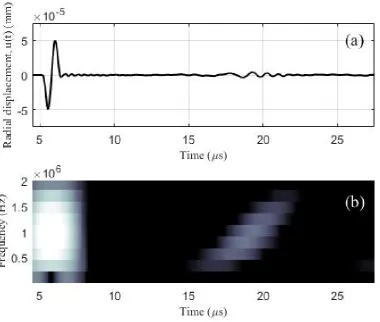
Fig.6shows the STFT spectrogram ofu(t)at transmitterTof model IM. In Fig.6, the first wave 192
packet (white-colored vertical shape) represented the transmitted ultrasonic wave traveling in the 193
longitudinal direction or path~s1(without geometric dispersion), whose amplitudes confirm our choice 194
Preprints (www.preprints.org) | NOT PEER-REVIEWED | Posted: 10 July 2018 doi:10.20944/preprints201807.0170.v1
on frequency range. The second wave packet (gray-colored tilted shape) represented the transmitted 195
ultrasonic wave traveling in the helical direction (with geometric dispersion) and coming back to 196
transmitter T. Due to the geometric dispersion in this FE simulation, ultrasonic waves at lower 197
frequencies (f <1 MHz) travel faster than the ones at higher frequencies (f >1 MHz). This explains 198
the tilted shape of the second wave packet. 199
Figure 6.Radial displacement and spectrogram of the intact steel rod model at transmitterT
Fig.7shows the STFT spectrograms ofu(t)at receiverRof all six models. In Fig.7, two wave 200
packets were observed within the time window of 4.5 - 27.5µs. The first wave packet centering at 8µs 201
represented the ultrasonic wave (vertical shape) propagating from transmitterTto receiverRalong 202
the longitudinal direction (z-axis). The second wave packet (tilted shape) represented the ultrasonic 203
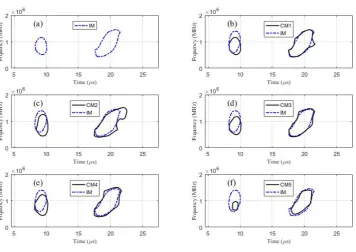
wave propagating along the helical direction or path~s2. Fig.8shows the contours at the half-power 204
level of the first wave packet in each spectrogram. In corroded steel rod models (CM1 CM5), higher 205
frequencies in the first wave packet were reduced due to smaller effective depth. In addition, shape of 206
the second wave packet changed due to the size change of surface rust, as shown in Fig.8. 207
4.3. Surface rust detection 208
Detection of surface rust in a corroded steel rod model was accomplished by comparing its 209
centroid frequencyfcwith the one of an intact model (IM). Fig.9compares the half-power contours
210
of intact (model IM) and corroded (models CM1 CM5) FE models in individual STFT spectrogram at 211
receiverR. Center of the half-power contour of model IM was denoted by centroid frequency fc,i. For
212
five other corroded models, their centroid frequency was denoted by fc,cwith different values. After
213
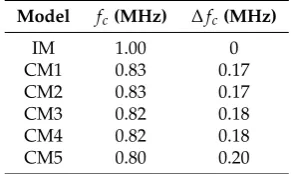
findingfc,iandfc,c, their difference∆fcwas calculated and reported in Table3. Based on Eq. (1), the
214
10 of 18
Figure 7.Spectrogram of intact and corroded steel rod models at receiverR
Table 3.Centroid frequency (fc) of half-power contour for all models
Model fc(MHz) ∆fc(MHz)
IM 1.00 0
CM1 0.83 0.17
CM2 0.83 0.17
CM3 0.82 0.18
CM4 0.82 0.18
CM5 0.80 0.20
4.4. Surface rust localization 216
Eq. (3) was used to locate surface rust in our simulations. In view of the presence of geometric 217
dispersion inu(t), measuring TOF in the time domain became challenging. To avoid the problem of 218
chasing multiple frequencies at a time, the center frequency of transmitted ultrasonic wave in the STFT 219
spectrogram (i.e., 1 MHz in this paper) was chosen. 220
Fig.10shows the STFT spectrogram (at 1MHz) of model IM at receiverRto demonstrate how to 221
calculate the TOF of the scattered wave (t02) traveling through paths~s3and~s4. In Fig.10(a), the 1-MHz 222
curves on the STFT spectrogram of model IM and model CM1 were extracted. Timet1denoted the 223
TOF of the first wave packet and timet2the second wave packet for model IM. In Fig.10,t1andt2 224
were measured from the timet0when the ultrasonic wave was introduced at transmitterT; in this 225
paper,t0=6.13µs. Since the peak amplitude of the first wave packet was 9.01µs,t1= (9.01−6.13)µs 226
= 2.88µs. With traveling distances1being 10 mm, the wave velocityc1can be calculated by 227
c1=
s1
t1 (12)
⇒c1= 10
2.88 =3.47 mm/µs, (13)
Preprints (www.preprints.org) | NOT PEER-REVIEWED | Posted: 10 July 2018 doi:10.20944/preprints201807.0170.v1
Figure 8.Half-power contours in STFT spectrogram for six models at receiverR
This wave velocity can be compared with the theoretical surface wave velocity ct. ct can be
228
approximated by [21] 229
ct≈ 0.87
+1.2ν 1+ν
s
E
2ρ(1+ν) (14)
WithE= 210,000 MPa,ρ= 7,850 kg/m3, andν= 0.3, approximated theoreticalctvalue was found to be
230
3.03mm/µs. Consequently, theoretical TOFttfor the first wave packet was found to be
231
tt= s1 −zl
ct (15)
⇒tt=3.14µs (16)
wheres1 = distance from center of transmitterTto receiver R(mm) (= 10 mm) andzl = distance
232
from center of transmitterTto the edge of loading area atT(mm) (= 0.5 mm). An error of 8.2% was 233
obtained between the approximated theoreticalctvalue and numericalc1value. 234
235
A subtracted/differential 1-MHz curve (subtract model IM from model CM1) was generated 236
and shown in Fig.10(b) from where differential TOF values of the first wave packett01and of the 237
second packett02were determined to be 15.16−t0=9.03µs and 22.28−t0=22.28−6.13=16.15µs, 238
respectively. In our algorithm, differential TOF of the second wave packett20 was used for surface rust 239
localization. 240
From the differential 1-MHz curve in Fig.10(b), a propagation velocity model from literature 241
[17] for elastic waves on a cylindrical geometry was used. 242
c4(s4) =3.47−0.8348
p s4
12 of 18
Figure 9.Half-power contours of the first wave packet at receiverR
Figure 10.Spectrograms of model IM and model CM1 at 1 MHz
In all six FE models,p= 12.7π= 39.9 mm. From the Mercator projection shown in Fig.3, it is clear that 243
s4= q
(d+s5)2+p2 (18)
⇒s4= q
(s1−s3)2+p2 (19)
Preprints (www.preprints.org) | NOT PEER-REVIEWED | Posted: 10 July 2018 doi:10.20944/preprints201807.0170.v1
Withs1= 10 mm,p= 39.9 mm,c1= 3.47 mm/µs,a= 3.47,b=−0.8348, Eq. (5) could be written as 244
3.47h(10−s3)2+39.92 i
− t20 −3.47s3 q
(10−s3)2+39.92+155.58t02−33.31s3=0 (20) ⇒5871.27−
102.71− q
20371.8−240.8s3+12.04s23
s3+3.47s23
+
155.58−q1692.01−20s3+s23
t02=0 (21)
Eq. (21) provides the condition betweens3andt02. With differential TOFt02, surface rust locations3 245
can be found from Eq. (21). Since Eq. (21) cannot be solved analytically, the graphic method was 246
applied with its result shown in Fig.11. Eq. (21) represents a model for locating the surface rust in our 247
algorithm. Following the same procedure, 1-MHz curves of models CM2 and CM3 were generated
Figure 11.Relationship betweens3andt02
248
(similar to Fig.10(b) for model CM1) in order to determine different TOF for models CM2 and CM3. 249
For model CM2,t02was found by 22.51−t0=22.51−6.13=16.38µs. For model CM3,t20 was found 250
by 23.01−t0=23.01−6.13=16.88µs. Oncet02was found, Eq. (21) can be used for finding surface 251
rust locations3. 252
Estimated surface rust locations (s3) in corroded steel rod models was reported in Table4. 253
Table 4.Comparison between predicted and actual location and dimensions
Model Predicted (mm) Actual (mm) Error(%)
Location,s3 CM1 3.86 4 3.5
CM2 5.91 6 1.5
CM3 2.92 3 2.6
Length,d CM1 1.97 2 1.5
CM2 3.69 4 7.75
Width,w CM1 2.36 2.2 7.27
CM4 4.2 4.4 4.54
Thickness,h CM1 0.98 1 2
14 of 18
4.5. Surface rust quantification 254
For surface rust quantification, Eq. (8) was used to determine surface rust lengthdfor models 255
CM1 and CM2 by using measured timet01. Eq. (9) was applied to determine surface rust widthwfor 256
models CM1 and CM4 by using measured timet08. Eq. (11) was utilized to determine surface rust 257
depthhfor models CM1 and CM5 by using measured curvature d2U
1
d f2
. 258
For determining surface rust lengthdby using Eq. (8),s1= 10 mm and propagation velocity in steel 259
c1= 3.47 mm/µs (from Eq.(13)). Propagation velocity in rustcrwas calculated by 0.08454ct=0.257
260
mm/µs from [20]. Therefore, Eq. (8) became 261
d(t01) = 0.257(10)−0.257(3.47)t 0
1
3.47−0.257 (22)
⇒d(t01) =
2.57−0.892t01
3.213 (23)
For model CM1,t01was found by 16.10−t0=16.10−6.13=9.97µs. For model CM2,t01was found by 262
22.31−t0=22.31−6.13=16.18µs. With Eq. (23), estimated surface rust lengthdfor models CM1 263
and CM2 were reported 1.97 mm and 3.69 mm, respectively. 264
was applied to determine surface rust lengthdfor models CM1 and CM2. Withs3(from surface 265
rust localization) anddfound, surface rust widthwvalues for models CM1 and CM4 were determined 266
by solving Eq. (9) with measuredt8(TOF of the first wave wave packet as shown in Fig.12). 267
Figure 12.Time delay of the first wave packet
For surface rust widthwquantification, estimateds3andd were substituted into Eq. (9). For 268
example, in model CM1, Eq. (9) became 269
t83.47− q
3.862+ (w/2)2−1.97−q(10−3.86−1.97)2+ (w/2)2=0 (24) wheret8was found by 9.11−t0=9.11−6.13=2.98µs. Surface rust widthwvalues for model CM1 270
was hence determined to be 2.36 mm. Similarly, 271
t83.47− q
3.912+ (w/2)2−1.98−q(10−3.91−1.97)2+ (w/2)2=0 (25) was obtained for models CM4.t8was found by 9.31−t0=9.31−6.13=3.18µs in CM4. Predicted 272
wis 4.2 mm as shown in Table4. 273
Preprints (www.preprints.org) | NOT PEER-REVIEWED | Posted: 10 July 2018 doi:10.20944/preprints201807.0170.v1
At last, curvature values of the first wave packet for models IM (∂2U1
∂f2 =−4.22×10
5), CM1 (∂2U1
∂f2 =
274
−5.12×10⁵), and CM5 (∂2U1
∂f2 =−4.72×10
5) were calculated from Fig.13(a). These curvature values 275
were modeled with surface rust depthhby Eq. (11) to obtain model parameterse=−1.1053×10⁵and 276
g=−4.6818 (R2=0.996). Therefore, Eq. (11) was written as 277
h
∂2U1
∂f2
=−1.1053×10⁵× ∂ 2U
1
∂f2 −4.6818 (26)
Performance of proposed algorithm (Eqs. (23), (24), (25) and (26)) for surface rust quantification 278
was summarized in Table4.
Figure 13.Ridge of the first wave packets and their second-order derivatives
279
4.6. Findings 280
By conducting the FE analysis of ultrasonic wave propagation in intact and corroded steel rod 281
models, following research findings are obtained: (1) in the time domain, the first peak amplitude 282
(u1) is reduced due to the presence of a surface rust; (2) in the STFT spectrogram, shape of the second 283
wave packet in the spectrogram is tilted due to the geometric dispersion in ultrasonic waves; (3) the 284
first wave packet in corroded steel rod models suffered from high frequency components loss. This is 285
because that higher frequencies have smaller effective depths and are affected by surface rust more 286
than lower frequencies. As a result, non-zero centroid frequency reduction∆fcoccurs to corroded steel
287
rod models; (4) when measuring TOF from dispersive ultrasonic waves, single frequency is used on 288
the STFT spectrogram (e.g., 1 MHz in this paper); (5) ultrasonic wave propagation velocity on different 289
curved paths can be estimated by an empirical model described in Eq. (4); (6) six empirical equations 290
are proposed for detecting (Eq. (1)), locating (Eq. (21)) and quantifying (Eqs. (23), (24), (25) and (26)) 291
surface rust on a steel rod model. Based on aforementioned findings, a surface rust detection algorithm 292
16 of 18
Figure 14.Surface rust detection algorithm
5. Conclusion 294
This paper reports a finite element study of utilizing point-source generated ultrasonic waves for 295
detecting surface rust in steel rod models. Methods of detecting, locating and quantifying the surface 296
rust are achieved by using the STFT (short time Fourier transform) spectrogram of radial displacement 297
collected on the surface of corroded steel rod models. We have concluded the following. 298
• Presence of surface rust can be detected by the reduction of centroid frequency of the first wave 299
packet in the STFT spectrogram of corroded steel rod models. 300
• Location of surface rust is estimated by finding the difference in arrival time (TOF) between 301
helically propagating ultrasonic waves and scattered ultrasonic waves (due to surface rust). 302
• Length of surface rust can be predicted by calculating the difference in TOF between longitudinally 303
propagating ultrasonic waves of intact and corroded steel rod models. This difference in TOF is 304
related to the longitudinal dimension (length) of surface rust. 305
• Width of surface rust can be determined by calculating the difference in TOF of the first wave 306
packet between intact and corroded steel rods in the STFT spectrogram at a fixed frequency (e.g., 1 307
MHz in this paper). 308
• Thickness of surface rust can be estimated by utilizing the second-order derivative of the first wave 309
packet of corroded steel rod models. 310
Preprints (www.preprints.org) | NOT PEER-REVIEWED | Posted: 10 July 2018 doi:10.20944/preprints201807.0170.v1
In conclusion, this paper presents our finite element analysis of ultrasonic waves on intact and corroded 311
steel rod models for detecting, locating, and quantifying surface rust in a systematically approach. 312
While research result is obtained in several empirical equations, it is believed that our proposed 313
damage detection algorithm can be applied to other corrosion detection problems using distributed 314
photoacoustic fiber optic sensors on steel rods or steel rebars. 315
Acknowledgments: The authors would like to thank the National Science Foundation (NSF), Division of 316
Civil, Mechanical and Manufacturing Innovation (CMMI) for partially supporting this research through Grant 317
CMMI-1401369. 318
Author Contributions:Qixiang Tang and Tzuyang Yu conceived and designed the simulation; Qixiang Tang, Jie 319
Hu and Cong Du analyzed the data; Xingwei Wang and Tzuyang Yu contributed analysis tools; Qixiang Tang 320
drafted the manuscript. 321
Conflicts of Interest:The authors declare no conflict of interest. 322
323
1. Huston, D.Structural Sensing, Health Monitoring, and Performance Evaluation; 2010. 324
2. for Testing, A.S.; Materials. Metals Test Methods and Analytical Procedures.1999 Annual Book of ASTM 325
Standards1999,3. 326
3. Qixiang Tang, Tzuyang Yu, M.J. Finite element analysis for the damage detection of light pole structures. 327
Proc.SPIE2015,9437, 9437 – 9437 – 15. 328
4. Cheng, W. Pulsed Eddy Current Testing of Carbon Steel Pipes’ Wall-thinning Through Insulation and 329
Cladding. Journal of Nondestructive Evaluation2012,31, 215–224. 330
5. Wallbrink, C.; Wade, S.A.; Jones, R. The effect of size on the quantitative estimation of defect depth in steel 331
structures using lock-in thermography. Journal of Applied Physics2007,101, 104907. 332
6. Cook, D.; Berthelot, Y. Detection of small surface-breaking fatigue cracks in steel using scattering of 333
Rayleigh waves. NDT & E International2001,34, 483–492. 334
7. Resch, M.T.; Nelson, D.V. An ultrasonic method for measurement of size and opening behavior of small 335
fatigue cracks. Small-crack test methods. ASTM International,1992, pp. 169–196. 336
8. Rodríguez, G.; Casas, J.; Villalba, S. SHM by DOFS in civil engineering: a review. "Structural Monitoring 337
and Maintenance. Structural monitoring and maintenance2015,2. 338
9. Li, H.N.; Li, D.S.; Song, G.B. Recent applications of fiber optic sensors to health monitoring in civil 339
engineering. Engineering Structures2004,26, 1647 – 1657. 340
10. Du, C.; OwusuTwumasi, J.; Tang, Q.; Guo, X.; Zhou, J.; Yu, T.; Wang, X. All-Optical Photoacoustic Sensors 341
for Steel Rebar Corrosion Monitoring.Sensors2018. 342
11. Zou, X.; Chao, A.; Tian, Y.; Wu, N.; .; Yu, T.; Wang, X. A novel Fabry-Perot fiber optic temperature sensor 343
for early age hydration heat study in Portland cement concrete.Smart Structures and System2013,12. 344
12. Wu, N.; Zou, X.; Zhou, J.; Wang, X. Fiber optic ultrasound transmitters and their applications.Measurement 345
2016,79, 164–171. 346
13. Tang, Q.; Yu, T. Finite element simulation for damage detection of surface rust in steel rebars using elastic 347
waves. Proceedings of SPIE Vol. 98042016. 348
14. Sansalone, M.; Carino, N.J. Detecting Delaminations in Reinforced Concrete Slabs with and without 349
Asphalt Concrete Overlays Using the Impact-Echo Method.National Bureau of Standards Journal of Research 350
1987,Nov./Dec., 369–381. 351
15. Tang, Q.; Yu, T. Finite element simulation of ultrasonic waves in corroded reinforced concrete for early-stage 352
corrosion detection. Proc.SPIE2017,10169, 10169 – 10169 – 9. 353
16. Zhang, S.; Shen, W.; Li, D.; X.Zhang.; Chen, B. NONDESTRUCTIVE ULTRASONIC TESTING IN ROD 354
STRUCTURE WITH A NOVEL NUMERICAL LAPLACE BASED WAVELET FINITE ELEMENT METHOD. 355
Latin American Journal of Solids and Structures2018. 356
17. Tang, Q.; Twumasi, J.O.; Hu, J.; Wang, X.; Yu, T. Finite element simulation of photoacoustic fiber optic 357
sensors for surface corrosion detection on a steel rod. Proc.SPIE2018,10599, 10599 – 10599 – 13. 358
18. Dassault Systémes, 10 rue Marcel Dassault, CS 40501, 78946 Vélizy-Villacoublay Cedex-France.Abaqus/CAE 359
18 of 18
19. Liu, G.R.; Quek, S.S. A non-reflecting boundary for analyzing wave propagation using the finite element 361
method. Fn. Elem. in Anal. Des.2003,39, 403–417. 362
20. Bergmann, L. Ultrasonics and their Scientific and Technical Applications. Wiley, New York1948. 363
21. Viktorov, I. Rayleigh Waves and Lamb waves-Physical Theory and Application. New York: Plenum1967. 364
Preprints (www.preprints.org) | NOT PEER-REVIEWED | Posted: 10 July 2018 doi:10.20944/preprints201807.0170.v1