Performance Analysis of Handovers Using TDD and FDD
in Long Term Evolution
G.K.Venkatesh
1, Dr.P.V.Rao
2 1PhD Scholar Department, Electronics Engg, Dept.of ECE,
Jain University Banglaore, (India)
1
Professor, P.G. Coordinator, Vignana Bharati Institute of Technology, Hyderabad
ABSTRACT
In Long Term Evolution Advanced Technology Handovers is the basic criteria of mobility of the user in
cellular networks in Time Division Duplex and Frequency Division Duplex. Handover is one of the essential
elements that can affect the Quality of Service (QoS) and Capacity of Mobile Broadband Networks. In the
cellular network communication systems, a limited shared resource (spectrum) needs to be shared with all
users so full duplex communication is possible. This paper involves studying the different Hand over delay
parameters and also focusing on reducing “Hard Handover delay” by reducing interruption time,
activation time, wireless channel access time and the wireless link transmission delay. An efficient handover is
implemented by post optimization in order to reduce the handover delay time in Time Division Duplex
network and it also reduces the wireless channel access time and the wireless link transmission delay. By
analyzing the handover parameters with different air cell selection, cluster areas, signal strength and post
optimization improvement in the Quality of service can be achieved. The future work on hard handover may be
by applying different handover strategies to get better performance and Quality of service in Time Division
Duplex and Frequency division Duplex mobile network.
Key words: QoS Quality of Service, TDD Time division duplex, FDD Frequency division
duplex.
I.
INTRODUCTION
operates by toggling transmission directions over a time signals in both the downstream and single
frequency channel is used to transmit point- to-point systems that use TDD, between downstream
transmission and the upstream transmission. handled dynamically. The TX/RX Transition Gap (TTG) is
a gap mix of both traffic types. The relative band) between transmit and receive streams. Capacity
of the downstream and upstream require a guard time (instead of a guard links can be altered in favor of
one direction over the other. This is accomplished by giving a greater time interval. This toggling
receives large information payloads downstream. In contrast, TDD systems take place very rapidly
and are imperceptible to the user. Thus, TDD can support voice and for this technique is Internet access
in which a user enters a short message upstream and other symmetrical communication services as well
as asymmetric data services. TDD also can processes characterized by unbalanced information flow. An
obvious application asymmetry is useful for communication.
II. TIME DIVISION DUPLEX
TDD uses a single frequency to transmit signals in both the downstream and upstream directions. In fixed
wireless point-to-point systems that use TDD, a single frequency channel is used to transmit signals in both
the downstream and upstream directions. TDD operates by toggling transmission directions over a time
interval. This toggling takes place very rapidly and is imperceptible to the user. Thus, TDD can support voice
and other symmetrical communication services as well as asymmetric data services. TDD also can handle a
dynamic mix of both traffic types. The relative capacity of the downstream and upstream links can be altered in
favor of one direction over the other. This is accomplished by giving a greater time allocation through time
slots to downstream transmission intervals than upstream. This asymmetry is useful for communication
processes characterized by unbalanced information flow. An obvious application for this technique is
Internet access in which a user enters a short message upstream and receives large information payloads
downstream. In contrast, TDD systems require a guard time (instead of a guard band) between
transmit and receive streams. The TX/RX Transition Gap (TTG) is a gap between downstream transmission
and the upstream transmission.
This gap allows time for the base station to switch from transmit mode to receive mode and subscribers to
switch from receive mode to transmit mode. The TDD frame structure is shown in below fig2.3 which consists
of uplink and downlink frequencies.
TDD systems use the same frequency for transmission and reception, and the transmitted and
received signals are separated in the time-domain. This contrasts with FDD, where each transceiver
transmits and receives on two different frequencies, separated by the duplex spacing as defined in various
CEPT recommendations. CEPT recommended channel arrangements for both point-to-point and
point-to-multipoint make little explicit reference to duplex method although those arrangements which
incorporate paired frequencies clearly are able to accommodate FDD systems but do not necessarily
preclude TDD systems. However Regulators often overlook the P-MP possibilities offered by TDD,
especially in bands traditionally occupied by FDD systems. TDD was not a practical alternative to FDD for
Advantages
Advantage of TDD is that the uplink and downlink radio paths are likely to be very similar. This means that techniques such as beam forming work well with TDD systems.
Advantage in the case where there is asymmetry of the uplink and downlink data rates. As the amount of uplink data increases, more communication capacity can be dynamically allocated, and as the traffic load becomes lighter, capacity can be taken away. It is possible to dynamically change the UL and Dl capacity ratio to match demand.
Fig 1: TDD frame
III . HANDOVER
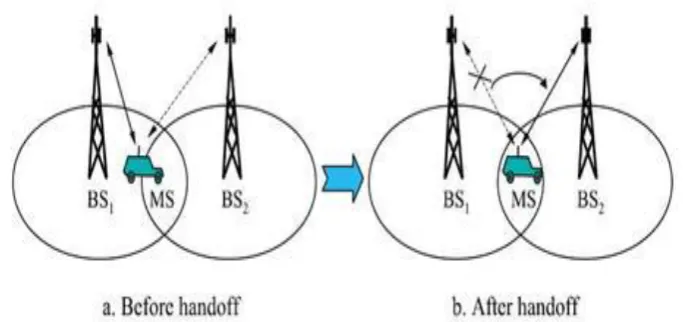
The most basic form of handover is when a phone call in progress is redirected from its current cell (called source) to a new cell (called target). In terrestrial networks the source and the target cells may be served from two different cell sites or from one and the same cell site. Such a handover in which the source and the target are different cells (even if they are on the same cell site), is called inter-cell handover. The purpose of inter-cell handover is to maintain the call as the subscriber is moving out of the area covered by the source cell and entering the area of the target cell. The pictorial representation of handover before and after shown in below fig2
The steps involved in the Handover Process
Compare the Target SINR-enb with the Servins SINR-enb plus HHM.
Compare UE velocity and predict user mobility.
If traffic used is voice do proactive handover else reactive handover.
Compare Target SINR-Henb with the Serving
SINR-enb plus HHM.
Compare UE velocity.
Don’t perform Hand-in or perform Hand-in or reactive Hand-in based on the Velocity value.
Compare Target SINR-Henb with the Serving
SINR-Henb plus HHM.
If traffic used is voice do proactive handover else reactive handover.
Compare Target SINR-enb with the Serving
SINR-Henb plus HHM.
If traffic used is voice do proactive handover else reactive handover.
Fig3: Route Pattern of Driven User
IV SIMULATION RESULTS
Table:1 Cluster selected with surrounding areas
CLUSTER: Rajajinagar
On Air Sites 8
Off Air Sites 0
Proposed Sites 0
IBS 1
Total SQ Km 0.8
Table:2 Areas covered under cluster
AREA Covered:
1
Dr MC Modi hospital Road
2
Chord Road
3
Basaveshwara Nagar
4
RajajiNagar
Table:3Location of the areas with Latitude and Longitude
Location
Lat
Long
KLE Law College
12.9957
77.5537
Citi hospital
12.9955
77.5508
Swati restuarant
12.9978
77.5500
Star Circle
12.9976
77.5503
Ranganath Swamy temple
12.9955
77.5503
J Spider training center
12.9949
77.5510
Nadgir institute of tech
12.9951
77.5468
UCO Bank
12.9965
77.5463
Rajajinagar RTO
12.9943
77.5536
Basaveshwar College
12.9946
77.5562
Sycone
12.9971
77.5507
KFC
12.9973
77.5464
Navya College
12.9986
77.5421
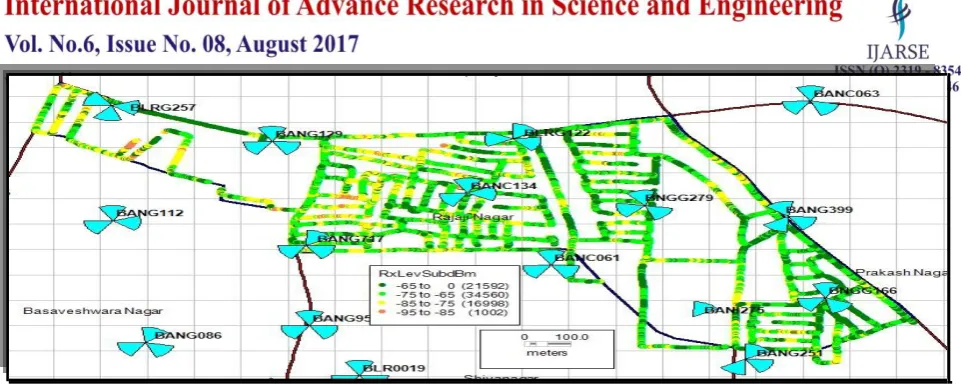
Fig 3: Rx Level Dedicated
Fig 4: Rx Quality
Table:4 Receiver Quality Statistics
Rx Quality Statistics
Rx Quality 4G
Samples Percentage
0 to 5 59088 82.66
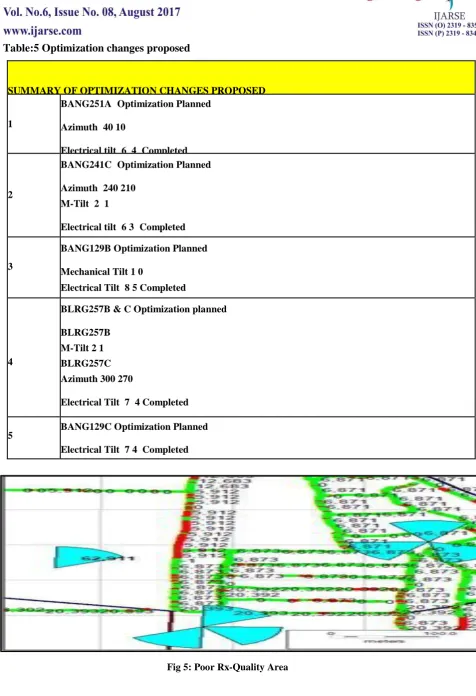
Table:5 Optimization changes proposed
SUMMARY OF OPTIMIZATION CHANGES PROPOSED
1
BANG251A Optimization Planned
Azimuth 40 10
Electrical tilt 6 4 Completed
2
BANG241C Optimization Planned
Azimuth 240 210
M-Tilt 2 1
Electrical tilt 6 3 Completed
3
BANG129B Optimization Planned
Mechanical Tilt 1 0
Electrical Tilt 8 5 Completed
4
BLRG257B & C Optimization planned
BLRG257B
M-Tilt 2 1
BLRG257C
Azimuth 300 270
Electrical Tilt 7 4 Completed
5 BANG129C Optimization Planned
Electrical Tilt 7 4 Completed
Fig 6: POST OPTIMIZATION
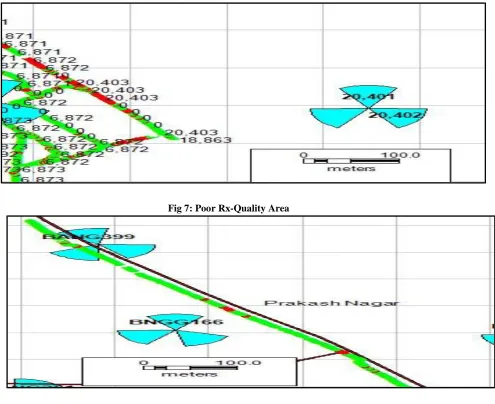
Fig 7: Poor Rx-Quality Area
AREA Covered:
1
Dr MC Modi hospital Road
2
Chord Road
3
Basaveshwara Nagar
4
Rajaji Nagar
Table:7 Location with Latitude and Longitude
Location Lat Long
KLE Law College 12.9957 77.5537
Citi hospital 12.9955 77.5508
Swati restuarant 12.9978 77.5500
Star Circle 12.9976 77.5503
Ranganath Swamy temple 12.9955 77.5503
J Spider training center 12.9949 77.5510
Nadgir institute of tech 12.9951 77.5468
UCO Bank 12.9965 77.5463
Rajajinagar RTO 12.9943 77.5536
Basaveshwar College 12.9946 77.5562
Sycone 12.9971 77.5507
KFC 12.9973 77.5464
Navya College 12.9986 77.5421
Modi Hospital 12.9975 77.5457
Table:6 Cluster with 7 on Air sites
CLUSTER: Rajajinagar
On Air Sites 7
Off Air Sites 0
Proposed Sites 0
IBS 0
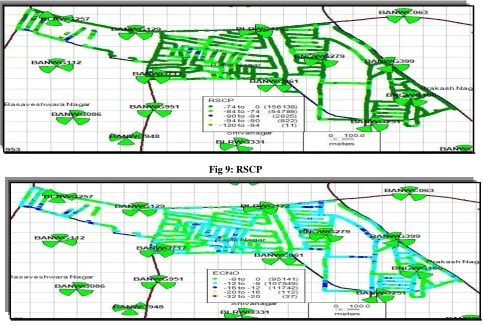
Fig 9: RSCP
Fig 10: Ec/No
Table:8 3G BIN COUNT with RSCP
RSCP
Range Count Percentage (%)
0 to -74 156138 72.76
(-74 to -84) 54785 25.53
(-84 to -90) 2825 1.31
(-90 to -94 822 0.38
Table:9 3G BIN COUNT Ec/No
Ec/No
Range
Count
Percentage (%)
0 to -8
95141
44.33
(-8 to -12)
107549
50.12
(-12 to -16)
11742
5.47
(-16 to -20)
112
0.05
(-20 to -32)
37
0.01
VIII CONCULSION
The paper provides an efficient method of Handover by optimizing the handover parameters
like number of air sites selected, cluster area, Signal strength in order to improve the quality
of Service in mobile communication for driven wards. Simulation results shows that the
handover percentage is improved and the access and delay time are reduced.
REFERENCES
[1] Mugen Peng Wenbo Wang “A framework for investigating radio resource management algorithms in TD-SCDMA systems”, ,Communications Magazine, IEEE Volume:43 , Issue: 6 , 2014
[2] Azita Laily Yusof, Norsuzila Ya’acob, and Mohd Tarmizi Ali, “Handover Adaptations for Load Balancing Scheme in Macrocell/Femtocell LTE Network”, Journal of Advances in Computer Networks, Vol. 1, No. 4, December 2013
[3] Nagy Faroug Merghani, Rashid A. Saeed, Rania A. Mokhtar, “Hard Handover Optimization for Co- Channel WCDMAHeterogeneous Networks”, Proceedings of 2014 International Conference on Sustainable Research and Innovation, Volume 5, 7th- 9th May 2014
Hamed Fehri, Jalil Chitizadeh, Mohammad H. Yaghmaee, “A Novel Downlink Handover Priority Scheduling Algorithm for Providing Seamless Mobility and QoS in IEEE802.16e BWA System”, 978-0-7695-3501-2/09 $25.00 © 2009 IEEE
[5] Thanachai Thumthawatworn, Anjum Pervez, “Multi-level Threshold Handover for Hmogeneous Wireless Mobile Networks”, PGNet ISBN: 978-1- 902560-22-9 © 2009
[7] Ravichandra M, Kiran Gowda H N, Udaya Kumar C A, “A Survey on Handovers Literature for Next Generation Wireless Networks”, International Journal of Advanced Research in Computer and Communication Engineering Vol. 2, Issue 12, December 2013
[8] Singhal, D. Kunapareddy, M. Chetlapalli, V. James, V.B. Akhtar, N. “LTE-Advanced:Handover interruption time analysis for IMT-A Evaluation” 2014, Computing and Networking Technologies (ICSCCN)