Faculty of Business and Law
Victoria University
Master of Business by Research, Management
Supervisor: Professor Michael Muetzelfeldt
Co-Supervisor: Mr Richard Gough
Date Submitted: November 2009
Understanding Outer-Urban Governance: A case study of local
government administration in Melbourne’s north-west
Abstract
Context
Building up over several decades, local government reform has been repeatedly investigated by successive Victorian state governments. Municipal boundaries had remained largely unchanged since the 1880s. Following the election of the neo-liberal Kennett Government in 1993, a dramatic reform program was initiated through the establishment of the Local Government Board and amalgamation of 210 councils into 78. This process was combined with the removal of democratically elected councils, appointment of Commissioners, introduction of Compulsory Competitive Tendering, a 20 percent rate reduction and the introduction of a permanent rate cap.
Purpose of this research and methodology
The research aims to provide an understanding of local governance in an outer metropolitan area of Melbourne Through the examination of the policy framework that has established and maintained community governance in Victoria by the State Government from the period of local government amalgamations in 1994 to the present day and the use of a case study, Hume City Council, the thesis has descriptive and analytical elements drawing on empirical inquiry using case study methodology. The case study method has been chosen because it is most suitable for discovering how the community participants perceive their level of governance and their desires for future governance structures.
Major conclusions reached
Master by Research Declaration
I, Lawrence Robert Seyers, declare that the Master by Research thesis entitled Understanding Outer-Urban Governance: A case study of local government administration in Melbourne’s north-west is no more than 60,000 words in length including quotes and exclusive of tables, figures, appendices, bibliography, references and footnotes. This thesis contains no material that has been submitted previously, in whole or in part, for the award of any other academic degree or diploma. Except where otherwise indicated, this thesis is my own work.
Signature
Table of Contents
ABSTRACT ...2
FIGURES ...6
TABLES ...7
CHAPTER 1: INTRODUCTION ...8
CHAPTER 2: LITERATURE REVIEW ...12
2.1INTRODUCTION...12
2.2LOCAL GOVERNMENT IN VICTORIA...12
2.3AMALGAMATIONS...24
2.4MANAGERIALISM...31
2.5NETWORKS...41
2.6GOVERNANCE...45
2.7TRUST...49
2.8CONSULTATION...53
2.9IDENTITY...59
2.10WICKED PROBLEMS...63
CHAPTER 3: CASE STUDIES...72
3.1INTRODUCTION...72
3.2HUME CITY COUNCIL – DESCRIPTION...73
3.3.HUME CITY COUNCIL –PLANNING ISSUES...84
3.3.1EARLY BEGINNINGS...85
3.3.2HISTORICAL SATELLITE CITIES AND GREEN WEDGES...85
3.3.3MODERN SATELLITE CITIES AND GREEN WEDGES...93
3.3.4SUNBURY’S URBAN GROWTH BOUNDARY AND GREEN WEDGES...97
3.3.5SUNBURY STRATEGIC FRAMEWORK PLAN...104
3.4HUME CITY COUNCIL –MANAGERIAL ISSUES...108
3.5HUME CITY COUNCIL –POLITICAL ISSUES...113
3.6HUME CITY COUNCIL –ANALYSIS...116
3.7DELATITE SHIRE –CASE STUDY...118
3.8CONCLUSION...128
CHAPTER 4: DATA, PERCEPTIONS AND UNDERSTANDINGS...129
4.1INTRODUCTION...129
4.2METHODOLOGY...130
4.3SECONDARY DATA...131
4.3.1REVENUE AND EXPENDITURE...134
4.3.2POPULATION AND DEMOGRAPHICS...154
4.3.3CONCLUSION...165
4.4INTERVIEW METHODOLOGY...167
4.5PERCEPTIONS AND UNDERSTANDINGS...170
4.6CONCLUSION...180
CHAPTER 5: ANALYSIS AND CONCLUSION...182
5.1INTRODUCTION...182
5.2HYPOTHESIS...184
5.3ANALYSIS AND CONCLUSION...186
LIST OF INTERVIEWS 2008...195
Figures
Figure 1: Network patterns in different conflict/consensus environments...43
Figure 2: The stratified public ...52
Figure 3: Arnstein’s Ladder of Citizen Participation ...54
Figure 4: Consultation bridge...58
Figure 5: New South Wales local government resource sharing partnerships ...70
Figure 6: Hume City Council and Delatite Shires in Victorian context ...72
Figure 7: Local Government Board Interim Report Recommendations for the geographic area that is now occupied by Hume City Council...74
Figure 8: Hume City Council Panel Terms of Reference...78
Figure 9: Support for a separate Shire of Sunbury ...81
Figure 10: Overall community satisfaction from 2001-2004 ...83
Figure 11: 1969 Victorian Government Satellite Cities Study Area ...87
Figure 12: 1974 Sunbury Designated Growth Area ...90
Figure 13: Sunbury Population Expectations and Actual Growth ...91
Figure 14: Melbourne 2030 Direction 3 ‘Networks with regional cities’ ...92
Figure 15: Peri-Urban Typologies...96
Figure 16: Growth Area Population Projections to 2030 ...97
Figure 17: Melbourne Airport Environs Overlay – shown as red and yellow ...98
Figure 18: Urban Growth Boundary Changes...100
Figure 19: Sunbury Zones and Urban Growth Boundary ...102
Figure 20: Sunbury development areas inside the Urban Growth Boundary...103
Figure 21: Sunbury Strategic Framework Plan ‘Investigation Areas’ (A, B and C)...105
Figure 22: The wider ‘Sunbury region’...107
Figure 23: North-west Melbourne pre/post-amalgamation boundaries and head offices...109
Figure 24: Results from 2006 State Election, Macedon electorate and Sunbury booth comparison – first preference total data ...115
Figure 25: First preference votes in the seats of Tullamarine and Macedon (inclusive of Sunbury) for the 1996, 1999, 2002 and 2006 State Elections...115
Figure 26: Average local government revenue composition 2006-07...136
Figure 27: Average outer metropolitan councils revenue composition 2006-07 ...136
Figure 28: Hume City Council Rate Revenues ...137
Figure 29: Hume City Council Total Revenues and Expenses...139
Figure 30: Hume City Council Grant Revenues...139
Figure 31: Metropolitan council employee expenditure per capita 1991-92...142
Figure 32: Provincial centres expenditure per capita 1991-92 ...143
Figure 33: Rural shire expenditure per capita 1991-92 ...143
Figure 34: Metropolitan council employees per capita 1991-92...145
Figure 35: Provincial centres employees per capita 1991-92...145
Figure 36: Rural shire employees per capita 1991-92...146
Figure 37: Hume City Council Employee Costs ($000s) ...147
Figure 38: Victorian local government staffing before and after amalgamations ...147
Figure 39: Average Victorian local government expenditure 2006-07 ...148
Figure 40: Average Victorian local government expenditure 2006-07 ...148
Figure 41: Hume City Council expenditure composition 2006-07 ...149
Figure 42: Hume City Council Road and Footpath Expenditure ...150
Figure 43: Average small shire councils revenue composition 2006-07...151
Figure 44: Five year underlying result for small shires...153
Figure 46: Sunbury’s population growth projections...160
Figure 47: Sunbury’s historical population growth and projection scenarios ...160
Figure 48: Sunbury’s changing age profile ...162
Figure 49: Birthplace comparison Sunbury and Melbourne 1961 and 2006 (percent) ...165
Figure 50: Hume City Council Average Rates and Charges per Assessment ...175
Figure 51: Hume City Council Average Rates and Charges per Residential Assessment ...176
Figure 52: Thesis flow chart...185
Figure 53: Interaction of key concepts ...187
Tables
Table 1: Functions of the Local Government Board ...14Table 2: Reports completed by the Local Government Board ...15
Table 3: Victorian public service employment arrangements in three successive management models ...34
Table 4: Attributes of a peri-urban zone...96
Table 5: Sunbury Strategic Framework Plan ‘Sustainable Planning Principles’ ...106
Table 6: Hume City Council Panel de-amalgamation establishment costs ...111
Table 7: Delatite Shire Panel de-amalgamation establishment costs...112
Table 8: Sunbury booth results from 2006 State Election – first preference all data...114
Table 9: Selected demographics for the Delatite Shire, 1996 ...125
Table 10: Victorian Local Government Indicators...133
Table 11: Auditor General quantitative performance indicator framework ...134
Table 12: Hume City Council Total Revenues, Expenses and Surplus/Deficit ($000s) ...138
Table 13: Victorian Grants Commission Cost Adjustors and Functions...140
Table 14: Local government financial sustainability risk rating ...151
Table 15: Local Government populations ...156
Chapter 1: Introduction
Local government in Victoria has undergone unprecedented change. The research aims to provide an understanding of local governance in an outer-metropolitan area of Melbourne following the amalgamation of local government areas in 1994. This is achieved by examining the key issues in regard to local government administration, with particular reference to a case study of outer suburban Sunbury in Melbourne’s north-west. The research questions that drive this study are:
• How effective has the rationale behind local government amalgamations been in delivering benefits in this outer suburban context,
• How could cost effective governance and administrative principles be applied to the case study, and
• To what extent has this amalgamation created an environment in which key concepts of trust, identity, governance and government have prospered?
Current government policy in relation to the governance of Sunbury is perceived by the community to be out-of-date (it was last examined in 2000) and policy makers are unwilling to undertake a further review. This research provides a significant contribution to knowledge on aspects local government amalgamations and arguments presented throughout the community for continuous refinement of these administrative structures.
The research provides a critical review of the impact of amalgamation and associated policies such as managerialism, disseminates research findings to stimulate debate and discussion in the community regarding how State Government policies and institutions provide effective governance to local communities in a post-amalgamation environment, and tests the applicability of wicked problems in a local government context.
local governance. Current debate has stalled, with policy makers referring to outdated reports that have been superseded by new information and other government policies.
While most municipalities grudgingly accepted the new centrally-determined boundaries that were created as a result of the Kennett governments amalgamations, one municipality in Melbourne’s north-west found it difficult to accept. Hume City Council saw ongoing resistance to the amalgamation from its north-western community of Sunbury, which was opposed to the amalgamation with the eastern side of the municipality, that included suburbs such as Broadmeadows and the Hume Growth corridor (the common geographic description of the Craigieburn, Somerton, Roxburgh Park areas).
The approach used by the Local Government Board was less problematic for inner metropolitan councils. Here, existing boundaries between local governments were somewhat arbitrary and populations fluid and less tied to specific councils, rather than specific localities. Rural and regional councils tend to fall between natural population centres often focused on major rural cities or towns. This made regional amalgamation a question of determining which population centres would be brought together, where ‘natural’ communities of interest and interaction occurred, and how larger population centres would interact with smaller towns that had been brought into their domain. However as discussed in the next chapter, Sunbury is neither a regional amalgam of communities, nor is it an urban extension of the metropolitan area.
There appear to be three types of issues involved in this debate over de-amalgamation: • Planning issues such as communities of interest, transport and services,
socio-demographic factors, effective representation, community services, cost-effective administrative structures and community satisfaction with local governance, • Managerial issues such as rational efficient administration, and
The instability that comes from the interaction of these types of issues leads to the intractable nature of some of these issues, which makes them suitable for analysis as wicked problems that may be managed but not ultimately resolved.
Though local in context, through the Hume City Council case study the thesis describes and analyses the wider policy framework and decision making processes concerning local government amalgamation. By exploring the ideas conceptually the research has broader implications for local government. The conceptual framework concerns the interaction of political issues, managerial issues and planning issues, including communities of interest, de-amalgamation, effective representation, community services, cost-effective administrative structures, and community satisfaction with local governance.
The secondary source data – descriptive narrative – includes data collected from secondary sources such as Australian Bureau of Statistics and Department of Planning and Community Development. The interviews form the basis for the interpretative narrative. Chapter 5 pulls together the literature review, quantitative results and data to analytically argue the thesis contention. Chapter 6 concludes the thesis with a summary of findings, implications of research and the contribution to knowledge.
Chapter 2: Literature Review
2.1 Introduction
This chapter investigates the process of local government reform in Victoria and provides evidence that amalgamation was only one piece of the reform puzzle. Other aspects of reform, which may have had more far reaching implications for local governance and administration include the introduction of Compulsory Competitive Tendering, rate reductions, permanent rate caps and private sector themed new public management. These themes are described in the first half of this chapter.
The second half of this chapter introduces several concepts that are applied in the analysis. It describes the concepts of networks, aspects of governance and its relationship to government and the critical requirement for a process that builds trust through meaningful community consultation. The chapter then describes the identity concepts that are so common in local government literature including communities of interest. It concludes by describing the phenomenon of wicked problems, and how it applies to often intractable problems in local government administration.
2.2 Local Government in Victoria
that municipal boundaries required restructuring for the following reasons: a number of municipalities were too small to be viable, many boundaries cut across communities of common interest, and the boundaries of some councils did not coincide with natural land forms (Galligan, 1998).
Dunstan (1998) was highly critical of Victoria’s system of local government, describing it as structurally flawed and overdue for reform. He claimed there was a ‘depressing monotony’ of reports that would surface with the same issues again and again, yet curiously the popular discourse had remained defensive of the status quo (1998, p.3).
The 1985 Victorian Grants Commission’s report on The Prospective Financial Advantages of Restructuring Local Government in Victoria produced a detailed review of the income and expenditure characteristics of all Victorian municipalities and outlined parameters to be used as a basis for a more efficient local government structure. As noted by the Institute of Public Affairs ‘in every case the State Government of the day judged the task of implementing reform too difficult politically’ (1993, p. i). As with all proposals for change, there was considerable resistance from groups whose interest is in maintaining the status quo. Indeed in August 1986, Jeff Kennett, then Leader of the Opposition, attended a Local Government Commission hearing and addressed a crowd of protesters saying ‘we in the Liberal Party will ensure that any forced amalgamations will be stopped’ (Morris 1998, p. 31). This was reiterated by the Shadow Minister for Local Government, Robin Cooper, who said ‘under no circumstances should any municipality be put in the hands of persons who have not been democratically elected by the people under the provisions of the Local Government Act’ (Morris 1998, p. 50).
Information and financial reporting arrangements were equally important as boundary changes (Hallam 1994).
Functions of the Local Government Board:
• to advise the Minister on improving the efficiency and effectiveness of local government in Victoria;
• to advise the Minister on local government financial issues;
• to conduct reviews and report to the Minister on proposals for boundary changes; and • to advise the Minister on any other matters referred to it by the Minister.
Table 1: Functions of the Local Government Board
(Victorian Government 1993, Local Government General Amendment Act)
The Local Government Board could, at its discretion, have regard to all or any of the following considerations:
• sociological, demographic, topographic, economic and employment patterns and factors in the area covered by the review;
• community or diversity of interest in the area, including community identity, expectation and involvement;
• the impact of any proposal on the accessibility to and the effective delivery of local government services in the area;
• the financial impact of the proposal on the area; and
• any other matters that the board may have considered relevant.
(Victorian Government 1993, Section 2201, Local Government General Amendment Act)
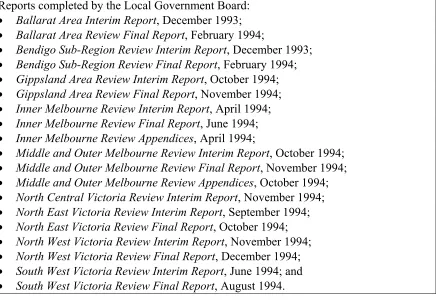
Reports completed by the Local Government Board: • Ballarat Area Interim Report, December 1993; • Ballarat Area Review Final Report, February 1994;
• Bendigo Sub-Region Review Interim Report, December 1993; • Bendigo Sub-Region Review Final Report, February 1994; • Gippsland Area Review Interim Report, October 1994; • Gippsland Area Review Final Report, November 1994; • Inner Melbourne Review Interim Report, April 1994; • Inner Melbourne Review Final Report, June 1994; • Inner Melbourne Review Appendices, April 1994;
• Middle and Outer Melbourne Review Interim Report, October 1994; • Middle and Outer Melbourne Review Final Report, November 1994; • Middle and Outer Melbourne Review Appendices, October 1994; • North Central Victoria Review Interim Report, November 1994; • North East Victoria Review Interim Report, September 1994; • North East Victoria Review Final Report, October 1994; • North West Victoria Review Interim Report, November 1994; • North West Victoria Review Final Report, December 1994; • South West Victoria Review Interim Report, June 1994; and • South West Victoria Review Final Report, August 1994.
Table 2: Reports completed by the Local Government Board (Economic Development Committee 2002, p.256)
The Local Government Board noted:
The Board further noted:
If councils are to do justice to their future responsibilities, they need to be larger and better resourced than they are at present. Some smaller councils lack the capacity to manage their present responsibilities in areas like planning, tourism, economic development, community services, native vegetation protection, pest control and drainage. Restructuring will not only increase the size of municipal units, it will also enhance local government services in each area, produce a more equitable allocation of resources, improve regional decision-making and give each area a stronger voice in dealing with its neighbours and the State Government. Along with compulsory competitive tendering, structural reform will enable councils to:
• overcome existing inefficiencies and inequities;
• increase their financial autonomy;
• stabilise and even reduce rates;
• operate more cost-effectively;
• secure savings by flexing their purchasing power;
• free up resources for investment in community assets and services; and
• focus more clearly on customer needs and expectations (Local Government Board 1994, June p.10).
Following the release of the interim and final reports, all existing Councillors were removed and government appointment Commissioners selected to oversee the amalgamations recommended by the Local Government Board. Commissioners were appointed to administer the amalgamation of 210 councils into 78. This process was completed by 1995. For a period of eighteen months unelected Commissioners managed the complex task of administering newly merged councils and by May 1997 all councils had held elections and returned democratically elected Councillors (Hallam 1998).
The pace and scale of reform to local government surprised many. Described by Victorian Parliament’s Economic Development Committee (2002, p.95) as ‘one of the most significant structural changes in the history of Victoria’ the scale of amalgamation was unprecedented in Australian history. The Minister for Local Government (1992-96), Roger Hallam, described it as ‘the most extensive public sector reorganisation ever undertaken in Australia’ (1995a, p.1). The administrators had to manage the difficult merger of political and administrative systems and cultures. Council service delivery underwent dramatic change with severe rate cuts and a move to new public management principles of contract management and privatisation of council functions.
Heavily influenced by a submission by the Institute of Public Affairs, Project Victoria, the Kennett government reform agenda included boundary reform and amalgamation. However, the introduction of private sector management practices, increased role of private sector in public services such as Compulsory Competitive Tendering and a dramatic rate reduction and permanent capping was equally significant. Yehudi Blacher, a career public servant and Director of Local Government (1991-96) saw the irony that the reform of local government was ultimately undertaken by a government which when in opposition, had vehemently opposed a more modest set of reforms (1998, p. 115).
think-tank The Tasman Institute, clearly focusing on addressing the $27 billion government debt through public service cuts and privatisation. This ‘first wave’ of ideological papers was followed by the ‘second wave’ detailing inefficiencies in particular areas of the Victorian economy. This included papers on transport, health and local government. Recognising that local government ‘is an important instrument for the expression of local aspirations, concerns and priorities’ the report sought to address the indecisiveness of former government led inquiries into local government reform (Institute of Public Affairs 1993, p. i).
The reforms that were introduced even exceeded the expectations of the right-wing think tanks such as the Institute of Public Affairs which had lobbied for a reduction in council numbers to 82 (government reduced the number to 78), suggested a rate cap (government mandated a rate cap) and suggested contracting out rather than resource sharing (government introduced Compulsory Competitive Tendering).
Champions of these changes cast themselves as bold reformers. Quoting Machiavelli, Leonie Burke and Greg Walsh (both members of the Local Government Board) claimed ‘there is nothing more difficult and dangerous, or more doubtful of success, than an attempt to introduce a new order in any state’ (Burke & Walsh 1998, p.71). Hallam quoted Otto von Bismark when recalling his experience during the tumultuous reform period ‘politics is the art of the possible’ (Hallam 1998, p. 99).
Whilst Aulich notes local government was empowered under the Victorian Local Government Act to ‘do all things necessary or convenient to be done for or in connection with the performance of its functions and to enable it to achieve its purposes and objectives’ (1999, p. 14), Marshall suggests this reform process was a forceful top-down approach (1998).
using a percentage of budget approach, whereby councils were required to submit an increasing percentage of their annual budget to competitive tendering. The rate commenced at 20 per cent in the 1994-95 financial year and was increased to 30 per cent in 1995-96 and moved to the target of 50 per cent of total expenditure by 1996-97 (Hunt 1998, p.65). Within these percentage targets, councils were permitted to determine for themselves which services should or should not be subjected to competitive tendering.
Rob Spence, Chief Executive Officer, Municipal Association of Victoria, suggested some councils took Compulsory Competitive Tendering further than it needed to be taken and ‘were quite brutal in the way they ran it, and the impact of that was quite destructive’ (Economic Development Committee 2002, p. 110). Alan Hunt, Victoria’s longest serving Minister for Local Government and Planning, claimed Compulsory Competitive Tendering was ‘both harsh and unnecessary and unduly constrained the autonomy of councils’ (Hunt 1998, p.65). The Economic Development Committee found while there were some concerns associated with the implementation of Compulsory Competitive Tendering a number of benefits have also arisen including:
• an increased understanding of services and projects;
• increased likelihood of work objectives, budgets and timeframes being achieved; • improved documentation of work processes; and
• a broadening of staff skills and responsibilities (2002, p. 112).
Funding requirements were also imposed in October 1994 through a freeze on residential rates and other charges. This was compounded by a reduction in council rates by 20 per cent and a cap on future rate increases. In 1996, three years after these reforms, the state government claimed that the combined effect of these measures had resulted in savings of $323 million in municipal expenditure and rate reductions for 88 percent of the state’s residents (Victorian Government 1996).
government were ignored. Kiss claimed ‘the pace of implementation and unrelenting pursuit of an agenda drawn up at least in part by a think-tank operating on behalf of business interests (Project Victoria), without public debate, guaranteed that there would be little resistance’ (1999, p. 115). Kiss continued ‘community discussion was virtually non-existent and council submissions were cobbled together as arguments intended to conform to the very general guidelines issued by the Local Government Board’ (1999, p. 115).
In 2002 the Victorian Economic Development Committee noted that:
During times of such unprecedented reform, it was reported that many councils, their employees and their communities experienced initial feelings of turmoil following council amalgamations. Today, however, they are much more likely to recognise the positive outcomes of the process (2002, p. 103).
The Bracks Government was elected in 1999 and immediately set about abolishing Compulsory Competitive Tendering. In its place, the Government introduced the Local Government Best Value Principles Act, released in July 2000, a framework outlining the Best Value Principles for councils:
• all services provided by a council must meet specified quality and cost standards; • all services provided by a council must be responsive to the needs of its community; • each service provided by a council must be accessible to those members of the
community for whom the service is intended;
• a council must achieve continuous improvement in the provision of services for its community;
• a council must develop a program of regular consultation with its community in relation to the services it provides; and
• a council must report regularly to its community on its achievements in relation to the principles set out above (Economic Development Committee 2002, p. 112).
government were modelled on those introduced in the United Kingdom by the Thatcher and Major governments (Kiss 1996, p.114), one difference that was tolerated (and indeed promoted) in the United Kingdom was variability within institutional design. Such variability is a way of building capacity for innovation and adaptation to different environments. Robert Goodin (1996, p. 42) argues that:
We ought to encourage experimentation with different structures in different places; and we ought, furthermore, to encourage reflection upon the lessons from elsewhere and a willingness to borrow those lessons where appropriate.
In the scholarly literature on local governance, it is widely acknowledged that democratic local government can be reduced to three main functions: administration, representation and participation (Jones, 1989). In general, local government restructuring in Victoria has focused overwhelmingly on the administrative dimension. Policy makers have sought to get ‘value for money’ by improving efficiencies – largely through the ‘bigger is better’ belief. Dollery and Johnstone argue this emphasis is misplaced and instead flat management structures associated with smaller councils bring decision makers into direct contact with those affected by their decisions and thus reduce the propensity for large bureaucracies to ‘depersonalise’ policy outcomes (2005). Aulich similarly argues large municipal units are less responsive to community needs and aspirations than smaller ones (1993).
Rouse and Putterill (2005) evaluated the effectiveness of a change in public policy which was designed to consolidate small-sized units of government to lead to an improvement in productivity. Using road construction and maintenance as their case study they sought to determine whether amalgamation was justifiable on the grounds of reducing or eliminating diseconomies associated with increasing returns to scale. Rouse and Putterill concluded that:
A 1975 United Nations review concluded that relatively larger units of local government were endowed with more productive resources; better able to employ qualified professional staff; more readily able to establish their presence; better able to attract popular support; less vulnerable to central government intervention; better placed to co-operate productively with central government; and able to free Councillors from the drudgery of supervising administration in detail, thus allowing them to concentrate on general policy making and monitoring (Bush 1990, p. 237).
These ‘benefits’ can be associated with what Mouritzen (1989) describes as the Reform Theory. This theory states that citizens’ satisfaction with public services will increase with increasing size. However as Rouse and Putterill (2005) suggest, economies of scale may be present in some capital-intensive programs (like harbours, waste disposal, sewage) they are typically not present in labour intensive programs.
The decision on the ‘right’ size of the unit of provision is to be distinguished from the decision on the optimal size of the unit of production (Mouritzen 1989, p. 663). He stresses that the smaller the size of the organisation, the more homogenous is the population and the better is the representation of local preferences. A closer relationship between representatives and their constituency makes for effective information flows and consequently greater efficiency. This theory argues that citizens’ satisfaction will decrease with increasing size and that optimum size depends on more than just technical managerial production.
derive mainly from decreasing returns to scale leading to the conclusion that the technical efficiency frontier was non-increasing returns to scale.
Amalgamation of small councils into larger authorities may have enabled them to reach a critical mass for achieving increased professionalism, improved network management and an effective response to across the board changes such as outsourcing, competitive price tendering and increased accountability requirements, Rouse and Putterill (2005) found there is no evidence to support the claim that amalgamation contributed to this.
Under Victoria’s current municipal structure, Councillors report to both the state government and their local community as corporate board members (Kloot 2001). The rate-payers are the equivalent to shareholders in a company and they hold their Councillors accountable through the election box (O'Toole 2003). In terms of the representational structures allowed under the Act, 14 of the 78 councils are unsubdivided and 64 have a combination of wards. Each council’s representational structure must be approved by the Minister for Local Government. The councils themselves undertake an analysis to determine the most appropriate structure for the municipality and then apply to the Minister who takes it through an Order-in-Council process.
had a local shire office which was re-located to a central headquarters after amalgamations.
Heavily influenced by the reforms introduced in the United Kingdom and New Zealand, the Victorian reforms went one step further by introducing elements which were untested and unproven. Whilst the reforms were decades in the making, the scope and pace of reform was unprecedented. With constant refinement the local government sphere in Victoria has come to accept that the reforms were inevitable and have resulted in a wider range of service delivery. There is evidence to suggest that small sized local units of government can be productive in certain circumstances, there is also evidence to suggest that with increased size of local government comes benefits such as a better ability to employ qualified professional staff, more readily able to establish a presence, better able to attract popular support, less vulnerable to state government intervention, better placed to work with state government and broader vision and general policy making capability.
2.3 Amalgamations
Government only sought to encourage the state’s 178 councils to consider resource sharing and greater regional cooperation.
Aulich suggests the more dramatic changes in the ‘southern states’ of Victoria, South Australia and Tasmania may be the result of the collective title as the ‘rust belt states’, which indicates an economic structure which have groaned under the transition from primary to secondary based economics to ones dominated by service industries (1999, p. 20).
In all states the rationale underlying the implementation of local government amalgamations was that of increased efficiency. Amalgamation is perceived as producing economies of scale; as size increases the unit cost of tasks and services diminishes. In particular it is felt that administrative costs of councils can be reduced by rationalising staff, plant and equipment. At the same time such moves would increase the purchasing power and the scope to employ more specialised personnel and equipment. Chapman (1995, p. 10) has noted in the Australian context that ‘it seems universally accepted that administration costs as a percentage of total expenditure will fall as a result of mergers.’ Marshall suggests that the international evidence on whether local government amalgamation actually results in greater efficiencies, is however, inconclusive (1998, p. 650).
Galligan suggests ‘localness’ has always been a central element of democratic aspiration and political organisation (1998, p. 208). He argues smallness has always been considered an essential attribute of democracy, because democracy is participatory, and active participation of the citizens in public policy decision making was possible only in a small polity such as a city state. He cites Rousseau, who insisted smallness was essential for democracy and considered a city state such as Geneva the best practical option. Galligan suggests Aristotle had recommended that the size of a polity should be such that citizens know each other or at least had indirect personal knowledge of each other.
As the third tier of government closest to the population, it is often argued that smaller councils deliver better quality of services to residents (Allan 2003; Dollery & Byrnes 2002). The appropriateness and effectiveness of service provision of smaller councils are enhanced through being ‘closer to the people’. The ‘bigger is better’ argument for consolidation to create efficiencies through economies of scale is often used by neo-classical policy makers to justify amalgamations. The benefits promised by amalgamations include larger, stronger councils offering an expanded resource and expertise base (Hallam 1994).
The limited Australian literature on this subject also indicates that the extent of savings to be gained from amalgamation is uncertain. Aulich warns against assuming that economies of scale will naturally follow amalgamations and points out that the costs of mergers may outweigh the benefits, that economies will vary according to the type of service being offered, that diseconomies of scale will set in at some point and there will be hidden costs to mergers (1993 pp. 185-6).
(Victorian Government 1994, p.66). This report establishes a clear link between council size and efficiency and has highly relevant as the Victorian Government’s strategy during the period 1993-1999 for local government stressed three principles of improvement:
1. efficiency,
2. effectiveness, and
3. accountability (Victorian Government 1994, December, p. 2 p.2).
Not only are many communities suffering from reform fatigue, but there is an understanding that administrative reform breeds more cynicism than efficiency and effectiveness (Rhodes 1994). Assessing various reform attempts to the public service in the United Kingdom, Rhodes suggests these changes create uncertainty, long hours for practitioners, yet there are very few tangible benefits. The simple fact that there has been a continuous stream of reforms clearly shows that they are ‘under achieved’. Critical questions must be asked though. Does this task need to be done? Does it need to be done by government? If not, who should do it? Contracting out has been a feature of local government since inception (Rhodes 1994, p. 141). Whilst an established feature, its role was dramatically increased in the 1990s. The role of government was increasingly to facilitate the delivery of services by other and oversee their performance.
O’Toole suggests local Councillors and local bureaucracies have come to terms with many of the new structural arrangements inside local government. Service delivery has been transformed and corporate management is well bedded down (O'Toole 2003). He explains the refocusing of service delivery under the ‘best value’ approach essentially means building consultation with the local community into the design and implementation of local government services.
found to be particularly strong in metropolitan municipalities, where councils with populations of less than 25,000 were estimated to have per capita administrative expenses more than three times greater than the average of councils with populations between 75,000 and 100,000. The Commission concluded that there was no doubt that economies of scale exist in relation to administration expenses in local government (Victorian Government 1985, June). The Commission also found a strong relationship between the range of functions performed and population, with larger municipalities performing significantly more functions than smaller ones concluding ‘this is consistent with resource constraints on less populous municipalities’ (Victorian Government 1985, June p. 15).
By comparing the level of council employment levels with population size to determine if any economy of scale exists, the Victorian Grants Commission found a strong inverse relationship across all municipalities in Victoria. The smallest municipalities were found to employ 28 permanent staff for every thousand residents, whereas the most populous municipalities employed only three staff for every thousand residents (Victorian Government 1985, June p. 18).
The function of local government in the broader economic context is summed up by the then Minister for Local Government when he wrote:
Municipal reform in Victoria was always seen as part of a wider micro-economic reform agenda. The government’s overarching goal was, and remains, to stimulate investment, wealth creation and employment growth. Increasing the efficiency and reducing the cost of local government is one important means of achieving that goal (Hallam 1995b).
The reports proposals were adopted in April 1995 when the states and the commonwealth agreed to sign a package of agreements to implement National Competition Policy (National Competition Council 1998). The most important aspect of this policy is competitive neutrality. Competitive neutrality is intended to ensure government businesses do not enjoy a financial advantage because they are publicly owned. It requires that the business functions of councils operate under similar competitive pressures as those experienced in the private sector. That is, they should not enjoy existing net competitive advantages such as immunity from taxes and cheaper borrowings.
For Victorian local government, the introduction of Compulsory Competitive Tendering was the most important element of the structural reform program. The Minister argued that ‘in the long term it will do more to revolutionise the culture of local government than boundary changes’ (Hallam 1995a, p. 9). While the bulk of services put to tender were mainly public works and services, it is clear that by the end of 1996 there were few areas of Victorian local government activity that had not been exposed to market testing (Maclellan 1996, p. 11). The change in the level of contracting was described by Ernst as an ‘exponential leap beyond the established and piecemeal approach’ that had existed previously in local government tendering (Ernst 1994, p. 118).
Though the other five states were signatories to the National Competition Policy, none had followed Victoria’s lead with regard to local government. The agreement contained a clause which allowed each signatory to determine its own framework for the implementation of the policy. This clause was used by all parties (except Victoria) to protect their local government sectors from the indiscriminate imposition of market practices (Marshall 1998, p. 656).
compared with a nearby comparable unreformed metropolitan area (Benton & Gamble 1984).
Sancton (1996) observes, for example, that virtually none of the benefits identified as flowing from the amalgamation of Toronto-area municipalities required reorganisation but were merely improvements in practices that could have been made within the existing system. Bish (2000) reported that the structures that most successfully facilitate responsive governance can also be the least expensive. For example, in Halifax, Canada, during the post amalgamation in the period from 1996 to 2000, user charges increased significantly and average residential property taxes rose by about 10 percent in urban areas and by as much as 30 percent in suburban and rural areas (Bish 2000). Debt has also increased, since, despite these tax increases, most of the implementation costs were financed through borrowing. Bish concluded that based on the Canadian, European and United States examples of local government amalgamation ‘it is simply not the case that big governments cost less because they can achieve economies of scale’ (2000, p. 26).
2.4 Managerialism
The Victorian reforms to local government described earlier in this chapter grew out of, and were a variant of, an intellectual movement that has been characterised as ‘New Public Management’ (Hood 1991). This model was a public sector adaptation of international management movements. It sought to organise the public sector to be more like the private sector in operation and structure. Innovations such as ‘let management manage’, flatter organisational structures, the shift from process to a focus on outputs and the increase in scale, were key elements of this new managerialism (Gerritsen 1998).
Following local government amalgamations, Councillors were expected to take on new roles as a board of directors where there would be a separation of ‘steering’ or setting the policy framework and ‘rowing’ or the provision of services (Newnham & Winston 1997). This concept is based on the principles established by Osborne and Gaebler (1992) who suggest the most successful organisations in the public services separate management from operations so as to allow management to concentrate on decision making and direction. They suggest that if this separation of responsibility is not made, management will be distracted by operational tasks and basic steering decisions will not be made.
Rhodes (1996) suggests managerialism stresses hands-on professional management; explicit standards and measures of performance; managing by results; value for money; and closeness to the customer. This change in administration is a global trend in public sector management and advocates a paradigm shift from administrative to managerial values. van Gramberg and Teicher suggest this policy transforms public servants to managers and the public to customers (2000). Under this new public management, private sector management practices, underpinned by human resource management concepts and a focus on entrepreneurship, efficiency and quality are imported into the public sector.
administration of local government (service delivery). These Corporate Plans were supported by Key Performance Indicators which would be reported on a yearly basis. In addition councils were required to complete annual customer satisfaction surveys and compile performance measurement data to be used for State-wide league tables.
Released by the Office of Local Government in December 1993, Local Governments Side by Side sought to provide comparison data series. This release was part of the Project Victoria proposal from the Institute of Public Affairs which described previous administrations’ reluctance to provide such analysis for the reason it may ‘embarrass’ local councils that are shown to be less efficient (1993, p. 25).
This performance system was designed to deliver effective and relevant services to the community. van Gramberg and Teicher suggest this performance system became a tool of control of state government over local government (2000). This was emphasised by the Minister for Local Government having the power to dismiss councils and appoint municipal inspectors to review council decisions. The Auditor General was also given the powers of oversight of local government in 1996.
Ryan suggests the introduction of new public management has required public agencies to shift their focus from:
process towards purpose, reorganise their structures around programmes and strategy, adopt the financial and human resources management approaches of the private sector, and the de-bureaucratised forms of organisation emerging (1997).
The concept of managerialism reflects a commitment to the values of individualism, efficiency and entrepreneurship. This underpins the notion that public services are best contracted out to the private sector. Alford and O’Neill (1994) coined the term ‘contract state’ to describe the reforms being introduced in Victoria, the central instrument of all these changes, particularly to local government has been the contractual form. This challenges the traditional conception that managers are organisational functionaries or bureaucrats trapped by an organisational culture which values rule-following above innovation (van Gramberg & Teicher 2000).
Model
Personnelaspect Staff level Conventional Managerialist Contractual
Recruitment CEO,
Secretary, Head of Department Statutory appointment Limited term contract Limited term contract Senior Executive Sub-Senior Executive Recruitment and internal promotions Recruitment and internal promotions some outsiders Some outsiders
Who is the employer? CEO, Secretary, Head of Department Governor in Council Governor in
Council Premier Senior Executive Sub-Senior Executive Crown, via the Public Service Board
Crown, via the Public Service Board CEO, Secretary, Head of Department
Remuneration CEO,
Secretary, Head of Department Senior Executive Element of performance pay, but mainly payment by grades Packages (partly in kind), performance bonuses, higher quanta Sub-Senior Executive Payment by grade Payment by grade Payment by grade
Job security CEO,
Secretary, Head of Department
Hard to
terminate Limited term, 4 weeks notice Senior Executive Sub-Senior Executive Tenure Tenure, hard
to terminate Mainly tenure
Table 3: Victorian public service employment arrangements in three successive management models
The Victorian reforms can be placed within more general analyses. Despite the best intended policies to improve organisational efficiencies through employment contracts, often internal politics, management styles or dysfunctional administrative structures can impede the delivery of services to residents. Walsh suggests that one response to improving government’s response to local communities is place management (2001). Not only is place management a solution to improve government response to communities with special needs, it offers government a range of management and administrative structures that are only available to such authorities.
Dollery and Johnson provide an evaluation of alternative models of municipal governance to enhance the efficiency of local government (2005). As discussed previously, they suggest three functions of local government: administrative, representative and participatory, and that the administrative functions can be dealt with through various other mechanisms. This work argues that efficiency is not driven simply by amalgamations and there are options available to policy makers for limited function municipalities, resource sharing, regional organisation of councils and virtual local government.
Dollery and Johnson (2005) argue that all the available empirical evidence, both in Australia and abroad, suggests that not only does local government amalgamation fail to yield any benefits, but larger local governments are inherently less efficient and thus more expensive (Bish 2000). Council amalgamation is only one of several different possible models, and it is by no means either the most obvious or most efficient method of enhancing performance (2005). Alternatives suggested include limited function municipalities, ad hoc resource sharing, regional organisations of councils, joint board models and virtual local governments. The latter developed in response to the forced amalgamations of Balmain Council (Allan 2001).
systems. The consolidation also reduced duplication, improved productivity of capital works and staff management and retention. Admittedly, this voluntary amalgamation was between four councils with some of the smallest population bases in New South Wales.
The research conducted by Leach suggests that effective governance is more important than just organisational structures of government (2001). There is greater importance placed on the interaction between structures and actors than the structures themselves. Assessment of organisation effectiveness criteria and how the preferences of individuals change, sometimes dramatically, over time is analysed extensively (Cameron 1986). Cameron argues that what was preferred at one point in time may not be valued at another point – this is particularly important in the context of local government amalgamations.
Lapsley and Pallot (2000) provide an assessment of the 1997 United Kingdom reforms and the 1989 New Zealand reforms to local government. They explain how the reforms are similar to those introduced in the mid 1990s in Victoria, and describe the decoupling of politics and management under which citizens have become customers and ratepayers have become stakeholders. Blacher suggests that the United Kingdom and New Zealand reforms were timid compared to those introduced in Victoria (1998, p. 162). O’Toole suggests that in Victoria this prevailing corporate governance model there is a passive role of ratepayers – they are shareholders rather than active citizens. This is reflected in the reduced satisfaction levels of the population (2003).
Managerialism is one of the most pervasive reforms introduced during local government amalgamations. Aulich (1999) provides an assessment of Australia’s local government systems, and argues the move away from traditional notions of local government in Victoria has shifted the focus from governance, democracy and local services. This has been witnessed through the development of Corporate Plans, Compulsory Competitive Tendering or Best Value, and the principals of managerialism in the public service. This has in turn reduced the effectiveness of local government as an advocacy and representative authority.
Boyne (2003) suggests the introduction of managerialism concepts in local government has triggered a vigorous policy debate on the most appropriate path towards higher performance – and especially the contribution of the private sector. Boyne’s conclusion is there are no universal criteria for effectiveness and, by implication, improvement. Zammuto (1984) suggests an organisation is effective if its multiple constituencies perceive it as effective. Gaertner and Ramnaravan argue that an ‘effective organisation is one that is able to fashion accounts of itself and its activities in ways which constituencies find acceptable’ (1983 p. 98). Thus, the multiple constituency model emphasises organisational image and legitimacy rather than substance and service delivery. This model takes the definition of public service improvement and effectiveness into the realms of political science and market research. This partly explains the new public management focus on customer satisfaction surveys and best value reviews.
(e.g. speed, quality, reliability) that are likely to be valued by all stakeholders (Boyne 2003, p. 222). Boyne argues that there is one benefit of the multiple constituency model as it recognises that concepts of improvement are often political rather than technical. Taken together, the goal and multiple constituency model imply a working definition of improvement must incorporate both the substance of organisational achievements, and the inherently political nature of judgements of success or failure. This is supported by Connolly, Conlon and Deutsch who suggest divergent views on effectiveness is desirable and under a multiple constituency model (1980).
Victorian Auditor General’s Office reported on performance reporting in Victorian local government, it found most councils non-financial performance data is of limited relevance to ratepayers and residents, the principal users of that data (Victorian Government 2008, p. 1). The Auditor General suggested one inference that could be made is that councils select indicators because they are easily measured, not because they are the right things to measure (Victorian Government 2008). Whilst financial reporting requirements are standard across Australia with the introduction of Australian Accounting Standard AAS 27 Financial Reporting by Local Governments, non-financial measures are inconsistent.
Compulsory Competitive Tendering represented the ‘high water mark’ (Boyne et al. 1999, p. 23) of the neo-liberal approach to public sector management that was predicated on the belief that the discipline of the market was a precondition for the efficient management of the public services.
Value in the local government sector and concluded it ‘represents an unusual cocktail of top-down concept and bottom-up realisation’ (2002, p.9).
The introduction of Best Value in the United Kingdom was based on the 3E’s of ‘economy, efficiency and effectiveness’ (United Kingdom 1999). This was enforced through a set of procedures for external audit and inspection. The rigor placed on local government for the introduction of Best Value created a situation of becoming a ‘time consuming and over inspected process in which the carrying out the procedures has become more important than the challenge Best Value was intended to provide’ (Stewart 2002, p. 4). In a series of reforms to affect this situation the United Kingdom government released a White Paper in 2001 which puts forward a new initiative of league tables and labelling councils high performing, striving, coasting or poor performing. This also introduced the principle of selectivity, allowing central government to intervene for poor performance and allowing greater freedom and flexibility for high performance.
As discussed in Section 3.6 on governance, local government can be conceived as an organisation controlled by directly elected representatives of the community with a mandate to deliver services and perform a variety of community-oriented functions in the manner of community self-governance (van Gramberg & Teicher 2000, p. 489). The introduction of managerial principles runs counter to this concept, and has seen local government transformed from an institution of governance to a reporting arm of state government. This is supported by arguments presented by van Gramberg (2000) and Marshall (1998) who see local government as little more than sophisticated mechanisms for selecting and delivering services. Davies asserts that despite central government attempts to promote local government, political power continues to be centralised to an extent unparalleled in recent United Kingdom history (2004). This would equally apply in Victoria. Game argues that:
Stoker suggests that in the United Kingdom this apparent tension is the product of calculated incoherence by a paranoid, fatalistic government that mistrusts the institutions of devolved governance. ‘Contrived randomness’ is a strategy for creating uncertainty, the best way to keep capricious institutions on their toes (Stoker 2002, p. 149). New Labour was at first committed to decentralisation, but this has evolved into a centralising, managerialist government (Davies 2005, p. 319). The 1979-1997 era under successive Neo-liberal governments saw intervention become reality. The aim was to weaken and bypass elected local authorities and empower consumers, wheras under New Labour the aim has been to empower partnerships – an interesting comparison. As Michael Loughlin comments:
the basic thrust of Conservative government’s programme seems to deny that local authorities should any longer be treated as institutions of governance; they seem now to be treated merely as agencies for delivering centrally-determined policies (Loughlin 1996, p. 417).
As Stoker observes, many commentators argue that in the United Kingdom, New Labour’s approach to central-state relations can be seen as ‘a classic case of hierarchist approach, or in more common parlance control freakery gone mad’ (Stoker 2001, p. 3). Jones and Stewart lamented the failure of central government to relate to local government needs:
Community strategies need to cross departmental boundaries. They require an integrated response from central government. Too often central government has been capable of only a departmental response ... In terms of service delivery, central government departments are remote and have little understanding of the problems of implementing strategy in specific localities. In frustration it tries to do more itself, resorting to over-detailed prescription, over-inspection, excessive initiatives and a naïve approach to change (Jones & Stewart 2001, p. 14).
tenure contracts reporting to the Councilors. The performance reporting introduced during local government reforms such as business plans, annual reports, Auditor General reviews and Freedom of Information has increased transparency and accountability. This paradigm shift from administrative to managerial values has been one of the foundation stones of New Public Management. Whilst transforming senior public servants to managers, ratepayers to customers, and making local government responsible to the State Government, this reform package has resulted in efficiency improvements equal to the impact of amalgamations. Further testing of principles such as place management for governance is required before conclusions can be drawn.
The drive for efficiency should not simply be through amalgamations. This chapter has canvassed options that are available to policy makers to improve efficiency in local government. There is argument that managerialism has reduced the effectiveness of local government as an advocacy and representative authority. Managerialism runs counter to the concept of self-governance and has transformed local government to simply a reporting arm of State Government. Principles such as Compulsory Competitive Tendering had an adverse result on council administrative structures, driven by a belief that the private sector knew best how to manage service delivery. With the introduction of Best Value the addition of effectiveness criteria to local government service delivery has resulted in a better outcome for rate payers.
2.5 Networks
confronting government in the era of governance is to mediate agreement among diverse actors about the aims and objectives for governing (2005, p. 313).
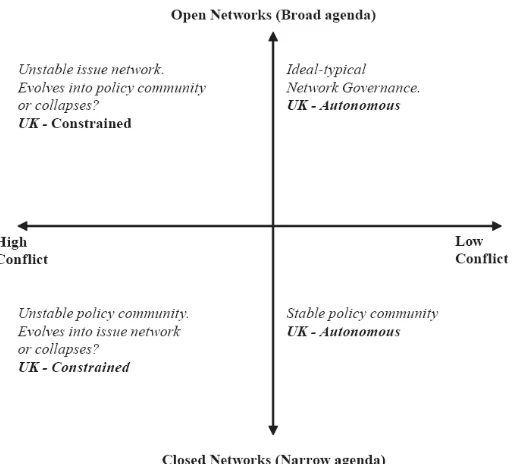
Granovetter’s analysis of weak ties between individuals and groups found weak ties link different social groups, while strong ties are concentrated within groups such as friendship circles and organisations. He suggests weak ties can be effective in bringing groups together in open networks because they facilitate information flows. Strong ties on the other hand, tend to create cliques or closed networks (Granovetter 1973, p. 1373). Davies suggests that weak ties do not automatically facilitate effective information flows. What makes weak ties effective is a ‘bridge’, for example the discovery of a common purpose which strengthens the link (2005, p. 314).
Figure 1: Network patterns in different conflict/consensus environments (Davies 2005, p. 328)
According to Alcock, the policy idea of a partnership, the institutionalisation of the governance principle by government action, reflects the notion of civil society ‘within which all partners, and all citizens, have mutual interests and obligations in securing local social and economic progress’ (2002, p. 243). Davies suggests that in the United Kingdom this is the central idea that underpins New Labour’s political economy and drives its normative commitment to multi-level governance (2005, p. 315), however the reality of conflict requires the central government to intervene in networks it originally indented to be decentred, autonomous and inclusive.
Multi-level governance, in the context of networks linking central government with local communities, is likely to ‘stick’ better if there is a greater understanding of what are very different worlds. Stewart argues ‘There are deep divides between the worlds of local government and central government, so that one can almost describe them as two worlds acting in isolation and in ignorance of each other’ (2000, p. 91). In their research for the Commission for Local Democracy in London, Jones and Travers emphasised this point:
authority members or officers. A gap of understanding exists between central and local government, much of which appears to be based on simple ignorance (or worse still, mistaken, stereotyped, views). The mundane nature of many local services appears to encourage (at least some) civil servants to believe that they possess ‘Rolls Royce minds and local government officers have motor cyclists’ minds (Jones & Travers 1994, p. 16).
Leat, Seltzer & Stoker (2002) came up with similar findings:
The view from the centre is that these people lack the passion to transform, are less competent, less accountable, more prone to take the line of least resistance and to relax into the comfortable sofas of administrative routine. Hence only the most relentless regime of inspection, incentive, sanction and discipline will produce effective action. This type of impatience results from a lack of trust.
A suggestion of transferring staff between departments and organisations is a ‘powerful method’ in developing a common understanding of the challenges faced by local government in responding to central government Leat, Seltzer & Stoker (2002, p. 139). Secondments such as these can, in theory, enhance organisational learning and thereby, facilitate more joined-up government. In practice, it may simply reinforce existing prejudices.
relationships is discussed further in this chapter when discussing methods of handling wicked problems.
2.6 Governance
The structural reform of local government began in the 1970s and 1980s in the United Kingdom, United States and New Zealand. It reached Australia in the 1990s and continues through to today. These reforms were introduced as a result of pressures to achieve improved levels of efficiency and performance. As has been described in previous sections of this chapter, these reforms have been achieved through ongoing boundary reform, imposition of new managerial strategies and exposure to private sector competition through Compulsory Competitive Tendering and Best Value. In the United Kingdom the process of local government consolidation took place in the early 1970s and was followed by further substantial reorganisation during the period of neo-liberal rule from 1979 to 1997. This period saw the imposition of increased central government control and subsequent diminution of local government’s discretionary powers. Much of the substance and direction of the British reforms was taken up in New Zealand’s Local Government Act 1989. Strict new financial frameworks were imposed on authorities, including mandatory requirements for the introduction of strategic management processes and improved accountability and transparency. Councils were encouraged to adopt business procedures, competitive tendering (though this was compulsory in the United Kingdom) and set up Local Trading Enterprises to conduct potentially profitable ventures. With the objective of achieving economies of scale the number of local councils was reduced from 741 to 92.
its Compulsory Competitive Tendering and heavy emphasis on economic functions, bears a closer similarity to the United Kingdom than New Zealand reforms.
The Bracks Labor Government took office in Victoria in October 1999, following an election result which surprised most commentators which expected the comfortable re-election of the Kennett Liberal-National Coalition. Wiseman (2005) identified four key constraints of the incoming Labor Government. First, it was a minority government dependent on the support of three independents. Second, the Legislative Council was controlled by the Liberal and National parties. Third, the members of the newly appointed Ministry were inexperienced, some without previous experience of being in Parliament, much less running a department. Fourth, the Victorian public service had become increasingly focused on outsourcing and contract management with a diminished capacity to explore and develop broader policy options and processes (Wiseman 2005). All of which combined to create a cautious and neo-liberal government.
As local government is a sphere that is subordinate to State Government, the policies of State Government are critically important. The Bracks Government policy blueprint Growing Victoria Together identifies a government that listens and leads as an important principle. It states that more Victorians would be consulted on issues that matter to them (Victorian Government 2001). However as identified by Wiseman, there is mounting concern within local government and non-government organisations about the extent of State Government commitment to back the language with real changes in decision making and resource allocation processes (2005).
Local government in Australia is the creation of State Parliaments and has operated under statutes that in most cases are fairly prescriptive. Local government was not recognised in the Victorian Constitution until 2000. This highlights the subservient structure in which local government exists.
governance is its focus on governing mechanisms which do not rest on recourse to the authority and sanctions of government’ (Pierre and Stoker 2002, p. 32).
Rhodes suggests that there are at least six different uses of the term governance: as minimal state, as corporate governance, as new public management, as good governance, as socio-cybernetic system, as self-organising networks (1996). The use of the term governance is also a mechanism for making decisions ‘within’ the organisation. For the purposes of this research this definition is excluded as internal governance refers to relationships between the council, individual Councillors, mayor, chief executive officer and senior managers. The notion of internal governance is akin to corporate governance. Governance is more than just the organisational structures of government and has more to do with the interactions between structures and actors than the structures themselves (Leach 2001).
The World Bank describes governance as the exercise of political power to manage a nation’s affairs, and good governance involving an efficient public service, independent judiciary and legal framework, accountable administration of public funds, independent public auditor responsible to a representative legislature, respect for the law and human rights, a pluralist institutional structure and a free press (1992).