New techniques for multi-value input
homomorphic evaluation and applications
Sergiu Carpov1, Malika Izabach`ene1, and Victor Mollimard1,2 1
CEA LIST, Point Courrier 172, 91191 Gif-sur-Yvette Cedex, France 2
Univ. Lyon, ENS de Lyon, 15 parvis Ren´e Descartes, 69342 Lyon Cedex
Abstract. In this paper, we propose a new technique to perform sev-eral homomorphic operations in one bootstrapping call over a multi-value plaintext space. Our construction relies on the FHEW-based gate boot-strapping; we analyze its structure and propose a strategy we call multi-value bootstrapping which allows to bootstrap an arbitrary function in an efficient way.
The security of our scheme relies on the LWE assumption over the torus. We give three possible applications: we first describe how to efficiently evaluate an arbitrary boolean function (LUT) and combine LUTs in cir-cuits. We also explain how to apply our procedure to optimize the circuit bootstrapping from (Asiacrypt’2017) which allows to compose circuits in a leveled mode. And we finally present a simple method which makes use of the multi-value bootstrapping to evaluate a encrypted neural network. We have implemented the proposed method and were able to evaluate an arbitrary 6-to-6 LUTs under 1.6 seconds. Our implementation is based on the TFHE library but can be easily integrated into other homomorphic libraries based on the same structure, such as FHEW (Eurocrypt’2015). The number of LUT outputs does not influence the execution time by a lot, e.g. evaluation of additional 128 outputs on the same 6 input bits takes only 0.05 more seconds.
Keywords: lwe-based FHE, multi-value bootstrapping, homomorphic LUT
1
Introduction
Fully homomorphic encryption (FHE) allows to perform arbitrary computations directly over encrypted data. The first FHE scheme has been proposed by Gen-try [16]. The construction relies on a technique calledbootstrapping, which han-dles noise increase in FHE ciphertexts. This construction theoretically enables to execute any computation directly over encrypted data but remains slow in practice. Several works ([15, 6, 18, 22, 19] for example) followed Gentry’s initial proposal and contributed to further improve FHE efficiency.
Fully homomorphic encryption schemes are divided in two types of construc-tions. The first one is based on Gentry’s initial proposal, where basically the bootstrapping procedure consists of the evaluation of the decryption circuit at gate level. In this case, the operations remain slow but their design allows to pack data efficiently using batching techniques. The second one is based on the Gentry, Sahai and Waters Somewhat homomorphic scheme [17] proposed in 2013 which supports branching programs with polynomial noise overhead and determinis-tic automata logic. Alperin-Sheriff and Peikert [3] improved the bootstrapping by implementing an efficient homomorphic arithmetic function, showing that boolean function and Barighton circuit can be avoided in bootstrapping. In 2015, Ducas and Micciancio [14] gave a construction of bootstrapping with NAND gate evaluation, named FHEW, and suggested extension for larger gates. They provided an implementation for their scheme taking less than a second per boot-strapping on a single core. Biasse and Riuz [4] adapted the FHEW construction for arbitrary gates. Recently, Chillotti, Gama, Georgieva and Izabach`ene [10, 12] also improved the bootstrapping procedure and provided a construction named TFHE. Their implementation [13] runs in less than 13ms for any binary gate and 26ms for the MUX gate. They also proposed new techniques for the TFHE toolbox which allow to pack data and compose bootstrapped gates in a leveled mode with a new procedure they called circuit bootstrapping. Recently, Bon-noron, Ducas, and Fillinger [5] introduced a FHEW-based type scheme which allows to perform more computation per bootstrapping call. They implemented their method for the evaluation of a 6-to-6 bit LUT in about 10 seconds.
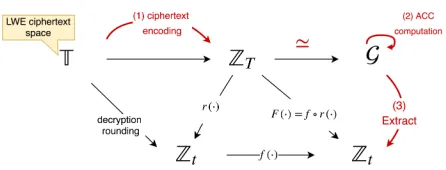
Our multi-value bootstrapping is built from the same line of scheme as the FHEW bootstrapping. In order to explain our contribution, we first review its basic construction and give later a more detailed description. The FHEW-based boostrapping algorithms are implemented via an homomorphic accumulator which evaluates the linear part of decryption function followed by a non-linear part. Given an LWE ciphertext of m and GSW encryptions of the secret key, we want to homomorphically evaluate a known arbitrary functionf onmwhere f : Zt → Zt. We define F = f ◦r where r is the rounding function which corresponds to the final non-linear step of the ciphertextcdecryption function. We write F : ZT → ZT. To be as clear as possible, we depict the bootstrap-ping algorithm in three steps : Setp (1) the input ciphertext of m is rescaled modulo T and the operations are mapped over a cyclic group G. We explain later how G is constructed; Step (2) the accumulator ACC is computed using blind shift operations in G which uses encryptions of the secret key; Step (3) a test polynomialTVF is then applied toACCand an LWE ciphertext off(m) is extracted. Here TVF encodes the possible output values of the function f, i.e. the correspondence between the messagemencoded in the input ciphertext and the output ciphertext off(m). Note that the test polynomial TVF can also be applied before the blind shift operations.
algo-rithms and make a comparison in term of noise overhead output and modularity, i.e. the functions they allow to evaluate. To be efficient, our solution should out-put a small noise while being able to ‘statistically’ encode all the possible values of the function. As a first proof concept and for sake of comparison, we imple-ment a 6-to-6 LUT which runs in 1.6 seconds for a concrete security of about 128 bits (asserted using the estimator from [1]) compared to a timing of about 10 seconds at a security level of about 100 bits for the implementation of [5]. Our construction makes it possible to evaluate several arbitrary functions on the same set of inputs by calling only once the main subroutine of the TFHE bootstrapping. The name multi-value is derived from many-valued logic which is a propositional calculus with more than two values. We give examples of pos-sible applications of our procedure in this paper: we explain how to efficiently compose homomorphic LUTs and we give an idea on how to optimize the cir-cuit bootstrapping proposed in Section 4 of [12] which can be used to compose circuits in a leveled mode. We finally show an application to the homomorphic evaluation of a neural network where the linear part is evaluated using a gen-eralization of the key-switching procedure and the non-linear part is evaluated with our multi-value bootstrapping.
Our technique and comparisons to other works. In previous constructions, ex-cept [13], test polynomialTVF is integrated at the end, after the accumulator is computed, we haveACC·TVF . In the TFHE gate bootstrapping of [13], the test polynomial TVF is embedded in the accumulator from the very start when the accumulator is still noiseless and, at step 2 the accumulator isTVF ·ACC. This allows to save a factor √N, whereN is the dimension. On the other end, they are only able to encode two possible values in TFHE gate bootstrapping. A naive idea for computing multi-value input function f would be to decomposef into pMuxgate functions and then combine the results of thep gate bootstrapping calls, but this method is quite inefficient. To optimize this naive construction, we define a common factorTV(0)F which is shared between all thepcalls. The most expensive part is made once for thepcalls. Then the specification with respect to the 2-value functions is made at the end using a second test polynomialTV(1)F . This last step consists only of a multiplication by constant polynomial, which is much cheaper thanpblind rotations. We manage to decrease the output cipher-text noise by choosing a low-norm second-stage test polynomials when compared to previous methods integrating the test polynomial at the end.
Organization of the paper. We first describe the high level structure of FHEW based bootstrapping algorithms and provide a comparison between the different scheme in the literature. Then, our preliminary section reviews the mathematical backgrounds for LWE and GSW encryption over the torus and gives the building blocks from the TFHE framework [13] used in our constructions. In section 3, we present the optimized multi-value bootstrapping together with test polynomial
factorization. In section 4, we present applications to the homomorphic eval-uation of arbitrary functions and describe our implementation results for the case of a 6-to-6 LUT function. Finally, we explain how to apply the multi-value bootstrapping and extended keyswitching to optimize the circuit bootstrapping from [12] and to evaluate a encrypted neural network system.
2
Preliminaries
Notation. The set{0,1}is written asB. The set of vectors of sizeninE is de-notedEn, and the set ofn×mmatrices with entries inEis notedMn,m(E). The real torusR mod 1 is denotedT.TN[X] denotes theZ-moduleR[X]/(XN+ 1) mod 1 of torus polynomials, here N is a fixed power of 2 integer. The ring Z[X]/(XN+ 1) is denotedR. The set of polynomials with binary coefficients is denoted BN[X].
2.1 High level structure of FHEW-based bootstrapping
We first describe the high level structure of the FHEW-based bootstrapping algorithms. The procedure can be split in three steps we detail below. We explain later how schemes in this line can be instanciated using this formalism. Figure 1 gives a schematic overview of the bootstrapping steps.
1. In the first step, the coefficients (a, b) of input LWE ciphertextc= (a, b) are mapped toZT. A cyclic multiplicative group G, whereZT ' G, is used for an equivalent representation ofZT elements. The groupG contains all the powers ofX:X0, . . . , XT−1andT is defined as the smallest integer verifying XT modΦ(X) = 1 where Φ(X) is the quotient polynomial defining the input Ring-LWE scheme. Most of the times Φ(X) is the T-th cyclotomic polynomial.
2. In this step, the message m encrypted as c = (a, b) is transformed to an intermediary GSW encryption ofXm. Messagem∈
ZT is obtained fromc= (a, b) using the linear transformationb−a·s≡m(i.e. the linear part of the decryption algorithm). Given encryptions ofXsi one can homomorphically
apply linear mappingϕtoc. We obtain the so-called accumulatorACCwhich contains an encryption ofXϕ(c)∈ G.
3. At the third step, a test polynomialTVF ∈ Gis multiplied toACC. The test polynomial encodes output values of a function F for each possible input message m ∈ ZT. HereF is a function from ZT to ZT. It finally extracts an LWE encryption ofF(m) fromTVF ·ACC(or from ACC·TVF ifTVF is applied after computing the accumulator) with a modified noise. As input messagemis a noised version of the actual message encrypted inc= (a, b) function F is a composition of a ‘payload’ function f : Zt → Zt and a rounding functionr:ZT →Zt.
Fig. 1. Structure of the bootstrapping Algorithm. Setp (1): The ciphertext of m is rescaled modulo T and the operations are mapped over the cyclic group G where G =hXi is the group ofT-th roots of unity associated to the cyclotomic polynomial ΦT(X) (for example). Step (2): the accumulator ACC is computed using blind shift operations in G which uses encryptions of the secret key in the powers of X. Step (3): a test polynomial is applied to ACC, it can also be applied before blind shift operations, and an LWE ciphertext off(m) is extracted fromACCusing the encoding of an alternative representation off overZT.
G={1, . . . , Xp−1}andG={1, . . . , Yq−1}for primespandqand recomposes the result in the circulant ring Z[Z]/(Zpq−1); at step (3), a test polynomial (encoding F(x) = f(btx/pqe) where f is an arbitrary function) is applied to the accumulator and a LWE ciphertext off(m) is extracted, where the extrac-tion is implemented by the trace funcextrac-tion. In [13],G is the multiplicative group {1, X, . . . , X2N−1}whereN is a power of 2. Functionf implements a rounding (i.e. torus most significant bit extraction); step (1) does the rounding fromTto
Z2N and the test polynomial is applied before the computation of the accumu-latorACC; step (2) computesACC∈ G with a blind rotation; step (3) extracts LWE(f(m)) by extracting the constant coefficient ofTVF·ACC. Our multi-value bootstapping is instanciated using [13].
2.2 Backgrounds on TFHE
In this work, we will use the torus representation from [10] of the LWE encryption scheme introduced by Regev [21] and the ring variant of Lyubashevsky et al [20].
Distance, Norm and Concentrated distribution We use the`p distance for torus elements. By abuse of notation, we denote as kxkp the p-norm of the repre-sentative of x ∈ Tk with all its coefficients in
−1 2,
1 2
. For a torus polyno-mial P(X) modulo XN + 1, we take the norm of its unique representative of degree ≤ N −1. A distribution on the torus is concentrated iff its sup-port is included in a ball of radius 14 of T except with negligible probability. In this case, we can define the usual notion of expectation and variance over T. Let N(0, σ2) be a normal distribution centered in 0 and of variance σ2. We denote κ(ε) = mink{PrX←N(0,σ2)[|X|> k·σ] < ε}. In this case, we have
PrX←N(0,σ2)[|X|> k·σ] = erf(k/
√
A real distributionX is said σ-subgaussian iff for all t ∈R, E(exp(tX))≤ exp(σ2t2/2). IfX andX0 are two independentσ andσ0 subgaussian variables, then for allα, γ∈R,αX+γX0 ispα2σ2+γ2σ02-subgaussian. All the errors in this document will follow subgaussian distributions. In what follows, we review TFHE for encryption of torus polynomial elements.
TRLWE samples. To encrypt a messageµ∈ TN[X], one picks a Gaussian ap-proximation of the preimage ofϕ−1
s (µ) over theΩ-probability space of all possi-ble choices of Gaussian noise. If the Gaussian noiseαis small, we can define the expectation and the variance over the torus. The expectation of ϕs(c) is equal to µ and its variance is equal to the variance ofα. We refer to [10] for a more complete definition of theΩ-probability space.
Definition 2.1 (TRLWE).LetMbe a discrete subspace ofTN[X]andµ∈ M a message. Lets∈BN[X]k aTRLWEsecret key, where each coefficient is chosen uniformly at random. ATRLWEsample is a vectorc= (a, b)ofTN[X]k+1which can be either :
– A trivial sample:a= 0 andb=µ. Note that this ciphertext is independent of the secret key.
– A freshTRLWE sample ofµ of standard deviationα:a is uniformly chosen in TN[X]k and b follows a continuous Gaussian distribution of standard deviationαcentered inµ+s·a and of varianceα2.
– Linear combination of fresh or trivialTRLWEsamples.
We define the phaseϕs(c) of a sample c= (a, b)∈TN[X]k×TN[X] under key s∈ BN[X]k as ϕs(c) = b−s•a. Note that the phase function is a linear
(kN + 1)-lipschitzian function from TN[X]k+1 to TN[X]. We say that c is a validTRLWEsample iff there exists a keys∈BN[X]k such that the distribution of the phaseϕs(c) is concentrated over theΩ-space around the messageµ, i.e.
included in a ball of radius< 14 aroundµ. Note thatc=Ppj=1rj·cj is a valid TRLWEsample ifc1, . . . ,cpare validTRLWEsamples (under the same key) and r1, . . . , rp∈R. We also use the functionmsg() defined as the expectation of the phase over theΩ-space. Ifµis inM, one can decrypt aTRLWEsamplecunder secret key swith small noise (smaller that the packing radius) by rounding its phase to the nearest element of the discrete message spaceM. We also use the function error Err(·) of a sample defined as the difference between the phase and the message of the sample. We writeVar(Err(X)) the variance of the error of X and kErr(X)k∞ its amplitude. When X is a normal distribution we have kErr(X)k∞≤κ(ε)·Var(Err(X)) with probability 1−ε.
Given p valid and independent TRLWE samples c1, . . . , cp under key s, if c=Ppi=1ei·ci, then msg(c) =
Pp
i=1ei·msg(ci) withkErr(c)k∞≤Ppi=1keik1· kErr(ci)kandVar(Err(c)) =
Pp
i=1keik22·Var(Err(ci)).
k = 1, the TRLWE problem is the LWE problem over torus polynomials with binary secrets. In addition, theTLWEand the TRLWEcorrespond to the Scale invariant variants defined in [7, 9, 11] and to the Ring-LWE from [20]. We refer to Section 6 of [10] for more details on security estimates on the LWE problem of the torus.
TRGSW samples . We define a gadget matrix that will be used to decompose over ring elements and to reverse back. Other choices of gadget basis are also possible. H=
1/Bg · · · 0 .
.
. . .. ... 1/Bg`· · · 0
. .
. . .. ... 0 · · · 1/Bg .
.
. . .. ... 0 · · · 1/B`g
∈ M(k+1)`,k+1(TN[X]).
A vectorv∈TN[X]k+1can approximately be decomposed asDecH,β,(v) = u where u∈ R(k+1)`, s.t.kuk
∞ ≤β and ku·H−vk∞ ≤. We callβ ∈R>0 the quality parameter and ∈R>0 the precision of the decomposition. In this paper, we use the gadget H where the decomposition in baseBg is a power of 2. We takeβ=Bg/2 and= 1/2Bg`.
Definition 2.2 (TRGSW Sample). Let ` and k ≥ 1 be two integers and α ≥ 0 be a noise parameter. Let s ∈ BN[X]k be a TRLWE key, we say that
C∈ M(k+1)`,k+1(TN[X])is a fresh TGSW sample of µ∈ </H⊥ with standard deviation αiff C=Z+µ·H where each row of Z∈ M(k+1)`,k+1(TN[X]) is a TRLWE sample of 0 with Gaussian standard deviationα. Reciprocally, we say that an element C ∈ M(k+1)`,k+1(TN[X]) is a valid TRGSW sample iff there exists a unique polynomialµ∈ </H⊥ and a unique keyssuch that each row of
C−µ·His a validTRLWEsample of 0under the keys. We call the polynomial µthe message of C.
Since a TRGSW sample consists of (k+ 1)` TRLWE under the same secret key, the definition of the phase, message, error, norm and variance and the result on the sum ofTRLWE samples can easily be extended forTRGSWsamples.
External Product. We review the module multiplication of the messages of TRGSW and TRLWE samples from [8, 10]. This operation is called external product operation and is defined as: : TN[X]k+1× M(k+1)`,k+1(TN[X]) →
TN[X]k+1. The operation has the following property :
We have Var(Err(A b)) ≤(k+ 1)`N β2Var(Err(A)) + (1 +kN)kµ
Ak222+ kµAk22Var(Err(b)) where β and are the parameters used in the decomposition Dech,β,(˙).
Assumption 2.4 (Independence heuristic).All the previous results rely on the Gaussian Heuristic: all the error coefficients of TRLWE orTRGSW samples of the linear combinations we consider are independent and concentrated. In particular, we assume that they areσ-subgaussian whereσis the square-root of their variance.
2.3 TFHE gate bootstrapping
We review the TFHE gate bootstrapping and the key-switching procedure from [10, 12]. The TFHE gate bootstrapping changes the noise of the LWE input to bring it to a fix noise; it can also change the dimension of the ciphertexts. We specify with an under-bar the input parameters and with an upper-bar the output parameters when needed.
Definition 2.5. Let K ∈ Bn, K¯ ∈
BkN and α be a noise parameter. We define the bootstrapping key BKK→K¯,α as the sequence of n TGSW samples BKi ∈TGSW¯K,α(Ki).
TFHE gate bootstrapping. The ternary Mux gate takes three boolean values c, d0, d1 and returns Mux(c, d0, d1) = (c ∧d1)⊕((1−c)∧d0). We also write
Mux(c, d0, d1) =c?d1:d0.
The controlled Mux gate, CMux takes in input samples d0,d1 of messages
µ0, µ1, aTRGSW sampleCof a message bitmand returns aTRLWEsample of messageµ0 ifm= 0 andµ1 ifm= 1. Lemma 2.6 gives the error propagation of
CMux.
Lemma 2.6. Let d0,d1 be TRLWE samples andC∈TRGSWs(m) where
mes-sage m ∈ {0,1}. Then,msg(CMux(C,d1,d0)) =msg(C)?msg(d1) :msg(d0)and we have: Var(Err(CMux(C,d1,d0))) ≤ max(Var(Err(d0)),Var(Err(d1))) +ϑ(C) whereϑ(C) = (k+ 1)`N β2Var(Err(C)) + (1 +kN)2.
The gate bootstrapping from [12] also uses the BlindRotate algorithm. As-sumingc= (a1, . . . , ap, b) is a LWE ciphertext under secret keys, Algorithm 1 computes the blind rotation ofv by the phase of c.
Theorem 2.7. Let α > 0 ∈ R be a noise parameter, K ∈ Bn be a TLWE secret key and K ∈ BN[X]k be its TRLWE interpretation. Given one sample
c∈TRLWEK(v) with v ∈TN[X], p+ 1 integers a1, . . . , ap, b∈ Z/2NZ, and p TRGSW ciphertexts C1, . . . ,Cp where eachCi ∈TRGSWK,α(si)forsi ∈Bthe BlindRotatealgorithm outputs a sampleACC∈TRLWEK(X−ρ·v)whereρ=b− Pp
i=1aisi such thatVar(Err(ACC))≤Var(Err(c))+p(k+1)`N β 2ϑ
Algorithm 1BlindRotate
Input: ATRLWEsamplecofv∈TN[X] with keyK. 1: p+ 1 int. coefficientsa1, . . . , ap, b∈Z/2NZ
2: pTRGSWsamplesC1, . . . , Cpofs1, . . . , sp∈Bwith keyK
Output: ATRLWEsample ofX−ρ.vwhereρ=b−Pp
i=1si.ai mod 2N with keyK 3: ACC←X−b•c
4: fori= 1top
5: ACC←CMux(Ci, Xai·ACC,ACC) 6: returnACC
TRLWE-to-TLWEsample extraction. Given oneTRLWEsample of messageµ∈ TN[X] theSampleExtractprocedure allows to extract aTLWEsample of a single coefficient of polynomialµ. Indeed, aTRLWEciphertext of messageµ∈TN[X] of dimension k under a secret key K ∈BN[X] can alternatively be seen as N TLWE ciphertexts whose messages are the coefficients of µ. It is of dimension n=kN and the secret keyKis in Bn, whereKi=
PN−1
j=0 KN(i−1)+j+1Xj. Functional key-switching. The functional key-switching procedure allows to switch between different parameter sets and between scalar and polynomial mes-sage space. It allows to homomorphically evaluate a morphism from Z-module
Tp to TN[X]. We recall in Algorithm 2 the functional keyswitching algorithm (from Sect. 2.2 of [12]) where the morphismf is public; we adapt its definition to be able to use other decomposition basis of the key than the decomposition in base 2.
Algorithm 2TLWE-to-TRLWEpublic functional key-switch
Input: p TLWE samples c(z) = (a(z),b(z)) ∈ TLWEK(µ
z) for z = 1, . . . , p, a public R-lipschitzian morphismf fromTptoTN[X],KSi,j∈TRLWEK(baseKij), wherebase
is an integer.
Output: ATRLWEsamplec∈TRLWEK(f(µ1, . . . , µp)) 1: fori∈[[1, n]]do
2: Letai=f(a(1)i , . . . ,a (p) i )
3: Let ˜ai be the closest multiple of1/basettoai(i.e.k˜ai−aik∞<base −(t+1)
) 4: Binary decompose each ˜ai=Ptj=1˜ai,j·base−jwhere ˜ai,j∈ZN[X] and each of
its coefficient is in{0, . . . ,base−1}. 5: end for
6: return(0, f(b(1), . . . ,b(p)))−Pni=1Ptj=1˜ai,j×KSi,j
Theorem 2.8. (Public functional key-switch) GivenpTLWEsamplesc(z)under the same keyKofµzwithz= 1, . . . , p, a public R-lipschitzian morphismf from
Tp to TN[X], and a family of samplesKSi,j ∈ TRLWEK,γ(baseKij) with standard
sam-ple c∈TRLWEK(f(µ1, . . . , µp)) with Var(Err(c))≤R2Var(Err(c)) +ntN ϑKS+ nNbase−2(t+1), whereϑKS=γ2 is the variance of the error of KS.
Forp= 1 andf the identity function, we retrieve the classical key-switching where the KSi,j is a sample TLWEs,γ(ci·base−j) for i ∈ [[1, n]] and j ∈ [[1, t]]. In this case, the output is aTLWEsamplecof the same input message µ1 and secret s, withVar(Err(c))≤Var(Err(c)) +ntγ2+nbase−2(t+1)
.
We are now ready to recall the TFHE gate bootstrapping in Algorithm 3. The TFHE gate bootstrapping algorithm takes as inputs a constant µ ∈ T, a TLWE sample of x· 1
2 with x ∈ B, a bootstrapping key and returns a TLWE sample ofx·µwith a controlled error.
Algorithm 3TFHE gate bootstrapping
Input: A constant µ∈ T, aTLWE samplec= (a,b)∈ TLWEK,η(x·12) withx ∈B, a bootstrapping key BKK→K,α¯ = BKi∈TRGSWK,α¯ (Ki)
i∈[[1,n]] where ¯K is the TRLWEinterpretation of ¯K.
Output: ATLWEsample¯c= (¯a,b)¯ ∈TLWEK,¯η¯(x·µ) 1: Let ˆµ=12µ∈T(Pick one of the two possible values) 2: Letb=b2Nbeandai=b2Naie ∈Zfor eachi∈[[1, n]]
3: LetTVF := (1 +X+· · ·+XN−1)·XN2 ·µˆ∈TN[X]
4: ACC←BlindRotate((0, v),(a1, . . . , an, b),(BK1, . . . ,BKn)) 5: Return (0,µ) +ˆ SampleExtract(ACC)
Lines 1 to 4 compute a TRLWE sample of message Xϕ·v where ϕ is the phase ofc(actually an approximated phase because of rescaling in line 2). The SampleExtract extracts its constant coefficient (ˆµ if x = 1 and −µˆ if x = 0) encrypted in aTLWEsample. The final addition allows to either obtain aTLWE sample of 0 or aTLWEsample of 2·µˆ=µ. The error of the output ciphertext is obtained from the combination of the output error of Theorem 2.7 and the error of theSampleExtract procedure. An internal cumulated errorδis introduced in line 2 by the rescaling. We have δ ≤ h+1
4N where h is the number of non-zero coefficients ofTLWEsecret keyK and 4N comes from the rescaling by 2N and rounding of (a,b) coefficients. This error does not influence the output.
Theorem 2.9 (TFHE gate boostrapping). Let K ∈ Bn and K¯ ∈ BkN be two TLWE secret keys, K¯ ∈ BN[X]k be the TRLWE interpretation of K¯ and α >0∈Ra noise parameter. LetBKK→K¯,αbe a bootstrapping key, i.ensamples BKi ∈ TRGSWK,α¯ (Ki) for i ∈ [[1, n]]. Given a constant µ ∈ T and a sample
c ∈Tn+1, Algorithm 3 outputs a TLWE sample¯c ∈TLWE¯
K(¯µ) where µ¯ = 0 if
|ϕK(c)| < 41 −δ and µ¯ = µ if |ϕK(c)| > 14+δ. We have Var(Err(¯c)) ≤ n(k+
1)`N β2ϑ
3
Multi-value bootstrapping
In the previous section, we recall the bootstrapping procedures based on an auxiliary GSW scheme. Instead of the bootstrapping procedures where only a ‘re-encryption’ of input ciphertext is made, we explain here how to bootstrapp an arbitrary function of the input message. For example in [10] the arbitrary function was the rounding (or modulus switching) of ciphertext decryption func-tion. Recall,G =hXi is the group of powers ofX where X is a 2N-th root of unity. This corresponds to the cyclotomic polynomialΦ2N(X) =XN+ 1 defin-ing the TRLWE ciphertext polynomials. The bootstrapping procedure consists of a linear step where an approximate phase m ∈Z2N of the input ciphertext
cis computed followed by a non-linear step described by the following relation, here R(X)∈ZN[X] is a polynomial with zero-degree coefficient equal to zero:
TVF(X)·Xm≡F(m) +R(X) modΦ2N(X) (1) To ease the exposition, only the plaintext counterpart is presented. The BlindRotate procedure is used to obtain ACC which encrypts the phase m in the form of a power ofX. This new representation is then multiplied by a test polynomial T VF, for a functionF : Z2N →Z2N. In the zero-degree coefficient of the resulting polynomial the evaluation of functionF in pointmis obtained. Several possibilities to evaluate relation (1) exist. Hereafter we present 3 different ways to perform this evaluation and discuss their advantages and drawbacks.
TVF (X)·Xm – The first one is to start the BlindRotate procedure with
TVF already encoded in ACC. The main advantage is that the output noise is independent of the test polynomial and is the lowest possible. The drawback is that only one function can be computed per bootstrapping procedure. This is howTVF is encoded in the bootstrapping of [10].
Xm·TVF(X) – Another possibility is to integrateTVF after theBlindRotate procedure is performed. In this case, one can use several test polynomials and thus, compute several functions in the same input. This is howTVF is encoded in the bootstrapping of [14, 4, 5]. The main drawback is that output ciphertext noise depends on test polynomial coefficient values.
TV(0)(X)·Xm·TV(1)F (X) – Finally, we can split test polynomialTVF into two factors, with a first-phase factorT V(0) and a second-phase factorTV(1)
The test polynomial is specific to a functionf we want to evaluate. As the phasemis a noised version of the message of the inputc, it should be rounded before functionf is applied to. We haveF =f◦round, where the functionF is a composition of a rounding function and the ”payload” function.
In the next subsection, we give a possible way to factorize test polynomials. Afterwards, we examine an updated version of Algorithm 3 which implements a bootstrapping procedure where the test polynomials are split.
3.1 Test polynomial factorization
Hereafter, we examine the conditions a functionFshould verify and we introduce a ”half-circle” factorization of the test polynomial.
Theorem 3.1. LetF :Z2N →Z2N be a function to be evaluated in a bootstrap-ping procedure using relation (1). FunctionF must satisfy relationF(m+N) = −F(m) for0≤m < N.
Proof. LetP(X) be a polynomial fromZN[X]. Multiplying it byXN gives the initial polynomial with negated coefficients, i.e.P(X)·XN ≡ −P(X)∈ZN[X]. This is due to relation XN =−1 defining cyclotomic polynomial Φ2N(X), i.e. the negacyclic property of the ring ZN[X]. If we apply this observation to the left-hand side of equation (1) we have:
TVF(X)·X(m+N)≡ −T VF(X)·Xm modΦ2N(X), 0≤m < N Respectively, the right-hand side must satisfy the conditionF(m+N) =−F(m) for 0≤m < N.
In what follows we restrict equation (1) to values ofm belonging toZN. In this way, the conditionF(m+N) =−F(m) is automatically verified.
Half-circle polynomial bootstrapping. Let TVF be a test polynomial defined as TVF =PNi=0−1tiXi, wheret0=F(0) and ti=−F(N−i) for 1≤i < N. Thus, TVF equals to F(0)−PNi=1−1F(i)·XN−i. It is straightforward to see that the relationTVF·Xm=F(m)+R(X) mod Φ2N(X) is satisfied for any 0≤m < N. The test polynomialTVF must be factored into two polynomials such that the first one TV(0) does not depend on the evaluated function F. We did not mentioned earlier but the factorization can be fractional. Letτ denote the least common multiple of the factorization such thatT V(0), T V(1)
F ∈ZN[X]:
τ·T V(0)·T VF(1)≡T VF modΦ2N(X) We define the first-phase test polynomial asT V(0)=PN−1
i=0 Xi andτ =1/2. Let second-phase test polynomial be T VF(1) = PNi=0−1t0
i·Xi. Polynomials TV(0) andTV(1)F being factors ofTVF we have:
X
i
ti·Xi≡1/2· X
i
t0i·Xi·X i
Using the fact thatXN =−1, we obtain the following system of linear equations withN unknownst0i, 0≤i < N:
X
0≤i≤k t0i−
X
k<i<N
t0i= 2tk, 0≤k < N (2)
Theorem 3.2. The system of linear equation (2)admits an analytical solution given by:t00=t0+tN−1 andt0k =tk−tk−1 fork≥1.
Proof. Observe that two consecutivetk−1 andtk differ only byt0k element sign. Computing their difference, we have 2·(tk−tk−1) =P0≤i≤kt0i−
P k<i<Nt
0 i− P
0≤i≤k−1t0i+ P
k−1<i<Nt0i= 2t0k. The case fort00is equivalently proved except that fort0and tN−1 only the sign oft00 is the same.
Property 1. Suppose that functionF has the same output value for consecutive points N −k and N −k+ 1, thus F(N −k) = F(N −k+ 1). Observe that t0k =tk−tk−1 =−F(N−k)−F(N−k+ 1) = 0. We deduce that the second-phase test polynomial coefficient t0k is zero in this case. More generally, this test polynomial has exactly s non-zero coefficients where s is the number of transitions of functionF, i.e. s=|{F(k)6=F(k+ 1) : 0≤k < N}|.
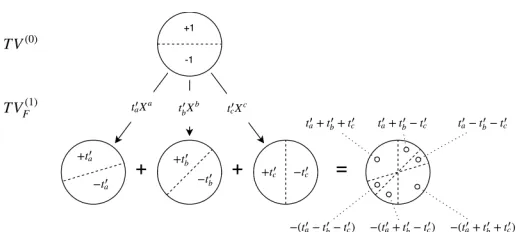
The test polynomial factorization introduced earlier can be graphically in-terpreted as follows:
1. The first-phase test polynomial divides the torus in two parts. The bootstrap-ping with test polynomialτ·T V(0) returns +τ for first half-circle [0,1/2[ of torus and−τ for the other part.
2. The second-phase test polynomial builds a linear combination of such half-circles, thus the half-circles from step 1 are rotated by Xi and scaled by t0i.
Example. We give in Figure 2 an example over T of the previously explained procedure. We ignore the coefficient τ in this illustration. On the top torus circle are denoted values returned by the first-phase test polynomial, i.e. test polynomial values projected on torus circle. The second-phase test polynomial has 3 terms and is equal to t0aXa+t0
bXb+t0cXc. The 3 bottom torus circles denote the linear mapping performed by each monomial of the second-phase test polynomial. Summing up these terms gives a torus circle values illustrated on the rightmost part of the figure. Observe the negacyclic property of cyclotomic polynomial XN + 1 on the torus circles from the fact that symmetric output values are negated.
Function evaluation with rounding. Letf be a function fromZttoZq fort <2N andq≤2N. Letrbe a rounding function which takes as input a message from
Fig. 2.Illustration of the high-level strategy for the multi-value bootstrapping
Test polynomial T Vf◦r = Piti for the composed function f ◦r is defined as:t0 =f◦r(0) andtk =−f ◦r(N−k) for 1≤k < N. Building the system of linear equation (2) and using explicit solution given in Theorem 3.2 we can deduce the coefficients for second-phase test polynomial.
Proposition 1 (Second-phase test polynomial norm).Letf be a function fromZs toZq and letT V
(1)
f◦r be the corresponding second-phase test polynomial.
The squared norm of this polynomial is given by: T V
(1) f◦r 2 2
≤s·(q−1)2. Proof. (Number of non-zero coefficients) From the definition of the rounding functionrwe haver(k) =lfor anyksuch thatl·2N/t≤k <(l+1)·2N/t. Without loss of generality we suppose here thatt divides 2N. Composed functionf ◦r, denoted by F, has the same output value for 2N/t consecutive input messages from Z2N, i.e. F(k) = f ◦r(k) = f(l) for l·2N/t ≤ k < (l+ 1)·2N/t. Using Property 1 we deduce that the T Vf(1)◦r polynomial is sparse and has exactly s non-zero coefficients. LetS,|S|=s, be the set of indexes of non-zero coefficients, we have T Vf(1)◦r=P
i∈St0iX i.
(Coefficient range) Each non-zero coefficientt0i,i∈S, is defined as the differ-ence between consecutive output values of functionf◦r, or equivalently function f. Refer to Theorem 3.2 andT Vf◦r definition. We have (t0i)
2
≤(f(k)−f(k0))2 for any k, k0 ∈
Zt. As function f is defined over Zq relation 0 ≤f(.) ≤ q−1 is verified. We deduce (t0
i) 2
≤(q−1)2. Combining these results we obtain the bound expression:
T V
(1) f◦r 2 2
=
X
i∈S t0iXi
2
2
=X
i∈S
(t0i)2≤s·(q−1)2
3.2 Optimized multi-value bootstrapping
We assume that first and second phase test polynomials,T V(0), T V(1)
F ∈ZN[X], together with scale factorτ verifying condition (3) are given.
τ·T V(0)(X)·Xm·T VF(0)(X)≡F(m) +R(X) modΦ2N(X) (3) Algorithm 4 illustrates the steps of optimized bootstrapping procedure using split test polynomials. It takes as input a ciphertext encrypting a messagem/2N, m ∈Z2N, and outputs a ciphertext encryptingF(m) ∈Z2N. Test polynomial T V(0)belongs toZN[X]. It is mapped toTN[X] by multiplication with1/2N ∈T and with scale factor τ (algorithm step 2). There is not need to map second-phase test polynomial toTN[X] because in step 4 a linear transformation ofACC byT VF(1) is performed.
Algorithm 4Multi-value bootstrapping algorithm
Input: ATLWEsamplec= (a,b)∈TLWEK,η(µ) whereµ=m/2N,m∈Z2 N
Input: First, second phase test polynomialsT V(0), T VF(1)∈ZN[X] and scale factorτ
Input: A bootstrapping key BKK→¯K,α = BKi∈TRGSWK,α¯ (Ki)
i∈[[1,n]] where ¯K is theTRLWEinterpretation of ¯K.
Output: ATLWEsample¯c∈TLWE¯K,η¯(F(m)/2N)
1: Letb=b2Nbeandai=b2Naie ∈Z2N for eachi∈[[1, n]] 2: Letv←TV(0)·1/2N·τ∈TN[X]
3: ACC←BlindRotate((0, v),(a1, . . . , an, b),(BK1, . . . ,BKn)) 4: ACC←TV(1)F ·ACC
5: Return¯c=SampleExtract(ACC)
Theorem 3.3. Given a TLWE input ciphertext c of message µ = m/2N, m ∈ Z2N, first-phase TV(0) ∈ ZN[X], second-phase TV
(1)
F ∈ ZN[X] test polyno-mials, factorization factor τ verifying condition (3) and a valid bootstrapping key BKK→K¯,α = (BKi)i∈[[1,n]], Algorithm 4 outputs a valid TLWE ciphertext ¯c of message F(m)/2N with error distribution variance verifying: Var(Err(c)) ≤
TV
(1) F
2 2
n(k+ 1)`N β2ϑ
BK+n(1 +kN)2whereϑBK is the variance of boot-strapping keyVar(Err(BKK←K¯,α)) =α2.
Proof. (Correctness) The first 3 lines of Algorithm 4 compute aTRLWE cipher-text of messageXb−aK·T V(0)·1/2N·τ. Line 4 applies a linear transformation to it and message τ/2N ·Xb−aK ·T V(0) ·T V(1)
F is obtained. Input message µ is a multiple of 1/2N on the torus so we have b−aK = µ·2N. Recall that τ·T V(0)·T V(1)
F ·X
m≡F(m) +. . .for anym∈
(Error Analysis) The error analysis for this method follows from the error analysis of the TFHE gate bootstrapping. It adds one multiplication by a con-stant polynomial T VF(1) and gives the following variation of error distribution: Var(Err(c))≤
T V (1) F
2 2
n(k+ 1)`N β2ϑ
BK+n(1 +kN)2
.
Theorem 3.4. Under the same hypothesis as in Theorems 2.8 and 3.3, when given a correct input ciphertext c of messageµ, m=µ·2N ∈Z2N, the multi-value bootstrapping of Algorithm 4 followed by the classical key-switching outputs a ciphertext¯cof message F(m)/2N with error distribution variance:
Var(Err(c))≤ TV
(1) F
2 2
n(k+ 1)`N β2ϑBK+n(1 +kN)2+
ntϑ2KS+n2−2(t+1) (4) where ϑBK and ϑKS are respectively the variances of bootstrapping and key-switching keys error distributions.
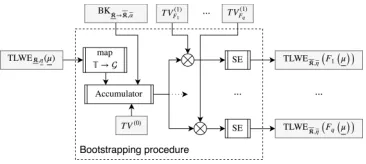
Multi-output version In many cases one needs to evaluate several functions over the same encrypted message. The naive way is to execute bootstrapping Algorithm 4 several times for each function. Remark that for equal first-phase test polynomialsT V(0)algorithm 4 performs the same computations up to line 3. Thus, until second-phase test polynomial integration into the accumulator. By repeating steps 4-5 for several second-phase test polynomials TV(1)F
1, . . . ,TV
(1) Fq
the bootstrapping algorithm outputs encryptions of messagesF1(m), . . . , Fq(m). Figure 3 is a schematic view of the bootstrapping procedure which evaluates several functions over same input message.
Fig. 3. Multiple output multi-value bootstrapping overview. Test polynomials TV(1)F1, . . . ,TV(1)Fq correspond toq functions evaluated over messageµencrypted in the input ciphertext.
4
Homomorphic LUT
4.1 Homomorphic LUT evaluation
A boolean LUT is a function defined asf :Zr 2→Z
q
2. At first we focus on single-output LUTs, i.e. the caseq= 1. Afterwards we show how to efficiently evaluate multi-output LUTs. It is straightforward to see an equivalent formulation forf over the ring of integers modulo 2rusingF :
Z2r →Z2 and the linear mapping
φ(m0, . . . , mr−1) = Pr−1
j=0mj·2jfromZr2toZ2r. We haveF◦φ(m0, . . . , mr−1)≡
f(m0, . . . , mr−1) for any (m0, . . . , mr−1)∈Zr2. The multi-value bootstrapping is used to evaluate LUT functionFas follows. We encode integers over the torus as multiples of1/2r+1. Only the first half-circle of torus is used for input and output
message spaces. In this way any function can be evaluated using bootstrapping procedure - refer to restrictions from Theorem 3.1. Full message space is used for the input j/2r+1 for j ∈
Z2r and only the first 2 elements are used for the
output messages j/2r+1 for j ∈
Z2. Test polynomial factorization described in previous section is used. Recall, the first-phase test polynomial TV(0) isP
iX i
and scaling factor is τ = 1/2. The second-phase test polynomial is computed using Theorem 3.2 for LUT function F composed with a rounding function.
From Proposition 1 this test polynomial norm verifies relation T V
(1) F◦r
2 2
≤2r.
4.2 LUT circuits
A naive solution for multi-output LUT evaluation is to map Zq2 to Z2q.
Do-ing so, we would be able evaluate functions F : Z2r → Z2q where q ≤ r. The
drawback of this method appears when we need to compose LUTs into a circuit and evaluate it. A reverse mapping from Z2q to Zq2 would be needed. It will be
an overkill to use another function to extract bits from Z2q messages, because
it implies to use another multi-value bootstrapping. Let F(`) :
Z2r → Z2 be
a multi-value input function computing the `-th output bit of LUT function f : Zr
2 → Z q
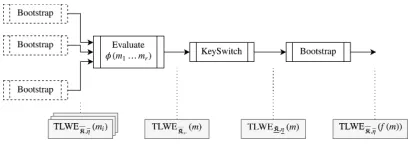
2, ` = 1, . . . , q. Each of these functions, F(1), . . . , F(q), is evalu-ated as described previously.Note that the expensive blind rotate part from the bootstrapping is performed once. Only the multiplication by second-phase test vector and sample extract is done for each evaluated function. Figure 4 illus-trates intermediary steps for interfacing LUTs. Firstly, ciphertexts encrypting messages m1, . . . , mr ∈ B obtained from several bootstrapping procedures are combined together into a multi-value messagemusing the linear transformation φ. Note that this transformation is performed in the output key space of the bootstrapping procedure under the secret key K. Next, a key-switching proce-dure is performed and a ciphertext of the same message munder the secret K
Fig. 4.LUT composition into circuits. On top are shown executed algorithms and at the bottom obtained ciphertexts.
4.3 Implementation details and performance
We implement the previous method forr= 6. The parameters of samples are:
– TLWE – n = 803, noise standard deviation 2−20 and h = 63 (TLWE key non-zero coefficient count),
– TRLWE–N = 214 and noise standard deviation 2−50,
– TRGSW– decomposition parameters`= 23 andB g= 26.
To estimate the security, we used thelwe-estimator script from [1] which in-cludes the recent attacks on small LWE secrets [2]. We found that our instances achieve at least 128 bits of security which is better than to the concrete security level (about 100 bits) of the 6-to-6 LUT implementation of [5]. The key-switch parameters are t = 4 and decomposition base 24. We have implemented the multi-value bootstrapping technique proposed above on-top of the TFHE li-brary [13] and a test implementation is available in the torus genericbranch. Several modifications were performed in order to support 64-bit precision torus. Approximate sample sizes are: TLWE 6.3kB, TRLWE 256kB and the TRGSW 2MB. As for the keys we have: multi-value bootstrapping key < 2GB and the switching key ≈ 6GB. The key sizes can be reduced using a pseudo-random number generator as in [10]. Our experimental protocol consisted in: (i) a 6 bit multi-value message is encrypted, (ii) parameters (i.e. second-phase test poly-nomials) for several LUTs are generated randomly, (iii) the multi-value boot-strapping is executed on this encrypted message (several ciphertexts encrypting boolean messages are obtained), (iv) a weighted sum is used to build a new multi-value message ciphertext from 6 of the output boolean messages obtained previously, (v) finally a key-switching procedure is performed in order to regain the bootstrapping input parameter space. We executed the algorithms on a single core of an Intel Xeon E3-1240 processor running at 3.50GHz. The bootstrapping and switching keys are generated in approximatively 66 seconds. Multi-value bootstrapping on 6 bit words with 6 boolean outputs runs in≈ 1.57 sec. with the bit combination plus key-switching phase and in under 1.5 sec. without the key-switching. For comparison the gate bootstrapping from TFHE library takes 15ms on the same machine. We did not observed a significant increase in the
execution time when the number of LUT outputs augments. For example com-puting 128 different functions on the same input message increased the execution time only by 0.05 sec., almost for free! We shall note that the combination and key-switching was performed a single time in this last experiment.
4.4 Further applications
We present here possible applications of the multi-value bootstrapping. We do not implement them but give a brief overview on the multi-bootstrapping could be used and leave the model analysis and teh implementation for a future inde-pendent work. The first one concerns the optimization of the circuit bootstrap-ping from [12, Sec. 4.1] which allows to compose circuits in a leveled mode by turning aTLWEsample into aTRGSWsample. The first step of thecircuit boot-strapping consists to`TFHE gate bootstrapping calls on the sameTLWEinput sample. Here each bootstrapping call is associated to a different test polynomial. We can apply the multi-value bootstrapping to optimize this step: since the LWE input sample is the same, the idea is to perform Algorithm 1 only once for the` bootstrapping calls, and to adapt the output using corresponding test polynomi-alsTV(1)F as in subsection 3.2. We then obtain the`desired outputs. This allows to save a factor`in one of the circuit bootstrapping phases. The second one re-lates to homomorphic evaluation of neural networks. Our multi-value bootstrap-ping can also be used to homomorphically evaluate a neural network. Assume neuronsx1, . . . , xp inputs and outputyare encrypted asTLWEciphertexts. The computational neuron network functionality is defined by two functions, a linear function f : Tp 7→
T and an activation function g : T 7→ T. The result is a TLWEsample ofy=g(f(x1, . . . , xp)). Function f is usually implemented as an inner-product. We can compute the inner-product betweenpneuron inputs and a fixed weight vector using a functional key-switch, and afterwards extract the TLWEencryption from theTRLWEkey-switch output. Note that the public func-tional key-switch allows to compute up toN inner-products. Thus, using a single key-switch procedure we can compute all the linear functions of a whole neural network layer! Afterwards, using our multi-value bootstrapping, we compute a TLWE sample of g(.) which is not an arbitrary function. Usually a threshold function is used forg. In this particular case, the multi-value bootstrapping can be more efficiently instantiated than for an arbitrary function.
Conclusion
References
1. M. Albrecht, R. Player, and S. Scott. On the concrete hardness of learning with errors. J. Mathematical Cryptology, ePrint Archive 2015/046, 2015.
2. M. R. Albrecht. On dual lattice attacks against small-secret lwe and parameter choices in helib and seal. InEurocrypts, vol. 10211, pages 103–129. Springer, 2017. 3. J. Alperin-Sheriff and C. Peikert. Faster bootstrapping with polynomial error. In
Crypto, pages 297–314, 2014.
4. J. F. Biasse and L. Ruiz. FHEW with efficient multibit bootstrapping. InProc. of Latincrypt 2015, LNCS 9230, pages 119–135. Springer, 2015.
5. G. Bonnoron, L. Ducas, and M. Fillinger. Large FHE gates from tensored homo-morphic accumulator. InAfricacrypt 2018, LNCS 10831, pages 217–251. Springer. 6. Z. Brakerski, C. Gentry, and V. Vaikuntanathan. (leveled) fully homomorphic
encryption without bootstrapping. InITCS, pages 309–325, 2012.
7. Z. Brakerski, A. Langlois, C. Peikert, O. Regev, and D. Stehl´e. Classical hardness of learning with errors. InSTOC, pages 575–584, 2013.
8. Z. Brakerski and R. Perlman. Lattice-based fully dynamic multi-key FHE with short ciphertexts. InCrypto’2016, volume 9814, pages 190–213, 2016.
9. J. H. Cheon and D. Stehl´e. On dual lattice attacks against small-secret lwe and parameter choices in helib and seal. InIn Proc. of EUROCRYPT, volume 9057 of LNCS, pages 513–536. Springer, 2015.
10. I. Chillotti, N. Gama, M. Georgieva, and M. Izabach`ene. Faster fully homomorphic encryption: Bootstrapping in less than 0.1 seconds. InAsiacrypt 2016, Part I 22, pages 3–33. Springer, 2016.
11. I. Chillotti, N. Gama, M. Georgieva, and M. Izabach`ene. A homomorphic lwe based e-voting scheme. InPQCrypto, pages 245–265. Springer, 2016.
12. I. Chillotti, N. Gama, M. Georgieva, and M. Izabach`ene. Improving tfhe: faster packed homomorphic operations and efficient circuit bootstrapping. In Proc. of Asicacrypt 2017, LNCS 10624, pages 377–408. Springer-Verlag, 2017.
13. I. Chillotti, N. Gama, M. Georgieva, and M. Izabach`ene. TFHE: Fast fully homo-morphic encryption library. https://tfhe.github.io/tfhe/, August 2016.
14. L. Ducas and D. Micciancio. FHEW: Bootstrapping homomorphic encryption in less than a second. InEurocrypt, pages 617–640, 2015.
15. J. Fan and F. Vercauteren. Somewhat practical fully homomorphic encryption. https://eprint.iacr.org/2012/144, 2012.
16. C. Gentry. Fully homomorphic encryption using ideal lattices. InSTOC, volume 9, pages 169–178, 2009.
17. C. Gentry, A. Sahai, and B. Waters. Homomorphic encryption from learning with errors: Conceptually-simpler, asymptotically-faster, attribute-based. In Crypto, pages 75–92, 2013.
18. S. Halevi and I. V. Shoup. Helib - an implementation of homomorphic encryption. https://github.com/shaih/HElib/, September 2014.
19. T. Lepoint. FV-NFLlib: Library implementing the Fan-Vercauteren homomorphic encryption scheme. https://github.com/CryptoExperts/FV-NFLlib, May 2016. 20. V. Lyubashevsky, C. Peikert, and O. Regev. On ideal lattices and learning with
errors over rings. InEUROCRYPT, pages 1–23. Springer, 2010.
21. O. Regev. On lattices, learning with errors, random linear codes, and cryptography. InSTOC, pages 84–93, 2005.