ANC experiments for nuclear astrophysics
G.D’Agata1, V. Burjan1, J. Mrázek1, V. Glagolev1, A. I. Kilic1, V. Kroha1, M. La Cognata2, L. Lamia2,3,S.Palmerini4,5,Š.Piskoˇr1,R. G.Pizzone2,G. G.Rapisarda2,S.Romano2,3,I.Siváˇcek1, C.Spitaleri2,R.Spartá2, andA.Tumino2,6
1Nuclear Physics Institute of the Czech Academy of Sciences, 250 68 ˇRež, Czech Republic
2INFN - Laboratori Nazionali del Sud, Via Santa Sofia 62, 95123, Catania, Italy
3Dipartimento di Fisica e Astronomia, Università degli Studi di Catania, Via S. Sofia, 64, 95123, Catania,
Italy
4Dipartimento di Fisica e Geologia, Università degli Studi di Perugia, via A. Pascoli s/n, 06123, Perugia, Italy
5INFN-sezione di Perugia, via A. Pascoli s/n, 06123, Perugia, Italy
6Facoltà di Ingegneria ed Architettura, Kore University, Viale delle Olimpiadi, 1, I-94100 Enna, Italy
Abstract.Among the indirect methods to determine nuclear cross-section present in liter-ature, the so-called Asymptotic Normalization Coefficient (ANC) has proven to be useful in retrieving the direct part of a radiative capture cross-section in reactions of interest for astrophysics. In this work, the method will be presented, and some results obtained in collaboration between NPI CAS and INFN-LNS will be presented.
Introduction
Experimental measurements of reactions of relevance for astrophysics are a big challenge for experimentalists due to the presence of the Coulomb barrier between charged particles: in fact, it highly decreases the cross-section in the energy range of interest, that usually is between few keV and some MeV. It is therefore necessary, when direct methods are not feasible, to use indirect ones.
Among these, the Asymptotic Normalization Coefficient (ANC) method allows to retrieve the ANC
of the overlap function for the bound-state wave functions in the initial and final states [1, 2]. Such a method is widely used under the condition that the reaction of interest is peripheral. This is, for example, the case of radiative captures involving p,n andα-particles in stellar environment. In the following work the method will be presented, marking the key points of the theoretical framework and the advantages of its usage. Then an experimental overview of the method will be given, using as a benchmark the ongoing data analysis for the26Mg(d,p)27Mg reaction: this reaction is interesting
due to its mirror,26Si(p,γ)27P, considered to be important as a constraint to the production of26Al
and26mAl. The production of both is among the most debated issues concerning novae and x-ray
bursts[3, 4].
The ANC method, as stated in the introduction, is usefull to study direct capture reactions of astrophysical interest by means of the study of a direct transfer reaction. It allows to study reactions
1
involving protons [5], neutrons [6] orα-particles [7] and it has also proven to be useful to investigate subthreshold resonances [8–10].
In the general case, this kind of reactions can be considered (as sketched figure 1) asX+A→Y+B, whereX=Y+a,B=A+a, withais the transferred particle.
Figure 1.Sketch of a typical transfer reaction.
For that case, the Distorted Wave Born Approximation (DWBA) leads to an approximation for the transition amplitude between the states before and after the reaction. Here, the matrix element for the transition can be written as
M=χ(f−)IAaB |ΔV|IYaX χ(i+) (1)
whereIB
AaandIYaX are the radial overlap integral of the two systemsY+aandA+awith the nucleiBand
Xrespectively,χ(i+) andχ(f−)are the distorted waves for the entrance and exit channels, andΔVis the perturbative part of the total potential, composed by a real (V) and an optical (U) part (ΔV =V−U). In general, for the nuclear process between two particlesa+b →c, withc=(ab), both the overlap functions in equation 1 can be written using a quantity known as spectroscopic factor (SF) - in general Sab- that has been widely used in the last fifty years to estimate the occupation of the orbitals. The
overlap funcion of the bound state wave functions of particlesa,bandc, Icabl
cjc, can be written as:
Iabc,lc,jc(rab)=S
1/2
ab,lc,jcφnc,lc,jc(rab) (2)
withφnclcjc(rab) as the bound state wave function [11].
Regarding the SF, the description of the cross-section depends on the binding portential and optical model parameters (OMP)[11]. The binding potential is adjusted according to the binding energy to reproduce the bound state, while the OMP are usually extracted from elastic scattering. In general then the SF is sensitive to the selection of the optical model adopted, and different families of those can reproduce the angular distributions retrieved from experimental data [12].
By means of DWBA calculation it is in the end possible to reproduce the experimental angular distri-bution:
dσexp
dΩ =
jB,jX
SAa,lB,jBSYa,lXjXσ
DW
lB,jb,lX,jX (3)
where dσ
dΩ andσ
DW
lBjblXjX are related by the two SF for the entrance and exit channel: one of those is
usually known, while the other is left to be determined.
In 1990 it was pointed out by Mukhamedzhanov and Timofeyuk[13] that the direct part of the radiative cross-section at low energies usually contains the same radial overlap integral (Ic
ab in general) as a
determine the cross-section of reactions of interest in astrophysics, and in this case is possible to write both the radial overlap functions (Eq. 1) and bound-state wave functions (Eq. 2) as it follows:
IAaB,lc,jc(rab)
rab>Rn
−−−−−→Ccab,lb,jb W−η,lc+1
2(2kabrab) rab
(4)
φab,lc,jc(rab)
rab>Rn
−−−−−→bcab,lc,jc W−η,lc+1
2(2kabrab) rab
(5)
In both equations (4) and (5)W−η,lc+1
2 stands for the Whittaker function, well known to have its asymp-totic behaviour asW−η,lc+12(−2kIr)→e
−klr+ηIln(2kI). In equation 4 and 5 for the first time the coefficient bandCappear: those are the so-called single-particle ANC (SPANC) and ANC coefficients, respec-tively. Finally, by substitution of equations (4) and (5) in (3), we obtain:
dσ dΩ =
jB,jX
CBAa,lB,jB
2
CXYa,lX,jX
2 σDW BAlB,jB,lX,jX b2
Aa,lB,jBb
2 Ya,lX,jX
=
jB,jX
CBAa,lB,jB
2
CXYa,lX,jX
2
RlB,jB,lX,jX (6)
In the end, using DWBA, we are able to retrieve the ANC’s for the direct part of the cross-section for reactions of astrophysical interest. This approach is useful because the ANC’s have a small depen-dence on the chosen nucleon binding potential (see Fig.11 in [11], for example), so the ratioRlB,jB,lX,jX
in equation 6 has also small dependence onb2.
26
Si(p,
γ
)
27P reaction
One of the latest experiments meant to apply the ANC method at NPI CAS has been the study of the26Si(p,γ)27P reaction, that is supposed to be of some importance in the framework of the
produc-tion of26Al. This reaction is studied using the mirror pair of26Si,26Mg: in particular, the reaction 26Mg(d,p)27Mg is used with the aim to extract ANC’s for the 26Mg(n,γ)27Mg, and then using the
mirror pair properties [14, 15] to obtain information on the ANC of the reaction of interest.
In the last years, the production of26Al has been matter of debate for scientists: it is, in fact
clearly observable in novae and x-ray bursts [3, 4]. Its production chain seems to be dominated by the24Mg(p,γ)25Al(β+)25Mg(p,γ)26Al, but the scenario has been strongly complicated by the presence
of the widely known, short-lived isomer of26Al(T
1/2=6.34s). The ratio between ground and isomeric
states should be known to better understand the observed wide and intense distribution of26Al through
the galactic plane [16].
A possible bypass of the chain mentioned above is represented by the 25Al(p,γ)26Si(p,γ)27P one,
and so the 27P production has been considered of some importance as a possible competitive
channel of the 26Al production. Furthermore, the isomeric state 26mAl can be produced via the
25Al(p,γ)26Si(β+)26mAl. In this scenario the reaction26Si(p,γ)27P is important, because26Si destroyed
in this way would not end up feeding the isomeric state.
In novae, it has been proposed that the thermal equilibrium between26Al and26mAl can possibly be
reached at T9 ≈0.4 [17]. At this range of temperature, the Gamow window lies between 0.2 and
0.5 MeV for the26Si(p,γ)27P reaction.
3 An experimental example: the
For all the reasons explained in section 2.1, we decided to study the26Si(p,γ)27P using the mirror
pair approach:27P is in fact the mirror nucleus (inverted number of protons and neutrons) of27Mg,
and so the proton ANC for the process27P→26Si+p can be derived [14, 15] asC27P
i j
2
=R
C27i jMg
2
,
whereRcan be calculated asR=
Fl
ikpRN
kpRnjl(iknRN)
2
,Flbeing the regular Coulomb wave function, jl
the Bessel function ofl−th order, andRNthe radius of the nuclear interior, whilekpandknare related
to the neutron and proton separation energy via the relationk=
2μ
2[14, 15]. Here another relation
has been found [14] betweenΓpand|Cn|2as
Γp |Cn|2
=RΓ≈Rres0 =
2k p μ
Fl
ikpRN
kpRnjl(iknRN)
2
.
We decided then to use the26Mg(d,p)27Mgreaction, using the 19MeV deuteron beam provided by the
U120M cyclotron of the NPI CAS ( ˇRež, Czech Republic), operated by CANAM infrastructure project. About this reaction, a similar attempt using ANC has been made [18] reanalyzing data avaliable in litterature, but the extracted ANC values are in disagreement with other results obtained studying the
26Mg(t,d)27Mg reaction [19]. The discrepancies between the two analyses ended up in an S-factor that
in the second case is 1.7 times smaller. Further investigations are therefore necessary.
Our experimental set-up was composed by threeΔE-E telescopes placed at 10◦ difference between each other on one side of the beam, and twoΔE-E at 17◦and 37◦on the other side, that were meant as monitors. All theΔE-E detectors are composed by a 500μm silicon detector for the thin stage and a 5000μm one for the thick one. Angular distributions are measured by moving the detectors to higher angles from the beam axis at fixed steps. The target, provided by the target laboratory of LNS-INFN was composed by 70μg/cm2 26MgO with a 32μg/cm2natural carbon backing.
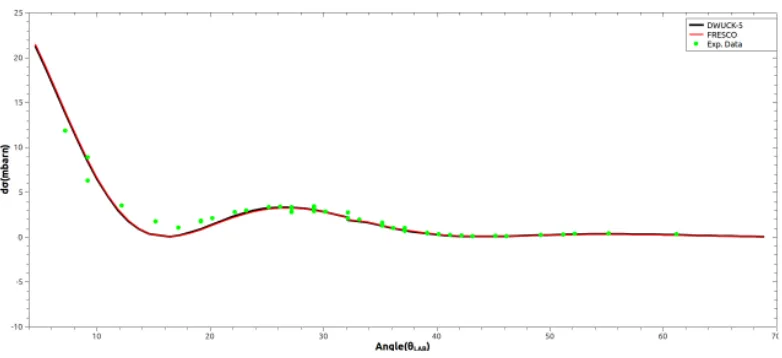
Figure 2.Angular distributions for ground state (same procedure for the first excited state has also been made) for the reaction26Mg(d,p)27Mg. The curve is extracted by means of DWBA calculations. More details will be
given in a forthcoming paper.
After particle identification, the resulting optical potential parameters for both elastic scattering
26Mg+d and26Mg(d,p)27Mg reaction (exit channel) were obtained fitting the angular distribution by
means of DWBA calculation (figure 2).
With the analysis of the26Mg(d,p)27Mg, as for now we were able to obtain information on the
behaviour of the angular distribution, on the optical potential parameters necessary for DWBA calcu-lation, and on the SF of the reaction. ANC calculation has yet to be done. Before the extraction of ANC’s, peripherality checks must be performed. This part is crucial for the method, given that the reaction must be peripheral. We will apply the standard procedure explained for example in [11]: it consists in a comparison of the modelledσDW BA behaviour for different Rcuto f f of integration. If the
process is peripheral, the calculated cross-section must be indipendent on the nucleus interior. An-other check that is usually done consists in comparing the radial behaviour of the single-particle wave functionφwith the potential parameter r0[11]. Also, the dependence of C2 on the binding potential
involved must be investigated, for example plotting the dependance of it from SPANCb. If the vari-ation of C2for increasing values ofbis small (usually less than 9%) than we have another argument
for peripherality. Here lies another advantage of the ANC with respect to the SF: the variation of the latter for different values of the SPANC is usually quite severe. Once those checks are performed, the proper ANC calculations will be performed, and mirror pair ANC procedure will be applied to extract the cross-section for the26Si(p,γ)27P reaction.
In this work, the key points of the ANC method are highlighted (section 1), along with an experimental example of an ongoing data analysis (section 2), and some preliminary results have been shown, along with the standard method of extraction of the OMP (through scattering, see section 2.2). Also, the usual ways to check the applicability of the method are discussed (section 2.3).
This work was supported by MEYS Czech Republic under the project EF16_013/0001679
References
[1] A. M. Mukhamedzhanov and N. K. Timofeyuk, JETP Lett.51, 282 (1990)
[2] H. M. Xu et al., Phys. Rev. Lett.73, 2027 (1994) [3] J. José et al., Astrophys. J.520, 347 (1999) [4] O. Koike et al., Astrophys. J.342, 464 (1999) [5] V Burjan et al., EPJ A55, 114 (2019)
[6] A. M. Mukhamedzhanov et. al., Phys. Rev. C.84, 024616 (2011) [7] Y. P. Shen et al, Phys. Rev. C.99, 025805 (2019)
[8] A. M. Mukhamedzhanov & R. E. Tribble, Phys. Rev. C.59, 1418 (1999) [9] A. M. Mukhamedzhanov et. al., Phys. Rev. C.67, 065804 (2003) [10] A. M. Mukhamedzhanov et. al., Phys. Rev. C.78, 015804 (2008) [11] A.M. Mukhamedzhanov et al., Phys. Rev. C56, 1302 (1997) [12] X.D. Liu et al., Phys. Rev. C69, 064313 (2004)
[13] A. M. Mukhamedzhanov & A. S. Kadyrov, Phys. Rev. C82, 051601 (2010) 3.3 Future Work
[14] N. K. Timofeyuk et al., Phys. Rev. Lett.91, 232501 (2003) [15] L. Trache et al., Phys. Rev. C.67, 062801 (2003)
[16] J. A. Caggiano et al,Phys. Rev. C.64, 025802 (2001) [17] A. Coc et al., Phys. Rev. C61, 015801 (1999) [18] B. Guo et al., Phys. Rev. C.73, 048801 (2006)