Scholarship@Western
Scholarship@Western
Electronic Thesis and Dissertation Repository
4-14-2016 12:00 AM
Evaluating the Quantum Postulate in the Context of Pursuit
Evaluating the Quantum Postulate in the Context of Pursuit
Molly M. Kao
The University of Western Ontario
Supervisor Wayne Myrvold
The University of Western Ontario
Graduate Program in Philosophy
A thesis submitted in partial fulfillment of the requirements for the degree in Doctor of Philosophy
© Molly M. Kao 2016
Follow this and additional works at: https://ir.lib.uwo.ca/etd
Part of the Philosophy of Science Commons
Recommended Citation Recommended Citation
Kao, Molly M., "Evaluating the Quantum Postulate in the Context of Pursuit" (2016). Electronic Thesis and Dissertation Repository. 3675.
https://ir.lib.uwo.ca/etd/3675
This Dissertation/Thesis is brought to you for free and open access by Scholarship@Western. It has been accepted for inclusion in Electronic Thesis and Dissertation Repository by an authorized administrator of
The purpose of this dissertation is to contribute to our understanding of
scientific theory pursuit by providing a detailed case study on the development of
quantum theory.
In 1900, Max Planck introduced the notion of ‘energy elements’ into his attempt
to account for the observed anomalous blackbody radiation spectrum. Despite the
fact that the physical interpretation of this notion was ambiguous, a similar idea
was later taken up by several scientists. These investigations eventually led to the
formulation of quantum mechanics, one of our most successful physical theories to date. However, the intervening years of study were marked by theoretical
uncertainty and inconsistency, during which time scientists had to proceed
according to a patchwork collection of principles and heuristics.
I first elaborate on why this case should be considered an instance of piecemeal
pursuit by presenting the historical ‘quantum conjectures’ that were being used in
different contexts. These conjectures gave quite varied interpretations of what
quantization might refer to. By comparing these conjectures, I identify a general
quantum postulate that captures the underlying assumption that is common to all
the cases. I argue that it is possible to consider a general postulate about
quantization even when its proper application is ambiguous in a given context, and
that the postulate can be separated from different elements of the framework being
used to investigate it.
I show that the quantum postulate can be deemed promising by analysing the
support it gains using a Bayesian framework. I first defend the use of such a
framework by considering the purported inconsistencies in Planck’s introduction of
his quantum conjecture and how we should handle these. I then explicate two cases
of support for the postulate. First, I show how we can use a particular solution to
the Bayesian problem of old evidence to interpret the support the quantum
postulate received by accounting for phenomena that had no previous explanation.
Finally, I show that the quantum postulate is also supported by a unification
argument, where unification is interpreted as informational relevance between the
different domains of inquiry.
Keywords: quantum postulate, context of pursuit, quantum theory, scientific
theories, history of physics, Bayesian epistemology, inconsistency, old evidence,
unification
First and foremost, I must extend my sincere gratitude to my supervisor Wayne
Myrvold. His confidence in me from the very beginning, his judicious guidance, and
his intellectual example have been invaluable not only for the completion of this
project, but also in my personal development as a philosopher. I am also deeply
indebted to Bill Harper and Chris Smeenk, both of whom have greatly influenced
my thinking and helped me to improve my work in countless ways over the years.
Their support for my project was instrumental in its completion. Additionally, I am
indebted to John Bell for his kindness and intellectual generosity, and for being someone from whom I have learned much about many different things.
This dissertation has benefited significantly from feedback from various people.
In addition to those mentioned above, Michel Janssen provided detailed and
thoughtful comments that not only brought to my attention useful additional
sources, but that also helped me to better situate my work. Sam Fletcher also
pushed me to clarify my arguments at several points, for which I am grateful.
Many thanks go to the community of students at Western and, in particular, to
Emerson, Nic, Sona, Dave, Lori, Rob, Melissa, and Yann. I am fortunate to have
found in them mentors, interlocutors, and friends with whom I can share both challenges and successes.
I am profoundly grateful to my parents, Diana and Wayne, and my sister
Christine for their unconditional love and unwavering support. And finally, I am
grateful to Mike, who continues to be a seemingly endless source of encouragement
and inspiration. All of them have contributed immeasurably to making this
dissertation possible.
Abstract i
Dedication ii
Acknowledgements iii
1 Introduction 1
1.1 The Context of pursuit . . . 1
1.2 Quantum theory as case study . . . 3
1.3 Formal framework . . . 6
1.4 Argument structure . . . 8
2 Quantum Conjectures in 1900–1916 11 2.1 Introduction . . . 11
2.2 The quantum conjectures . . . 14
2.2.1 Blackbody radiation . . . 14
2.2.2 Light quanta . . . 18
2.2.3 Specific heats . . . 20
2.2.4 Atomic theory . . . 23
2.3 The general postulate . . . 25
2.4 Implications . . . 27
2.5 Conclusion . . . 30
3 The Photoelectric Effect 31 3.1 Introduction . . . 31
3.2 Einstein and light quanta . . . 32
3.3 Millikan’s experiment . . . 36
3.4 Context of pursuit . . . 38
3.5 Conclusion . . . 43
4 Blackbody Radiation, Inconsistency, and Tempered Personalism 44 4.1 Introduction . . . 44
4.2 Inconsistency and Blackbody Radiation . . . 45
4.3 Tempered Personalism . . . 51
4.4 Analysis . . . 55
4.5 Correct Prediction . . . 59
5 The Quantum Postulate and Old Evidence 62
5.1 Introduction . . . 62
5.2 Phenomena to consider . . . 63
5.3 Bayesian analysis . . . 66
5.4 Conclusion . . . 75
6 Unification and the Quantum Postulate: Agreeing Measurements of Planck’s Constant 76 6.1 Introduction . . . 76
6.2 Unification . . . 77
6.3 Informational relevance . . . 80
6.3.1 Blackbody radiation . . . 80
6.3.2 Light phenomena . . . 81
6.3.3 Spectral phenomena . . . 84
6.3.4 Summary of Informational Relevance . . . 86
6.4 Further considerations . . . 88
6.5 Conclusion . . . 92
7 Conclusion 93
Bibliography 96
A Publication Permission for Ch. 6 104
Vita 106
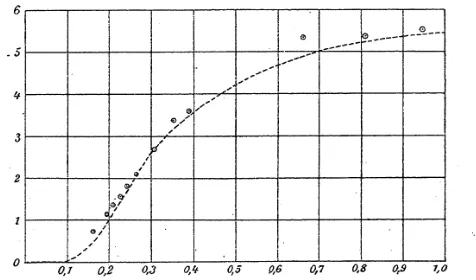
2.1 Graph ofdE/dT from Einstein (1907) . . . 22
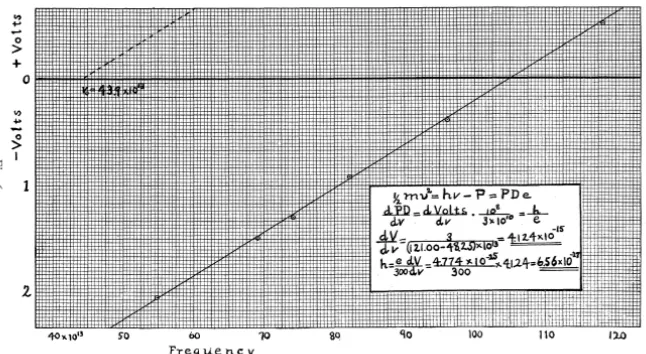
3.1 Graph from Millikan (1916), p. 373 . . . 37
Chapter 1
Introduction
1.1
The Context of pursuit
In the past few decades there has been growing acknowledgement of the idea that
philosophers of science can both learn from and contribute to the study of the
process of constructing scientific theories. Much of this discussion arose out of
Reichenbach’s famous distinction between the “context of discovery” and the
“context of justification,” first formulated in his (1938) article, where he calls the
first a matter of the “psychology of scientific discovery” and the latter a matter of the “logic of science” (p. 36). Since then, this distinction has generally been
interpreted as a kind of division between the process of coming up with a scientific
theory, and the process of testing said theory in order to determine whether one is
justified in accepting it. For much of the twentieth century, the dominant view
among philosophers of science was that philosophical investigations should be
confined to the context of justification. For instance, Karl Popper believed that
there was no “logic of scientific discovery” despite the English title of his famous
work (1959). According to him, the process of discovery was a topic for empirical
psychology rather than logical analysis due to an ineliminable creative element, and that the initial stage of conceiving or inventing a theory was not relevant for the
practice of philosophy (1959, p. 7). This separation of discovery and justification
arose from a belief that a hypothesis arrived at by pure luck or guesswork may still
be tested via methods we have determined to be well-justified and accepted as
scientific knowledge, despite its questionable origins. Of course, the process of
scientific inquiry does not proceed overwhelmingly by pure luck or guesswork, and it
is a rare occurrence for theories to simply present themselves to scientists wholesale,
In recent years, some have argued that the distinction between discovery and
justification cannot be upheld (Arabatzis, 2006). Others have argued that
Reichenbach’s position was misinterpreted, and that the distinction was never
meant to be a temporal one, as a chronological division between initial discovery
and subsequent justification, but simply as a directive for separating out the psychological components of theory construction from the justificatory ones
(Nickles, 1980b). Furthermore, the view began to emerge that the attempt to find
an infallible logical procedure for justification ignores the complicated processes
scientists actually undergo, and that a more historically oriented viewpoint can help
overcome this imbalance.
Several foci of study emerged from this line of thought. Some authors have
turned their attention to the investigation of methods by which scientific theories
are constructed or ‘discovered.’ Although there is a general consensus that there
exists no infallible set of rules by which scientists can construct new theories, authors have drawn attention to important processes that are often used in such
development (Nickles 1980b, Meheus & Nickles 2009). Such analyses agree on the
idea that we should take into account the process of developing and constructing
theories. As a result, these studies tend to be focused on episodes of actual scientific
development, such as Lindley Darden’s work on the discovery of biological
mechanisms (Darden, 2009).
In addition to the work on the process of discovery, Larry Laudan (1977) argued
for an understanding of scientific growth primarily in terms of progress in solving
problems, and introduced the term ‘context of pursuit’ to draw attention to the fact that before deciding whether to accept or reject a theory, scientists must determine
whether or not a fledgling theory is worth pursuing for a variety of reasons, both
epistemic and pragmatic, often in cases where the theory is not developed enough to
warrant acceptance in the usual sense. Laudan’s discussion centres on the question
of rationality in science in such contexts, but several authors have picked up on this
theme and introduced different ways to evaluate theories in the context of pursuit.
For instance, Laurie Anne Whitt argues for a combination of conceptual and
empirical dimensions to theory appraisal, and discusses possible indices of theory
promise focusing largely on the usefulness of analogies from a more established domain to a newly developing line of inquiry (1992). More recent work by Dunja ˇ
Seˇselja and Christian Straßer (2014) has discussed the question of epistemic
justification in the context of pursuit, where they have presented a coherentist
studies to help support their analyses (Whitt 1990, ˇSeˇselja & Weber 2012). Peter
Achinstein has approached the topic of pursuit by considering general features of
the reasoning employed in this context that tend to differ from a purely justificatory
perspective, also using a case study (Achinstein, 1993). What these discussions have
in common is their characterization of pursuit as occurring after a theory has already been articulated, at which point a judgment must be made about whether
to pursue it or not. This allows for a contrast with the context of discovery, before
such a theory exists, and the context of justification, at which time scientists are
deciding whether or not to accept such a theory.
The purpose of my dissertation is to contribute to our understanding of pursuit
by providing a detailed case study on the development of quantum theory. One
might consider this to be an investigation of the context of discovery rather than
pursuit, but I claim that one thing that becomes clear in my analysis is that pursuit
and discovery are not always easily separable. In what follows, I use the language of ‘pursuit’ but I do not see my project as being closer in kind to Laudan’s conception
of science than to those who choose the terminology of ‘discovery.’ Indeed, my case
study is concerned with both of these contexts, but I find that the language of
‘pursuit’ better captures the process in question than the term ‘logic of discovery.’ I
will also show that despite the fact that I characterize my project as one that is
focused on pursuit, there is an essential difference between my goal and that of
authors I have discussed above. This difference consists in the fact that authors like
Whitt and ˇSeˇselja & Straßer are trying to answer the question “Is a given theory
worth pursuing?” My analysis will instead focus on issues related to the queston, “How should we proceed in the context of pursuit?” This means that I will be
concerned with how we can identify and evaluate promising features of theories in
this context. I will now introduce my case study, and explain why it is particularly
appropriate for an investigation of the process of pursuit.
1.2
Quantum theory as case study
In the latter years of the nineteenth century, various components of classical physics — including classical mechanics and Maxwell’s electromagnetic theory — seemed to
be quite well confirmed by almost all experiments up to that point. However,
around that time, a few experimental results began to point to the inability of
classical theories to account for all phenomena. In 1900, Max Planck introduced a
attempt to account for the observed radiation spectrum. Despite the fact that the
idea of quantization was ambiguous in terms of its specific physical interpretation, a
similar idea was later taken up by several scientists, most notably, Einstein and
Bohr. The investigations into quantization that took place during this time
eventually led to the formulation of quantum mechanics, one of our most successful physical theories to date. However, the intervening years of study were marked by
theoretical uncertainty and inconsistency, during which time scientists had to
proceed according to a patchwork collection of principles and heuristics. There was
no theoretical framework that was even a candidate for acceptance, and so it is
difficult to see how we could characterize this as the justification of a theory.
Instead, we can consider this period as one in which scientists were engaged in
both discovery and pursuit. On the one hand, we might say that scientists were
working to discover the theory of quantum mechanics, where ‘discovery’ refers to
the first articulation of the modern mathematical form of the theory. On the other hand, this period provides an excellent example of scientists working in the context
of pursuit. For instance, Planck’s work is often referred to as his ‘theory of
blackbody radiation’, and Bohr’s work is often referred to as the ‘old quantum
theory.’ Scientists evidently judged each of these individual theories to be worth
pursuing. However, one theme that will arise from my analysis is that an
understanding of pursuit in one individual context must take into account its
relation to the other domains, despite the absence of an overall coherent framework
in which all of these investigations could be situated.
There is a significant amount of work addressing the modern formulation and interpretation of quantum mechanics, as well as many treatments of the ‘old
quantum theory,’ beginning with Bohr’s atomic model of 1913. However, despite the
fact that the developments of 1900 to 1913 are historically well-documented, the
philosophical literature on this period is more limited. While John Norton has
written on this topic, his focus has been on the justification of certain aspects of the
theory, in the traditional sense of justification as making it reasonable to accept the
ideas in question, primarily through deductive arguments.1 Leplin (1980) and
Nickles (1980a) recognise the significance of this period, and both refer to it as an
example in their suggestions of how to understand the process of pursuit. However, this period has not yet been subject to a detailed historical analysis from the
perspective of theory pursuit. I submit that such an analysis yields insights on
1See for instance Norton (1987) on Planck’s theory of blackbody radiation and Norton (1993)
scientific methodology and, in particular, for the process of pursuit in the absence of
an overarching theory that is guiding the inquiry.
By restricting my attention to the years roughly up to 1913, I focus on the ways
in which quantization was applied in different experimental contexts, and how this
advanced the development of quantum theory in a ‘piecemeal’ manner. My purpose is to provide a reconstruction of the arguments made and experiments performed
during this developmental period in order to better understand the process of
piecemeal pursuit that I claim was operative at the time.2 The term ‘piecemeal
pursuit’ is meant to reflect several facts. First, the notion of quantization was being
deemed promising in various contexts, but there was no overarching theoretical
framework, and so the investigation of quantization had to be pieced together from
application in these different domains. Second, each domain was itself something of
a piecemeal investigation, since elements of classical theories were being used in
conjunction with conjectures and hypotheses that did not clearly fit within classical frameworks.
In what follows, I take it as given that scientists were interested in the notion of
quantization because it had the potential to solve unaddressed problems, and that
they were trying to construct a theory that could account both for the successes of
classical physics, and that included some kind of quantum postulate. This attitude
of situating scientists in the midst of pursuit is nicely summed up by Planck in the
Preface to the Second Edition of hisTheory of Heat Radiation:
[I]t follows from the nature of the case that it will require painstaking
experimental and theoretical work for many years to come to make
gradual advances in the new field. Any one who, at present, devotes his
efforts to the hypothesis of quanta, must, for the time being, be content
with the knowledge that the fruits of the labor spent will probably be
gathered by a future generation. (Planck, 1913/1914, p. ix)
My analysis provides a more detailed explanation of how and why such a
postulate had the potential to succeed in this endeavour.
2That said, some of the experimental work I discuss, such as Millikan’s work on the
photoelectric effect, occurred after 1913. I include it because it is directly related to specific
elements of theoretical work that arose before this date, and was relatively disconnected to the
1.3
Formal framework
I will be limiting my analysis to broadly epistemic factors. While I would certainly
not deny that science is a social activity, and that a full understanding of whether it is wise to pursue a theory will take social and pragmatic factors into account, I put
these considerations aside for the purpose of this particular study. Furthermore,
none of what I will say hinges on a particular conception of the end goal of science
beyond a commitment to its adequacy in accounting for the phenomena in which we
are interested. Part of my goal is to show that many of the same epistemological
features we take to be indicative of justification are also applicable when we
consider whether a theory is worth pursuing or not, but this does not mean that
such features necessarily indicate truth. In parts of my analysis, I will use Bayesian
epistemological tools. Specifically, I will be working within a framework very similar to the one Abner Shimony calls ‘tempered personalism’ (1970). There are several
reasons that make this epistemological framework appropriate for my purposes.
First, consider John Earman’s characterization of theory acceptance.
[T]here is no natural Bayesian explication of theory acceptance, save in the case where the probability of the theory is 1. Since scientists qua
judges of theories are almost never in a position to justify such an
acceptance, the Bayesian prediction is that rarely is a theory accepted in
the epistemic sense. Similarly, when theory choice is a matter of
deciding what theory to devote one’s time and energy to, the Bayesian
prediction is that in typical situations where members of the community
assign different utilities to such devotions, they will make different
choices. Thus, from either the epistemic or practical perspective, the
Bayesian prediction is for diversity. (Earman, 1992, p. 194)
I will be arguing that this diversity of views is an important part of the kind of
theory pursuit I am interested in. In particular, we will see that scientists tried to
give different physical explanations of experimental results, and that scientists had
different levels of commitment to various claims. This framework is thus suited for an examination of the pursuit of a quantum theory. Shimony’s view in particular
captures what I consider to be my general purpose for using Bayesian epistemology.
That is, I consider probabilistic reasoning one of the best ways to formalize some of
the steps of scientific inference, and I believe that it can yield results that are not
normative recommendations for a rational agent in understanding the relations
between a claim and its support, as well as between different pieces of evidence.
Another important feature of tempered personalism is that “the individual
investigation delimits an area in which probabilities are calculated” (Shimony, 1970,
p. 99). Thus, in our case, probabilities are assigned in the context of particular investigations of energy quantization. How this is being done will be discussed in
more detail, but it fits well with the notion of piecemeal pursuit since I claim that
the idea of quantization was being investigated in various disparate domains.
Finally, the ‘tempered’ part of tempered personalism comes from the prescription of
open-mindedness towards new, seriously proposed hypotheses; that is, scientists
should at least consider such hypotheses when there are good reasons to do so.
Although we will need to make judgments that are not prescribed by the Bayesian
framework to determine whether a hypothesis is a serious proposal, I take this to be
a good general methodological rule. We will thus see that there were uses of the idea of quantization that were applied in cases that were ultimately unsuccessful,
but it would be unreasonable to expect that they should have been ruled out at the
outset.3
Furthermore, I believe that the use of this framework helps to sharpen some
methodological points. For one thing, we see that the use of this framework requires
that in each particular context, we must make an effort to clarify what information
should be included in the background knowledge. This will result in a closer
identification of the kinds of assumptions scientists were making when considering
various experimental results to be evidence for quantization. This will also lead to an examination of how perceived inconsistencies in these background assumptions
were treated. For another thing, in order to evaluate probabilities in any meaningful
way, we will need to be able to link the hypothesis with evidence statements, and I
argue that this requires the inclusion of the parameter h. This helps to highlight the fact that it was the introduction of Planck’s constant that turned experimental
results into evidence for a hypothesis of quantization, and not a hypothesis about
the specific mechanism that caused the observed behaviour of energy.
As an added benefit, this analysis can contribute to the project of Bayesian
epistemology by providing a plausible example of how it can be used in real
3There are also more specific elements of tempered personalism that make it an appropriate
characterization of the reasoning I am interested in, such as the assignment of degree of belief 0 to
the belief that a given theory is literally true, but these will be considered in more detail in later
scientific contexts. While the tools being developed in Bayesian epistemology are
becoming more powerful, the literature linking these concepts to historical case
studies has not appeared to keep pace. By applying elements of this case study to
Bayesian analyses of specific theoretical features, I am able to evaluate the
appropriateness of these analyses as explications of scientific reasoning. Specifically, I evaluate a particular Bayesian solution to the problem of old evidence by deciding
whether it is a good explication of the reasoning operative at the time, and consider
how the solution needs to be modified to properly capture the case.
1.4
Argument structure
In what follows, I will first elaborate on why this case should be considered an
instance of piecemeal pursuit by presenting the historical ‘quantum conjectures’ that were being used in different contexts to account for anomalous behaviour.
These conjectures all made use of the notion of quantization, but gave quite varied
interpretations of what this quantization might refer to. By comparing these
conjectures, I identify a generalquantum postulate that captures the underlying
assumption that is common to all of them. This shows that it is possible to consider
a general postulate about quantization even when the proper way to apply or
interpret the postulate is ambiguous in a given context.
In Chapter 3, I argue that the quantum postulate can be separated in an
epistemic sense from different elements of the framework being used to investigate it. This is done by examining the way that the particular quantum conjecture of
light quanta guided research in the context of experiments on the photoelectric
effect. While the conjecture of light quanta was crucial for the investigation of this
phenomenon, I argue that the experimental results forced agreement on a general
postulate about quantization, but did not provide direct support for the existence of
light quanta.
I go on to show that the quantum postulate can be deemed promising by
analysing the support it gains using a Bayesian framework. The main task of
Chapter 4 is to defend the use of the tempered personalist framework by considering the purported inconsistencies in Planck’s introduction of his quantum conjecture
and how we should handle these. I also give a brief example of how we can use the
framework to explicate support by way of correct prediction in the case of the
photoelectric effect. In the next two chapters, I use the Bayesian framework to
we can use a particular soution to the Bayesian problem of old evidence to interpret
the support the quantum postulate received by accounting for certain phenomena
that had no previous explanation in Chapter 5. In so doing, I evaluate and provide
some modifications to the solution in question that I claim arise naturally out of
historical considerations. Finally, in Chapter 6, I show that the quantum postulate is also supported by a unification argument, where unification should be interpreted
as informational relevance of the various disparate domains of inquiry.
From the above arguments, I extrapolate some general conclusions about the
process of piecemeal pursuit, arising from both the relation of the specific domains
of applicability to the quantum postulate, and features of the postulate itself. For
one thing, this characterization helps to demonstrate how a general postulate can be
supported by evidence from a particular domain, even when the postulate itself is
not an explicit part of the framework being used in that context. This shows that
we can identify specific elements of theories that are promising, even when there is no overall theoretical framework that is guiding the investigation. Furthermore,
experimental results can be interpreted in such a way as to develop a new theory,
even when experiments are conducted largely in the framework of the old theory.
We are also able to see that the quantum postulate was promising due to its
combination of wide applicability, and specificity. The wide applicability of a
postulate is important not only because scientists may happen upon an appropriate
application, but also because these applications help scientists narrow down to a
common core that is supported in each context that should be the focus of further
inquiry. However, this wide applicability must be tempered by a form of specificity, which in this case takes the form of the inclusion of Planck’s constant h. Not only does this specificity allow for features such as prediction and accounting for evidence
to gain support, the inclusion of this constant allows the experimental results to
yield information about the postulate itself in the form of measurements of the
constant. The importance of the quantum postulate is borne out by features that
persisted in the transition from the piecemeal application of quantum conjectures to
the theory of quantum mechanics. The fundamental quantum of action h continues to play a crucial role in quantum mechanics, and though our understanding of the
concept is different, the basic idea of quantization of action remains.
Overall, this analysis shows that the feature of promise need not attach to entire
theories. Instead, we can consider specific elements of emerging theories, and so the
pursuit of a theory, or a particular part of a theory, can be deemed promising even if
this case, a ‘quantum theory’ was not a fully consistent theory, and certainly not a
candidate for acceptance. Nevertheless, there were specific components of the ideas
found at that time that we can see were worth pursuing for empirical reasons.
As a reconstruction of an argument, I do not claim that my representation
always accurately captures the thought processes of the scientific community at the time. However, as an account of pursuit, I consider it important to deal primarily
with information that was generally known at the time, lest the reconstruction
become an idealized and unachievable norm. Thus, although my project is one of
philosophical reconstruction, historical facts about the nature of evidence available
at the time play a crucial role. Indeed, in this sense, I take to heart Smith’s (2010)
comments on the relation between history and philosophy of science: a philosophical
account of support for a claim must take into account the kinds of things that were
considered evidence for that claim by attending to history. This approach allows me
Chapter 2
Quantum Conjectures in
1900–1916
2.1
Introduction
In the previous chapter, I argued for the importance of better understanding the
context of pursuit when pursuit occurs as a piecemeal process, and suggested that a case study on the early development of quantum theory could help us gain insight
into this process. In this chapter, I further explain why we should consider this as
an instance of piecemeal pursuit. To this end, I present an overview of some of the
ways that the idea of quantization was being applied in physics from the years 1900
to 1916. I will distinguish between several distinct ‘quantum conjectures’ that were
being used in different domains to try to explain anomalous behaviour, and argue
that we can extract a general ‘quantum postulate’ from these conjectures that
captures the core common assumption among these uses.
One of the central assumptions in classical physics is the idea that energy is
correctly described in continuous terms. However, in the late nineteenth-century, various experiments and observations began to point to the inadequacy of classical
theories in accounting for certain phenomena. Max Planck’s introduction of “energy
elements” in 1900 as a way to recover the behaviour of blackbody radiation was a
groundbreaking step in physics, and was followed by other applications of the idea
of quantized amounts of energy by scientists in diverse contexts. However, these
were not simply applications of a single, unambiguous hypothesis of energy
quantization. Planck’s quantum conjecture had to do with the interaction between
characterized electromagnetic radiation itself as being quantized. He also applied a
quantum conjecture to the description of the energy of a physical molecule in his
work on the specific heats of solids. Bohr used a quantum conjecture to define the
stable states of an atom to account for the emission spectra of hydrogen gas. Thus,
these tentative conjectures were based on quite different assumptions about the physical reasons for quantization. Indeed, it would be more accurate to characterize
Planck, Einstein and Bohr as appealing to various members of a family of quantum
conjectures, all regarding the behaviour of energy in particular contexts. Despite
these differences, there was clearly an important commonality among these
conjectures, as evidenced by the fact that this body of work eventually led to the
development of a quantum theory.
There is no shortage of detailed historical treatments of the idea of energy
quantization in the period from 1900 to 1916.1 Such work frequently draws
attention to Planck’s reluctance in accepting Einstein’s proposal of light quanta, as well as Einstein’s claim that Planck’s ideas were a much more drastic break from
classical theories of energy than Planck himself believed.2 These disagreements were
ostensibly about the import of the idea of energy quantization for a possible revision
of classical physics, so this issue is closely related to the question of exactly how and
where a hypothesis of quantized energy is applicable. Philosophers who are
interested in the process of theory pursuit have noted the importance of this period.
For instance, Leplin (1980) refers to this period as an example of the process of
theory construction and mentions the quantization of energy in various forms.
Nickles (1980a) discusses how scientists at this time were able to rationally violate what one might have taken to be general constraints on theory development in
seeking to solve particular problems. The historical accounts all present these varied
applications as important steps in the pursuit and construction of a quantum
theory. While I certainly do not wish to deny that this is true, I believe that the
very fact that these differences exist has important implications for the
characterization of theory pursuit and, to my knowledge, an analysis that takes this
into account has not yet been provided.
Although there is no general consensus about the proper way to characterize the
end goal of a physical theory, I will assume for my purposes that a theory must at least be empirically adequate over the domain it purports to cover. Thus, in the
1Among others cited, see for instance Barkan (1993), Darrigol (1992), Mehra & Rechenberg
(1982).
context of my discussion, I assume that scientists were trying to construct a theory
that could both incorporate new ideas about quantization in order to account for
observations that were anomalous in the framework of classical theories, while
maintaining the successes of those classical theories in the domains where they were
highly accurate. My main goal in this chapter will be first, to articulate what was common between the conjectures and second, to argue that if we accept the idea
that this particular quantum postulate was being supported by various experimental
phenomena, we must recognise the fact that this postulate should be divorced from
the specific physical assumptions underlying it in each case, and instead be seen as
indicating that a change is required at the level of fundamental kinematical laws of
classical theories. I will not be concerned here with exactly how the quantum
conjectures were being supported by the various experimental phenomena: the
explication of the nature of this support will be the role of later chapters. For now, I
take for granted that each discussed phenomenon does indeed provide support for the idea of quantization.
The chapter will proceed as follows. The next section presents in detail the
different quantum conjectures of Planck, Einstein, and Bohr that I have already
mentioned. In each case, I carry out a brief exposition of the work in question,
drawing attention to the differences between the conjectures in terms of the physical
assumptions that the conjectures imply. I then argue that, despite these differences,
we can articulate a statement that I call “the quantum postulate,” abbreviated QP, that picks out a common assumption between its various uses, and that I formulate
as follows: “There is a universal, nonzero parameter hwith the dimensions of action (energy·time) that can be used to impose a quantization condition on quantities that were previously considered to be continuous in such a way that reduces to the
specific conjectures in each of the domains.” I submit that this captures the core
assumption common to all the appeals to quantized energy, and that it is not tied to
a particular physical cause of experimental results. Indeed, I show that scientists
themselves were not committed to the physical causes of quantized behaviour.
Finally, I will explain how the quantum postulate as I have articulated it possesses a
combination of the features of wide applicability and specificity. The wide
applicability is important not only for pragmatic reasons, but also because this is what allows for the identification of a common core between its various applications.
In this case, the fact that the postulate was applicable in increasingly diverse ways
indicated that a conceptual change was required in certain fundamental classical
specific, in the sense that we would require a precise way of interpreting the
observations of relevant phenomena. Here, the specificity comes by way of an
inclusion of the parameterh. These features will be important for my analyses of evidence for the postulate in subsequent chapters.
2.2
The quantum conjectures
2.2.1
Blackbody radiation
It was the investigation of blackbody radiation which first gave rise to the
consideration of an explicit quantum conjecture by Planck. In this chapter, I will
not discuss how Planck arrived at his formula for the emission spectrum of
blackbody radiation.3 I focus instead on Planck’s attempt to provide a theoretical
interpretation of this radiation equation and his appeal to the idea of quantization.
We will see that there are various ways in which we might interpret Planck’s
quantum conjecture, and it is not clear which version should be attributed to him if
it is even indeed the case that he was committed to a single meaning.
The formula for the spectrum of blackbody radiation suggested by Planck and
confirmed by experiments at both high and low frequency is given by the expression
u= 8πhν 3
c3 · 1
ehν/kT −1, (2.1)
where u is the energy density as a function ofν, the frequency of radiation,T is the temperature, and h and k are constants introduced by Planck. We now call k
Boltzmann’s constant, and h Planck’s constant. The attempt to provide a
theoretical explanation for this experimentally confirmed equation is what gave rise
to the idea of quantization. Planck employed a model of a blackbody that arose out
of Kirchhoff’s Law, which posited that the behaviour of radiation was independent
of the specific properties of the system. He thus incorporated Hertzian resonators in
this description — small, nonresistive, oscillating electric circuits. Since no theory of
electrons existed at the time, Planck used the simplest model possible.4
In his 1901 presentation of the derivation of the radiation law, Planck drew on
previous work to outline the problem. As he already had a relation between the
3This will be discussed in Chapter 4. For helpful treatments, see Klein (1961), Kuhn (1978),
Gearhart (2002).
4Planck was drawing on his earlier work in thermal radiation in which he modeled a system as
energy density u and the mean energy E of a single resonator, as well as relations between E and temperature T by way of the entropy S of a single resonator, a major part of Planck’s task was to determine the relation between E and S, the mean energy and entropy of a single resonator in the system. To do this, he
considered a large numberN of identical resonators, and took the total entropy of the resonators SN to be klogW +const, in analogy to the entropy found in kinetic
gas theory. In order to find a value for W, the probability that the system of resonators possesses energy UN, Planck assumed that the energy can be considered
in portions of yet undetermined size . Rather than simply taking the limit as →0 as one would expect for continuous amounts of energy, he used this discretized
consideration of the energy UN to calculate the number of ways the energy elements
could be divided between the N resonators, thus yielding a value for W. This yielded an expression for SN in terms of energyE and energy element , and in turn, an expression for the entropy S of a single resonator. The form of S is
restricted by Wien’s displacement law, which gives a relation between the radiation
density of a frequency range and the temperature of the body. This yielded the
result that must be proportional to ν, and Planck introduces the constant h to express that proportionality as =hν. The last part of the paper is dedicated to calculating numerical values for Boltzmann’s constantk and Planck’s universal constant h based on experimental work on blackbody radiation.5
The foregoing is a simplified version of Planck’s presentation of 1901, which also
differed from his 1900 presentation. Nevertheless, we can extract much of interest
from this and Planck’s subsequent work on radiation. The main point will be that it is possible to attribute two different quantum conjectures to Planck, and that it is
not clear which of these Planck was genuinely committed to, if he indeed had a
single conjecture in mind. Both conjectures will arise from an interpretation of the
“energy element” =hν, and what it might mean for energy of frequency ν to be considered in amounts of .
One way to read Planck’s quantization condition is to attribute the
discontinuous nature of energy to the behaviour of the resonators modeling the
blackbody. In this case, one assumes only that we must describe the energy that a
single resonator possesses in integral multiples of hν. This is how historians such as Klein have read Planck, who says for instance “Planck had quantized only the
5Many will be familiar with the fact that some of Planck’s assumptions here appeared to be
inconsistent. While I will have more to say on this matter in the next chapter when I address the
energy of the material oscillators and not the radiation” (Klein, 1961, p. 477). This
is also how Einstein explicates Planck’s assumption: “The energy of an elementary
resonator can only assume values that are integral multiples of hν; by emission and absorption, the energy of a resonator changes by jumps of integral multiples of hν” (Einstein, 1906/1989, p. 195).6 In 1901, in describing the total energy of the
resonators, Planck writes,
Es kommt nun darauf an, die WahrscheinlichkeitW daf¨ur zu finden, dass dieN Resonatoren insgesamt die Schwingungsenergie UN besitzen. Hierzu ist es notwendig, UN nicht als eine stetige, unbeschr¨ankt teilbare, sondern als eine discrete, aus einer ganzen Zahl von endlichen gleichen
Teilen zusammengesetzte Gr¨osse aufzufassen. (p. 556)
or,
It is now a matter of finding the probability W, so that theN resonators together possess the vibrational energy UN. Here, it is necessary to
interpret UN not as a continuous, infinitely divisible quantity, but as a
discrete quantity composed of an integral number of finite equal parts.
Planck later developed this idea further into a conjecture that the oscillators
could absorb energy continuously, but could only emit it in quantized amounts. For
instance, in the 1913 edition of his Theory of Heat Radiation, he writes,
Whereas the absorption of radiation by an oscillator takes place in a
perfectly continuous way, so that the energy of the oscillator increases
continuously and at a constant rate, for its emission we have . . . the
following law: The oscillator emits in irregular intervals, subject to the
laws of chance; it emits, however, only at a moment when its energy of vibration is just equal to an integral multiple n of the elementary quantum =hν, and then it always emits its whole energy of vibration
n. (Planck, 1913/1914, p. 161)
This particular quantum conjecture is thus that an oscillator of frequency ν can only emit energy in integral amounts hν, despite the fact that we would have previously assumed that there was no discrete restriction on this quantity.
An alternative reading of Planck’s quantum conjecture is that he was specifically
imposing a quantization condition on the phase space of a resonator when
calculating its entropy. Let us consider Planck’s words when introducing the notion
of energy elements in 1900.
IfE is considered to be a continuously divisible quantity, this
distribution is possible in infinitely many ways. We consider, however —
this is the most essential point of the whole calculation — E to be composed of a very definite number of equal parts and use thereto the
constant of natureh= 6.55·10−27erg·sec. This constant multiplied by the common frequency ν of the resonators gives us the energy element
in erg, and dividingE by we get the number P of energy elements which must be divided over theN resonators. If the ratio is not an integer, we take for P an integer in the neighbourhood. (Planck, 1900/1967, p. 84)
The inclusion of the caveat, “in case P is not an integer,” seems to indicate that he considers the possibility that the energy elements are merely a convenient
calculational device, and do not reflect a physical fact. To better understand what
this might mean, I return to Planck’s calculation of the entropy of a single
resonator, which required a determination of the probability W of a state of the system. Although Planck was guided by Boltzmann’s earlier statistical treatment of
the kinetic theory of gases, his treatment differs from Boltzmann’s in an important
way. First of all, Boltzmann was clear that his division of phase space into regions was merely a calculational convenience, and he quickly went on to consider the
limiting case where the elements go to zero (Kuhn, 1978). For Boltzmann, the size
of the partition is not important since, for an ideal gas, changing the size of a
phase-space element changes the entropy by an additive constant, but in classical
thermodynamics, only entropy differences are physically significant. In Planck’s
work however, the size of the partition is of crucial importance because it determines
the probability W of a thermodynamic state, which in turn determines the absolute value of the entropy. In this context, the absolute value of the entropy is meaningful
because it is needed to recover the radiation law. In the second edition of hisTheory of Heat Radiation, Planck describes the elements in phase space as follows:
That such a definite finite quantity really exists is a characteristic
Boltzmann, and forms the content of the so-calledhypothesis of quanta
(Planck, 1913/1914, p. 125).
Kuhn has argued that this kind of conjecture should not be connected to
quantization of energy specifically. It is not clear what physical significance we
should attribute to this specific partition of phase space.
These two conjectures show that even the mere introduction of the idea of
quantization was ambiguous in terms of its physical interpretation. However, we
note that its application was limited to the phenomenon of blackbody radiation,
and the interaction between radiation and matter, since this is what Planck was attempting to understand at this time. In the next quantum conjectures, we will see
that the idea of quantization was applied beyond this domain.
2.2.2
Light quanta
The first notion of quantized energy in Einstein’s work appeared in his 1905 paper
on light quanta. He begins this paper by saying that the wave theory of light “has
been excellently justified for the representation of purely optical phenomena and it
is unlikely ever to be replaced by another theory,” thus indicating his commitment
to classical methods and concepts in many contexts (Einstein, 1905, p. 91).
However, he points out that these equations govern observations of optical
phenomena which refer to averages over time rather than instantaneous values, the fact of which raises the possibility of different laws governing light phenomena on a
different timescale, such as its creation and conversion. These considerations lead
Einstein to suggest that the idea of quantization should be applied to light itself
rather than in the interaction of radiation with matter.
Einstein first shows that when assuming the validity of the doctrine of
equipartition to describe the velocities of the molecules, using Maxwell’s theory to
analyse the energy of resonators and gas molecules in a volume surrounded by
reflecting walls leads to the prediction that the amount of radiation will continue to
grow with the frequency of radiation, a result we now refer to as the ultraviolet
catastrophe. Einstein saw the potential in Planck’s work for solving this problem, but provided a more rigorous underpinning for the idea of quantization.
He proceeds to the suggestion of light quanta by considering the entropy in a
system of radiation. He proves that the entropy of monochromatic radiation of
sufficiently small density varies with volume according to the same rules as the
kinetic theory of gases by interpreting this entropy as a function of the probability
of the state. By comparing the expression for the entropy of the system of
monochromatic radiation with the expression for entropy according to Boltzmann’s
principle, Einstein is able to conclude that “Monochromatic radiation of low density
behaves . . . in a thermodynamic sense, as if it consisted of mutually independent energy quanta of magnitudehν” (1905, p. 102).
There are several features of Einstein’s work here that indicate that he is not
simply applying Planck’s quantization conjecture, but is instead providing his own
version of such a conjecture that is merely inspired by Planck’s work. First is the
fact that he provides a different argument to justify the appeal to such a hypothesis.
While Planck was representing a blackbody as a system of vibrating resonators that
could absorb and emit energy, Einstein considered a system withn moving points in a given volume, in analogy with gaseous systems. In contrast, Planck’s appeal to
Boltzmann’s work in the kinetic theory of gases seems to stem primarily from its mathematical expediency in leading to the correct radiation formula. Einstein’s
analogy with kinetic theory is carefully formulated so that although its applicability
is limited only to domains of low-density radiation, the argument is much better
grounded than Planck’s.7
Most importantly, Einstein’s quantum conjecture is given specifically in terms of
light phenomena. He presents the major assumption of this paper as follows:
According to the assumption considered here, when a light ray starting
from a point is propagated, the energy is not continuously distributed
over an ever increasing volume, but it consists of a finite number of
energy quanta, localised in space, which move without being divided and
which can be absorbed or emitted only as a whole. (Einstein, 1905/1967,
p. 92)
Therefore, this assumption is applicable to phenomena that Planck never
considered, such as Stokes’s law, the ionisation of gases, and the photoelectric effect.
While we will see evidence below that the degree to which Einstein was genuinely
committed to a literal interpretation of physical light quanta is questionable, it is
significant that his conjecture refers to radiation in vacuo in a way that Planck’s
clearly does not. Indeed, there is nothing in Planck’s discussions of blackbody radiation that indicate that his conjecture of quantized energy was meant to be
exported to other domains.
[P]revious electron theories suffer from an essential incompleteness which
demands a modification, but how deeply this modification should go into
the structure of the theory is a question upon which views are still
widely divergent. . . . [Some physicists, including Einstein] even believe
that the propagation of electromagnetic waves in a pure vacuum does not occur precisely in accordance with the Maxwellian field equations,
but in definite energy quanta hν. I am of the opinion, on the other hand, that at present it is not necessary to proceed in so revolutionary a
manner, and that one may come successfully through by seeking the
significance of the energy quantum hν solely in the mutual actions with which the resonators influence one another. (Planck, 1909/1915, p. 68)
Thus, the suggestion of light quanta is evidently a more radical use of
quantization than Planck’s quantization of oscillator energy. Einstein’s subsequent
work on the specific heat of solids stretched the idea of quantization even further.
2.2.3
Specific heats
At the beginning of the twentieth century, a problem with the theory of specific
heats loomed over the scientific community. Lord Kelvin, in a lecture to the Royal
Society in 1900 described it as a “cloud which has obscured the brilliance of the
molecular theory of heat and light during the last quarter of the nineteenth
century,” (1901, p. 527). Despite the many successes of the atomic-molecular theory
of gases, the application of the Maxwell-Boltzmann doctrine of the equipartition of
energy demanded by classical physics yielded mixed results in the prediction of
specific heats of various substances. This doctrine posited that a substance in
thermal equilibrium had its energy equally divided between all its available degrees
of freedom. More specifically, each degree of freedom should contribute (1/2)kT to the energy. However, its use in the prediction of specific heats of many common
monatomic and diatomic gases were at variance with observed values. Furthermore,
while its application in the Dulong-Petit law successfully predicted the specific heats
of certain crystalline structures at high temperatures, the same law yielded values that were significantly higher than the observed values for substances such as
diamond at room temperature.8 In what follows, I will not address the quantum
8The Dulong-Petit law provided the molar specific heat capacity of a substance as a constant
with units Joules/Kelvin. This constant is now expressed as 3R, whereRis the universal gas
treatment of gases, since a fuller treatment of such phenomena was not forthcoming
until later years.9 However, as early as 1907, Einstein was able to use a quantum
conjecture quite successfully in accounting for the values that were lower than
expected of the specific heats of certain solids and, in particular, that of diamond.
Einstein’s 1907 paper was the first attempt at using a quantum conjecture in a context other than that of radiation phenomena. He proposed that the idea that
energy should be considered in quantized amounts be applied to the energy of
molecules of solids and. In his explication, Einstein did not require that the energy
take on exact quantities, but only that the energy take on values infinitesimally
close to discrete values (Einstein, 1907/1989, p. 217). Using this conjecture in
combination with a canonical distribution to describe the system, he calculated the
mean energy of an oscillator with frequency ν,10
¯
E = (R/N0)hν/k
ehν/kT −1 . (2.2)
By making the simplifying assumption that all the atomic vibrations were
independent and of the same frequency ν, Einstein was able to calculate the average energy of one oscillator (1907, p. 186). The energy of one mole of such a solid would
be
E = 3R hν/k
ehν/kT −1, (2.3)
and the specific heat can be calculated by differentiating the energy with respect to
temperature. Note that as kT /hν approaches 0, hν/kT grows large, and the expression goes to 0. In the limit as kT /hν goes to 1 (and larger), the expression takes the value of 3R. As Klein explains, “If the specific heat is plotted as a function of temperature, or rather of (T k/hν), one obtains a curve that rises smoothly and monotonically from zero at the origin and approaches the
equipartition value, 3R, asymptotically, when (T k/hν) becomes large” (1965, p. 176). We can see the resulting graph from Einstein’s 1907 paper in Figure 2.1.
equipartition theorem, it was first proposed as a phenomenological law to describe the observed
specific heat capacities of certain substances.
9We now know that these divergences between predictions and observations occur because of
quantum effects at relatively low temperatures. Roughly, some degrees of freedom require a certain
minimum temperature before they are activated and can store energy, so certain substances at low
temperatures have low specific heats.
10I have written Einstein’s equations replacing the constantβ with the equivalenth/kto render
Figure 2.1: Graph of dE/dT from Einstein (1907)
The contradictions between the experimental observations and theoretical
predictions based on equipartition occurred primarily among lighter atoms, which
could be expected to vibrate at higher frequencies. Einstein’s quantized treatment thus fit well with these observations since they would be expected not to conform to
the equipartition predictions, but to be much lower. For the first time, there was a
plausible explanation for why the specific heats of these substances were so much
lower than the Dulong-Petit values.
This version of a quantum conjecture is clearly a much broader interpretation of
the notion of energy quantization, despite the fact that Einstein’s argument for this
energy quantization is based on ideas in Planck’s radiation theory. Having begun
the paper by showing that the molecular-kinetic theory of heat combined with
Planck’s relation between the average energy of an oscillator and the radiation density yields the untenable Rayleigh-Jeans law, Einstein concludes that the
molecular-kinetic theory must be amended in some way in order to obtain the
experimentally verified Equation 2.1. As Einstein phrases it, “this stipulation
involved the assumption that the energy of the elementary structure under
consideration assumes only values that are infinitesimally close to 0, ,2, etc.” (1907/1989, p. 217). He explains, “we had to make the assumption that the
mechanism of energy transfer is such that the energy of elementary structures can
was thus not limited to the context of radiation, but any elementary structure that
could be modeled as an oscillator. In this context, the energy of an oscillator has to
do with its position and momentum, which seems prima facie to be unrelated to the
constitution of electromagnetic radiation. Thus, Einstein’s quantum conjecture here
presents another very different application of the idea of quantization.
2.2.4
Atomic theory
The final quantum conjectures I will address come out of Bohr’s model of the
hydrogen atom.11 Bohr motivates his 1913 paper by noting that certain
experimental results on α-ray scattering seem to support Rutherford’s atomic model, but that this model comes up against conceptual and theoretical problems
not encountered in alternative atomic models such as Thompson’s. One important
issue is that Rutherford’s model requires the existence of stable states that cannot
be determined based on classical electrodynamics. Furthermore, the quantities
present in the Rutherford model do not provide enough information to determine a characteristic length for the radius of the atom. Bohr notes that the introduction of
h provides this information, since its units and dimensions make it possible to calculate the length of the atom which turns out to be of the expected order of
magnitude based on other experiments. Thus, Bohr’s use of the quantum postulate
is directed towards providing a preliminary theory of the structure of the atom, in
contrast to the work on radiation that came before. However, his quantum
conjecture is again notably different from Planck’s, even though the fundamental
idea of quantization comes directly from Planck’s work.
In the first section of the paper, Bohr shows how applying assumptions found in
Planck’s theory of radiation to ideas on the atomic structure of hydrogen results in an account of how electrons might be bound to a positive nucleus in stable states.
He first considers an atomic model in the style of Rutherford, consisting of a system
of a positively charged nucleus with an electron orbiting this nucleus. He describes
how a classical treatment of energy radiation by the electron would result in a
continuously shrinking orbit, with large, continuous quantities of emitted radiation,
such as are not observed in experiments. Here is where Bohr brings in assumptions
from Planck’s work, which he phrases as follows.
Now the essential point in Planck’s theory of radiation is that the energy
radiation from an atomic system does not take place in the continuous
way assumed in the ordinary electrodynamics, but that it, on the
contrary, takes place in distinctly separated emissions, the amount of
energy radiated out from an atomic vibrator of frequency ν in a single emission being equal toτ hν, whereτ is an entire number, and h is a universal constant. (Bohr, 1913, p. 4)
It is crucial that Bohr had to determine how he might apply something like Planck’s quantum conjecture to an atomic system. In order to do so, he posited the
existence of stable states, with electrons orbiting the nucleus in definite orbits. He
initially considered the emission process from an atomic system as taking place in
quantized amounts, dependent on the parameter h. He assumed that the radiation is monochromatic, and that the amount of energy emitted is equal to hν, whereν is the frequency of the emitted radiation (p. 8). More importantly, Bohr then goes on
to show how a modification of this conjecture can be used to recover the same
results. Rather than assuming that the stationary states correspond to emissions of
integral quanta, Bohr assumes “that the frequency of the energy emitted during the passing of the system from a state in which no energy is yet radiated out to one of
the different stationary states, is equal to different multiples of ω/2, where ω is the frequency of revolution of the electron in the state considered” (p. 14). Thus, he
eliminates the reference to actual quanta of energy, and relates instead the
frequency of emitted radiation to the frequency of revolution of an electron in one of
the stable states. Bohr’s ultimate statement of his conjecture is the following.
If we therefore assume that the orbit of the electron in the stationary
states is circular, the result . . . can be expressed by the simple condition:
that the angular momentum of the electron round the nucleus in a
stationary state of the system is equal to an entire multiple of a universal value, independent of the charge on the nucleus. (Bohr, 1913, p. 15)
Using this conjecture along with his elementary atomic model, Bohr was able to
account for the Balmer formula, which described the discrete spectral lines observed
when hydrogen gas is heated.12
Although Bohr explicitly references Planck’s quantization conjecture, Bohr’s
interpretation of quantization is a novel one. First, it is clearly the case that his
quantum conjecture differs from those of Planck and Einstein. Several quotes from
Bohr emphasize the fact that this application is different from what has come
before. For instance,
It is readily seen that there can be no question of a direct application of
Planck’s theory. This theory is concerned with the emission and
absorption of energy in a system of electrical particles, which oscillate
with a given frequency per second, dependent only on the nature of the
system and independent of the amount of energy contained in the system. (Bohr, 1922, 10)
This is in contrast to an atomic system, where the frequency depends on the
energy of the system. Therefore, despite the reference to the emission of discrete
amounts of energy, this is not a straightforward application of Planck’s idea. This difference is unsurprising. While quantum hypotheses raised in the context of
blackbody radiation and light quanta were dealing with thermodynamical
phenomena, and thus evaluating behaviour on a large scale, Bohr was using a
quantum hypothesis in the investigation of individual atomic structure. Unlike
Einstein’s conjecture of light quanta, Bohr does not hypothesize about the
constitution of electromagnetic radiation itself.
2.3
The general postulate
In the previous section, I emphasized the different quantum conjectures in use in
various domains of application. We have seen that these conjectures differed quite
widely in terms of the scientists’ intended scope, as well as their physical
underpinnings. Planck’s conjecture was one about the behaviour of radiation in its
interaction with ‘resonators’; Einstein hypothesized the existence of physical quanta
of light, as well as suggesting that the energy of an oscillator as a model of solid
matter could be quantized; Bohr’s conjecture was used to determine the stable
states of his atomic model of hydrogen. Despite these differences, it is clear that there was some common idea that linked all of these applications. I submit that the
core assumption that we can infer from all of the quantum conjectures can be
articulated in the following way: “There is a universal, nonzero parameter h with the dimensions of action that can be used to impose a quantization condition on
quantities that were previously considered to be continuous, in such a way that
reduces to the specific conjectures in each of the domains.” Each of the more
specific claims about radiation or physical systems can be seen as a particular
instance of quantization. I claim that scientists were implicitly seeking to find
to apply the idea to different systems despite disagreements or ambivalence about
the underlying physical mechanisms causing the quantized behaviour.
Such ambivalence can be observed in several contexts. I have already discussed
the varying ways in which we might understand Planck’s quantum conjecture. It
was not clear whether the quantization was meant to apply to the physical
resonators modeling a blackbody, or merely in a mathematical description of phase
space when calculating the entropy. Lorentz, for instance, said,
[W]e cannot say that the mechanism of the phenomena has been
unveiled [by Planck’s theory], and it must be admitted that it is difficult to see the reason for this partition of energy by finite portions, which are
not even equal to each other, but vary from one resonator to the other.
(Lorentz 1909, quoted in Jammer 1966, 24)
Even Planck’s assumption of resonators was not meant to be a literal description of the physical system; instead, he was relying on Kirchhoff’s law which states that
the radiation in blackbodies is dependent purely on temperature and not on their
specific material. Whether this was an appropriate model or not, the fact that
quantization was a crucial feature for the recovery of the distribution law for
blackbody radiation emerged quite clearly. Subsequent applications of quantization
can be seen as ways that scientists were exploring the possibility of a general
postulate that would still recover the distribution law.
We should also consider the fact that Einstein was likely not as committed to the
existence of physical light quanta as one might have assumed. Although in the first part of his 1905 paper Einstein phrases the underlying assumption as one about light
quanta, his primary argument is about the behaviour of monochromatic low-density
radiation. Consider what Einstein writes to Lorentz in 1909: “As far as the light
quanta are concerned, it seems that I did not express myself clearly. For I am not at
all of the opinion that light has to be thought of as being composed of mutually
independent quanta localized in relatively small spaces” (Einstein 1909/1995, p.
123). This might seem quite surprising, but it likely reflects his recognition of the
fact that Maxwell’s equations for electromagnetic radiation were extremely well
confirmed in certain domains. Indeed, at the start of the paper, Einstein says that “The wave theory of light which operates with continuous functions in space has
been excellently justified for the representation of purely optical phenomena and it
is unlikely ever to be replaced by another theory” (Einstein, 1905, 91). Thus, even