Testing New Range Forage Plants1
JOHN L. SCIIWENDIMAN
Plant Materials Specialist, Soil Conservation Service, U. S. Department of Agriculture, Pullman, Washington 2
America’s wide open spaces,
the range lands of the West, are beginning to receive some long
deserved attention. Large areas
of this country’s original range lands have been diverted to uses
other than grazing. They were
first used by native game and
native Americans, then crossed
by explorers, missionaries, and
livestock growers. Finally per-
manent settlers came to plow up and dry farm or irrigate large tracts of range land. Although
some plowed areas have been
abandoned, range lands are still decreasing in acreage because of new reclamation projects and the
expansion of highways, cities
and industrial sites. ’
The remaining range lands,
heavily used for more than a
hundred years, are still impor- tant to the economy of the West, first because of the tremendous acreage involved; second because the roughages produced on these wild lands can be profitably used by livestock; third because the
range lands are adjacent to
ranches producing livestock in
small irrigated valleys where
hay for winter feeding can be produced; and fourth range lands are often watersheds for irriga- tion projects and are also used for recreation and by big game
animals. /
Many attempts to domesticate
range plants have failed, largely because the methods used were too direct. They were based on collections of seed where abun- dant, and direct seeding of such seeds into range areas without
intermediate testing. Under the
rigorous and droughty climatic
conditions the seed produced on native stands and vigor of seed- lings from native seed were sel-
dom good. Cultural practices
were not known. The wide varia-
tion among ecotypes of many
species made improbable the se- lection of the right strain for
optimum establishment. After
heavy use almost to the extinc-
tion of some species, native
grasses have finally caught the attention of plant collectors,
IPaper presented at the 1956 A.A.A.S. meetings and included in their forth- coming symposium volume on
“Grasslands.”
2 All work at the Pullman Plant Ma-
terial Center is in cooperation with the AgricuZturaZ Research Service and the Washington, Idaho, and
Oregon Agricultural Experiment
Stations.
FIGURE 1. Aerial view of dhe U.S.D.A. Soil Conservation Service Plant Materials Center at Pullman, Washington, adjacent to and cooperating with the Washington Agricultural Experiment Station. This center is important in the introduction, domestication, testing, and increase of plant (materials for use in the conservation program of the northwest. Near the left center cattle are on grazing trials, and in the lower right some foundation seed fields can be seen. The observational test areas in the center are separated by terraces and roadways.
plant breeders, conservationists
and eventual users. Native
American range grasses are now being developed and tested for use in reseeding depleted ranges and marginal farm lands. Figure 1 shows the physical plant and
main development area of a
Plant Materials Center.
Work on range reseeding has been slow in developing because of the high cost of reseeding in relation to the value of the land
involved. Range reseeding has
also been retarded by the lack of
adapted varieties, the lack of
successful cultural methods, and the general thought that forage production could be increased by range protection and a reduction
in livestock numbers. Proper
management and integration of
domestic livestock and wild game use are still the most important
hope for improvement of non-
plowable acres. On many other
range acres where important
productive native plants are
scarce, large tracts are now in- vaded by sagebrush, rabbitbrush and other weeds. Here manage-
ment is a slow, if not impractical, method of increasing production. When in the early 1930’s this country became erosion consci- ous and attempts were made to
reseed worn out and eroded
lands to commercially available grasses and legumes, conserva- tionists became aware of the lack of adequate plant materials for use on depleted range sites.
Assembling Plank Material Beginning with the extensive foreign plant explorations made in 1930-34, forage plants from northern Asia began to arrive in the United States. These intro-
ductions were supplemented by
collections from the native vege-
tation of the western United
States, by strains from plant
breeders and commercial seeds
used as checks. Material was as- sembled with the thought that
somewhere on the western
ranges from the various site, soil
and climatic conditions there
could be found plants of superior
performance and adaptation -
plants equal to those from Euro- pean countries from which some
introductions have been under
cultivation in this country for more than 200 years. In order to be useful any new plant would also have to be as good or better, at least in some characteristics,
than presently available ma-
terial. The most widely used in- troduced range grass was crested
wheatgrass, therefore, any new
dryland range forage plant had to be as good or better than crested wheat.
Testing Procedure
The large number of plants as-
sembled, required thorough,
rapid and economical methods of testing. The testing procedure used at the U.S.D.A. Plant Ma- terial Centers begins with an ob- servational rod row of each ac- cession established in the field, or if seed is scarce, in the green-
house and transplanted to the
field. Figure 2 shows a group of native wheatgrasses. Within each particular “use group” a standard
FIGURE 2. ‘Initial observational testing of strains of beardless wheatgrass (Agropyron inerme) and bluebunch wheatgrass (A. syicatum). These Pacific Northwest collections show a wide variation in growth habit and productivity.
commercial check plant is in-
cluded at regular intervals so
that direct visual comparisons can be made. This observational testing is based not so much on the botanical differences in the plants as upon their eventual use.
In all testing procedures,
grasses were compared within
“use groups.” A “use group” may be defined as a group of grasses having similar growth require- ment, adapted to similar sites
and to a large degree inter-
changeable with respect to con- servation use. For example, two important range grass use groups are: (1) Drought tolerant, long
lived bunchgrasses. Included
here are crested wheatgrass, Fairway crested wheatgrass, Si-
berian wheatgrass, Whitmar
beardless wheatgrass, bluebunch
wheatgrass and Russian wild-
rye. (2) V ernal dominant dry-
land grasses, which includes
Sherman big bluegrass, Nevada
bluegrass, Sandberg bluegrass,
prairie Junegrass (Koeleria cri- stata) and bulbous bluegrass. The “use group” concept of test- ing plants in groups based on their similarities in growth char- acteristics and possible conserva- tion use has saved many man years of technical help by speed- ing up the testing procedure. Many species of only botanical interest rapidly fell by the way- side.
Individual plant performance
records for each accession in-
elude such data as source, date of
planting, emergence, seedling
vigor, growth stages on various dates, dates of bloom, maturity, disease-resistance, cold tolerance, drought-resistance, forage char- acteristics, aggressiveness, pro- duction, and conservation use.
Notes taken over a period of five years resulted in a thorough acquaintance of the technician with each accession. Many plants were eliminated by rigors of the climate or simple non-perform- ance. In 20 years of testing some 14,000 accessions were subjected to this observational procedure. About five percent have been se- lected for secondary testing.
Even within “use groups” great
differences within species oc-
curred, which resulted in selec-
tion of prominent ecotypes of
each important range grass to
represent that species in secon- dary tests, called field evaluation
studies. Range plants were
promptly put into field evalua- tion studies along with appropri- ate checks at six outlying sites, mainly on State Agricultural Ex-
periment Station Branch loca-
TESTING NEW RANGE FORAGE PLANTS 73
While these adaptation tests
were being run at locations,
studies on germination and seed- ling vigor, seed habits and seed production, cultural trials, mix- ture studies, and others were be- ing made at the plant material centers. In this secondary test-
ing stage experiment stations
and federal research agencies as- sisted in randomized replicated trials involving all phases of test- ing. Assistance of other groups was also obtained to get the wid- est possible information on adap-
tation and performance. From
limited seed stocks seed was
made available to cooperating
experiment stations for inde-
pendent tests.
New promising species were
included in standard seed pack-
ets supplied to Smith-Hughes
Agricultural Instructors, 4-H
clubs, and County Agents. Pack- ets were made up on the basis of adaptation areas. For example,
in Washington these areas are
semi-humid, dryland, irrigated
and West Coast. These nurseries served to acquaint the general public with new grasses and le- gumes. Some nurseries have de-
veloped into seed production
studies under irrigation, others into range reseeding. trials or
mixture studies. At one time
over 300 such small nurseries were being observed in the state
of Oregon, many of them on
range sites far removed from any other test locations.
The Forest Service Research
Centers have provided many
tests on lands and conditions not
accessible to private owners .
These have been effective in
checking adaptation and the per- formance of grasses and legumes,
particularly on high elevation
mountain meadows and timb-
ered sites. The Bureau of Land
Management, Bureau of Recla-
mation and other agencies have
also cooperated in testing new
dryland grasses under actual use conditions.
On the basis of field evalua- tions plus other studies, small seed increase plantings of a li-
mited number of range grasses are made at the plant material centers. This provides sufficient
seed for field planting trials
which are essentially an exten- sion of nursery plot seedings to farms in soil conservation dis- tricts. Such field plantings are made in comparison with stand- ard practices and species which the rancher would normally use.
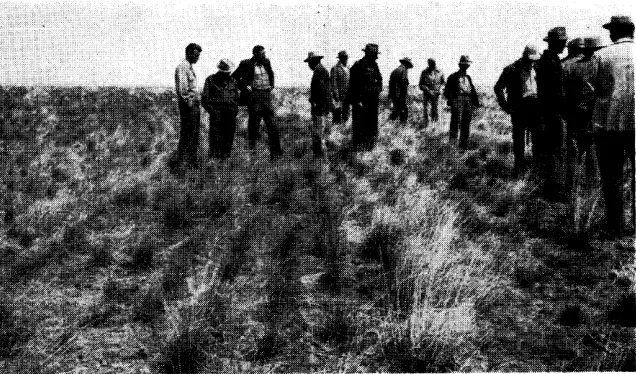
Figure 3 shows a good field
planting. New dryland grasses
have been tested alone and in mixture by grazing animals on a typical site in the semi-humid area. Field size plantings of im- proved range grasses are now being made on range sites where comparative grazing data can be obtained.
The participation of district supervisors in selecting coopera- tors and in choosing sites from
variable land conditions has
helped in making these trials ef- fective. Grasses, legumes, trees, shrubs, and other materials have been widely used in these trials in comparison with common ma- terials or practices. To date there have been 856 grass or legume trials and 280 woody plant trials in the Pullman Plant Materials Center zone. About one-third of these are still active. These trials allow new things to speak for themselves.’ Results are used in
modifying and keeping technical standards for use of plant ma- terials up to date.
When results from the field scale trials and the various coop- erative research studies are sum- marized, an excelIent cross sec-
tion of the performance under
various testing conditions is
available. This summary pro-
vides data for decisions on the possible release of new varieties.
Release of New Varieties
New varieties are released
through state experiment sta-
tions after the performance data
have been presented and an
agreement has been reached both on the value of the variety and on a designated name. Upon re- lease the plant material centers
make foundation seed available
to state experiment stations and crop improvement associations as well as to soil conservation dis-
trict seed producers. The seed
bears an official foundation seed tag and is for the purpose of reg- istered and certified seed produc- tion. This is the way improved
varieties get into commercial
production. Thereafter the plant materials center is responsible for the continued maintenance of
foundation seed. Limited seed
production is also maintained
with which to continue the field
FIGURE 3. A good field planting of Whitmar beardless wheatgrass on the Mont Johnson
farm in the Wood River Soil Conservation District of Southern Idaho. Ranchers are
RESEARCH STUDIES BY AGRICULTURAL EXPERIMENT STATION
AGRICULTURAL RESEARCH SERVICE AND OTHER AGENCIES
Strain trials Improvement through breed!ng Disease resistance & control Palatability & feeding value
Pasture & range studies Erosion control measurements Influence on soil structure
& fertility
SOURCES OF MATERIAL Collections fran native vegetation
Foreign plant introductions Strains fran plant breeders
Commercial seeds
EVALUATION
BY COMPARATIVE OBSERVATION AT PLANT FATERIALS CENTERS Germination & seedling vigor
Rate of growth 4 development Season of use for range or
pasture Resistance to disease and
insects
Response to acid or alkali soils
Resistance to cold & drought puality & quantity of vegetation Seeding habits & seed production Probably conservation uses & value
for forage
SUPPLZME~AL OBSERVATIONS IN F?EID EVALUATION STUDIES IN CONSERVATION PROBLEM
AREAS
-1
I
CULTURALTRIALS Seeding methods Rate of seeding Date of seeding Response to fertilizers Management of young stands
for establishment
CONSERVATICN USE TRIAlS Ability to grow on different DJC sites
Ground cover production Value for waterways, terrace outlets,
diversions, etc.
Amount of roots produced in plow
I
layerValue for use in soil conservation mixtures
I ’ I
FIEIl) PLANTINGS ONFARMS IN SOIL CONSERVATION DISTRICTS Comparison with common species
Evaluation on eroded sites Evaluation on waterways Evaluation in soil conserving
rotation
Evaluation under range & pasture uses
Evaluation for watershed protection Final check on culture
SEED PRODUCTIONTRIAIS Solid 8 row plantings Kind d amount of fertilizer Use of selective weed sprays When to harvest
How to harvest Processing seed When & how to irrigate
I
PRODUCTION OF SEED BY FARMERS
In District Seed Plots By Members of Crop Improvement
Associations
Procedure tor evaluating ond domesticating grasses for conservation uses at the U.SD.A.- S.CS.
plant matetio I centers
planting trial program until the
areas of adaptation, and the cul-
ture and management of the
variety are well known. The ef-
fectiveness of this combination
testing procedure developed by
the plant material centers is at-
tested by the relatively abundant
seed supply of improved range
grasses in the Pacific Northwest.
The procedure for evaluating
grasses, leading to the release of
new varieties, is summarized and
the relationship of the various
steps is shown in the chart.
Whifmar Beardless Wheafgrass -a Case History
During the years of 1934-38
more than 1,000 field collections
of beardless wheatgrass and re-
lated bluebunch wheatgrasses
were made in the Pacific North-
west states. These were planted
in observational rod rows. Seed
in quantity was collected from a
native bluebunch
wheatgrass
field near Shaniko, Oregon, and
beardless wheatgrass from Fort
George Wright Military Reser-
vation near Spokane, Washing-
ton. These two strains were used
as checks in all observational
plantings.
TESTING NEW RANGE FORAGE PLANTS 75
FIGURE 4. A registered Whitmar beardless wheatgrass seed field on the Ernest Egan farm in t’he North Side Sail1 Conservation District, Kimberly, Idaho. Good seed of an adapted strain is essential to successful range seedings. Foundation seed came from a Plant Materials Center.
grass seed were collected each
year during 1937-40. Seed varied by seasons in germinative capaci-
ty, abundance and quality. Re-
sults from field plantings in
which this seed was used were only fair. It was found that the
strains occurring in greatest
abundance and available for
large scale seed collection were not the most desirable or produc- tive strains. This accelerated the work of testing to find a superior strain.
The various ecotypes of beard- less wheatgrass were studied in the field and in observational plantings. Representative strains of each major ecotype were. se- lected for secondary testing and included in plantings at outly-
ing stations. The sites which
most nearly provided dryland
range testing conditions were at
Moro, Pendleton, and Condon,
Oregon, and at Lind and Golden- dale, Washington.
Results of tests showed that strains most productive at Pull- man were also the most produc- tive at the outlying dryland test sites.
Bluebunch wheatgrass was
found generally more robust and
vigorous than beardless wheat-
grass, but it had the disadvan- tage of awned seeds. A method of de-awning was developed as a stop-gap measure, while further testing for a suitable awnless strain continued.
The most vigorous disease re-
sistant productive strain of
beardless wheatgrass was one
found in a strip of the native Palouse prairie at Colton, Whit-
man County, Washington. On
the basis of its performance in field evaluation studies a small
seed field was established in
1938 to obtain seed for plot trials,
additional plantings, and ex-
change purposes.
A 1941 summary of data
showed this strain was more
productive, by 130 to 1000 pounds of dry matter per acre, than crested wheatgrass at all six dry- land test locations. In 1942 an eight acre seed field was estab- lished. Resulting seed was used for field planting trials on range and abandoned farm lands in soil conservation districts.
In 1947 accumulated data were
reviewed and the name “Whit-
mar” was recommended and ac-
cepted by cooperating experi-
ment stations. Foundation seed
was released to district seed pro-
ducers and through crop im-
provement, associations for reg- istered and certified seed pro-
duction. The new improved
range grass was on its way to
commercial production. Figure
4 shows a seed production field of Registered Whitmar.
The Plant Materials Center
continues to produce a small
foundation seed field from which
authentic seed stocks are ob-
tained. Some seed is also pro- duced for use in field planting trials in new areas and for man- agement studies. This will con- tinue until adequate commercial seed is available, and Whitmar has been either accepted or re- jected as a standard grass for
range seeding in areas of its
adaptation using good cultural
techniques and under good man- agement practices. Present com-
mercial production is about
20,000 pounds annually. The de- mand for seed is greater than the
supply. Whitmar does not re-
place crested wheatgrass in
range seedings. It supplements crested. Results from large range seedings indicate that Whitmar has a great future on western range lands that need reseeding. Range Grasses Cooperatively
Developed
Some of the range grasses de- veloped in the West that have been through this testing pro-
cedure now available commer-
cially for use in range reseeding are:
Native Grasses
Whifmar beardless wheafgrass
(Agropyron inerme) selected
from the native vegetation of
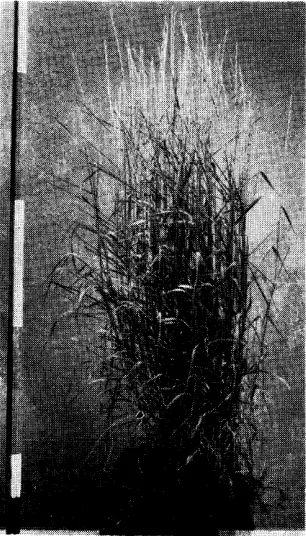
the Palouse climax prairie is a vigorous, productive, leafy, high- ly awnless type. Figure 5 is a portrait of Whitmar. It is a per-
ennial bunchgrass with good
west dryland areas of 8-15 inches
average annual precipitation.
When properly managed, it ex- ceeds crested wheatgrass in for- age and root production. It has a later season of use and is slower in becoming established.
Sodar sfreambank wheafgrass
(Agropyron riparium) is drought-resistant, alkali-toler- ant, low-growing and produces a good ground cover. “Sodar” re- fers to its rapid sod-forming ability. It is easy to establish, aggresive, spreads rapidly, sup-
presses weeds and forms a
smooth, long-lived protective
sod. In range seedings Sodar
serves as an understory cover
when used with large wheat-
grasses. When mixtures are
grazed, the percentage of Sodar may increase, since it is relative- ly low in palatability.
Sherman big bluegrass (Pea am-
pla) is a selection from a collec- tion made near Moro, Sherman County, Oregon. It is early in spring growth, early maturing,
drought escaping, tall, erect-
growing, fine stemmed. It has
blue, moderately abundant
leaves and a large compact pur- plish seedhead. It is a long-lived productive perennial bunchgrass adapted to range use .in semi- humid and dryland areas of the
Northwest. It is superior to
crested wheatgrass in earliness and amount of spring growth. In low rainfall areas of light soil it should always be fall seeded. It must be well established before grazing, otherwise it is easily up- rooted, especially on sandy soils.
Introduced Grasses
Greenar intermediate wheafgrass
(Agropyron intermedium) is a
vigorous growing, mild-sod-
forming, late-maturing, leafy,
dark green, high producing va-
riety. Plants are variable. It
FIGURE 6. Topar pubescent wheatgrass is a representative improved named grass variety resulting from selection and testing among the many foreign plant introduc-
tilons of recent years.
grows best on well drained soils in the rainfall areas of 15 to 30 inches at elevations of 1,000 to 3,500 feet. It produces well in
the Northwest, wherever dry-
land alfalfa is adapted.
, Topar pubesbent wheafgrass (Ag-
ropyron trichophorum) is a
drought-resistant; sod-forming,
late-maturing wheatgrass. Fig-
ure 6 is a portrait of Topar. It
resembles intermediate wheat-
grass but has pubescence on the leaves, stems and seed. It spreads more rapidly by rhizomes. It is better adapted than intermediate wheat to rainfall areas of 10 to 15
inches and low fertility, to
eroded and alkaline soils, and to high elevations.
Siberian wheafgrass (Agrop yron
sibiricum) is essentially an awn- less form of crested wheatgrass.
It has narrow leaves, narrow
heads and blunt glumes. It is a little lower in seedling vigor, but on dry sites and light soils or in dry years it is better adapted and
more productive than crested
wheatgrass.
Hard fescue (Festuca ovina var.
duriuscula) is similar to Idaho fescue in growth and adaptation but is much higher in seed pro- duction and easier to establish. It is a bunch-type, fine-leaved fescue with long, narrow, rolled, lax leaves. It is being used in rainfall areas of 12 to 30 inches
annually pending the develop-
ment of a superior Idaho fescue. It is a very abundant root pro- ducer.
All of the above grasses are in
commercial production. Their
total annual production is near-
ing l,OOO,OOO pounds of clean
seed. Foundation seed is avail- able for certified seed produc- tion.
Other promising range grasses in various stages of development and testing include sheep fes- cue (Festuca ovina) , a dwarf, more densely tufted, drought-re- sistant grass than hard fescue; a superior strain of bulbous blue-
grass (Poa bulbosa), which is
more productive and stays green
longer than commercial types;
Canby bluegrass (Poa canbyi)
for use in understory seedings, and several hybrid bluegrasses resulting from cooperative work
of the Carnegie Institution of
Washington.
The system of finding superior range grasses used at the Soil
Conservation Service Plant Ma-