L E X I C A L K N O W L E D G E R E P R E S E N T A T I O N IN AN I N T E L L I G E N T D I C T I O N A R Y H E L P SYSTEM
E. Agirre, X. Arregi, X. Artola, A. Diaz de Ilarraza, K. Sarasola
Informatika Fakultatca (Univ. of the Basque Country)
P. K. 649, 20080 DONOSTIA (Basque Country - Spain) E-mail: [email protected]
1 I N T R O D U C T I O N .
IDItS (Intelligent Dictionary lielp System) is conceived as a monolingual (explanatory) dictionary system for hum,'m use (Artola & Evrard, 92). The fact that it is intended for people instead of automatic processing distiuguishes it from other systems dealing with s e m a n t i c k n o w l e d g e acquisition from conventional dictiouaries, ql~e system provides various access possibilities to the data, allowing to deduce implicit knowledge from the explicit dictionary information. IDIIS deals with reasoning mechanisms analogous to those used by humans when they consult a dictionary. User level functionality of the system has been defined ,'rod is partially hnplementcd.
q'he starting point of IDIIS is a Dictionary Database (DDB) built from an ordinary French dictionary. Meaning definitions have been analysed using linguistic information from the DDB itself and interpreted to be structured ,as a Dictionary Knowledge Base (DKB). As a result of the parsing, different lexical-semantic relations between word senses are established by means of semantic rules (attached to the patterns); this rules are used for the initial construction of the DKB.
This paper describes tile knowledge rcprcsentatiou model adopted in IDIIS to represent the lexical knowledge acquired from the source dictionary. Once the acquisition process has been performed and the I)KB built, some enrichment processes have becn executed on the I)KB in order to enhance its knowledge about the words in the language. Besides, the dynamic exploitatiou of this knowledge is made possible by means of specially conceived deduction mechanisms. Both the enrichment processes and the dynamic deduction mechanisms are based on the exploitation of the properties of the lexical semantic relations represented in the DKB.
In the following section an overview of II)IIS is given. Section 3 briefly presents the process of c o n s t r u c t i o n of the DKB. The k n o w l e d g e representation model and the enrichmeut mechanisms are fully described in sections 4 and 5. Section 6 describes some inferential aspects of the system. Finally, in section 7, some figures about the size of tile prototype built are presented.
2 TIIE IDIIS DICTIONARY SYSTEM.
IDIIS is a dictionary help system iuteuded to assist a human user in hulguage comprehension or production tasks. The system provides a set of functions that have
been inspired by the different reasoning processes a human user performs when consulting a conventional dictionary, such as definition queries, search of alternative definitions, differences, relations and analogies between concepts, thesaurus-like word search, verification of concept properties and interconceptual relationships, etc. (Arregi et at., 91).
II)IIS can bc seen as a repository of dictionary knowledge apt to be accessed and exploited in several ways. The system has been implemented on a symbolic architecture machiue using KEE knowledge engineering environment.
Two plmscs are distinguished in the construction of tile DKB. Firstly, information containcd in the DDB is used to produce an initi,-d DKB. General information about the cntries obtained from the DDB (POS, usage, examples, etc.) is conventionally represented --attribute-value pairs in thc frame structure-- while the semantic component of the dictionary, i.e. the definition scntenees, has been analysed and represented as an interrelated set of concepts. In this stage the relations established between concepts could still be, in some cases, of lexical-syntactic nature. In a sccond phase, the semantic knowledge acquisition process is complcted using for that the relations established in the initial DKB. The purpose of this phase is to perform lcxical and syntactical disambiguation, showing that semantic knowledge about hierarchical relations between concepts c,'ul be determinant for this.
3 BUILDING TIlE DICTIONARY KNOWLEDGE BASE.
'File starting point of this system is a small monoliugual French dictionary (Le Plus Petit Larousse, Paris: Librairie Larousse, 1980) consisting of nearly 23,000 senses related to almost 16,000 entries. The dictionary was recorded in a relational database: the Dictionary Database (DDB). This DDB is the basis of every empirical study that has been developed in order to design the final model proposed for representation and intelligent exploitation of the dictionary.
The definition sentences have been analysed in the process of transformation of tbe data contained in the DDB to produce the DKB. The analysis mechanism used is based on hierarchies of phrasal patterns (Alshawi, 89). The semantic structure associated to each analysis pattern is expressed by means of a Semantic Structure Construction Rule (SSCR). The
prncess oF construction of the I)KB is automatic and based on these SSCR's (Artola, 93).
The intcrconcelmml lexical-semantic relations delcclcd li'om Ihe analysis of the source dictionary are classified into paradigmatic and synlagmatic...Mnong the paradigmatic rclalions, the followiug have bccn found: sylu)uy~ny au(l antonymy, laxonomic relalions as hyperuymy/hyponymy --obtained from definitions of type "gcnt,s et differenlia"--, aud taxonymy itself (expressed by nlcaus of specific relators such as sorte de aad espbce de), mcronymy, and others as gradation (for adjectives and verbs), equiwdcnce (between adjectives and past pmticiplc), factitive and rcllexivc (for verbs), lack and reference (to the previous sense). Whereas among the synlagmalic relations, i.e. those thai relate concepls belonging to different POS's, derivation is the most important, I)ut also relationships bctweell concepts without auy morphological relation its case relations, attributivc (for verbs), lack and couforlllily have Ix3eil dclccle(l,
The hierarchies created have already been used to parse all Ihe noun, verb, and adjective definitions in the ])l)B. The hierarchy devoted to aualyze noun tit',f tuitions is formed with 65 l)attcrns, 49 differcut patlerns have been dcfiued lo analyze verb delinilion,% aud 45 for a([jectives. Although it is a partial parsing procedure, 57.76% of noun dcfinitious, 79.8% o1 verbs and 69.04% of those corresponding to a(!jeclivcs have been Iotally "caught" it, Ihis al)plication, l lowcver, wilh this technique of partial parsing, the parse is considered successful when all initial phrase slructure is recognized, which iu general contains Ihe gCllUS or Sul)erordinatc oF Ihe delincd sense. This is not so lbr I h c c a s e o F l c x i o o g r a p h i c m e l a - l a n g t l a g e c o n s l r u c t i o l ! s (specific relators), whose corresponding semantic structure is built in a specific way and which deserve also spccilic patterns in the hierarchk:s.
4 Ili,~PRI,;SI,;NTATI[ON O F T I l E I ) I C T I O N A R Y KN(IWLI,;I)(;E: T I l E I)KB.
As we have just seen, the knowledge reprcscntadou scheme chosen for the I)KB of IDIIS is composcd of three clemenls, each of thetn structured as a dilTerent knowledge base:
KI3-TIII~SAURUS is the reprcsentatio,l e l the diclionary as a semautic network of frames, where each li'alne rcprcsenls a Olle-word collcepl (word seuse) or a phrasal concept. Phrasal concepts rcpresent phrase structures associated to the occurrence of concepts in meaning definilions. Frames ... or trails--- are interrelated by slots rcpreseutiug lexical-semanlic rclati(ms such as synonymy, taxonomic relations (hypcrnymy, hyponymy, and taxonymy ilselD, mertmymic relations (parl-of, cl('menl-of, sctoof, member-oD, specific rclalions rcali:;cd by nleallS of lllela-. linguistic relators, casuals, elc. Olhcr :;lois col|laiu phrasal, inetadinguislic, and general itfformali(m. K B - I ) I C T I O N A R Y allows access from the diclionm-y word level lo the conesponding concept level in Ihc DKBo Ihfils in Ihis kuowledge 1)ase rcp,'esem Ihe elltries (words) of flu: dictionmy and
are directly linked to their corresponding senses in KB-TI IESAURUS.
* K B - S T R U C T U R E S contains recta-knowledge about concepts and relalions in KB-DICTIONARY aud KB-'IIIESAURUS: all the different structures in tim DKB arc defined here specifying the corresponding slots aud describing the slots by means of facets Ihat specify their value ranges, inherilaucc modes, etc. Units in KB-TIIESAURUS aud KB-I)ICTIONARY m'e subclasses or instances of classes defined in KB-STRUCI'URES.
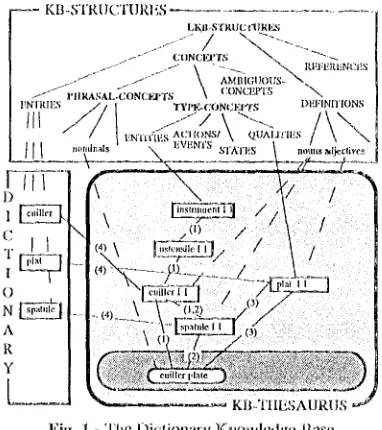
Fig. 1 gives a parlial view of tim three knowlcdge bases which form the DKB with their correspondent units and Ihcir inter/inlra relationships.
In tim K B - T I I E S A U R U S , some of the links representing lexicat-semmltic relations are created when buildiug Ihe initial version of the knowledge base, while others are deduced later by means of specially conceived deduction mechauisms.
When a dictionary entry like spatule I I: aerie de cuiller plate (a kind of flat Sl)Oon) is treated, new concept unils arc created in KB-TIII';SAURUS (aud subsidiarily iu KB-DICTIONAR.Y) and linked to olhers previously included in il. l)uc to the ellct:l of these links new wflucs lot some l)roperlies arc propagaled flmmgh the resulliug taxonomy.
~ - - K B ' S ' f R U C T U R I ~ ' S LKII .STRUC ( I I R E-~4 . . . . i
. ~ - ... C tIN C,,21"ft/ ~ . x ~ ... N [ .... ---" f J " \ " - ~ -.\Ra:e~u~scJ~.s I
z " ~ . \ AMB GIJOUS- !
I!NIIRIILS . ' / / I TYlq~: UONCEIZFS DF.FINFI'IONS ]
Fig. 1.- The l)ictionary Kliowlcdge Base.
' ~ SUB(2I,ASS link - - - MI:.MP, I';R-OF liuk (instance)
(1) Taxollomic Relalion: IIYPERNYM/t|YI'ONYM
(2) Specili¢ (melaqlngulsllc) relaiknl: SORTP;.DE/SO|rfI';-DF, INV (K[ND-OlqKINI)-OF+INV)
(3) CARACfERISTIQUI~,/CARA(YEERISTI(2UI{#INV (PROI)I/RTY/PROPI;.RTY+IN V) relafiou
(4) MOTS-FNTRIiE/SENS (I'2NTRY--WORD/WORD.SENSE) rclatiolx
[image:2.612.315.506.334.549.2]are uoun definitions and considered subclasses of ENTITII'~S while plat I 1 (an adjective) is a sulx:lass of QUALITIF.S. The phrasal concept unit representing the noun phrase cuiller plate is treated as a l,yponym of its nuclcar conccpt (cuil&r 1 1).
4.1 KII-STi{UCTURES: the recta-knowledge. This k n o w l e d g e base reflects the hierarchical orgauisation of tile knowledge included in the I)KB.
We will focus on the LKB-STRUCTURES class w h i c h d e f i n e s the data types used in KB- D I C T I O N A R Y and K B - T I I E S A U R U S , and that organises the units belonging to these knowledge bases inlo a taxonomy.
Slots d e f i n e d in K B - S T R U C T U R I ' ; S h a v e associatcd aspects such as the value class, the inheritance role detcrmiuing how values in children's slots me calcttlated, and so ou. Each lcxical-scmantic relation --xeprcs(-ntcd by an attribute or s l o t - - has its own inheritance role. For instance, the inheritance role of the CARACTI~.RISTIQIJL: relation slates that every concept inherits the union of the valucs of the hypenlyms lot tltat relation, whilc the role dclincd fi)r Ihc SYNONYMES relation inhibits value inheritance from a concept to ils hylxmyms.
The subclasses defined under LKB-STI(UCTURFS are the following:
o ENTRII~,S, that groups dictionary entries belonging to KB-DIC~I'IONARY;
I)ElqNITIONS, that groups word senses classified according to their l O S ;
o REFI~;RI~:;NCI~;S, c o n c e p t s c r e a t e d in KB- TI IESAURUS due to their occuncnce in definitions of other concepts ("definitionlcss");
• CONCEVFS, that groups, under a conceptual point of view, word senses aud other conceptual utfits of KB-TIIESAURUS.
The classification of conceptual units under this last class is as follows:
• T Y P E - C O N C E P T S c o r r e s p o n d to Quillian's (1968) "type nodes"; this class is, in fact, like a supcrclass under which every concept of KB- TIII2SAURUS is placed. It is fi~rthcr subdivided in the classes ENTITII'?.S, ACTIONS/F.VF.NTS, Q[JALITIES and STAq'ES, that classify different types of concepts.
• P I I R A S A L - C O N C E P T S is a class that includes c o n c e p t s s i m i l a r to Q u i l l i a u ' s " t o k e n s " .--occurrences of type concepts in the delinitio,i scnlcnccs--. Phrasal concepts ,'u'e the representation of phrase stn~ctures which are composed by several concepts with semantic content. A phrasal couccpt is always built as a subclass of the class which ,cpresents its head (the nouu of a noun phrase, the verb of a verb phrase, and so on), and integrated in the conceptual taxonomy. Phrasal concepts are c l a s s i f i e d i n t o N O M I N A L S , V E R B A L S , A1)JFL;TIVALS, ~md AI)VERBIALS.
For iustance,' Iplaute I 1#31 is a phrasal concept (see Fig. 2), subclass of the type concept Iplaute I 11, and represents the noun phrase "une plante d'ornement". • Finally, the concepts that, after the analysis phase, are not yet completely disambiguated (lexical a m b i g n i t y ) , are p l a c e d u n d e r the c l a s s A M B I G U O U S - C O N C E I r F S , w h i c h is further subdivided into the subclasses I I O M O G R A P I I E (e.g. Ifacult6 ? ?1), S E N S E ( I p a n s e r I ?1), and COMPLEX (Idouner I 5/61), in order to distinguish them according to the level of ambiguity they present.
The links between units iu KB-TIII]SAURUS and KB-DICTIONARY are implemented by means of slots tagged with the n,'une of the link they represent. These slots are defined in the different classes of KB- STI~.UC~I'URI:S.
The representation model used in the system is made up of two levels:
• Definitory level, where the surface representation of the d e f i n i t i o n of e a c h s e n s e is m a d e . Morphosyntactic features like verb mode, dine, determination, etc. arc represented by means of faeets attached to the attributes. The defiuitory level is implemented using representational attributes. Examples of this kiud of attributes are: DEF- SORTI:D, 1) t'." F-QUI, CARACTERISTIQUE a n d AVEC.
o Relational level, that rellccts the relational view of the lexicon. It supports the deductive behaviour of the system and is made up by means of relational attributes, that may eventu,'dly contain deduced knowledge. These attributes, defined in the class TYPE-CONCEPTS, are the implementation of the iuterconceptual relations: ANTONYMES, AGENT, CARACTI~.RISTIQUE, SORTI:.-I)E, CE-QUI, etc.
4.2 KB-I)ICT1ONARY: from words to COliCepl,',;. This knowledge base represents the links between each dictionary entry and its senses (see link 4 in Fig. 1).
4.3 K B - T I I E S A U R U S : the c o n c e p t n e t w o r k . KB-TIIESAUI~,US stores the concept network that is implemented as a network of frames. Each node ill the net is a fnune that rcpresent.s a conceptual unit: one- word concepts and phrasal concepts.
The ~ c s interconnect |lie concepts and represent lexical-semantic relations; they are implemented by means of frame slots containing pointers to other concepts. I Iypcruym and hyponym relations have been made explicit, making up a concept taxotlonty. These taxonomic relations have bccn implemented using the environment hierarchical relationship, in order to get inheritance automatically.
Let us show an example. The representatiou of the followiug dclinition
gdranium I 1: une plante d'ornement
rcqltires the el'cation o f two new conccplual units in TIII';SAURUS: Illo OIkO which coircspotlds to Ihc dcfiuicndum and Ihc phrasal COlkCCpt which rcpresculs Ihc nOkltk phrase o f t i m dclinition. Morcovcr, the IInils which rcprcsen!
plante
and o r n e m e n t are lo be created also (if they have not been previously crcatcd because their occuklence ill another definiiiou).l , c t us suppose that three n e w trails arc created: Igdranium I 11, Iplamc 1 11131 mid lonmnmnt 1 11.
Altdbutes ilk tile units m a y contain laccts (attribules for the allribtllcs) used in the dcfinitory level to record aspects like dctcrmination, genre and so on, but also to establish the relations b c l w c c n delinitory allrihules with their corresponding rclalitmal, el to specify the certainly that the value in a rcprcscntational athibutc has to be "promoted" It) a con csponding rclational (scc hclow like case o f like slol I)F, in Iplanlc I 11131).
Following is given Ihe COmlX)sition of tim liamcs of d m s c t h r e e u n i l s at Ihc d c f i n i l o r y l e v e l o f rcprcsentatkm (slots a v e in small capitals whereas lacct idcn|ificrs are ill italics):
Igfranium I 11 MEMBIr.R.OF: NOMS ( ;I)OUI'F,-(TNfEGOR II*~L: NOM
CIASSI?-AITRIII[H': INI"O-(il';NERAId'~ TI:XTF,-I)I':FIN1TION: "llII,J t~hmtc d'orncmcnt"
CIASSI'LA'I'IRIIIU1;" INFO (;I,~VERALI:
I)I;.F-CI,ASSIQUF,: Iplantc I 1#31
C'IA.%'EA1TRIBUI': DEFINITOIRI'S DI;fFRMINAIION: UN
t;k'NRE: F
I~EIA'ITONN1"IS-CORRI(SI'ONDANI"S: DI';FINIq'AR
Iplante i 1#31
b;IJBCI,ASS.OF: Iplantc l 11 MISMIII{IGOF: NOMINAI,ES TI(XTI;,: "[:.]alltl3 d'Olllclnell1"
CIASSI'~ ATI'RlflUT: INI"O-(;I,?NliRALI i
I)P2 Iornement I I t
CIASSF~-ATfRIItIH? SYNI)I(13b'(FIQUI:;'~"
RI'3A11ONNEL%CORRESPONDANI'S: Oh'It;INK. POSSI!'S,Yl;,UR, ,MAIIERI';. OIUliCflF
011.11,~c7"11,': 0,9
lovnemenl I 11
MI"MIW, R.OF: RI".FliRI!NCFS
Before showing Ihe representation of these units at the rclalional level, it has It) be said that after the inilkd I)KB has been built s o m e deductive procedures have been cxccutcd: e.g. dcduclion o f inverse relationships, taxonomy formation, etc. It is to say that in l;ig. 2, where the rehktional view is presented, Ihc relations deduced by Ihesc procedures arc also rcprcscntcd.
The coaccptual units in TIIF, SAUI(US am placcd ilk tWO layeks (see Fig. 2), rccallillg tile two plalles o f
Quillian. The upper layer coffesponds to tylv concepts w h e r e a s ill the l o w e r phrasal concepts are placed. Every phrasal c o n c e p t i,,; phlccd in | h e t a x o n o m y directly d e p e n d i n g from its nuclear concept, as a hyl~mym of it.
It is inlcrcsling {o nolicc it) tile ligurc the relation o f
c o n c e p t u a l e q u i v a l e n c e e s t a b l i s h e d b e t w e e n Ig6ranium I 11 and Iplanlc 1 11131 (link labelled (3)). T h e s e units represent, in fact, Ihc s a m e c o n c e p t b e c a u s e I p l a n t c l 11131, s t a n d i n g IOf "title p l a n t e d ' o r n e m e n t " , is lhc dclinition of Ig&anium I 11.
f -
(1) 'l'axolm role r¢lado.:
Fig. 2. Relational view of Ihc concept Iv6rauium 1 11 (in the TIIILSAURUS net).
The lianlc o f Ig6ranium 1 II at the relational level of representation lakes the hkllowing aspect, once the relational atlxibules have been (partially) COmlfletcd:
Ig6ra,dum 1 11
SUn(:I,ASS.Ot;: F,N'I1TF, S, Iplante I 11 MEMBER.OF: NOMS
(;Rokaq~ 4 ~ATI:GORII'~I,: NOM
CIASSI'.ATI'RIIIUT" INI,'O-UI:WEI~I3: 'I'I~X'I'I'~ I)I'~],INIII()N: "Ulle plante d'ornelnent"
CIASSF.-AYTRIBUI~ INFO-GENERAIJg
DEF-CI.ASSIQUE: fl,lante I l#31
CIA&TE-ATTRIBIH9 ItI(I'TNIJ'OIRI"~" DKITqI?MINA'I7ON: UN
GENRt';: I"
II EIA TIONNI'~I.% CORRIL~I'ONDANI;~: DI?FINI-I~A R
DEHNIopAR: Iphmte I 1#31
CIASSF.oA'ITRIB(/I:" RI';IAITONNEIS" INVEI¢SkL%CORRI(SI'ONDANIS: DI'Lt;INI'lION-DE
t)BJI;.CIIF: Iornement III
C'IAGYE-AITRIBI/I': RI'~IATIONNI'~LY INVFRSI~%UORRFSI'ONDANTS: 0IUECTIF41NV
Let us show n o w another exmnlfl¢. It is the case o f two definitions stated by m e a n s o f two difR:rekkt stcrcotylmd lbmullac belonging to lhe lexicographic mcta-hmguage. Mauy verbs in the LPPI, are dclined by means o f a formula b e g i n n i n g with " r e n d r e " and m a n y notms with o n e b e g i n n i n g with " q u i " . T h e dcliailions selected for this e x a m p l e correspond to the Chilies p u b l i e r I 1 aml a j u s t e u r I 1, w h i c h are represcuted a l II,c definilory level using the mela-. l a n g u a g e attributes I) EILIH;,NDRI{ and 1) E F-QUI rcswctively:
p u b l i e r 1 1: r e m l r e p u b l i c
a j u s t e u r I 1 : q u i a j u s t e d e s p i ~ c e s d e radial
T h e tranm c o n ' c s p o n d i n g to Ipublier I 11 is rite followin g:
Ipubller 1 11
MFMBFR.OF: VERBI~,S ( i I,~ OUPI{-C ATI'X; O1Ul';[ ,: VI;,RIt F,
CIASSI¢-AITRIBU'f : INI.'O-GF.NERAIZ
TI';XTF, q)EIqNITR)N: "ren(h'e public"
CIASSI';-AITIClBUI'; INI"O-GbXVERAI d*;
DEF-I)I'~NI)RFZ Ilmblic I II
CIASSI'LAITRIBUf : DEI,'INII"OIR 'I~'; REIA ITONNI(IS - CORRIL~I'ONDANI"S: RlhVDRE
[image:4.612.316.500.73.217.2]Ipublic I 11. Ilowevcr, in the case of the definition of
ajusteur 1 1,
two phrasal concepts are created: timattribute DEF-QUI points to the phrasal concept lajuster I 1 # 1 I, representing
"ajuster des pi?:ces de mdtal",
and this phrasal concept, in turn, has a syntagmatic attribute (OBJE'I) pointing to a nominal Ihat represents"piece de mdtal",
l~et us show the frames involved in this last case:laJustettr [ I I M EMIn.iR.OF: NOMS G ROUPE-CATI~AJORIEL: N O M
CIASSE-AITRIBUT: INFO-GENERALE
TEXTE-DEIqNITION: " q u i ajuste d e s pib.ces de radial" CIASSF-ATI'RIBfZY: INFO-GFAVERALE
DEF-QUI: hjuster I l# II CIASSF-A?TRIBIZf : DEFINITOIRF~ MODE: 11'41)
ASI'FCI': NI' TFAtPS: I'RI'~" I'ERSONNE: 3
RHATIONNEIS'-CORRI-~'PONDAP[£S: QUI In l u s t e r I i f l l
SUBCLASS.OF: [njustcr 1 II MEMBF.R.OF: V I " . R B A L E S TEXTE; " a j u s t e r des p i s c e s d e radial"
CIASSI:~A 1TRIB 07:. tNI,'O- G ~ E R A IJS OUJE-r: IpR~,ce I 1#21
CIASSE~A~[TRIBU£: SYNFAGMATIQUI'~7 DIQ'ERMINATION: UN
NOMBRE: PI.
RELAllONNEL~'.CORRI:SI'ONDANT& TIIEME
Ilri~ce 1 1#21
SUBCLASS.OF: Ipi~ce I II MEMItER.OF: NOMINALES TEXTE: "piece tic mdtal"
CIASSE-ATI'RIBUI~: INFO-GI'hVERAI E DE: Imdtal I It
CIASS'E-A11'RIBIfK: SYNI"AGMA'ITQUI,L7
REI ATIONNEL,';;oCORRESPONDANFS: ORIGINE, POS,e, lfSSE(IR, MATIERE, OBJI'JCTIF
MATIFRE: 0.9
Frequently, phrased concel)tS represent "mllabcllcd" concepts, i.e., they iudeed represent concepts that do not have a significant in the language. For instance, there is not, at least in French, a verbal concept meaning
'ajuster des pi~ces de radial'
nor a nouu meaning'piece de radial'.
I Iowevcr, tiffs is not the c~L~,c of tim phrasal concepts that are linked to type concepts by means of the relation I)EFINI-PAI~,/DEFINrrlON-I)F., because there, the phrasal concept is, in fact, another rcprcsemation of Ihc concept bcing defincd (see above tim example of the definition ofgdranium
I i). In the representation model proposcd in this work, phrasal concepts denote concepts that are typically cxpressed in a periphrastic way and that do not have necessmily any corresponding entry in the dictionary 1.Another intcrcsting lmint related to the creation of thesc phrasal couccpts is the maintenance of direct links bclwc£,u a concept and ~dl tile occnrrences of tiffs concept in the definition sentences of other eonccpts. It
1 "nits coohl bc very interesting also, in tile opinion of tile authors, in a multilingual environment: it is l~ssible that, in auother language, tire concept equivalent to that which has beer~ represented by tire phra.~al concept Ipit~ce I 1#21 Ira.,; ils own sigltificant, a word that denotes it, In this case, the phrasal concept based representation may be useful to represent the exluivalence between both concepts.
gives, in fact, a virtual set of usage examples that may be useful for different functions of the final system.
5 E N R I C I l M E N T P R O C F S S E S P E R F O R M E D ON T H E DKB.
In this section tim cnrichment processes accomplished on the D K B are explained. T w o phases are dislinguished: (a) the enrichment obtained during the construction o f the initial D K B , and (b), where different tasks concerning mainly tim exploitation of the properties of synonymy and taxonymy have been performed.
5.1 Enrichment obtained during the construction of the initial I)KB.
K B - T I I E S A U R U S itself, r e p r e s e n t e d - - a s a network--- at the relational level, can be considered an enrichment of the definitory level becanse, while the DKB was built, tim following processes have been performed:
. Values coming from file definiiory k;vel have been promotcd to the relational level.
• Values coming from the nnit which represents the t i e f i n i e n s havt: b e e n t r a n s f e r r e d to the corresponding definiendum unit.
The maintcnancc of the relations in both directions has been antomalically guamntccd.
• "Ille concepts included in REFERENCES have becn directly related to other concepts.
The taxonomy of coneepls has bccn made explicit, thus obtaining wduc iuhcritanee.
5.2 Second phase in tile e n r i c h m e n t of the DKB, Several processes have tmeu carried out in order to infer new facts to be asserted in tile DKB 2. "lhe enrichment obtained in this phase concerns tim two follt)wing aspects:
o Exploitation of the properties of the synonylny (symmetric and transitive).
* Enlargement of the concept taxonomy based on synonymy.
Another aspect that has been considered to be exploitexl in this phase is that of disambiguation, q h e use of the l e x i c a l - s e n t a n t i c k n o w l e d g e a b o u t hierarchical relations contained in the DKB can be detcnninant in order to reduce tim level of lexical and syntactical ambiguity 3. l l e u r i s t i c s based on the t a x o n o m i c and s y n o n y m i c k n o w l e d g e o b t a i n e d previously have been considered in tiffs phase. Some of them have been designed, i m p l e m e n t e d and cwlluatcd in a sample of the DKB.
2 By tnear~s of rules fired following a forward chaining strategy. 3 Lexical ambiguity comes from tile definitions themselves; syntactical ambiguity is due lroinly to the anadysis process,
6 I N F E R E N T I A l , A S P E C T S : D Y N A M I C D E D U C T I O N O F K N O W L E I ) G E .
I)ynalnie acquisition of knowlcdgc deals with the knowledge not explicitly represented ill the 1)KB aqd c a p t u r e d by m e a n s o f e s p e c i a l l y c o n c e i v e d mechanisms which ,arc aelivaled when thc system is to answer a question posed by the user (Arregi et al., 91). Thc lollowing ,aspect,,; ,'u'e considered:
• Inheritance (concept taxouomy). Composition o1 lexic~d relations.
Links bctweeu concepts and relations: users are allowed to use actual c o n c e p t s to d e n o t e relationships (and not only primitive rclatious). . Anlbiguity ill file DKB: trealnlent of reraaining
imccrlainty.
In the following, some aspects couccnliug to Ihe secoud point will be discusscd.
lu IDIIS, Ihe relationships atnoug the diffcrenl lcxical-semautic relations can be easily expressed in a declarative way. It is tile way of expressing these ,elationships that is cMled Ihc composition of lexical relations. From an operative poiat of view, this mechanism permits the dyuamic exploitation - - u n d e r Ihc user's requests--- n f Ihe tnopcrties of Ihe lexical relations in a direct maturer. It is, in fact, a way of acquiring iml)licit knowledge Ii'om II,c DKB.
The declarative aspect of the mcchanism is based on the definilion of triples: each llil)le expresses a relationship among difli'.reut lcxical-scmanlic relations. These Iriples have thr, form (R l R 2 R3), where R i represcnls a lexical rehdiou 4. The opel alive eflgct of these d e c l a r a t i o n s is Ihe dynalnic crealiou of Irausitivity rules based on the triples stated. The l, cueral fornl of these rules is file lbllowing:
i f X R l Y a n d Y I ( 2 Z t h e n X R 3 Z
Whea the value(s) of the attribute R3 are asked, a reading demon (attached to the attribute) creates the rule aqd tires the reasoning l)rocess with a backward- chaitling strategy. The deduced lhcts, if ;lily, will not be asserted in lint: I)KB, but in a telnpora[y context.
l"or instance, tile prol)lenl of Irausitivily in mcronymic relations (Cruse, 86; Winston et al., 87) can be easily expressed by slating the triple (PARTll';~ I)F, PARTIE-I)F PARTIE-I)[!) but not slating, fur itlslat~ce, (I'AR'IIE-I)I'; MI~MBRIM)P; PARTII;iq)I';), lhlls cxprcssiug that the Irmlsilivity in tile secolld case is not true. Examples of uther triples that have been staled in tilt; s y s l e n l a r e :
• ( ] t ) l l l b i l l a t i o l l ()1" l / l e r o n y n l i c a u d l n ) l l - l u c r o l l y l l l i c relalioas:
(PARTIF,-|)I'; L(X2ATII; I..OCATII ;) (I.OCATIF IIYPEI(ONYME IX~K;ATIF) (MEMBRE-I)E I1YPEF, ONYMI'2 MEMBI~d';-I)I';)
4 The rcsull of tim hau,silivity iule that will Ire cJe~tcd witi bc the dcductimt el values lilt tile. R 3 attlibute.. "llle Iriple.'; arc t,lored ill a facet of It 3.
• C o m b i n a t i o l l o f relations derived front the delinilion metaolanguage:
(CARA(TI'I';RISTIQUE QItI-A I'OSSESSION) (OBJEC'I IF CE-QUI OBJECTIF)
Explicit rules of lexical composition cau Ix~ ilsc(l when the general form of the triplcs is not valid. These rules are uscxl following the same re`asoning strategy.
Following is givcn the rule dcrived tYom the last Iriple and one insl;mee of it. By means of this rule instance, the lact that tile purpose of a gdranium is the action of orner is deduced from the delinitions of gdranium and orttemettt:
if X OBJFCrIF Y and ;;; the objective of X is Y (entity) Y CE-QUI Z ;,;; Y "est ce qui" Z (action) then X ouJt.:c-rll~Z ;;; the objective of X is Z (action) If Ig&anium 1 II oBnKYI'|F Iornement I II and
Ionlcment III CF.-QUI Iorner III then Igdraniunl I II OltJF.Orll z Iorner III
7 T I l E I ' R O T O T Y P E O F IDIIS: S I Z E O F T I I E I)KIL
Following some ligures are given in order to show the size of tim prototype obtained alter the initial conshuction of the DKB. This l)rotntype contains au imporlant subset of the source dictionm y.
KIM)ICrIONNAIRI~ contains 2400 entries, each one r c p r c s e n t i u g one word. K B - T I I E S A U R U S comains 6130 conceptual units; 1738 units of these arc phrasal concepts, in this Kilt there arc 1255 mnbig~lous conccpls. Once the initial c o a s t m c t i o n phase was finished, 19691 relatioual arcs - - i n t e r c o u c e p t u a l rclalionships--- had been established.
After Ihe enrichment llroccsses, the m n n b c r of relational links have been incremented up to 2180{) (10.7%). it has been estimated that, using the m e c h a n i s m of lexical composition, the n u m b e r intcrconceptual relations could reach an incremcnt of betwccn 5 and 10% 5.
8 CONCLIISIONSo
A frame-based kuowlcdge representation model has been described° This model has been m;ed in an Intelligent Dictionary llelll System to represent the lexical knowledge acquired automatically I'ronl a conventional dielionm-y.
The characterisadon of the different iuterconcepm~d lcxical-semantic relations is tile basis lot the prolx~stxl model and it has becu established as a result of tim analysis process c,'micd out on dictionary delinitkms.
SewaM emichmcnt pmta~sscs have bccn pcrlbnned on the DKB ~--after tile initiM consh'uction--- in order to add new l~lct,'; to it; these processes are bascxl on the exploitatiou of the properties of lexical--scmanfic relalious. Moreover, a mechanism li)r acquiring ~--4n a @ n a m i c w a y - - knowlcdgc not explicitly reprc~etttcd
in lit(: DKB is proposed. 'lhis mechanism is based on the composi[ion t)l lcxicai relations.
I~ I~;ICEREN ( ~,ES,
AlshawL Iio (1989). Al~alysi~g dictionary deihfitions m B. Boguraev, T. Briscoe eds., pp. 153-.169~ Computational l,e×icography for Natnral Language Processing. New Yolk: I ,ongman.
Amsler, R.Ao (1981)o A. Ta×onomy fur English Nouns and Verbs, Plot. 19th Annual Meeting A(_Z, pp. 133-
1:38.
Arango Gaviria, G. (15)83). Une approche pour amomer le pwcessus & comprdhensiota el d'utilisa*iot, du sens des mo~s en langage nagurel. These tie 3~me cycle (P~nis VI). Pnblica/ious du G t o u ~ tic Rcz:hcr(:hc ( liat~de Fr~m~ois Pic~ud.
Arrcgi X°, X. A~tola, A. Diaz tie lkura~a, F. Evrard, Ko Sarasola (1991). Apmximaci6n funcitmal a I)IAC: l)iccionark) inteligen(~: de ayuda a la cemprcnsi6tL
Pro< SEPLN, 11, pp. 127=138o
A~:tola X., I v. Evrard. (1992)o l)ictiommire intelligen! d'aide h la compr6hension, Aclas I1/ Congreso Int.
EURALEX'90 (Benalm,/tdena), pp~ 45-57. Barcekma:
B iblograph°
Artola Xo (1993)o "ilIZTSUA: lIiztegi-sistema urDrt.lc a(lime~dunaren sorkuntza eta eraikuntza /Conccption d'un syst~,me intelligent d'aide dictionnarialc (SIAl))" Ph.D. Thesis. UPV-I?,tlU.
Boguraev B., T. Briscoe eds. (1989). Conqmtational
Lexicography for Natural Language Processing. New
Yolk: 1 .ongman.
Byrd R.J., N. Calzolari, M.S. Chodomw, .I.L. Klavmls, M.S. Nell, O,A. Rizk (1987). Tools and Mclhods for Computational l.exicography, Computational Linguistics 13, 3-4, pp. 219-240.
Calzolmi, N. (1984). Machine-readable diction~u'ics, lexical data bases and the lcxical system, Prec.
COLING (SUmdford Univ.), p. 460.
Calzolari N., E. Picchi (1988). Acquisition of semantic inlbnnation liom an on-line dictionary, Prec. COLING
(Budapest), pp. 87-92.
Chtxlorow M.S., R.J. Byrd (1985). Exuacting semantic hierarchies from a large on-line dictionary, Prec. A CL,
pp. 299-304.
Chouraqui E., E. Godbert (1989), Rcprdsen|alion ties descriptions ddfitlies dans un r6scau s6mantique, Actes 7&he Congr~s Reconnaissance des Formes et
Intelligence Artificielle (AFCET-INRIA, Paris), pp.
855-868.
Copestake, A. (1990). An approach to building tile hierarclfical element of a lexical knowledge base from
a machine-readable dictionm'y, paper read at First Int.
Workshop on Inheritance in NLP (Tilburg).
Crnse D.A. (1986). Lexical Semantics. Cambridge: Cmnbridge University Press.
wm den llurk I., W. Meijs. The dictionary as a coqms: analyzing i.DOCE's definition-language, Corpus Linguistics II, pp. 9%125.
l.itkowsky K.C. (1978)o Models of.tim semantic structure of dictionarics,"American Journal o[
Computational Linguistics, ME 81, ppo 25-74.
Ma~kowi~z J.0 T° Ahlswcdc, M. Evens (1986)o Scman|ieaHy significant pat~cn~a m dictionary delinitious, Proco 24th Annual Meeting ACL (New York), pp. 112d 19°
Pazienza M.T., 1'. Velardi (1987)o A structured representation u[ word.senses for semantic analysis,
l)rec, grd Europe.an Cotgerence A CI, (Copenhagt~en),
pp. 2/t9-.257.
Quillian M.R, (1968). Semanlie Memory in M. Minsky ed., pp. 227-270, Semam'ic Information Processing.
Cmxlbrklge 0Vlas&): MIT Press°
Tsurumam ll°, T° llitaka, S. Yoshida (1986). An attempt to au/omatic thesatm~s conslraelion froln an ordinary japanese language dicthmary, Prec. COLING
(Bonn), pp. 445+447+
Vossen P., W. Meijs, M. den Breeder (1989)+ Mcanin)+ m~d structure in dicliona~y deiinltions in B. Boguracv, T. Briscoc eds., pp. 171.-192, C o m p u t a t i o n a l
Lexicography.lbr Natural Language Processing° New
York: l.,ongmm~.
Wilks Y., 1). Fass, G. (ihcng.-Ming, J°E. Mcl)onald, T° Plate, B.Mo Slator (1990). Providing Machine Tractable l)ictionary Tools, Machine 2)anslalion, no.
5, pp. 99.I54o
Wioston M.E°, R. Chaffin, D. Ilemmnm (198'1). A Taxonomy of Pmt-Whoh~ Relations, Cognitive Science, no. 12, pp. 417o444,