A LINEAR LEAST S Q U A R E S FIT M A P P I N G M E T H O D F O R I N F O R M A T I O N RETRIEVAL F R O M N A T U R A L L A N G U A G E T E X T S
YIMING Y A N G C H R I S T O P H E R G. C H U T E Section of Medical Information Resources
Mayo Clinic/Foundation Rochester, Minnesota 55905 USA
A B S T R A C T
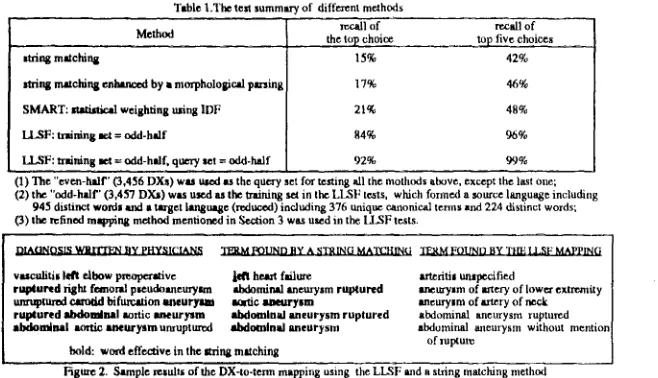
This paper describes a unique method for mapping nat- ural language texts to canonical terms t h a t identify the contents of the texts. This method learns empirical as- sociations between free-form texts and canonical terms from human-assigned matches and determines a Lin- ear Least Squares Fit (LLSF) mapping function which represents weighted connections between words in the texts and the canonical terms. The mapping function enables us to project an arbitrary text to the canon- ical term space where the "transformed" text is com- pared with the terms, and similarity scores are obtained which quantify the relevance between the the text and the terms. This approach has superior power to dis- cover synonyms or related terms and to preserve the context sensitivity of the mapping. We achieved a rate of 8 4 ~ in both the recall and the precision with a test- ing set of 6,913 texts, outperforming other techniques including string matching (15%), morphological parsing (17%) and statistical weighting (21%).
1. I n t r o d u c t i o n
A common need in natural language information re- trieval is to identify the information in free-form texts using a selected set of canonical terms, so that the texts can be retrieved by conventional database techniques using these terms as keywords. In medical classifica- tion, for example, original diagnoses written by physi- cians in patient records need to be classified into canon- ical disease categories which are specified for the pur- poses of research, quality improvement, or billing. We will use medical examples for discussion although our method is not limited to medical applications. String matching is a straightforward solution to auto- matic mapping from texts to canonical terms. Here we use "term" to mean a canonical description of a con- cept, which is often a noun phrase. Given a text (a "query ~) and a set of canonical terms, string matching counts the common words or phrases in the text and the terms, and choo~s the term containing the largest overlap as most relevant. Although it is a simple and therefore widely used technique, a poor success rate (typically 15% - 20%) is observed [1]. String-matching- based methods suffer from the problems known as "too
little" and "too many". As an example of the former, high blood pressure and hypertension are synonyms but a straightforward string matching cannot capture the equivalence in meaning because there is no common word in these two expressions. On the other hand, there are many terms which do share some words with the query high blood pressure, such as high head at term, fetal blood loss, etc.; these terms would be found by a string matcher although they are conceptually distant from the query,
Human-defined synonyms or terminology thesauri have been tried as a semantic solution for the "too little" problem [2] [3]. It may significantly improve the map- ping if the right set of synonyms or thesaurus is avail- able. However~ as Salton pointed out [4], there is "no guarantee t h a t a thesaurus tailored to a particular text collection can be usefully adapted to another collec- tion. As a result, it has not been possible to obtain reliable improvements in retrieval effectiveness by us- ing thesauruses with a variety of different document collections".
Salton has addressed the problem from a different an- gle, using statistics of word frequencies in a corpus to es- timate word importance and reduce the "too many" ir- relevant terms [5]. The idea is that "meaningful" words should count more in the mapping while unimportant words should count less. Although word counting is technically simple and this idea is commonly used in existing information retrieval systems, it inherits the basic weakness of surface string matching. T h a t is, words used in queries but not occurring in the term col- lection have no affect on the mapping, even if they are synonyms of important concepts in the term collection. Besides, these word weights are determined regardless of the contexts where words have been used, so the lack of sentitivity to contexts is another weakness. We focus our efforts on an algorithmic solution for achiev- ing the functionality of terminology thesauri and se- mantic weights without requiring human effort in iden- tifying synonyms. We seek to capture such knowledge through samples representing its usage in various con- texts, e.g. diagnosis texts with expert-assigned canoni- cal terms collected from the Mayo Clinic patient record archive. We propose a numerical method, a "Linear
(a) text/term pairs and the matrix representation tagh grade cmx~id ulceratipn I dr, cry ruplure "-"'7
highgmdegLi°rnit / I maliss~"~"e°vtasml stom~hm~um I I / gastdcinjL~y, [
0 1 l l g ' / j
high o 1 1 1 i~j~-y l 1 0 0 l rapture 1 0 0 1 malignant | 0 1 01 stornaeh 1 0 O [ neoplasm [ 0 1 0 l ul~ration 0 0 1 .J rupture L 0 0 1 /
matrix A matrix B
(b) an L L S F solution W o f the linear system W A = B carotid glioma grade high rupture stomach ulceration ~ . I ' 0 . 3 7 5 -0.25 0.t25 0.125 0 0 0.375-] 8as~c / 0 0 0 0 0.5 0.5 0 l
injta'Y / 0 0 0 0 0.5 0.5 0 l malignant / -0.25 0.5 0.25 0.25 0 0 -0.25 1 neoplasm | -0.25 0.5 0.25 0.25 0 0 -0.25 / rupture10.375 -0.25 0.125 0.125 0 0 0.375.]
IPisure 1. The nmn'ix rep~scntmlon of • text/term pair collection and the mapping function W computed from the collection.
Least Squares Fit" m a p p i n g model, which enables us to obtain m a p p i n g functions based on the large collec- tion of k n o w n matches and then use these functions to determine the relevant canonical terms for an arbitrary text.
2. C o m p u t i n g a n L L S F m a p p i n g function W e consider a m a p p i n g between two languages, i.e. from a set of texts to a set of canonical terms. W e call the former the source language and the latter the target language. For convenience w e refer to an item in the source language (a diagnosis) as "text", and an item in the target language (a canonical description of a disease category) as "canonical term" or "term". W e use "text" or "term" in a loose sense, in that it m a y be a paragraph, a sentence, one or m o r e phrases, or simply a word. Since w e do not restrict the syntax, there is no difference between a text and a term, both of t h e m are treated as a set of words.
2 . 1 A n u m e r i c a l r e p r e s e n t a t i o n o f t e x t s In m a t h e m a t i c s , there are well-established numerical m e t h o d s to a p p r o x i m a t e u n k n o w n functions using known d a t a . A p p l y i n g this idea to our text-to-term mapping, the known d a t a are t e x t / t e r m pairs and the unknown function we w a n t to determine is a correct (or nearly correct) text-to-term m a p p i n g for not only the texts in- cluded in the given pairs, b u t also for the texts which are n o t included. We need a numerical representation for such a computation.
Vectors a n d matrices have been used for representing n a t u r a l l a n g u a g e texts in information retrieval systems for decades [5]. We employ such a representation in our model as shown in Figure 1 (a). Matrix A is a set o f texts, m a t r i x B is a set of terms, each column in A represents an individual text a n d the correspond- ing column of B represents the m a t c h e d term. Rows in these matrices correspond to words a n d cells con- t a l n the n u m b e r s of times words occur in corresponding texts or terms.
2.2 T h e m a p p i n g f u n c t i o n
Having m a t r i x .4 a n d E, we are ready to compute the m a p p i n g function by solving the equation W A = B where W is the unknown function. The solution W, if it exists, should satisfy all the given t e x t / t e r m pairs, i.e. the equation WE~ = b~ holds for i = 1, ...,k, where k is the number of t e x t / t e r m pairs, Ei(n x 1) is a text vector, a column of A; bi(rn x 1) is a term vector, the corresponding column in B; n is the n u m b e r of distinct source words and m is the n u m b e r of distinct target words.
Solving W A = B can be straightforward using tech- niques of solving linear equations if the system is con- sistent. Unfortunately the linear system W A = B does not always have a solution because there are only m x n unknowns in W , but the n u m b e r of given vector pairs m a y be arbitrarily large and form an inconsistent sys- tem. T h e problem therefore needs to be modified as a Linear Least Squares Fit which always has at least one solution.
Definition 1. The LLSF problem is to find W which
minimizes the s u m
k k
i=l i=1
where ~ d=~ Wgl - b'i is the m a p p i n g error of the ith t e x t / t e r m pair; the n o t a t i o n 11...112 is vector 2-norm, defined as 11712 = x ] r ~ ' =iv~ 2 and ~'is m x 1; II . . . l i t is the Frobenius m a t r i x norm, defined as
IIMIIF = m 2 q
i = 1 j = l
and M is m x k.
The meaning of the LLSF problem is to find the map- ping function W t h a t minimizes the total m a p p i n g er- rors for a given t e x t / t e r m pair collection (the "training
set"). The underlying semantics of the transformation W ~ = b'~ is to "translate" the meaning of each source word in the text into a set of target words with weights, and then linearly combine the translations of individ- ual words to obtain the translation of the whole text, Figure 1 (b) is the W obtained from matrix A and B in (a). The columns of W correspond to source words, the rows correspond to target words, and the ceils are the weights of word-to-word connections between the two languages. A little algebra will show that vector bi = WS"i is the sum of the column vectors in W, which correspond to the source words in the text.
The weights in W are optimally determined according to the training set. Note t h a t the weights do not de- pend on the literal meanings of words. For example, the source word glioma has positive connections of 0.5 to both the target words malignant and neoplasm, show~ ing t h a t these different words are related to a certain degree. On the other hand, ruptur~ is a word shared by both the source language and the target language, but the source word rupture and the target word rupfure have a connection weight of 0 because the two words do not co-occur in any of the t e x t / t e r m pairs in the training set. Negative weight is also possible for words that do not co-occur and its function is to preserve the context sensitivity of the mapping. For example, high grade in the context of high grade carotid ulceration does not lead to a match with malignan~ neoplasm, as it would if it were used in the context high grade glioma, because this ambiguity is cancelled by the neg- ative weights. Readers can easily verify this by adding the corresponding column vectors of W for these two different contexts.
2.3 T h e c o m p u t a t i o n
A conventional method for solving the LLSF is to use singular value decomposition (SVD) [6] [7]. Since math- ematics is not the focus of this paper, we simply outline the computation without proof.
Given matrix A (n x k) and B ( m x k), the computation of an LLSF for W A = B consists of the following steps: (1) Compute an SVD of A, yielding matrices U, S and V:
if n > k, decompose A such t h a t A = U S V T, if n < k, decompose the transpose A T such that
.A T = V S U T,
where U (n x p) s a d V (k x p) contain the left and right singular vectors, respectively, and V ~r is the transpose of V; S i s a diagonal (pxp) which contains p non-zero singular values al > s2 ... > sp > 0 and p < rain (k,n);
(2) Compute the mapping function W = B V S - 1 U T, where S - t = diag ( l / s 1 , 1/s:~ ... 1/sl, ).
3, M a p p i n g a r b i t r a r y q u e r i e s t o c a n o n i c a l t e r m s The LLSF mapping consists of the following steps: (1) Given an arbitrary text (a "query"), first form a query vector, ~, in the source vector space.
A query vector is similar to a eolunm of matrix A, whose elements contain the numbers of times source words occur in the query. A query may Mso contain some words which are not in the source language; we ignore these words because no meaningful connections with them are provided by the mapping function. As an example, query severe stomach ulcers*ion is converted into vector ~ = ( 0 0 0 0 0 1 1).
(2) Transform the source vector a7 into t7 = W:~ in the target space.
In our example, 17 = W £ - (0.375 0.5 0.5 -0.25 -0.25 0.375). Differing from text vectors in A and term vec- tors in B, the elements (coefficients) of 17 are not limited to non-negative integers. These numbers show how the meaning of a query distributes over the words in the target language.
(3) Compare query-term similarity for all the term vec- tors and find the relevant terms.
In linear algebra, eosine-theta (or dot-product) is a common measure for obtaining vector similarity. It is also widely accepted by the information retrieval com- munity using vector-based techniques because of the reasonable underlying intuition: it captures the siufi- larity of texts by counting the similarity of individual words and then summarizing them. We use the cosine value to evaluate query-term similarity, defined as be- low;
De]tuition 2. Let ~ = (Yl , y2, ..., y,n) be the query vector in the target space and g = (vl,v2, ...,vm) be a term vector in the target space,
similarity(~, v-') = cos(~',
y l V l + y2V2 + ... + y m V m
= 2 ; ~ .. . . 2
...+~
V V ~ S r V ~ + . . . + Y o ~ x / 11 + v 2 +
]In order to find the closest match, we need to compare with all the term vectors. We use C to denote the matrix of these vectors distinct from matrix B which represents the term collection in the training set. In general only a subset of terms are contained in a train- ing set, so (7 has more columns than the unique columns of B. Furthermore, C could have more rows than B be- cause of the larger vocabulary. However, since only the words in B have meaningful connections in the LLSF mapping function, we use the words in B to form a re- duced target language and trim C into the same rows as B. Words not in the reduced target language are ignored.
An exhaustive comparison of the query-term similarity
values provides a ranked list of all the terms with re- spect to a query. A retrieval threshold can be chosen for drawing a line between relevant and irrelevant. Since relevance is often a relative concept, the choice of the threshold is left to the application or experiment. A potential weakness of this method is that the term vectors in matrix C are all surface-based (representing word occurrence frequency only) and are not affected by the training set or the mapping function. This weak- ness can be attenuated by a refined mapping method using a reverse mapping function R which is an LLSF solution of the linear system R B = A . The refinement is described in a separate paper [8].
4. T h e r e s u l t s 4.1 T h e p r i m a r y t e s t
We tested our method with texts collected from patient records of Mayo Clinic. The patient records include di- agnoses (DXs) written by physicians, operative reports written by surgeons, etc. The original texts need to be classified into canonical categories and about 1.5 mil- lion patient records are coded by human experts each year. We arbitrarily chose the cardiovascular disease subset from the 1990 surgical records for our primary test. After human editing to separate these texts from irrelevant parts in the patient records and to clarify the one-to-one correspondence between DXs and canonical terms, we obtained a set of 6,913 DX/term pairs. The target language consists of 376 canonical names of car- diovascular diseases as defined in the classification sys- tem ICD-9-CM [9]. A simple preproceseing was applied to remove punctuation and numbers, but no stemming or removal of non-discriminative words were used. We split the 6,913 DXs into two halves, called "odd- half" and "even-half". The odd-half was used as the training set, the even-half was used as queries, and the expert-assigned canonical terms of the even-half were used to evaluate the effectiveness of the LLSF mapping. We used conventional measures in the evaluation: recall and precision, defined as
r e c a l l = j;erms r e t r i e v e d a n d r e l e v a n t t o t a l t e r m s r e l e v a n t p r e c i s i o n = t e r m s r e t r i e v e d a n d r e l e v a n t
t o t a l t e r m s r e t r i e v e d For the query set of the even-half, we had a recall rate of 84% when the top choice only was counted and 96% recall among the top five choices. We also tested the odd-half, i.e. the training set itself, as queries and had a recall of 92% with the top choice and 99% with the top five. In our testing set, each text has one and only one relevant (or correct) canonical term, so the recall is always the same as the precision at the top choice. Our experimental system is implemented as a combi- nation of C + + , Perl and UNIX shell programming.
For SVD, currently we use a matrix library in C + + [10] which implements the same algorithm as in LIN- PACK[Ill. A test with 3,457 pairs in the training set took about 4.45 hours on a SUN SPARCstation 2 to compute the mapping function W and R. Since the computation of the mapping function is only needed once until the data collection is renewed, a real time re- sponse is not required. Term retrieval took 0.45 sec or l e ~ per query and was satisfactory for practical needs. Two person-days of human editing were needed for prepar- ing the testing set of the 6,913 DXs.
4.2 T h e c o m p a r i s o n
For comparing our method with other approaches, we did additional tests with the same query set, the even- half (3,456 DXs), and matched it against the same term set, the 376 ICD-9-CM disease categories.
For the test of a string matching method, we formed one matrix for all the 3,456 texts and the 376 terms, and used the cosine measure for computing the similarities. Only a 15% recall and precision rate was obtained at the top choice threshold.
For testing the effect of linguistic canonicalization, we employed a morphological parser developed by the Evans group at CMU [12] (and refined by our group by adding synonyms) which covers over 10,000 lexical variants. We used it as a preprocessor which converted lexical variants to word roots, expanded abbreviations to full spellings, recognized non-discriminative categories such as conjunctions and prepositions and removed them, and converted synonyms into canonical terms. Both the texts and the terms were parsed, and then the string matching as mentioned above was applied. The recall (and precision) rate was 17% (i.e. only 2% improve- ment), indicating that lexical canonicalization does not solve the crucial part of the problem; obviously, very little information was captured. Although synonyms were also used, they were a small collection and not especially favorable for the cardiovascular diseases. For testing the effectiveness of statistical weighting, we ran the SMART system (version 10) developed at Cor- nell by Salton's group on our testing set. Two weighting schemes, one using term frequency and another using a combination of term frequency and "inverse document frequency", were tested with default parameters; 20% and 21% recall rates (top choice) were obtained, re- spectively. An interactive scheme using user feedback for improvement is also provided in SMART, but our tests did not include t h a t option.
For further analysis we checked the vocabulary over- lap between the query set and the term set. Only 20% of the source words were covered by the target words, which partly explains the unsatisfactory results of the above methods. Since they are all surface-based up-
Table l.The test summtw Method
string matching
~ring matching ~ by • morphological p~rsing SMART: atathai~ weighting using IDF LLSF: training act = odd-half
LLSF: uainin 8 met = odd-half, query set = o&l-lud f
of different methods
mcall of recall of
the top choice ~ five choices
15% 42%
17% 46%
21% 48%
84% 96%
92% 99%
(1) The "cven-hLlf" (3,456 D ~ ) was used as the query set for testis 8 all the mothuds above, except the last one; (2) the "odd-ludf' (3,457 DXs) was used as the Iraining sa in the LLSF tests, which formed a source l~8uage including
945 distinct wolds and t lascar language (reduc.ed) including 376 unique canonical terms and 224 distinct words; O) the refined mapping method mentioned in Section 3 was u~d in the I]~SF tests.
]
DIAGNOSISWRITTFNIIyPHYSICIAN~ TI~d~IFOUNDHYAS~IRINGMATCHING TERM FOUNI] BY THE LLSF MAPPING /
/
vasculitis Itft elbow tn~oimr~ve left heart failure art~fiti, unspecified
r up/ured fight fe~noral p seudoaneurytm dxlominal aoeurysm r Ul~ured aneurym of urtery o f low~ extreanit y | unmpturexl cJcutld 5ifmr~on emeurym amaic ueur,/sm anent]urn of artery of neck / ruptured abdominal aortic m~eurysm abdominal aneurysm ruptured abdominal aneurysm ruptured | abdominal aortic mncaryamunruptured I~lomlnal aneurysm abdominal aneurysm without mention /
of luptule /
bold: word effective in the staSng matching ]
J
Hgttre 2. Sasnple ~ult~ of file DX--to-tenn mapping using the LLSF and a string matching method
proaches, only 20% of the query words were effectively used a n d roughly 80% of the information was ignored. The~e approaches share a c o m m o n weakness in t h a t they can not c a p t u r e the implicit m e a n i n g of words (or only c a p t u r e d a little), a n d this seems to be a crucial problem.
The LLSF m e t h o d , on the other hand, does not have such disadvantages. First, since the training set and the query set were from the sanle d a t a collection, a much higher v o c a b u l a r y coverage of 67% was obtained. Second, the 67% source words were further connected to their s y n o n y m s or related words by the LLSF map- ping, according to the m a t c h e s in the training set. Not only word co-occurrence, "but also the contexts (sets of words) where the words have been used, were taken into account in the c o m p u t a t i o n of weights; these connec- tions were therefore context-sensitive. As a result, the {~7% word coverage achieved a n 84% recall and preci- sion rate (top choice), o u t p e r f o r m i n g the other methods by 63% or more. Table 1 summarizes these tests. Figure 2 shows some sample results where each query is listed with the t o p choice by the LLSF m a p p i n g and the top choice by the s t r i n g m a t c h i n g . All the terms cho- sen b y the LLSF m a p p i n g agreed with expert-aesigned matches. It is evident t h a t the LLSF m a p p i n g succem- fully captures the semantic associations between the different surface expressions where a~ the string match- ing failed completely or missed i m p o r t a n t information. ,5. D i s c u s s i o n
5.1 I m p a c t t o c o m p u t a t i o n a l l i n g u i s t i c s ltecognizing word meanings or underlying concepts in n a t u r a l language texts is a m a j o r focus in computa- tional linguistics, especially in applied n a t u r a l language processing such as information retrieval. Lexico-syntaetic approaches have had limited achievement because lexo icai canonicalization and syntactic categorization can not capture much information a b o u t the implicit mean- ing of words and surface expressions. Knowledge-based approaches using semantic thesauri or networks, on the other hand, lead to the f u n d a m e n t a l question about w h a t should be put in a knowledge base. Is a gen- eral knowledge base for unrestricted subject areas re~ aiistic? If unlikely, then w h a t should be chosen for a domain-specific or application-specific knowledge bane? ls there a systematic way to avoid ad hoe decisions or the inconsistency t h a t have often been involved in hu- m a n development of semantic classes a n d the relation- ships between t h e m ? No clear answers have been given for these questions.
The LLSF m e t h o d gives an effective solution for captur- ing semantic implications between surface expressions. The word-to-word connections between two languages capture synonyms a n d related terms with respect to the contexts given in the t e x t / t e r m pairs of the training set. Furthermore, by t a k i n g a training set from the same d a t a collection as the queries the knowledge (semm~- tic~) is self-restricted, i.e. domain-specific, application- specific a n d user-group-specific. No symbolic represen- t a t i o n of the knowledge is involved nor necessary, so subjective decisions by h u m a n s are avoided. As a re-
suit, the 6%69% improvement over the string matching and the morphological parsing is evidence of our asser- tions.
5.2 D i f f e r e n c e f r o m o t h e r v e c t o r - b a s e d m e t h o d s The use of vector/matrix representation, cosine mea- sure and SVD makes our approach look similar to other vector-based methods, e.g. Saiton's statistical weight- ing scheme and Deerwester's Latent Semantic Index- ing (LSI) [13] which uses a word-document matrix and truncated SVD technique to adjust word weights in a document retrieval. However, there is a fundamental difference in that they focus on word weights based on counting word occurrence frequencies in a text collec- tion, so only the words t h a t appeared in queries and documents (terms in our context) have an affect on the retrieval. On the other hand, we focus on the weights of word-to-word connections between two languages, not weight of words; our computation is based on the information of human-assigned matches, the word co- occurrence and the contexts in the text/term pairs, not simply word occurrence frequencies. Our approach has an advantage in capturing synonyms or terms seman- tically related at various degrees and this makes a sig- nificant difference. A s we discussed above, only 2 0 % of query words were covered by the target words. So even if the statistical methods could find optimal weights for these words, the majority of the information was still ignored, and as a result, the top choice recall and preci- sion rate of S M A R T did not exceed 2 0 % by much. Our tests with the LSI were mentioned in a separate paper [14]; the results were not better than S M A R T or the string matching m e t h o d discussed above.
In short, besides the surface characteristics such as us- ing matrix, cosine-theta and S V D , the L L S F mapping uses different information and solves the problem on a different scale.
5.3 P o t e n t i a l a p p l i c a t i o n s
We have demonstrated the success of the LLSF map- ping in medical cP, ssification, but our method is not limited to this application. An attractive and practi- cal application is automatic indexing of text databases and a retrieval using these indexing terms. As most existing text databmms use human-assigned keywords for indexing documents, numerous amounts of docu- m e n t / t e r m pairs can be easily collected and used as training sets. The obtained LLSF mapping functions then can be used for automatic document indexing with or without human monitoring and refinement. Queries for retrieval can be mapped to the indexing terms using the same mapping functions and the rest of the task is simply a keyword-based search.
Another interesting potential is machine translation. Brown[15] proposed a statistical approach for machine
translation which used word-to-word translation prob- ability between two languages. They had about three million pairs of English-French sentences but the dif- ficult problem was to break the sentence-to-sentence association down to word-to-word. While they had a sophisticated algorithm to determine an alignment of word connections with maximum probability, it re- quired estimation and re-estimation about possible align- ments. Our LLSF mapping appears to have a great op- portunity to discover the optimal word-to-word trans- lation probability, according to the English-French sen- tence pairs but without requiring any subjective esti- mations.
5.4 O t h e r a s p e c t s
Several quastion~ deserve a short discussion: is the word a good choice for the basis of the LLSF vector space? Is the LLSF the only choice or the best choice for a numerical mapping?
The word is not the only choice as the basis. We use it as a suitable starting point and for computational effi- ciency. We also treat some special phrases such as Ac- gulfed Immunod~ficiency Syndrome as a single word, by putting hyphens between the words in a pre-formatting. An alternative choice to using words is to use noun phrases for invoking more syntactic constraints. While it may improve the precision of the mapping (how much is unclear), a combinatorial increase of the problem size is the trade-off.
Linear fit is a theoretical limitation of the LLSF map- ping method. More powerful mapping functions are used in some neural networks[16]. However, the fact that the LLSF mapping is simple, fast to compute, and has well known mathematical properties makes it preferable at this stage of research. There are other nu- merical methods possible, e.g. using polynomial fit in- stead of linear fit, or using interpolation (going through points) instead of least squares fit, etc. The LLSF model demonstrated the power of numerical extrac- tion of the knowledge from human-assigned mapping results, and finding the optimal solution among differ- ent fitting methods is a matter of implementation and experimentation.
A c k n o w l e d g e m e n t
We would like to thank Tony Plate and Kent Bailey for fruitful discussions and Geoffrey Atkin for program- ruing.
R e f e r e n c e s
1. Blair DC, Maron ME. An evaluation of retrieval effec- tiveness of a full-text document-retrieval system. Com. rauaications of the ACM 1985;28:289-299.
2. Chute CG, Yang Y, Evans DA. Latent semantic in-
dexing of medical diagnoses using UMLS semantic struc- tures. Proceedings of the 15th Annual Symposium on Computer Applications in Medical Care 1991;15:185- 189.
3. Evans DA, Handeraon SK, Monarch IA, Pereiro J, Delon L, Hersh WR. Mapping vocabularies using "La- tent Semantics." TechnicaI Report No. CMU-LCL-91-1. Pittsburgh, PA: Carnegie Mellon University, 1991.
4. Salton G, Development in Automatic Text Retrieval, Science 1991:253:974-980.
5. Salton G, Yang CS, Wu CT. A theory of term im- portance in automatic text analysis. J Amer Soc Inf Sci 1975;26:33-44.
6. Lawson CL, and Hanson RJ. Solving Least Squares Problems. Englewood Cliffs, N.J.: Prentice-Hall, 1974.
7. Golub GH, Van Loan CE. Matrix Computations, ~nd Edition. The Johns Hopkins University Press, 1989,
8. Yang Y, Chute CG. A Numerical Solution for Text in- formation Retrieval and its Application in Patient Data Classification. Technical Report Series, No. 50, Section
of
Biostatistics, Mayo Clinic 1992.9. International Classification of Diseases, 9th Revi- sion, Clinical Modifications. Ann Arbor, MI: Commis- sion on Professional and Hospital Activities, 1986.
10. M-t-+ Class Library, User Guide, Release 8. Dyad Software Corporation; Bellevue, WA: 1991.
11. Dongaxra JJ, Moler CB, Bunch JR, Stewart GW. LINPACK Users' Guide. Philadelphia, PA: SIAM, 1979.
12. Evans DA, Hersh WR, Monarch IA, Lefferts RG, Handerson SK. Automatic indexing of abstracts via natural-language processing using a simple thesaurus. Medical Decision Making 1991;11/4 Suppl;1O8-115.
13. Deerwester S., Dumals ST, Furnas GW, Landauer TK, Harshman R. Indexing by Latent Semantic Anal- ysis. J Amer Soc l n f Sci 1990;41(6):391-407.
14. Chute CG, Y~ng Y. An Evaluation of Concept Based Latent Semantic Indexing for Clinical Information Ke- trieval. Proceedings of the 16th Annual Symposium on Computer Applications in Medical Care 1991;submit- ted.
15. Brown PG, Cocke J, Pietra SD, Pietra VJD, Jelinek F, Lafferty JD, Mercer RL, Roossin PS. A Statistical Approach to Machine "lYanslation. Computational Lin- guistics, 1990;16(2): 79-85.
16. Rumelhart DE, McClelland ~L and the PDP Re- search Group. Parallel Distributed Processing: Explo- rations in the Microstrncture of Cognition. Cambridge, Mas~.: MIT Press, 1986.