Single Character Chinese Named Entity Recognition
Xiaodan Zhu, Mu Li, Jianfeng Gao and Chang-Ning Huang Microsoft Research, Asia
Beijing 100080, China
[email protected] {t-muli,jfgao,cnhuang}@microsoft.com
Abstract
Single character named entity (SCNE) is a name entity (NE) composed of one Chinese character, such as “ ” (zhong1, China) and “” e2,Russia. SCNE is very
common in written Chinese text. However, due to the lack of in-depth research, SCNE is a major source of errors in named entity recognition (NER). This paper formulates the SCNE recognition within the source-channel model framework. Our experi-ments show very encouraging results: an F-score of 81.01% for single character loca-tion name recogniloca-tion, and an F-score of 68.02% for single character person name recognition. An alternative view of the SCNE recognition problem is to formulate it as a classification task. We construct two classifiers based on maximum entropy model (ME) and vector space model (VSM), respectively. We compare all pro-posed approaches, showing that the source-channel model performs the best in most cases.
1 Introduction
The research of named entity recognition (NER) becomes very popular in recent years due to its wide applications and the Message Understanding Conference (MUC) which provides a standard test-bed for NER evaluation. Recent research on Eng-lish NER includes (Collins, 2002; Isozaki, 2002; Zhou, 2002; etc.). Chinese NER research includes (Liu, 2001; Zheng, 2000; Yu, 1998; Chen, 1998; Shen, 1995; Sun, 1994; Zhang, 1992 etc.)
In Chinese NEs, there is a special kind of NE, called single character named entity (SCNE), on which there is little in-depth research. SCNE is a NE composed of only one Chinese character, such as the location name “ ” (zhong1,China) and “” (e2,Russia) in the phrase “ ”
(zhong1-e2-mao4-yi4, trade between China and Russia). SCNE is very common in written Chinese text. For instance, SCNE accounts for 8.17% of all NE tokens according to our statistics on a 10MB corpus. However, due to the lack of research, SCNE is a major source of errors in NER. Among three state-of-the-art systems we have, the best F-scores of single character location (SCL) and sin-gle character person (SCP) are 43.63% and 43.48% respectively. This paper formulates the SCNE rec-ognition within the source-channel model frame-work. Our results show very encouraging performance. We achieve an F-score of 81.01% for SCL recognition and an F-score of 68.02% for SCP recognition. An alternative view of the SCNE recognition problem is to formulate it as a classification task. For example, “ ” is a SCNE in “ ”, but not in “
”(bei3-jing1-si4-zhong1, Beijing No.4 High School). We then construct two classifiers respectively based on two statistical models: maximum entropy model (ME) and vector space model (VSM). We compare these two classifiers with the source-channel model, showing that the source-channel model is slightly better. We then compare the source-channel model with other three state-of-the-art NER systems.
2 SCNE Recognition and Related Work
We consider three types of SCNE in this paper: single character location name (SCL), person name (SCP), and organization name (SCO). Be-low are examples:
1. SCL: “ ”and “” in “ ”
2. SCP: “ ” (zhou1, Zhou) in “ ”
(zhou1-zong3-li3,Premier Zhou),
3. SCO: “” (guo2, Kuomingtang Party)
and “” (gong4, Communist Party ) in
“ ” (Guo2-gong4-he2-zuo4,
Cooperation between Kuomingtang Part and Communist Party)
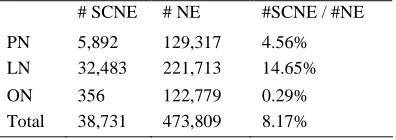
SCNE is very common in written Chinese text. As shown in Table 1, SCNE accounts for 8.17% of all NE tokens on the 10MB corpus. Especially, 14.65% of location names are SCLs. However, due to the lack of research, SCNE is a major source of errors in NER. In our experiments described below, we focus on SCL and SCP, while SCO is not considered because of its small number in the data.
# SCNE # NE #SCNE / #NE PN 5,892 129,317 4.56% LN 32,483 221,713 14.65% ON 356 122,779 0.29% Total 38,731 473,809 8.17%
Table 1. Proportion of SCNE in NE
To our knowledge, most NER systems do not report SCNE recognition results separately. Some systems (e.g. Liu, 2001) even do not in-clude SCNE in recognition task. SCNE recogni-tion is achieved using the same technologies as for NER, which can be roughly classified into rule-based methods and statistical-based methods, while most of state-of-the-art systems use hybrid approaches.
Wang (1999) and Chen (1998) used linguistic rules to detect NE with the help of the statistics from dictionary. Ji(2001), Zheng (2000), Shen(1995) and Sun(1994) used statistics from dictionaries and large corpus to generate PN or LN candidates, and used linguistic rules to filter the result, and Yu (1998) used language model to
filter. Liu (2001) applied statistical and linguistic knowledge alternatively in a seven-step proce-dure. Unfortunately, most of these results are incomparable due to the different test sets used, except the results of Chen (1998) and Yu (1998). They took part in Multilingual Entity Task (MET-2) on Chinese, held together with MUC-7. Between them, Yu (1998)’s results are slightly better. However, these two comparable sys-tems did not report their results on SCNE sepa-rately. To evaluate our results, we compare with three state-of-the-art system we have. These sys-tems include: MSWS, PBWS and LCWS. The former two are developed by Microsoft® and the last one comes from by Beijing Language Uni-versity.
3 SCNE Recognition Using an Improved Source-Channel Model
3.1 Improved Source-Channel Model1
We first conduct SCNE recognition within a framework of improved source-channel models, which is applied to Chinese word segmentation. We define Chinese words as one of the following four types: (1) entries in a lexicon, (2) morpho-logically derived words, (3) named entity (NE), and (4) factoid. Examples are
1. lexicon word: (peng2-you3, friend).
2. morph-derived word:
(gao1-gao1-xing4-xing4 , happily)
3. named entity:
(wei1-ruan3-gong1-si1, Microsoft Corporation)
4. factoid2: (yi1-yue4-jiu3-ri4, Jan 9
th )
Chinese NER is achieved within the framework. To make our later discussion on SCNE clear, we introduce the model briefly.
We are given Chinese sentence S, which is a character string. For all possible word segmen-tations W, we will choose the one which achieves the highest conditional probability W* = argmax wP(W|S). According to Bayes’ law and
dropping the constant denominator, we acquire the following equation:
1
This follows the description of (Gao, 2003).
) | ( ) ( max arg *
W S P W P W
W
= (1)
Following our Chinese word definition, we de-fine word class C as follows: (1) each lexicon word is defined as a class; (2) each morphologi-cally derived word is defined as a class; (3) each type of named entities is defined as a class, e.g. all person names belong to a class PN, and (4) each type of factoids is defined as a class, e.g. all time expressions belong to a class TIME. We therefore convert the word segmentation W into a word class sequence C. Eq. 1 can then be rewritten as:
) | ( ) ( max arg *
C S P C P C
C
= . (2)
Eq. 2 is the basic form of the source-channel models for Chinese word segmentation. The models assume that a Chinese sentence S is gen-erated as follows: First, a person chooses a se-quence of concepts (i.e., word classes C) to output, according to the probability distribution P(C); then the person attempts to express each concept by choosing a sequence of characters, according to the probability distribution P(S|C).
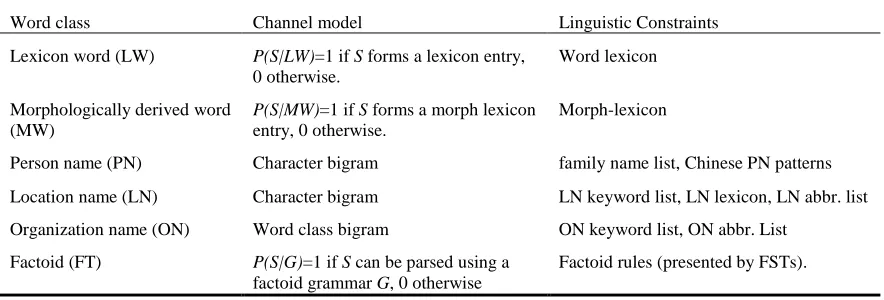
We use different types of channel models for different types of Chinese words. This brings several advantages. First, different linguistic constraints can be easily added to corresponding channel models (see Figure 1). These constraints can be dynamic linguistic knowledge acquired through statistics or intuitive rules compiled by linguists. Second, this framework is data-driven, which makes it easy to adapt to other languages.
We have three channel models for PN, LN and ON respectively. (see Figure 1)
However, although Eq. 2 suggests that channel model probability and source model probability can be combined through simple multiplication, in practice some weighting is desirable. There are two reasons. First, some channel models are poorly estimated, owing to the sub-optimal assumptions we make for simplicity and the insufficiency of the training corpus. Combining the channel model probability with poorly estimated source model probabilities according to Eq. 2 would give the context model too little weight. Second, as seen in Figure 1, the channel models of different word classes are constructed in different ways (e.g. name entity models are n-gram models trained on cor-pora, and factoid models are compiled using lin-guistic knowledge). Therefore, the quantities of channel model probabilities are likely to have vastly different dynamic ranges among different word classes. One way to balance these probability quantities is to add several channel model weight CW, each for one word class, to adjust the channel model probability P(S|C) to P(S|C)CW. In our ex-periments, these weights are determined empiri-cally on a development set.
Given the source-channel models, the procedure of word segmentation involves two steps: first, given an input string S, all word candidates are generated (and stored in a lattice). Each candidate is tagged with its class and the probability P(S’|C), where S’ is any substring of S. Second, Viterbi search is used to select (from the lattice) the most probable word segmentation (i.e. word class se-quence C*) according to Eq. 2.
Word class Channel model Linguistic Constraints Lexicon word (LW) P(S|LW)=1 if S forms a lexicon entry,
0 otherwise.
Word lexicon
Morphologically derived word (MW)
P(S|MW)=1 if S forms a morph lexicon entry, 0 otherwise.
Morph-lexicon
Person name (PN) Character bigram family name list, Chinese PN patterns Location name (LN) Character bigram LN keyword list, LN lexicon, LN abbr. list Organization name (ON) Word class bigram ON keyword list, ON abbr. List
Factoid (FT) P(S|G)=1 if S can be parsed using a factoid grammar G, 0 otherwise
Factoid rules (presented by FSTs).
3.2 Improved Model for SCNE Recognition
Although our results show that the source-channel models achieve the state-of-the-art word segmentation performance, they cannot handle SCNE very well. Error analysis shows that 11.6% person name errors come from SCP, and 47.7% location names come from SCL. There are two reasons accounting for it: First, SCNE is generated in a different way from that of multi-character NE. Second, the context of SCNE is different from other NE. For example, SCNE usually appears one after another such as “
”. But this is not the case for multi-character NE.
To solve the first problem, we add two new channel models to Figure 1, that is, define each type of SCNE (i.e. SCL and SCP) as a individual class (i.e. NE_SCL and NE_SCP) with its chan-nel probability P(Sj |NE_SCL), and P(Sj list includes 151 SCP.
= probabilities with other NE’s.
To solve the second problem, we trained a new source model P(C) on the re-annotated training corpus, where all SCNE are tagged by SCL or SCP. For example, “” in “”is tagged as SCP
instead of PN, and “ ” in “
” is tagged as SCL in stead of LN.
4 Character-based Classifiers
In this section, SCNE recognition is formulated as a binary classification problem. Our motiva-tions are two folds. First, most NER systems do not use source-channel model, so our method described in the previous section cannot be
ap-plied. However, if we define SCNE as a binary classification problem, it would be possible to build a separate recognizer which can be used together with any NER systems. Second, we are interested in comparing the performance of source-channel models with that of other meth-ods.
For each Chinese character, a classifier is built to estimate how likely an occurrence of this Chinese character in a text is a SCNE. Some ex-amples of these Chinese character as well as
Table 2. The probability of a character as SCNE
We can see that the probabilities of being a SCNE of many characters are very small. Thus, SCNE recognition is an ‘unbalanced’ classifica-tion problem. That is, in most cases, it is safer to assume that a character is not a SCNE.
We construct two classifiers respectively based on two statistical models: maximum entropy model (ME) and vector space model (VSM). Local context characters (i.e. left or right characters within a window) are used as features.
4.1 Maximum Entropy
ME provides a good framework to integrate various features from different knowledge sources. Each feature is typically represented as a binary constraint f. All features are then com-bined using a log-linear model shown in Eq. 5.
where i is a weight of the feature fi , and Z(x) is a normalization factor.
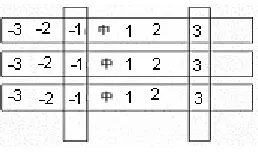
Weights ( ) are estimated using the maximum entropy principle: to satisfy constraints on ob-served data and assume a uniform distribution (with the maximum entropy) on unseen data. The training algorithm we used is the improved itera-tive scaling (IIS) described in (Berger et al, 1996)3. The context features include six charac-ters: three on the left of the SCNE, and three on the right. Given the context features, the ME classifier would estimate the probability of the candidate being a SCNE. In our example, we treat candidates with the probability larger than 0.5 as SCNEs. To get the precision-recall curve, we can vary the probability threshold from 0.1 to 0.9.
4.2 Vector Space Model
VSM is another model we used to detect SCNE. Similar to ME, we use six surrounding characters as the features, as shown in Figure 2.
Figure 2. Context window
In this approach, we apply the standard tf-idf weighting technique with one minor adaptation: the same character appearing in different positions within the context window is considered as different terms. For example, character Cj appearing at position i, i
{-3,-2,-1,1,2,3}, is regarded as term Cji,. Term weight-ing of Cji is acquired with Eq.6.
i ji ji
ji TFC IDFC PW C
Wei( )= ( )* ( )* (6)
With this adaptation, we can apply an additional weighting coefficient PWi to different position, so as to reflect the importance of different positions. PWi is determined in a heuristic way as shown in Table.3 with the underlying principle that the closer the context character is to the SCNE candi-date, the larger PWi is.
3
Thank Joshua Goodman for providing the ME toolkit.
Pos -3 -2 -1 1 2 3
PWi 1 4 7 7 4 1
Table 3. Weights assigned to deferent positions
A precision/recall curve can be obtained by mul-tiplying a factor to one of the two cosine dis-tances we get, before comparing them.
5 Experiment results
5.1 Evaluation Methodology
To achieve a reliable evaluation, we developed an annotated test set. First, we discuss a standard of Chinese NE and SCNE. Most previous searches define their own standards; hence re-sults of different systems are not comparable. Recently, two widely accepted standards were developed. They are (1) MET-2 (Multilingual Entity Task)4 for Chinese and Japanese NE, and (2) IEER-99’5 for Chinese NE. IEER-99 is a slightly modified version of MET-2. Our NE/SCNE standard is based on these two well-known standards.
Second, we manually annotated a 10MB training corpus and a 1MB test corpus. The texts are randomly selected from People’s Daily, in-cluding articles from 10 subjects and 5 writing styles. This test set is much larger than MET-2 test data (which is about 106 KB), and contains more SCNE for evaluation.
The evaluation metrics we used include precision (P), recall (R), and F-score. F-score is calculated as
R P
R P
+ +
) * (
* * ) 0 . 1 (
2 2
β
β , while =1 in our
experiments.
5.2 Results of Source-Channel Models
We show the SCNE recognition results using the source-channel models described in Section 3. Two versions of NE models are used. M1 is the original model described in Section 3.1. M2 is the one adapted for SCNE, shown in Section 3.2. The results in Table 4 show that obvious improvement can be achieved on SCL and SCP after adapting source-channel models for SCNE. As shown in Table 5, the improvement of SCL and SCP has significant impact on performance of LN and PN
recognition. We can see that the increase of F-score of LN is 5.13%, and PN is 0.92% absolutely.
SCL SCP
P% R% F P% R% F M1 83.77 15.25 25.80 * * * M2 84.38 77.90 81.01 76.14 61.47 68.02 * No SCP is detected
Table 4. Improvement of SCL and SCP recognition
LN PN
P% R% F P% R% F M1 88.60 71.35 79.04 83.23 76.17 79.54 M2 88.20 80.49 84.17 83.51 77.63 80.46
Table 5. Improvement of LN and PN recognition 5.3 Results of Different Methods
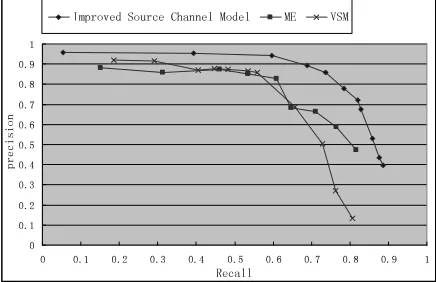
In Figures 3 and 4, we compare the results of the source-channel models with two classifiers de-scribed in Section 4: ME and VSM.
!"
##
$
$% &
$
Figure 3. Result of different methods on SCL
' '() '(* '(+ '(, '(-'(. '(/ '(0 '(1 )
' ' () ' (* ' (+ ' (, ' (- '(. ' (/ '(0 ' (1 )
234566 7
8 9 : ; < ; = >
?
@ AB C D 3 EF
CGB 43
HI5
J J 36K
C
E36 KL MFK
Figure 4. Result of different methods on SCP
We can see that source-channel model achieves the best result. This can be interpreted as follows. The source-channel models use more
informa-tion than the other two methods. The feature set of ME or VSM classifiers includes only six sur-rounding characters while the source-channel models use much rich global and local informa-tion as shown in Figure 1. Based on our analysis, we believe that even enlarging the window size of the local context, the performance gain of these classifiers is very limited, because most error tags cannot be correctly classified using local context features. We can then say with con-fidence that the source-channel models can achieve comparable results with ME and VSM even if they used more local context.
5.4 Comparison with Other State-of-The-Art Systems
The section compares the performance of the source-channel models M2, with three state-of-the-art systems: MSWS, LCWS and PBWS.
1. The MSWS system is one of the best avail-able products. It is released by Microsoft® (as a set of Windows APIs). MSWS first con-ducts the word breaking using MM (aug-mented by heuristic rules for disambiguation), then conducts factoid detection and NER us-ing rules.
2. The LCWS system is one of the best research systems in mainland China. It is released by Beijing Language University. The system works similarly to MSWS, but has a larger dictionary containing more PNs and LNs.
3. The PBWS system is a rule-based Chinese parser, which can also output the NER results. It explores high-level linguistic knowledge such as syntactic structure for Chinese word segmentation and NER.
To compare the results across different systems, we have to consider the problem that they might have different tagging format or spec. For exam-ple, the LCWS system tags the two-character string “
NO
” as a location name, and tags “P QR
” other than “P” as a person name. We
* No SCL is detected
Table 6. Comparison with other systems
We can see that our system (M2) achieves the best results in both SCL and SCP recognition. PBWS has the second best result in recognizing SCL (43.63%), and MSWS in SCP (43.48%). However, they achieved the worst result on SCP and SCL, respectively.
5.5 Error Analysis
Through human checking, we list the typical er-rors as follows:
1. Ambiguity between NE: “
N
”(mei3-zhong1-mao4-yi4-quan2-guo2-wei3-yuan2-hui4, National Committee on United States-China Relations) is a ON, but “
”, “
N
” are usually wrongly recognized as SCL. On the contrary, “
N
”(ri4- zhong1-you3-hao3-qi1-tuan2-ti3, seven Janpan-China friendship organiza-tions ) is tagged as ON falsely. So shi3-chu1-da4-men2, the middle bus drives out from the gate),“ SCNE is usually a part of multi-character NE, such as “ multi-character NE, or recognizing SCNE. Current features we used seem not powful enough to
resovle this ambiguity well. Errors in (3) come from another kind of ambiguities such as ambiguity between SCNE and normal lexicon words. They are partly caused by noises in training data, because SCNE are very likely to be neglected by annotators, which makes training data more sparse. Both errors in (1) and (3) are not easy to handle.
Our immediate work is to cope with errors in (2), which account for about 8.9% of all errors. We can obtain additional SCNE entries from resources such as abbreviation dictionaries. However, the procedure to select SENE entries should be careful, because the SCNE characters we do not cover currently might be rare to act as SCNE, and difficult to recall. Besides, unsupervised methods can be applied to the task, considering insufficiency of the training data of the task.
6 Conclusion
Although SCNE is very common in written Chi-nese text, due to the lack of in-depth research, SCNE is a major source of errors in NER. This paper formulates the SCNE recognition within the source-channel model framework. Our experi-ments show very encouraging results: an F-score of 81.01% for single character location name rec-ognition, an F-score of 68.02% for single character person name recognition. An alternative view of the SCNE recognition problem is to formulate it as a classification task. We construct two classifiers respectively based on maximum entropy model (ME) and vector space model (VSM), respectively. We compare all proposed approaches, showing that the source-channel model performs the best in most cases.
References
A. Berger, S. Della Pietra and V. Della Pietra, 1996. A maximum entropy approach to natural language processing. Computational Linguistics 22(1):39-71.
Andrew Borthwick, John Sterling, Eugene Agichtein, and Ralph Grishman. 1998. NYU: Description of the MENE Named Entity System as Used in MUC-7. Proceedings of the Seventh Message Understanding Conference (MUC-7)
Michael Collins, 2002. Ranking Algorithm for Named-Entity Extraction: Boosting and Voted Perceptron. Proceedings of 40th Annual Meeting of Association for Computational Linguistics.
Jianfeng Gao, Mu Li and Chang-Ning Huang, 2003. Improved Source-Channel Models for Chinese Word Segmentation. Proceedings of 41th Annual Meeting of Association for Computational Linguistics.
Hideki Isozaki and Hideto Kazawa, 2002. Efficient Support Vector Classifier for Named Entity Recogni-tion, Proceedings of 19th International Conference on Computational Linguistics.
Heng Ji, Zhensheng Luo, 2001. Inverse Name Fre-quency Model and Rule Based Chinese Name
Identi-fication. (In Chinese) Natural Language
Understanding and Machine Translation. Tsinghua University Press. pp. 123 -128.
Kaiying Liu, 2001. Research on Chinese Proper Noun and Internet Words Recognition. (In Chinese) Pro-ceedings of Conference of the 20th Anniversary of CIPSC. Tsinghua University Press. pp. 7-13.
Song Rou, Benjamin K T’sou, 2001. Primary Study on Chinese Proper Noun. (In Chinese) Proceedings of Conference of the 20th Anniversary of CIPSC. Tsinghua University Press,14-19.
Dayang Shen, Maosong Sun, 1995. Chinese Location Name Recognition. (In Chinese) Development and Applications of Computational Linguistics. Tsinghua University Press.
Jian Sun, Jianfeng Gao, Lei Zhang, Ming Zhou, and Changning Huang, 2002. Chinese named entity iden-tification using class-based language model. COLING 2002. Taipei, Taiwan, August 24-25, 2002.
Maosong Sun, Changning Huang, Haiyan Gao, Jie Fang, 1994. Chinese Person Name Recognition. (In Chi-nese) Journal of Chinese Information Processing.
Xing Wang, Degen Huang, Yuansheng Yang, 1999. Identifying Chinese Names Based on Combination of Statistics and Rules. (In Chinese) proceedings of JSCL-99. Tsinghua University Press. pp. 155 -161
Shihong Yu, Shuanhu Bai and Paul Wu. Description of the Kent Ridge Digital Labs System Used for MUC-7. Proceedings of the Seventh Message Understand-ing Conference (MUC-7), 1998.
Junsheng Zhang, 1992. Chinese Person Name Recogni-tion. (In Chinese) Journal of Chinese Information Processing. 9(2) .
Jiahen Zheng, Xin Li, Hongye Tan, 2000. The Researh of Chinese Names Recognition Based on Corpus,. (In
Chinese) Journal of Chinese Information Processing. 14(1): 7-12