Vol. 3, Issue 3, March 2015
An Image Removal Using Local Tetra
Patterns for Content Based Image Retrieval
Manish K. Shriwas
1, Prof. Vivek. R. Raut
2P.G. Scholar, Department of Electronics and Telecommunication, Prof. Ram Meghe Institute of Technology and
Research, Badnera, Amravati, Maharastra, India1
Associate Professor, Department Electronics &Telecommunication Engineering, Prof. Ram Meghe Institute of
Technology and Research, Badnera, Amravati, Maharastra, India2
ABSTRACT:Content-based image retrieval is a technique of automatic retrieval of images from large database that perfectly matches the query image. For the large database, many of the research works had been undertaken in the past decade to design efficient image retrieval system. On many fields such as industry, education, biomedical and research the amount of image data that has to be stored, managed, searched and retrieved grows continuously. In this paper, we propose a new image retrieval technique for Content-based image retrieval (CBIR) using local tetra pattern (LTP). The local tetra pattern (LTP) and local binary pattern (LBP) determines the correlation on grey level difference between referenced pixel and its surrounding neighbours. The proposed technique encodes the relationship between the referenced pixel and its neighbours and by via first-order derivatives in vertical and horizontal directions. The proposed algorithm has been experienced on different real images and its performance is found to be somewhat acceptable when compared with performance of conventional technique of content based image retrieval. In terms of average precision and average recall we calculated the performance of proposed method..
KEYWORDS: Content Based Image Retrieval, Local Tetra Pattern (LTP), Local Binary Pattern (LBP), Precision and Recall.
I. INTRODUCTION
There is a need to develop a proficient technique for automatically retrieved the desired image from large database. To retrieve the images in database mostly two methods are common in practice, text based image retrieval and visual based i.e. content based image retrieval (CBIR).In text based image retrieval systems, images are characterized by text information such as keywords and captions. Many communities had retrieved the image using a text based data management system [DBMS] in 1970. In this technique, the user retrieved the images using keywords and images were stored in database with text annotation. Various techniques used in text retrieval are Bag of words approach, a technique where in Stop words can be removed, correction in spelling etc. In text base system different problems occur such as incorrect spelling, never complete the annotation, same thing can be said in different ways [1].
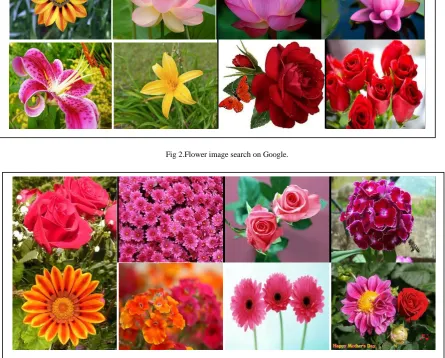
It is not possible to retrieved images more precisely in text based image retrieval system and in case of large database(hundreds of thousands) result became inaccurate. Figure 1 and figure 2 shows the result of images search on
Google and Yahoo via text annotation Flower
.
The term CBIR describes the method of retrieving desired images from a huge database collection on the basis of characteristics (such as colour, texture and shape) that can be automatically retrieved from the images themselves. In this technique, image is retrieve based on similarity matched between the query image and database images and similarity is measures in terms of its color, texture and shape.[2]
In the early 1990s, due to increasing the growth of digital images as a accurate result in the Internet and new digital image sensor technologies. Progress in image retrieval related to different domain such as industrial, scientific,
educational, biomedical and other have grown rapidly. To retrieve the images more accurately the new technology was
Vol. 3, Issue 3, March 2015
Fig 2.Flower image search on Google.
Fig 2.Flower image search on yahoo.
R. Vijaya Arjunan et.al has proposed the color histogram feature for retrieval of the images. The method uses histogram investigation of image in Hue Saturation Value than RGB and for increasing the accuracy it measures the quadratic distance of the histogram. The process accumulates the pixel value of input image to database images and the results are arranged in ascending order. Its retrieval accuracy was 90%. [3]
Vol. 3, Issue 3, March 2015
A new algorithm for image retrieval using wavelet correlogram has introduced by H.A.Moghaddam et.al.[6]
M. Saadatmand Tarzjan et.al has proposed image indexing and retrieval by using Gabor wavelet correlogram.[7] For
texture classification Ahmadian et al. have used the discrete wavelet transform (DWT) [8]. The application of the
discrete wavelet transform DWT using comprehensive Gaussian density with Kullback–Leibler distance has shown to present proficient results for texture image retrieval [9] and image segmentation [10]. Image retrieval has some advantage in biomatrics such as user need to place his hand on hand rest for finger printing or hand geometry detection and place fix position in front of camera for iris and retina identification. Retrieval algorithm using local tetra pattern is more discriminant and less sensitive to noise in uniform region.
Subrahamanyam Murala has gives an idea of CBIR system using Local Tetra Pattern (LTP), Local Binary pattern (LBP), Local Ternary Pattern (LTPr) and Local Derivative Pattern (LDP).It compare the LBP, LTP, and LDP and described that the LTP pattern has better performed than other patterns.[11]
II. RELATED WORK
The LBP, the LDP, and the LTP retrieve the information of query image similar to the database image based on the distribution of edges, which are implied using only two directions (positive direction or negative direction). Thus, it is clear that by differentiating the edges in more than two directions the performance of this method can be improved. This examination has stimulated us to propose the four direction code, referred to as local tetra patterns (LTrPs) for Content Based Image Retrieval system.
Ojala et al. has describedRelative study of texture measures with classification based on feature distributions
using Local Binary Pattern LBPs [12].Z. Guo et al. has has proposed the Local Binary Pattern for dissimilar extension such as LBP variance with global matching for pattern recognisation.[13] For texture classification S. Liao et al. has described the dominant Local Binary Patterns (LBPs) [14]. Z. Guo et al. has introduced completed modelling of local binary pattern operator for texture classification [15]. For Texture classification H. Lategahn et al.has proposed joint distributions of local patterns with Gaussian mixtures [16]. T. Ahonen et.al used Loacal Binary Pattern (LBP) as a face descriptor for the application of face recognition [17]. For facial expression analysis G. Zhao and M. Pietikainen used Dynamic texture recognition using local binary patterns [18].
Zhang et al. described local derivative patterns (LDPs) for face recognition, where they measured the Local Binary
Pattern as non directional first-order local patterns collected from the first-order derivatives and complete the same approach for n th order Local Derivative Patterns[19].
Lei et al. [20] proved that the process for exploiting the image information jointly in image space, scale, and
orientation domains can make available richer clues, which are not evident in any one individual domain. This process worked in two phases. In the first phase, the face image is decomposed into dissimilar scale and direction responses by convolving with multiscale and multiorientation Gabor filters. In the second phase, used analysis of Local Binary Pattern (LBP) to illustrate the neighbouring relationship not only in image space but also in different scale and orientation responses.
Zhao et al.used Local Binary Pattern for a local spatiotemporal descriptor to signify and distinguish spoken isolated
phrases solely based on visual input [21].In this technique Spatiotemporal Local Binary Patterns extracted from mouth regions are used for recounting isolated phrase sequences.
The hybrid technique proposed by Su et al. for pixel based graphic recovery with the Local Binary Pattern and the Haar wavelet referred as structured local binary Haar pattern that encodes the polarity rather than the magnitude of the variation between accumulated gray values of neighbouring rectangles [22].
Vol. 3, Issue 3, March 2015
III.PROPOSED ALGORITHM
In this paper, we propose a second-order Local Tetra Pattern that is evaluated based on the direction of pixels using vertical and horizontal derivatives. Our technique is different from the existing Local Derivative Patterns in a approach
that it makes use of 00 and 900 derivatives of Local Derivative Patterns for further determined the directionality of
every pixel. In the end, the generalized n order Local Tetra Patterns operator has been obtainable by using (n-1) th-order derivatives. We also discuss the performance of our system is compared with the LBP, the LDP, and the LTP . Similar to LDP, in order to compare our method with the LBP, we consider the LBP as a nondirectional first-order
local pattern called the first-order LTrP. From the earlier section, we can see that a capable image retrieval scheme
requires the perfect mixing of numerous examine communities efforts.
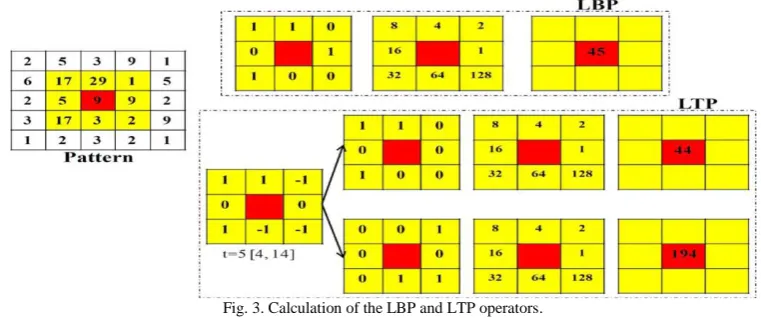
Figure 3 shows the LTP, the obtained ternary pattern is again coded into upper and lower binary patterns. The upper pattern is obtained by retaining 1 and replacing 0 for 1 and 0. Lower pattern is coded by replacing 1 with 1 and 0 for 1 and 0.
Fig. 3. Calculation of the LBP and LTP operators.
We propose a novel technique called as local tetra pattern (LTrPs) for content based image retrieval (CBIR). The proposed technique encodes the relationship between the referenced pixel and its neighbours and by via first-order derivatives in vertical and horizontal directions. Our system is different from the current local derivative (LDP) in a
approach that it makes use of 0o and 90o derivatives of LDPs for additional manipulation of the directionality of every
pixel. The different patterns used to retrieved the image feature are discussed in following sections. Local Binary Patterns (LBPs) :
In Local Binary Patterns it specified a center pixel value in the image, the LBP value is determined by comparing its gray value with its neighbors, The LBP machinist was introduced by T.ojala et al. [28] for texture classification. as shown in Fig. 3, based on
LBPP,R = 2 P−1
P
P=1
× f1 gp− gc (1)
f1 x = 1,0, 𝑥 ≥ 0𝑒𝑙𝑠𝑒 (2)
Where gp is the gray value of its neighbors and gc is the gray value of the center pixel, P is the number of neighbors, R
is the radius of the neighborhood. Local Ternery Patterns (LTPs) :
Tan and Triggs [29] complete the LBP to a three-valued code called the LTP, in which gray values in the zone of
width ±t around gc are quantized to zero, those above (gc+t) are quantized quantized to +1, and those below (gc-t) are
quantized to -1, i.e. indicator f1(x) is replaced with three-valued function and the binary LBP code is replaced by a
Vol. 3, Issue 3, March 2015
f x, g1 c, t =
+1, x ≥ gc + t
0, x − gc < 𝑡
−1, x ≤ gc − t
𝑥 = 𝑔𝑝 (3)
Local Derivative Patterns (LDPs) :
The LBP as the nondirectional first-order local pattern operator and extended it to higher orders ( nth-order) called the Local Derivative Pattern. The LDP contains more detailed discriminative features as compared with the LBP.To
calculate the nth-order LDP, the (n-1) th-order derivatives are calculated along 00 , 450 , 900 , and 135 0directions.
Finally, nth-order LDP is calculated as,
𝐿𝐷𝑃∝𝑛 = 2(𝑝−1)× 𝑓2(𝐼∝
𝑛−1 𝑔𝑐 , 𝐼 ∝
𝑛−1 𝑔𝑝 𝑃
𝑝=1 P=8 (4)
𝑓2 𝑥, 𝑦 = 1, 𝑖𝑓𝑥, 𝑦 ≤ 0
0, 𝑒𝑙𝑠𝑒. (5)
Local Tetra Patterns (LTrPs) :
The LTrP describes the spatial structure of the local texture using the direction of the center gray pixel gc. Given
image I , the first-order derivatives along 00and 900 directions . Let gc indicate the center
pixel in I , and let gh and gv indicate the horizontal and vertical neighborhoods of gc , respectively. Then, the
first-order derivatives at the center pixel g ccan be written as
𝐼010 𝑔𝑐 = 𝐼 𝑔 − 𝐼(𝑔𝑐) (6)
𝐼9010 𝑔𝑐 = 𝐼 𝑔𝑣 − 𝐼(𝑔𝑐) (7)
and the direction of the center pixel can be determined by,
𝐼𝐷𝑖𝑟 .1 (𝑔𝑐) =
1, 𝐼010 𝑔𝑐 ≥ 0 𝑎𝑛𝑑 𝐼9010 𝑔𝑐 ≥ 0
2, 𝐼010 𝑔𝑐 < 0 𝑎𝑛𝑑 𝐼9010 𝑔𝑐 ≥ 0
3, 𝐼010 𝑔𝑐 < 0 𝑎𝑛𝑑 𝐼9010 𝑔𝑐 < 0
4, 𝐼010 𝑔𝑐 ≥ 0 𝑎𝑛𝑑 𝐼9010 𝑔𝑐 < 0
(8)
From (8), it is marked that the probable direction for each center pixel can be either 1, 2, 3, or 4, and ultimately, the image is converted into four values, i.e., directions.
The second-order LTrP2 (gc)is defined as
LTrP2 (𝑔𝑐) = 𝑓3 𝐼𝐷𝑖𝑟 .
1 𝑔𝑐 , 𝐼
𝐷𝑖𝑟 .1 𝑔1 , 𝑓3 𝐼𝐷𝑖𝑟 .1 𝑔𝑐 , 𝐼𝐷𝑖𝑟 .1 𝑔2 , … ,
… , f3(𝐼𝐷𝑖𝑟 .1 𝑔𝑐 , 𝐼𝐷𝑖𝑟 .1 (𝑔𝑝))
(9)
f3 𝐼𝐷𝑖𝑟 .1 𝑔𝑐 , 𝐼𝐷𝑖𝑟 .1 𝑔𝑝 =
0, 𝐼𝐷𝑖𝑟 .1 𝑔𝑐 = 𝐼𝐷𝑖𝑟 .1 𝑔𝑝 𝐼𝐷𝑖𝑟 .1 𝑔𝑝 , else
(10)
From (9) and (10), we get 8-bit tetra pattern for each center pixel. Then, we divide all patterns into four parts based on the direction of center pixel. Finally, the tetra patterns for each part (direction) are converted to three binary patterns.
Let the direction of center pixel obtained using (8) (I1Dir. (gc)) be “1”; then, LTP2 can be defined by segregating it into
three binary patterns as follows:
LTrP2 (Direction =2,3,4)= 𝑃 2(𝑝−1)× 𝑓4(𝐿𝑇𝑟𝑃(𝑔𝑐))
𝑝=1 Direction = 2,3,4 (11)
𝑓4 𝐿𝑇𝑟𝑃2 𝑔𝑐 , (𝐷𝑖𝑟𝑒𝑐𝑡𝑖𝑜𝑛 = ∅) = 1, 𝑖𝑓 𝐿𝑇𝑟𝑃2 𝑔𝑐 = ∅
0, 𝑒𝑙𝑠𝑒
(12)
Where, Ø=2,3,4
Similarly, the other three tetra patterns for remaining three directions of center pixels are converted to binary patterns Thus, we get 12 (4 ×3) binary patterns.
Vol. 3, Issue 3, March 2015
1)The LTrP is able to encode images with four different values as it is able to extract additional detailed information. where The LBP, the LDP, and the LTP are able to encode images with only two and three different values.
2) The LTrP encodes the relationship between the center pixels and its neighbors based on directions.
Whereas, the LBP and the LTP encode the relationship between the gray value of the center pixel and its neighbors,
Fig 4.Calculation of tetra pattern bits for the center-pixel direction “1” using the direction of neighbors. Red direction is the center pixel and cyan that its neighborhood pixels.
Fig. 4 shows the feasible local pattern transitions resulting in an LTrP for direction “1” of the center pixel. The LTrP is coded to “0” when it is equal to the direction of center pixel, otherwise coded in the direction of neighborhood pixel. Using the same correlation, LTrPs are calculated for center pixels having directions 2, 3, and 4.
In Fig. 5. Shows the example of the second-order LTrP calculation resulting in direction “1” for a center pixel marked with red. When we concern first-order derivative in vertical and horizontal directions to the neighborhood pixel “8,” we obtain direction “3” the direction obtained from the neighbourhood pixel and the direction of the center pixel are not same, we assign value “3” to the orresponding bit of the LTrP. It can be seen that the magnitude of the center pixel is “6,” which is less than the magnitude of neighbourhood pixel. Hence, we assign value “1” to the corresponding bit of the magnitude pattern.
Similarly, the remaining bits of the LTrP and the magnitude pattern for the other seven neighbours are computed resulting in the tetra pattern “3 0 3 4 0 3 2 0” and the magnitude binary pattern “1 1 1 0 0 1 0 1.” After coding the tetra pattern, we separate it into three binary patterns as follows. Referring to the generated LTrP, the first pattern is obtained by keeping “1” where the tetra pattern value is “2” and “0” for other values, i.e., “0 0 0 0 0 0 1 0.” Similarly, the other two binary patterns “1 0 1 0 0 1 0 0” and “0 0 0 1 0 0 0 0” are computed for tetra pattern values “3” and “4,” respectively. In the same method used for computing the tetra patterns for center pixels having directions 2, 3, and 4 Thus, with four tetra patterns, 12 binary patterns are obtained.
The performance of this scheme is measured in terms of average precision and average recall.
Precision =Number of related images retrieved
Total number of images retrieved
Recall = Number of related images retrieved
Total number of images in the database
The 13th binary pattern calculated by using the magnitudes of horizontal and vertical first-order derivatives using
𝑀𝐼1(𝑔𝑝)= (𝐼010(𝑔𝑝))2+ (𝐼9010(𝑔𝑝))2 (13)
𝐿𝑃 = 𝑃𝑝=12 𝑝−1 × 𝑓1(𝑀𝐼1 𝑔𝑝 − 𝑀𝐼1 𝑔𝑐 ) p=8 (14)
For the local pattern with P neighborhoods,2P combinations of LBPs are possible, resulting in the feature vector
Vol. 3, Issue 3, March 2015
Fig 5.Example to obtain the tetra and magnitude patterns. For generating a tetra pattern, the bit is coded with the direction of neighbour when the direction of the center pixel and its neighbor are not same, otherwise “0”.
Figure 6 shows the graphical demonstration of the proposed image retrieval system and process as given below
1. Load the query image, and translate it into gray scale.
2. In horizontal and vertical axis apply the first-order derivatives. 3. Determine the direction for all pixel whether it is 1, 2, 3 or 4
4. Depending on the direction of the center pixel divide the patterns into four parts. 5. Determine the tetra patterns, and separate them into three binary patterns. 6. Calculate the histograms of binary patterns.
7. Calculate the magnitudes of center pixels using [10]. 8. Construct the binary patterns, and analyze their histogram. 9. Combine all histograms calculated from steps 6 and 8. 10. Assemble the feature vector.
Vol. 3, Issue 3, March 2015
Figure 6.Framework of proposed image retrieval methodology
IV. SIMULATION RESULTS
Figure 7 shows the retrieval result by using Local Tetra Patterns technique for different database images such as Flower, Bus, Fruit, Buildings, Zebra, and Collage Students etc. The proposed LTP algorithm is implemented with MATLAB. In this method we compared the query image used as a flower image with all different eight images in the database. The comparison is done on the basis of direction of pixel whether it is 1,2,3 or 4, magnitude of pixel, histogram calculation. Based on the most excellent matches retrieve image from database.
Vol. 3, Issue 3, March 2015
V. CONCLUSION AND FUTURE WORK
In this paper, we presented a new approach referred as LTrP for Content Based Image Retrieval system. The Local Tetra Pattern encodes the images based on the direction of pixels that are calculated by vertical and horizontal derivatives. The precision and average recall of the proposed approach has been extensively improved as compared with the LBP, the LTP and the LDP respectively.
In this paper ,for the derivative calculation only horizontal and vertical pixel have been used. By considering the diagonal pixel for derivative calculation in addition to horizontal and vertical direction the result will also be improved. Due to the effectiveness of proposed method it can also be used for many applications such as Biomedical, Industrial, Educational, Face Recognition, Finger print Recognition etc.
REFERENCES
1. Roger Weber and Michael Mlivoncic, "Efficient Region-Based Image Retrieval", ACM CIKM '03 November 3-8,USA,2003.
2. Subrahmanyam Murala, R.P.Maheshwari and R.Subramanian,” Local Tetra Patterns: A New Feature Discriptor for Content-Based Image 3. Retrieval”, IEEE Trans.on Image Processing,vol.21,No.5,May2012.
4. R.Vijaya Arjunan, Dr.V.Vijaya Kumar „‟Image Classification in CBIR systems with Colour Histogram Features‟‟, International Conference On Advances In Recent Technologies In Communication and Computing. 2009.
5. Y. Rui and T. S. Huang, “Image retrieval: Current techniques, promising directions and open issues,” J. Visual Commun. Image Represent., vol. 10, no. 1, pp. 39–62, Mar. 1999.
6. M. Kokare, B. N. Chatterji, and P. K. Biswas, “A survey on current content based image retrieval methods,” IETE J. Res., vol. 48, no. 3&4, pp. 261–271, 2002. 7. H. A. Moghaddam, T. T. Khajoie, and A. H. Rouhi, “A new algorithm for image indexing and retrieval using wavelet correlogram,” in Proc. ICIP, 2003, pp.
III-497–III-500.
8. M. Saadatmand Tarzjan, and H. A. Moghaddam “Gabor wavelet correlogram algorithm for image indexing and retrieval,” in Proc. ICPR, 2006, pp. 925–928. 9. A. Ahmadian and A. Mostafa, “An efficient texture classification algorithm using gabor wavelet,” in Proc. EMBS, 2003, pp. 930–933.
10. M. N. Do and M. Vetterli, “Wavelet-based texture retrieval using generalized Gaussian density and Kullback–Leibler distance,” IEEE Trans. Image Process., vol. 11, no. 2, pp. 146–158, Feb. 2002.
11. M. Unser, “Texture classification by wavelet packet signatures,” IEEE Trans. Pattern Anal.Mach. Intell., vol. 15, no. 11, pp. 1186–1191, Nov. 1993.
12. Subrahmanyam Murala, R. P. Maheshwari, “Local Tetra Patterns: A New Feature Descriptor for Content-Based Image Retrieval,” IEEE TRANSACTIONS ON IMAGE PROCESSING, VOL. 21, NO. 5, MAY 2012.
13. T. Ojala, M. Pietikainen, and D. Harwood, “A comparative study of texture measures with classification based on feature distributions,” Pattern Recogn., vol. 29, no. 1, pp. 51–59, Jan. 1996.
14. Z. Guo, L. Zhang, and D. Zhang, “Rotation invariant texture classification using LBP variance with global matching,” Pattern Recogn., vol. 43, no. 3, pp. 706–719, Mar. 2010.
15. S. Liao, M.W. K. Law, and A. C. S. Chung, “Dominant local binary patterns for texture classification,” IEEE Trans. Image Process., vol 18, no. 5, pp. 1107–1118, May 2009.
16. Z. Guo, L. Zhang, and D. Zhang, “A completed modeling of local binary pattern operator for texture classification,” IEEE Trans. Image Process., vol. 19, no. 6, pp. 1657–1663, Jun. 2010.
17. H. Lategahn, S. Gross, T. Stehle, and T. Aach, “Texture classification by modeling joint distributions of local patterns with Gaussian mixtures,” IEEE Trans. Image Process., vol. 19, no. 6, pp. 1548–1557, Jun. 2010.
18. T. Ahonen, A. Hadid, and M. Pietikainen, “Face description with local binary patterns: Applications to face recognition,” IEEE Trans. Pattern Anal. Mach. Intell., vol. 28, no. 12, pp. 2037–2041, Dec. 2006.
19. G. Zhao and M. Pietikainen, “Dynamic texture recognition using local binary patterns with an application to facial expressions,” IEEE Trans.Pattern Anal. Mach. Intell., vol. 29, no. 6, pp. 915–928, Jun. 2007.
20. B. Zhang, Y. Gao, S. Zhao, and J. Liu, “Local derivative pattern versus local binary pattern: Face recognition with higher-order local pattern descriptor,” IEEE Trans. Image Process., vol. 19, no. 2, pp. 533–544, Feb. 2010.
21. Z. Lei, S. Liao, M. Pietikäinen, and S. Z. Li, “Face recognition by exploring information jointly in space, scale and orientation,” IEEE Trans. Image Process., vol. 20, no. 1, pp. 247–256, Jan. 2011.
22. G. Zhao, M. Barnard, and M. Pietikäinen, “Lipreading with local spatiotemporal descriptors,” IEEE Trans. Multimedia, vol. 11, no. 7, pp. 1254–1265, Nov. 2009. 23. S.-Z. Su, S.-Y. Chen, S.-Z. Li, S.-A. Li, and D.-J. Duh, “Structured local binary Haar pattern for pixel-based graphics retrieval,” Electron. Lett., vol. 46, no. 14, pp.
996–998, Jul. 2010.
24. M. Li and R. C. Staunton, “Optimum Gabor filter design and local binary patterns for texture segmentation,” Pattern Recog., vol. 29, no. 5, pp. 664–672, Apr. 2008. 25. M. Heikkila andM. Pietikainen, “A texture based method for modelling the background and detecting moving objects,” IEEE Trans. Pattern Anal. Mach. Intell., vol.
28, no. 4, pp. 657–662, Apr. 2006.
26. X. Huang, S. Z. Li, and Y. Wang, “Shape localization based on statistical method using extended local binary patterns,” in Proc. ICIG, 2004, pp. 184–187. 27. M. Heikkila, M. Pietikainen, and C. Schmid, “Description of interest regions with local binary patterns,” Pattern Recog., vol. 42, no. 3, pp. 425–436, Mar. 2009.
28. D. Unay, A. Ekin, and R. S. Jasinschi, “Local structure-based region- of-interest retrieval in brain MR images,” IEEE Trans. Inf. Technol. Biomed., vol. 14, no. 4, pp. 897–903, Jul. 2010.
29. T. Ojala, M. Pietikainen, and T. Maenpaa, “Multiresolution gray-scale and rotation invariant texture classification with local binary patterns,” IEEE Trans. Pattern Anal. Mach. Intell., vol. 24, no. 7, pp. 971–987, Jul. 2002.