ISSN(Online): 2320-9801 ISSN (Print) : 2320-9798
I
nternational
J
ournal of
I
nnovative
R
esearch in
C
omputer
and
C
ommunication
E
ngineering
(An ISO 3297: 2007 Certified Organization)
Vol. 3, Issue 9, September 2015
Expert System an Artificial Intelligence
Methodology- An Overview
Sudhanshu Tiwari, Hitesh Somani
Student, Final Year, Dept. of Computer Engineering, V.E.S.I.T, Mumbai, India
ABSTRACT: The intelligence of human to control the machines and to make them act and perform with precision and to more than precise output led to the development of intelligent programming in the form of expert system using artificial intelligence. The process of developing these expert systems are termed as knowledge engineering and mining of data at various levels of intelligence. The development of the system involves the experts from the fields and the knowledge engineers who develop these expert system with decision making capacity. The knowledge engineer “extracts” from the human experts their data’s, functions, methodologies, procedures, strategies, and builds this knowledge into the Expert System. The heart of an expert system is the powerful corpus of knowledge that is accumulated during the development of the system with the exact requirement based building. The knowledge is unique and organized to simplify decision-making. “The collection, learning, mining and coding on the available knowledge is one of the important aspects of an Expert System”. The important domain experts in the development of expert system are human expert, the knowledge engineer, the expert system building tool, and the end user, whose specifications makes the development a real implementation. This paper tries to highlight the important aspects of expert system, artificial intelligence and the development of an system based on these outline structure.
KEYWORDS: Artificial Intelligence, KDD, Expert System, Data Mining, knowledge representation.
I. INTRODUCTION
To develop systems which work on the knowledge of the human experts collected in the form of lots of data. The development of the expert system depends on the complexity of the application needed and the data that is collected and can be mined for the suitable development of an expert system. The system behaves on the data manipulated and trained by the knowledge engineer for the development, which is termed as artificial intelligence. Expert system deals with identifying the specifications, to develop the concept, find the solution for the problem and formalization and implementation of the solution.
II. WHAT IS ARTIFICIAL INTELLIGENCE
The modern definition of artificial intelligence (or AI) is "the study and design of intelligent agents" where an intelligent agent is a system that perceives its environment and takes actions which maximizes its chances of success.
The terminology of artificial intelligence describes the machines that exhibits and demonstrates the functionality of learning, communication, reasoning, movement and gestures as needed by the application. The knowledge engineering is the heart of artificial intelligence system which deals with giving the machine the capacity and capability to work according to the trained human brain.
ISSN(Online): 2320-9801 ISSN (Print) : 2320-9798
I
nternational
J
ournal of
I
nnovative
R
esearch in
C
omputer
and
C
ommunication
E
ngineering
(An ISO 3297: 2007 Certified Organization)
Vol. 3, Issue 9, September 2015
General intelligence shows the relation between the various objects which relates to the objects, situations, its real time instance, visual effects, knowledge representation and knowledge engineering.
Artificial intelligence describes the functioning of expert system with mining of data for processing of knowledge with representation, knowledge acquisition and the knowledge data dictionaries.
To lay down a set of rules to be followed for the Knowledge representationis considered as an important factor in AI. The data is collected and stored in the data warehouse and data mining seeks to discover interesting patterns from large volumes of data. The combination of these patterns are in the form of association rules, classification rules, and decision trees, and therefore, knowledge representation
The sharing of knowledge and the process of acquiring the knowledge from the warehouse according to the requirement of the application and applying the various mining algorithms is called as Knowledge acquisition. The learning process is important acquisition.
The reference has to be calculated with the various data mining algorithms to build a Knowledge inference. The various patterns discovered are essential for the development and prediction in development of expert system.
Therefore, the concept and the development of application on knowledge representation, knowledge acquisition and knowledge inference, the three fundamental techniques in AI are all relevant to data mining.
III. APPLICATIONS OF AI
Development of Games and toys
The various gaming applications which have the ability to play with human as an opponent are developed. The best example of the application developed is the game of chess, where human can compete with the machine. The trained robot toys which are programmed for playing.
Recognition of speech
The recognition of speech is an important concept developed to train the machines which can work as required by the trainer, where it is difficult for the human trainers and the knowledge engineers to be there.
Natural Language Processing
Parsing of the phrases are done in the natural language processing. The nouns and the phrases are collected and the data bank is formed. The recent implementation of NLP is the development of abstract or the important content from the number of nouns and verbs given in the input.The implementation of NLP also plays an important role in the fuzzy logic and the character recognition systems.
Expert Systems
The experts in the specific field is designed and data bank is made by taking the requirements and specifications from the knowledge engineer. The development of expert system is the trained system on the set of parameters and the values calculated after the data mining on the data ware house by the domain expert and the knowledge engineer.
Heuristic Classification
Heuristic approach and the classification of the categories are based on the Meta heuristic approach to application development. The classification can be a fuzzy development, ant colony optimization and building the system for the same.
IV. WHAT IS DATA MINING
Data mining, or knowledge discovery in databases (KDD), integrates and develops the data warehouse with the collection of large amount of data.
Mapping the patterns from the images.
ISSN(Online): 2320-9801 ISSN (Print) : 2320-9798
I
nternational
J
ournal of
I
nnovative
R
esearch in
C
omputer
and
C
ommunication
E
ngineering
(An ISO 3297: 2007 Certified Organization)
Vol. 3, Issue 9, September 2015
Expert results on the integration of data and the application from various fields.
A relatively easy task that requires knowledge of the business problem/subject matter expertise
V. WHAT ARE EXPERT SYSTEMS?
The major application and the need to develop an expert system are to enable the machines to behave an act like humans. The problem solving power of programs are driven by the knowledge they possess after the various data mining algorithms applied on the data ware housing “To make a program intelligent, the knowledge engineer provides it with lots of high quality, specific knowledge about the domain area.”
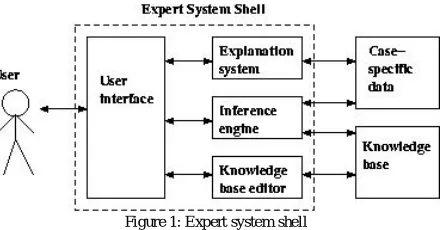
To make intelligent programs and applications led to the development of expert system using domain knowledge of knowledge engineers. The process of building expert systems is called Knowledge Engineering. It typically involves a special form of interaction between the expert system builders called knowledge engineers and one or more human experts in the problem area. The knowledge engineer with discussion and communication techniques “extracts” from the human experts their procedures, strategies, and builds this knowledge into the Expert System as shown below
Figure 1: Expert system shell
1. Knowledge base: An expert system tool that provides the measure to extract and develop the knowledge representation with objects. The example being in PROLOG the knowledge is represented as logical statements. 2. Reasoning engine:The important mechanism for the interference mechanisms and reasoning of the knowledge
and its database for symbolic information and knowledge in the knowledge base to form a line of reasoning in solving a problem.
3. Knowledge acquisition subsystem:An important knowledge based system for collection of knowledge and to remove the bottleneck between the domain engineer and the working functionality of knowledge engineer.
4. Explanation subsystem:The explanation to justify the existence of the system from the final to intermediate solution has to be arrived at.
5. User interface:An interface that acts like a communication tool for the expert system, artificial intelligence and the user using the system. It is now widely accepted that the user interface can make a critical difference in the perceived utility of a system regardless of the system's performance.
VI. FEATURES OF AN EXPERT SYSTEM
ISSN(Online): 2320-9801 ISSN (Print) : 2320-9798
I
nternational
J
ournal of
I
nnovative
R
esearch in
C
omputer
and
C
ommunication
E
ngineering
(An ISO 3297: 2007 Certified Organization)
Vol. 3, Issue 9, September 2015
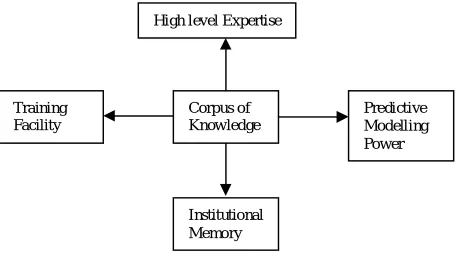
Figure 2: Features of expert system.
The most useful feature of an expert system is the domain expertise which is termed as high level expertise, it provides an important support for problem solving. This expertise can represent the best thinking of the level exerts in the field leading to the problem solutions that are imaginative, accurate and efficient.
The predictive modeling power and enhancing the theory related with domain helps the system to act as information processing theory or model of problem solving.
The center of knowledge defines the efficiency and proficiency of the expert system can provide an additional feature, institutional Memory
The expert systems provide learning, guiding and training facility as they are programmed with necessary knowledge and ability to explain the important reasoning process.
VII. BUILDING AN EXPERT SYSTEM
The main features and important attributes of an expert system are the expert system, the domain expert, the knowledge engineer, the expert system building tool and the user.
The Expert System is designed and developed to solve the important problem in domain for a specific area of interest. It is called a system as it is designed and developed with solving component and the support component.
The Domain expert is a person responsible for creating the data for the ware house on which the various data mining algorithms have to be applied for the development of an expert system.
The Knowledge Engineer is human, usually with a background in computer science and AI, who knows how to build an Expert Systems.
The expert system building tool is the programming language used by the knowledge engineer and helps the programmer to write the code.
The user is the human who uses the expert system once it is developed.
VIII. APPLICATIONS OF EXPERT SYSTEMS
The broad domain area exists for the applications of expert system, from the field of medicine, research for development of medicines, industrial atomization, and o solve the commercial problems which needs the experts at every instance.. The applications find their way into most areas of knowledge work. They are as varied as helping salespersons sell modular factory-built homes to helping NASA plan the maintenance of a space shuttle in preparation for its next flight.
High level Expertise
Corpus of Knowledge
Predictive Modelling Power
Institutional Memory Training
ISSN(Online): 2320-9801 ISSN (Print) : 2320-9798
I
nternational
J
ournal of
I
nnovative
R
esearch in
C
omputer
and
C
ommunication
E
ngineering
(An ISO 3297: 2007 Certified Organization)
Vol. 3, Issue 9, September 2015
IX. CONCLUSION
The expert system developed uses the brains of human intelligence with the power of artificial intelligence to speed up the working environment. Saving on the human experts are the important factor for the development of expert systems. For small systems, savings are sometimes in the tens or hundreds of thousands of rupees; but for large systems, often in the tens of millions of rupees and as high as hundreds of millions of rupees. The experts of the domain are required and they are considered at the higher level of applications till the implementation of expert system can be handled without the humans. ESs are used to preserve scarce know-how in organizations, to capture the expertise of individuals who are retiring, and to preserve corporate know-how so that it can be widely distributed to other factories, offices or plants of the company.
REFERENCES
[1] Neither Nikkei AI nor the JTEC panel know if the respondents have fielded systems or not. We must assume that some percentage of non-respondents have developed and/or fielded knowledge-based systems. Therefore, the figures quoted in the following discussion mustrepresent minima.http://www.wtec.org/loyola/kb/c2_s2.htm
[2] Anonymous. Dictionary of Computing, 1986, New York: Oxford University Press.
[3] Bishop, Peter. Fifth Generation Computers Concepts, Implementations& Uses, 1986, Chichester, England: Ellis Horwood Ltd. [4] Brule, James F. Artificial Intelligence: Theory, Logic and Application, 1986, Blue Ridge Summit, PA: TAB Books.
[5] Edwards, Alex and Connell, N.A.D. Expert Systems in Accounting, 1989, Herfordshire, UK: Prentice Hall International (UK) Ltd. [6] Forsyth, Richard, Expert Systems: Principles and Case Studies, 1984, London: Chapman and Hall Computing.
[7] Harmon, Paul and King, David. Expert Systems: Artificial Intelligence in Business. 1985, New York: Wiley. [8] Liebowitz, Jay, Introduction to Expert Systems, 1988, Santa Cruz, CA: Mitchell Publishing, Inc.
[9] Michaelsen, Robert H.; Michie, Donald and Boulanger, Albert. "The Technology of Expert Systems" Byte; April 1985; 10(4): pp. 303-312. [10] Rich, Elaine and Knight, Kevin. Artificial Intelligence Second Edition. 1991, New York: McGraw-Hill.
[11] Waterman, Donald A. A Guide to Expert Systems, 1986, Reading, MA: Addison-Wesley.