
ISSN(Online): 2320-9801
ISSN (Print): 2320-9798
I
nternational
J
ournal of
I
nnovative
R
esearch in
C
omputer
and
C
ommunication
E
ngineering
(An ISO 3297: 2007 Certified Organization)
Vol. 3, Issue 7, July 2015
Future’s Smart Objects in IOT, Based on
Big-Data and Cloud Computing Technologies
Sandeep Ravikanti, Gadasu Preeti
Assistant Professor, Dept of CSE, Methodist College of Engineering &Technology, Hyderabad, India
ABSTRACT: The Internet of Things (IoT)[1] is simply known "smart[3]". How does IoT affect and change the relation between humans and objects. The IoT introduces issues that lead us to turn a philosophical eye to those 50 billion objects which are predicted in near future: Big Data[6] flowing from sensors[7] and other smart devices[3], RFID[2], IPV6[2], cloud computing[7]. like technology trends , Security, Privacy and other important technological challenges such as Arrive and operate[2], Interoperability, Software complexity and many more challenges of smart objects used in everyday life. This paper discusses the basics, architecture, the challenges, applications, and building blocks of the ―Internet of Things‖[1] The full deployment of the IoT is likely to bring about a set of new issues such as the autonomy of humans in a world where smart objects that make a ratio of 1: 10; the 'right to be forgotten' in a scenario of billions of things exchanging one's data; trust in the things that will decide on behalf of the humans or for them. Finally, as IoT evolves through a combination of big data and cloud computing.
KEYWORDS: Sensors, RFID, IPV6, cloud computing, big-data, MDM.
I. INTRODUCTION
Imagine a world where billions of objects can sense, communicate and share information, all interconnected over public or private Internet Protocol (IP)[1] networks. These interconnected objects have data regularly collected, analyzed and used to initiate action, providing a wealth of intelligence for planning, management and decision making. This is the world of the Internet of Things (IOT)[2]. The Internet of Things (IoT) is a technological revolution that represents the future of computing and communications. Its development depends on the dynamic technical innovation in a number of important fields, from wireless sensors to nanotechnology. The concept of the IoT comes from Massachusetts Institute of Technology (MIT)’s Auto-ID[9] Center in 1999. The MIT Auto-ID Laboratory is dedicated to create the IoT using Radio Frequency Identification (RFID)[4] and Wireless Sensor Networks[3]. IoT is a foundation
for connecting things, sensors, actuators, and other smart technologies, thus enabling Machine to machine, machine to
infrastructure, machine to environment communications. A new dimension has been added to the world of Information and Communication Technologies (ICTs)[4]: anyone can access the information from anywhere, any device anytime
what you want? It’s happening, and its potential is huge. We see the IoT as billions of smart, connected ―things‖ (Includes People, Location (of objects) ,Time Information (of objects) ,Condition (of objects))that will encompass every aspect of our lives, and its foundation is the intelligence that embedded processing provides. The IoT is comprised of smart machines interacting and communicating with other machines, objects, environments and infrastructures. As a result, huge volumes of data are being generated, and that data is being processed into useful actions that can ―command and control‖ things to make our lives much easier and safer—and to reduce our impact on the environment.
ISSN(Online): 2320-9801
ISSN (Print): 2320-9798
I
nternational
J
ournal of
I
nnovative
R
esearch in
C
omputer
and
C
ommunication
E
ngineering
(An ISO 3297: 2007 Certified Organization)
Vol. 3, Issue 7, July 2015
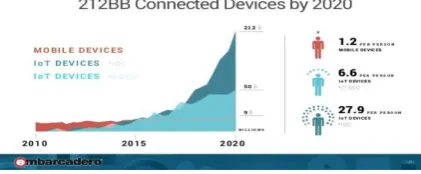
So now many people are concentrating on the phrase ―Internet of Things‖ which refers to general idea of things specially the objects which we are using in our daily life are readable, recognizable, locatable, addressable, and/or controllable via the Internet, irrespective of the communication means[1]. Everyday objects include not only the electronic devices we encounter or the products of higher technological development such as vehicles and equipment but things that we do not ordinarily think of as electronic at all - such as food and clothing. These ―things[3]‖ of the real world shall seamlessly integrate into the virtual world, enabling anytime, anywhere connectivity. In 2010, the number of everyday physical objects and devices connected to the Internet was around 12.5 billion. Cisco forecasts that this figure is expected to double to 25 billion in 2015 as the number of more smart devices per person increases, and to a further 50 billion by 2020[10].
Figure 1 number of connected devices to internet by 2012
1.1 IOT Architecture
IOT architecture consists of different technologies in different layers these technologies will provide support to IOT and all these technologies related to each other and communicate the scalability, modularity and configuration of IOT deployments in different cases[2].The below IOT architecture shows the functionality of each and every layer. This architecture mainly consists of three layers [2].
Reference image is taken form ref [2]
1. Applications layer: this is the top layer in iot architecture .it layer mainly deals with the different applications of IOT[1] where smart devices are in widely use like home automation, health care, intelligent communication, industry automation, government sector, fleet management etc.
2. Networking layer: This layer acts as interface between sensor and application layer. This layer again sub divided into two layers they are
ISSN(Online): 2320-9801
ISSN (Print): 2320-9798
I
nternational
J
ournal of
I
nnovative
R
esearch in
C
omputer
and
C
ommunication
E
ngineering
(An ISO 3297: 2007 Certified Organization)
Vol. 3, Issue 7, July 2015
A) Gateways and Network Layer: Massive volume of data will be produced by these tiny sensors and this requires a robust and high performance wired or wireless network infrastructure as a transport medium. Current networks, often tied with very different protocols, have been used to support machine-to-machine (M2M)[3] networks and their applications. With demand needed to serve a wider range of IOT services and applications such as high speed transactional services, context-aware applications, etc, multiple networks with various technologies and access protocols are needed to work with each other in a heterogeneous configuration. These networks can be in the form of a private, public or hybrid models[4] and are built to support the communication requirements for latency, bandwidth or security. A possible deployment could consist of a converged network infrastructure that resolves the fragmentation by integrating disparate networks into a single network platform. Converged network layer abstraction allows multiple organizations to share and use the same network independently for their information to be routed without compromising their privacy, security and performance requirements. Each organization thus utilizes the network as if it is a private network resource to them.
B) Management Service Layer: The management service renders the processing of information possible through analytics, security controls, process modeling and management of devices[2]. One of the important features of the management service layer is the business and process rule engines[1]. IOT brings connection and interaction of objects and systems together providing information in the form of events or contextual data such as temperature of goods, current location and traffic data. Some of these events require filtering or routing to post-processing systems such as capturing of periodic sensory data, while others require response to the immediate situations such as reacting to emergencies on patient’s health conditions [8]. The rule engines support the formulation of decision logics and trigger interactive and automated processes to enable a more responsive IOT system. In the area of analytics, various analytics tools are used to extract relevant information from massive amount of raw data and to be processed at a much faster rate. Analytics such as in-memory analytics allows large volumes of data to be cached in random access memory (RAM) rather than stored in physical disks[4]. In-memory analytics reduces data query time and augments the speed of decision making. Streaming analytics is another form of analytics where analysis of data, considered as data-in-motion, is required to be carried out in real time so that decisions can be made in a matter of seconds. For example, this requirement is typical in the transportation sector where real-time traffic information enables drivers to optimize their routes and travelling times. Analytics can be carried out at other layers within the IOT architecture [2]. For example, analytics may be carried out in the smart object layer, i.e., local hub or edge device, so that subsets of the information can be carried through the network for further processing. At this layer, analytics helps to reduce the stress placed on the network layer, reduce power needs of sensors by less frequent communication backend and allow faster responses to data received by the sensors. Data management is the ability to manage data information flow. With data management in the management service layer, information can be accessed, integrated and controlled.
ISSN(Online): 2320-9801
ISSN (Print): 2320-9798
I
nternational
J
ournal of
I
nnovative
R
esearch in
C
omputer
and
C
ommunication
E
ngineering
(An ISO 3297: 2007 Certified Organization)
Vol. 3, Issue 7, July 2015
Figure 3.IOT architecture with example devices in each layer [10]
II. RELATED WORK
From ref[2] Moving into the future, RFID has the potential to provide streams of data that will provide information systems with real-time, item-specific data and be flexible enough to be placed in extremely small spaces and locations, i.e., coil-on-chip technology. With technology developments in areas such as chip design, energy usage and preservation, RF[4] technologies and manufacturing, new ways of RFID usage will emerge for applications such as automatic meter reading, remote home automation and real-time vehicle tracking. Neither the buzzword nor the concept of the "Internet of things"[1] is new. Since the Internet emerged back in the 1990s (and before), we found it interesting to connect Coke machines and coffee pots, among other items. These days, everything comes with some kind of network connection option. This includes our thermostats, TVs, refrigerators, and even coffee makers. The real progress is being made in the area of industrial equipment, such as those sold by GE and other manufacturers that have pushed this concept in the last few years.
The idea is to go beyond simple monitoring of these, well, things, to advanced analytical services(like Big-Data) that let devices provide critical information about how they are functioning and what they are doing. That, in turn, let’s automated corrective action take place based on remote analysis of this data. The more "things" that we connect the greater use of cloud computing and Big-Data analytics. The cloud, Big-data[7] and the things are tightly coupled in the ―Internet of things”.
With the help of special-purpose clouds and Big-Data tools we can focus on connecting devices and machines. They'll gather data quickly, likely streaming off devices with very little structure, as well as performing quick analysis of the data with the ability to instantly respond to the device by considering all these we wrote one paper related to smart objects future in coming years. This is perhaps the most interesting aspect of cloud computing. Our ability to connect pretty much anything lets us operate devices that have much more intelligence than machines from just a few years ago. These smart devices operate more effectively and can even self-repair. So we are saying the use of the cloud and Big-Data will play an important role in every human life in coming generations.
III. TECHNOLOGIES USED TO SHAPE INTERNET OF THINGS
1. Smart Objects: A Smart Object [3] is an object that enhances the interaction with not only people but also with other Smart Objects. It can not only refer to interaction with physical world objects but also to interaction with virtual (computing environment) objects. A smart physical object may be created either as an artifact or manufactured product or by embedding electronic tags such as RFID[2] tags or sensors into non-smart physical objects. Smart virtual objects are created as software objects that are intrinsic when creating and operating a virtual or cyber world simulation or game. The concept of a smart object has several origins and uses. There are also several overlapping terms, like Smart device, Tangible Object or Tangible User Interface and Thing as in the Internet of Things. Characteristics of smart objects[3]:
1. Humans use models of smart objects situated in the physical world to enhance human to physical world interaction;
versus how
2. Smart physical objects situated in the physical world can model human interaction in order to lessen the need for
ISSN(Online): 2320-9801
ISSN (Print): 2320-9798
I
nternational
J
ournal of
I
nnovative
R
esearch in
C
omputer
and
C
ommunication
E
ngineering
(An ISO 3297: 2007 Certified Organization)
Vol. 3, Issue 7, July 2015
3. Virtual smart objects by modeling both physical world objects and modeling humans as objects and their subsequent
interactions can form a predominantly smart virtual object environment.
2. Radio Frequency Identification (RFID)
Radio Frequency Identification (RFID)[1][2] technology is of particular importance to IOT as one of the first industrial realizations of IOT is in the use of RFID technology to track and monitor goods in the logistics and supply chain sector. RFID frequency bands range from 125 kHz (low frequency/LF) up to 5.8 Ghz/super high frequency (SHF)[4] and the tags have at least three basic components:
- The chip holds information about the object to which it is attached and transfers the data to reader wirelessly via an air interface.
- The antenna allows transmission of the information to/from a reader.
- The packaging encases chip and antenna, and allows the attaching of the tag to an object for identification. Today, the one dimension bar (ID) code has made a significant contribution to the supply chain and other businesses such as asset management. Two dimension (2D) bar codes have provided a richer source of data but, once printed, are not up-datable. RFID, with its ability to permanently collect and process data in its environment, is proving to be the next technology for the identification of goods. Many industry verticals, especially in the logistics and supply chain, have been using RFID[2] as tagging solutions to improve their tracking and monitoring processes. Moving into the future, RFID has the potential to provide streams of data that will provide information systems with real-time, item-specific data and be flexible enough to be placed in extremely small spaces and locations, i.e., coil-on-chip technology. With technology developments in areas such as chip design, energy usage and preservation, RF technologies and manufacturing, new ways of RFID usage will emerge for applications such as automatic meter reading, remote home automation and real-time vehicle tracking.
3. Internet Protocol version 6 (IPv6) The IPv4[2] address pool is effectively exhausted, according to industry accepted indicators. The final allocations under the existing framework have now been made, triggering the processes for the Internet Assigned Numbers Authority (IANA) to assign the final five IPv4/8 blocks, one to each of the five regional registries. With the exhaustion of the IANA pool of IPv4 addresses, no further IPv4 addresses can be issued to the regional registries that provide addresses to organizations. IPv6 is the next Internet addressing protocol that is used to replace IPv4. With IPv6[1][2], there are approximately 3.4×1038 (340 trillion trillion trillion) unique IPv6 addresses, allowing the Internet to continue to grow and innovate. Given the huge number of connected devices (50 billion), IPv6 can potentially be used to address all these devices (and systems), eliminating the need of network address translation (NAT) [4]and promoting end-to-end connectivity and control. These features provide seamless integration of physical objects into the Internet world.
4. Security and Privacy: Today, various encryption and authentication technologies such as Rivest Shamir Adleman (RSA)[2] and message authentication code (MAC) protect the confidentiality and authenticity of transaction data as it ―transits‖ between networks. Encryptions such as full disk encryption (FDE)[1] is also performed for user data ―at rest‖ to prevent unauthorized access and data tampering.
For data privacy, policy approaches and technical implementations exist to ensure that sensitive data is removed or replaced with realistic data (not real data). Using policy approaches, Data Protection Acts are passed by various countries such as the USA and the European Union to safeguard an individual's personal data against misuse. For technical implementations, there are Privacy Enhancing Techniques (PETs) [2]such as anonymisation and obfuscation to de-sensitize personal data. PETs use a variety of techniques such as data substitution, data hashing and truncation to break the sensitive association of data, so that the data is no longer personally identifiable and safe to use. For example, European Network and Information Security Agency (ENISA)[4] has proposed to approach data privacy by design22, using a ―data masking‖ platform which uses PETs to ensure data privacy.
IV. TECHNOLOGICAL CHALLENGES RELATED TO IOT
ISSN(Online): 2320-9801
ISSN (Print): 2320-9798
I
nternational
J
ournal of
I
nnovative
R
esearch in
C
omputer
and
C
ommunication
E
ngineering
(An ISO 3297: 2007 Certified Organization)
Vol. 3, Issue 7, July 2015
Arrive and operate: Smart everyday objects should not be perceived as computers that require their users to configure and adapt them to particular situations. Mobile things[2], which are often only sporadically used, need to establish Connections spontaneously, and organize and configure themselves to suit their particular environment.
Interoperability: Since the world of physical things is extremely diverse, in an Internet of Things each type of smart object is likely to have different information, processing and communication capabilities. Different smart objects would also be subjected to very different conditions such as the energy available and the communications bandwidth required. However, to facilitate communication and cooperation, common practices and standards are required. This is particularly important with regard to object addresses. These should comply with a standardized schema if at all possible, along the lines of the IP standard [2] used in the conventional Internet domain.
Discovery: In dynamic environments, suitable services for things must be automatically identified, which requires appropriate semantic means of describing Their functionality. Users will want to receive product-related information, and will want to use search engines that can find things or provide information about an object’s state.
Software complexity: Although the software systems in smart objects will have to function with minimal resources, as in conventional embedded systems, a more extensive software infrastructure will be needed on the network and on background servers in order to manage the smart objects and provide services to support them.Data volumes: While some application scenarios will involve brief, infrequent communication, others, such as sensor networks, logistics and large-scale ―real-world awareness‖ scenarios, will entail huge volumes of data on central network nodes or servers.
Security and personal privacy: In addition to the security and protection aspects of the Internet with which we are all familiar (such as communications confidentiality, the authenticity and trustworthiness of communication partners, and message integrity), other requirements would also be important in an Internet of Things. We might want to give things only selective access to certain services, or prevent them from communicating with other things at certain times or in an uncontrolled manner; and business transactions involving smart objects would need to be protected from competitors’ prying eyes[1].
V. WAYS THE INTERNET OF THINGS WILL CHANGE THE WAY WE WORK
The "Internet of Things" (IoT) may sound like the futuristic wave of talking refrigerators and self-starting cars, but Internet-connected devices that communicate with one another will affect our lives outside the "smart home[8]" as well. For workers, IoT[1] will change the way we work by saving time and resources and opening new opportunities for growth and innovation[5].
1. Know where everything is, all the time
"IoT has the potential to make the workplace life and business processes much more productive and efficient [5]‖ One significant way IoT will increase productivity and efficiency is by making location tracking much simpler and seamless. As currently done in hospitals, Internet-connected equipment and devices will all be geographically tagged, which will save workers time hunting things down and save money by reducing the loss rate. "Companies can track every aspect of their business, from managing and fulfilling orders as quickly as possible to locating and deploying field service staff. Tools and factories and vehicles will all be connected and reporting their locations [8]‖.
2. Get anywhere faster IoT is the next big thing in your daily commute. The interconnectivity of mobile devices, cars and the road you drive on will help reduce travel time, thus enabling you get to work faster or run errands in record time.Today, the "connected car" is just the start of IoT capability. "AT&T, together with automotive manufacturers such as GM and BMW, are adding LTE connectivity
ISSN(Online): 2320-9801
ISSN (Print): 2320-9798
I
nternational
J
ournal of
I
nnovative
R
esearch in
C
omputer
and
C
ommunication
E
ngineering
(An ISO 3297: 2007 Certified Organization)
Vol. 3, Issue 7, July 2015
3. Cheaper, greener manufacturing
Thanks to IoT, device interconnectivity will facilitate the adoption of "smart grid" technologies, which use meters, sensors and other digital tools to control the flow of energy and can integrate alternative sources of power, such as solar and wind."The Internet of Things[2] will drastically lower costs in the manufacturing business by reducing wastage, consumption of fuel and the discarding of economically unviable assets," Namie said. "IoT can also improve the efficiency of energy production and transmission and can further reduce emissions by facilitating the switch to renewable[5]."
4. Completely remote mobile device management (MDM)
IT departments may have remote access to computers and mobile devices, but IoT will also enable remote control of other Internet-connected devices, said Roy Bachar, founder and chief executive officer of MNH Innovations and member of the Internet of Things Council.Bachar, who also works with CommuniTake, a startup that provides remote-access technology, said that the cutting-edge technology that has given them full control over smart phones and tablets now allows remote management over other devices, including Android cameras and set-top boxes, among others. Soon[4], MDM technologies will extend to the remote management of IoT devices, which will introduce changes for IT departments and IoT connected employees."It's clear that the telecommunication giants will play a major role in the IoT domain and they are all introducing solutions. I believe that as early 2014, we will see the introduction of platforms for managing the IoT applications as well as solutions offered by companies, such as CommuniTake, for remote management of IOT devices [1]‖.
5. Increased device management complexity
As the number of connected devices grows, so does the complexity of managing them. For instance, today workers use smart phones for communication, productivity and entertainment. With IoT, they will have an additional function: controlling IoT-connected devices. "Many of the future IoT-connected devices will not have a screen. The way to take control over the device will be via smart phones"."The complexity will also increase due to the variety of operating systems," he added. Thus, employees and IT departments will have a broader range of platforms to deal with, not just Android or iOS.Both of these instances may require training for employees to learn how to control and manage connected, cross-platform devices [2].
6. Save time and get more out of your day Other than controlling other IoT devices, your smartphone will also be much like a remote control for your life, said Brendan Richardson, co-founder and chief executive officer of PsiKick, a Charlottesville, Va.-based startup that develops IoT wireless sensors.One of the most convenient aspects of IoT is that you have devices that "know" you and will help save time by allowing you to get in and out of places and conduct transactions faster using a mobile device[5]."The iPhone or Android will increasingly interact with a whole range of sensors that you never see and don't own, but which provide your smartphone with valuable information and act on your behalf through an app,".With these sensors, even just getting your morning coffee will eliminate the need to wait in line for a less stressful start to your day. For instance, wireless sensors can detect when you walk into a Starbucks, which alert the barista of your likely order based on your order history. You can then confirm or choose a different order, and then pay for it using your phone.
V. INTERNET OF THINGS AND BIG DATA
ISSN(Online): 2320-9801
ISSN (Print): 2320-9798
I
nternational
J
ournal of
I
nnovative
R
esearch in
C
omputer
and
C
ommunication
E
ngineering
(An ISO 3297: 2007 Certified Organization)
Vol. 3, Issue 7, July 2015
IoT Needs Big Data
While larger enterprises like Coca-Cola, General Electric [8], and Domino’s Pizza have managed to tap into its value, most businesses will have to wait some time before they can really enjoy the advantages of embedded sensor technology. In the meantime, it’s imperative that those businesses prepare by adopting a big data strategy – and looking into analytics technology. Big Data [6] capacity is, in essence, a prerequisite to tapping into the Internet of Things. Without the proper data-gathering in place, it’ll be impossible for businesses to sort through all the information flowing in from embedded sensors. What that means is that, without Big Data, the Internet of Things can offer an enterprise little more than noise [6].
VI. INTERNET OF THINGS AND CLOUD COMPUTING
ISSN(Online): 2320-9801
ISSN (Print): 2320-9798
I
nternational
J
ournal of
I
nnovative
R
esearch in
C
omputer
and
C
ommunication
E
ngineering
(An ISO 3297: 2007 Certified Organization)
Vol. 3, Issue 7, July 2015
But it’s not just you who needs this cloud. Manufacturers do too. In the shower gel example, there are lots of insights that can be gleaned from this, for example how long does it take the average person to get through a bottle of the stuff, will that person buy the same brand again, the same bottle size again, or does he or she prefer something different? Using these insights, retailers and manufacturers will come up with customized special offers for certain types of people, and deliver these to their Smartphone in time for when they go shopping later that afternoon.Such insights can only be extracted using Big Data technologies, and cloud solutions will be an essential partner to this. Cloud software[7] is the only technology capable of handling this data and delivering it where it needs to be in real time.The Internet of Things[2] still has some way to go before we reach this point, but it’s getting there and cloud computing will be driving it every step of the way.
VIII. REAL LIFE APPLICATIONS OF IOT WITH BIG-DATA AND CLOUD
1. Smart home: Smart Home clearly stands out, ranking as highest Internet of Things application on all measured channels. More than 60,000 people currently search for the term ―Smart Home[3]‖ each month. This is not a surprise. The IoT Analytics company database for Smart Home includes 256 companies and startups. More companies are active in smart home than any other application in the field of IoT. The total amount of funding for Smart Home startups currently exceeds $2.5bn. This list includes prominent startup names such as Nest or AlertMe as well as a number of multinational corporations like Philips, Haier, or Belkin.
2. Wearable’s: Wearables [8] remain a hot topic too. As consumers await the release of Apple’s new smart watch in April 2015, there are plenty of other wearable innovations to be excited about: like the Sony Smart B Trainer, the Myo gesture control, or Look See bracelet. Of all the IoT startups, wearable maker Jawbone is probably the one with the biggest funding to date. It stands at more than half a billion dollars!
3. Smart City: Smart city spans a wide variety of use cases, from traffic management to water distribution, to waste management, urban security and environmental monitoring. Its popularity is fueled by the fact that many Smart City [8] solutions promise to alleviate real pains of people living in cities these days. IoT solutions in the area of Smart City solve traffic congestion problems, reduce noise and pollution and help make cities safer.
4. Smart grids: Smart grids are a special one[2]. A future smart grid promises to use information about the behaviors of electricity suppliers and consumers in an automated fashion to improve the efficiency, reliability, and economics of electricity. 41,000 monthly Google searches highlight the concept’s popularity. However, the lack of tweets (Just 100 per month) shows that people don’t have much to say about it.
5. Industrial internet: The industrial internet is also one of the special Internet of Things applications. While many market researches such as Gartner or Cisco[8] see the industrial internet as the IoT concept with the highest overall potential, its popularity currently doesn’t reach the masses like smart home or wearable do. The industrial internet however has a lot going for it. The industrial internet gets the biggest push of people on Twitter (~1,700 tweets per month) compared to other non-consumer-oriented IoT concepts [4].
6. Connected car: The connected car is coming up slowly. Owing to the fact that the development cycles in the automotive industry typically take 2-4 years, we haven’t seen much buzz around the connected car yet. But it seems we are getting there. Most large auto makers as well as some brave startups are working on connected car solutions. And if the BMWs and Fords of this world don’t present the next generation internet connected car soon, other well-known giants will: Google, Microsoft, and Apple have all announced connected car platforms [8].
ISSN(Online): 2320-9801
ISSN (Print): 2320-9798
I
nternational
J
ournal of
I
nnovative
R
esearch in
C
omputer
and
C
ommunication
E
ngineering
(An ISO 3297: 2007 Certified Organization)
Vol. 3, Issue 7, July 2015
8. Smart retail: Proximity-based advertising as a subset of smart retail is starting to take off. But the popularity ranking shows that it is still a niche segment. One LinkedIn post per month is nothing compared to 430 for smart home.
9. Smart supply chain: Supply chains have been getting smarter for some years already. Solutions for tracking goods while they are on the road, or getting suppliers to exchange inventory information have been on the market for years. So while it is perfectly logic that the topic will get a new push with the Internet of Things, it seems that so far its popularity remains limited.
10. Smart farming: Smart farming is an often overlooked business-case for the internet of Things because it does not really fit into the well-known categories such as health, mobility, or industrial. However, due to the remoteness of farming operations and the large number of livestock that could be monitored the Internet of Things could revolutionize the way farmers work. But this idea has not yet reached large-scale attention. Nevertheless, one of the Internet of Things applications that should not be underestimated. Smart farming [8] will become the important application field in the predominantly agricultural-product exporting countries.
IX. CONCLUSION
In conclusion, Internet of Things is the concept in which the virtual world of information technology connected to the real world of things. The technologies of Internet of things such as RFID [2] and Sensor make our life become better and more comfortable. This paper discusses the Internet of Things which is one of the upcoming concepts in the field of Internet. We analyzed the general architecture, challenges of IOT, ways the IOT change our way of work, and real life applications that can be used to implement internet of things and the actual technologies that can be used to implement IOT like RFID, IPV6[1]. We also found relationship between big data [6] and Internet of things and Cloud Computing [7] and Internet of things how these two fields related to each other.
REFERENCES
[1].https://www.ida.gov.sg/~/media/Files/Infocomm%20Landscape/Technology/TechnologyRoadmap/InternetOfThings.pdf [2].http://www.freescale.com/files/32bit/doc/white_paper/INTOTHNGSWP.pdf
[3].https://en.wikipedia.org/wiki/Smart_objects
[4].https://en.wikibooks.org/wiki/A_Bit_History_of_Internet/Chapter_8_:_Internet-of-Things [5].http://www.businessnewsdaily.com/4858-internet-of-things-will-change-work.html
[6].http://www.datamation.com/applications/why-big-data-and-the-internet-of-things-are-a-perfect-match.html [7].http://siliconangle.com/blog/2013/07/17/cloud-computing-the-internet-of-things-go-hand-in-hand/ [8].http://iot-analytics.com/10-internet-of-things-applications/
[9].http://internetofthingsphilosophy.com/keynote-speakers/ [10]https://www.googleimags.com
[11]http://www.infoworld.com/article/2608029/cloud-computing/the-cloud-is-the-secret-weapon-in-the-internet-of-things.html
BIOGRAPHY
Sandeep Ravikanti received his Masters degree in Computer Science & Engineering in 2012 from HITAM College, Hyderabad, India. Presently, he is working as Assistant Professor in the Department Of CSE, Methodist College of engineering and technology Hyderabad, Telangana, India.
![Figure 3.IOT architecture with example devices in each layer [10]](https://thumb-us.123doks.com/thumbv2/123dok_us/1481730.1181308/4.595.200.395.150.267/figure-iot-architecture-example-devices-layer.webp)
