An Efficient Implementation of Area Reduced
S-MB Fused Add-Multiply Operator
Revathy S Kumar
1, Subin Suresh
2PG Student [Applied Electronics], Dept. of ECE, Ilahia College of Engineering, Muvattupuzha, Kerala, India1
Assistant professor, Dept. of ECE, Ilahia College of Engineering, Muvattupuzha, Kerala, India2
ABSTRACT: Electronic circuits comprises of complex arithmetic units, one such field is DSP applications. Multiplier is the base of any arithmetic circuits. A system performance is generally determined by the performance of the multiplier. Recent research activities in the field of arithmetic optimization combining operation which share date lead to significant performance improvement. The proposed optimized design of Add Multiply operator is based on the fusion of the adder and MB encoding unit into a single datapath block. For the design of Fused Add Multiply (FAM) unit different recoding techniques are introduced(SMB1,SMB2,SMB3) for the odd and even bit width of input. These techniques are used to implement direct recoding of sum of two numbers in the Modified Booth Form. Modified Booth Form are mainly used in multiplier, it reduce the number of partial products into half. By comparing the proposed recoding techniques with existing one , the proposed system yields considerable reduction in terms of area . The proposed FAM unit is coded in Verilog, simulated and synthesized using Xilinx tool.
KEYWORDS: Modified Booth Recoding ,Adder, Multiplier.
I.INTRODUCTION
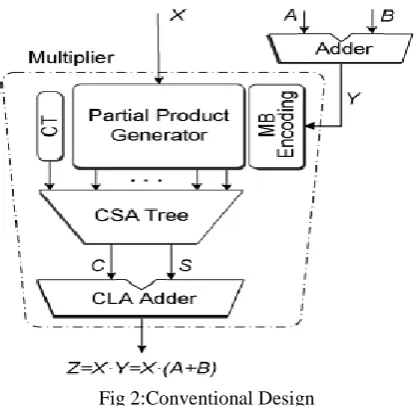
Multiplier are the basic elements of an arithmetic unit. One such field is digital signal processing application such as fast fourier transform, filtering , convolution etc. Thus multiplier optimization in terms of area and speed is a major concern for digital designs. A system performance is generally determined by the performance of the multiplier because the multiplier is generally the slowest element in all system and also it is occupying more area consuming. Recent research activities in the field of arithmetic optimization shown that the design of arithmetic components combining operation which share data lead to significant performance improvement [1],[2],[3]. Based on the observation Multiply- Accumulator (MAC) [4-6] and Multiply- Add (MAD) units where introduced. Except the MAC/MAD operations, many DSP applications are based on Add- Multiply (AM) operations. The straight forward architecture of AM unit by first allocating an adder then driving its output to the input of a multiplier. An optimized design of the AM operator is based on the fusion of the adder and the Modified Booth encoding unit into a single data path block. The FAM component contain only one adder. As a result significant area saving is observed and the critical path delay of the recoding process is reduced. To optimize the design of AM operator, the direct recoding of the sum of two numbers in its Modified Booth (MB) form are introduced [7],[8],[9],[10]. The direct recoding of the sum of two numbers in its MB form gives an efficient implementation of the fused Add Multiply operator.
II.RELATED WORK
ISSN(Online): 2320-9801
ISSN (Print): 2320-9798
I
nternational
J
ournal of
I
nnovative
R
esearch in
C
omputer
and
C
ommunication
E
ngineering
(An ISO 3297: 2007 Certified Organization)
Vol. 3, Issue 10, October 2015
an adder and then driving its output to the input of a multiplier, increases significantly both area and critical path delay of the circuit.
III. FUSED ADD MULTIPLY OPERATOR
An optimized design of an Add Multiply operator is based on the fusion of the adder and the MB encoding unit into a single data path block, by direct recoding of the sum to its MB representation . The direct recoding of the sum of two numbers in its MB form leads to more efficient implementation of the Fused Add Multiply (FAM). Unit compared to the conventional one. In this work, we present three new technique for direct recoding of sum of two numbers in the MB representation.
1. SMB 1 2. SMB 2 3. SMB 3
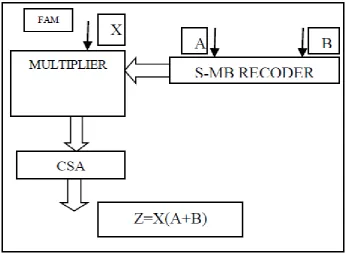
Fig 1.represents the fused design of AM operator
Fig 1:Fused Add Multiply Operator
Fig 2:Conventional Design
III. MODIFIED BOOTH RECODER
Modified Booth (MB) is a prevalent form used in multiplication. It is a redundant signed digit radix-4 encoding technique. Its main advantage is that it reduces the number of partial products by half in multiplication comparing to radix-2 representation.
Let us consider the multiplication of two numbers X & Y with each number consisting of n=2K bits. The multiplicand Y can be represented in MB form as:
YjMB = 2Y2j+1 + Y2j + Y2j-1 (1)
Digits Yj MB
∑ { -2,-1,0,+1,+2}, 0 ≤ j ≤ k-1, correspond to the three consecutive bits Y2j+1 , Y2j & Y2j-1 with one bitoverlapped and considering that Y-1=0. Table 1 shows the Modified Booth encoding table. Each digit is represented by three bits named S, ONE , TWO. The sign bit S shows If the digit is negative (S=1) or positive (S=0). Signal ONE shows if the absolute value of a digit is equal to 1 (ONE=1) or not (ONE=0). Signal TWO shows if the absolute value of a digit is equal to 2 ( TWO = 1 ) or not (TWO = 0). Using these three bits we calculate the MB digits Yj
MB by the following relation:
YjMB= (-1)sj [ onej+ twoj] (2)
ISSN(Online): 2320-9801
ISSN (Print): 2320-9798
I
nternational
J
ournal of
I
nnovative
R
esearch in
C
omputer
and
C
ommunication
E
ngineering
(An ISO 3297: 2007 Certified Organization)
Vol. 3, Issue 10, October 2015
IV. FAM IMPLEMENTATION
The proposed system fuses the adder unit with multiplier to implement Z= X(A+B) operation which uses the MB encoding technique [11],[12],[13]. Where A and B are the inputs of the adder, whose output Y is driven as an input to the multiplier along with another input X as shown in fig 1.
In optimized AM operator design the adder unit is fused with MB encoding unit to form a single datapath unit. Three new techniques has been introduced to implement this FAM unit. In all techniques separate designs are implemented for an even and odd number of input bits. Three techniques are-
A) SMB1 Technique:
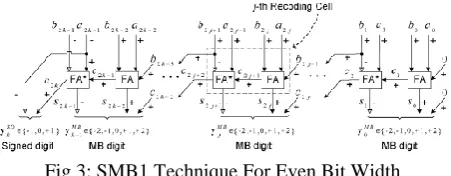
This technique uses two full adders to implement the design for odd and even width of bits stream. For the even number of bits two FAs are used as FA , a conventional full adder and FA* whose output value is given as:
FA*= -2co + s = p –q + ci .
Fig 3: SMB1 Technique For Even Bit Width
For odd bit-width an additional FA** is used at the endwhose output value is
FA**= -2co +s = -p –q +ci .
Fig 4:SMB1 Technique For Odd Bit Width
B) SMB2 Technique:
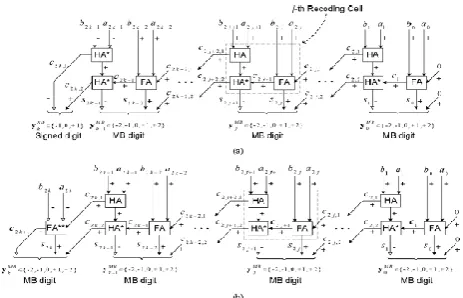
In this technique , for even bit-width a conventional full adder along with two half adders with the output value
HA*= - 2c +s = - p- q
Fig5:SMB2 Technique for (a)Even (b)Odd Number Of Bits
C) SMB3 Technique
:
Here in this proposed scheme for even bit-width of input numbers a conventional full adder along with three different half adders has been used where the half adders are conventional HA,HA* and HA**.HA** output value is
HA**= 2c – s = - p + q.
The odd bit-width input uses a conventional FA,HA andHA* along with and additional FA** at the end of the recoding scheme.
Fig 6: SMB3 Technique For (a)Even (b)Odd Number Of Bits
The output of the Sum-MB recoder , is the direct recoding of sum of two numbers in its MB representation. By using this gate level circuit (fig 7) MB encoding signals are generated that is, 𝑆𝑗, 𝑂𝑁𝐸𝑗,𝑇𝑊𝑂𝑗. Then the Booth decoder
ISSN(Online): 2320-9801
ISSN (Print): 2320-9798
I
nternational
J
ournal of
I
nnovative
R
esearch in
C
omputer
and
C
ommunication
E
ngineering
(An ISO 3297: 2007 Certified Organization)
Vol. 3, Issue 10, October 2015
Fig7:Gate Level Implementation For MB Encoding Signals
Fig8: Booth Decoders
Exact Compressor:
A 4-2 compressor consists of five inputs and three outputs. It is called compressor, since it compress four partial products into two. This can be implemented with two stages of full adders (FA) connected in series as shown in Fig.9
Fig9: Compressor
V. RESULT
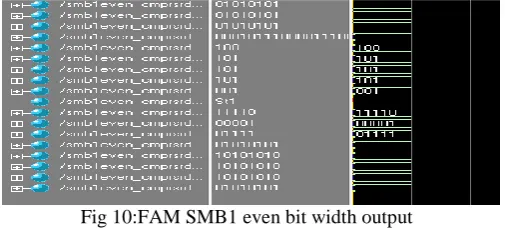
Fig 10: Shows the simulation result for SMB1, even number of input bits. In this paper We Consider 8 bit input A,B,X.
Fig 10:FAM SMB1 even bit width output
Fig 11: Shows the simulation result for SMB2, even number of input bits. In this paper We Consider 8 bit input A,B,X.
Fig 11:FAM SMB2 even bit width output
Fig 12: Shows the simulation result for SMB3, even number of input bits. In this paper We Consider 8 bit input A,B,X.
Fig 12:FAM SMB3 even bit width output
ISSN(Online): 2320-9801
ISSN (Print): 2320-9798
I
nternational
J
ournal of
I
nnovative
R
esearch in
C
omputer
and
C
ommunication
E
ngineering
(An ISO 3297: 2007 Certified Organization)
Vol. 3, Issue 10, October 2015
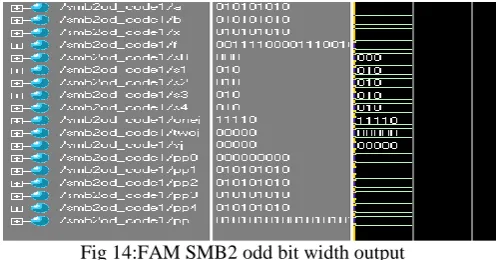
Fig 14: Shows the simulation result for SMB2, odd number of input bits. In this paper We Consider 9 bit input A,B,X.
Fig 14:FAM SMB2 odd bit width output
Fig 15: Shows the simulation result for SMB3, odd number of input bits. In this paper We Consider 9 bit input A,B,X.
Fig 15:FAM SMB3 odd bit width output
TABLE 2: Comparison Of Existing And Designed FAM
Conventional Existing Proposed Even Odd Even Odd Even Odd Area(Out of
1728 slices)
100 110 99 117 94 111
Delay (in ns)
53.0 55.1 47.5 49.9 51.9 47.9
VI.CONCLUSION
This paper focus on optimizing the design of the Fused-Add Multiply operator. Proposed system is based on the fusion of the adder and MB encoding unit into a single datapath block. Three different recoding techniques are introduced (SMB1,SMB2,SMB3). The techniques has been designed for the odd and even bit width of the input numbers. Thecomparison with the existing Modified Booth technique has shown an effective optimization in terms of area.
REFERENCES
[1] Kostas Tsoumanis , Sotiris Xydis , Nikos Moschopoulos , Kiamal Pekmestzi , “An Optimized Modified Booth Recoder For Efficient Design Of The Add-Multiply Operator”,IEEE Transactions On Circuits And Systemsi: Regular Papers,Vol. 61, No. 4, April 2014.
[4] O. Kwon, K. Nowka, and E. E. Swartzlander, “A 16-bit by 16-bitMAC design using fast 5: 3 compressor cells,” J. VLSI Signal Process. Syst., vol. 31, no. 2, pp. 77–89, Jun. 2002.
[5] L.-H. Chen, O. T.-C. Chen, T.-Y.Wang, and Y.-C. Ma, “A multiplication-
accumulation computation unit with optimized compressors and minimized switching activities,” in Proc. IEEE Int, Symp. Circuits andSyst., Kobe, Japan, 2005, vol. 6, pp. 6118–6121.
[6] Y.-H. Seo and D.-W. Kim, “A new VLSI architecture of parallel multiplier–accumulator based on Radix-2 modified Booth algorithm,” IEEE Trans. Very Large Scale Integr. (VLSI) Syst., vol. 18, no. 2, pp. 201–208, Feb. 2010.
[7] Wen-Chang Yeh and Chein-Wei Jen, “High-Speed Booth Encoded Parallel Multiplier Design” IEEE TRANSACTIONS ON COMPUTERS, VOL. 49, NO. 7, JULY 2000.
[8] O. L. Macsorley, “High-speed arithmetic in binary computers,” Proc. IRE, vol. 49, no. 1, pp. 67–91, Jan. 1961.
[9] R. Zimmermann and D. Q. Tran, “Optimized synthesis of sum-of-products,” in Proc. Asilomar Conf. Signals, Syst. Comput., Pacific Grove, Washington, DC, 2003, pp. 867–872.
[10] M. Daumas and D. W. Matula, “A Booth multiplier accepting both a redundant or a non redundant input with no additional delay,” in Proc. IEEE Int. Conf. on Application-Specific Syst., Architectures, and Processors,
2000, pp. 205–214.
[11] C. N. Lyu and D. W. Matula, “Redundant binary Booth recoding,” in Proc. 12th Symp. Comput. Arithmetic, 1995, pp. 50–57.
[12] J. D. Bruguera and T. Lang, “Implementation of the FFT butterfly with redundant arithmetic,” IEEE Trans. Circuits Syst. Il, Analog Digit.Signal Process., vol. 43, no. 10, pp. 717–723, Oct. 1996.