Secure Data Transmission by Combining
Genetic Algorithm and Steganography
Techniques with Visual Cryptography
Technique
Aayasha Kausar, Deepty Dubey
M.Tech scholar, Dept. of Co mputer Science & Engg..CSIT , Durg (C.G.), India
Associate Professor, Dept. of Co mputer Sc ience & Engg., CSIT, Durg (C.G.), India
ABSTRACT: Cryptography is a method of storing and transmitting data in a particular form so that only those for whom it is intended can read and process it. Steganography is method of hiding information behind multimedia file such as text, image, audio, video. The current work proposes a scheme that uses the combined approaches of Genetic Algorith m, Steganography, and Visual Cryptography for secure transmission of data over network. Genetic algorithm is used for encryption where plain text is converted into cipher text then it is hidden in LSB p ixe ls of an image using Steganography technique. Visual cryptography technique is then used to divide the image into mult iple shares to provide security and reliability for data transmission over network.
KEYWORDS: Cryptography, Genetic Algorith m, Steganography, Visual Cryptography.
I.INTRODUCTION
Security, integrity, non-repudiation, confidentiality, and authentication services are becoming the most challenging issues in today’s age of informat ion technology. For secure communicat ion means of electronic cryptography is used. Cryptography is concerned with encoding and decoding of information to ensure the security. [2]
A. GENETIC ALGORITHM
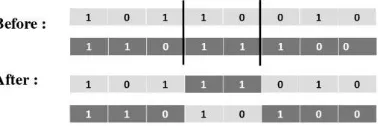
Genetic algorith ms are evolutionary algorithms based on the notion of natural selection [4]. A genetic algorithm has proven to be reliable and powerful optimizat ion technique in a wide variety of applications. It can be applied to both texts and images. Genetic algorith m is secure since it does not utilize the natural numbers directly. The res ults obtained for generating keys using genetic algorith m should be good in terms of coeffic ient of autocorre lation. Generally genetic algorith m has two basic functions namely Crossover and mutation [5]. Crossover is genetic process where random bits of parent genes are swapped in order to generate offspring . There are many types of crossover techniques such as single point crossover, two point crossovers, and uniform c rossover [6]. In this paper approach of two point crossover technique is used. Figure1 shows two point crossover approaches where child chromosomes are produced from parent chromosomes.
Mutation shows genetic diversity. In this process the generated offspring is having properties of both is parent chromosomes i.e. the genes of both the parents are randomly incorporated in t he offspring. There are many types of mutation such as flipping of b its, boundary mutation, uniform mutation and Gaussian mutation. In this paper flipping of bit technique is used.
B.VI SUAL CRYPTOGRAPHY
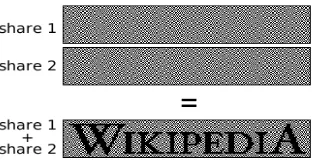
The basic idea of visual cryptography is that secret image is div ided into several parts called shares, whic h separately reveal no information about the secret image. By stacking these shares directly, secret image can be revealed. Visual cryptography is a new technique which provides information security which uses simple a lgorith m unlike the comple x, computationally intensive algorith m used in other technique like tradit ional cryptography. This technique allows Visual informat ion to be encrypted in such a way that their decryption can be performed by the human visual system, without any comple x cryptographic algorith ms [3].
Figure 2: Visual Cryptography Technique
We can achieve Visual Cryptography Scheme (VCS) by one of the following access structure schemes.
1. (2, 2) - Threshol d VCS scheme- This is a simp lest threshold scheme that takes a secret message and encrypts it in
two different shares .
2. (n, n) -Threshol d VCS scheme-This scheme encrypts the secret image to n shares such that when all n of the
shares are comb ined will the secret image be revealed.
3. (k, n) Threshol d VCS scheme- This scheme encrypts the secret image to n shares such that when any group of at
least k shares are overlaid the secret image will be revealed.
C.ST EGANOGRAPHY
Beco mes
01011100 11010001 00011100 10101100 11100110 10000110 01101010 11100011
II. LITERATUREREVIEW
Moni Naor and Adi Sha mir (1995) proposed visual cryptography technique. Visual cryptography scheme is perfectly secure and very easy to imp le ment. It e xtends image into a visual variant of k secret sharing problem. Any k of the m can see the image but any k-1 of the m ga in no information about it [1].
Dr. Dilbagh singh, Pooja Rani, Dr. Rajesh Ku mar (2013) suggested a genetic algorithm design for cryptography for enhancing the security. In the model the concept of genetic algorith m has been incorporated within cryptography algorith m to get an optimized solution and within minimu m possible time [7].
In the technique used by Sindhuja K, Pra me la Dev i S.(2014) the Symmetric Key encryption technique is combined with Genetic a lgorithm. The GA functions are applied on the intermediate c ipher to produce the final c ipher te xt. The proposed algorithm has basic two steps, substitution followed by genetic crossover and mutation [8].
Swati M ishra, Siddharth Bali (2013) presented public key cryptography using Genetic Algorith m. In this paper Pearson’s Coefficient of auto- correlation was used to calculate the fitness of key. Purely random and non- repeating final keys we re obtained by application of GA which increased the key strength and security [9].
Chandra mathi S., Ra mesh Ku mar R., Suresh R., and Harish (2010) presented an overview of v isual cryptography. In this paper they provide an overview of emerg ing Visual Cryptography (VC) and related security research work done in this area [3].
III. PROPOS EDMETHODOLOGY
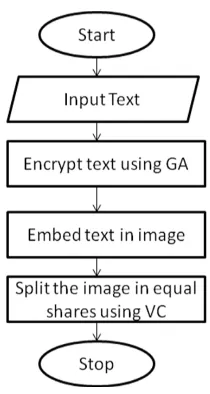
The data is first encrypted using advanced encryption technique using Genetic A lgorit h m. The encrypted data is then embedded in the image using Steganography. Multiple shares of single image a re created using Visual Cryptography technique. Until and unless the destination end or user has full share of images it’s hard to decrypt. Decryptiion process is reverse of it.
Figure 3: Advanced Encryption Technique
The proposed work will be div ided into following phases:
Phase1: Data encryption using Genetic Algorith m.
Phase2: Encrypted data hiding using LSB Steganography.
Phase3: Applying Visual cryptography for secure image and data transfer.
IV. CONCLUS ION
The proposed algorithm provides better result in terms of security. It is concluded that the security features of genetic algorithm are highly optimized using Steganography and visual cryptography. Visual cryptography also ensures the secure transmission of image over the internet. The future work could be toward adding public key encryption and also face recognition facility for the user to introduce more security.
REFERENCES