Available Online at www.ijcsmc.com
International Journal of Computer Science and Mobile Computing
A Monthly Journal of Computer Science and Information Technology
ISSN 2320–088X
IMPACT FACTOR: 6.017
IJCSMC, Vol. 8, Issue. 2, February 2019, pg.86 – 92
QoS-Aware Load Balancing Approach (QALBA) for
Task Scheduling and Resource Selection using
Enriched-Look ahead HEFT (E-LHEFT) Algorithm
K. Mohamed Sathik
Department of Computer Science, College of Arts and Sciences, Tanomah, King Khalid University, Abha, Saudi Arabia
Abstract— The present work discusses the service level agreement based optimization approach to satisfy both the mobile users and cloud service providers in the proposed MCC framework. The QoS-aware load balancing approach (QALBA) was implemented the task scheduling and resource selection using Enriched-Look ahead HEFT (E-LHEFT) algorithm by exploiting MAUI architecture and Pareto principle. The implementation results of the QALBA methodology with the baseline methods were presented.
Keywords— QALBA, MCC framework, E-LHEFT, MAUI architecture, Algorithm
I. INTRODUCTION
In MCC environment, the mobile application requires a high level of responsiveness, and it demands intensive computing resources in a mobile device to execute the sophisticated applications [1]. The remote execution and code offloading in MCC environment have created a significant impact on the capabilities of smartphones and availability of cloud remote servers. The major impacts on MCC framework related to local execution, computation offloading, and remote execution are load balancing, task scheduling, and resource selection. Load balancing is the process of balancing the load between schedulable tasks of mobile applications with selected cloud resources. Balancing the load between the tasks and resources are impacted from two broad main categories: task scheduling and resource allocation. Task scheduling in the mobile cloud is crucial for executing the requests of a similar application from multi-tenants. In resource allocation [2], the tasks are allocated to mobile core processors or available cloud resources. Task scheduling management increases resource consumption and reduces turnaround time during the task execution on a mobile device and the cloud. QoS is the mutual attempt of service performance that decides the user’s degree of satisfaction with a particular service. To preserve the device energy and improve the user experience, the QoS-aware load balancing approach (QALBA) implements task scheduling and resource selection using Enriched-Look ahead HEFT (E-LHEFT) algorithm by exploiting MAUI architecture and Pareto principle. Furthermore, this chapter presents the implementation results of the QALBA methodology with the baseline methods.
II. ANOVERVIEWOFEXISTINGLOADBALANCINGAPPROACHES
level of the mobile device for various cloud-based mobile applications. Genetic algorithm (GA) [6] based scheduling strategy achieves load balancing and reduces dynamic migration. HACAS [7] and PA-LBIMM [8] ensures in satisfying the users’ demand with high QoS and load balancing. GA, TS-QoS, and HACAS algorithms initially perform scheduling followed by the load balancing but do not consider concurrent monitoring system. The conventional Look ahead variation of the Heterogeneous Earliest Finish Time (L-HEFT) algorithm [9] schedules the tasks of an application using precedence requirements of the tasks. Resource selection depends on only EFT (Earliest Finish Time) value of each task and corresponding children tasks in the task graph. Look ahead algorithm reduces the makespan about 20% compared to the HEFT algorithm due to the consideration of the currently selected task and also upcoming tasks. The L-HEFT algorithm does not work on the feasibility of a higher look ahead depth of the mobile applications. Even though the existing task scheduling algorithms provide QoS and achieve load balancing in a stringent mobile cloud environment, many priorities based scheduling techniques affect the low priority of users. The scheduling strategy suffers by the uncertainty when there is the waiting time of the task is high in the queue. Also, the existing migration based load balancing after scheduling the task increases the processing delay. Pareto principle
Pareto principle based task-group-mapping of cloud resources maintains the load balancing based on the length of the task group and server utilization or current load on the server. Each application has the sequence of tasks that executes on cloud and mobile device. For instance, each offloaded move to the next position in a chess game is the task to the cloud. Several mobile users offload the tasks at the same time in which similar EFT of tasks is considered as a group for execution. In proposed QALBA approach, task grouping, and Pareto principle process simultaneously to select the PM resource for the task execution. The proposed approach divides the length of the task group as high and low. Similarly, utilization of PM is categorized into high and low utilization. Pareto principle depends on the 80/20 rule. The proposed algorithm states that 80% of the length of the task group schedules on 20% of PM utilization or load, and 20% of length of task group schedules on 80% of PM utilization or load. Hence, it maintains the load balance of all active servers while executing the application in a cloud environment.
E-LHEFT task scheduling algorithm for MCC
Input: List of input tasks
Output: Scheduled tasks with QoS and load balancing
Step 1: Initially assign task groups m=0
Step 2: Declare tasks of an application i= 0 to total number of tasks (TL_size)
Step 3: Declare cloud and mobile resources j= 0 to total number of available cloud resources (RL_size)
Step 4: Compare processing requirements of each task (TLENi) with threshold value (α)
If (TLENi > α) then tasks of an application as cloud tasks (TiC) or (TLENi < α) then tasks of an
application as mobile tasks (TiM)
//E-LHEFT task scheduling algorithm
Step 5: Rank tasks of an application using upward rank value of each cloud task RU(Ti) from DAG
For unscheduled tasks, find out highest RU (Ti) from {RU (Ti)} and put into selection priority variable
//Task grouping and Pareto principle based PM selection
Step 6: Assign children of selected cloud task to task list of an application {TL}
Step 7: Consider cloud tasks from {TL}
Step 8: Check total lower length of task group with total higher length of task
group {Total_GTLEN (L) ≤ Total_GTLEN (H)}
Groups current task and similar execution time of children tasks as GTLm
Splits GTLm into lower length task group GTLm (L) and higher length task
group GTLm (H)
Step 9: Consider all tasks to schedule and all resources
Step 10: Find expected load (utilization) of PM
Assign GTLm (L) → min (PMjU) ∀ active PMs
Assign GTLm (H) → max (PMjU) ∀ active PMs
// VM selection
Step 11: Calculate expected completion time of each task Ti (ECT)
Step 12: Consider length of task group GTLEN, file size and VM specification VMjS
Step 13: Check (GTLEN=VMjS && VMj (Ti (ECT)) ≤ VMjS) then
III.EXPERIMENTALEVALUATION
To demonstrate the importance of the proposed approach, numbers of experiments were carried out in a Cloud simulator environment. The proposed approach compares with existing algorithms such as GA, TS-QoS, Min-Min, and PA-LBIMM in a cloud environment. Furthermore, the proposed algorithm is compared with existing Green spot, EAPA and HACAS in a mobile cloud environment.
A. Experimental setup
MCC environment is highly dynamic in nature with a surplus amount of mobile user requesting the similar application at a time. In this proposed work, Cloud Sim tool simulates the task scheduling based grouping method and load balancing model of cloud resources. The simulation environment simulates mobile cloud framework by mobile user, mobile application model, and remote cloud server to run large scale mobile applications. Cloud executes the resource-intensive and compute-intensive tasks of an application on the remote server, and mobile executes the part of the task of an application based on mobile resource availability. The location of task processing varies according to the current task processing in mobile and cloud. The Cloud Information Service (CIS) provides the information about available cloud resources and resource name, ID, the total number of machines, total processing elements, and processing capability of each machine. Table 1 shows the simulation parameters and simulation values were used in experimental evaluation. Experimental setup considers 30 Chess OCR applications with various specifications and each application partitioned into the number of tasks with different length. Makespan of application ranges from 0 second to 1 second. The processing capabilities of PM resources vary between 1800, 2000, 4000, 6000 MIPS.
TABLEI SIMULATION SETUP
Simulation parameters Simulation value
Number of tasks 10-150
Input file size 10-1000MB
Average task length 250-12500KB Number of requests 500-2500 Number of mobile cores 3-5 Number of physical machines 10-50 Number of virtual machine instances 100-1000 Number of mobile applications 30
Execution time 0-35 minutes Percentage of load change 10-50%
CPU Speed 30GHz-300GHz
PM MIPS 1500-6000MIPS
VM MIPS 100-1500MIPS
VM memory 4GB-32GB
VM bandwidth 200-1200Kbps
VM processing element 2
B. Evaluation metrics Makespan
It is the total time taken to complete a mobile application execution in the mobile, and the cloud server, representing the time difference between the finish time of the exit task and start time of an entry task.
Energy level: It refers that the battery (energy) level of the mobile device while running a specific mobile application in the mobile cloud environment. Hence, the energy consumption of the mobile device is based on application completion time and energy cost.
Load balancing: It denotes the percentage of load balancing process required by the system that is the percentage of load deviation among the allocated cloud resources.
Average Resource utilization: It is the average value of utilizing each cloud resource among the allocated resources while executing a specific application.
C. Experimental results and analysis
Fig. 1 Number of tasks Vs Makespan
Fig. 1. shows the makespan value while varying the number of tasks and the corresponding numeric values are shown in the Table 2. Comparison with the existing algorithms proves that the proposed QALBA approach minimizes the makespan value significantly using grouping method and Pareto principle. The proposed E-LHEFT algorithm groups the task request for execution. Each task group contains a different number of tasks 75 based on the task file size. Pareto principle based group of task processing enhances the performance of mobile devices in terms of energy and application completion time. Therefore, the proposed E-LHEFT algorithm minimizes the makespan value by 5.9% when increasing the number of tasks from 10 to 50 but, in the same case, the existing scheduling algorithms increases the makespan value by 6.4% to complete the same mobile application execution in the mobile cloud environment.
TABLEII
NUMBER OF TASKS VS MAKESPAN Number of
Tasks
Makespan (ms)
E-LHEFT Min-Min TS-QoS HACAS EAPA
10 40 74 67 63 57
20 65 92 85 77 72
30 96 126 119 112 104
40 123 182 162 151 141
50 165 210 191 182 173
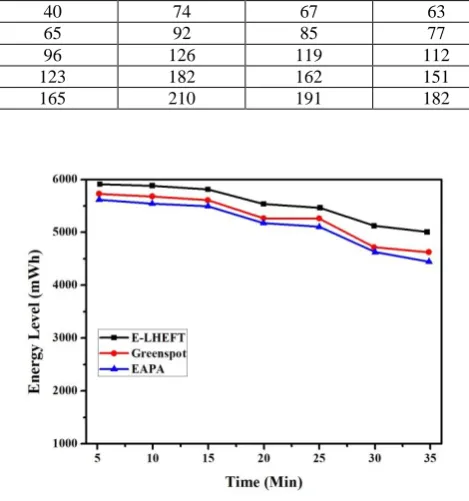
Fig. 2 Time Vs Energy level
task grouping which shortens the overall processing time of an application. Therefore, the proposed E-LHEFT algorithm consumes only 14.4% of battery energy from the initial energy level when executing the mobile application with the duration of 35 minutes but, the EAPA and green spot consumes 19.82% and 18.03% respectively.
TABLEIII TIME VS ENERGY LEVEL
Time (Min) Energy level(mWh)
E-LHEFT Greenspot EAPA
5 5912 5773 5680
10 5875 5720 5595
15 5870 5678 5520
20 5561 5356 5208
25 5477 5305 5153
30 5170 4778 4678
35 5042 4663 4515
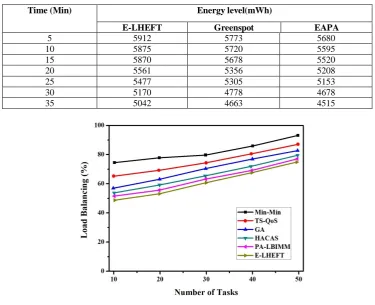
Fig. 3 Number of tasks Vs Load balancing
The number of mobile users and mobile user requests are not stable in the dynamic mobile cloud environment; hence, the load of each PM varies according to the number of mobile users' requests. The load deviation values of all resources are shown in Fig. 3 and corresponding numeric values are shown in Table 4. From the experimental graph, it is observed that the load deviation of E-LHEFT algorithm decreases compared to existing algorithms. The E-LHEFT algorithm balances the load of PM resources using concurrent processes of the task scheduling and load balancing in a mobile cloud environment. Each physical host handles the load balancing based on the consideration of availability and utilization of the host. Therefore, Pareto principle based task-group-mapping of cloud resources minimizes the load deviation value in the proposed approach. In resulting, the proposed E-LHEFT algorithm maintains the load deviation within 75%, but the existing methods have the load deviation values between 77% to 92%, when the number of tasks is 50.
TABLEIV
NUMBER OF TASKS VS LOAD BALANCING Number of
Tasks
Load balancing (%)
E-LHEFT TS-QoS GA HACAS PA-LBIMM Min-Min
10 48 65 57 53 51 74
20 53 69 63 59 55 78
30 61 74 70 65 63 79
40 67 80 77 71 69 85
50 74 87 82 79 76 92
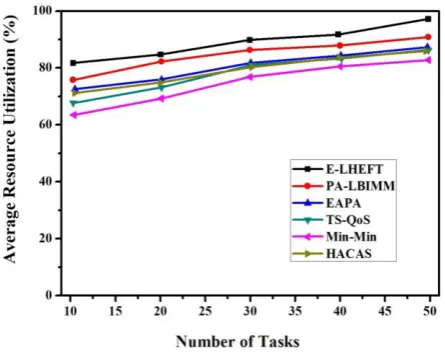
Fig. 4 Number of Tasks Vs Average Resource Utilization
Fig. 4 shows the average resource utilization that varies with the number of tasks for scheduling on cloud and mobile resources. Table 5 illustrates the numeric values of Fig. 4. The proposed E-LHEFT algorithm increases the average resource utilization based on the task grouping and resource capabilities matching method using Pareto principle. The proposed resource utilization depends on the task group size and started VMs on a particular server. The technique processes more number of applications by satisfying load balancing. Also, the E-LHEFT algorithm optimally utilizes the allocated resources rather than initiating a new PM and VM resources, which intends to reduce the energy consumption in cloud server.
TABLEV
NUMBER OF TASKS VS AVERAGE RESOURCE UTILIZATION Number of
tasks
Average Resource Utilization (%)
E-LHEFT TS-QoS EAPA HACAS PA-LBIMM Min-Min
10 81 67 72 71 76 63
20 85 73 76 74 82 69
30 90 81 82 82 86 77
40 91 84 85 85 89 81
50 98 87 87 87 91 83
IV.CONCLUSIONS
In summary, the design and development of MCC framework by enriching load balancing approach with task scheduling, and resource selection modules are presented. The proposed Enriched-Look ahead Heterogeneous Earliest Finish Time (E-LHEFT) algorithm for MCC framework using task prioritization, task selection, task grouping, Pareto principle, and processor selection are explained clearly. The Mobile Assistance Using Infrastructure (MAUI) mobile application model is utilized in QALBA approach for computation and data storage execution in outside of the mobile device. The significant performance improvement is attained by focusing on the QoS-aware mobile application execution on a remote server in mobile cloud environment. Eventually, it illustrates the evaluation results of the QALBA along with conventional mobile cloud task scheduling, resource allocation, and load balancing approaches when experimenting using the mobile gaming applications. In the proposed approach, the mobile device energy consumption is calculated using the energy profile model in MCC framework. The main contributions of this research work are computation offloading for multiple mobile user requests, task prioritization using an upward rank value for both current task and successor tasks, higher and lower length task groups, load balancing using Pareto principle, and processor selection in local (mobile cores) and remote execution (cloud server) in QoS-aware load balancing approach. The QALBA approach increases the provisioning of SaaS and PaaS services in the dynamic mobile cloud environment. The proposed E-LHEFT algorithm satisfies the QoS requirements in terms of minimizing the overall application completion time by 5.7%, significantly maintains the energy level of the mobile device by 14% to 19% on average, improves scalability and maintains the load deviation among physical and virtual machine resources within 75%, and maximizes the average resource utilization of cloud resources by 90% by processing more number of mobile client application requests..
ACKNOWLEDGEMENT
R
EFERENCES
[1] R Hasan, MM Hossain, and R Khan, “Aura: an IoT based cloud infrastructure for localized mobile
computation outsourcing”, 3rd IEEE International Conference on Mobile Cloud Computing, Services, and Engineering (MobileCloud), pp.183-188, 2015.
[2] S Nastic, M Vögler, C Inzinger, HL Truong, and S Dustdar, “rtGovOps: a runtime framework for
governance in large-scale software-defined IoT cloud systems”, 3rd IEEE International Conference on Mobile Cloud Computing, Services, and Engineering (MobileCloud), pp.24-33, 2015.
[3] Xiaonian Wu,Mengqing Deng, Runlian Zhang, Bing Zeng, and Shengyuan Zhou, “Task scheduling
algorithm based on QoS-driven in cloud computing”, Elsevier transaction on Information Technology and Quantitative Management, Vol.17, pp.1162-1169, 2013.
[4] M. Satyanarayanan, P. Bahl, R. Caceres, and N. Davies, “The case for VM-based cloudlets in mobile
computing”, IEEE transaction on Pervasive Computing, Vol.8, No.4, pp.14–23, 2009.
[5] Namboodiri, Vinod, and Toolika Ghose, “To cloud or not to cloud: A mobile device perspective on energy
consumption of applications”, IEEE International Symposium on World of Wireless, Mobile and Multimedia Networks, pp.1-9, 2012.
[6] J. Gu, J. Hu, T. Zhao, and G. Sun, “A new resource scheduling strategy based on genetic algorithm in
cloud computing environment”, Journal of Computers, Vol.7, No.1, pp.42–52, 2012.
[7] Xianglin Wei, Jianhua Fan, Ziyi Lu, and Ke Ding, “Application scheduling in mobile cloud computing
with load balancing”, Hindawi Publishing Corporation Journal of Applied Mathematics, pp.1-13, 2013.
[8] Huankai Chen, Frank Wang, Na Helian, and Gbola Akanmu, “User-Priority Guided Min-Min Scheduling
Algorithm for Load Balancing in Cloud Computing”, IEEE transaction on PARCOMPTECH, pp.1-8, 2013.
[9] Bittencourt, Luiz F., Rizos Sakellariou, and Edmundo RM Madeira, “DAG scheduling using a lookahead