Summarizing a multimodal set of documents in a Smart Room
Maria Fuentes, Horacio Rodr´ıguez, Jordi Turmo
TALP Research Center, Technical University of Catalonia (UPC) [email protected], [email protected], [email protected]
Abstract
This article reports an intrinsic automatic summarization evaluation in the scientific lecture domain. The lecture takes place in a Smart Room that has access to different types of documents produced from different media. An evaluation framework is presented to analyze the performance of systems producing summaries answering a user need. Several ROUGE metrics are used and a manual content respon-siveness evaluation was carried out in order to analyze the performance of the evaluated approaches. Various multilingual summarization approaches are analyzed showing that the use of different types of documents outperforms the use of transcripts. In fact, not using any part of the spontaneous speech transcription in the summary improves the performance of automatic summaries. Moreover, the use of semantic information represented in the different textual documents coming from different media helps to improve summary quality. Keywords: Summarization, Evaluation Methodologies, Multimedia Document Processing
1.
Introduction
In the last years the research on multimodal Human-Computer Interaction (HCI) is evolving from basic in-terpretations of the signals to richer semantic informa-tion. This research area combines information from several modalities: speech, vision, language, text. Only collabora-tive undertakings could address the full complexity of hu-man interaction.
The analysis of human interaction has attracted signifi-cant interest in the literature, being interactive lectures and meetings the central theme of analysis in several interna-tional projects: The AMI (Augmented Multiparty Inter-action) and the AMIDA (Augmented Multiparty Interac-tion with Distance Access) European Integrated projects, whose goal is the support and analysis of multi-modal inter-actions between people in meetings with small number of participants. The US CALO project (Cognitive Assistant that Learns and Organizes). Also in a meeting scenario, CALO has developed a meeting assistant focused on ad-vanced analysis of spoken meeting recordings, along with related documents, including emails. The CHIL European project (Computers in the Human Interaction Loop) has ex-plored the use of computers to enhance human communica-tion in smart environments, especially within lectures and post-lecture discussions. The research reported in this arti-cle concerns an intrinsic automatic summarization evalua-tion in the CHIL scientific lecture domain.
Automatic Summarization (AS) consists in “to take an in-formation source, extract content from it, and present the most important content to the user in a condensed form and in a manner sensitive to the user’s or application’s needs” (Mani and Maybury, 1999). AS strongly depends not only on the properties of the document, but also on the user needs (e.g., size of the summary, output media, content re-lated to a query).
Studies such as the one carried out by (Shriberg, 2005) show that oral communication is harder to process than written text. In addition, large amount of effort is required to train Automatic Speech Recognizers (ASR) models. It has to be taken into account the fact that these models are language and domain dependent. For those reasons, we
propose using a multidocument summarization (MDS) ap-proach capable of handling documents from different me-dia types to summarize the content of scientific oral presen-tations. Combining documents from different media can help counteract not only the difficulties in processing oral communication, but also those errors introduced by ASRs. The structure of this paper is as follows: next section gives an overview of related research in automatic summariza-tion and summarizasummariza-tion evaluasummariza-tion. Secsummariza-tion 3 describes the CHIL lecture corpus used for these experiments. Section 4 presents configuration details of the evaluated summariza-tion approaches. Secsummariza-tion 5 analyzes the results. Secsummariza-tion 6 concludes the paper.
2.
Related Work
Mostly, automatic summarization today is based on sentence-extraction paradigm for English documents, in both single document (SDS) and multidocument sum-marization (MDS). Knowledge-rich approaches either ex-tend basic methods by the incorporation of sophisticated, yet general lexical resources such as WordNet (Fellbaum, 2008), or apply discourse organization theories in generic contexts, or bring domain knowledge to the summarization enterprise. Lexical cohesion has long been considered a key component in assessing content relevance in text summa-rization and computation of lexical chains (Barzilay, 1997) has been used as text interpretation mechanisms for select-ing key sentences. There has been a growselect-ing interest on ap-plying graph-based representations, for instance (Mihalcea and Tarau, 2005) uses a PageRank algorithm to summarize Single and Multiple documents.
With respect to spontaneous speech, less effort has been devoted. Most of the research focuses on broadcast news, usually generated by reading aloud written text.
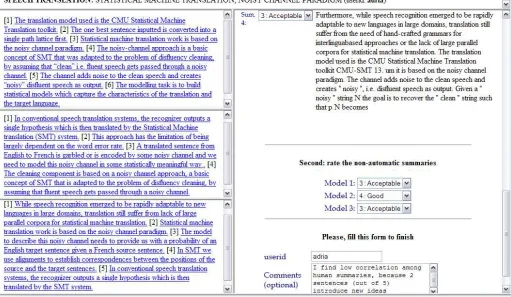
Figure 1: CHIL manual evaluation web interface.
finally, ROUGE-SUn are used to compute Skip Bigram (ROUGE-Sn) with a maximum skip distance ofn. In addition to the automatic evaluation, a manual content responsiveness evaluation was carried out at UPC, along the same lines as in DUC. Concretely, 20 assessors were asked to score each automatic and manual summary in terms of summary responsiveness content. Figure 1 shows the inter-face used by the UPC assessors in the evaluation process. As in DUC, UPC assessors were asked to assign an integer between 1 (least responsive) and 5 (most responsive) with respect the three reference summaries created at ELDA (at left site in Figure 1). Human evaluators were also asked to score the quality of the human summaries taking into ac-count the other two human models as reference.
4.
Evaluated approaches
In the reported experiments we evaluated 5 different summarization approaches, several of them integrated in FEMsum (Fuentes, 2008). FEMsum is a flexible and highly modularized Multitask Summarization architecture, on which parameterizable Summarizers suitable to specific needs can be built. The architecture is divided in four main components: Relevant Information Detector (RID), Con-tent Extractor (CE) and Summary Composer (SC). In ad-dition there is a language dependent Linguistic Processor (LP), and a Query Processor (QP) component. Not all the components are needed in all FEMsum instantiations. To allow the maximum flexibility, the main restriction of the proposed architecture is the input and the output ex-pected by each component. The LP component enriches
the original text (documents to be summarized or the user information need) with linguistic information. This compo-nent consists of a pipeline of language dependent linguistic tools. Different LP instantiations can be used depending on the requirements of the approach, as well as the language, media, genre or domain of the documents to be summa-rized. If a purely lexical FEMsum approach is instantiated, LP can be reduced to a segmentation task: splitting the in-put document into textual units, each composed by a se-quence of words2. However, semantic based approaches
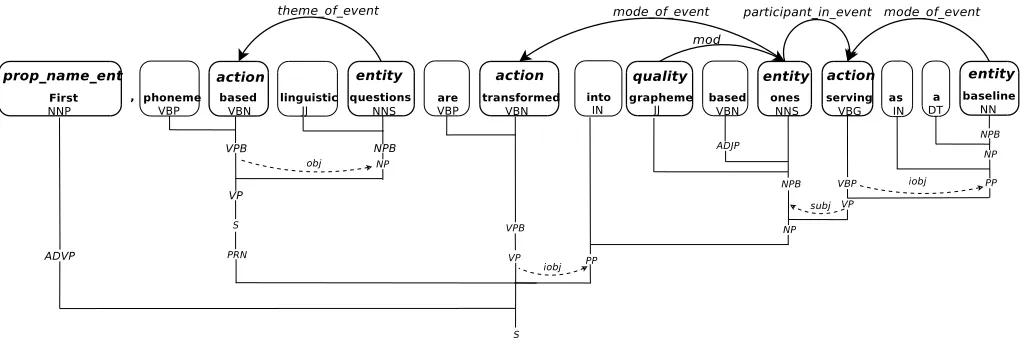
can require more sophisticated language dependent tools to enrich the text with syntactic or semantic information. Textual Unit (TU)s are enriched with lexical (sent) and syntactic (sint) language dependent representations. For each TU, its syntactic constituent structure (including head specification) and the syntactic relations between its con-stituents (subject, direct and indirect object, modifiers) are obtained (see an example in Figure 2). From sent and sint, a semantic representation of the TU is produced, the envi-ronment (env).
Env is a semantic-network-like representation of the se-mantic concepts (nodes) and the sese-mantic relations (edges) holding between the different tokens in sent. Concepts and relation types belong to an ontology of about 100 seman-tic classes (as person, city, action, magnitude, etc.), and 25
2
Figure 2: Example of preprocessed sentence
relations between them (mostly binary, as time of event, actor of action, location of event, etc.). Both classes and relations are related by taxonomic links allowing for inher-itance.
The input to the RID module is the document or set of doc-uments to be summarized. This docdoc-uments can be previ-ously enriched with some linguistic information. The orig-inal user need linguistically processed is the input of the QP component. The output of this component, expressing the user need, can be taken into account by RID to score the set of relevant TUs (segments, phrases or sentences). The out-put of RID is a set of TU identifiers ranked by relevance. The linguistic information and the relevance score of the TUs is the input to the CE and the SC components. The main function of the CE component is to extract and score by relevance summary candidate TUs. This is not always instantiated, but when it is, this component allows to apply different heuristics taking into account some in-put aspects, such as the genre of the document (journalistic vs. scientific); some purpose aspects, such as the type of audience of the produced summaries (background vs. just-the-news); or some output aspects, such as the content of the summary (text-driven vs. query-driven).
The final text summary is the output of the SC. This com-ponent carries out the post-processing of the summary con-tent. This post-processing takes into account the size or the format of the summary. In this component the summary TUs can be simplified, paraphrased, reordered, or removed. The following sections give a brief description of the five summarization approaches manually and automatically evaluated in the CHIL project is presented.
4.1. SEM
The RID component provides a ranked set of relevant TUs by using JIRS (G´omez et al., 2005), a Passage Retrieval (PR) software. Due to the fact that textual transcriptions from spontaneous speech are often ill-formed and they not always follow the written syntactic rules, transcription TUs have not been included in the input of the Content Extractor component. In this case, a twofold CE component scores the candidate sentences and selects the most appropriate one to be included in the summary. A similarity matrix
among candidates is computed. For that purpose, the se-mantic representation of each candidate TU is transformed into labeled directed graph representation, where nodes are assigned to positions in the sentence and labeled with the corresponding token, and edges are assigned to predicates (a dummy node, 0, is used for representing unary predi-cates). Only unary and binary predicates are used. This ap-proach on facing the summary extraction subtask follows the (Mihalcea and Tarau, 2005) line. However, instead of using only lexical measures, SEM (Fuentes et al., 2006) we proposed to add semantic measures to establish sentence scores.
Input:Simbe the similarity matrix,
Candidatesa list of candidate TUs,
Output:Summaryan ordered list of TUs to be included.
1. SetCandidatesto the list provided by the RID component. 2. SetSummaryto the empty list.
3. SetSimto the matrix containing the similarity values between members fromCandidates.
4. Compute for each candidate inCandidatesa score that takes into account the initial relevance score and the values inSim. The score used is based on PageRank, as used by (Mihalcea and Tarau, 2005), but without making the distinction between input and output links.
5. SortCandidatesby this score.
6. Append the highest scoring candidate (the head of the list) to theSummaryand remove it fromCandidates. 7. In order to prevent content redundancy, theS%most similar
TUs to the selected one (usingSim) are removed as well from
Candidatesand theR%least scored are also removed from
Candidatesto reduce the search space (S: 1,5%,R: 1,0%). 8. IfCandidatesis not empty go to 4, otherwise exit.
Figure 3: Candidates Selector procedure.
SDS LEX LEXnoT +www SEM
ROUGE-1 0.293 0.309 0.312 0.333 0.323
ROUGE-2 0.060 0.092 0.102 0.089 0.073
ROUGE-3 0.029 0.056 0.064 0.052 0.032
ROUGE-4 0.019 0.043 0.050 0.043 0.021
ROUGE-L 0.256 0.272 0.279 0.289 0.280
ROUGE-W1.2 0.089 0.098 0.100 0.104 0.098
ROUGE-S1 0.057 0.088 0.097 0.087 0.067
ROUGE-S4 0.064 0.089 0.095 0.094 0.073
ROUGE-S9 0.069 0.095 0.102 0.103 0.083
ROUGE-SU1 0.136 0.162 0.169 0.168 0.152
ROUGE-SU4 0.102 0.126 0.132 0.134 0.115
ROUGE-SU9 0.090 0.116 0.122 0.124 0.105
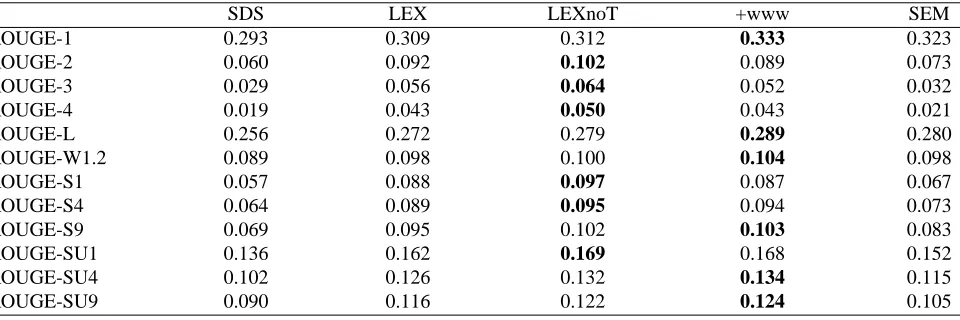
Table 3: ROUGE measures when considered 3 manual summaries as references.
M1 M2 M3 SDS LEX LEXnoT +www SEM
3.625 3.400 3.375 1.250 1.775 2.025 1.800 1.800
Table 4: Responsiveness considering 3 human models when evaluating automatic summaries and 2 when evaluating human summaries.
4.2. LEXnoT and LEX
As in SEM a JIRS PR software is used to instantiate the RID component. Because of having a small number of doc-uments to be summarized, all the TUs selected as relevant by the RID component are considered as a input of a simple SC component. The input of the SC are the TUs detected as relevant (this number ranges from 67 to 257 TUs - 186,75 in average). Following the JIRS ranking order, TUs are itera-tively added to the final summary until reaching the desired summary length.
The main difference between LEXnoT and LEX is the input type of documents to be summarized. In LEXnoT, as in SEM, transcription have not been taken into account.
4.3. SDS
As we assume that adding textual information helps when summarizing spontaneous speech, we consider as a base-line a SDS based on lexical chains (Fuentes et al., 2005). This approach extracts segments of about 30 words only from the transcriptions and has been adapted to be query-driven by increasing the weight of the lexical chain mem-bers that appear in the query. WordNet is used to identify synonymy relations between words. Once chains are iden-tified, the measure of chain strength can be classified into Strong, Medium and Light, depending on their score:
τ = µs+ 2·σs Strong = {c|scorec ≥τ} M edium = {c|τ > scorec ≥τ /2}
Light = {c|τ /2> scorec}
whereµs and σs are the average of the scores of all the chains and the corresponding standard deviation. In con-trast to other approaches where lexical chains are used, if necessary, we consider Medium and Light chains in addi-tion to the typical strong ones. That is specially useful when dealing with spontaneous speech, due to the fact that Strong chains tend to provide a misrepresentation of the informa-tion in a text, because the distribuinforma-tion of the frequency of
words is rather skewed, that is due to the fact that in oral presentation important concepts are numerously repeated. For that reason only few strong chains are found. Taking into account the lexical chains found, a windows ofn con-tiguous words (chunks) are extracted to form a summary of the targeted size. Chunks are included in the summary using a priority ranking function that tries to capture both relevance and well-formedness.
4.4. +www
In the CHIL corpus, the number of documents to be sum-marized is smaller than in the DUC one. However, since a lot of scientific information is available online, we de-cided to evaluate the UAM-Titech06 system (Alfonseca et al., 2006). This system identifies and uses background in-formation related to the query from the World Wide Web to produce the summaries.
5.
Analysis of the results
Table 3 shows the ROUGE metric results when comparing 20 extract-based summaries of a set of documents related to scientific presentations, against three human-created sum-maries. Best ROUGE values are shown in bold. All the evaluated approaches perform better than the baseline, SDS. Looking at the ROUGE measures, it is difficult to de-termine whether LEXnoT is better or not than +www. Looking at the content responsiveness results, in Table 4, we see that LEXnoT obtains the best mean score (2.025), while +www and SEM obtain the same score (1.800). The lower score obtained by a MDS approach is the one ob-tained by LEX (1.775). That means that better mean per-formance is obtained when not using the transcription as part of the final summary.