© 2018 IJSRCSEIT | Volume 3 | Issue 3 | ISSN : 2456-3307
Integration of Technology with Google Classroom in Higher
Education
Sanjeev Gour
Department of Computer Science, Career College, Bhopal, Madhya Pradesh, India
ABSTRACT
ICT-based technologies have great influences on both School and Higher education system. Today many technologies like digital/virtual Classrooms tools are integrating with higher education by many top ranked universities and colleges in world. Google classroom is one of them. It is a freely available web based online platform and web service that improves the learning and teaching experiences in the physical classroom for schools and colleges. Google Classroom makes an interface between students and educators inside and outside of the class. The purpose of this study to examine what students of higher education really think about this new technology. This paper proposed a survey based study about this tool and displays how this classroom affects teaching and learning process in classroom of colleges. Hundreds of students from Career College Bhopal have been online interviewed for this survey based study. The study has concludes some of interesting facts about this tool, education system and also presented its positives and negatives aspects for student’s perspectives. Keywords: Virtual Classroom, Google Classroom, Higher Education.
I.
INTRODUCTION
High quality with widely accessible Higher Education is one of fundamental goals of any developed country. Advanced digital innovation over the most recent two decades has changed the today education system drastically. Today many high ranked universities believe in integration of digital technology in teaching and learning methods in higher educational institutions [1]. ICT-based teaching and learning includes the utilization of the web and other critical advance combination of software and hardware tools to deliver materials for teaching and learning, communicate students, and furthermore manage courses in an organization [2]. It can increase the quality and accessibility of education in any educational institute obviously. There are numerous perspectives that recommend IT-based strategy for teaching and learning [3].A report [4] already stated that that technological innovation on teaching and learning methodologies over the next
conducting in Career College Bhopal and extracted some of useful knowledge and interesting facts about the Google Classroom. The Complete study encompasses six sections. Section first gives the introduction and section second states the role of virtual classroom in higher education. In third section, author has presented the brief introduction about Google classroom and section fourth describes the method and tool used to carry this survey based study. This section also gives the details about the interviewees. Section five elaborates the result of study followed by conclusion and discussion.
II.
ROLE OF VIRTUAL CLASS TOOLS IN
EDUCATION
Virtual Classroom is a reenacted classroom by means of Internet, which gives an advantageous correspondence of web enabled environment for students simply like conventional physical classroom. In ICT-based Education, the virtual classroom serves as specific resource or media to implement the teaching and learning process. It is basically the computer and network system empowered exchange or share of abilities and information. Advanced classroom applications and procedures incorporate Web-based learning, PC based learning, virtual classroom with digital collaboration. Content is transferred or delivered by means of the Internet, intranet/extranet, sound or video tape, satellite TV, and CD-ROM. As indicated by specialists that ICT-based education like virtual classroom will be one of most conventional methods of teaching in the year 2020[7]. It enables students to attend a class from anyplace in the familiar web world and plans to gives an on-line learning background that is like a genuine classroom [8]. In modern education system, physical classroom has been changed into a virtual classroom with enhanced features like online course material and books , online assignments, online feedback, online grading system , discussion boards, online examinations, online attendance and quizzes. A virtual classroom delivered course materials to the
students, as well as gives a live, relevant and intuitive environment for them. Moreover, educators can control the learning and teaching process as they do in the customary classroom [9].
III.
ABOUT GOOGLE CLASSROOM
Google Classroom is an online cloud based tool that improves the learning and teaching process in the physical classroom. It is one of web base cloud service of the Google Corporation for Education suite which endeavors to empower paperless learning in the classroom. More than 20 million teachers and students globally are using this tool. It launched in August 2014. Since then company adding new features continuously. With Google Classroom, teachers can create classes, circulate assignments, send feedback, and see everything in one place. Google Classroom is a free joint effort application for instructors and students. Instructors can make online classrooms, invite students for join the class, and make and give out assignments. Students and educators can impart about the assignments inside the same platform and instructors can screen progress of each student. Google Classroom is additionally advantageous for guardians. Educators can share the performance report of the students with their parents. Colleges in higher education can make a free Account under Google Apps for Education and use this classroom. Some of main features of Google classroom are presenting here briefly:
It is Easy to use and accessible from all devices at any place.
Effective communication and sharing of academic activities between teachers and students and instant collaboration between them even outside the classroom.
Simple and user-friendly interface. Less technical training requires.
Teachers can able to better track a student’s progress.
Parents or guardians are able to see the student progress updates.
IV.
METHOD AND TOOL FOR STUDY
Method- Survey research is a regularly utilized strategy for gathering data about a population of interest. In this research method. A predefined arrangement of inquiries or questionnaire is used to gather data from the target respondents. The questionnaire design can be closed-ended or open-ended. For this study, author has designed some close –ended questions as the respondents are given the list of predetermined options for the predetermined questions and from which respondents has to choose the answer. The respondents submit or deliver their responses through their e-mail id over the internet for the given closed ended questions asked by the interviewer. This type of survey is knows as e-mail based survey.
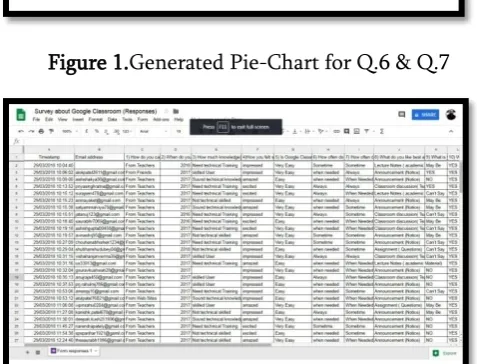
Tool- Google Forms give a quick method to make an online survey, with responses gathered in an online spreadsheet. Make your questionnaire in Google form and invite respondents for answering by email. Individuals answer your question from any web program - including versatile Smartphone, PC or tablet. You can see every response from individual in a solitary line of a spreadsheet. Furthermore, you can also generate the summary report of all respondents in chart form. A Google Form is an incredible method to gather information for particular survey. For this study, author has designed a sequence of close ended questions in Goggle form and sent to all target students through e-mail.
Targeted Respondents- For this online survey, author has chosen the students from selected class form the department of computer science of career college Bhopal India. More than 75 students have answered
to list of ten predetermined questions through e-mail.
Questionnaire – The list of closed ended questions which were asked to students for e-survey are as follows:
1)
How do you come to know about Google Classroom first time?2)
When do you come to know about Google Classroom first time (Year)?3)
How much knowledge (technology skills) you have about Google classroom?4)
How you felt while using Google Classroom?5)
Is Google Classroom easy to use?6)
How often do you use Google Classroom in class?7)
How often do you use Google Classroom at Home?8)
What do you like best about Google Classroom?9)
What is your opinion about academic dishonesty in the Google Classroom?10)
Would you like to be a part of a Google classroom in the future?Figure 1.Generated Pie-Chart for Q.6 & Q.7
Figure 2. Generated summarized Spread-Sheet
V.
RESULT AND DISCUSSION ABOUT STUDY
By analyzing the responses received from the students, some important and interesting results and suggestions about Google classroom are summarizing here:
More than 80 % students come to know about the classroom first time in last year (2017) from their teachers only.
Suggestion- It is needed to spread the information about this technology among the students and institutes of school and higher education across the nation.
Most of students are comfortable to operate and impressed with this new technology but there is also need to training for the slow learners in class. Suggestion- It is required to conduct a training program for slow learners of class.
Most of the students are using Google classroom in their physical class in college instead of
at their homes. They looked and used only when needed.
Suggestion- It is needed to active participation of teachers in Google classroom by creating academic activity consistently.
More than 50 % students seem interesting to look the “Announcement/Notice “feature of Google classroom only. It shows they like to see notices about the upcoming academic activity of college while they are showing less interest in participating group discussion and assignment activity in G-Classroom.
Suggestion- It is required to increase the participation of students in group discussion and by giving assignments and conduct online test.
Most of the students did not put their views about academic dishonesty in Google classroom but some of them believe that there is less chance for academic dishonesty in Google classroom.
Discussion- Academic dishonesty is matter of unskilled learners so proper training is again the solution for the same.
More than 95% students satisfied with the services of Goggle classroom and like to be a part of Goggle classroom in future.
Discussion- This is an urgent need to adopt or integrate any new technology with education system to complete the 100 % figure.
Limitation of the study- Author used very small sample size and limited data for the study. Only 77 students of a single class are interviewed for the survey. So the results of survey may not be generalized in perspective to students.
VI.
CONCLUSION
education gives a new direction to learn and practice in a visual and virtual environment.
The future of Google classroom is certainly bright as numbers of users are joining this virtual classroom in recent years. Additionally, it is always upgrading and making new features in view of the feedback that educators give the company. Google is assuming control over the world and possibly one day all students of the world will utilize this tool.
The results of this study showed that majority of the students like some of features or tools of Google classroom but it is also require to increase the ratio of satisfaction towards others active learning activities. The outcome of the survey indicated that comparative performance of Google classroom is better than physical classroom in area of ease to access anytime, anywhere, Interaction and communication with teachers even outside the class, circulation of academic notices, delivery of notes, submitting assignments and tests online etc.
Students and Teachers must be prepared and met all requirements to satisfy their roles in this virtual classroom. Colleges in higher education also must be prepared and managed for the new context of education. Despite, there are some urgent and difficult challenges like low digital fluency among students as well as teachers, lake of digital resources and less internet connectivity. These are obviously main challenges for traditional to virtual shifting in higher education system.
VII.
ACKNOWLEDGEMENT
I have to express my appreciation to authors mentioned in following reference section for referring the part of their reports, surveys, observations, book and research manuscripts during the study of this research although any errors are my own and should not tarnish the reputations of these esteemed professionals.
VIII.
REFERENCES
[1].European Commission Report to the European
Commission on New modes of learning and teaching in higher education, ISBN 978-92-79-39789-9,October 2014.
[2].Valentina Arkorful , Nelly Abaidoo,2014,The role
of e-learning, the advantages and disadvantages of its adoption in Higher Education, International Journal of Education and Research Vol. 2 No. 12 December 2014,pp. 397-410.
[3].John O’Donoghue, Gurmak Singh,2004, Charmaine
Green- A comparison of the advantages and disadvantages of IT based education and the implications upon students; Interactive Educational Multimedia, number 9 ,November 2004, pp. 63-76.
[4].Marie Glenn -Report- The future of Higher
Education: How technology will shape learning; the economist intelligence unit-2008.
[5].Report- Remaining the role of technology in
education; National Education Technology Plan Update-2017; US department of Education; http://tech.ed.gov.
[6].Sadia Ashraf , Tamim Ahmed Khan , Inayat ur
Rehman,2016, E-Learning for Secondary and Higher Education Sectors: A Survey; International Journal of Advanced Computer Science and Applications, Vol. 7, No. 9, 2016,pp.275-283.
[7].Mahmood Ghorbani and Samira Delavar,2012,The
Role of Virtual Education in Creative Learning Student of University , Middle-East Journal of Scientific Research 11 (7),2012,pp.950-958.
[8].M. Rajendra Prasad, B.Manjula and V. Bapuji,2013,
Virtual Classroom Pedagogy: New Tendency in Higher Education Institutions International Journal of Information and Computation Technology.ISSN 0974-2239 Volume 3, Number 7, 2013, pp. 671-676.
[9]. Nantha Kumar Subramaniam and Maheswari