A Dictionary-Based Approach for Evaluating
Orthographic Methods in Cognates Identification
Alina Maria Ciobanu Faculty of Mathematics
and Computer Science University of Bucharest
Liviu P. Dinu Faculty of Mathematics
and Computer Science
Center for Computational Linguistics University of Bucharest
Abstract
In this paper we propose a method for identifying cognates based on etymology and etymons. We employ this approach to evaluate the extent to which lexical simi-larity can be used for automatic detection of cognate pairs. We investigate some or-thographic approaches widely used in this research area and some original metrics as well. We apply this procedure for Ro-manian and its most closely related lan-guages, French and Italian, but our method is applicable to any languages.
1 Introduction and Related Work
Cognates are words in different languages having the same etymology and a common ancestor. The task of cognates identification is widely used in historical and comparative linguistics, in the study of languages relatedness (Chin et al, 2010), phy-logenetic inference (Atkinson et al, 2005) and in identifying how and to what extent languages changed over time. Besides these research a-reas, in which the genetic relationships between words are extremely relevant, cognates have been successfully used in other fields, such as lan-guage acquisition, bilingual word recognition (Di-jkstra et al, 2012), corpus linguistics (Simard et al, 1992), cross-lingual information retrieval (Buck-ley et al, 1998) and machine translation (Knight et al, 2003). In these domains, the term “cognates” is usually used with a somewhat different meaning, denoting words with high orthographic/phonetic and cross-lingual meaning similarity, the condi-tion of common etymology being left aside. Kon-drak (2001) makes the distinction between the dif-ferent interpretations of the notion and Inkpen et al (2005) present the definition of “genetic cog-nates”.
In this paper we focus on genetic relationships between words and we use the term “cognates”
in a broader meaning, counting as cognates the word-etymon pairs as well. Our motivation is that these pairs of words also share a common ances-tor, thus complying with the cognates’ definition. For example, the Romanian wordcampion (mea-ningchampion) has Italian etymology and the ety-mon campione, which has Latin etymology and the etymon campione(m). Thus, the Romanian wordcampion and the Italian wordcampioneare cognates, as they share a common Latin ancestor.
The paper is organized as follows: we intro-duce our approach to cognates identification in Section 2. We describe the corpus used for our research in Section 3. We present several ortho-graphic approaches used for cognates identifica-tion in Secidentifica-tion 4. We evaluate these metrics and analyse the results of our experiments in Section 5. Finally, we draw some conclusion regarding our research in Section 6.
2 Our Approach
We focus on the Romanian language and we inves-tigate its cognate pairs with two other Romance languages, French and Italian. We believe this comparison is interesting for the following reason: the two related languages differ significantly with respect to their orthographic depth: the mapping rules between graphemes and phonemes are more complex for French, which has a deep orthogra-phy, than for Italian, which has a highly phonemic orthography.
We identify the etymologies and etymons of the Romanian words using dexonline 1 machine-rea-dable dictionary, which is an aggregator for over 30 Romanian dictionaries. By parsing its defi-nitions, we are able to automatically extract in-formation regarding words’ etymologies and ety-mons. The most frequently used pattern is shown below.
1
http://dexonline.ro
<abbr class="abbrev"
title="limba language_name"> language_abbreviation </abbr> <b> etymon </b>
As an example, we provide below an excerpt from adexonline entry which uses this pattern to specify the etymology of the Romanian word capi-tol (which means chapter). When more options are possible for explaining a word’s etymology,
dexonlineprovides multiple etymologies. We ac-count for all the given alternatives, enabling our method to provide more accurate results. In our example, the word capitol has double etymolo-gy: Latin (with the etymoncapitulum) and Italian (with the etymoncapitolo).
<b> CAP´ITOL </b> <abbr class="abbrev"
title="limba italiana"> it. </abbr> <b> capitolo </b>
<abbr class="abbrev"
title="limba latina"> lat. </abbr> <b> capitulum </b>
After determining the etymologies of the Ro-manian words, we translate in French all words without French etymology and in Italian all words without Italian etymology using Google Trans-late 2. We consider cognate candidates pairs formed of Romanian words and their translations. Using French3 and Italian4 dictionaries, we ex-tract etymology-related information for French and Italian words. To identify cognates we com-pare, for each pair of candidates, the etymolo-gies and the etymons. If they match, we iden-tify the words as being cognates. Our solu-tion for addressing cognates identificasolu-tion answers Swadesh’s question, as cited in (Campbell, 2003): “Given a small collection of likely-looking cog-nates, how can one definitely determine whether they are really the residue of common origin and not the workings of pure chance or some other fac-tor?”, as we limit the analysis only to words that share a common etymology, i.e. words that are known to be related.
For example, for the Romanian word victorie,
dexonlinereports Latin etymology and the etymon
victoria. Because this word does not have Itali-an etymology, we assume it might have a cognate
2
http://translate.google.com
3
http://www.cnrtl.fr/etymologie
4
http://www.sapere.it/sapere/dizionari.html
pair in Italian. Consequently, we translate it in Italian, obtaining the wordvittoria. We consider the wordsvictorieandvittoriacognate candidates. Using the Italian dictionary we identify, for this word, Latin etymology and the etymon victoria. We compare etymologies and etymons for the Ro-manian word and its translation in Italian and, as they match, having a common ancestor (Latin) and the same etymon (victoria), we identify them as a cognate pair.
3 The Corpus
We apply our method on a high-quality Romanian corpus comprising of the transcription of the par-liamentary debates held between 1996 and 2007 in the Romanian Parliament, recently proposed in (Grozea, 2012). The sessions deal with a wide va-riety of topics regarding the political, social and economic fields. In this paper we decided to run our experiments using words extracted from a large corpus of transcribed spoken language, in order to investigate the cognates that are most fre-quently used in Romanian. This dataset covers particular cases in the task of cognates identifi-cation, such as cognates between which the de-gree of orthographic similarity is low (for ex-ample the Romanian word atotputernicie, which means almightiness, and its French cognate pair
omnipotence, both sharing the Latin etymon om-nipotentia) and vice versa, non-cognates that re-semble one another (for example the Romanian word m˘an˘astire, meaning monastery and having the Old Slavic etymon monastyr´ı, and its Italian translation monastero, having the Latin etymon
monasteriu(m)).
Many words have undergone transformations by the augmentation of language-specific diacri-tics when entering a new language. From an or-thographic perspective, the resemblance of words is higher between words without diacritics than between words with diacritics. For example, the similarity seems lower for the Romanian word
amicit¸ie(which meansfriendship) and its French cognate pair amiti´e than for their corresponding forms without diacritics,amicitieandamitie. For this reason, we investigate the performances of the orthographic approaches to the task of cognates identification using two versions of the corpus: with and without diacritics included.
as dates and numbers and all the transcribers’ des-criptions of the parliamentary sessions (such as
“The session began at 8:40.”), as we focus on the spoken language. We performed word segmenta-tion, using whitespace and punctuation marks as delimiters, we lower-cased all words and we re-moved stop words, using a list of Romanian stop words provided by Apache Lucene 5 text search engine library . We lemmatized the words using
dexonline, which provides information regarding the words’ inflected forms and enables us to cor-rectly identify lemmas where no part-of-speech or semantic ambiguities arise (in this case we con-sider the first occurred lemma).
4 Orthographic Approaches
Various word distances have been used in the task of string similarity computation. They have been applied in many different research areas, besides cognates identification, such as sentence align-ment (Brew and McKelvie, 1996), record link-age (Jaro, 1989), stemming (Dalbelo and Sna-jder, 2009) and bioinformatics (Dinu and Sgarro, 2006). In (Kondrak, 2001) some of the most widely used measures are analysed, and their flaws and the differences between them are emphasized. The approaches used to evaluate cognate pairs are divided in two groups: phonetic and ortho-graphic. The orthographic approaches are usu-ally used in corpus linguistics (Kondrak, 2001). We employ our method of identifying cognates to evaluate the extent to which lexical similarity can be used for automatic detection of cognates. We investigate some orthographic approaches widely used in this research area and some original me-trics as well.
In (Inkpen et al, 2005) several orthographic similarity measures are used for the classification of pairs of words as cognates or false friends. For our investigation we chose some of the distances used in this paper, another distance that was suc-cessfully employed for record linkage and also an original metric in the field of cognates identifica-tion, rank distance.
• Levenshtein distance (Levenshtein, 1965), also named the edit distance, counts the mini-mum number of operations (insertion, dele-tion and substitudele-tion) required to transform one string into another. We use a normalized Levenshtein distance computed as:
5
http://lucene.apache.org
EDIT(wi, wj) =
LD(wi, wj)
max(|wi|,|wj|)
where LD(wi, wj) is the Levenshtein
dis-tance for wordswiandwj.
E.g.∆(langue, lingua) =26 = 0.33
• Rank distance (Dinu and Dinu, 2005) is used to measure the similarity between two rank lists. A ranking of a set of n objects can be represented as a permutation of the inte-gers1,2, ..., n. S is a set of ranking results.
σ ∈ S. σ(i)represents the rank of object i
in the ranking resultσ. The rank distance is computed as:
RD(σ, τ) =
i=n
X
i=1
|σ(i)−τ(i)|
The ranks of the elements are given from bot-tom up, i.e. from n to1, in a Borda order. The elements which do not occur in one of the rankings receive the rank0. To extend the rank distance to strings, we index each oc-curence of a given letterawithak, wherek
is the number of its previous occurences, and then compute the rank distance for the new indexed strings which become in this situa-tion rankings. In order to normalize it, we divide the obtained value by the maximum possible distance between two stringsu and
v, which is:
|u|(|u|+ 1)
2 +
|v|(|v|+ 1) 2
E.g.∆(langue, lingua) =10 42 = 0.23
• Longest common subsequence ratio (Melamed, 1995) computes the simila-rity between two words dividing the length of the longest common subsequence of the two words by the length of the longer word:
LCSR(wi, wj) =
LCS(wi, wj)
max(|wi|,|wj|)
whereLCS(wi, wj) is the longest common
subsequence ofwi andwj. We subtract this
value from 1, in order to obtain the distance between two words.
• XDice (Brew and McKelvie, 1996) is a version of Dice’s coefficient (Adamson and Boreham, 1972) which counts the number of shared character bigrams between two words and divides it by the number of bigrams in both words, allowing also extended bigrams (formed by the first and third letter of tri-grams):
XDICE(wi, wj) =
2∗ |xbi(wi)∩xbi(wj)| |xbi(wi) +xbi(wj)|
wherexbi(w)is a function which determines the multi-set of character bigrams and ex-tended bigrams in w. As XDice computes similarity between words, we subtract its value from1to obtain distances.
E.g.∆(langue, lingua) = 1−2∗4 18 = 0.55
• Jaro distance (Jaro, 1989) and its version, Jaro-Winkler distance (Winkler, 1990), are measures which account for the number and position of common characters between words. These metrics are described in (Delmestri and Dinu, 2012). Given two strings wi = (wi1, ..., wim) and wj =
(wj1, ..., wj n), the number of common
char-acters for wi and wj is the number of
charachterswik inwi which satisfy the
con-dition:
∃wj linwj:wik=wj l,|k−l| ≤
max(m, n) 2 −1
Let c be the number of common characters inwi and wj and tthe number of character
transpositions (i.e. the number of common characters inwiandwjin different positions,
divided by2). Jaro distance is defined as fol-lows:
J(wi, wj) =
1 3∗
c m +
c n+
c−t c
As both Jaro and Jaro-Winkler metrics are string similarity measures, we subtract these values from 1 to obtain distances between words.
E.g.∆(langue, lingua) = 1−1 3∗
4 6 +
4 6+
4−0 4
= 0.22
Jaro-Winkler distance accounts also for the lengthlof the common preffix ofwi andwj
(l ≤ 4) and considers a scaling factor p = 0.1.
J W(wi, wj) =J(wi, wj) +p∗l∗(1−J(wi, wj))
where J(wi, wj) is the Jaro distance for
wordswiandwj.
E.g.∆(langue, lingua) = 1−(0.77 + 0.1∗1∗(1−
0.77)) = 0.20
5 Evaluation and Results Analysis
In order to evaluate the performances of these orthographic approaches to the task of cognates identification, we apply the method presented in Section 2 for determining cognate pairs in Italian and French for each word in the preprocessed cor-pus. The statistics for this phase of our procedure are listed in Table 1.
Nwords Ncognates French Italian
Type 162,399 77,029 35,581
Token 22,469,290 15,858,140 10,895,298
Lemmas 40,065 17,929 6,768
Table 1: Statistics for the Romanian corpus: the total number of type words, token words and lem-mas (in column 1) and the number of type words, token words and lemmas having an etymon or a cognate pair in French (column 2) or in Italian (column 3). It can be noticed that the sum of to-ken words with cognate pairs or etymons in French and Italian is higher than the total number of token words after preprocessing the corpus, due to the fact that many of these words have cognate pairs or etymons in both languages
French
th EDIT LCSR RD JW XDICE
R P A F R P A F R P A F R P A F R P A F
0.0 06.4 100.0 53.2 12.0 06.4 100.0 53.2 12.0 06.4 100.0 53.2 12.0 06.4 100.0 53.2 12.0 06.4 100.0 53.2 12.0 0.1 08.9 94.3 54.2 16.3 09.3 93.8 54.4 17.0 15.2 87.6 56.5 26.0 41.9 81.1 66.1 55.3 09.4 92.5 54.3 17.0 0.2 24.9 83.2 60.0 38.4 26.4 82.5 60.4 40.0 40.6 83.4 66.3 54.7 71.8 78.6 76.1 75.1 18.1 83.1 57.2 29.8 0.3 47.6 83.1 68.9 60.5 50.3 82.3 69.7 62.4 63.3 81.1 74.3 71.1 88.2 75.9 80.1 81.6 34.0 81.8 63.2 48.0 0.4 68.7 80.6 76.1 74.2 71.8 79.4 76.6 75.4 79.7 78.5 78.9 79.1 95.6 71.1 78.3 81.5 49.1 80.6 68.7 61.0 0.5 84.9 78.2 80.6 81.4 87.1 76.4 80.1 81.4 89.9 75.5 80.3 82.0 98.2 62.7 69.8 76.5 65.4 79.5 74.3 71.8 0.6 91.3 76.0 81.3 83.0 93.2 73.1 79.4 81.9 94.4 71.3 78.2 81.2 99.4 54.3 57.9 70.2 74.7 78.4 77.1 76.5 0.7 94.8 72.9 79.8 82.4 96.4 67.4 74.9 79.3 97.2 65.3 72.7 78.1 99.4 53.3 56.1 69.4 81.8 77.1 78.8 79.4 0.8 98.2 65.1 72.8 78.3 98.8 57.5 63.0 72.7 98.5 58.7 64.6 73.6 99.4 53.2 56.1 69.3 89.9 74.3 79.4 81.4 0.9 99.4 57.1 62.4 72.6 99.7 52.2 54.1 68.5 99.5 54.0 57.3 70.0 99.4 53.2 56.1 69.3 94.5 69.2 76.3 79.9 1.0 100.0 50.0 50.0 66.7 100.0 50.0 50.0 66.7 100.0 50.0 50.0 66.7 100.0 50.0 50.0 66.7 100.0 50.0 50.0 66.7
Italian
th EDIT LCSR RD JW XDICE
R P A F R P A F R P A F R P A F R P A F
0.0 03.8 100.0 51.9 07.2 03.8 100.0 51.9 07.2 03.8 100.0 51.9 07.2 03.8 100.0 51.9 07.2 03.8 100.0 51.9 07.2 0.1 08.5 71.3 52.5 15.3 08.6 70.0 52.5 15.4 15.7 72.7 54.9 25.9 58.3 70.8 67.1 64.0 15.4 72.4 54.8 25.4 0.2 35.7 70.6 60.4 47.4 36.3 69.1 60.0 47.6 40.8 68.9 61.2 51.2 80.5 67.8 71.1 73.6 33.4 72.9 60.5 45.8 0.3 60.3 70.6 67.6 65.0 61.9 69.7 67.5 65.6 64.1 68.0 67.0 66.0 91.5 66.4 72.6 77.0 47.8 70.6 64.0 57.0 0.4 76.0 68.5 70.6 72.1 77.7 67.6 70.2 72.3 79.6 66.8 70.0 72.6 96.7 63.5 70.5 76.7 61.1 69.2 66.9 64.9 0.5 88.5 67.4 72.8 76.5 90.1 66.1 72.0 76.3 88.5 65.1 70.6 75.0 99.4 58.2 64.0 73.4 72.6 67.7 69.0 70.1 0.6 93.1 66.0 72.6 77.3 94.6 64.0 70.7 76.4 94.2 63.0 69.5 75.5 99.8 52.5 54.7 68.8 80.0 66.9 70.2 72.9 0.7 96.5 64.4 71.6 77.3 97.7 61.0 67.7 75.1 98.0 59.7 66.0 74.2 99.8 51.8 53.4 68.2 85.8 65.9 70.7 74.5 0.8 99.1 59.4 65.7 74.3 99.7 54.4 58.1 70.4 99.3 55.5 59.8 71.2 99.8 51.7 53.3 68.1 92.6 64.4 70.6 76.0 0.9 99.8 54.5 58.2 70.5 99.9 51.3 52.6 67.8 99.7 52.3 54.4 68.6 99.8 51.7 53.3 68.1 96.5 61.5 68.0 75.1 1.0 100.0 50.0 50.0 66.7 100.0 50.0 50.0 66.7 100.0 50.0 50.0 66.7 100.0 50.0 50.0 66.7 100.0 50.0 50.0 66.7
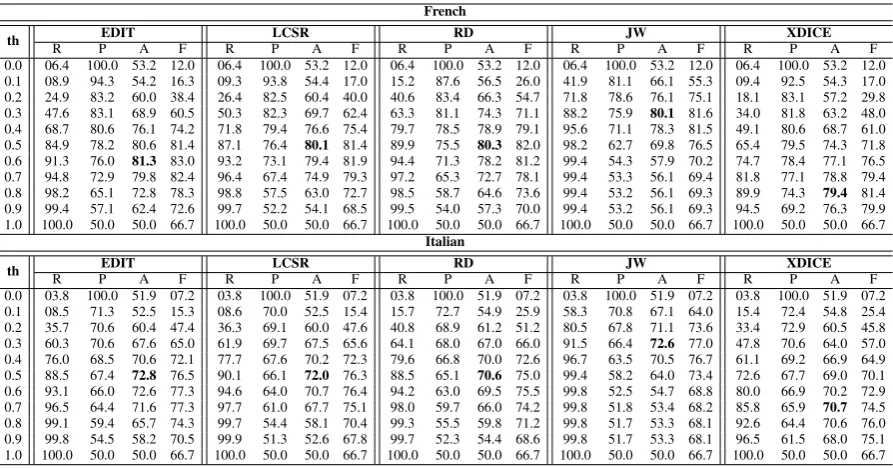
Table 2: Recall (R), precision (P), accuracy (A) and f-score (F) values (computed as percentages) for orthographic measures in the task of cognates identification when diacritics are accounted for
for identifying cognates. The lists of cognates and non-cognates and the values computed by the or-thographic distances for all the words in the Ro-manian-French and Romanian-Italian datasets are available from the authors on request. We count the occurences of each possible outcome: true positive (TP), true negative (TN), false positive (FP) and false negative (FN). In order to analyse and compare the relevance of these metrics, we further use these results to compute the values for recall, precision, accuracy and f-score using the formulas shown below, as presented in (Manning et al, 2008).
recall= T P
T P+F N precision= T P
T P+F P accuracy= T P+T N
T P+T N+F P+F N f−score= 2∗ precision∗recall
precision+recall
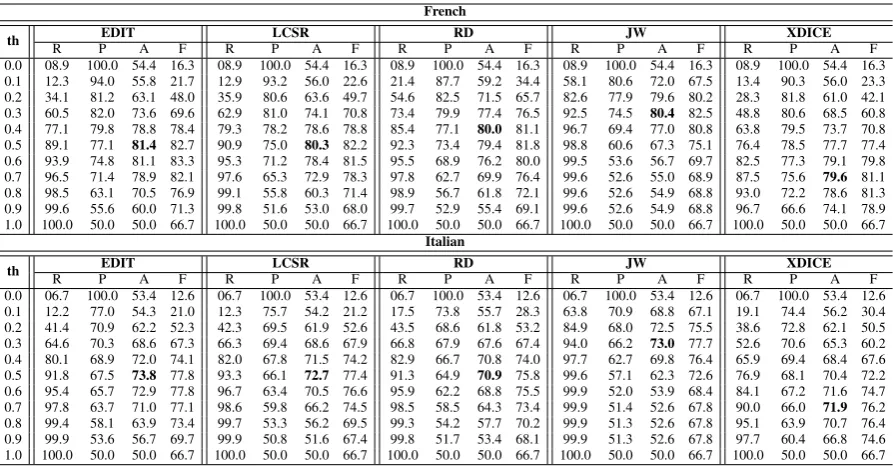
The results of our research are listed in Table 2 for the corpus with diacritics and in Table 3 for the corpus without diacritics. We highlighted the maximum accuracy obtained by each metric for thresholds between 0 and 1. Between Jaro and Jaro-Winkler distances, we decided to use only the latter metric in our analysis, as they are similar to a certain extent and we noticed that Jaro-Winkler distance provides better results.
According to the outcome of our investigation, the edit distance identifies Romanian-French and Romanian-Italian cognates with the highest degree of accuracy, reaching its maximum for a thres-hold value of 0.5 (and 0.6 for French, when diacri-tics are accounted for), followed closely by Jaro-Winkler distance and the longest common subse-quence ratio. An interesting situation can be ob-served for Jaro-Winkler distance, whose accuracy decreses dramatically starting with 0.5 threshold, especially when diacritics are not taken into con-sideration. As expected, for each orthographic method the accuracy increases, reaches a maxi-mum and then decreases, due to the precision-recall tradeoff. However, it is interesting to ob-serve the similarity for the longest common subse-quence ratio, rank distance and edit distance with regard to their accuracy curves when diacritics are accounted for. XDice and Jaro-Winkler distances exhibit different behaviours, in that Jaro-Winkler reaches its maximum accuracy for a threshold value lower than the average, while XDice has maximum accuracy for a higher threshold value. This behaviour stands for both languages.
French
th EDIT LCSR RD JW XDICE
R P A F R P A F R P A F R P A F R P A F
0.0 08.9 100.0 54.4 16.3 08.9 100.0 54.4 16.3 08.9 100.0 54.4 16.3 08.9 100.0 54.4 16.3 08.9 100.0 54.4 16.3 0.1 12.3 94.0 55.8 21.7 12.9 93.2 56.0 22.6 21.4 87.7 59.2 34.4 58.1 80.6 72.0 67.5 13.4 90.3 56.0 23.3 0.2 34.1 81.2 63.1 48.0 35.9 80.6 63.6 49.7 54.6 82.5 71.5 65.7 82.6 77.9 79.6 80.2 28.3 81.8 61.0 42.1 0.3 60.5 82.0 73.6 69.6 62.9 81.0 74.1 70.8 73.4 79.9 77.4 76.5 92.5 74.5 80.4 82.5 48.8 80.6 68.5 60.8 0.4 77.1 79.8 78.8 78.4 79.3 78.2 78.6 78.8 85.4 77.1 80.0 81.1 96.7 69.4 77.0 80.8 63.8 79.5 73.7 70.8 0.5 89.1 77.1 81.4 82.7 90.9 75.0 80.3 82.2 92.3 73.4 79.4 81.8 98.8 60.6 67.3 75.1 76.4 78.5 77.7 77.4 0.6 93.9 74.8 81.1 83.3 95.3 71.2 78.4 81.5 95.5 68.9 76.2 80.0 99.5 53.6 56.7 69.7 82.5 77.3 79.1 79.8 0.7 96.5 71.4 78.9 82.1 97.6 65.3 72.9 78.3 97.8 62.7 69.9 76.4 99.6 52.6 55.0 68.9 87.5 75.6 79.6 81.1 0.8 98.5 63.1 70.5 76.9 99.1 55.8 60.3 71.4 98.9 56.7 61.8 72.1 99.6 52.6 54.9 68.8 93.0 72.2 78.6 81.3 0.9 99.6 55.6 60.0 71.3 99.8 51.6 53.0 68.0 99.7 52.9 55.4 69.1 99.6 52.6 54.9 68.8 96.7 66.6 74.1 78.9 1.0 100.0 50.0 50.0 66.7 100.0 50.0 50.0 66.7 100.0 50.0 50.0 66.7 100.0 50.0 50.0 66.7 100.0 50.0 50.0 66.7
Italian
th EDIT LCSR RD JW XDICE
R P A F R P A F R P A F R P A F R P A F
0.0 06.7 100.0 53.4 12.6 06.7 100.0 53.4 12.6 06.7 100.0 53.4 12.6 06.7 100.0 53.4 12.6 06.7 100.0 53.4 12.6 0.1 12.2 77.0 54.3 21.0 12.3 75.7 54.2 21.2 17.5 73.8 55.7 28.3 63.8 70.9 68.8 67.1 19.1 74.4 56.2 30.4 0.2 41.4 70.9 62.2 52.3 42.3 69.5 61.9 52.6 43.5 68.6 61.8 53.2 84.9 68.0 72.5 75.5 38.6 72.8 62.1 50.5 0.3 64.6 70.3 68.6 67.3 66.3 69.4 68.6 67.9 66.8 67.9 67.6 67.4 94.0 66.2 73.0 77.7 52.6 70.6 65.3 60.2 0.4 80.1 68.9 72.0 74.1 82.0 67.8 71.5 74.2 82.9 66.7 70.8 74.0 97.7 62.7 69.8 76.4 65.9 69.4 68.4 67.6 0.5 91.8 67.5 73.8 77.8 93.3 66.1 72.7 77.4 91.3 64.9 70.9 75.8 99.6 57.1 62.3 72.6 76.9 68.1 70.4 72.2 0.6 95.4 65.7 72.9 77.8 96.7 63.4 70.5 76.6 95.9 62.2 68.8 75.5 99.9 52.0 53.9 68.4 84.1 67.2 71.6 74.7 0.7 97.8 63.7 71.0 77.1 98.6 59.8 66.2 74.5 98.5 58.5 64.3 73.4 99.9 51.4 52.6 67.8 90.0 66.0 71.9 76.2 0.8 99.4 58.1 63.9 73.4 99.7 53.3 56.2 69.5 99.3 54.2 57.7 70.2 99.9 51.3 52.6 67.8 95.1 63.9 70.7 76.4 0.9 99.9 53.6 56.7 69.7 99.9 50.8 51.6 67.4 99.8 51.7 53.4 68.1 99.9 51.3 52.6 67.8 97.7 60.4 66.8 74.6 1.0 100.0 50.0 50.0 66.7 100.0 50.0 50.0 66.7 100.0 50.0 50.0 66.7 100.0 50.0 50.0 66.7 100.0 50.0 50.0 66.7
Table 3: Recall (R), precision (P), accuracy (A) and f-score (F) values (computed as percentages) for orthographic measures in the task of cognates identification when diacritics are not accounted for
French etymons or cognate pairs than for words with Italian etymons or cognate pairs. A possible explanation is that starting with the 19th century numerous words were imported from French. That period represents a stage in the Romanian’s lan-guage evolution in which norms for the vocabu-lary of the literary language were defined, inclu-ding patterns for adapting neologisms to Roma-nian, and probably many of the French words which entered the language in the 19thcentury are in this situation.
6 Conclusion and Future Work
In this paper we proposed a dictionary-based ap-proach to identifying cognate pairs. We extracted etymology-related information from online dictio-naries and we accounted for etymologies and ety-mons to detect cognates. We applied our method on a high-volume Romanian corpus and we fo-cused on detecting cognate pairs between Roma-nian and its most closely related languages, Italian and French. We used this method to investigate to which extent the lexical similarity can be used for automatic detection of cognates, analysing the per-formances obtained by various orthographic ap-proaches: edit distance, rank distance, longest common subsequence ratio, XDice distance and Jaro-Winkler distance. Our results show that the edit distance classifies pairs of words as cognates or non-cognates with the highest degree of
accu-racy, obtaining better results for French than for Italian, with some improvements when diacritics are not accounted for.
A possible application for cognates identifica-tion is native language detecidentifica-tion (Popescu and Ionescu, 2013). We believe that accounting for genetic relationships between words could prove useful for this task. In our future work we intend to further investigate the performances of the ortho-graphic approaches to the task of cognates identi-fication by introducing an additional step of para-meter tuning for the threshold value in our proce-dure. We plan to apply this method of identifying cognates on the entiredexonlinedictionary. In this paper we focused on the cognates that are most frequently used in Romanian, but we believe that obtaining an almost exhaustive dataset of Roma-nian-French and Romanian-Italian cognate pairs would be an important achievement.
Acknowledgements
References
George.W. Adamson and Jillian Boreham. 1974. The use of an association measure based on character structure to identify semantically related pairs of words and document titles. Information Storage and Retrieval, 10: 253–260.
Quentin D. Atkinson, Russell D. Gray and Geoff K. Nicholls, David J. Welch. 2005. From words to dates: water into wine, mathemagic or phylogenetic inference? Transactions of the Philological Society, 103: 193–219.
Chris Brew and David McKelvie. 1998. Word-pair extraction for lexicography. Proceedings of the 2nd International Conference on New Methods in Lan-guage Processing, Ankara, Turkey, 45–55.
Chris Buckley, Claire Cardie, Mandar Mitra and Janet Walz 1998. Using Clustering and SuperConcepts within SMART: TREC 6. Proceedings of the Sixth Text Retrieval Conference (TREC-6).
Lyle Campbell. 2003. How to Show Languages are Related: Methods for Distant Genetic Relationship. In Joseph, Brian D. and Richard W. Janda (eds.).The Handbook of Historical Linguistics. Blackwell.
Beatrice Chin, Bali Ranaivo-Malanc¸on, Ee-Lee Ng and Alvin W. Yeo. 2010. Identification of Closely-Related Indigenous Languages: An Orthographic Approach.International Journal of Asian Language Processing, 20(2): 43–62.
Bojana Dalbelo Baˇsic and Jan ˇSnajder. 2009. String distance-based stemming of the highly inflected Croatian language.Proceedings of the International Conference RANLP-2009. Borovets, Bulgaria, 411– 415.
Antonella Delmestri and Liviu P. Dinu. 2012. An Assessment of String Similarity Methods for Cog-nate Identification In Methods and Applications of Quantitative Linguistics: Selected papers of the VI-IIth International Conference on Quantitative Lin-guistics (QUALICO), Belgrade, Serbia, April, Ed-itors: Ivan Obradovi´c, Emmerich Kelih, Reinhard K¨ohler, 16–19.
Ton Dijkstra, Franc Grootjen and Job Schepens. 2012. Distributions of cognates in Europe as based on Levenshtein distance. Bilingualism: Language and Cognition, 15: 157–166.
Anca Dinu and Liviu P. Dinu. 2005. On the Syl-labic Similarities of Romance Languages. A. Gel-bukh (ed.): CICLing 2005, Lecture Notes in Com-puter Science, 3406: 785–789.
Liviu P. Dinu and Andrea Sgarro. 2006. A Low-complexity Distance for DNA Strings. Fundam. In-form., 73(3): 361–372.
Diana Inkpen, Oana Frunza and Grzegorz Kondrak. 2005. Automatic Identification of Cognates and False Friends in French and English RANLP-2005, Bulgaria, 251–257.
Cristian Grozea. 2012. Experiments and Results with Diacritics Restoration in Romanian. TSD 2012, 199–206.
Matthew A. Jaro. 1989. Advances in record linkage methodology as applied to the 1985 census of Tampa Florida. Journal of the American Statistical Society, 84(406): 414-–20.
Kevin Knight, Grzegorz Kondrak and Daniel Marcu. 2003. Cognates Can Improve Statistical Translation Models.Proceedings of the Human Language Tech-nology Conference of the North American Chap-ter of the Association for Computational Linguis-tics, Companion volume of the Proceedings of HLT-NAACL 2003, 46–48.
Grzegorz Kondrak. 2001. Identifying cognates by phonetic and semantic similarity. NAACL ’01 Pro-ceedings of the second meeting of the North Amer-ican Chapter of the Association for Computational Linguistics on Language technologies, 1–8.
Vladimir I. Levenshtein. 1965. Binary Codes Capable of Correcting Deletions, Insertions, and Reversals. Soviet Physics Doklady, 10: 707–710.
Christopher D. Manning, Prabhakar Raghavan and Hinrich Sch¨utze. 2008. Introduction to Information Retrieval. Cambridge University Press, Cambridge, UK.
Dan Melamed. 1995. Automatic Evaluation and Uni-form Filter Cascades for Inducing N-Best Transla-tion Lexicons. In Proceedings of the Third Work-shop on Very Large Corpora.
Marius Popescu and Radu Tudor Ionescu. 2013. The Story of the Characters, the DNA, and the Native Language. In Proceedings of the BEA-8 Workshop of NAACL.
Michel Simard, George F. Foster and Pierre Isabelle. 1992. Using Cognates to Align Sentences in Bilin-gual Corpora. In Proceedings of the Fourth Interna-tional Conference on Theoretical and Methodologi-cal Issues in Machine Translation.