(a)
(b)
Fig. 1. (a) The LWEs of clean speech (b) The LWEs of speech with white noise added at SNR5.
scales contain different amounts of speech and noise information, and only the crucial scale(s) that contains maximum word signal information and is robust to noise should be used. Therefore, energy of the crucial scale is adopted as detection parameter for distinction between speech and noise in this paper.
To find the crucial scale, some observations on the effect of additive noise are made on different scales of DTWT. It is found that at the scale of a0m =26, distribution of the STWT amplitudes matches well with the speech interval.
Fig. 2. Distributions of speech/non-speech frames in the LWE-ZCR plane with noise ranging from SNR20 to SNR0, where “×” and “ +” denote non-speech and speech, respectively.
wavelet energy (LWE), is computed as follows, 0.8
6 3
0 1
1
LWE | ( , ) (2 ( ))
2
N N
n k
s i kψ − k n −
= =
=
∑
∑
− (4) For illustration, a clean speech and its corresponding WE parameters of each frame are shown in Fig. 1(a). The speech with white noise and its corresponding WE parameters at SNR5 is shown in Fig. 1(b). This example shows that the WE parameter can robustly represent the energy of speech signal at different SNRs.In addition to the WE parameter which is used to measure speech energy, the other parameter used for speech detection is the Zero Crossing Rate (ZCR). The reason for using the ZCR is that it is particularly suitable for un-voiced detection due to the high-frequency nature of the majority of fricatives.
Figure 2 shows distributions of speech/non-speech frames in the LWE-ZCR plane with noise levels SNR=20, 15, 10, and 5. The results show that the speech frames locate in a certain region of the two dimensional feature space.
3. SUPPORT VECTOR MACHINE DETECTOR
SVM is based on the statistical learning theory developed by Vapnik [7]. SVM first maps the input points into a high dimensional feature space and finds a separating hyperplane that maximizes the margin between two classes in this space. Suppose we are given a set S
of labeled training set, S ={( ,x y1 1), (x y2, 2), , (xN,yN)}, where
n i
is achieved, where K x x( , j)= Φ( )x ⋅Φ(xj) is called a kernel function. This paper uses a
Gaussian-kernel SVM with K x x( , j) =
2
exp(− −x xj / )γ , where γ is the width of a Gaussian-kernel. The two-dimensional inputs of the Gaussian-kernel SVM detector are ZER and LWE. For SVM, there is only one output and the desired output is “1” and “ 1− ” if the input frame is speech and non-speech, respectively. During test, the SVM output indicates where or not the input frame is speech.
4. EXPERIMENTS
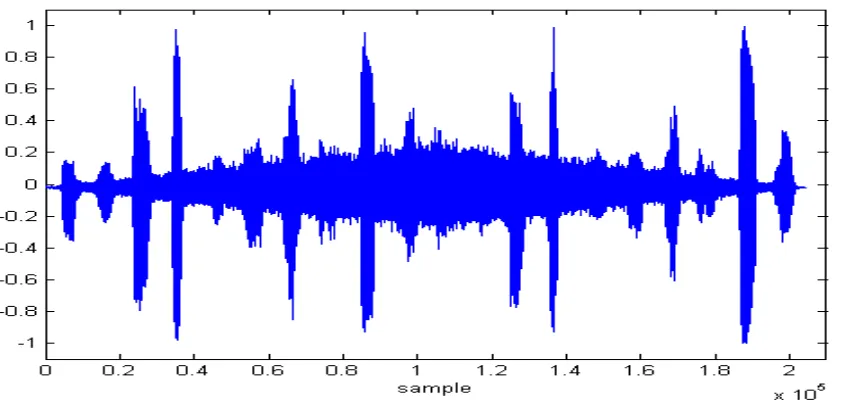
The wave files of speech are recorded by 11.025 kHz sample rate, mono channel and 16-bit resolution. For SVM training, the training sequence length is 13 seconds and is shown in Fig. 3. It consists of 20 words and is corrupted by white noise whose energy level increases from the start to SNR=0 and then decreases till the end of the sequence. For testing, the speech database is built of sequences of transcriptions from the same male speaker, where each sequence consists of ten isolated Mandarin words “0”, “1”, , “9”. There are a total of 50 test sequences used for playing the judicial role in performance comparison. The noise added to the speech sequence is of variable noise level during the sequence. Figure 4(a) shows the flowchart of training by
(a)
(b)
Fig. 4. (a) Flowchart of SVM training. (b) Flowchart of LWE-based SVM for test data. SVM
Fig. 5. Training performance of C in the range in the range [1, 85], where the range is spaced to 17 equal scales.
Fig. 6. Word boundary results by LWE-based SVM and RTF-based RSONFIN in variable noise level environment.
LWE-based SVM is shown, and Fig.4 (b) shows test of LWE-based SVM.
The classification rate defined in Eq. (9) is used as training performance index. Classification rate Correctly detected frame number
total frame number in training sequance
= (9)
For SVM, the value of C influences the training performance. Fig. 5 shows the training performance of C in the range [1, 85], where the range is spaced to 17 equal scales.
(a) (b)
Fig. 7. Noisy speech recognition results by different word boundary detection methods. (a) white noise (b) factory noise.
SVs in the trained SVM.
To get a quick view on the test performance, some illustrative examples are experimented and shown in Fig. 6, where white noise with sharp variation in amplitude is added to the clean speech. Most word boundaries are correctly detected. For comparison, Fig. 6 also shows the performance of refined time-frequency (RTF) feature –based recurrent self-organizing neural fuzzy inference network (RTF-based RSONFIN) [4] detection method. The result shows that RTF-based RSONFIN almost fails to detect most of the words, and the performance of LWE-based SVM shows much better performance than RTF-based RSONFIN.
Next, the ten Mandarin digital words in each sequence of transcriptions in the test database are to be recognized. The words in each sequence are detected by the two methods respectively. When the number of successive frames being detected as speech is larger than 0.1 second, we regard it as word for recognition, otherwise these frames are discarded. So the number of words
detected in each sequence of transcription may be larger or smaller than exact ten words. Considering this phenomenon, we define the following recognition rate
T E U S
recognition rate 100%
T
− − −
= × , (10) where T is the total number of words in the reference transcriptions, E is the number of words recognized incorrectly, U is un-detect words of reference transcriptions, and S is surplus words of reference transcriptions.
LWE-based SVM, and RTF-based RSONFIN methods under white and factory noise are shown in Fig. 7. The results show that recognition rate of the LWE-based SVM method is slightly lower than that of hand segmentation, but is much larger than that of the RTF-RSONFIN method.
5. CONCLUSIONS
Two research results on robust speech detection in variable noise-level environment have been presented this paper, one is the robust LWE-based parameters, and the other is detector design by SVM. Variable noise-level instead of fixed noise-level is added to each sequence of transcript. Distributions of the LWE-based parameters in the 2-dimensional feature space for different SNRs have shown that the LWE-based parameters are feasible for speech detection over variable level noise. The LWE-based SVM can be applied to a speech recognition system as demonstrated in the experiments.
REFERENCES
[1] M. H. Savoji, A robust algorithm for accurate end-pointing of speech signals, Speech Communication, vol. 8. no. 1, 1989, pp. 45-60.
[2] J. Rouat, Y. C. Liu, and D. Morissette, Pitch determination and voiced/unvoiced decision algorithm for noisy speech, Speech Communication, vol. 21, no. 3, 1997, pp. 191-207. [3] J. C. Junqua, B. Mak, and B. Reaves, A robust algorithm for word boundary detection in
the presence of noise, IEEE Trans. Speech and Audio Processing, vol. 2, 1994, pp. 406-412.
[4] G. D. Wu and C. T. Lin A recurrent neural fuzzy network for word boundary detection in variable noise-level environments, IEEE Transactions on systems, Man, and cybernetics, vol. 31, no. 1, 2001, pp. 84-97.
[5] J. F. Wang and S. H. Chen, “A C/V segmentation algorithm for mandarin speech signal based on Wavelet transforms,” Proc. of ICASSP, vol.1, pp.417-420, March 1999.
[6] Y. Qi and B. R. Hunt, Voiced-unvoiced-silence classification of speech using hybrid features and a network classifier, IEEE Trans. Speech and Audio Processing, vol. 1, 1993, pp. 250-255.
[7] C. Cortes, and V. Vapnik, “Support vector networks,” International Journal on Machine Learning, vol. 20, pp. 1-25, 1995.
[8] N. Cristianini and J. S.-Taylor, An Introduction to Support Vector Machines And Other Kernel-based Learning Methods, Cambridge University Press, 2000.
[9] Y. T. Chan, Wavelet Basics, 1995, Kluwer Academic Publishers.


![Fig. 5. Training performance of C in the range in the range [1, 85], where the range is spaced to 17 equal scales](https://thumb-us.123doks.com/thumbv2/123dok_us/1093848.1138190/7.595.113.512.332.592/training-performance-range-range-range-spaced-equal-scales.webp)