Experimental Study on Properties of Cement
with RHA as Replacement in Concrete
Divya Bhavana Tadepalli1, Mounika Kata2, Srikanth Reddy.G3& Ramu.P4
Assistant Professor, Department of Civil Engineering, Aurora’s Engineering College, Telangana, India1
B. Tech Student, Department of Civil Engineering, Aurora’s engineering college, Telangana, India 2,3,4
ABSTRACT: The production of Iron, Cement Stones the most important ingredients of modern development generates lot of harmful waste. Recycling of these waste material with cement concrete will improve environment for better living. In the last decade, the use of supplementary cementing materials has become an integral part of high strength and high performance concrete mix design. These can be natural materials, by-products or industrial wastes, or the ones requiring less energy and time to produce. One of the supplementary cementing material is Rice Husk Ash (RHA) . In the experimental study, a feasibility study is made to use Rice Husk Ash as an admixture to an already replaced Cement with (Portland Pozzolana Cement) in Concrete, and an attempt has been made to investigate the strength parameters of concrete (Compressive and split tensile). For control concrete, IS method of M30 is adopted and considering this a basis, mix design for replacement method has been made. Four different replacement levels namely 5%, 10%,15% and 20% are chosen for the study concern to replacement .
KEYWORDS: Rice husk ash (RHA),Ground granular blast furnace slag (GGBS),compressive strength, split tensile Strength ,conventional concrete, workability.
I. INTRODUCTION
Civil work is an essential part of any development activity. The modern civil work for creating any infrastructure work is the cement reinforcement concrete. This cement reinforced concrete contains cement, fine and coarse aggregates and steel. The production of these materials will generate considerable amount of harmful waste. Hence for sustainable development either the production of these constructional materials need to be reduced or usage of local waste material are to be used. Rice Husk Ash(RHA),is being experimented for replacement of cement. It is reported in that the locally available RHA could be used as partial replacement for ordinary Portland cement(OPC).RHA replacement cement has been proven to be effective to meet the requirement of durability. Research works have been carried out on the binary blends of OPC with different pozzolans in making cement composites.RHA with finer particle size than OPC improves concrete properties. Higher substitute amounts results in lower water absorption but increases results in lower water absorption but increases compressive strength. The research work examined the use of RHA as partial replacement for OPC in concrete The workability and compressive strength at different level of replacement.
II. LITERATURE REVIEW
Al Khalaf and A.Yousif (1984) have investigated the effect of rice husk on pozzolanic behavior of rice husk ash. They studied the actual range of temperature required to burn rice husk to get the desired pozzolanic product. They investigated that up to 40% replacement of cement with RHA can be made with no significant change in the compressive strength as compared to the controlled mix, if the rice husk is burnt under optimum temperature condition. Ismail and Waliuddin (1996) had worked on effect of rise husk ash on high strength concrete. They studied the effect of rice husk ash (RHA) passing 200 and 325 micron sieves with 10- 30 % replacement of cement on strength of HSC. Test result indicated that strength of HSC decreased when cement was partially replaced by RHA for maintaining same value of workability. They observed that optimum replacement of cement by RHA was 10 – 20 %. Ramezanianpour et al. 2009, 2010 concluded that burning rice husks at temperature below 700°C produces rice husk ashes with high pozzolanic activity.
Ramezanianpour & khani investigated ―The effect of rice husk ash on mechanical properties and
durability of sustainable concretes. RHA replaced with cement by weight are 7%, 10% and 15%. Results show that concrete incorporating RHA had higher compressive strength, splitting tensile strength and modulus of elasticity at various ages compared with that of the control cement concrete. In addition, results show that RHA as an artificial pozzolanic material has enhanced the durability of RHA concretes and reduced the chloride diffusion.
Divya BhavanaTadepalli, Madhavi Etaveni, Syed Eashan Adil had worked on sustainable development is mandatory to protect our environment . In this research the experimental investigations carried out in three phase M30 mix grade concrete is used with RHA in proportions of 0%,5%,10%and 15% .In second phase GGBS in various proportions of 10%,20%and 30% were tested . In third phase combination of GGBS and rice husk ash were tested .From this research the 10% RHA and 10 % RHA and 20% GGBS has obtained optimum results and are much better as compare to conventional concrete.
III.MATERIALS USED
Rice Husk Ash (RHA):
The Rice Husk used was obtained from locally available mills. After collecting the rice husk was burnt to a limit of ash that will be blown off. The ash was sieved through 90 micron sieve to remove large size particles. The Specific gravity of RHA is 2.57.
Coarse Aggregate:
Ordinary granite broken stone of size greater than 12mm are used conforming to IS 383-1987 having a specific gravity of 2.67.
Fine aggregate:
Good quality of river sand is used as fine aggregate conforming to grading zone 1 of IS: 383 1970. The specific gravity of Fine aggregate was 2.63.
Cement:
An ordinary Portland cement of 53 grade conforming to IS 12269:2013 is used. Its specific gravity was 3.04.
Water:
In this experimental investigation portable water which is free from organic substances is used for mixing and curing
IV.EXPERIMENTAL INVESTIGATION
In present study M30 grade concrete were designed as per IS:10262-2009
A. workability
Freshly mixed concrete were tested for workability by slump value. In this investigation, M30 mix concrete is considered to perform the test by weight basis by replacing 0%,5%,10%,15% and 20% of cement by RHA.
B. Compressive Strength
In this investigation, M30 mix concrete is considered to perform the test by-weight basis with 0%,5%,,10%,15&,20%of cement replaced by Rice Husk Ash. A 150x150 mm concrete cube was used as test specimens to determine the compressive strength of concrete cubes. The ingredients of concrete were thoroughly mixed till uniform consistency was achieved. The cubes were properly compacted. All the concrete cubes were de-moulded within 24 hours after casting. The demoulded test specimens were properly cured in water available in the laboratory at an age of 28 days. Compression test was conducted on a 2000KN capacity universal testing machine. The load was applied uniformly until the failure of the specimen occurs. The specimen was placed horizontally between the loading surfaces of the compression testing machine and the load was applied without shock until the failure of the specimen occurred.
C. Split Tensile Strength:
In this investigation, M30 mix concrete is considered to perform the test by-weight basis by replacing 0% ,5,10%,15 and 20% of cement by Rice Husk ash. Cylinders of 150 mm diameter and 300 mm length were used as test specimens to determine the split tensile strength of concrete .The ingredients of concrete were thoroughly mixed till uniform consistency was achieved. The cylinders were properly compacted. All the cylinders were demoulded within 24 hours after casting. The de-moulded test specimens were properly cured in water available in the laboratory for an age of 28 days. The split tensile strength was conducted as per IS 5816-1976.The specimen was placed horizontally between the loading surfaces of the compression testing machine and the load was applied without shock until the failure of the specimen occurred.
V. RESULTSANDDISCUSSIONS
A. Workability:
Table1:Slump values with various proportions of RHA replacing cement in M30 grade concrete
Fig 2: slump values when replacement of cement by RHA
B. Compressive Strength Test
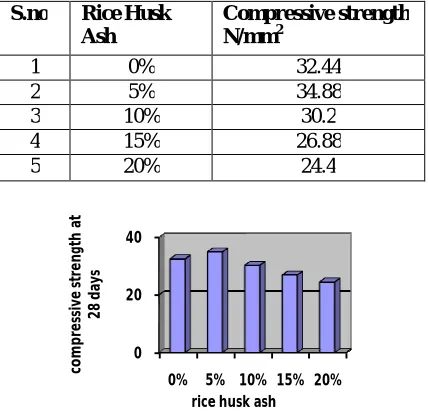
The compressive strength of concrete was achieved in 28 days of various proportions and presented below The specimens were cast and tested as per IS: 516-1959.
Table 2: Compression test at 28 day with various Proportions of Rice Husk Ash replacing cement in M30 grade concrete
.
Fig3: Compressive Strength when replacement of Cement by RHA 0 20 40 60 80 100
0% 5% 10% 15% 20%
sl
u
m
p
Rice husk ash
0 20 40
0% 5% 10% 15% 20%
co m p re ss iv e s tr e n gt h a t 2 8 d ay s
rice husk ash S.no RHA content Slump
1 0% 90
2 5% 86
3 10% 79
4 15% 70
5 20% 65
S.no Rice Husk Ash
Compressive strength N/mm2
1 0% 32.44
2 5% 34.88
3 10% 30.2
4 15% 26.88
From the above compressive strength results, it is observed that rice husk ash based concretes have achieved an increase in strength for 5% replacement of cement for 28 days when compared to conventional concrete
C. Split Tensile Test
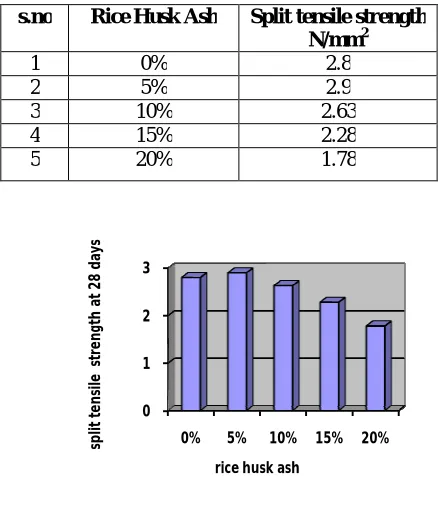
The tensile strength of concrete with 28 days curing period for various proportions and presented below The specimens were cast and tested as per IS: 516-1959.
TABLE 3: split tensile test at 28 day with various proportions of rice husk ash replacing cement in M30 grade concrete
Fig4: split tensile Strength when replacement of Cement by RHA
From the above split tensile strength results, it is observed that rice husk ash based concretes have achieved an increase in strength for 5% replacement of cement for 28 days when compared to conventional concrete
VI. CONCLUSION
Based on the experimental investigations the following conclusions are drawn:
As cement is very costlier and use of cement creates a environmental problems need to find alternative material. Rice husk ash is a waste material which is obtained from rice mills a, it is a suitable substitute for cement at very low cost.
By adopting critical mix and replacing the cement by rice husk ash fine, it is found that by increasing the percentage of rice husk ash workability decreases because of its increased water absorption and strength decreases gradually .From the above compressive strength results, it is observed that rice husk ash based concretes have achieved an increase in strength for 5% replacement of cement for 28 days when compared to conventional concrete
s.no Rice Husk Ash Split tensile strength N/mm2
1 0% 2.8
2 5% 2.9
3 10% 2.63
4 15% 2.28
5 20% 1.78
0 1 2 3
0% 5% 10% 15% 20%
sp
lit
t
e
n
si
le
s
tr
e
n
gt
h
a
t
2
8
d
ay
s
From the above split tensile strength results, it is observed that rice husk ash based concretes have achieved an increase in strength for 5% replacement of cement for 28 days when compared to conventional concrete.
From the above experimental investigation rice husk ash(RHA) can be used as alternate material to cement up to 5% .ACKNOWLEDGMENT
The authors wish to thank T.Divya Bhavana, Assistant professor for internal guidance ,HOD of civil department and Aurora Engineering College for their kind support, valuable guidance and providing all facilities for conducting this experiment on replacement of RHA in concrete.
REFERENCES
[1] Divya BhavanaTadepalli, Madhavi Etaveni, Syed Eashan Adil -Strength and Workability Properties of GGBS and Rice husk Ash [2] Ramezanianpour & khani investigated ―The effect of rice husk ash on mechanical properties and durability of sustainable concretes. [3] Kartini & Mahmud reported on the ―Improvement on Mechanical Properties of Rice Husk Ash Concrete with Super plasticizer. [4] Ismail and Waliuddin (1996) had worked on effect of rise husk ash on high strength concrete. They studied the effect of rice husk ash
(RHA) passing 200 and 325 micron sieves with 10- 30 % replacement of cement on strength of HSC. [5] Maurice & Godwin investigated the effects of partially replacing OPC with RHA .
[6] Abhilash & Arbind evaluated one type of commercially available RHA as supplementary cementations material for cement. [7] Al Khalaf and A.Yousif (1984) have investigated the effect of rice husk on pozzolanic behavior of rice husk ash.
[8] Marthong investigated the ―Effect of Rice Husk Ash (RHA) as Partial Replacement of Cement on Concrete Properties. [9] IS 2386: Part 3: “Methods of Test for Aggregates for concrete”Part 3, 1963.