A Steganography Method Based on Hiding secrete data in
MPEG/Audio Layer III
Mohammed Salem Atoum
†, Mamoun Suleiman Al Rababaa
††, Dr. Subariah Ibrahim
†††, Osamah
Abdulgader Ahmed
††††† Computer Science & Information System University Technology Malaysia81310 Johor Bahru, Johor ††Computer Science Department, Information Technology, Al al-Bayt University, Mafraq, Jordan ††† Computer Science & Information SystemUniversiti Teknologi Malaysia81310 Johor Bahru, Johor
††††College of Alkamel - Computer Department -King Abdulaziz University-110Alkamel 21931 Jedda, Saudia Arabia.
Summary
Steganography is a method for hidden information in such a way that can only be detected by its intended recipient. Steganography in audio becomes a challenging discipline, since the Human Auditory System (HAS) is highly sensitive. One of the main obstacles of the data hiding in audio is to develop a system which has the quality to include a big amount of data and without affectively the quality of sound . This paper proposes a novel information-hiding method to hide more information into audios media file (MP3). The bits of informatione will be hidden between frames (BF) in MP3 file. A In the experimental results, we hide more characters into audios and extract them Correctly. The audios with secret information are indiscernible to human ears.
Key words:
Steganography, MP3, Hiding
1. Introduction
secret digital music MP3 files, are an important and popular audio compression standard in the Internet. MP3 uses the destructive compression technologies to achieve high compression rate and the original file is shrunk to a very small size. [1] MP3 compression [2, 3], is too time-consuming [4]. To protect digital media files, researchers propose and improve many data-hiding algorithms, which are known as steganographic algorithms. steganography means covered writing. Steganography can be classified into three types: pure steganography, secret key steganography, public key steganography [5]. All data-hiding applications require hiding algorithms on the sender side and a detector mechanism or algorithm on the receiver side. The hiding hidden message or data in the can be retrieved by authorized people only. The most crucial parameters of the data-hiding applications are: security, reliability, invisibility, complexity, and data-hiding capacity, these parameters are mostly related to each other [6]. In recent years various techniques for steganography in digital audio with various purposes have been developed [7-14]. In [7] Presented spread spectrum audio data hiding. This method is different from the traditional way in that it is based on dealing with the original sound by sub-and phase shifting.
2. The Proposed method
This method is summed up by embedding data between frames in the MP3 file . The major requirements of this method:
1. k-lite multi-media player program(windows media player classic).
2. The MP3 file must be of CBR type only. The following algorithm demonstrates the way of embedding and extracting encrypted text file
3. Embeding
1) Read MP3 file into buffer 2) Pos=0
3) While (Pos < Buffer) {
Search for next header (header position) Remove all data before the header Calculate FS
Read FS byte and store into array frame Add frame array to all frame array Pos = Pos + Header Pos + FS }
4) Read remaining and store
5) Convert string text data to binary by using UTF8 encoding
6) Generate RSA keys
{ Store keys length in temp array Store keys in temp array
}
7) Encrypt (data string and keys length and keys) and store in temp
8) Find all location in temp=255 {
Store locations count in temp before all data in hexadecimal
Store all location in hexadecimal }
9) I=0 , Offset=2
NOB = Ceiling(temp count/ (frame count -2)) Num Saved =0
While I < All frames count {
If I> Offset then { If (I*NOB + NOB <= temp count + Offset) then Store NOB in result Num saved + = NOB } Else If num saved < n then store from (I-offset) NOB to end of temp } Store frame I in result Store remaining
Fig.1. shows the flow chart for Embedding text of (BF)
4. Extracting
Pos = Pos + Header Pos + FS } 4) Read hexadecimal from no of location.5) Read hexadecimal from all location. 6) Convert hexadecimal into 255.7) Read (key length and keys.)8) Decrypt data. 9) Convert data to string using UTF8 encoding . 10) Show text.
READ MP3 FILE INTO BUFFER
Fig.2. Flow Chart for Extracting text of (BAF)
READ LOCATIONS COUNT AND LOCATIONS FROM TEMP IN HEXADECIMAL
READ KEYS LENGTH FROM TEMP ARRAY
CONVERT BINARY DATA TO STRING TEXT BY USING UTF8 ENCODING
Different criteria have selected to measure either of the best previous methods. Three scales have been used to
5. Experimental results and analysis evaluate
those methods
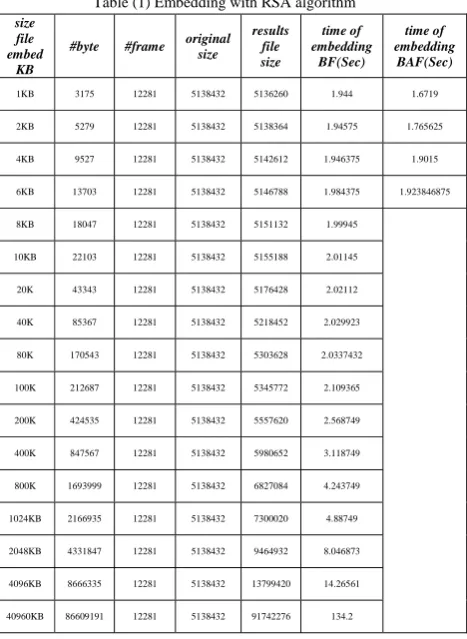
Time of embedding and extracting. The optimum evaluative criterion is embedding as much 2- Size of file embedded. text as possible with least time and high audio quality. A 3- Audio quality. number of tests has been conducted on the proposed method and Befor All Frames method (BAF), which Table (1) shows the results of methods BAF and BF using summed up by embedding all encrypted text before the RSA algorithm for embedding files from both time and first frame in MP3 file. size point of views:
Table (1) Embedding with RSA algorithm
From table (1) it is clearly seen that the embedded file size will affect the cover file size since the embedding processes is to insert the hidden text between frames. Although this method allow embedding large files within cover file, but it is recommended to embed relatively small files (with respect to cover size) in order not to make the stego file suspicious. Figure (1) shows the results of the analysis as shown in table(1) BF can embed 40960 KB in a short time and maintain the same sound quality where as BAF did not exceed 6 KB.
Table (2) shows the results of methods BAF and BF using RSA algorithm for extracting files time. Figure (2)shows the analysis results of table(2)The figure above shows that
size file embed
KB
#byte #frame original size results
file size
time of embedding
BF(Sec)
time of embedding
BAF(Sec)
1KB 3175 12281 5138432 5136260 1.944 1.6719
2KB 5279 12281 5138432 5138364 1.94575 1.765625
4KB 9527 12281 5138432 5142612 1.946375 1.9015
6KB 13703 12281 5138432 5146788 1.984375 1.923846875
8KB 18047 12281 5138432 5151132 1.99945
10KB 22103 12281 5138432 5155188 2.01145
20K 43343 12281 5138432 5176428 2.02112
40K 85367 12281 5138432 5218452 2.029923
80K 170543 12281 5138432 5303628 2.0337432
100K 212687 12281 5138432 5345772 2.109365
200K 424535 12281 5138432 5557620 2.568749
400K 847567 12281 5138432 5980652 3.118749
800K 1693999 12281 5138432 6827084 4.243749
1024KB 2166935 12281 5138432 7300020 4.88749
2048KB 4331847 12281 5138432 9464932 8.046873
4096KB 8666335 12281 5138432 13799420 14.26561
the time consumed inextracting increases with the size of the file. BF proved itsability in extracting files in a short time.
Figure (1) Embedding with RSA algorithm.
Table (2) Extracting with RSA algorithm
size file extract KB
#byte #frame Original file size
Result file size
time of extracting
BF(Sec)
time of extracting BAF(Sec)
1KB 3175 12281 5136260 5138432 1.284375 1.225
2KB 5279 12281 5138364 5138432 1.334375 1.328125
4KB 9527 12281 5142612 5138432 1.465625 1.4125
6KB 13703 12281 5146788 5138432 1.578125 1.528125
8KB 18047 12281 5151132 5138432 1.7
10KB 22103 12281 5155188 5138432 1.809375
20K 43343 12281 5176428 5138432 2.4313
40K 85367 12281 5218452 5138432 3.699999
80K 170543 12281 5303628 5138432 6.1375
100K 212687 12281 5345772 5138432 7.346875
200K 424535 12281 5557620 5138432 13.609375
400K 847567 12281 5980652 5138432 25.94688
800K 1693999 12281 6827084 5138432 50.63125
1024KB 2166935 12281 7300020 5138432 64.9
2048KB 4331847 12281 9464932 5138432 128.5
4096KB 8666335 12281 13799420 5138432 255
40960KB 86609191 12281 91742276 5138432 2618.2
Figure (2) Extracting with RSA algorithm.
7. Conclusion:
Steganography is really an interesting subject and is outside the mainstream of cryptography and systemadministration that most of us deal with day after day. But it is also quite real; this is not just something that is usedin the lab or an arcane subject of study in academia. In general, the suggested method satisfy the capacity and complexity of steganography properties in addition to that, the suggested method for hiding are robust against (noise only). It is also considered highly secure since data is encrypted using RSA algorithm before embedding data which makes the system secure especially agents passiveattack.
To overcome the shortcomings of the proposed method, suggested :Before All Frame (BAF). The merits of Before All Frames (BAF): extracting the text is faster than other methods for limited size, because the whole text lies in the beginning. The song can be played on all multi-media audio players. High audio quality. A relatively good text file size. It can be played whether the MP3 file encodes VBR or
CBR . Taking in consideration that the major issue is the numberof frames in the cover file not the file size (as number offrames will not actually depends on audio file size only but also on frame size).
8. References
[1] W. Jonker, J.-P. Linnartz, "Digital Rights Management in Consumer Electronics Products", IEEE Signal Processing Magazine, Vol. 21, No. 2, pp.82-91, 2004.
[2] D. Pan, “A tutorial on MPEG/Audio compression”, IEEE Multimedia, 2(2), pp. 60-74, 1995.
[3] E. Ambikairajah, AG Davis and W. Wong, “Auditory masking and MPEG-1 audio compression”, IEE Electronics & Communication Engineering Journal, 9(4), pp.165-175, 1997.
[4] Cheng-Te Wang, Tung-Shou Chen and Wen-Hung Chao, “A new audio watermarking based on modified discrete cosine transform of MPEG/Audio Layer III”, Proceedings of the 2004 IEEE International Conference on Networking, Sensing & Control, pp.984-989,2004.
[5] Cheng-Te Wang, Tung-Shou Chen and Wen-Hung Chao, “A new audio watermarking based on modified discrete cosine transform of MPEG/Audio Layer III”, Proceedings of the 2004 IEEE International Conference on Networking, Sensing & Control, pp.984-989,2004.
[6] Wang H, Wang S. Cyber warfare: steganography vs. steganalysis. Communications of the ACM 2004;47(10). [7] H. Matsuka, “Spread Spectrum Audio Steganography using
Sub-band Phase Shifting,” IEEE Int. conf. Intelligent Information Hiding and Multimedia Signal Processing (IIHMSP' 06), pp. 3-6, Dec. 2006 , Pasadena, CA, USA. [8] B. Deng and J. Tan and B. Yang and X. Li, "A Novel
[9] Diqun Yan and Rangding Wang,” Reversible Data Hiding for Audio Based on Prediction Error Expansion”, CKC Software Laboratory, University of Ningbo, Ningbo 315211, China, International Conference on Intelligent Information Hiding and Multimedia Signal Processing, IEEE, pp.249-252,2008.
[10]N. Cvejic, T.Seppanen, “Increasing robustness of LSB audio steganography using a novel embedding method,” In Proc. IEEE Int. Conf. Info. Tech. : Coding and Computing, Vol. 2, pp. 533-537, April 2004.