EFFICIENCY OF SUBGRADIENT METHOD IN SOLVING NONSMOOTTH OPTIMIZATION PROBLEMS
NUR AZIRA BINTI ABDULLAH
A dissertation submitted in partial fulfilment of the requirements for the award of the degree of Master of Science (Mathematics)
Faculty of Science Universiti Teknologi Malaysia
iii
In memory of my beloved father, you will always remain in our hearts To my beloved mother and sister
iv
ACKNOWLEDGEMENT
Assalamualaikum warahmatullahi wabarakatuh…
I would like to thank all those who have contributed in so many ways to the completion of this report. Firstly I acknowledge my great supervisor, PM DR. Rohanin binti Ahmad who gave me the opportunity to do this wonderful project on the topic ‘Efficiency of Subgradient Method in Solving Nonsmooth Optimization Problems’. I am extremely grateful for her excellent guidance, supervision, suggestions, and efforts throughout the duration of this study
Secondly, I am most indebted to my mother and sister who helped me, encouraged me and supported me each step of the way in finishing this study. I would like to acknowledge their valuable time and advice as well as their intellectual support and encouragement throughout my academic journey.
v
ABSTRACT
vi
ABSTRAK
vii
TABLE OF CONTENTS
CHAPTER TITLE PAGE
THESIS STATUS VALIDATION FORM SUPERVISOR’S DECLARATION
TITLE i
DECLARATION ii
DEDICATION iii
ACKNOWLEDGEMENT iv
ABSTRACT v
ABSTRAK vi
TABLE OF CONTENTS vii
LIST OF FIGURE x
LIST OF SYMBOLS xi
1 INTRODUCTION
1.1 Introduction 1
1.2 Background of the Study 3
1.3 Statement of the Problem 4
1.4 Objectives of the Study 5
1.5 Scope of the Study 5
1.6 Significance of the Study 5
1.7 Outline of the Study 5
viii
2 LITERATURE REVIEW
2.1 Introduction 7
2.2 Nonsmooth Optimization 7
2.3 Development of Subgradient Method 9
2.4 Summary 11
3 RESEARCH METHODOLOGY
3.1 Introduction 12
3.2 Research Process 13
3.2.1 Operational Framework 13
3.3 Subgradient Method 15
3.3.1 Lipshitz Condition 15 3.3.2 Subdifferential and Subgradient 16 3.3.3 Subgradient Method Algorithm 19
3.4 Summary 21
4 RESULT AND DISCUSSION
4.1 Introduction 23
4.2 Basic Step Sizes of Subgradient Method 24 4.2.1 Convergence Analysis on Step Sizes 25 4.3 Subgradient Method on Shor’s Problem 27 4.3.1 Convergence Analysis on Square 28
Summable but Not Summable Step Size
4.3.2 Convergence Analysis on Constant Step 33 Length and Nonsummable Diminishing
Stepsize Rule
4.4 Subgradient Method on L1 Regularized Form 35 4.4.1 Convergence Analysis on Constant 36
Step Length
ix
Summable but Not Summable Step Size 4.4.3 Convergence Analysis on Polyak’s 43
Step Size
4.4.4 Convergence Analysis on Various 46 Matrix Dimension
4.5 Summary 47
5 CONCLUSION AND RECOMMENDATIONS
5.1 Introduction 48
5.2 Summary 48
5.3 Conclusion 49
5.4 Recommendations 53
x
LIST OF FIGURE
FIGURE NO TITLE PAGE
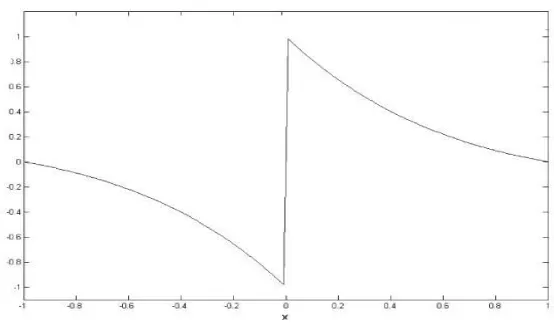
1.1 Nonlinear nonsmooth function | |
| |x ex. 3
3.1 Flow chart of the study. 14
3.2 Graph f(y) with hyperplane. 16 3.3 Graph f(x) with various subgradient. 17
3.4 Graph y = |x|. 18
4.1 Subgradient method with constant step length. 37 4.2 Result of fbestk based on different gamma,γ. 38 4.3 Subgradient method with nonsummable 40
diminishing step size rule and square summable but not summable step size.
4.4 Close up on subgradient method with square 42 summable but not summable step size.
4.5 Subgradient method with Polyak’s step size, 44 square summable but not summable step size,
xi
LIST OF SYMBOLS
g - Subgradient of function.
K - Lipshitz constant.
k
- Step size for function.
Z - Upper bound for all subgradients.
CHAPTER 1
INTRODUCTION
1.1 Introduction
Optimization is one of the areas of applied mathematics and it has been widely used in many areas such as control theory, optimal control, engineering, and economics. Optimization is about finding the largest or smallest values which can be attained by functions of several real variables subject to constraints [1]. Example of optimization problems are:
a) An architect wants to design a house of 460 million square feet and will be divided one third of it to build a playground for his children. How can he do this so as to minimize the cost of all the materials?
2
some of the objective functions and constraints are nonlinear. Examples of nonlinear optimization are problems which involve quadratic and cubic functions in the objective function.
In continuous optimization, the variables in the problems usually are from continuous range of values, usually real numbers [3]. This characteristic differentiates continuous optimization from discrete optimization in which the variables may be binary (limited to the values 0 and 1) and only integer allowable. Other than that, stochastic optimization is the process to find the best (maximum or minimum) optimal value of mathematical or statistical function which involves randomness [4].
3
1.2 Background of the Study
Figure 1.1: Nonlinear nonsmooth function| |x e| |x.
Nonsmooth, optimization (NSO) looks at problems where the functions involved are not continuously differentiable [8]. Figure 1.1 is one example of the nonsmooth function involved in NSO. The graph shows that, there are some regions of the function which is not differentiable as the graph has a corner or kink at x=0 and thus cannot be solved by classical nonlinear programming algorithm because the derivative information cannot be used to find the direction in which the function is increasing or decreasing. Although the function is not differentiable at the corner, it is still continuous at that point. Because of the very little information we get from the function, there will be some modification in the original method in order to derive a method that can solve such optimization problem involving nonsmooth functions. Most modification is at the derivative part of the algorithm where the direction can be estimated.
4
Since nonsmooth optimization involves nondifferentiable function, thus steepest descent cannot solve this type of problem because it requires information from the derivative of the function. As indicated by Wolfe [10] when the function is nondifferentiable, if one uses the steepest descent method with line search to solve the problem, it is possible to generate a sequence which most likely will converge to a non stationary point. One of the differences between the subgradient method and the steepest descent method is in the rule for finding the step size.
An extension of the subgradient method is the conjugate subgradient method which was developed by Wolfe [10] and it is similar to the well-established conjugate gradient method for solving quadratic optimization problems. However Wolfe’s method remained practically unused and a method has been extended from it, which is the Bundle method. Bundle methods are at the moment the most efficient and promising methods for nonsmooth optimization [11]. However, in this study we will focus on the subgradient method only.
1.3 Statement of the Problem
This study proposes to solve the optimization problems involving nonsmooth functions using the subgradient method.
1.4 Objectives of the Study
The objectives of this study are:
1. To apply the subgradient method on NSO problem. 2. To develop matlab code for the subgradient method.
5
1.5 Scope of the Study
We will limit our study to unconstrained Nonsmooth Optimization (NSO) problems where the function is convex and locally Lipschitz continuous, but not continuously differentiable. To solve such problem we use subgradient method and the problems is unconstrained type of problems.
1.6 Significance of the Study
This study contributes knowledge to better understand and solve NSO problem by using subgradient methods. Besides that, mathematicians can further investigate the modification of the present methods to have better method to solve the more difficult problems in the optimization areas.
1.7 Outline of the Study
This dissertation consists of five chapters. The arrangement of the content of this study is as follows.
Chapter 1: In this chapter we briefly discuss the general introduction of this study which consists of introduction, background of the study, statement of the problem, objectives of the study, scope of the study, and significance of the study.
Chapter 2: In Chapter 2, we will discuss the literature review on the topics selected. Most of the topics involve are nonsmooth optimization and subgradient method.
6
Chapter 4: Here we implementing the method that we have discussed on the selected nonsmooth problems. We discuss in detail the nonsmooth problems, and the results obtained.
Chapter 5: This chapter is the summary and conclusion of the result of this study. Some recommendations will be given for future work.
1.8 Summary
54
REFERENCES
1. Kiwiel, K.C. Methods of Descent for Nondifferentiable Optimization. Volume 1133 of Lecture Notes in Mathematics. Pennsylvania State University. 1985. 2. Luenberger, D. G. and Ye, Y. Linear and Nonlinear Programming.
International Series in Operations Research & Management Science, Springer. Volume 116, 2008.
3. Wright, S. J. Continuous Optimization (Nonlinear And Linear Programming). Computer Sciences Department, University Of Wisconsin, Madison, Wisconsin, Usa.
4. Fouskakis, D. and Draper, D. Stochastic Optimization: A Review, International Statistical Review. The Netherlands. 2002. 315-349.
5. Rockafellar, T. Nonsmooth Optimization. Mathematical Programming: State Of The Art. 1994. 248–258.
6. Erfanian, H. R., Skandari, M. H. N., and Kamyad, A. V. A Novel Approach For Solving Nonsmooth Optimization Problems With Application To Nonsmooth Equation. Journal of Mathematics. Volume 2013.
7. Ruszcynki, A. Nonlinear Optimization. Princeton University Press. 2011. 8. Goffin, J. L. Subgradient Optimization In Nonsmooth Optimization (Including
The Soviet Revolution). Mathematics Subject Classification. 2010.
9. Sun, W. and Yuan, Y. X. Optimization Theory And Methods: Nonlinear
Programming. 2006.
10. Wolfe, P. A Method of Conjugate Subgradients for Minimizing Nondifferentiable Functions. Math. Prog. Study 3. 1975. 145-173
55
12. Clarke, F. Nonsmooth Analysis in Systems and Control Theory. Institute Universitaire De France Et Université De Lyon. 2008.
13 Karmitsa, N. Nonsmooth Optimization In 30 Minutes. Department of Mathematics and Statistics, University Of Turku, Finland. 2013.
14. Sagastizábal, C. and Solodov, M. An Infeasible Bundle Method for Nonsmooth Convex Constrained Optimization without a Penalty Function or a Filter. SIAM Journal on Optimization. Volume 16, Issue 1. 2005. 146 - 169
15. Meza, J. C. Steepest Descent. Lawrence Berkeley National Laboratory: Lawrence Berkeley National Laboratory. LBNL Paper LBNL-3395E. 2010. 16. Shor, N. Z. Nondifferentiable Optimization And Polynomial Problems.
Nonconvex Optimization And Its Applications. Volume 24, Springer. 1998. 17. Shor, N. Z. Minimization Methods For Non-Differentiable Functions. Springer
Series In Computational Mathematics. 1985.
18. Held, M. and Karp, R. M. The Traveling-Salesman Problem And Minimum Spanning Trees: Part II. Mathematical Programming 1. 1971. 6–25.
19. Boyd, S., Xiao, L., and Mutapcic, A. Subgradient Methods. Stanford University, Autumn. 2003.
20. S. Boyd and Mutapcic, A. Subgradient Methods. Stanford University. 2006-07. 21. Camerini, P.M., Fratta, L., and Maffioli, F. On Improving Relaxation Methods
By Modified Gradient Techniques. Math. Prog. Study 3. 1975. 26-34
22. Bagirov, A. M., Karasözen, B., and Sezer, M. Discrete Gradient Method: Derivative-Free Method for Nonsmooth Optimization, Journal of Optimization Theory and Applications. Volume 137, Issue 2. 2008. 317-334
23. Nedi´c, A. and Ozdaglar, A. Subgradient Methods in Network Resource Allocation: Rate Analysis. In 42nd Annual Conference on Information Sciences and Systems. CISS, Princeton. 2008. 1189-1194
24. Nedi´c, A. and Bertsekas, D. P. Incremental Subgradient Methods for Nondifferentiable Optimization. SIAM Journal on Optimization. Volume 12 Issue 1. 2001. 109-138
56
26. Dixon, L., Spedicato, E., and Szego, G. Nonlinear Optimization, Theory And Algorithms, Springer. Bikhauser, Boston. 1980.
27. Bonnans, J. F. Numerical Optimization: Theoretical And Practical Aspects: With 26 Figures, 2003.
28. Lemarechal, C. and Mifflin, R. Nonsmooth optimization, Proceedings of a IIASA Workshop. 1997.