Buletin Ukur. Jld. 7, No.3, ms. 198-219, Disember 1996
(C) Penerbitan Akademik Fakulti Kejufuteraan dan Sains Geoinformasi
A Review of The Models of Land Development Process:
The Structure Models
Maziah bt. Ismail, PhD
Panel Pengurusan dan Pembangunan Harta Tanah Fakulti UkUf dan Harta Tanah Universiti Teknologi Malaysia
Abstract
This is the final part of a three series paper reviewing the models Df land development process. One aspect which is lacking in all the three types of models discussed earlier is the focus on the way the production of the built environment is influenced by ""ider forces, It is suggested that the structure models seek to overcome this by focu,sing cxplaination of the development process within the perspective of the structural dynamics of the modes of production. However, they barely penetrate into the details of the events of the land development process and the network of the agency relationships. Therefore, it is concluded that the land development process is best explained within the critical framework of the institutional analysis as shaped by the structure and agency approach
1.0 INTRODUCTION
One aspect which is lacking in all the three types of models discussed in the two earlier papers is the focus on the way the production of the built environment is influenced by wider forces. In contrast to the positivist approach. structure models attempt to explain the land development process by focusing attention within the perspective of the structural dynamics of the modes of production. Such models are derived primarily from Marxist sources as developed in the urban-political literature. As Healey (1991) notes, these models otTer alternative conceptualisations to the three previous groups of models, as of agents and economic processes.
The emphasis of these models is on the struggles between landowners and capitalist producers over the capture of 'surplus value' generated in the production of the built environment within a general model of a capitalist economy. Thus, instead of anempting to generalise from an understanding of the development process which is rooted in a given empirical reality, as event-sequence and agency models do, structure-based approaches start from a set of first principles which may be applied first to the particular characteristics of property development, and then to specific situations. Such approaches, therefore, are almost exclusively based on Marxist ideas about commodity production in capitalist societies, the prime focus being the ways in which capital flows into and out of different sectors of the economy (Gore and Nicholson, 1991).
2,0 THE STRUCTURE MODEL
The models devised by Boddy (1981) and Harvey (1978) are two main examples of structure models. These two models focus on the concept of 'circuits of capital' which in simple terms, means that usually a repayment with interest or profit is required for any capital invested at some point in the future or over a pe~iodof time. The return from this circuit may then be reinvested in the same circuit or another one. Both the source and the nature of the returns will depend on the type of capital involved and on the activity in which it IS invested. Hence the objective of these models is to explore the various possibilities available for capital investment and accumulation, and to analyse how these different circuits might fit together, as well as to relate this and its relation to the production of built property.
Boddy (1981) addresses this by referring to the three circuits of capital within a capitalist economy. The three Marxist circuits of capital arc the industrial, the commercial and the interest-bearing. In the circuit of industrial capital (I), money capital (M) is exchanged for commodity inputs (e), including
Mazlah bt Ismail. PhD
labour power (I) and means of production (p) leading (via productive capital, P) to the production of commodities (C) which are then sold for a given sum (M'), providing a profit of (M' - M):
I .
M
C
p ...p ...
C
M
(I)In the commercial capital circuit (2), elements involves are the use of money (M) to purchase commodities (C) for resale to consumers, to realise a profit of
(M' - M):
M
C
M
(2)This circuit enables the realisation of inherent value of a commodity as money capital in the industrial circuit before it is sold to the final customer (circuit 3) and providing a faster return to the producer:
M, _
C, ...
P, ...
C, _
M;
(3) where the subscripts i and c denote industrial and commercial capital, respectively.
Finally. in the circuit of interest bearing (circuit 4), the advance of money capital (M), is followed with a repayment of interest (M') :
M M' (4)
This circuit may again interact with the others: for example, to initiate the circuits of industrial and commercial capital, or to advance consumer credit. to facilitate the sale and purchase of commodities. Boddy (1981) claims that these principles are applicable to study any fonm of production. However, the precise ways in which the three circuits are constituted in any given sector are seen as being historically detenmined. As he notes, possible configurations, ' tell us little about changing structures and processes but serve, rather, as an analytic framework through which to interrogate the empirical, observable level' (Boddy, 1981,271).
He then .further examines the operation of these circuits in promoting 'the massive scale of commercial
and industrial property development' in post-war Britain (Boddy,1981), with particular reterence to office blocks. Circuit (5) illustrates the ways in which the different circuits interlock in this
development process:
interest bearing capital loaned to
builder
industrial capital directed by builder
M, _ C, ...
P, ...
C, _
M,
A(
-C
,-
M,
commercial capital directed by propertycompany
interest bearing capital based to property company
where the subscripts bf and pf indicate the capital is building or property finance.
A Review of The Models of Land Development Process: The Structure Models
The key issue is the way building contractors manage a circuit of industrial capital by acquiring money capital through a loan from a financial institution. When the building is completed, it is purchased by a property company, using an interest-bearing capital borrowed from another financial institution. The property company will then operate a circuit of commercial capital, selling the space of the building in return for rents, which in tum form the basis of the repayments on the borrowed interest-bearing capital.
Gore and Nicholson (1991) note that the model devised by Boddy offers a basis for investigating different methods and arrangements for property development, and thus helps to place development in its historical and geographical contexts. In addition, the model highlights the relationship between different aspects of the process, and the ways in which events that happens in one part can strongly affect the course of another part. However, as Gore and Nicholson (1991) note the approach is also presented within a broad and abstract level, making it difficult to understand particular development project in a simplistic way.
Another weakness is that the model reveals a tendency towards over simplicity as well as not reflecting the reality of certain aspects of development process. For example, in the model, the property company is presented as purchasing the completed development from the builder. whereas in the real world most developments are developed by property companies from the initial stage of site acquisition; the builder is only responsible for the construction work on a contractual basis. Another example is that payments to builders are presented as occurring at the end ofihe productive process, a feature that does not allow for the stream of regular payments that characterise most construction contracts.
Finally. the model lacks the emphasis for human agency, choice or discretion. Instead a strong determining role is given to the needs of capital, defined especially by the interaction between circuits. This is in direct contrast to the individualist approach of the agency model.
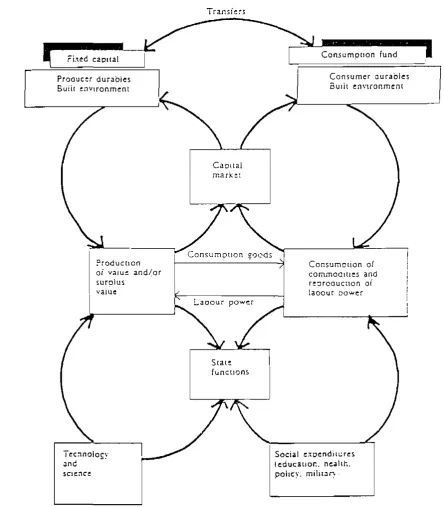
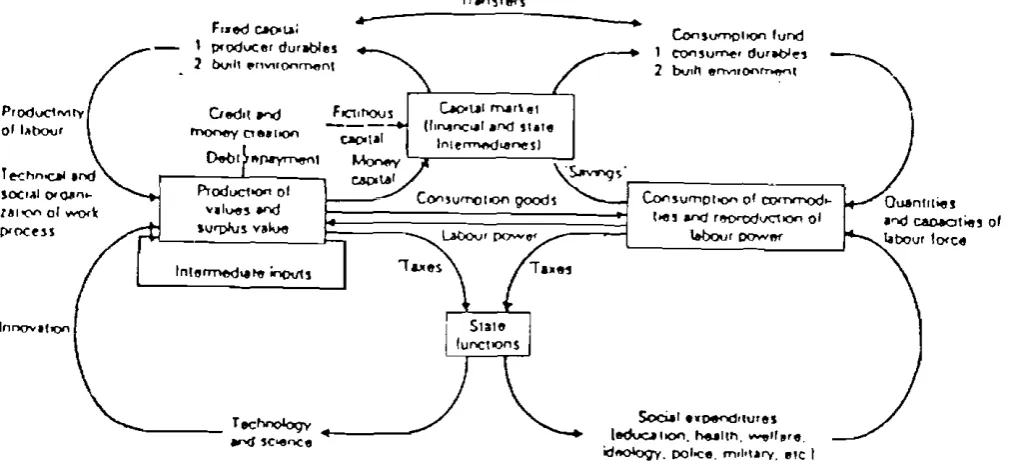
Harvey (1978; 1981; 1982; 1985) provides a theoretical interpretation of the development process which he argues is intimately linked to the modes of production through the circuits of capital. He identifies how the modes of production drive the development process with the built environment being continually prone to flows of finance into and out of property. The model he outlines is developed from Marx's analysis of circuits of capital which like Boddy (1981), is defined within three circuits of capital. In his model the starting point is again the industrial circuit which he calls it as the primary circuit or production. circuit, the secondary circuit through which capital flows into fixed assets and the formation of consumption assets, and the third circuit of capital flows into science and technology and social expenditure (see Figure I and 2. ).
According to Harvey (1981), in the primary circuit commodities will be produced and consumed allowing expansion of capital. However, eventually, overproduction will occur and lor declining profit rates will then limit the scope for fuither investment of such expanded capital in the primary circuit. Consequently, the surplus capital will be channelled into the secondary circuit through the financial and state intermediaries. Since the secondary circuit of capital is the fixed capital in the built environment, a switch of investment flow into the secondary circuit means the formation of large scale long term assets. On the other hand, the nature and form of the financial and state institutions and the policies they adopt can play an important role in checking or enhancing flows of capital or into specific aspects of it, for example, transportation, housing and public facilities. A change in the mediating structures can, therefore, affect both the volume and direction of the capital flows by constructing movement down some channels and opening up new conduits elsewhere. The end result of the operation of this circuit is the creation and modification of the physical environment within which all economic and social activity occurs.
In order to complete the picture of the circulation of capital, Harvey introduced a tertiary. circuit of capital into his model. This,' comprises, first, investment in science and technology am;l, second, the social 'expenditure which relates primarily to processes of reproduction of labour power' (1981, 97). Again, individual capitalists. rely on the agency of the state to channel investment into research and development and into the quantitative and qualitative improvement of the labour force. This is
Maziah bt Ismail, PhD
Figure
The primary, secondary and tertiary circuits of capital.
Source ; Harvey, 1978.
TraJ1sfe:-s
~~-Pi.,"-d
0.-011.--\
-.--Jr
~~~.Jc·0·n,·u·m·0'·'0·n·iu·n·d"-'
Consumer ouraoles Praoucer durables
Built en\'lronment Budt enVironment
CaOllal mark::
Consumptlon goods Production
oi value and/or surolus
value
State functlons
Social r:::toendit<;res Joe -"
Tr::c:'lnoloC\"
Consumolion of
COrilffiOOIUes and re::Jrcaucnoo oi laoou; DOWer Laoour powe.r
leciucallor.. neahr..
SCle:'lC'e poliCY. miht':H;'
Figure
2
The built environment in the structure of relations between primary,
secondary and tertiary circuits of capital.
Source: Harvey, 1985, 9.
Tr.,,~Ittr1
F•• e<;1 c.-ooui
1 P'odVC:'H durables
2 bvoll 'H'V1I()"uT~nl
'"
U'l(jl! ..-.d c..o.UI m..r\",s
~C1Ill.11()f'l 1I1I"1.4nc... r ..nd ".,'"Inlel"TT\,flo(jL8nes)
Dol>
'\0"""""'"
.~,.Ci"~
r ,-:---~---,
(('Yl'urnoIOf"l goods (..or,SU""'PII(Y'l 0' CQrl'YT"\(')(j..
1W!' and rl"t1)rO(1VC"l1()rl 01
UOov'~~
ProdUC"11()r1 01
".llJo$s ¥Id
PrOdvc1fV\ty 0' lAbour
Innovl!1QI1
Q~nlrti.e!
"
i
1f'Wj caoaolie, 01
1vrplus Y8k.J.e
I
"
a
\&bour OO'WItf labour !OC'ColI
InIIII f'TTledlf ~in(NU
Soci.Ir .1:~'IUTtU Technology .. . /
1~lon. he.lllh, ..."H,,'e. IIr'<1 SCIo8nc"
idflO4oo;7y. 00100;:8. m,hUlry, "Ie'
»
~
I'
a
-i
-
~..
-is:
Con SUfTlP IIQIl lund ~o
.. c.
1 ~,u~,dur~e'
m!!.
2 bvlf1 t111V1100i'nol'rnl
"
co
..
~\
a
c r; ~ s:c.
Maziah bt Ismail, PhD
because there is little incentive for individual investors to direct capital to such areas, in spite of the benefits to investment prospects in general, mainly because there is no immediate payback.
With respect to the development process and formation of the built environment, the Marxist approach, in which Harvey is one of the main authorities, states that the urban process is the creation of infrastructure for production, circulation, exchange, and consumption. The creation of the built environment is to provide a physical infrastructure for production. As Harvey (1981) states, the built environment is long lived, difficult to alter, spatially immobile and absorbent of large lumpy investments resulting from the over accumulation in the primary circuit being channelled through the financial and state institutions into the built environment.
Harvey (1981) advanced his analysis on the implications of the tendency to over accumulate and then under invest, by constructing a cyclical model of investment into and out of the built environment, whereby there are temporal and geographical ebbs and flows of investment into the built environment. This rhythm is dictated by the rhythms of capital accumulation. As he states, the waves of investment
into the built environment are due to:
each global crisis of capital preceded by massive movement of capital into long-term investment in the built environment as a kind of last ditch hope to find a production use for rapidly over accumulating capital' (Harvey, 1981,112).
The flow of investment into the built environment. therefore, depends upon the existence of surpluses of capital and investors looking for a steady and secure rate of return on their capital. As Harvey (1981), notes, under capitalism there is a perpetual struggle whereby capitalist development is trying to
preserve past capital investments in the built environment yet also needs to destroy these investments in order to open up new room for accumulations. This crisis of capital accumulation results in a
cyclical nature of development being built up then subsequently destroyed.
Harvey (1981), therefore, takes a comprehensive stance in his framework, placing development activity firmly within the context of all other economic activity and all other spheres of investment. He emphasises the links between the built environment and social and economic life. Hence, in contrast to Boddy's (1981) model, his model provides a wider view of the development process. However, as the focus is on the variable flow of capital into different types of activity at different points in time, there is not much emphasis on the mechanisms by which specific development takes place. This leads to a very blurred image of the development process.
In addition, as in Boddy's (1981) model, there is a strong determinism in that a role for human agency is largely constrained by the imperatives of capital flows within and between circuits of capital. Although the capital flows are influenced by the state of the struggle between different fractions of capital and between capital and labour, in this model these bargaining processes appear to have been predetermined. One last criticism is that although the built property is a saleable commodity, in the model, it is supposed to be produced in the secondary circuit of capital. In addition as Gore and Nicholson (1991) comment the main contribution of these two models is their use of a clearly specified theoretical framework. However, therein lies their major weakness. 'that the concern to develop such an all-embracing approach means that specific empirical applications are weakly developed' (1991, 725).
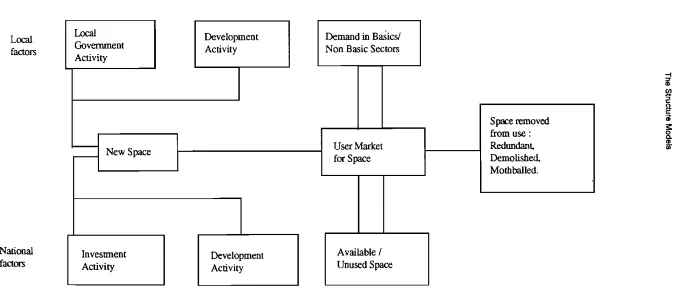
Nabarro (1990), is another author who seeks to explain the development process by way of a structure model. Like Boddy. (1981) and Harvey (1981), Nabarro (1990) attempts to explain the development process through the structuralist approach. However, the model as devised by Nabarro is oversimplified in that he distinguishes two levels of structures of provision, the local and the national level. The purpose of the model is to relate the production of new space with investment, development and local government activity (see Figure 3).
Figure 3 : Nabarro's model of the development process
Local Government Activity
-
New Space.---Investment Activity
Demand in BaSics! Development
Local
Non Basic Sectors Activity
factors
N
o
...
User Market for Space
National Development Available I
factors Activity Unused Space
Space removed from use: Redundan~ Demolished, Mothballed.
»
~
I·
a
~
-n:
" - 0 <1>0.
"'!!._<h 20 l l cor
iil~
;;:0.
§.~
ur~
.g
~
a
."
~
Source : Nabarro, 1990.
Maziah bt Ismail, PhD
As capital is reorganised to switch in and out of circuits of production in the built environment it is
suggested that capital is not monolithic. However, as Usher (1990) states, Harvey (1981) treats capital as monolithic; instead it is composed of a range of social agents with differentiated interests and strategies for investment in the production and transformation of the built environment. Cyclical switches of capital between sectors show that there are different fractions of capital with divergent agenda for development. For example Usher (1990) quotes the growth of mass ownership which is said to benefit 'capital' yet, instead, the benefits are highly selective for different fractions of capital.
It can be concluded that since the structure models operate within the framework of structuralism, they
display the features of this approach. As such, the argument of the models is that the production of the built environment is the result of the operation of processes that cannot be observed. Explanation, therefore, cannot be produced through empirical study of the phenomena alone but the underlying structures can only be appreciated through a combination of theory and observation.
As mentioned earlier, in a development process, the range of agents involved could be potentially vast (Healey, 1992). In order to analyse the 'driving forces' of the development process in different sectors, locations and time periods in a particular urban region, and thus to explain the processes of the production and re-production of the built environment in specific places; empirical analysis must enter
into the details of agency relations in the events of the development process,
However, as Healey and Barrett (1990) similarly argue, Harvey's (1981) model, and the problems with the Marxist approach in general, are that it is highly generalised and abstract. This abstraction is a common characteristic of most recent political-economy approaches. As Healey (1983, 245) states:
'Coherent theoretical structures are at such a broad level of generality that they cannot be tested against
actual events, while in investigating ~vents, it is difficult to substantiate precisely the connections
between these and wider forces, even though a good interpretative guess can be arrived at'.
Therefore, although the structure models offer ways of linking events and agency behaviour to the
dynamics of the modes of production and regulation of different economies, this link is empirically
difficult to prove. As Healey (1991,235) notes, 'they barely penetrate into the details of the events of the development process and the network of the agency relationships which might surround each'. Therefore, the problem with structure models is that the absence of theory in the middle ground which
could help to link the hroad concerns of structure approaches with studies of the ways in which
particular sectors of the development industry operate. Models with such characteristics is discussed in the following section.
3.0 THE STRUCTURE AND AGENCY MODEL
The authors which are most closely associated with this model are Healey (1991; 1992), Ball (1983: 1985: 1986a; 1986b) Dear and Moos (1986a, I 986b) and Krabben and Lambooy (1993). The land
development process is viewed as not only the physical process of creating and transferring buildings to their occupi~rs but is also a social process dominated by economic interests involved.
In an artempt to understand such provision it is argued that the institutional and other structures within
which it takes place as well as the social agencies involved in such structures should not be ignored.
However, as McNamara (1983) notes, the nature and manner in which these operate and interact varies between countries and over time. Hence, in these models the explanation of development process is
sought within the critical framework of the institutional analysis as shaped by the structure and agency
approach. As Giddens (1984) notes, both structure and human agency must be interlinked so that
social science has a more realistic grounding.
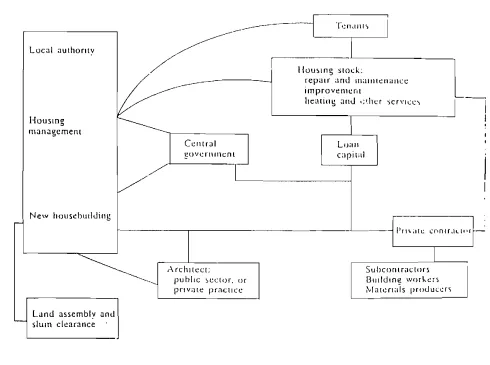
Ball expresses this argument in his extensive works on residential properties Two such models devised by Ball (l986a) are in relation to owner-occupied and council housing in contemporary Britain (see Figure 4 and5 ). In both these diagrams, Ball (1986a) emphasises two factors. First, he stresses that it is the relationships (that is the arrows) that are the most important element. Second, that
the ways in which relations between two types of agent work is likely to have repercussions
A Review of The Models of Land Development Process: The Structure Models
0
~
,
0
-..
-.
,
----r
n
Ii -:: :
, :
~.=J
~I
CO
'"
CO mCD
'"
Maziah bt Ismail, PhD
Figure
5
The structure of council - housing provision.Source: Ball, 1986a.
Local authority
Housing nl.:l/lagcmcm
New hOlJs~bl1tlJil1g
-I
T"II llll.,
II
110u~lng slOek:repair anti lIIallllt.:ntlllCl;
Il1lprOV~r1lCnl
~-
l1e;\lill~ anJ ';!.ht:r ')cr\'I~C'l/ /
CelurJI govcrlllllt:nl
r
Loan capj(;d
- ~--- Pn \;1 I L: ~() I
~~
A rchl teet;public ::.ector. or pnv.w:: pr;lctlce
Su bconI r'H: tors
BuddIng workers Maten;lIs prOlJuc
-
slum clearance Land assembly and.
A Review of The Models of Land Development Process: The Structure Models
models, is that rather than focusing solely on the structuring dynamics of the modes of production as in structure models, here agents are seen as having a significant role. In these models the relations between human agents are seen as the driving forces ofland development process.
Although the models were originally devised to analyse the housing provision in Britain, Ball (I986b) argued that the same principles can be applied to other forms of property development D""~rtha" providing a general model that is supposedly applicable to all type of development, the idea is to generate specific models, in order to provide 'a means of ordering material so that it may be investigated' (Ball, 1986b, 462).
This is, therefore, a theoretical as well as an empirical question involving historical and geographical specific situations by means of a common set of theoretical propositions (Gore and Nicholson, 1991).
In the attempt to elucidate the conflicts between agents, Ball (1988) suggests that what is required is a historical analysis of the evolution of the social relations within the development process. This is because, as a historical product, the nature of specific development processes simply cannot be read off from any related grand theory. In fact, it is not even possible to define the physical context of production without understanding the specific social context in which production takes place. Hence, emphasis should be on the institutional structures of the land development process, placing emphasis on their historical development and the pressures on each of them that lead to their reconstitution and dissolution (Ball, 1988).
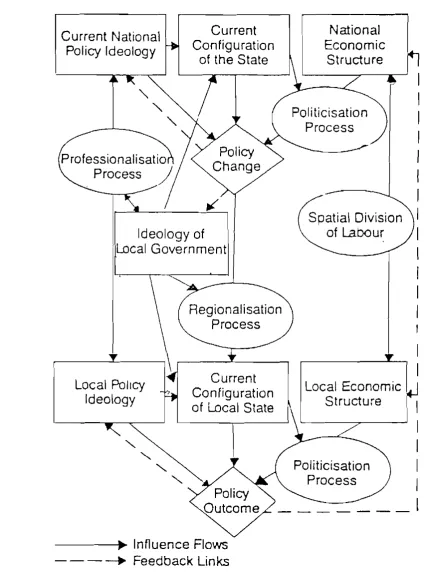
Rydin (1986) attempts to explain the development process within the mechanism of policy processes in relation to land development. She argued that there are a number of key interest groups concerned with the allocation of development land by the planning system, that is the public and private agencies (1986). Thus, it is necessary to analyse the sets of interests involved in order to reveal the way these interests affects decision making in the development process. However, the lack of recognition of potential conflicts by the interests involved suggests that a more radical power analysis is more appropriate. She further suggested that the interaction of economics, political and ideological forces at the local level can make such analysis very complex in that these may influence and affect development decisions. Figure 6 shows the model outlined by Rydin (1986). In this model she concluded that the structure of the building industry and its interests in land change is a response to the economic crisis.
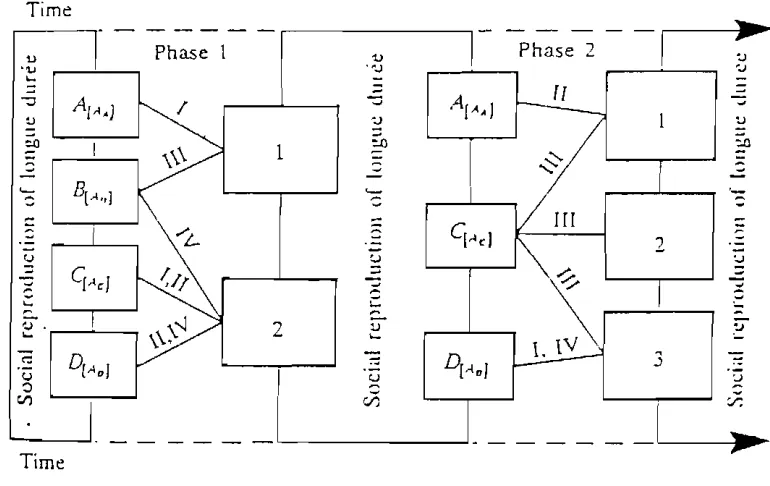
Another important model is the work carried out by both Dear and Moos (1986). In their model, they attempt to provide an insight· into the understanding of urban built environment by carrying out an empirical application of Giddens's (1984) structuration theory. The purpose is to investigate the utility of this theory as a framework for practical application. This was accomplished by operationalising the institutional model which they developed as shown in Figure 7. In their model, there are two levels of analysis that is the institutional analysis and the strategic conduct analysis.
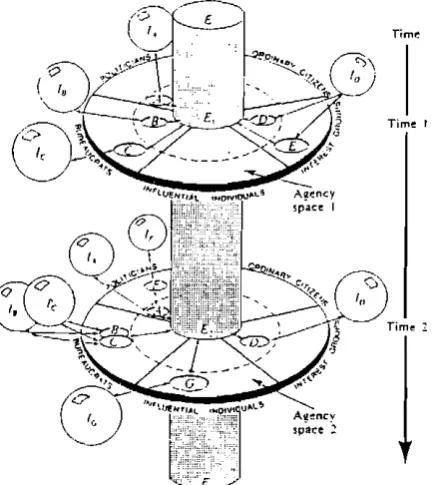
The primary goal of the institutional analysis is to understand how institutions affect interaction • communication, political, economic and sanction - between various institutions (Dear and Moos, 1986a). On the other hand, Figure 8 and 9 portray the analysis of strategic conduct which simultaneously brackets institutional analysis. This level of analysis focuses on the understanding of the power relationships between individuals, in which the agents are classified into five types that is the politician, the bureaucrats, interest groups, influential individuals and the ordinary citizen. Dear and Moos (l986a) argued that for each category of agent, the dialectical of control mediates the relations within these groups as well as between the five groups.
In the model devised by Dear and Moos (1986a), structure is represented as the 'medium and outcome' of social interaction in which agents are
a:
key to the analysis. In this model structure also reflects the medium and outcome of interaction by being posited as an infrastructure in relation to both the social system and agency (Dear and Moos, 1986a). This is because, as they argued, institutional components are directly affected by the actions of the individuals who reproduce them. The agen!.s relate to the institutions involved through the duality of structure, which considers agency effects on institution and also institutional effects on agents. As such the interaction between agents and institutions yields outcomes which may either be intended, unintended or some combination (Dear and Moos, 1986a).Maziah bt Ismail, PhD
Figure 6 : An analytic framework for the policy process.
Source: Rydin,
1986, 130.
Policy
Change
Current
Configuration
of the State
Current National
Policy Ideology
Professionalisatio
Process
)
Politicisation
Process
National
Economic
Structure
Current
Configuration
Regionalisation
Process
Spatial Division
Ideology of
of Labour
Local Government
I
I
Local
PoliCYLocal Economic
!.J
Ideology
Structure
II
of LDcal State
I
I
Politicisation
I
Process
I
_ _ _ _ _ _ _ 1
----.~
Influence Flows
- -
-
-.... Feedback Links
A Review of The Models of Land Development Process: The Structure Models
Vl
,.
N cO <.0 co (j) ",' 0 0 :L "tJ c OJ ' OJ OJ 0 OJ U ' :l 0 Vl=
~
~~
'0.::
-5•
E"
..,
0=
~
§ ~
0
.= 0
> " .~ 0; .~
=
,
¥
-.; e "--
-Iu,;
I
UO'i~WI1!6al 'UOljeUIWOC
3C1nL::lnl:JlS
-
-1---- 1
.
..,
•
OJ 11..
=3
~
"
S0v E 0
=
0 0 w-I
'uolle::)l~lU6"3
;0
ALlllino-
_T.
-
l.-.
"':Q""i;;;
•
~g
"
~ "= ~
.
~
=..,
~g
~.~,
"
~
~
0, '0~
-,; ~.~ <5 ,;
0.
~
~
;"'
..
- [ - - - - ;;
' saJnI~nJlS 3
.
-_____
Maziah bt Ismail, PhD
Figure
B ..
A methodology for institutional analysIs.Source: Dear and Moos, 1986b, 355.
Time u ·u ~
'""
"
Oll ~-
~"
c:: ~. ~ ?"
"
'"
,
Phase IA/A,}
I
B[A ..]
>
I
~
CiAc]~
IyY
DrA_)I
1 2J
-- - --I
Phase 2'"0
"
fl
~ f-
'0 AfA ,) 1
;;,
II
i
'rrr
Chi
~
D
f,,_/ l. IV-
I
~2
;
~ ~I
~ ~"
3
ur.i1
[ . _ - - - TimeA, B, C, D Institutions
[AA], [AB] Bracketed agents in analysis
I, II, III, IV Communicative, political, economic, and sanction mode
1, 2, 3 Outcomes from institutionaf action
A Review Of The Models of Land Development Process: The Structure Models
Empirical work as carried out by Dear and Moos (I986b) provides some significant implications in the understanding of social phenomena. It reveals that the formalisation of the theory into an integrated framework enables a clearer understanding of the relationship between system, agency, structure, time and space. In addition, the reformulation of structure as intrastructure provided the basis for redefining the notion of determinism from structuration theory in both theory and practice. Hence, this view of determinism enabled the delicate balancing of structure and agency in the development of the theoretical model and in the methodologies for institutional analysis and analysis of strategic conduct. Lastly, the consideration of space in an institutional context has extended Giddens's conceptualisation of the regiona/ised locale since it begins to articulate how social and spatial structures are connected. These proves that the conceptual view of structure and agency in structuration theory provides a comprehensive explanation that considers how agency and structure come together in the production, reproduction and transformation of society (Dear and Moos, I986a).
Apart from the above strengths. Dear and Moos (l986a, I986b) also uncovered some difficulties in the application of the theory. The twin use of the concept reflects the ambiguity surrounding the cOhcept which Giddens (1984) developed. In addition the analysis is itself problematic with a disadvantage of not providing clear rules of interpretation (Dear and Moos, I986b). The implications are that a set of criteria for establishing data requirements, for determining the adequacy of an explanation or for generating the results of a study is lacking. Another weakness is that the theory
does not develop a method of explanation for questions concerning historical interpretation.
humanism. or collective action. although an awareness of the problem was highlighted (Dear and Moos, 1986b). However, Dear and Moos (l986b) claimed that the theory has sufficient merit for
empirical work to warrant continued development and assessment.
The work of Dear and Moos (1986b) was developed further by Healey who then devised a model by applying the concepts of structure and agency to explain the complex process of land development process. In her model, Healey (1992) sought to develop an approach to the description of the development process by combining the understanding of structuring forces within the tradition of the
urban political economy with an appreciation of the detail of the social relations surrounding events in
the development process. The focus of the model is on distinguishing levels of analysis rather than placing the analytical emphasis on the different actors, events and interests involved.
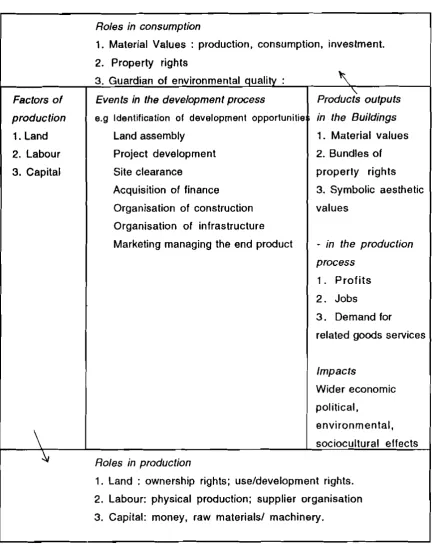
Figures 10 and 11 outline the general principles of the proposed approach. The models involves four levels:
(I) a description of the events which constitute the process, and the agencies which undertake them (2) identification of the roles played in the process aud the power relations between them
(3) an assessment of the strategies and interests which shape this roles. and the way these are shaped by resources, rules and ideas, and
(4) the relation between these resources, rules and ideas and the wider society.
As such, the model seeks to allow analysis to explain general tendencies in the social relations of the development process through macro-economic and political questions. In addition, Healey (1992) claimed that the model is comprehensive in form, relevant to all types of development projects. applicable under different economic and political regimes, at the same time taking into account the spatial and temporal variation and is capable of addressing whether particular 'driving dynamics' produce distinctive patterns of agency relations and whether these have particular effects on what is built, how and for whom.
Hooper (1992) in his comment on Healey's model outlines a number of interesting issues. First, he notes that Healey (1992) fails to define the term institutional which is used in the analysis of the development activity in Britain. Whereas, according to Hooper (/992). Healey's (1992) citation of relevant research reveals the existence of a wide disparity in the approaches of different authors regarding the treatment of institutional analysis. Therefore, in Healey's (1992) model, the conceptual composition of ,institution' should be clearly theorised to avoid the generation of an abstract model. The second criticism is in relation to the extent of the applicability of the model devised. Her assertion that the model is capable of application to all circumstances in which development projects
Time:
Tim",
All",ncv
,pace ~ Maziah bl Ismail, Phl)
Figure q . A methodology for strategic conduct analysIs.
Source: Dear and Moos, 1986b, 357.
Time
r
Figure.
16 .;
A consolidat.ed model of the development process.Source: Healey, 1992, 37.
H,dl:\ ill
~t"'lI"II'lil~"
- - - : ; " . - : ' - - - -
----~~ \ ..:nl" in lhe
Inpllb" F;lclors 01 prndllt!io!l dc\'doPlllCIl! I'loll,ln4It11p;ll.:r" ()lIlptrl~\)lIh~'IIl\l"
~ pI\'e..:>,,,
I{pk" ill
ptlU(lldll'll
r
Rules ;Illd ,et,'li\111"hrp~
I
r-.lodc (If j\.od"l"!'\I" I\hl\k HI rq~tllali,'rt
A Review of The Models of Land Development Process: The Structure Models
Figure
II:
A model of the elements of the development processRoles in consumption
1.
Material Values: production, consumption, investment.2. Property rights
3. Guardian of environmental Dualitv :
Factors 01 Events in the development process Products outputs
\.
production e.9 Identification of development opportunilie in the Buildings1. Land Land assembly 1. Material values
2. Labour Project development 2. Bundles of
3. Capital Site clearance
Acquisition of finance
Organisation of construction
Organisation of infrastructure
Marketing managing the end product
properly rights
3. Symbolic aesthetic
values
• in the production process
1. Profits
2. Jobs
3. Demand for
related goods services
Impacts
Wider economic
political,
environmental,
\
sociocultural effectsRoles in production
1. Land: ownership rights; use/development rights.
2. Labour: physical production; supplier organisation
3. Capital: money, raw materials/ machinery.
Source: Healey, 1992, 42.
Maziah btl.mail, PhD
are accomplished seems to indicate the construction of a grand theory which is beyond context. Whereas, as Hooper notes (1992, 45), 'elsewhere in the paper, Healey is clearly concerned to construct situated theory'.
Healey (1992) als9 claimed that the 'structure model' approaches treat the details of the events of the development process and the network of the agency relationships which might surround each as simply dependent variables. Contrastingly, one of the authors whose work she includes in the 'structure models' (Ball,1988,29) specifically notes that since, 'actual structures of provision are empirical constructs and cannot be theoretically deduced', analysis must focus upon the production of specific commodities in particular capitalist societies. In contrast, Healey (1992) suggests the construction of a comprehensive model which is applicable to all types of development projects. In a way this leads to the construction of models of the development process which' are excessively abstract, in the sense that they seem to be applicable to any social formation, whether capitalist or not.
In relation to the production of the built environment, Ball (1988, 21) has outlined an approach which focuses on, , the institutional structures of cqnstruction, placing emphasis on their ,historical development and the pressures on each of them lead to their reconstitution or dissolution '. However, it is this potentially transformative element in institutional structures which is lacking in Healey's model. As Hooper (1992, 48) comments:
'without this element the analytical approach outlined in the paper is unlikely to make further progress
in advancing beyond Form's "social congeries" or "organisational complexes" as these are represented
in the production of the built environment',
Healey's (1992) model of the development process has also drawn the attention of authors outside the UK. Krabben and Lambooy (1993), in their anempt to present a theoretical framework to aid understanding of the functioning of the Dutch property market endorsed Healey's (1992) model as providing a useful approach to underlying land development process. However, Krabben and Lambooy (1993) criticised Healey's (1992) model in two aspects.
First, although Healey stresses that a model of the land development process should take account of spatial variation, in her model, property development is not explicitly linked to location. Consequently, locational differences in property development probably cannot be satisfactorily explained. Second, Krabben and Lambooy (1993) claimed that Healey's notion of the institutional context which governs the way material resources are used for land development is seen as a static element, is too limited and neglects the element of time. Hence, their suggestions for the model to be further developed in the direction of overcoming the two weaknesses. Although, Krabben and Lambooy (1993) based their study using Healey's (1992) theoretical concept, they did 'not empirically apply the model to a case study. Their work was limited to the conceptual development of the Dutch property market.
The structure and, agency models, therefore, provide a much richer insight into the variety and complexity of the development process than the other four types of models. This, however, does not imply that the previous models are without value, rather the structure and agency approach is an attempt to Overcome the limitations of other theoretical frameworks and to build upon the strengths. In one way, this approach is a balanced form of the previous models which may be used to provide the fullest possible context for the analysis of any of their components. As Healey (1992) states, the model should enable the development of much richer hypotheses about spatial and temporal variations in property development activity.
4.0 STRENGTHS AND WEAKNESSES OF THE MODELS
The obvious characteristic of contemporary studies of the land development process is the diversity of approaches. Such a plurality of related models, encompass a broad scope in the investigations of land development activity. Yet, these developments are still unable to cope with the fundarnelltal issue of identifYing an accurate method and theory to explain and understand the increasingly complex
process.
A Review of The Models of Land Development Process: The Structure Models
Table
I Summary of strength and weakness of models of development processTvpe 01 model STRENGTH WEAKNESSES
Equilibrium allow critical appraisal of ppty market perlormance by way 01 quantitativa analysis on demand & supply factors, prices,values, rental, yield, return, etc.
only suitable 'or standard type 01 development in stable conditions & not dominated by law large operators, unable to cope with diverse lorm of demand, lail to considar non-economic values, difficult to astabllsh values, unable to cope with uncertainty 01 luture gain due to lime-scale, dilllcult to derive empiricallv. Event sequence Illustrate the main tasks involve
in development process focussing on the potential blockages 01 dev activity, anable the trace 0' cer taln activities that occurs in parallel or simultaneous or alter native path that a project may take as well as negalive decision Including external lactors and feedbacks ellects mav be displave(
too descriptive, lack specification of actors roles, interests and strategies, there is no standard sequence 01 development process therelore its applicability
remains an open question.
too descriptive and focus too much on agents behaviour and relationship and interaction, lack critical appraisal and men tion of the wider structural force that govern agents actions, weak because inlluence by limitation of event secuence model. too much emphasis on structural element but less scope on human agency
-highly generalised and abstract In nature and so empirically difficult to prove.
a quite demanding approach Agency an advance over event sequence
model by widening the scope to cover agents role, interest and strategies as well as the process of agent Interaclion-highlight the relationship of bargaining and consultation that character-rise develooment activitv. Structure offer ways to link events and
agency behaviour to the mode 0' production and regulation of different economies; enable the exploration 0' various possibi lilies that exist for capital in vestment and accumulation and shows how the dillerent circuits Illicht fit tocether in the orocess. Structure and prOVide lullest possible context
agency of development process by taking into consideration institutional & other structures within which development activity takes place as well as the social agencies involved; overcome the limitation of other approaches and to build upon their strength; enable the development of e much richer hypothesis about spallal and temporal variations in property development activitv .
involving carelul and time consuming data collection and analysis work especially in uncovering the interests and strategies of agents; lack of guidance to mark the boundaries between different structures of provisions .
Source : Own analysis
Ma,lah btllmail, PhD
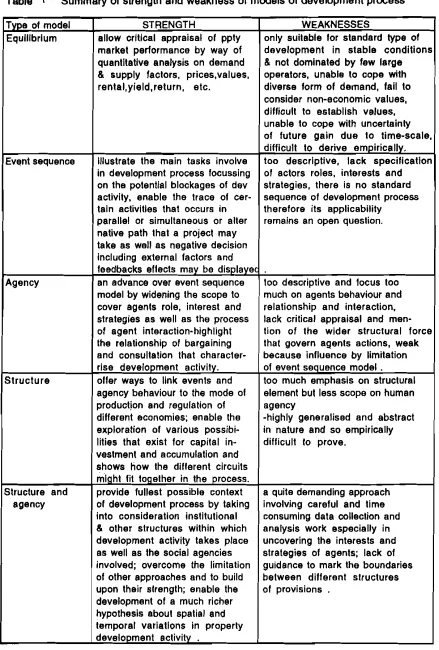
Table 1 summarises the different types of model discussed above, according to the different theoretical perspectives as well as the various types of approaches within the philosophy of social science. As shown in Table I, each of the models has its own strength and weaknesses. In its own way, each of the models facilitates understallding of development process. The models attempt to analyse development activity through different philosophical approaches as reflected in the characteristics of each model of the land development process belonging to the different categories of theoretical perspective. Thus, the models possess and are constrained by features which reflect the characteristics
f
of different theoretical framework.The equilibrium models which focus on demand for new property are viewed within the neo-classical perspective. The approach adopted is positivist in nature, whereby the development process is explained in terms of demand and supply relationships and the evidence is verified through the analysis of property prices, values and yields. Being established within the perspective of neo classical economics it therefore carries the assumption that property is hcmogenous, with the existence of a perfect property market with perfect competition, as well as a large market operation with all operators having perfect knowledge. Hence, such models are unable to consider the diverse forms of demand and are only suitable for a standard project: in stable conditions and where an active property market is not dominated by a few large operators. Since they focus on economic factors of demand and supply, they fail to consider the non-economic values which prevails within the development process. In a destabilised market, values of land are difficult to establish, hence such models are unable to cope with considerable uncertainty of future gain due to time scale and the limited number of transaction. Another weakness is that, since this model is set up at a level of sophistication, therefore it is difficult to derive empirically.
The second type of model are event-sequence models which attempt to explain the development process by unpacking it into the different stages. Although they focus on the potential blockages and so provide preliminary insights into the working of the development process, they lack the specification of actors'loles, interests and strategies. Philosophically, these model can be categorised under the empiricist approach. Hence, being empiricist in nature, such models are very descriptive, explaining the development activity only in terms of the experienced sequence of development process. In fact, the viability of the development process and its integral relationship is difficult to capture and since there is no standard sequence, the extent of the applicability of the model remains
an open question.
The third type is the agency models which are outlined within the framework of the humanist approach. Unlike the positivist equilibrium approach, these models emphasise actors decisions, actions, interests and strategies as well as relalionships of agents and events. However, being humanist in nature, the models focus too much on actors and agents interactions and are too descriptive and lack critical appraisal and mention of the wider economic and political forces that govern the actions of agents.
The structure models on the other hand seek to explain the development process by focusing on the way in which capital flows into and out of different sectors of the economy. These models, which revolved arou~dthe concepts of circuits of capital, are derived primarily from the Marxist sources as developed in the urban political economy literature. The objective of these models, therefore, is to explore various possibilities that exist for capital investment and accumulation, to analyse how these different circuits might fit together and relate to production of property. Since the models give too much emphasis on structural elements, they provide little room for human agency, choice or discretion. In addition, the models are highly generalised and abstract. Therefore, although they offer ways to link events and agency behaviour to the mode of production and regulation of different economics, the link is empirically difficult to prove. As such, the models barely penetrate into the details of events of the development process as well as the bonds of agents' relationships which might surround each.
r
,
A Review of The Models of Land Development Process'
The Structure Models
institutional and other structures within which it takes place should not be ignored. These models address the way the interests and strategies of actors are actively constituted as circumstances change and how this relates to broader structural shifts.
Clearly, therefore, all four types of models end up discussing similar issues. The differences lie in the way the development process is explained as a result of the different approaches adopted which are shaped by the different theoretical perspectives. In reviewing the different models of the development process, it can be concluded that more effort has to be put to improving unlierstanding of the production of the built environment. Although, much work and research has been carried out along this line in the past decades, models which make more progress in terms of accuracy'and validity have yet to be introduced. The different types of models as discussed above, although have some weaknesses, however, they do offer different levels of understanding and there is no reason to dismiss any of them.
It can be concluded that the previous models are likely to provide only a superficial appreciation of the process. However, they do provide a useful and convenient staning point for funher exploration ofthe process. From the above discussion of the strength and weaknesses of each type of model, it can be suggested that funher attempts should be carried out to devise a more 'realistic' and accurate model. Such a model must be able to provide the fullest possible picture of the development industry and this can only be achieved by incorporating the following features:
i. Since the land development process is complex consisting of heterogeneous propenies transacted within an imperfect propeny market which is usually dominated by a few' large operators, the model must not be devised at an abstract level but allows the process to be analysed empirically.
ii. Because property is a historical product and consists of broad categories such as residential, commercial, industrial and agriculture; and because each covers a sector and sub-sector of the
development industry with varied features according to different place and country as well as different time-scale. the end product would be a range of different structures of land development process, This suggests that it is important to generate specific models instead of a general one which is applicable to all kinds of conditions, This 'specificity' relates to the type ofland use, the time-space factor that retlects the changing urban form as intluenced by the wider structural economic, political and social forces for different regions and countries, as well
as the changing sets of agents' interactions.
ilL The model must, as Healey and Barrett (1990) suggest, focus not only on the economic aspects,
such as the market operation through the demand and supply factor as well as the circuits of capital tlow within the development process, but at the same time must emphasise the way agents' interests and strategies affect the development activity by way of shaping and reinforcing structural dynamics.
5.0 CONCLUSION
Of the five types of model reviewed only the structure and agency approach promises to achieve such extensive coverage. Clearly, the structure and agency models provide much richer insights into the variety and complexity of the development industry than the other models. Having said that, however, this does not imply that such work should stan from the scratch. Rather, the existing devised structure and agency model, as well as other existing approaches, must be used as a basis in an attempt to overcome the limitations of other theoretical frameworks and to build upon their strengths.
In this sense, Dear and Moos( 1986a, 1986b), Ball (1988) and Healey ( 1992) have developed the necessary theoretical basis for such investigations. However, it would be impossible to expect them to undenake the massive amount of empirical work that would be required to study the whole range of development subsectors not only in Britain but also elsewhere in the world. In order to enhance understanding of the different development processes in operation, therefore. research that sets out to explain the development processes within the conceptual framework of structure and agency approach must be funher developed.
Maziah bt Ismail, PhD
REFERENCES
Adams, CD and May. H,G (1991). Active and passive behaviour in land owneship. Urban Studies. Vol. 28. 687·705 Ambrose. P (1986), Whatever Happened to Planning", London, Methuen
Ambrose, P Bnd Colenutt. B (1977), The Dett:rminc:nts of urban Land Use Change. Open University Press. Milton Keynes.
Ball. M (1983), Housing Policy and Economic Power: The Political economy ofOwller·Occupation. London. Methuen
BarretL. S and Whitting. G (1983), Local authorities and land supply, OP - 10, School for Advanced Urban Studies, University of Bristol, Rodney Lodge. Grange Road, Bristol SSS 4EA
Bryan!. CR. Russworm, L.H and McLellan, A.G (1982), The City's Countryside. Land and its management in the Rural Urban Fringe. Harlow, Essex. Longman.
Chamberland. S.B (1972). Aspects ot"Dcvelpers Behaviour in the land Development Pro(;c:s~,research paper np. 56.Canadian Council on urban and Regional Research Centre for Urban and Community Studies. University of Toronto
Craven. LA. (1969), Private residential expansion in Kent 1956 - 1964: a study of pattern and process in urnan g.mwlh. Urban Studies, vol. 6. 1-6
Daniels. P: Leyton. A and Thrift. N (1990), The Operastional Development and Spatial Expansion of Large Commercial Property Firms, in Healey and R Nabarro, Land and Proeprty Development in a Changing Context, Gmver, Aldershot
Drewett R (1973), The developers decision processes, in The Containment of urban England. Volume II. The Planning System: Objectives, Operations, impacts Eds p Hall. H Gracey. R Drewett, R Thomas London. George. Allen & Unwin Ltd. Form. W.H (1954), The place of social structure in the determinants ofland usc, Social Forces, vol. 32, 317 - 323
Fraser. W (\ 985), principles of Property Investment and pricing London, Macmillan
Goodchild, Rand Munton. R 91985), Developer and the Landowner: An Analysis of the British Experience. London. Allen & unwin.
Gore. T and Nicholson. D (1991), Models of the land development process' a critical review, Enviroment and Planning A. Vol. 23, 705-730
Healey. P (IY92). An institutional model of the development process, Journal of property research, 9. 33-44
Kaiser. 1:.J and Weiss, S.t' (1970), Public and the Residential Development Proces~,American Institute of Planners Journal. No 36,30-37
Lambert. C and underwood, J 91984). The role of local plans in the land and development process, School of Advanced urban Studies. University of Bristol.
Lichtield. Nand Darin-Drabkill. H (1980), Land Policy in Planning, l,ondon. George Allen & unwin LichfieJd. N (1956). Economics of planned development, london. estate Gazette.
Marriol. 0 (1965). The Property Boom. London, Hamish, Hamilton.
Masscy. D and Catalano. A (1978), Capital and Land~Land ownership by C'apital in Great Britain. [.ondon, Edward Arnold
McNamara. P F (1983). Towards a classification of developers, urban Law and Policy. 6. 87-94
McNamara, P r and Turner. G (1987). Chartered surveyors and the site finding process. Occassional papacr Series. No. I. department of Estate 1\.1,magcmcnt. Oxford Polytechnic
Mc Namara. P F (l984), The role ofe~tateagents in the residenlial development process. Land Development Studies. I 101
Mc Namara, P F (1988), Interests in land and planning in action, Chapter 7, in P Healey. P: Me namara. P F; M J Elson and AJ Doak (eds) Land Use Planning and Mediation Change, Cambridge. Cambridge University Press.