Analysis of Various Clustering Algorithms in
Wireless Sensor Network
Kunkunuru Udaykumar#1, Tamizharasi Thirugnanam*2 #
School of Computing Science and Engineering, VIT University, Vellore, India
*
Asst. Professor, SCSE School, VIT University, Vellore India
Abstract - In this paper, we give a survey of various clustering algorithms like heuristic schemes- linked clustering, highest-connectivity clustering, MAX-MIN D clustering, weighted schemes- weighted clustering; hierarchical schemes -LEACH; TL- LEACH,EECS,HEED grid schemes –PEGASIS in order to reduce the energy consumption and compared their strength and limitations.
Keywords -wireless Sensor Networks(WSN), Cluster, Algorithms.
I. INTRODUCTION
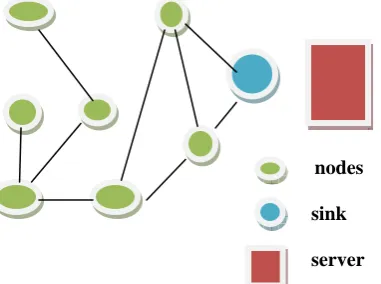
wireless sensors network is built of nodes (hundreds or even thousands). each node is connected to one or several sensors. Sensor network: sensor nodes are interconnected to exchange sensed data by wired or wireless communication in a network. Sensor node : A Device with capabilities of sensed data processing and networking consisting of sensors and optional actuators.[1] sensors nodes are spatially distributed and cooperate with each other, which have great numbers of nodes of the same type. every sensor node is a device consisting of transceivers, a microcontroller and a sensing elements ,which transmit signal to transceivers and energy source over the object.[1] sensor node is an autonomous devices (autonomy means sensor nodes not connected to any energy source) in above figure we have seen a sensor nodes and network sink (which also function as a gate and it is possible to intract with WSN through global network such as the internet).[29]network sink aggregates useful data from other sensors nodes and process data and has a stationary power source connected to a server.
nodes sink server Fig 1.overview of Sensor network architecture
A WSN is a heterogeneous or homogeneous system consisting of hundreds or thousands of low power and low-cost tiny sensors to monitor and gather real-time information from deployment environment. [2][3]. broad casting multicasting, routing, forwarding and route maintenance are the common functionalities of WSNs nodes. important characteristics of these networks are: weak connections and wireless communications; low reliability ; dynamic topology; hop -by -hop communications; ease of extendibility and configuration(scalability).
different types of WSNs architecture:[6,7] WSNs architecture has sensor nodes, aggregation points(clusters-heads), base stations(central server or sink),network manager ,security manager and user interface as a components, this components participate to each other. a)direct communication architecture: In wireless sensor network has a sensor nodes such that each sensor nodes communicates to the sink directly .thus this architecture is not appropriate for wide WSNs it is not scalable.
b)multi-hop and peer--to-peer architecture: in this architecture sensors nodes have routing capability; sensors nodes which are placed near to sink use packets routing between other nodes and traffic of such nodes will increase because WSNs is a widespread consequently their energy will be waste ,consumed and finished so they go out of the WSN(i e this architecture is not scalable
c)multi-hop based on clustering architecture: in this architecture sensors nodes make a clustering structure ;for any clustering architecture choose a cluster-head which directly communicate to the sink and other cluster nodes send their gathered data to the corresponding cluster head; disadvantage: cluster-head play a important role because most communication operations are done by cluster -head and their energy will be wasted, consumed and decreased sooner than other sensor s nodes.
end user . base station is at upper level of the WSNs. end users: the data in the sensor network can be used for many applications and this applications make use of the network data over the internet, using a PDA or a desktop computer .In a queried sensor network data is gathered from a queary, sent through the network .This query is generated by the end user ,every cluster have a leader commonly called cluster-head(CH) .A CH is a sensor node generally richer in resources than other nodes and elected by the sensors nodes in the cluster or assigned by the network designer .cluster membership may be fixed or variable and supports network scalability. data aggregation: In a network there are multiple nodes sensing similar information but data aggregation differentiation between sensed data and useful data. it a major advantage in wireless sensor networks .[8] clustering can be classified into a) centralized clustering : in this clustering has fixed cluster head and remaining nodes in the cluster act as member nodes .centralized architecture is used in the clustering process[10,11]. accessible global information about whole WSN topology; disadvantage: reliability of a wireless sensor network goes down because if centralized architecture is used in a WSNs and central node fails ,the entire network collapse .b)distributed clustering: in this clustering cluster head changing from node to node based
on some parameters (ie residual energy)no fixed central cluster head. only neighbouring and local information are accessible; reliablity of the wireless sensor network improved by distributed clustering. advantage over centralized clustering because it provide backup in case of failure of the central node and forwarding the redundant information can also be minimized. since there is no centralized body to allocate the resources, they have to be self-organized. c)hybrid clustering: this clustering is formed by combination of both centralized and distributed clustering.
II. RELATED WORK
1. HEURISTIC SCHEMES.
A . LCA(LINKED CLUSTER ALGORITHM):
[13],[14],[15] IN LCA , each node has two ways of becoming a cluster head and each node is assigned a unique ID number. the one way is if the node have the highest ID number in the network including all neighbor nodes and the node itself. other way, assumeing none of its neighbors are cluster heads, then it become a cluster-head. It is one of the first clustering algorithm developed. firstly LCA developed for wired sensors and presently implemented in wireless sensor networks . B. LCA2(LINKED CLUSTER ALGORITHM 2)
[14][15] LA2 algorithm elects as a cluster head ,the node with lowest id among all the nodes that are neither a cluster-head nor are within 1-hop of the ready chosen cluster-heads. in LCA 2 introduce the concept of a node being covered and non-covered .covered: A node is covered one if its neighbour is a cluster-head .among non covered neighbour , cluster-heads are elected the node which have lowest ID .it was proposed to remove the election of an unnecessary number of cluster heads.
C. HIGHEST-CONNECTIVITY CLUSTER ALGORITHM: [14] this algorithm is much similar to LCA(LINKED CLUSTER ALGORITHM).in LCA we select according to the lowest ID number but in highest-connectivity cluster algorithm ,connectivity of the node is consider .the node which is connected to the most number of nodes is elected as cluster head.
D. MAX-MIN D-CLUSTER ALGORITHM:
[16]max -min D cluster is a new distributed cluster-head election procedure, selection criteria of the cluster-head is each node initiate 2d rounds of flooding(from which the results are logged).to determine the cluster head each node follows a simple set of rules. "flood-max" are 1st d rounds used to propagate the largest node ids and after this is complete ,2nd d rounds of flooding called "flood-max used to allow the smaller node ids .
[16]following are the rules how each node evaluates the logged entries.
rule1: if each node have received own id in the 2nd d rounds of flooding then declare itself the cluster head and skip the other rules. otherwise it proceeds to rule2.
rule2 : each node looks for node pairs if it exists ,it selects the minimum node pair to the cluster head. proceed to rule 3 if node pair does not exist.
rule3: In the 1st d rounds of flooding elect the maximum node id as the cluster head .after the node has completed following the rules, it needs to determine if it is a gateway or not(gate way node is a node where some or most of the neighbouring nodes have a different cluster-head).this is done by sending a broadcast out to its neighbouring elected cluster-head. a node is able to determine whether or not after hearing back from all neighbours it is gateway. once the gateway node has been found , each node communicates with the cluster-head by sending a message inward from fringes of the cluster. This message contains its node id, all neighboring gateway nodes and their associated cluster-heads.
III. WEIGHTED SCHEMES
A. WEIGHTED CLUSTERING ALGORITHM(WCA): [17][9]this algorithm is fully distributed (all the nodes in the mobile network share the same responsibility acting as cluster-heads) based on a combination of metrics that takes into account parameters such as: mobility; transmission power; remaining energy of the nodes and ideal node degree ,this parameters can be used to elect cluster-heads. this clustering algorithm during the first cluster-head election tries to find a long -lasting architecture. this section explains a non-periodic procedure to the cluster-head election. election procedure is invoked to find a new clustering topology when a sensor loses the connection with any clusterhead.re-election procedure is an important feature in power saving, occurs less frequent.
cluster-head election procedure:
election procedure of cluster-head is based on global parameter called "combined weight" which is described by
where w1,w2,w3,w4 are the weighting factors for the corresponding system parameters. based upon the specific application weighting factors can be chosen , calculate combined weight of each node and broadcast across the network. cluster head is chosed according to the node with smallest Wv. first component ,w1_v helps in efficient MAC functionality and bound on maximum number nodes in a cluster .the second component( Dv )is strictly related to power consumption and the average distance from the neighbours ,note: more power is required for long range transmission. the third component(Mv) is due to mobility of the nodes. in order to make stable cluster architecture ,cluster head moves very slowly .so that the node moves very slow is a better choice to be a cluster-head. last component(Pv)( is directly related to the available energy in a node. large amount of energy is consumed if the node already a cluster-head and should not be considered for the next cluster-head election.
the algorithm proposes a distributed solution in which all nodes broadcast their ids along with Wv values and each node stores the information which broadcast from its neighbours .stored information again exchange with the immediate neighbours and process continues untill all the nodes become aware of the node with the smallest Wv. note: the time required will depend on the diameter of the underlying network; the time required for the selection of header node with minimum Wv depends on the implementation of the algorithm.
IV. HIERARCHICAL SCHEMES:
A. LEACH : (LOW ENERGY ADAPTIVE CLUSTERING HIERARCHY)
[18],[19]It is a time division multiple access based MAC protocol which is integrated with clustering and a simple routing protocol in wireless sensor networks(WSN).GOAL is TO Improve the lifetime ,maintain and create clusters LEACH is to lower the energy consumption in a wireless sensor network. network is a purely distributed and randomly elected cluster-heads. information of the nodes coming under cluster-head is collected. for each round LEACH protocol involves four main steps Advertisement phase: firstly cluster- head send a notification to a nodes to become a cluster member in its cluster which nodes coming under them. Nodes will be accept offer based on received signal strength(RSS).set-up phase: nodes will answering to their selected CHs. schedule creation: the cluster-head make a TDMA scheme and send back to its cluster member to intimate them when they have to pass the information to data transmission.[18] IN wireless sensor network LEACH was one of the first major improvements on conventional approach. minimum transmission energy (MTE) or direct-transmission is a conventional approach algorithms. MTE do not lead to even energy dissipation throughout network. when there is random rotation of cluster-heads LEACH provides a balancing of energy in a WSNs. At each interval decision of whether a node elevates to cluster-head is made dynamically. To minimize overhead in cluster-head establishment elevation decision by each node independent to other nodes.
properties : cluster based ;cluster membership adaptive; communication done with cluster head via TDMA(time division multiple access);data aggregation at cluster head. B. TL LEACH:(TWO LEVEL LOW ENERGY ADAPTIVE CLUSTERING HIERARCHY)
[20][21]it is proposed extension to the LEACH algorithm .TL-LEACH use the concept of data-fusion in order to avoid the overload of data. performing the data fusion in a network large energy gains can be achieved and require less data to be transmit to the base station. to achieve energy and latency efficiency TL-LEACH uses following techniques. randomized ,adaptive ,self-configuring cluster formation and localised control for data transfers. considering the original version of LEACH protocol introducing a new level of hierarchy to better exploitation of data fusion mechanism and elaborate the information to transmit to a base station(BS) over two different levels. for transmitting a data to the base station uses of two levels of clusters and each node can decide in a way that is autonomous ,to result in a good cluster. use of two levels of clusters advantages of small transmit distance for more nodes more than in the original LEACH. [20]so, to transmit data far distance to the base station require less nodes. if use of bigger number of hierarchy levels advantages is higher. two level hierarchy : top cluster-head called here primary cluster-head (CHi) and second level representation secondary cluster head(CHij) and finally simple node(SN) . introduction of partial local computation in each cluster-head at the second level and complete the local computation at top level where data will be transmitted to the base station directly; protocol is composed from four fundamental phases:1) advertisement phase
2)cluster setup phase 3)schedule creation 4) data transmission. first phase ,primary cluster head at top level (CHi) and secondary cluster-head called CHij or simple nodes. to advertise other nodes particular node elected itself as primary cluster head and mechanism used in this phase is CSMA .subsequently secondary cluster-heads nodes send the advertisement to the simple nodes(SN). each simple node decide which will be its secondary cluster-head and informs it through an opposite message, clusters are created .primary cluster head decide the schedule with respect to the TDMA such that each node can transmit according to it.
Fig 3.construction of atipical cluster in TL-LEACH initially each simple node(SN) Sends data to the secondary cluster head(CH ij) .[20]when this phase is completed ,each secondary cluster head send aggregated data to its primary cluster head(CH i) .AT that time SN can be turnoff in sleep mode therefore reduce of energy consumption in the network the two level structure of TL-LEACH reduces the amount of nodes that need to transmit to the base station ,effectively reducing the total energy usage.
C. EECS( ENERGY EFFICIENT CLUSTERING SCHEME) [22]IT is a clustering algorithm in which cluster head helps in elevation to cluster head. it is a LEACH like clustering scheme, the network is divided into set of clusters with one cluster head in each cluster. communication between cluster head and BS is single-hop(direct).[12] BS broad casts "hello message to all the nodes at certain power level .each node based on the received signal strength from BS (base station) compute the approximate distance. base station helps to select the proper power level to communication with it.
[23]cluster head selection: in cluster head election phase, well distributed cluster heads are elected with a little control overhead. nodes become CANDIDATE nodes with a probability T and then broadcast the COMPLETE-HEAD MSG with in radio range R complete to advertise their wills. each CANDIDATE node checks whether there is a CANDIDATE node with more residual energy within radius R complete. if the CANDIATE node finds more powerful CANDIATE node ,it will give up the competition without receiving sub sequential COMPETE HEAD MSG. otherwise it will be elected as HEAD in the end.
.
D. HEED: ( HYBRID ENERGY EFFICIENT DISTRIBUTED )
[25]it is a clustering protocol using residual energy as primary parameter and network topology features such as node degree, distance to neighbours are only used as secondary parameters to break tie between candidate cluster heads, as metric for cluster selection to achieve load balancing. it is an extension of basic scheme of LEACH protocol. in homogeneous sensor network all the sensor nodes have same initial energy but in heterogeneous sensor network sensor nodes have different computing power and sensing range. life time of the sensor network is limited so re-energize the sensor network by adding more nodes. this nodes have more energy than the already in use ,which creates heterogeneity in terms of node energy ,leads to the introduction of H-HEED protocol.
Cluster Formation of HEED PROTOCOL:
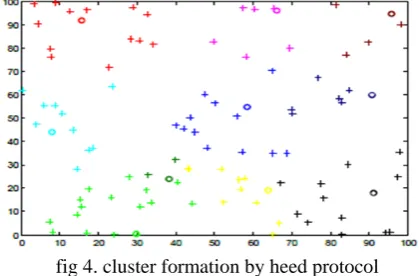
We describe the network model which has N sensors nodes ,randomly dispersed within a 100m*100m square region. Assumptions are made regarding the network model is: Nodes in the network are quasi-stationary, nodes location are unaware ie it is not equipped by the GPS capable antenna, nodes have equal significance , similar processing and communication capabilities .firstly selection of cluster head based on the residual energy of each node. residual energy easily estimated by energy consumed per bit for sensing ,processing and communication is known. if there is tie intra cluster communication cost is considered as the secondary parameter(tie means if more than one cluster head ,node might fall within the range).
fig 4. cluster formation by heed protocol
If the network contains multiple cluster heads then the cluster head yields lower intra -cluster communication cost. The secondary clustering parameter, intra-cluster communication cost is a function of cluster properties such as cluster size and whether or not variable power levels are permissible for intra-cluster communication. in intra-cluster communication, if power level is fixed for all nodes then cost will be directly proportional to node degree. each node sets its probability of becoming a cluster head, CHprob as follows
levels of heterogeneity are used . 1n 2-level H-HEED protocol ,two types of sensors nodes ie normal nodes and advanced nodes are used. let us assume there are N number of sensor nodes deploying in a field. initial energy of the normal nodes be E0 and m is the fraction of the advanced nodes which own a times more energy than normal once . thus there are m*N advanced nodes equipped with initial energy of Eo*(1+a) and (1-m)*N normal nodes w quipped with initial energy of Eo.
the total intial energy of the network is given by:
this type of network has am times more energy and virtually am more nodes.
in 3-level H-HEED PROTOCOL ,there are three types of sensors nodes super nodes ,advanced nodes and normal nodes. let m be the fraction of the total numbers of nodes N and mo is the percentage of the total number of nodes N*m which are equipped with BETA times more energy than the normal nodes called super nodes .[26],[27] the total energy of the network is given by:
so ,the total energy of the network is increased by the factor of
in multi-level H-HEED protocol, initial energy of sensors nodes is randomly distributed
over the close set[Eo, Eo*(1+a max)] .where Eo is the lower bound and a max determine the value of the maximal energy. initally ,the node si is equipped with initial energy of Eo*(1+ai) which ai times more energy than the lower bound Eo.
total initial energy of the network is given by:
V. GRID SCHEMES
A. PEGASIS: (POWER-EFFICIENT GATHERING IN SENSOR INFORMATION SYSTEMS)
[28] it is a data-gathering algorithm and nodes in a network not directly forming clusters. energy load among the sensors nodes in the network will distribute and main idea in PEGASIS is for each node to receive from and transmit to close neighbours and take turns being the leader for transmission to the BS(base station).
initially nodes are placed randomly in the play field and ith node is at a random location. nodes will be organized to form a chain can be accomplished by sensor nodes themselves using greedy algorithm starting from some nodes or base station(BS) can compute this chain and broadcast it to all the sensors nodes[19]. we assumption that all nodes have global knowledge of the network for constructing the chain and employ the greedy algorithm. for constructing the chain greedy approach works well and this done before the first round of communication. to construct the chain , we start from the BS and make sure that nodes farther from the BS have close neighbours . nodes which are already in a chain cannot be revisited because greedy algorithm the neighbour distances will increase gradually .
Fig 5.chain construction using greedy algorithm Figure shows node 0 connecting to node 3 ,node 3 connecting to node 1 and node 1 connecting to node 2 in that order note: when a node dies, chain is reconstructed in the same manner to bypass the dead node. token passing approach for gathering data in each round ,each node receives data from one neighbour, fuses with its own data and transmits to other neighbour on the chain .leader in each round of communication will random position on the chain ,which is important for nodes to die at random locations network failures .we use simple protocol token passing approach initiated by the leader to start the data transmission from the ends of the chain.
Fig 6.token passing approach
VI. ANALYSIS OF VARIOUS CLUSTERING ALGORITHMS
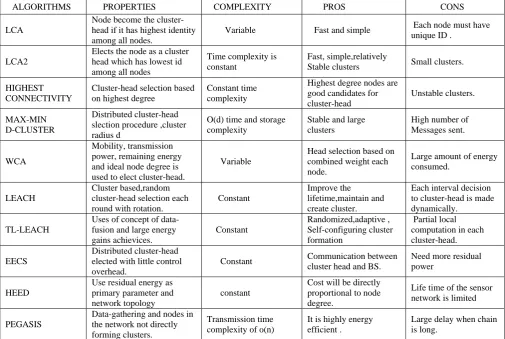
TABLE I COMPARSION OF VARIOUS CLUSTERING ALGORITHMS
ALGORITHMS PROPERTIES COMPLEXITY PROS CONS
LCA
Node become the cluster-head if it has highest identity among all nodes.
Variable Fast and simple Each node must have
unique ID .
LCA2
Elects the node as a cluster head which has lowest id among all nodes
Time complexity is constant
Fast, simple,relatively
Stable clusters Small clusters.
HIGHEST CONNECTIVITY
Cluster-head selection based on highest degree
Constant time complexity
Highest degree nodes are good candidates for cluster-head
Unstable clusters.
MAX-MIN D-CLUSTER
Distributed cluster-head slection procedure ,cluster radius d
O(d) time and storage complexity
Stable and large clusters
High number of Messages sent.
WCA
Mobility, transmission power, remaining energy and ideal node degree is used to elect cluster-head.
Variable
Head selection based on combined weight each node.
Large amount of energy consumed.
LEACH
Cluster based,random cluster-head selection each round with rotation.
Constant
Improve the lifetime,maintain and create cluster.
Each interval decision to cluster-head is made dynamically.
TL-LEACH
Uses of concept of data-fusion and large energy gains achievices. Constant Randomized,adaptive , Self-configuring cluster formation Partial local computation in each cluster-head.
EECS
Distributed cluster-head elected with little control overhead.
Constant Communication between
cluster head and BS.
Need more residual power
HEED
Use residual energy as primary parameter and network topology
constant
Cost will be directly proportional to node degree.
Life time of the sensor network is limited
PEGASIS
Data-gathering and nodes in the network not directly forming clusters.
Transmission time complexity of o(n)
It is highly energy efficient .
Large delay when chain is long.
VII.CONCLUSIONS
In this paper, we have analyzed various clustering algorithms in WSNs. Finally, we have analytically analyzed a few standard WSN clustering algorithms in bottomless and compared these different approaches based on their cluster head selection, cluster formation and some major metrics.
REFERENCES
[1] Requirements for support of ubiquitous sensor network (USN) applications and services in the NGN environment.” ITU-T Recommendation Y.2221 (2010).
[2] S. Mohammadi, R. A. Ebrahimi and H. Jadidoleslamy; A Comparison of Routing Attacks on WirelessSensor Networks; International Journal of Information Assurance and Security (JIAS); ISSN 1554- 1010 Volume 6, pp. 195-215; 2011.
[3] V. Handziski, A. K¨opke, H Karl, C. Frank, and W. Drytkiewicz ; Improving The Energy Efficiencyof Directed Diffusion Using Passive Clustering; in Proc. 1st European Workshop on Wireless Sensor Networks, pp. 172 – 187, Berlin, Germany; 2004.
[4] A. A. Abbasi, M. Younis; A survey on clustering algorithms for wireless sensor networks; ComputerCommunications, vol. 30, pp. 2826–2841; June, 2007.
[5] O. Younis, M. Krunz, and S. Ramasubramanian; Node Clustering in Wireless Sensor Networks: Recent Developments and Deployment Challenges; IEEE Network; May/June, 2006.
[6] H. Jadidoleslamy; A Distributed and Hierarchical Intrusion Detection Architecture for Wireless Sensor Networks; International Journal of Network Security and its Applications (IJNSA); Vol. 3, No.5, pp. 131-154; September, 2011.
[7] Hossein Jadidoleslamy ; An introduction various basicconcepts of clustering techniques on wireless sensor networks. International journal of Mobile Network Communications & Telematics ( IJMNCT) Vol. 3, No.1, February 2013
[8] A Survey of Adaptive Distributed Clustering Algorithms for Wireless Sensor Networks International Journal of Computer Science & Engineering Survey (IJCSES) Vol.2, No.4, November 2011 DOI : 10.5121/ijcses.2011.2412 165
[9] A Survey of Clustering Algorithms for Wireless Sensor Network D. J. Dechene, A. El Jardali, M. Luccini, and A. Sauer.
[10] S.D.Murugananthan, D.C.F.Ma, R.I.Bhasin, A.O.Fapojuwo, A centralized energy-efficient routing protocol for wireless sensor networks, IEEE Transactions on Communication Magazine 43(3) (2005) S8-13.
[11] F.Bajaber, I.Awan, Centralized dynamic clustering for wireless sensor networks, in: Proceedings of the International Conference on Advanced Information Networking and Applications, 2009. [12] Ankita Joshi 1, Lakshmi Priya.M A Survey of Hierarchical Routing
Protocols in Wireless Sensor Network (pp 67 - 71)
[13] D. J. Baker and A. Epheremides, “The Architectural Organization of a Moblie Radio Network via a Distributed Algorithm,” IEEE Transactions on Communications, vol. Com-29, no. 11, November 1981.
[14] P. Tsigas, “Project on Moblie Ad Hoc Networking and Clustering for the Course EDA390 Computer Communcation and Distributed Systems,” Manual for University Course.
[15] A. Amis, R. Prakash, T. Vuong, and D. Huynh, “Max-Min D-Cluster Formation inWireless Ad Hoc Networks,” IEEE INFOCOM, March 2000
[17] M. Chatterjee, S. K. Das, and D. Turgut, “WCA: A Weighted Clustering Algorithm for Mobile Ad Hoc Networks,” Clustering Computing, vol. 5, pp. 193–204, 2002.
[18] T. Meng and R. Volkan, “Distributed Network Protocols for Wireless Communication,” Proc. IEEE ISCAS, May 1998.
[19] W. R. Heinzelman, A. Chandrakasan, and H. Balakrishnan, “Energy-Efficient Communication Protocol for Wireless Sensor Networks,” Proceedings of the 33th Hawaii International Conference on System Sciences, 2000.
[20] V. Loscrì, G. Morabito, S. Marano A Two-Levels Hierarchy for Low-Energy Adaptive Clustering Hierarchy (TL-LEACH) via P.Bucci, 42/c 87036 Rende.
[21] M. Bani Yassein, A. Al-zou'bi, Y. Khamayseh, W. Mardini Improvement on LEACH Protocol of Wireless Sensor Network. [22] Nisha Saini; Aashima Singla A Wireless Sensor Networks Routing
Protocols Survey for Energy Efficiency Techniques, International Journal of Advanced Research in Computer Science and Software Engineering , Volume 4, Issue 4, April 2014.
[23] Mao Ye1, Chengfa Li1, Guihai Chen1 and Jie Wu2 EECS: An Energy E±cient Clustering Scheme in Wireless Sensor networks.
[24] S. Bandyopadhyay, et. al., An Energy-efficient Hierarchical Clustering Algorithm for Wireless Sensor Networks," in IEEE INFOCOM'03.
[25] Harneet Kour, Ajay K. Sharma, Hybrid Energy Efficient Distributed Protocol for Heterogeneous Wireless Sensor Network, International
Journal of Computer Applications (0975 – 8887) Volume 4 – No.6, July 2010.
[26] R. B. Patel, T. S. Aseri, Dilip Kumar. 2009. EEHC: Energy efficient heterogeneous clustered scheme for wireless sensor networks. International Journal of Computer Communications, Elsevier, 32(4): 662-667.
[27] Yingcghi Mao, Zhen Liu, Lili Zhang and Xiaofang Li. 2009.An Effective Data Gathering Scheme in Heterogeneous Energy Wireless Sensor Network. In International Conference on Computational Science and Engineering.
[28] Stephanie Lindsey and Cauligi S. Raghavendra PEGASIS: Power-Efficient GAthering in Sensor Information Systems