Type of the Paper (Article)
Characteristics of soil organic carbon and total nitrogen along various vegetation types in Hongqipao reservoir, Northeast China
Bing Yu 1, Patteson Chula Mwagona1*, Yuncong Li 2, Xiaoyu Li 1, Hongjun Wang 3, Xiao Wang 4, and Jihong Li 4,*
1College of Wildlife and Protected Area, Northeast Forestry University, Harbin 150040, China; [email protected](B.Y.); [email protected] /[email protected] (P.C.M); [email protected] (X.L.)
2Department of Soil and Water Sciences, Tropical Research and Education Center, IFAS, University of Florida, Homestead 33031, USA; [email protected] (Y.L.)
3Urban Environment & Sanitation Service Center, Suihua 152200, China; [email protected] (H.W.) 4School of Forestry, Northeast Forestry University, Harbin 150040, China; [email protected](X.W.); [email protected] (J.L.)
*Correspondence: [email protected] (J.L.); [email protected] /[email protected] (P.C.M)
Abstract: This study investigated the spatial variability of soil organic carbon (SOC), total nitrogen (TN), soil microbial biomass carbon (SMBC) and soil microbial biomass nitrogen (SMBN) in Hongqipao reservoir dominated by different vegetation types and the possible relationships with other soil properties. Top 0–50cm soil samples were collected in sites dominated by different vegetation types within the reservoir littoral zone. There was high spatial variability for SOC, TN, SMBC and SMBN in the Hongqipao reservoir. In addition, the SOC, TN, SMBC and SMBN contents decreased with increasing soil depth. This could be attributed by the fact that when plants detritus decompose, most of their organic matter is mineralized and a new soil layer which contains a greater amount of organic carbon is formed at the top. According to Pearson's correlation values and redundancy analysis (RDA) results, SOC was significantly and positively correlated with TN likely because the vegetation organic matter and liter could be the main nitrogen sources. Similarly, soil moisture content (MC) was significant positive correlated with SOC and TN. Conversely, BD was significant negative correlated with SOC and TN contents in the 0-50 cm soil profiles. However, no significant correlations were observed between SOC, TN, SMBC and SMBN contents
and soil pH values. SMBN was significantly and positive correlated with C:N ratio and BD and negative related with MC. Multiple linear regression model revealed that all measures soil properties in this study could explain higher significant variability of the response variables (SOC, TN, SMBC and SMBN contents). This implies that all the measured soil variables within the different vegetation types in the reservoir played a crucial role in determining the contents of SOC, TN, SMBC and SMBN. This study further suggests that vegetation types play a major role in determining the spatial characteristics of SOC and TN. Any changes in the vegetation types in the reservoir may influence the distribution of SOC and TN. This may affect the global carbon budget and the atmospheric greenhouse gas concentration significantly.
Keywords: Total organic carbon; Total nitrogen; Soil microbial biomass; Vegetation types; Hongqipao reservoir
1. Introduction
reservoirs, large and small 12. However, limited studies have been carried out to determine the role of reservoirs in storage of soil organic carbon and nitrogen 2, 13.
Studies have revealed that the spatial variation, accumulation and distribution characteristics of organic carbon and nitrogen in wetland soil is influenced by the vegetation types, hydrology (water level fluctuation), soil microbial community, pH, salinity, temperature, soil moisture among many others may have a strong influence on soil organic carbon and nitrogen storage 14-15. Changes in the hydrological regime can have substantial effects on soil properties, particularly carbon and nitrogen accumulation and release due to alterations in their chemical forms and spatial movements 16-17. Wetlands littoral zones with abundant vegetation and soil microbes has been reported to have higher capacity of carbon deposition than other land types 18. Bahn, et al. 19 noted that different types of vegetation communities and their development will have obvious influence on soil organic carbon contents, and soils with high primary productivity have high organic carbon storage. Soil mechanical composition, bulk density, salinity, and nutritional status will influence the capacity of vegetation directly and affect the input and output of soil carbon 20. Moreover, the vegetation in growth process affects the soil organic carbon content and distribution through changing the surrounding environment, especially the rhizosphere microenvironment (such as soil salinity, pH value, water, etc.) 21.
Studies on spatial variability of SOC and TN have been one of the hotspot in soil ecology in the past decades 1, 3, 22 . For example, Wang, et al. 3 characterized the spatial patterns of SOC and TN within 0–80 cm for minesoils in the Loess Plateau area. Bai, et al. 23 determined the spatial variability of soil carbon, nitrogen, and phosphorus content and storage in an alpine wetland in the Qinghai–Tibet Plateau, China. More studies on spatial variability of soil properties have been conducted in the southeast of Xi’an, Shannxi, China 24, and the Three Gorges Reservoir area 13. However, similar studies is lacking in Hongqipao reservoir, Northeast China despite the fact that this reservoir is characterized by different vegetation types including Phragmites communis, Typha angustifolia, Scirpus tabernaemontani, Potamogeton pectinatus, Potamogeton crispus, Spirodela polyrhiza, Scirpus yagara, and Echinochloa crusgalli which creates high environment heterogeneity.
the effect environmental factors on SOC, TN, SMBC and SMBN in the Hongqipao reservoir, and (iii) to evaluate the total SOC, TN, SMBC and SMBN in the soils collected from sites dominated by different vegetation types in the Hongqipao reservoir.
2. Materials and Methods
2.1 Study Area
The study was conducted in Hongqipao reservoir littoral zone located in Nenjiang plain between Anda and Daqing city in Heilongjiang Province (Figure 1). The size of the reservoir is 35km2 with a capacity of 116,000,000m3. This study area lies in an area which is under the influence of a mid-temperate continental monsoon climate characterized by long and cold winters and high-temperature and rainy summers. The mean annual temperature in this area is 3.3°C with the lowest and highest temperature values measured in January and July of -37.2°C and 38.3°C,
respectively. Moreover, the average precipitation received in this study area is 426 mm per year.
Figure 1 Location of the study area. Top left is the map of China and bottom right is the Hongqipao reservoir.
2.2 Soil sampling and laboratory analyses
Taisite in Tianjin, China), and then sieved through a 100-mesh sieve. The Sieved soil samples were treated with 2 M HCl for 24 h at room temperature to remove carbonates 25-26. The soil was then washed to pH>5 with distilled water and dried at 40 °C. The SOC and TN were determined using an automatic elemental analyzer (Flash EA 1112, Italy). Soil pH was measured using a digital pH meter
in in the supernatants of 1:5 soil:water mixtures. The soil BD and MC were calculated on a dry weight basis. Soil MC was determined by the oven drying method (weighing before and after drying at 105 °C for 24 h). Soil BD was calculated by dividing the total dry weight of the soil sample by the volume of the core 27. All results were expressed on a dry gram basis.
The soil microbial biomass carbon (MBC) and the soil microbial biomass nitrogen (MBN) were determined using the soil microbial biomass chloroform fumigation extraction method 28-30. The extraction was performed using K2SO4 (0.5 mol L-1) on un-fumigated samples and fumigated samples in alcohol-free chloroform. Soil organic carbon and total nitrogen in fumigated and un-fumigated extracts was measured with Multi N/C 3100 SOC/TN analyzer (Analytik Jena, Germany). The MBC and MBN were calculated as the concentration of organic carbon and total nitrogen in fumigated samples subtracted by that in un-fumigated (control) samples with a conversion factor of 0.45 for microbial carbon and 0.54 for microbial nitrogen 31.
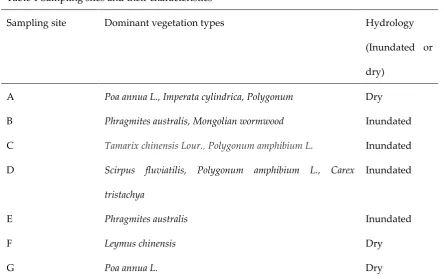
Table 1 Sampling sites and their characteristics
Sampling site Dominant vegetation types Hydrology
(Inundated or dry)
A Poa annua L., Imperata cylindrica, Polygonum Dry
B Phragmites australis, Mongolian wormwood Inundated
C Tamarix chinensis Lour., Polygonum amphibium L. Inundated D Scirpus fluviatilis, Polygonum amphibium L., Carex
tristachya
Inundated
E Phragmites australis Inundated
F Leymus chinensis Dry
2.3 Determination of vegetation aboveground biomass
Three quadrants (1 m × 1 m) were established at each sampling sites. The vegetation in the quadrants were manually cut close to the soil surface, harvested and weighed immediately while fresh. The weighed samples were then taken to the laboratory and oven dried at 80°C, to a constant weight. The dry biomass was calculated by multiplying the fresh weight of the harvested vegetation and the dry/wet ratios of the samples.
2.4 Calculations and Statistical Analysis
Total SOC (TSOC; g C m−2), total TN (TSN, g N m−2), total SMBC (TSMBC; mg C m−2) and total SMBN (TSMBN; mg C m−2) on the ground-area basis to a 50-cm depth were calculated according to the formula proposed by Wang, et al. 32 as follows:
TSOC =
Di
Pi
SOCi
S
[1]TSN =
Di
Pi
TNi
S
[2]TSMBC =
Di
Pi
MBCi
S
[3]TSMBN =
Di
Pi
MBNi
S
[4]where Di, Pi, SOCi, TNi, MBCi, MBNi and S represent soil thickness (cm), bulk density (g cm−3), organic carbon concentration (g kg−1), total nitrogen concentration (g kg−1), microbial biomass carbon (mg kg−1), microbial biomass nitrogen (mg kg−1) and cross-sectional area (cm−2) of the ith layer (i = 1, 2, 3, 4, and 5).
Data were statistically analysed using SPSS (version 19.0). A one-way analysis of variance (ANOVA) was conducted to test the spatial variation of SOC, TN, SMBC, SMBN and other soil properties. Correlation analyses were carried out to evaluate the relationships between SOC, TN, SMBC, SMBN and soil properties. Multivariable linear regressions were used to build regression models for SOC, TN, SMBC and SMBN. The figures were drawn using Origin 9 and Canoco 5 softwares.
3. Results
3.1 Spatial variation of SOC, TN, SMBC, SMBN and other soil properties
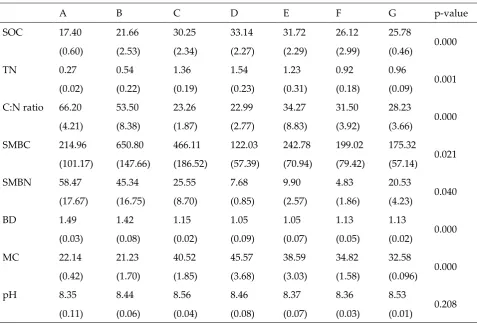
the overall mean values of SOC differed significantly among sites (F(6,28) = 7.067, p<0.05) with the highest value of 33.14±2.27 g C m−2 recorded in sampling site D and the least value of 17.40±0.60 g C m−2 measured at site A (Table 2). Just like SOC, the mean TN also differed significantly among the sites (F(6,28) = 5.188, p<0.05). The mean soil TN from sampling site D dominated by Scirpus fluviatilis, Polygonum amphibium L., and Carex tristachya vegetation was highest (1.54±0.23 g N m−2) while that from site A dominated by Poa annua L., Imperata cylindrica, Polygonum of 0.27±0.02 g N m−2 was the least. Moreover, soil TN varied with depth with remarkably higher mean values being recorded in the top soil profiles (0-10, 10-20 and 20-30 cm depth) (Figure 2).
The soil microbial biomass which is an important parameter of nutrient cycling in ecosystems also revealed spatial variations. One-way ANOVA analysis showed that both SMBC and SMBN differed significantly among sites (Table 2). With exception of sampling site C, the SMBC in site B dominated by Phragmites australis and Mongolian wormwood of 650.80±147.66 mg C m−2 was more than three times higher than the other sites. The overall mean SMBN values of 58.47±17.67 and 45.34±16.75 mg C m−2 recorded in sites A and B, respectively were significantly higher than the other sites. Unlike SOC and TN which showed a clear decreasing trend with soil depth in all sites, there was no clear pattern of SMBC and SMBN with soil depth (Figure 2). The SMBC and SMBN values were lower and higher in the upper soil layers, respectively in both site A and D. In site B higher SMBN values were observed on top soil profiles (0~20 cm depth).
Table 2. Overall means values (Standard error) of soil properties measured during the study period from different sites dominated by different vegetation types in Hongqipao reservoir.
A B C D E F G p-value
SOC 17.40
(0.60) 21.66 (2.53) 30.25 (2.34) 33.14 (2.27) 31.72 (2.29) 26.12 (2.99) 25.78
(0.46) 0.000
TN 0.27
(0.02) 0.54 (0.22) 1.36 (0.19) 1.54 (0.23) 1.23 (0.31) 0.92 (0.18) 0.96
(0.09) 0.001 C:N ratio 66.20
(4.21) 53.50 (8.38) 23.26 (1.87) 22.99 (2.77) 34.27 (8.83) 31.50 (3.92) 28.23
(3.66) 0.000 SMBC 214.96
(101.17) 650.80 (147.66) 466.11 (186.52) 122.03 (57.39) 242.78 (70.94) 199.02 (79.42) 175.32
(57.14) 0.021 SMBN 58.47
(17.67) 45.34 (16.75) 25.55 (8.70) 7.68 (0.85) 9.90 (2.57) 4.83 (1.86) 20.53
(4.23) 0.040
BD 1.49
(0.03) 1.42 (0.08) 1.15 (0.02) 1.05 (0.09) 1.05 (0.07) 1.13 (0.05) 1.13
(0.02) 0.000
MC 22.14
(0.42) 21.23 (1.70) 40.52 (1.85) 45.57 (3.68) 38.59 (3.03) 34.82 (1.58) 32.58
(0.096) 0.000
pH 8.35
(0.11) 8.44 (0.06) 8.56 (0.04) 8.46 (0.08) 8.37 (0.07) 8.36 (0.03) 8.53
(0.01) 0.208
3.2 Correlation analysis between SOC, TN, SMBC, SMBN and other soil properties
Figure 2. Soil organic carbon (SOC), TN, SMBC, SMBN, BD, MC, pH and C:N ratio at different soil depth from sites (seven sites) dominated by different vegetation types
Table 3. Pearson correlation coefficients among SOC, TN, SMBC, SMBN and soil properties; *p < 0.05; **p < 0.01; p<0.001
SOC TN SMBC SMBN C:N ratio MC BD
SOC
TN 0.93***
SMBC - 0.15 - 0.04
SMBN - 0.40* - 0.30 0.15
C:N ratio - 0.81*** - 0.89*** 0.08 0.42*
MC 0.76*** 0.79*** - 0.17 - 0.54*** - 0.75***
BD - 0.80*** - 0.83*** 0.23 0.42* 0.84*** - 0.82***
pH 0.07 0.03 0.05 0.17 - 0.09 - 0.01 - 0.01
3.3 Multiply regression models for SOC, TN, SMBC, SMBN and other measured soil factors
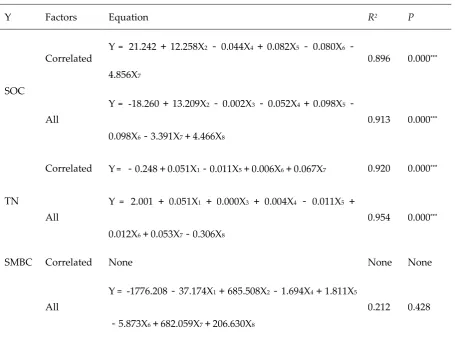
A multiple regression analysis was done to model the relationship among SOC, TN, SMBC, SMBN and other soil properties measures. Table 4 present the results of the regression analysis. For every response variable, two models were presented. One is correlated model in which only those soil variables which were significant correlated with the response variable under the Pearson correlation analysis (Table 3). The second model included all the soil factors measures. From the results (Table 4), 89.6% of SOC contents variability could be explained by only the correlated variables. However, when the full model was run, 91.3% of SOC contents variability was explained by all the factors. The correlated variables explained 92.0% of soil TN variability while when all factors were included in the model, 95.4% of soil TN variability could be explained. Only 29.1% variability of SMBN could be explained by the correlated variables while 55.4% could be explained by all variables.
Table 4. Multiply regression models for SOC, TN, SMBC, SMBN and other soil properties measured during the study period
Y Factors Equation R2 P
SOC
Correlated
Y﹦21.242+12.258X2-0.044X4+0.082X5-0.080X6-
4.856X7
0.896 0.000***
All
Y﹦-18.260+13.209X2-0.002X3-0.052X4+0.098X5-
0.098X6-3.391X7+4.466X8
0.913 0.000***
TN
Correlated Y﹦-0.248+0.051X1-0.011X5+0.006X6+0.067X7 0.920 0.000***
All
Y﹦2.001+0.051X1+0.000X3+0.004X4-0.011X5+
0.012X6+0.053X7-0.306X8
0.954 0.000***
SMBC Correlated None None None
All
Y﹦-1776.208-37.174X1+685.508X2-1.694X4+1.811X5
-5.873X6+682.059X7+206.630X8
SMBN
Correlated Y﹦91.997+0.098X1+0.169X5-1.648X6-17.303X7 0.291 0.031*
All
Y﹦-283.215-4.373X1+85.588X2-0.009X3+1.144X5-
2.051X6-23.803X7+47.233X8
0.554 0.000***
X1, SOC; X2, TN; X3, SMBC; X4, SMBN; X5, C:N ratio; X6, MC; X7, BD; X8, pH. *, **, ***, Significant correlation at p < 0.05, 0.01, and 0.001, respectively.
3.4 Total SOC, TN, SMBC and SMBN Storage
In the 0~50 cm depth, total SOC ranged from 12.98 to 17.39 kg C m-2 across the sampled sites dominated by different vegetation types in Hongqipao reservoir. TSOC differed significantly among the sites (P < 0.05) (Table 5). Sites which were inundated had relative higher TSOC values than the dry sites. Site D recorded the highest TSOC, while site B had the highest TSMBC. The TSMBN was remarkable higher in site A dominated by Poa annua L., Imperata cylindrica, and Polygonum . Sampling sites which were not inundated (site which were dry during the sampling period) had the lowest TSOC.
Table 5. Total SOC, TN, SMBC and SMBN storage
Sampling site
TSOC (kg C m-2)
TSN (kg N m-2)
TSMBC (g C m-2)
TSMBN (g N m-2)
A 12.98±0.31 0.20±0.02 157.07±39.88 43.30±9.79
B 15.01±0.49 0.35±0.04 473.34±97.55 30.74±8.09
C 17.35±1.47 0.77±0.11 270.71±98.73 14.75±0.03
D 17.39±1.19 0.80±0.04 63.12±18.61 4.05±0.33
E 16.32±0.34 0.60±0.12 126.81±15.18 5.04±0.03
F 14.58±0.89 0.51±0.06 105.25±13.09 2.58±0.35
3.5 Aboveground biomass production
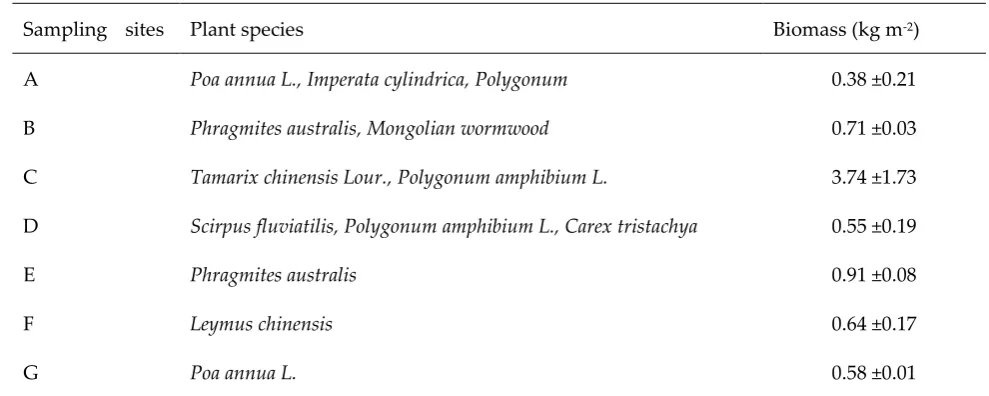
The results of aboveground plant biomass are presented on Table 6. In site C which was dominated by Tamarix chinensis Lour. and Polygonum amphibium L. the biomass was 3.74 ±1.73 kg m-2 which was about ten times higher than that of site A of 0.38 ±0.21 kg m-2 which was the lowest. Site E which was dominated by Phragmites australis had the second relative high value of 0.91 ±0.08 kg m-2 which was about four times lower than that of site C. The aboveground biomass production of most of the sites did not exceed 1 kg m-2 (Table 6).
Table 6. Aboveground biomass production of the vegetation from the different sampling sites in Hongqipao reservoir.
Sampling sites Plant species Biomass (kg m-2)
A Poa annua L., Imperata cylindrica, Polygonum 0.38 ±0.21
B Phragmites australis, Mongolian wormwood 0.71 ±0.03
C Tamarix chinensis Lour., Polygonum amphibium L. 3.74 ±1.73
D Scirpus fluviatilis, Polygonum amphibium L., Carex tristachya 0.55 ±0.19
E Phragmites australis 0.91 ±0.08
F Leymus chinensis 0.64 ±0.17
G Poa annua L. 0.58 ±0.01
4. Discussion
4.1 Soil Organic Carbon (SOC) and TN variations among vegetation types and soil depths
to the fact that soil BD is considered to be the basic property that varies with the soil structural conditions, and increases with soil depth, due to changes in porosity, soil texture, and organic matter content 35. The mean BD among sites differed significantly with sampling site A and B having remarkable high values. This could have been likely due to mineral sedimentation since these sites were located close to reservoir shoreline where the inflowing rivers pour water into the reservoir. Wang, et al. 36 observed relative high BD over a depth of 24 cm from site located near influent of a river flowing in a freshwater marsh. These authors attributed their findings to rates of mineral sediment accumulation which tend to increase towards the lake/open water in a wetland than in the interior marshes 37. Another possible reason for the relative high soil BD in sites A and B could be due to sediment settling out of the water column which is then transformed into a soil layer that bonds with the preexisting surface, thus decreasing pore space, resulting in increased BD 38.
Unlike BD, the SOC and TN decreased with depth from the soil surface to the bottom of the soil profile, reflecting the variations in growth and distribution of roots and rhizome, and the decomposition with depth. According to Huang, et al. 39 the difference between organic matter input and output determines the amount of soil organic matter and carbon. The vertical profile of SOC from the soil collected in the sites dominated by different vegetation types in Hongqipao reservoir showed that the plants detritus decreased with depth. When plants detritus decompose, most of their organic matter is mineralized and a new soil layer which contains a greater amount of organic carbon is formed 39-40. This therefore led to higher SOC and TN in the top soil profiles than in the lower soil profiles.
reported that the liter falls of Phragmites australis were important reservoirs of organic carbon which were mineralized into the soil. Zhang, et al. 43 and Gower, et al. 44 noted in their studies that accumulation of organic carbon in soil and the proportion of carbon fixed to soil carbon pool with different turnover rates tend to vary with vegetation types. Secondly, since sites A, F and G were located on dry places within the littoral zone of the reservoir, then their relative low SOC concentration could probably because mineralization was favoured since the soil was dry most of the time. Scores of studies have shown that hydrological processes (such as groundwater level, depth, duration and frequency of flooding) affect the decomposition of litter hence soil SOC and TN 45.
Soil microbial biomass (SMB), plays an important role in SOC mineralization and nutrient cycling
46-47. The composition of vegetation species and soil water availability in wetlands greatly influences
the soil microbial biomass 48-49. In this study, the overall mean SMBC did not differ significantly
among the sites dominated by different vegetation types. However, relative high mean values were observed in site B which was mainly dominated by Phragmites australis and Mongolian wormwood. Sturz and Christie 50 and Kyambadde, et al. 51 noted in their study that the vigorous root system of Phragmites community vegetation increase the level of soil microbial activity hence its biomass. These authors further noted that higher organic matter from Phragmites community increases the carbon enrichment of the soil, which then helped maintain the microbial activities in the soil. More importantly, the mean SMBN which differ significantly among the sites was relatively higher at site B.
Correspondingly, the relative high SMBC and SMBN at the top soil profiles indicate higher microbial metabolic activities in these profiles.
4.2 Soil Organic Carbon (SOC) and TN relationships with other soil properties
According to Bi, et al. 53 the carbon cycle is closely linked with nitrogen cycle through production and decomposition. Our study also revealed that the soil TN concentration was significant positive related with SOC concentration in the 0-50cm soil layer of the different vegetation types (Table 3 and Figure 3). This observation could be because the main nitrogen sources were the vegetation organic matter, litter, and biological nitrogen fixation 54. The Pearson correlation analysis and RDA also showed that soil MC was positive correlated with SOC and TN. This concurs with finding of other studies 55-56. Under high soil MC conditions, the anoxic decomposition of soil organic matter tends to be inhibited resulting in the accumulation of SOC. Importantly, soil MC also affects nitrogen since higher soil MC can hinder soil microbial activities, creating environment which is not conducive to the mineralization and decomposition of soil organic nitrogen 57. This therefore implies a high soil MC can lead to a high soil TN concentration.
Unlike soil MC which was significantly positively correlated with SOC and TN, the soil BD was significant negative correlated with SOC and TN concentration in the 0-50 cm soil profiles (Table 3 and Figure 3). While assessing stock and thresholds detection of SOC and nitrogen along an altitude gradient in an east Africa mountain ecosystem, Njeru, et al. 58 observed that BD was negative correlated with SOC and TN. This observation could be likely due to the fact that mineralization of SOC and nitrification of nitrogen were suppressed in soils with high BD values53, 59. It is documented in the literature that low BD soil can store more SOC and TN as SOC and TN can be mobilized in porous spaces within soil matrix 60.
From the multiple regression models results in this study, it is quite clear that all measured soil variables played a major role in influencing SOC, TN, SMBC and SMBN. A comparison of the two models (for each response variable; SOC, TN, SMB and SMBN), one including all the soil variables measured and the other one including only those significantly correlated with the response revealed a slight difference. The variability of the response variable could be explained more when all the predictor variables measured in this study were included in the model. This implies that all the measure soil variables play a role in influencing the response variable.
5. Conclusions
spatial characteristics of SOC and TN. Any changes in the vegetation types in the littoral area of the reservoir may influence the distribution of SOC, TN, SMBC, SMBN and other soil properties. This may affect the global carbon budget and the atmospheric greenhouse gas concentration significantly.
Author Contributions: Conceptualization, B.Y. and J.L.; methodology, B.Y. and Y.L.; software, B.Y.; validation, B.Y. and X.L.; formal analysis, J.L.; investigation, B.Y. and X.L.; resources, H.W.; data curation, B.Y.; writing—original draft preparation, B.Y. and P.C.M; writing—review and editing, P.C.M.; visualization, X.W.; supervision, B.Y. and J.L.; project administration, B.Y.; funding acquisition, B.Y. and J.L. All authors have read and agreed to the published version of the manuscript.
Funding: This study was funded by the Fundamental Research Funds for the Central Universities (2572017CA14), and the postdoctoral scientific research developmental fund of Heilongjiang Province (LBH-Q15006).
Acknowledgments: We want to acknowledge all those who contributed to the accomplishment of this paper.
References
1. Yao, X.; Yu, K.; Deng, Y.; Liu, J.; Lai, Z., Spatial variability of soil organic carbon and total nitrogen in the hilly red soil region of Southern China. Journal of Forestry Research 2019, 1-10.
2. Yang, M.; Geng, X.; Grace, J.; Lu, C.; Zhu, Y.; Zhou, Y.; Lei, G., Spatial and seasonal CH 4 flux in the littoral zone of Miyun Reservoir near Beijing: the effects of water level and its fluctuation. PLoS One 2014, 9 (4), e94275.
3. Wang, J.; Yang, R.; Bai, Z., Spatial variability and sampling optimization of soil organic carbon and total nitrogen for Minesoils of the Loess Plateau using geostatistics. Ecological Engineering 2015, 82, 159-164.
4. Mitsch, W. J.; Zhang, L.; Anderson, C. J.; Altor, A. E.; Hernández, M. E., Creating riverine wetlands: ecological succession, nutrient retention, and pulsing effects. Ecological Engineering 2005, 25 (5), 510-527.
5. Reddy, K. R.; DeLaune, R. D., Biogeochemistry of wetlands: science and applications. CRC press: 2008.
6. Wang, J.; Bai, J.; Zhao, Q.; Lu, Q.; Xia, Z., Five-year changes in soil organic carbon and total nitrogen in coastal wetlands affected by flow-sediment regulation in a Chinese delta. Scientific Reports 2016, 6, 21137.
7. Bohn, H. L., Estimate of organic carbon in world soils. Soil science society of America journal 1976, 40 (3), 468-470.
8. Wildi, W., Environmental hazards of dams and reservoirs. Near Curriculum in Natural Environmental Science 2010.
9. Gunkel, G., Hydropower–A green energy? Tropical reservoirs and greenhouse gas emissions. CLEAN–Soil, Air, Water 2009, 37 (9), 726-734.
10. Li, S.; Lu, X., Uncertainties of carbon emission from hydroelectric reservoirs. Natural hazards 2012, 62 (3), 1343-1345.
12. Chen, X., Gazette of the ministry of water resources of the People's Republic of China. Beijing: Ministry of Water Resources of the People’s Republic of China 2009.
13. Teng, M.; Zeng, L.; Xiao, W.; Huang, Z.; Zhou, Z.; Yan, Z.; Wang, P., Spatial variability of soil organic carbon in Three Gorges Reservoir area, China. Science of The Total Environment 2017, 599, 1308-1316.
14. Cao, Q.; Wang, H.; Zhang, Y.; Lal, R.; Wang, R.; Ge, X.; Liu, J., Factors affecting distribution patterns of organic carbon in sediments at regional and national scales in China. Scientific reports 2017, 7 (1), 1-10.
15. Li, Y.; Wu, H.; Wang, J.; Cui, L.; Tian, D.; Wang, J.; Zhang, X.; Yan, L.; Yan, Z.; Zhang, K., Plant biomass and soil organic carbon are main factors influencing dry-season ecosystem carbon rates in the coastal zone of the Yellow River Delta. PLoS One 2019, 14 (1), e0210768.
16. Yu, L.; Huang, Y.; Sun, F.; Sun, W., A synthesis of soil carbon and nitrogen recovery after wetland restoration and creation in the United States. Scientific reports 2017, 7 (1), 1-9.
17. Craft, C., Freshwater input structures soil properties, vertical accretion, and nutrient accumulation of Georgia and US tidal marshes. Limnology and oceanography 2007, 52 (3), 1220-1230. 18. Xu, X.; Thornton, P. E.; Post, W. M., A global analysis of soil microbial biomass carbon, nitrogen and phosphorus in terrestrial ecosystems. Global Ecology and Biogeography 2013, 22 (6), 737-749. 19. Bahn, M.; Rodeghiero, M.; Anderson-Dunn, M.; Dore, S.; Gimeno, C.; Drösler, M.; Williams, M.; Ammann, C.; Berninger, F.; Flechard, C., Soil respiration in European grasslands in relation to climate and assimilate supply. Ecosystems 2008, 11 (8), 1352-1367.
20. Zhang, S.; Wang, L.; Hu, J.; Zhang, W.; Fu, X.; Le, Y.; Jin, F., Organic carbon accumulation capability of two typical tidal wetland soils in Chongming Dongtan, China. Journal of Environmental Sciences 2011, 23 (1), 87-94.
21. Santín, C.; González-Pérez, M.; Otero, X.; Vidal-Torrado, P.; Macías, F.; Álvarez, M., Characterization of humic substances in salt marsh soils under sea rush (Juncus maritimus). Estuarine, Coastal and Shelf Science 2008, 79 (3), 541-548.
23. Bai, J.; Ouyang, H.; Xiao, R.; Gao, J.; Gao, H.; Cui, B.; Huang, L., Spatial variability of soil carbon, nitrogen, and phosphorus content and storage in an alpine wetland in the Qinghai–Tibet Plateau, China. Soil Research 2010, 48 (8), 730-736.
24. Song, Y.-Q.; Yang, L.-A.; Li, B.; Hu, Y.-M.; Wang, A.-L.; Zhou, W.; Cui, X.-S.; Liu, Y.-L., Spatial prediction of soil organic matter using a hybrid geostatistical model of an extreme learning machine and ordinary kriging. Sustainability 2017, 9 (5), 754.
25. Dieckow, J.; Mielniczuk, J.; Knicker, H.; Bayer, C.; Dick, D. P.; Kögel-Knabner, I., Comparison of carbon and nitrogen determination methods for samples of a paleudult subjected to no-till cropping systems. Scientia Agricola 2007, 64 (5), 532-540.
26. Hedges, J. I.; Stern, J. H., Carbon and nitrogen determinations of carbonate‐containing solids 1. Limnology and oceanography 1984, 29 (3), 657-663.
27. Blake, G. R.; Hartge, K., Bulk density. Methods of soil analysis: Part 1 Physical and mineralogical methods 1986, 5, 363-375.
28. Brookes, P.; Landman, A.; Pruden, G.; Jenkinson, D., Chloroform fumigation and the release of soil nitrogen: a rapid direct extraction method to measure microbial biomass nitrogen in soil. Soil biology and biochemistry 1985, 17 (6), 837-842.
29. Vance, E. D.; Brookes, P. C.; Jenkinson, D. S., An extraction method for measuring soil microbial biomass C. Soil biology and Biochemistry 1987, 19 (6), 703-707.
30. Tate, K.; Ross, D.; Feltham, C., A direct extraction method to estimate soil microbial C: effects of experimental variables and some different calibration procedures. Soil Biology and Biochemistry 1988, 20 (3), 329-335.
31. Jenkinson, D., Microbial biomass in soil: measurement and turnover. Soil biochemistry 1981, 5, 415-471.
32. Wang, X.; Song, C.; Sun, X.; Wang, J.; Zhang, X.; Mao, R., Soil carbon and nitrogen across wetland types in discontinuous permafrost zone of the Xiao Xing'an Mountains, northeastern China. Catena 2013, 101, 31-37.
34. Nair, A.; Ngouajio, M., Soil microbial biomass, functional microbial diversity, and nematode community structure as affected by cover crops and compost in an organic vegetable production system. Applied Soil Ecology 2012, 58, 45-55.
35. Chaudhari, P. R.; Ahire, D. V.; Ahire, V. D.; Chkravarty, M.; Maity, S., Soil bulk density as related to soil texture, organic matter content and available total nutrients of Coimbatore soil. International Journal of Scientific and Research Publications 2013, 3 (2), 1-8.
36. Wang, H.; Piazza, S. C.; Sharp, L. A.; Stagg, C. L.; Couvillion, B. R.; Steyer, G. D.; McGinnis, T. E., Determining the spatial variability of wetland soil bulk density, organic matter, and the conversion factor between organic matter and organic carbon across coastal Louisiana, USA. Journal of Coastal Research 2017, 33 (3), 507-517.
37. Hatton, R.; DeLaune, R.; Patrick Jr, W., Sedimentation, accretion, and subsidence in marshes of Barataria Basin, Louisiana 1. Limnology and Oceanography 1983, 28 (3), 494-502.
38. Nyman, J. A.; DeLaune, R. D.; Roberts, H. H.; Patrick Jr, W., Relationship between vegetation and soil formation in a rapidly submerging coastal marsh. Marine Ecology Progress Series 1993, 269-279.
39. Huang, W.; Chen, Q.; Ren, K.; Chen, K., Vertical distribution and retention mechanism of nitrogen and phosphorus in soils with different macrophytes of a natural river mouth wetland. Environmental monitoring and assessment 2015, 187 (3), 97.
40. Brinson, M. M.; Lugo, A. E.; Brown, S., Primary productivity, decomposition and consumer activity in freshwater wetlands. Annual Review of Ecology and Systematics 1981, 12, 123-161.
41. Partridge, J. W., Persicaria amphibia (L.) Gray (Polygonum amphibium L.). Journal of Ecology 2001, 89 (3), 487-501.
42. González-Alcaraz, M.; Egea, C.; Jiménez-Cárceles, F.; Párraga, I.; Maria-Cervantes, A.; Delgado, M.; Álvarez-Rogel, J., Storage of organic carbon, nitrogen and phosphorus in the soil–plant system of Phragmites australis stands from a eutrophicated Mediterranean salt marsh. Geoderma 2012, 185, 61-72.
44. Gower, S.; Krankina, O.; Olson, R.; Apps, M.; Linder, S.; Wang, C., Net primary production and carbon allocation patterns of boreal forest ecosystems. Ecological applications 2001, 11 (5), 1395-1411. 45. Zhang, Q.; Zhang, G.; Yu, X.; Liu, Y.; Xia, S.; Ya, L.; Hu, B.; Wan, S., Effect of ground water level on the release of carbon, nitrogen and phosphorus during decomposition of Carex. cinerascens Kükenth in the typical seasonal floodplain in dry season. Journal of Freshwater Ecology 2019, 34 (1), 305-322.
46. Ashraf, M. N.; Hu, C.; Wu, L.; Duan, Y.; Zhang, W.; Aziz, T.; Cai, A.; Abrar, M. M.; Xu, M., Soil and microbial biomass stoichiometry regulate soil organic carbon and nitrogen mineralization in rice-wheat rotation subjected to long-term fertilization. Journal of Soils and Sediments 2020, 1-11. 47. Xu, Y.; Ding, F.; Gao, X.; Wang, Y.; Li, M.; Wang, J., Mineralization of plant residues and native soil carbon as affected by soil fertility and residue type. Journal of Soils and Sediments 2019, 19 (3), 1407-1415.
48. Steenwerth, K.; Drenovsky, R.; Lambert, J.-J.; Kluepfel, D.; Scow, K.; Smart, D., Soil morphology, depth and grapevine root frequency influence microbial communities in a Pinot noir vineyard. Soil Biology and Biochemistry 2008, 40 (6), 1330-1340.
49. Rangel-Vasconcelos, L. G. T.; Zarin, D. J.; Oliveira, F. d. A.; Vasconcelos, S. S.; Carvalho, C. J. R. d.; Santos, M. M. d. L. S., Effect of water availability on soil microbial biomass in secondary forest in eastern Amazonia. Revista Brasileira de Ciência do Solo 2015, 39 (2), 377-384.
50. Sturz, A.; Christie, B., Beneficial microbial allelopathies in the root zone: the management of soil quality and plant disease with rhizobacteria. Soil and Tillage Research 2003, 72 (2), 107-123.
51. Kyambadde, J.; Kansiime, F.; Gumaelius, L.; Dalhammar, G., A comparative study of Cyperus papyrus and Miscanthidium violaceum-based constructed wetlands for wastewater treatment in a tropical climate. Water research 2004, 38 (2), 475-485.
52. Singh, J. S.; Gupta, V. K., Soil microbial biomass: a key soil driver in management of ecosystem functioning. Science of the Total Environment 2018, 634, 497-500.
54. Bai, J.; Deng, W.; Zhang, Y., Spatial distribution of nitrogen and phosphorus in soil of Momoge Wetland. Journal of Soil and Water Conservation 2001, 15 (4), 79-81.
55. Baumann, F.; HE, J. S.; Schmidt, K.; Kuehn, P.; Scholten, T., Pedogenesis, permafrost, and soil moisture as controlling factors for soil nitrogen and carbon contents across the Tibetan Plateau. Global Change Biology 2009, 15 (12), 3001-3017.
56. Sun, J.; Wang, H., Soil nitrogen and carbon determine the trade-off of the above-and below-ground biomass across alpine grasslands, Tibetan Plateau. Ecological Indicators 2016, 60, 1070-1076.
57. Zhao, Q.; Bai, J.; Liu, Q.; Lu, Q.; Gao, Z.; Wang, J., Spatial and seasonal variations of soil carbon and nitrogen content and stock in a tidal salt marsh with Tamarix chinensis, China. Wetlands 2016, 36 (1), 145-152.
58. Njeru, C. M.; Ekesi, S.; Mohamed, S.; Kinyamario, J.; Kiboi, S.; Maeda, E., Assessing stock and thresholds detection of soil organic carbon and nitrogen along an altitude gradient in an east Africa mountain ecosystem. Geoderma Regional 2017, 10, 29-38.
59. De Neve, S.; Hofman, G., Influence of soil compaction on carbon and nitrogen mineralization of soil organic matter and crop residues. Biology and fertility of soils 2000, 30 (5-6), 544-549.
60. Anh, P. T. Q.; Gomi, T.; MacDonald, L. H.; Mizugaki, S.; Van Khoa, P.; Furuichi, T., Linkages among land use, macronutrient levels, and soil erosion in northern Vietnam: a plot-scale study. Geoderma 2014, 232, 352-362.
61. Zhang, C.; Nie, S.; Liang, J.; Zeng, G.; Wu, H.; Hua, S.; Liu, J.; Yuan, Y.; Xiao, H.; Deng, L., Effects of heavy metals and soil physicochemical properties on wetland soil microbial biomass and bacterial community structure. Science of the Total Environment 2016, 557, 785-790.