Drug Design, Development and Therapy
Dove
press
O r i g i n a l r e s e a r c h open access to scientific and medical research
Open access Full Text article
stability of refrigerated miglustat after preparation
in inOrpha
®
flavored suspending excipient for
compounding of oral solutions and suspensions
sofyen riahi Michael ambühl Jürgen stichler Dirk Bandilla
actelion Pharmaceuticals ltd, allschwil, switzerland
Background: Miglustat (Zavesca®) is an oral treatment for type 1 Gaucher disease and
Niemann–Pick disease type C. Patients with Niemann–Pick disease type C often have difficul-ties swallowing, and miglustat has an unpleasant taste. The stability of miglustat at 2°C–8°C prepared in InOrpha® suspending vehicle, a liquid taste-masking agent, was assessed.
Methods: The contents of Zavesca® 100 mg capsules (a powder blend comprising miglustat
and several excipients) were transferred into InOrpha®. Although miglustat was soluble in
InOrpha® at all concentrations tested, some of the excipients were not. An InOrpha®
suspen-sion containing 20 mg/mL miglustat was investigated initially. Subsequently, a pH-adjusted suspension of 20 mg/mL, and non-adjusted 10 and 5 mg/mL suspensions were evaluated. All suspensions were stored under refrigerated conditions. Physicochemical and microbiological challenge testing was performed at 0 hours and after 14 and 28 days. Degradation was assessed by high-performance liquid chromatography, appearance was assessed visually, and pH was recorded. Suspensions were inoculated with seven species of bacteria, yeast, and mold, and growth evaluated using membrane filtration.
Results: Miglustat 20 mg/mL suspension changed from yellow (0 hours) to brown (days 14
and 28); pH remained stable at 7.4–7.6. Pure InOrpha® (pH 4.6) remained yellow throughout
the study. Pure InOrpha® adjusted to pH 7.5 displayed a brownish discoloration after 9 days.
Miglustat 5 and 20 mg/mL suspensions, adjusted to pH 6.5 and 4.4, respectively, remained yellow at days 14 and 28. Miglustat 10 mg/mL suspension (pH 7.3) changed from yellow to brown on day 9. No degradates were detected for any of the concentrations tested. There was no proliferation of microorganisms over the study period; in all cases the level of contamina-tion was clearly reduced.
Conclusion: InOrpha® suspensions containing miglustat 5 mg/mL (without pH adjustment)
and 20 mg/mL (with pH adjusted to 4.4) display stable physicochemical and microbiological properties over 28 days.
Keywords: microbiological challenge, Niemann–Pick disease type C, type 1 Gaucher
disease
Introduction
Miglustat (Zavesca® 100 mg hard gelatine capsules; Actelion Pharmaceuticals Ltd,
Allschwil, Switzerland) is used to treat mild to moderate type 1 Gaucher disease (GD1) when enzyme replacement therapy is unsuitable, and Niemann–Pick disease type C (NP-C), which are both inherited metabolic disorders.1–4 The standard adult
miglustat dose for GD1 is 100 mg three times a day. For NP-C, the standard dose for adults and adolescents is 200 mg three times a day and for patients under the age of 12 the dose should be adjusted on the basis of body surface area.1
correspondence: Dirk Bandilla actelion Pharmaceuticals ltd, gewerbestrasse 16, 4123 allschwil, switzerland
Tel +41 61 565 6004
email [email protected]
Journal name: Drug Design, Development and Therapy Article Designation: Original Research
Year: 2015 Volume: 9
Running head verso: Riahi et al
Running head recto: Stability of miglustat in InOrpha® suspending excipient DOI: http://dx.doi.org/10.2147/DDDT.S74497
Drug Design, Development and Therapy downloaded from https://www.dovepress.com/ by 118.70.13.36 on 22-Aug-2020
For personal use only.
This article was published in the following Dove Press journal: Drug Design, Development and Therapy
17 January 2015
Glycosphingolipid lysosomal storage disorders, such as GD1, arise as a result of deficiencies of the enzymes responsible for the catabolism of glycosphingolipids.5 GD1
is a rare inherited metabolic disorder caused by a failure to degrade glucosylceramide, resulting in lysosomal storage of this material and widespread pathology. The inhibitory action of miglustat on glucosylceramide synthase forms the rationale for substrate reduction therapy in GD1. NP-C is a rare, invariably progressive, and eventually fatal neurode-generative disorder characterized by impaired intracellular lipid trafficking leading to glycosphingolipid accumulation in neuronal and glial cells without any particular defect in catabolic enzymes. The resulting pathological lysosomal accumulation of these glycolipids has widespread clinical consequences. Through its action as a competitive and reversible inhibitor of the enzyme glucosylceramide synthase and its ability to cross the blood–brain barrier, miglustat can reduce the amount of glucosylceramide formed in the brain, and subsequently reduce the neurotoxic accumulation of more complex glycosphingolipids.5,6
Miglustat (1,5 [butylimino]-1,5-dideoxy-D-glucitol) is a single stereoisomer synthetically derived from an imino sugar extracted from plants and microorganisms. It has a molecular weight of 219 and is a white crystalline sub-stance that is highly soluble in water (1 g/mL at ambient temperature).7
InOrpha® (Inresa Pharma, Bartenheim, France) is a
liquid suspending excipient for compounding of oral solu-tions and suspensions that is free from sugar, alcohol, and paraben. It contains a noncarcinogenic sweetener, sucral-ose, as well as a caramel flavor agent and a taste-masking agent. It has successfully been used as a suspending vehicle for hydrocortisone8 and melatonin.9 The aim of this study
was to evaluate the stability of miglustat preparations when dissolved in InOrpha® suspending vehicle with regard to
physicochemical and microbiological properties.
Methods
First stability study
Physicochemical testing
Miglustat 20 mg/mL suspension was prepared by transferring the contents of one Zavesca 100 mg capsule per 5 mL of InOr-pha® suspending vehicle (Inresa Pharma). The resulting
sus-pension was thoroughly shaken to ensure complete dissolution of miglustat. A volume of 100 mL of suspension was kept in a 100 mL glass volumetric flask and stored under refrigerated conditions at 2°C–8°C. To serve as a blank, 100 mL of pure InOrpha® suspending vehicle in a 100 mL glass volumetric
flask was stored under the same conditions.
Degradation of miglustat suspension at 0 hours and after 14 and 28 days was assessed via high-performance liquid chromatography (HPLC) using an Agilent 1100 system with a single wavelength detector set to 208 nm (Agilent Technolo-gies, Santa Clara, CA, USA). Chromatographic separation was achieved on a Waters X-Bridge Amide HPLC column (150 mm ×2.1 mm, 3.5 μm particle size; Waters Corpora-tion, Milford, MA, USA) using a mobile phase consisting of 10% ammonium acetate buffer/90% acetonitrile (both reagents from Sigma-Aldrich Co, St Louis, MO, USA) at an isocratic flow rate of 0.8 mL/min. Prior to analysis, 5 mL miglustat suspension was diluted with 95 mL of mobile phase to give a final concentration of 1 mg/mL of miglustat. An aliquot was filtered through a 0.45 μm PTFE syringe filter (AIT, Houilles, France) prior to injection into the high-performance liquid chromatograph. The injection volume was 10 μL, the autosampler temperature was 20°C, and the column temperature was 40°C. Miglustat reference standard (Actelion Pharmaceuticals Ltd) was used to validate the fol-lowing method parameters: selectivity (no interferences from known degradates and excipients), linearity (R2=0.9999 for
50%–200% method concentration, n=6), repeatability (0.3% relative standard deviation for injections at 100% method concentration, n=6), reference solution stability (24 hours at ambient room temperature), limit of detection (0.03% of method concentration), and limit of quantification (0.10% of method concentration).
The appearance of miglustat 20 mg/mL suspension and pure InOrpha® suspending vehicle was assessed by manual
visual inspection in both 50 mL glass volumetric flasks and 50 mL polypropylene tubes (Sarstedt AG, Nümbrecht, Germany) at 0 hours and after 14 and 28 days. The pH at each of these time points was measured using a Uniprobe Pt 1000 glass electrode (Metrohm, Zolfingen, Switzerland). Following the results of appearance testing, follow-up experiments were conducted where the pH of the pure InOrpha® suspending vehicle was adjusted to be the same as
that of the miglustat 20 mg/mL suspension, ie, pH 7.5.
Microbiological challenge testing
All microbial testing was performed by Compliance GmbH (Cologne, Germany). Miglustat 20 mg/mL suspension was again prepared by dissolving the contents of one Zavesca 100 mg capsule per 5 mL of InOrpha® suspending vehicle.
Microorganisms used were the bacteria Staphylococcus
aureus ATCC 6538, Pseudomonas aeruginosa ATCC
9027, Escherichia coli ATCC 8739, and Pseudomonas
chlororaphis DSM 6698; the yeasts Candida albicans ATCC
10231, and Zygosaccharomyces rouxii NCYC 381; and the
Drug Design, Development and Therapy downloaded from https://www.dovepress.com/ by 118.70.13.36 on 22-Aug-2020
Dovepress stability of miglustat in inOrpha® suspending excipient
mold Aspergillus brasiliensis ATCC 16404. P. chlororaphis was purchased from Leibniz Institute DSMZ – German Col-lection of Microorganisms and Cell Cultures (Braunschweig, Germany), Z. rouxii from National Collection of Yeast Cul-tures (NCYC) (Norwich, UK), and all other organisms from American Type Culture Collection (ATCC) (Manassas, VA, USA). The cultures were prepared as per manufacturer’s instructions and used within 24 hours of preparation.
Prior to stability testing, the suitability of the micro-biological challenge testing method was verified according to European Pharmacopoeia Edition 8 Chapter 2.6.1210 to
ensure that detection of 100 colony forming units (cfu) was possible. For this, 1 mL of miglustat 20 mg/mL suspension was pipetted into 9 mL of sodium chloride-peptone buffer. After vortexing, the pH values were recorded to ensure they were between pH 6 and 8. The samples were then inoculated with 1×10² cfu/mL of each microorganism (one sample per
organism). Samples of sodium chloride-peptone buffer were also inoculated with microorganisms to serve as a reference. Membrane filtration was performed for each sample using a stainless steel filtration unit and cellulose nitrate filters (Sartorius AG, Göttingen, Germany). Filters were washed three times with 100 mL of sodium chloride-peptone buffer. The filters were then put on agar plates as follows: casein-soya-peptone agar and incubation for 2 days at 32.5°C±2.5°C for S. aureus, P. aeruginosa, and E. coli; and casein-soya-peptone agar and incubation for 2 days at 22.5°C±2.5°C for
P. chlororaphis. For yeasts and molds, the filters were put on
Sabouraud agar and incubated for 5 days at 22.5°C±2.5°C. In addition, control miglustat samples were prepared, filtered, and incubated as described but without being inoculated with microorganisms to verify the absence of any microbial contamination in the test articles.
Microbial proliferation risk of the miglustat suspen-sions was tested using low-level inoculum and a brief daily exposure to air to simulate conditions of possible contami-nation during the preparation of the suspension or during its use. The concentration of each microorganism inoculum was adjusted to yield approximately 5×10⁴ cfu/mL. From
this, 50 μL was added to 4.95 mL of miglustat 20 mg/mL suspension to reach 102 to 103 cfu/mL. All samples were then
stored under refrigerated conditions at 2°C–8°C. Everyday the samples were taken out of the refrigerator and opened for approximately 10 seconds. The microbial counts of the inoculum at 0 hours and at 14 and 28 days were determined by the membrane filtration method, as described above for the suitability test. Microbial growth was considered evident when the microbial population increased by 0.5 log10 com-pared with the precedent inoculum count.
second stability study
A second stability test study was conducted following the results of the first stability study to investigate the stabil-ity of lower concentrations of miglustat suspension at 5 mg/mL and 10 mg/mL. In addition, the effect of adjust-ing the pH of miglustat 20 mg/mL suspension to 4.4, ie, similar to the pH of pure InOrpha® suspending vehicle,
was examined.
Miglustat 20 mg/mL suspension pH 4.4 was prepared as per the first stability test study and an additional 2.5 g of citric acid (Sigma-Aldrich Co) was added to 100 mL miglustat suspension (Sigma-Aldrich Co). Miglustat 10 mg/mL suspen-sion was prepared by dissolving the contents of one Zavesca 100 mg capsule per 10 mL of InOrpha® suspending vehicle.
Miglustat 5 mg/mL suspension was prepared by dissolving the contents of one Zavesca 100 mg capsule per 20 mL of InOrpha® suspending vehicle.
Physicochemical testing was conducted as described above for each of these suspensions. Microbiological chal-lenge testing was conducted as described above but only for the miglustat 20 mg/mL suspension adjusted to pH 4.4 and for the miglustat 5 mg/mL suspension.
Results
First stability test study
Physicochemical testing
No degradates were detected for the miglustat 20 mg/mL suspension after 28 days of refrigerated storage at 2°C–8°C versus at 0 hours.
The appearance of miglustat 20 mg/mL suspension compared with pure InOrpha® suspending vehicle at 0 hours
was similar, both being yellowish, turbid, and slightly vis-cous. Although no degradation could be detected, miglustat 20 mg/mL suspension was brown after 14 and 28 days of refrigerated storage. In contrast, there was no change in the appearance of InOrpha® suspending vehicle over time.
The pH of miglustat 20 mg/mL suspension at 0 hours and after 14 and 28 days refrigerated storage was 7.4, 7.6, and 7.4, respectively. Pure InOrpha® suspending vehicle had a
lower pH of 4.7, 4.9, and 4.7, respectively, at these time points. When the pH of pure InOrpha® suspending vehicle
was adjusted to 7.5 to match that of the miglustat 20 mg/mL suspension, a brownish discoloration became visible after 9 days. The appearance of either miglustat 20 mg/mL sus-pension or pure InOrpha® suspending vehicle at each time
point tested was not dependent on the storage vessel being glass or plastic, ie, the discoloration of miglustat 20 mg/mL after 14 and 28 days was visible in both glass and plastic storage vessels.
Drug Design, Development and Therapy downloaded from https://www.dovepress.com/ by 118.70.13.36 on 22-Aug-2020
Microbiological challenge testing
The suitability test of the methodology for microbial testing confirmed that the method was suitable for the intended appli-cation as the recovery for all microorganisms in the miglustat suspensions was within 50%–200% of the corresponding sodium chloride-peptone reference sample. In addition, no microorganisms were detected in the noninoculated control miglustat suspensions, demonstrating the absence of micro-biological contamination of the test items.
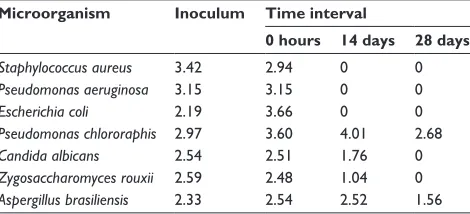
Table 1 summarizes the log-numbers of the microor-ganisms tested for miglustat 20 mg/mL suspension. For
S. aureus, P. aeruginosa, and E. coli, a 3-log reduction was
found after 14 days and no increase was found after 28 days. For P. chlororaphis, a 0.41-log increase was found after 14 days compared with at 0 hours, and a 1.33-log reduction was found after 28 days compared with the 14-day time point. There was a 0.75-log reduction for C. albicans after 14 days and no cfus found after 28 days. A 1.44-log reduction was found for Z. rouxii after 14 days and no cfus after 28 days.
A. brasiliensis was not reduced after 14 days but did show a
0.96-log reduction after 28 days compared with at 14 hours.
second stability test study
Physiochemical testing
The appearances of miglustat 20 mg/mL suspension adjusted to pH 4.4, miglustat 10 mg/mL suspension, miglustat 5 mg/mL suspension, and pure InOrpha® suspending vehicle at 0 hours
were all similar, namely yellowish, turbid, and slightly vis-cous. After 14 days storage under refrigerated conditions, the miglustat 10 mg/mL suspension had turned brownish (onset of change occurring 9 days after storage).
However, miglustat 5 mg/mL suspension, miglustat 20 mg/mL adjusted to pH 4.4, and pure InOrpha®
suspend-ing vehicle remained yellow. A similar observation was made after 28 days, with the miglustat 10 mg/mL having a darker brown color than after 14 days. The other miglustat suspensions and pure InOrpha® suspending vehicle remained
yellow. The pH of miglustat 20 mg/mL suspension adjusted to pH 4.4 remained at 4.4 after 14 and 28 days. For miglustat 10 mg/mL, the pH was 7.0 at 0 hours and 7.3 after 14 and 28 days. For miglustat 5 mg/mL, the pH was 6.3 at 0 hours and 6.5 after 14 and 28 days. The pH of pure InOrpha®
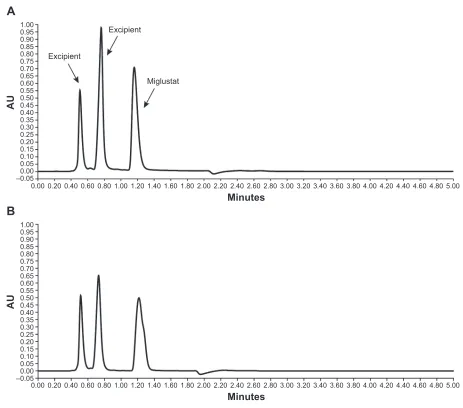
sus-pending vehicle was 4.7 at 0 hours and 4.7 and 4.9 after 14 and 28 days, respectively. No degradation was observed for any of the suspensions when tested by HPLC (see Figure 1 showing example chromatograms after 0 hours and 28 days for the 20 mg/mL suspension).
Microbiological challenge testing
Table 2 summarizes the log-numbers of the microorganisms tested for miglustat 20 mg/mL in InOrpha® suspending vehicle
adjusted to pH 4.4. For all bacteria, a reduction to the limit of detection of 1 cfu/mL (ie, 0 log number) was reached within 14 days and no increase was observed after 28 days. For C. albicans, a reduction to 5 cfu/mL was reached within 14 days followed by further reduction to the limit of detection of 1 cfu/mL after 28 days. A 1.76-log reduction was found for Z. rouxii after 14 days and a reduction to the limit of detec-tion of 1 cfu/mL was reached after 28 days. A. brasiliensis showed a 1.54-log reduction after 14 days and a reduction to the limit of detection was reached after 28 days.
Table 3 summarizes the log-numbers of the microorgan-isms tested for miglustat 5 mg/mL in InOrpha® suspending
vehicle. For S. aureus, P. aeruginosa, and E. coli, a reduction to the limit of detection of 1 cfu/mL was reached within 14 days and no increase was observed after 28 days. For
P. chlororaphis, a reduction to 5 cfu/mL was reached within 14 days with further reduction to 1 cfu/mL after 28 days. A 0.31-log reduction was observed for C. albicans after 14 days and a 1.45-log reduction was observed after 28 days compared with the at 14 days. For Z. rouxii, a reduction to 5 cfu/mL was reached within 14 days with further reduction to 1 cfu/ mL after 28 days. A. brasiliensis showed a 0.51-log reduction after 14 days and a further 1.78-log reduction after 28 days.
The test was also performed for pure InOrpha®
suspend-ing vehicle (data not shown). For S. aureus, P. aeruginosa,
E. coli, and Z. rouxii, a reduction to the limit of detection
of 1 cfu/mL was reached within 14 days and no increase was observed after 28 days. For P. chlororaphis and C. albicans, a reduction to 5 cfu/mL was reached within 14 days and no increase was observed after 28 days. A. brasiliensis showed a 0.78-log reduction after 14 days and a reduction to the limit of detection of 1 cfu/mL was reached within 28 days.
The three microbial studies demonstrate that none of the microorganisms tested showed any growth over the period of 28 days when stored under refrigerated conditions.
Table 1 Microbiological challenge testing of miglustat 20 mg/ml
in inOrpha® suspending vehicle over time (cfu/ml expressed as log10-numbers)
Microorganism Inoculum Time interval
0 hours 14 days 28 days
Staphylococcus aureus 3.42 2.94 0 0
Pseudomonas aeruginosa 3.15 3.15 0 0
Escherichia coli 2.19 3.66 0 0
Pseudomonas chlororaphis 2.97 3.60 4.01 2.68
Candida albicans 2.54 2.51 1.76 0
Zygosaccharomyces rouxii 2.59 2.48 1.04 0
Aspergillus brasiliensis 2.33 2.54 2.52 1.56
Drug Design, Development and Therapy downloaded from https://www.dovepress.com/ by 118.70.13.36 on 22-Aug-2020
Dovepress stability of miglustat in inOrpha® suspending excipient
Table 2 Microbiological challenge testing of miglustat 20 mg/ml
in inOrpha® suspending vehicle adjusted to ph 4.4 over time (cfu/ml expressed as log10-numbers)
Microorganism Inoculum Time interval
0 hours 14 days 28 days
Staphylococcus aureus 2.66 2.35 0 0
Pseudomonas aeruginosa 3.25 0.7 0 0
Escherichia coli 3.18 3.29 0 0
Pseudomonas chlororaphis 3.02 0.7 0 0
Candida albicans 2.60 2.75 0.7 0
Zygosaccharomyces rouxii 2.50 2.46 0.7 0
Aspergillus brasiliensis 2.48 2.54 1.00 0
Table 3 Microbiological challenge testing of miglustat 5 mg/ml
in inOrpha® suspending vehicle (cfu/ml expressed as log 10 -numbers)
Microorganism Inoculum Time interval
0 hours 14 days 28 days
Staphylococcus aureus 2.66 2.69 0 0
Pseudomonas aeruginosa 3.25 2.40 0 0
Escherichia coli 3.18 2.30 0 0
Pseudomonas chlororaphis 3.02 2.62 0.7 0
Candida albicans 2.60 2.71 2.40 0.95
Zygosaccharomyces rouxii 2.50 2.56 0.7 0
Aspergillus brasiliensis 2.48 2.57 2.08 0.30
A
Excipient
Excipient
Miglustat
AU
Minutes
1.00 0.95 0.90 0.85 0.80 0.75 0.70 0.65 0.60 0.55 0.50 0.45 0.40 0.35 0.30 0.25 0.20 0.15 0.10 0.05 0.00 –0.05
B
AU
1.00 0.95 0.90 0.85 0.80 0.75 0.70 0.65 0.60 0.55 0.50 0.45 0.40 0.35 0.30 0.25 0.20 0.15 0.10 0.05 0.00 –0.05
0.00 0.20 0.40 0.60 0.80 1.00 1.20 1.40 1.60 1.80 2.00 2.20 2.40 2.60 2.80 3.00 3.20 3.40 3.60 3.80 4.00 4.20 4.40 4.60 4.80 5.00
Minutes
0.00 0.20 0.40 0.60 0.80 1.00 1.20 1.40 1.60 1.80 2.00 2.20 2.40 2.60 2.80 3.00 3.20 3.40 3.60 3.80 4.00 4.20 4.40 4.60 4.80 5.00
Figure 1 chromatograms of 20 mg/ml miglustat in inOrpha® suspension at (A) 0 hours and (B) after 28 days at 2°c–8°c.
Furthermore, all organisms tested were reduced by at least 97% after 28 days.
Discussion
The presented results suggest that miglustat 5 mg/mL in InOrpha® suspension and miglustat 20 mg/mL in InOrpha®
suspension adjusted to pH 4.4 with citric acid are stable with regard to their physicochemical and microbiological proper-ties when stored and refrigerated (2°C–8°C) over the period of 4 weeks (28 days).
Based on HPLC analysis, there appears to be no degradates when miglustat is suspended in InOrpha® suspending vehicle.
Drug Design, Development and Therapy downloaded from https://www.dovepress.com/ by 118.70.13.36 on 22-Aug-2020
Drug Design, Development and Therapy
Publish your work in this journal
Submit your manuscript here: http://www.dovepress.com/drug-design-development-and-therapy-journal
Drug Design, Development and Therapy is an international, peer-reviewed open-access journal that spans the spectrum of drug design and development through to clinical applications. Clinical outcomes, patient safety, and programs for the development and effective, safe, and sustained use of medicines are a feature of the journal, which
has also been accepted for indexing on PubMed Central. The manu-script management system is completely online and includes a very quick and fair peer-review system, which is all easy to use. Visit http://www.dovepress.com/testimonials.php to read real quotes from published authors.
Dove
press
A brownish discoloration of miglustat 10 mg/mL and 20 mg/mL suspensions became evident after 9 days of refrigerated stor-age. This discoloration seemed to be a result of the higher pH of the 10 mg/mL and 20 mg/mL as it was not evident at the 5 mg/mL concentration or when miglustat 20 mg/mL suspension was adjusted to a similar pH of pure InOrpha®
suspending vehicle, ie, pH 4.4. Moreover, increasing the pH of pure InOrpha® suspending vehicle by addition of sodium
hydroxide also resulted in a brownish appearance after 9 days, suggesting that one or more excipients of the suspending vehicle undergo a change when exposed to a higher pH. It is not clear which excipient/excipients is/are responsible.
The microorganisms tested in this study represent a broad spectrum of potential manufacturing, nosocomial, and household contaminants, including gram-negative and gram-positive bacteria, common yeasts, and molds, as recom-mended per the European Pharmacopeia chapter 5.1.311 for
oral applications for antimicrobial effectiveness test. In addi-tion, the sugar tolerant yeast Z. rouxii, which is recommended for antimicrobial testing if carbohydrate concentrations are high, and the psychrotolerant (“refrigerator”-tolerant) bac-terium P. chlororaphis were included. The results from the microbiological challenge testing of all miglustat suspensions show that, when challenged with a low level of contamination by microorganisms, there was no proliferation in miglustat in InOrpha® suspending vehicle. It should be noted that
InOrpha® suspending vehicle does contain a preservative.
Conclusion
In conclusion, miglustat 5 mg/mL in InOrpha® suspension
and miglustat 20 mg/mL in InOrpha® suspension adjusted
to pH 4.4 appear to be stable with regard to their physico-chemical and microbiological properties for 28 days under refrigerated conditions.
Acknowledgments
Microbiological challenge testing was conducted by Hil-degard Haag and Klaus Haberer (Compliance GmbH), and funded by Actelion Pharmaceuticals Ltd. Medical writing support was provided by Dr Lisa Thomas from Elements
Communications Ltd, Westerham, UK, and funded by Actelion Pharmaceuticals Ltd. Editorial assistance was provided by Clemence Hindley from Fishawack Communi-cations GmbH, Basel, Switzerland, and funded by Actelion Pharmaceuticals Ltd. The authors would like to thank Pepijn Bink as well as Marcel Goverde (MGP Consulting GmbH) for helpful discussions, and Deborah Sansotera (Actelion) for her support with the analytical work.
Disclosure
All authors are employees of Actelion Pharmaceuticals Ltd, Allschwil, Switzerland, the manufacturers of miglustat. The authors report no other conflicts of interest in this work.
References
1. Zavesca® (miglustat) 100 mg hard capsules [webpage on the Internet]. Leatherhead: Dataphram; 2004. Available from: http://www.medicines. org.uk/EMC/medicine/13933/SPC/Zavesca+(miglustat)+100+mg+
hard+capsules/. Accessed October 22, 2013.
2. Futerman AH, Sussman JL, Horowitz M, Silman I, Zimran A. New directions in the treatment of Gaucher disease. Trends Pharmacol Sci. 2004;25(3):147–151.
3. Wraith JE, Imrie J. New therapies in the management of Niemann-Pick type C disease: clinical utility of miglustat. Ther Clin Risk Manag. 2009; 5:877–887.
4. Patterson MC, Hendriksz CJ, Walterfang M, et al. Recommendations for the diagnosis and management of Niemann-Pick disease type C: an update. Mol Genet Metab. 2012;106(3):330–344.
5. Moyses C. Substrate reduction therapy: clinical evaluation in type 1 Gaucher disease. Philos Trans R Soc Lond B Biol Sci. 2003;358(1433): 955–960.
6. Ichikawa S, Hirabayashi Y. Glucosylceramide synthase and glycosphin-golipid synthesis. Trends Cell Biol. 1998;8(5):198–202.
7. European Medical Agency. Zavesca® EPAR, Scientific Dis-cussion. London: European Medical Agency; 2005. Available from: http://www.ema.europa.eu/docs/en_GB/document_library/ EPAR_-_Scientific_Discussion/human/000435/WC500046721.pdf. Accessed October 22, 2013.
8. Bourget P, Amin A, Vidal F, et al. Physicochemical and microbiological stabilities of hydrocortisone in InOrpha suspending agent studied under various conditions. Int J Pharm Compd. 2014;18(5):427–431. 9. Zerbit J, Bordenave J, Benoit G. Physicochemical and
microbiologi-cal stability studies of a melatonin oral suspension in a commercially available vehicle for paediatric use. Eur J Hosp Pharm Sci Pract. Epub 2014 Sept 22.
10. Chapter 2.6.12. In: European Pharmacopoeia. 7th ed. Strasbourg: The EDQM Council of Europe.
11. Chapter 5.1.3. In: European Pharmacopoeia. 7th ed. Strasbourg: The EDQM Council of Europe.
Drug Design, Development and Therapy downloaded from https://www.dovepress.com/ by 118.70.13.36 on 22-Aug-2020