Available Online atwww.ijcsmc.com
International Journal of Computer Science and Mobile Computing
A Monthly Journal of Computer Science and Information Technology
ISSN 2320–088X
IJCSMC, Vol. 4, Issue. 7, July 2015, pg.438 – 445
RESEARCH ARTICLE
A HYBRID DIFFERENTIAL EVOLUTION
METHOD FOR THE DESIGN OF HIGH
PASS DIGITAL FIR FILTER
Rajni
1, Balraj Singh
21,2Department of Electronics and Communication Engineering, Punjab Technical University, Giani Zail Singh
Campus, Bathinda-151001, India
1
[email protected]; 2 [email protected]
Abstract— This paper introduces a stochastic evolutionary algorithm known as hybrid Differential Evolution (DE) for the design of digital High pass FIR filter. It combines the features of both the basic DE and exploratory move for the fine tuning of DE parameters locally as well as globally in the promising search area. A multi-objective function having different performance requirements of minimum magnitude error and minimum pass band and stop band ripples is created to obtain the desired high pass digital FIR filter as close as possible to the ideal FIR filter. From the simulation results, it is confirmed that the proposed algorithm gives more accurate and better results.
Keywords— Digital Signal Processing (DSP), Finite Impulse Response (FIR) Filter, Differential Evolution (DE), exploratory move
I. INTRODUCTION
Digital signal processing (DSP) is the mathematical manipulation of an information signal to modify or to improve it [1]. The objective of DSP is to measure and filter the analog signals. The first step is to convert the analog signal into digital form, then sampling and digitizing it by using an analog to digital converter (ADC). After applying signal processing techniques and algorithms using digital signal processor the digital signal is converted back to analog form by using digital to analog converter (DAC). The digital signal processor may be composed of resistors, capacitors or integrated circuits to accomplish a more difficult task. The applications of digital signal processing are more accurate, less sensitive to tolerances of component values, easily transported, independent of temperature, ageing and other external parameters. DSP is mainly used in audio and video signal processing, seismology, biomedicine and filter applications.
components such as ADC, digital signal processor and DAC. Digital filters are usually software based, have better signal-to-noise ratio, definite filter coefficients and flexible [2].
There are two fundamental types of digital filters based on their impulse response: Finite impulse response (FIR) and Infinite impulse response filters (IIR) [3]. IIR filters are the filters whose impulse response extends over an infinite duration of time. The values of the output samples depend on present and past inputs and past outputs. So these are also known as recursive or feedback filters. But FIR filters have impulse response of only finite duration and the output is the function of only previous and present input samples, not of the past outputs. So they are known as non-recursive or feed forward filters. It is always possible to design an FIR filter transfer function with an exact linear-phase response, while it is nearly impossible to design a linear-phase IIR filter transfer function [4]. So this paper concentrates on the design of High pass digital FIR filter owing to its many advantages over IIR filters.
Various techniques to design digital FIR filters are: window method, frequency sampling and optimization. Window method is used to change infinite non causality sequence into finite impulse response sequence [5]. First, a proper ideal frequency selective response is chosen and then it is truncated to obtain the desired FIR filter. This method is most commonly used due to its simplicity and efficiency. The designing of filters using frequency sampling method is very easy but the designed filter has small attenuation in stop band and suffers from a lack of control over the frequency domain characteristics [5]. The frequency sampling methods give errors at the point where it is not sampled. So to overcome these drawbacks, Optimization technique is used for the remaining points.
Manira Khatun (2014) implemented new window function based on the Blackman window function for the design of FIR digital filter. This window function results in increased main lobe width by reducing transition width. But the ripples also increased [6]. Aggarwal et. al. (2012) implemented Hamming window method, Parks-McClellan method and Genetic Algorithm (GA) for the design of Low pass digital FIR filter. It has shown that filter design using GA is best because of its less transition bandwidth, small amount of ripples in pass band and stop band and better phase response as compared to other techniques. Most of the zeroes lie inside the unit circle due to which the phase delay is minimum [7]. Vijay. P et. al. (2012) implemented Particle Swarm Optimization (PSO) for low pass FIR filter design and compared it with various window methods. This method is superior to window method in terms of its fast convergence speed and minimum error. It is also better than GA in terms of complexity due to the absence of operators like mutation and crossover [8]. Kumar et. al. (2013) presented the hybrid of GA and PSO for low pass FIR filter which is better than individual GA and PSO in terms of efficiency as well as numerical stability. But if the initial parameters are not chosen correctly due to any reason, then it results in trapping in local minima [9]. So to overcome these drawbacks, Differential Evolution is used in this paper.
DE algorithm was firstly introduced by Storn and Price in 1995. It can be applied for nonlinear, non differentiable and non-convex functions. It provides the advantage of few control parameters and can find the global minimum independent of the initial parameter values. It uses the basic operators of evolution like mutation, crossover and selection as in GA. But the control parameters are less than that in GA which are: Population Size, Mutation Factor and Crossover Rate. Different mutation strategies are available for evolution in DE. This paper focuses on the design of High pass digital FIR filter using Hybrid DE which simultaneously explores and exploits the search space. The minimum magnitude error, pass band and stop band ripples are achieved by optimizing the filter coefficients.
The rest of the paper is structured into four sections. Section II illustrates the problem formulation for the High pass digital FIR filter design. Section III explains the detailed methodology for Hybrid DE which gives the mechanism of basic DE and exploratory move. The Section IV depicts the simulation results for the High Pass FIR filter. Finally, the conclusion is specified in Section V.
II. PROBLEM FORMULATION FOR HIGH PASS DIGITAL FIR FILTER
FIR filters are digital filters with finite impulse response. They are also known as non-recursive digital filters as they do not have the feedback i.e. a recursive part of a filter. For the phase characteristic of a FIR filter to be linear, the impulse response must be symmetric or anti-symmetric, which is expressed in the following way:
symmetric impulse response
anti-symmetric impulse response
The difference equation for digital FIR filter is as below:
The order of the filter is N, while the length of the filter (which is equal to the number of coefficients) is N + 1.
The transfer function of digital FIR filter is given as:
∑
Where
is the frequency domain representation of impulse response and
is the time domain representation of impulse response. N is the order of the filter.
For a digital High pass FIR filter the ideal response is defined as:
(
) {
The performance of High pass digital FIR filter is evaluated by using -normand -norm approximation error of magnitude response and ripple magnitude of both pass-band and stop-band. The High pass digital FIR filter is designed by optimizing the filter coefficients.
For optimization, we have to minimize the -norm approximation error function. -norm is expressed as :
{∑
}
⁄where
is the desired magnitude response of the ideal digital FIR filter and
is the obtained
magnitude response of the FIR filter.
For p=1, magnitude error denotes the -norm error which is stated below:
∑
For p=2 magnitude error denotes the -norm error which is given as:
{∑
}
⁄
The desired magnitude response
of high pass digital FIR filter is given as :
{
The ripple magnitude of pass band and stop band is expressed as :
{
} {
}
{
}
Four objective functions for optimization are:
The multi objective function is converted into single objective function :
where
are the weighting functions.
III.HYBRID DIFFERENTIAL EVOLUTION
be implemented very easily and it requires negligible parameter tuning, which has made the algorithm reasonably popular. DE algorithm includes four steps namely initialization, mutation, crossover and selection. A. Parameter Selection
The optimization performance depends largely on the selection of control parameters such as population size (P), boundary constraints of population, mutation factor (fm), crossover rate (CR) and maximum number of
iterations (Tmax). This algorithm always starts with the population size (P) which remains same throughout the
entire execution process. Each population vector is D-dimensional where D is the number of filter coefficients. The whole population is represented in the form of matrix .
B. Initialization
Initially, the values associated with the population vector are selected randomly according to uniform probability distribution within the range [0,1]. But the entire search space should be covered. Let denote the
element of the member of population at current iteration. This value is chosen within a certain limit
according to the following relation:
where and are lower and upper limits of the random variable respectively.
Individuals are generated within the specified limits according to the following equation:
(
)
where rand() is the values of random numbers lying in the range [0,1]. C. Mutation
Mutation expands the entire search space. It is the process of creating a new vector from the existing population by adding weighted difference of two or more vectors to any other vector. For the generation of resultant or mutant vector, different mutation strategies exist out of which five are listed below:
(
)
(
)
(
)
(
)
(
)
(
)
where R1,R2, R3, R4,R5 are randomly chosen indices from the population, which are different from index i,is a mutation control parameter, is a coefficient responsible for the level of recombination.
represents the mutant vector.
D. Recombination
Successful solutions from the previous generations are incorporated in the third step called cross-over or recombination. The process of recombination plays a very important role in order to enhance the diversity of the population. The components of target vector are mixed with donor vector to produce trial vector. The crossover probability CR controls the fraction of parameters values that are copied from the mutant vector.
{
(
)
(
)
Where
and
indicates the trial vector.
is the evaluation of a uniform random number generation with [0,1].
is the crossover rate within [0,1].
E. Selection
This is the final step of the DE algorithm. To decide whether or not the trial vector will be a member of the next generation, it is compared with the target vector. If the trial vector yields smaller objective function than the target vector, then it will be a part of next generation. Otherwise, the existing target vector will be preserved. The algorithm will continue until any stopping criterion is arrived.
{
( (
) (
))
F. Exploratory move
Hooke and Jeeves performed two types of moves: Exploratory move and pattern search method. The exploratory move obtains the information about any function in the neighbourhood of the current base point. The search directions are created iteratively in such a way that they completely span the search space [10]. Then the best point is perturbed in the positive and negative directions along the created search directions. The exploratory move is a success when the small value of objective function is obtained in any of the perturbed directions and the current base point is updated along it. But it is a failure if the value of the objective function is not improved and the current base point remains unchanged. The current point indicating filter coefficientsis perturbed as follow:
{
D represents number of variables.
The value of the objective function
is calculated as below:
{
When all the filter coefficients are explored and minimum value of the objective function is found, the algorithm stops.
IV.RESULTS AND DISCUSSION
The multi-objective design of High pass digital FIR filter using the Hybrid Differential Evolution optimization technique is considered in this paper. This section represents the work performed for the design of FIR high pass filter.
The high pass digital FIR filter is designed by setting 200 equally spaced points within frequency domain [0, ]. FIR filter is to be designed with the initial conditions described in Table I.
Table I: Design conditions for High Pass digital FIR filter
FILTER TYPE PASS BAND STOP BAND MAX VALUE OF
x
H
,
High Pass
1
The high pass FIR digital filter is designed by using hybrid differential evolution algorithm with different mutation strategies. After that various parameters like order of filter, population size, mutation factor and crossover rate are varied. DE parameters used for design of FIR high pass filter are given in Table II.
Table II: DE algorithm Parameters
PARAMETER PARAMETER VARIATION
RANGE
OPTIMIZED PARAMETERS
Filter Order 20-50 42
Population Size 60-140 120
Mutation Factor 0.5-1.0 0.8
Crossover Rate 0.1-0.5 0.30
yields minimum objective function which also fulfills the objective of this paper. So the design of high pass digital FIR filter is performed at filter order 42 which results in only half number of filter coefficients i.e. 22 due to symmetry property. After that, population size is varied from value 60 to 140 for mutation strategy 4 and filter order 42. The best population is obtained at 120. This population is selected to design digital high pass FIR filter having objective function value of 0.904886. The mutation factor is varied from 0.5 to 1.0 for population size 120, mutation strategy 4 at order 42. The minimum value of objective function is found at 0.8 mutation factor. The crossover rate value is varied from 0.10 to 0.50 at 0.8 mutation factor. The minimum objective function is obtained at 0.30 which is selected to design High pass FIR digital filter.
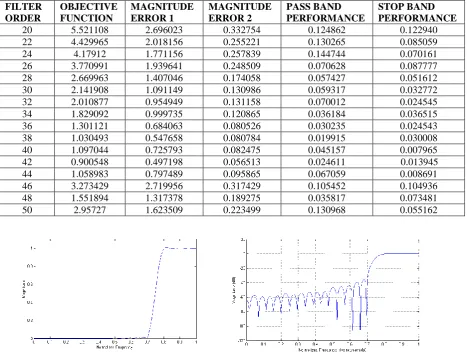
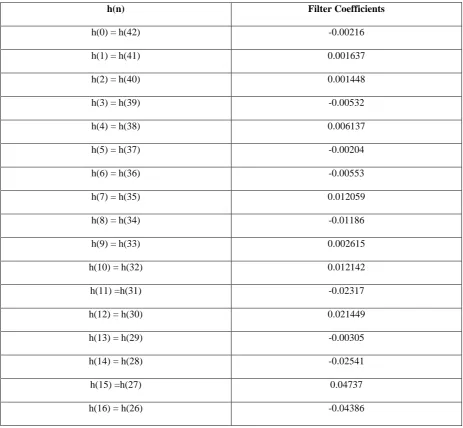
The variation in magnitude with respect to Normalized frequency has been drawn in Fig. 1 for order 42 of High Pass FIR filter. The Fig. 2 shows the graph between Magnitude Response in dB and normalized frequency to design High pass digital FIR filter and Fig. 3 shows the graph between Phase Response and normalized frequency of order 42 to design High pass FIR filter. Obtained filter coefficients are given in Table IV. Table V depicts the Statistical data for order 42 which shows minimum value, maximum value, average value and standard deviation of the objective function.
Table III: Design results of High Pass digital FIR Filter for different orders
FILTER ORDER
OBJECTIVE FUNCTION
MAGNITUDE ERROR 1
MAGNITUDE ERROR 2
PASS BAND PERFORMANCE
STOP BAND PERFORMANCE
20 5.521108 2.696023 0.332754 0.124862 0.122940 22 4.429965 2.018156 0.255221 0.130265 0.085059 24 4.17912 1.771156 0.257839 0.144744 0.070161 26 3.770991 1.939641 0.248509 0.070628 0.087777 28 2.669963 1.407046 0.174058 0.057427 0.051612 30 2.141908 1.091149 0.130986 0.059317 0.032772 32 2.010877 0.954949 0.131158 0.070012 0.024545 34 1.829092 0.999735 0.120865 0.036184 0.036515 36 1.301121 0.684063 0.080526 0.030235 0.024543 38 1.030493 0.547658 0.080784 0.019915 0.030008 40 1.097044 0.725793 0.082475 0.045157 0.007965 42 0.900548 0.497198 0.056513 0.024611 0.013945 44 1.058983 0.797489 0.095865 0.067059 0.008691 46 3.273429 2.719956 0.317429 0.105452 0.104936 48 1.551894 1.317378 0.189275 0.035817 0.073481 50 2.95727 1.623509 0.223499 0.130968 0.055162
Fig. 3: Plot of Phase Response in dB vs. Normalized Frequency
Table IV: Filter coefficients obtained for designing High pass digital FIR filter.
h(n) Filter Coefficients
h(0) = h(42) -0.00216
h(1) = h(41) 0.001637
h(2) = h(40) 0.001448
h(3) = h(39) -0.00532
h(4) = h(38) 0.006137
h(5) = h(37) -0.00204
h(6) = h(36) -0.00553
h(7) = h(35) 0.012059
h(8) = h(34) -0.01186
h(9) = h(33) 0.002615
h(10) = h(32) 0.012142
h(11) =h(31) -0.02317
h(12) = h(30) 0.021449
h(13) = h(29) -0.00305
h(14) = h(28) -0.02541
h(15) =h(27) 0.04737
h(17) = h(25) 0.003155
h(18) = h(24) 0.070603
h(19) =h(23) -0.15717
h(20) = h(22) 0.226645
h(21) -0.25324
Table V: Maximum, Minimum, Average value of objective function and Standard Deviation
Filter Type Maximum Value Minimum Value Average Value Standard deviation
High Pass 0.960612 0.908638 0.930982 0.011267
From the above results it is observed that the designed high pass digital FIR filter yields minimum value of – norm and
– norm magnitude error, pass-band and stop band ripples.
V. CONCLUSIONS
The Hybrid DE is used to design the High pass digital FIR Filter by varying the various control parameters. The first five mutation strategies have been applied for different filter orders. On the basis of above results it can be concluded that it gives satisfied results for the filter order 42 at mutation strategy 4. Simulation results show better performance of the proposed algorithm in terms of magnitude error, maximum pass band and stop band performance. It is concluded that the maximum value, minimum value, average values of objective functions are 0.960612, 0.908638 and 0.930982 respectively. The achieved value of standard deviation is less than 1 which authenticates the robustness of the designed filter. Thus proposed algorithm is a useful tool for design of high pass FIR digital filter. The hybrid DE technique further can be extended to design low pass, band pass and band stop filters.
REFERENCES
[1] John G. Proakis and Dimitris G. Manolakis,”Digital Signal Processing,” Pearson Education Limited, fourth edition, 2013. [2] Amanjeet Panghal, Nitin Mittal, Devender Pal Singh, R.S. Chauhan, Sandeep K. Arya,” Comparison of Various
Optimization Techniques for Design FIR Digital Filters”, National Conference on Computational Instrumentation(NCCI),
CSIO Chandigarh, pp. 177-181, March 2010.
[3] Karamjeet Singh, Navdeep Kaur,”Design of Digital FIR Filters Using Differential Evolution Algorithm Based on
Reserved Genes”,International Journal of Advanced Research in Computer Science and Software Engineering, vol. 4, issue
7, pp. 813-819, July 2014
[4] S. Chattopadhyay, S.K. Sanyal and A. Chandra,” Design of FIR Filter Using Differential Evolution Optimization & to
Study its Effect as a Pulse-Shaping Filter in a QPSK Modulated System”, International Journal of Computer Science and
Network Security (IJCSNS), vol.10, no.1, pp. 313-321, January 2010
[5] Mukesh Kumar, Rohit Patel, Rohini Saxena, Saurabh Kumar,”Design of Bandpass Finite Impulse Response Filter Using
Various Window Method”, International Journal of Engineering Research and Applications, vol. 3, issue 5, pp. 1057-1061,
2013.
[6] Manira Khatun,” Implement a New Window Function and Design FIR Filter by using this New Window”, International
Journal Of Engineering And Computer Science, vol. 3, issue 3 , pp. 4087-4090, 2014.
[7] Sonika Aggarwal, Aashish Gagneja, Aman Panghal ,”Design of FIR Filter using GA and its Comparison with Hamming
Window and Parks McClellan Optimization Techniques”, International Journal of Advanced Research in Computer Science
and Software Engineering, vol. 2, issue 7, July 2012.
[8] Vijay. P, M. Venkata Sudhakar,”Comparison of Various FIR Low Pass Filter Design Techniques with PSO Algorithm”,
International Journal of Advanced Research in Computer and Communication Engineering, vol. 1, issue 9, pp. 679-682, November 2012.
[9] Yadwinder Kumar, Priyadarshni,” Design of Optimum Digital FIR Low Pass Filter Using Hybrid of GA & PSO
Optimization”, International Journal of Advanced Research in Computer Science and Software Engineering, vol. 3, issue 9,
pp. 685-692, 2013.
[10] G.S KIRGAT, A.N Surde,” Review of Hooke and Jeeves Direct Search Solution Method Analysis Applicable To
Mechanical Design Engineering”, International Journal of Innovations in Engineering Research and Technology (IJIERT),