© 2019, IRJET | Impact Factor value: 7.34 | ISO 9001:2008 Certified Journal
| Page 1358
Study on the Effect of the Concentric Brace and Lightweight Shear Steel
Wall on Seismic Behavior of Lightweight Steel Structures
Hossein Alimohammadi
1, Mohammadali Lotfollahi Yaghin
21
Ph.D. Student, Civil, Construction and Environmental Engineering Department, Iowa State University, Iowa, USA
2
Professor, Civil Engineering Department, Tabriz University, East Azerbaijan, Iran
---***---Abstract -
In this study, the seismic behavior of light steelframe structures has been studied by two lateral diagonal load bracing resistant systems and lightweight steel shear walls. In this regard, a number of the shear panels in the two-dimensional form as an alternative to a lateral resistance system have been modeled and analyzed with the same qualities. Modeling has been done by the SAP Software, and the coefficient of hardness, added resistance coefficient, ultimate deformation, final strength level, base shear coefficient, and other seismic behavior factors was compared to various shear panels. The results indicated suitable seismic performance and behavior for this type of structures, but lightweight steel-framed (LSF) shear walls’ behavior was more favorable and desirable than the diagonal bracing.
Key Words: Light Steel Frame (LSF), Diagonal bracing, Lightweight steel shear wall, Seismic behavior, Cold-formed
1. INTRODUCTION
Using Light Steel Frame (LSF) structures have been extensively applied in industrial production of commercial, residential, and office buildings, due to its role in lightening the structures in comparison with the conventional systems of construction around the world these days. This method started in developing countries as an alternative to replace traditional methods of construction and provide extensive applications [1]
In this study, the effect of seismic behavior of light steel frame has been studied by two lateral diagonal load bracing resistant systems and lightweight steel shear walls and several shear panels in the two-dimensional form as an alternative to a lateral resistance system with the same qualities have been modeled and analyzed. Modeling was performed by the SAP software, and the results of resistance and other seismic behavior parameters were compared to the panels and also due to the new standard "code-style of design and implementation of the structural lightweight steel frame (LSF) " [2]. In particular, this research can lead to understanding and further develop this type of structures.
The study assumed different types of resisting lateral and diagonal bracing cold rolled steel that has different effects on the building with shear walls light steel frame systems (from flexibility, ultimate load, hardness, etc.).
2- Basics of Design Theory and Method
The behavior of structural members according to the curve of force - deformation under a controlled force or controlled deformation can be classified by force and are introduced based on three different behaviors including deformable, semi-deformable and brittle behavior. Deformable behavior is a kind that its structure in that area is elastic, but brittle behavior is that structures are low with great difficulty and the distance between the stress and the yield [3].
[image:1.595.312.560.385.538.2]Deformable structures where the gap between the end and yield stress is high, and structures in the elastic area will continue.In Fig-1, the pushover curve load-shift is shown.
Fig -1: Pushover load-displacement curve of a sample of structures [3]
Pushover analysis is an analysis of the structure under lateral loads increasing and determining diagrams of load - shift with a curve of the structural capacity of the quantities of base shear and lateral displacement that is usually used a reference level point for drawing the graph.
© 2019, IRJET | Impact Factor value: 7.34 | ISO 9001:2008 Certified Journal
| Page 1359
µ = ∆ max / ∆ y Eq. (1)Added resistance coefficient of the shear panel is a factor of resistance in most structural design codes, and a structure is tolerated more than designed resistance, and it is the ratio of ultimate strength to yield strength panel that could be defined as Eq. (2):
𝛺 = Vu / Vy Eq. (2)
3- Analyze of designing Panels in SAP2000 software
[image:2.595.307.556.246.395.2]SAP2000 Program, as a general software application, with the most advanced two-dimensional [4] and three-dimensional structural analysis methods, was used for pushover analysis. According to the capabilities of the SAP2000 Program in static pushover analysis, the user can do this type of analysis as a simple and quick for two-dimensional [5] and three-two-dimensional structures based on the evidence presented in FEMA-273 and ATC-40 [6]. In Fig-2, the three-dimensional image of the model and output of pushover diagram is presented in SAP2000 Software.
Fig -2: Frame has designed in software with the
output curve results of a pushover
It is worth mentioning that the lateral behavior of diagonal bracing and shear walls panel were compared by the steel frame of the lateral shear resistant system and how to connect two systems. According to the results of research conducted by previous researchers, since holes, less than 4 percent are effective on the resistance of the frame. Thus, it affects to facilitate the modeling of all members of the panel without holes and models in this study.
4-Shear Panel Analysis in Software
In this section, the modeling and charting a pushover shear panel, and the physical properties of the LSF system will be examined.
4.1 Dimensions and Mechanical Properties in
Modeling Frames
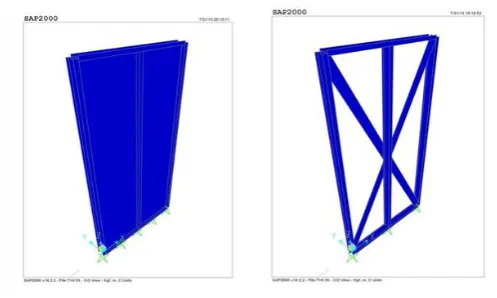
As indicated in Fig-2, a two-dimensional frame of structures which represents lateral load system in that direction is modeled, and a selected sample is modeled in a laboratory by Cheng Yu [7], and SAP2000 Software and the results are compared. As can be seen in Fig-3, the structure has two openings at intervals of 0.61 m and a height of 2.44 m with parallel clamps in the middle which have fixed connections and lateral roller staddle at the junction of staddles to the rolling pin.
Fig -3: View of the shear frame with the lateral resisting system was designed in the software
[image:2.595.38.288.356.517.2]Table-1 has indicated the values of the modulus elasticity, Poisson's ratio, and yield stress of the frame sections and diagonal bracing lateral load resisting system and shear walls of the lightweight steel frame (LSF).
Table -1: material properties of sections
No. Section names E (Mpa) Poisson's
ratio Fy (MPa)
1 STUD 203,000 0.3 230
2 TRACK 203,000 0.3 230
3 BRACE X 203,000 0.3 230
4 STEEL WALL 203,000 0.3 230
[image:2.595.302.567.515.606.2]Table-2 has illustrated the dimensions of the staddles and the tracks used in this study that are identical in all cases.
Table -2: Dimensions of the staddles and the tracks
No. Section names Flange width, bf
(mm)
Section depth, D
(mm)
Length of edge (mm)
1 STUD 41.3 88.9 12.7
[image:2.595.300.568.671.743.2]© 2019, IRJET | Impact Factor value: 7.34 | ISO 9001:2008 Certified Journal
| Page 1360
Table 3 has shown the height and width of the shearframe with naming the different sections and thickness of lateral load resistant system.
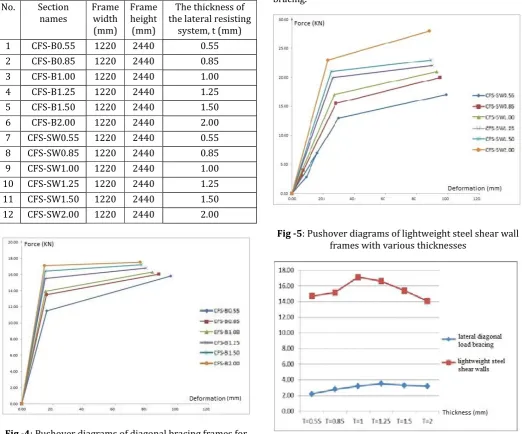
Fig-4 has illustrated the analysis results of the pushover diagrams for diagonal bracing frames with different thickness in one graph.
[image:3.595.35.558.262.696.2]Fig-5 has indicated the analysis results of pushover diagrams for cold-rolled shear wall frames with various thicknesses in one graph as well.
Table -3: height and width of the shear frame with naming the different sections and thickness
No. Section
names Frame width (mm)
Frame height (mm)
The thickness of the lateral resisting
system, t (mm)
1 CFS-B0.55 1220 2440 0.55
2 CFS-B0.85 1220 2440 0.85
3 CFS-B1.00 1220 2440 1.00
4 CFS-B1.25 1220 2440 1.25
5 CFS-B1.50 1220 2440 1.50
6 CFS-B2.00 1220 2440 2.00
7 CFS-SW0.55 1220 2440 0.55
8 CFS-SW0.85 1220 2440 0.85
9 CFS-SW1.00 1220 2440 1.00
10 CFS-SW1.25 1220 2440 1.25
11 CFS-SW1.50 1220 2440 1.50
12 CFS-SW2.00 1220 2440 2.00
Fig -4: Pushover diagrams of diagonal bracing frames for different thickness
According to the pushover diagrams of case studies in this research, the following analysis could be developed:
4.2 Deformability and Hardness
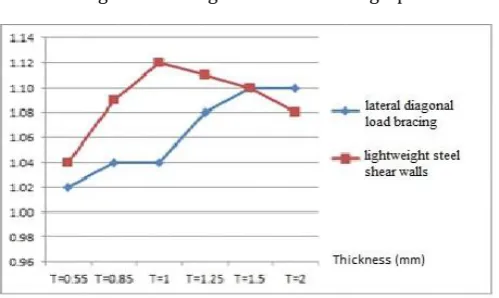
Fig-6 offered the comparison chart of deformability factor of lightweight steel shear wall frames with diagonal bracing, and Fig-7 indicated the comparison chart of the hardness of frames with diagonal bracing and lightweight steel shear walls.
4.3 Ultimate load and gain strength
Figure 8 offered a comparison chart of increasing the ultimate load of frames with diagonal bracing and lightweight steel shear walls, and Figure 9 presented comparison chart of gain strength and cold rolled shear wall frame with diagonal bracing.
Fig -5: Pushover diagrams of lightweight steel shear wall frames with various thicknesses
[image:3.595.303.559.275.471.2]© 2019, IRJET | Impact Factor value: 7.34 | ISO 9001:2008 Certified Journal
| Page 1361
Fig -7: Hardness of the frames graphFig-8 Increasing the ultimate load graph
Fig-9 Gain strength graph
4.4 Average values
Table 4 compared the average coefficients of deformability, hardness, ultimate load, and added resistance in the frames with diagonal bracing and lightweight steel shear walls.
Table -4: The average values
Description numerical values (concentric brace/shear wall)
shear steel
wall
concentric brace
Deformability 4.89 15.4 3.15
Hardness 12.49 3.5 0.28
ultimate load 1.1 16.81 15.41
gain strength 1.02 1.09 1.07
5- Conclusions
In lightweight steel frame (LSF) panels, lightweight steel shear walls or diagonal bracing or other adverse allowable bearing systems in accordance with the regulations of " lightweight steel frame (LSF) Design and Construction". The main components of lateral diagonal bracing in lightweight steel shear walls LSF are with other aforementioned lateral load resisting systems that lateral behavior, in general, is dependent on the performance of the components, the lateral load applied to the panel are tolerated by tensile and frame performance of vertical and horizontal members of the panel. Meanwhile, the system is much more resistant to the lateral portion of the lateral load, if the under lateral loads, lateral load resisting system has a larger portion to tolerate the tension without serious damage to other parts of the panel, desirable behavior of the panel will be observed. In this regard, the materials of lateral load resistant system than other members of the panel, especially in the vicinity of the border areas are considered such a weak connection. Given that the seismic behavior of structures to a large extent depends on the type and resistance of structural connections. The seismic design should be submitted to the lateral resisting system.
By definition, the maximum ratio of shift to shift yielding place, deformability of system, the maximum load ratio to yielded load is once called, by averaging accordance with the comparison table and the corresponding addition of resistance and area under the pushover curve of load-shift indicate that the statistical results of increasing the shear wall thickness lightweight steel frame (LSF) to diagonal bracing lead to see an increase in deformability equal 4.89, an increase of 12.49 times in difficulty, an increase 1.1 times in the final load, and increase 1.02 times in added resistance.
[image:4.595.36.286.472.621.2]© 2019, IRJET | Impact Factor value: 7.34 | ISO 9001:2008 Certified Journal
| Page 1362
According to the presented results, cross bracing, andcold-formed steel (CFS) framed shear walls performance in a thickness of about half or two-thirds thickness of the staddles and tracks in these structures, and the panel recommended deformable behavior.
According to Table-4 the regulation of " design and implementation of lightweight steel frame (LSF)" for lightweight steel walls with diagonal bracing belt, multiplier factor of 4 and resistance 2 (with a maximum height of the structure 15 meters) in all seismicity zone as well as the lightweight steel walls that are covered with steel plates, the coefficient of 5.5 and coefficient of resistance 3 (with a maximum height of the structure 15 meters) in all zones of seismicity, and this also confirms the good performance of this type of structures (short and mid-rise structures).
REFERENCES
[1] S. Mashhadifarahani, “Light Weight Steel Frames vs. Common Building Structures - Structural Performance Evaluation,” Am. Sci. Res. J. Eng. Technol. Sci., vol. 12, no. 1, pp. 222–229, 2015.
[2] K. Abubakri, “Investigation of the Behavior of Steel Shear Walls Using Finite Elements Analysis,” vol. 6, no. 5, pp. 1155–1157, 2016.
[3] Y. Mondet and U. Bumann, “Pushover Analysis for the Assessment of Seismic Safety Margins of Auxiliary Buildings,” SMiRT 19, pp. 1–8, 2007.
[4] H. Alimohammadi, “Finite element analysis of a Piezoelectric layered plate with different materials,”
Int. J. Eng. Appl. Sci., vol. 6, no. 7, 2019.
[5] H. Alimohammadi and M. Abu-Farsakh, “Finite Element Parametric Study on Rutting Performance of Geosynthetic Reinforced Flexible Pavements,”
Transp. Res. Board, vol. 98, 2019.
[6] M. C. Constantinou, I. Kalpakidis, A. Filiatrault, and R. a E. Lay, “LRFD-Based Analysis and Design Procedures for Bridge Bearings and Seismic Isolators,” Mceer, vol. MCEER-11-0, no. 65, pp. 1–371, 2011.
[7] C. Yu, “Shear resistance of cold-formed steel framed shear walls with 0.686 mm, 0.762 mm, and 0.838 mm steel sheet sheathing,” Eng. Struct., vol. 32, no. 6, pp. 1522–1529, Jun. 2010.
BIOGRAPHIES
Hossein Alimohammadi has M.SC. in Earthquake Engineering and currently is Geotechnical engineering Ph.D. student at Iowa State University, Iowa, USA.
![Fig -1: Pushover load-displacement curve of a sample of structures [3]](https://thumb-us.123doks.com/thumbv2/123dok_us/9311466.432835/1.595.312.560.385.538/fig-pushover-load-displacement-curve-sample-structures.webp)