IJEDR1604056
International Journal of Engineering Development and Research (www.ijedr.org)367
Optimization of Automatic voltage regulator using
Moth Flame optimization algorithm
Ajay Dixit, Mahesh Lokhande, Pragati joshi
1Electrical Department,
Jawaharlal Institute of Technology, Borawan , M.P.
________________________________________________________________________________________________________
Abstract - The various optimization techniques are in use for optimization of electrical system before its installation in the field. Due to various parameter dependencies some time it is difficult to use the conventional methods for the optimization of the system. The evolutionary algorithm becomes the solution for multi parameter and multi objective case of optimization. The most popular evolution algorithms are genetic algorithm, particle swarm optimization, big bang big crunch algorithm, ant colony optimization. Etc. In this paper, the use of moth flame algorithm is described for the optimization of the PID controller of automatic voltage regular. The PID coefficients are initially chosen randomly and within little iteration this method of optimization reaches to the better solution. The integral of error signal and maximum error are considered for the fitness function for optimization.
IndexTerms - MFO, GA, PSO, optimization, AVR etc.
________________________________________________________________________________________________________
I.INTRODUCTION
A voltage regulator is designed to automatically maintain a constant voltage level. Depending on the design, it may be used to regulate one or more AC or DC voltages. The role of an AVR is to keep constant the output voltage of the generator in a specified range. Simple AVR consists of amplifier, exciter, generator and sensor. The block diagram of AVR with PID controller is shown in Figure 2. Theory of particle swarm optimization (PSO) and moth flame optimization (MFO) has been growing rapidly. PSO has been used by many applications of several problems. There are three coefficients: proportional coefficient, differential coefficient, and integral coefficient in the PID controller.
It was developed through simulation of a simplified social system, and has been found to be robust in solving continuous nonlinear optimization problems. The moth flame optimization technique can generate a high-quality solution within shorter calculation time and stable convergence characteristic than other stochastic methods.
This is due to the inefficiency of the transverse orientation, in which it is only helpful for moving in straight line when the light source is very far. When moths see a human-made artificial light, they try to maintain a similar angle with the light to fly in straight line. Since such a light is extremely close compared to the moon, however, maintaining a similar angle to the light source causes a useless or deadly spiral fly path for moths [2].
II.LITERATURE REVIEW
Snigdha Priyambada et.al, [1], study in this paper, the analysis of Automatic Voltage Regulator (AVR) using proportional-integral-derivative controller optimized by Teaching Learning Based Optimization method. The optimum gain of the controller for the proposed model is obtained with objective function as Integral Time Absolute Error. Performance of the system is found to be better in every aspect in terms of the settling point, peak overshoot. The transient response analysis and robustness analysis of the AVR system tuned by TLBO algorithm is documented profitably.
Leandro dos Santos Coelho, [2], in this paper, , a tuning method for determining the parameters of PID control for an automatic regulator voltage (AVR) system using a chaotic optimization approach based on Lozi map is proposed. Since chaotic mapping enjoys certainty, ergodicity and the stochastic property, the proposed chaotic optimization introduces chaos mapping using Lozi map chaotic sequences which increases its convergence rate and resulting precision. The COLM methodologies were successfully validated for tuning of PID controller for the AVR system about six different operational conditions. From the case studies and comparison of the results through five tested COLM approaches, it has been show that the parameter of step size k is essential to the good convergence profile. In this context, the parameter k regulates the trade-off between the global and local exploration abilities of the chaotic local search. However, in future works will include a detailed study of self-adaptive heuristics for the step size design.
III.MOTH FLAME OPTIMIZATION
IJEDR1604056
International Journal of Engineering Development and Research (www.ijedr.org)368
It should be noted here that moths and flames are both solutions. The difference between them is the way we treat and update them in each iteration. The moths are actual search agents that move around the search space, whereas flames are the best position of moths that obtains so far. In other words, flames can be considered as flags or pins that are dropped by moths when searching the search space. Therefore, each moth searches around a flag (flame) and updates it in case of finding a better solution. With this mechanism, a moth never lose its best solution.I chose a logarithmic spiral as the main update mechanism of moths in this paper. However, any types of spiral can be utilized here subject to the following conditions:
Spiral’s initial point should start from the moth Spiral’s final point should be the position of the flame
Fluctuation of the range of spiral should not exceed from the search space Considering these points, I defined a logarithmic spiral for the MFO algorithm as follows:
𝑆(𝑀𝑖𝐹𝑖) = 𝐷𝑖. 𝑒𝑏𝑡. cos(2𝜋𝑡) + 𝐹𝑗 (1)
where Di indicates the distance of the i-th moth for the j-th flame, b is a constant for defining the shape of the logarithmic spiral, and t is a random number in [-1,1].
D is calculated as follows:
𝐷𝑖= |𝐹𝑗− 𝑀𝑖|
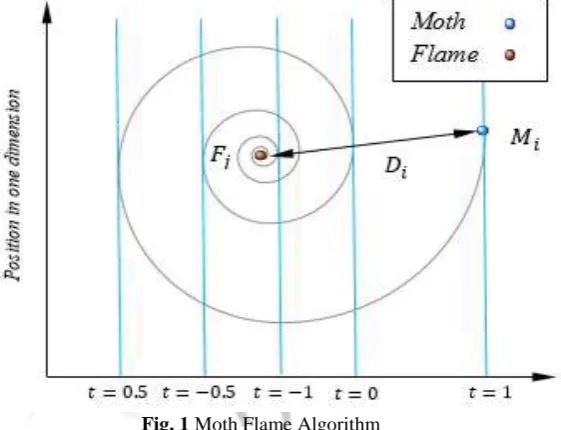
With the above equations, the spiral flying path of moths is simulated. As may be seen in this equation, the next position of a moth is defined with respect to a flame. The t parameter in the spiral equation defines how much the next position of the moth should be close to the flame (t = -1 is the closest position to the flame, while t = 1shows the farthest). Therefore, a hyper ellipse can be assumed around the flame in all directions and the next position of the moth would be within this space. Spiral movement is the main component of the proposed method because it dictates how the moths update their positions around flames. The spiral equation allows a moth to fly “around” a flame and not necessarily in the space between them. Therefore, the exploration and exploitation of the search space can be guaranteed. The logarithmic spiral, space around the flame, and the position considering different t on the curve are illustrated as follows:
Fig. 1 Moth Flame Algorithm
IV.SIMULATION AND RESULTS
The block diagram of the linear automatic voltage regulator (AVR) with the PID controller and using Particle swarm Optimization (PSO) and Moth Flame Optimization (MFO) is shown in Fig. 2.
IJEDR1604056
International Journal of Engineering Development and Research (www.ijedr.org)369
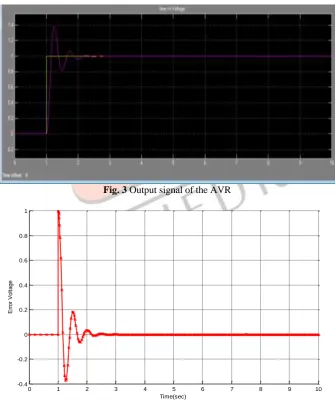
Fig. 2 Simulink model of AVRFig. 3 Output signal of the AVR
Fig. 4 Error voltage with time
0 1 2 3 4 5 6 7 8 9 10
-0.4 -0.2 0 0.2 0.4 0.6 0.8 1
Time(sec)
E
rr
o
r
V
o
lt
a
g
IJEDR1604056
International Journal of Engineering Development and Research (www.ijedr.org)370
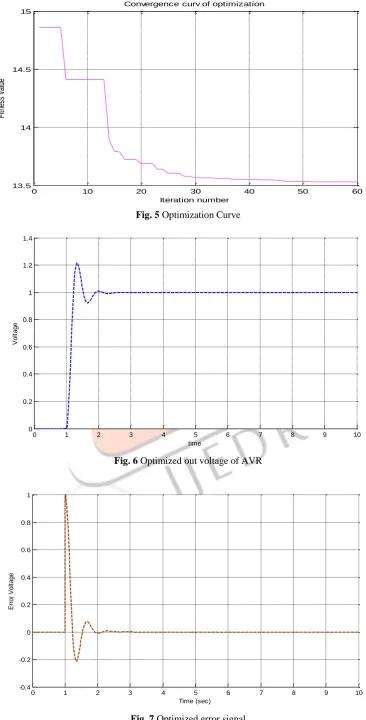
Fig. 5 Optimization CurveFig. 6 Optimized out voltage of AVR
Fig. 7 Optimized error signal
0 10 20 30 40 50 60
13.5 14 14.5 15
Iteration number
Fi
tn
es
s
va
lu
e
Convergence curv of optimization
0 1 2 3 4 5 6 7 8 9 10
0 0.2 0.4 0.6 0.8 1 1.2 1.4
time
V
o
lt
a
g
e
0 1 2 3 4 5 6 7 8 9 10
-0.4 -0.2 0 0.2 0.4 0.6 0.8 1
Time (sec)
E
rr
o
r
V
o
lt
a
g
IJEDR1604056
International Journal of Engineering Development and Research (www.ijedr.org)371
Table: 1 Performance of With and Without optimizationParameters Without Optimization
With Optimization
Kp 4.6 3.004
Ki 1.91 1.22
Kd 2 1.21
Maximum overshoot
39% 20%
Integral error 5.05% 4.6 %
Study state time
1.4 sec 1.25 sec
V.CONCLUSION
The error has been significantly reduced by the optimization in limited iteration. In literature we have seen the PSO and GA used for optimization requires more than 100 iteration for optimization whereas it requires only 50 iteration for the optimization. From the table given in result section, it is clear that the maximum overshoot integral error and study state time are reduced significantly.
REFERENCES
[1] Snigdha Priyambada, Pradeep Kumar Mohanty, Binod Kumar Sahu “Automatic Voltage Regulator Using TLBO Algorithm Optimized PID Controller”, 2014.
[2] Leandro dos Santos Coelho, “Tuning of PID controller for an automatic regulator voltage system using chaotic optimization approach”, Elsevier, 2014.
[3] SeyedaliMirjalili, “Moth-flame optimization algorithm: A novel nature-inspired heuristic paradigm”, Volume 89, November 2015.
[4] V. Mukherjee and S. P. Ghoshal, “Intelligent particle swarm optimized fuzzy PID controller for AVR system”, Electric Power Systems and Research, no. 77, pp. 1689-1698, 2007.
[5] Dong Hwa Kim, “Hybrid GA-BF based intelligent PID controller tuning for AVR system,” Applied Soft Computing Journal, 2008.
[6] L. S. Coelho, “Tuning of PID controller for an automatic regulator voltage system using chaotic optimization approach”, Chaos, Solitions and Fractals, vol. 39, no. 4, pp.1504-1514, 2009.
[7] Bensenouci A, Besheer AH, “Voltage and Power Regulation for a Sample Power System using Heuristics Population Search Based PID Design”, International Review of Automatic Control (IRACO), 2012; 5(6): p.737-748.