Psychology and Psychotherapy: Theory, Research and Practice (2019) ©2019 The Authors. Psychology and Psychotherapy: Theory, Research and Practice published by John Wiley & Sons Ltd on behalf of British Psychological Society
www.wileyonlinelibrary.com
Attachment-specific speech patterns induce
dysphoric mood changes in the listener as a
function of individual differences in attachment
characteristics and psychopathology
Anna Linda Leutritz
1,2, Lejla Colic
1,3, Viola Borchardt
1,
Xuemei Cheng
4, Bin Zhang
5, Sarah Lison
6, J
org Frommer
€
6,
Anna Buchheim
7, Bernhard Strauss
8, Peter Fonagy
9,10,
Tobias Nolte
10,11and Martin Walter
1,3,12,13,14*
1
Clinical Affective Neuroimaging Laboratory, Magdeburg, Germany
2
Department of Psychiatry and Psychotherapy, Otto von Guericke University,
Magdeburg, Germany
3
Leibniz Institute for Neurobiology, Magdeburg, Germany
4
Department of Mechanical and Electrical Engineering, Beijing Polytechnic College, China
5
The Affiliated Brain Hospital of Guangzhou Medical University (Guangzhou Huiai
Hospital), Guangzhou, China
6
Department of Psychosomatics and Psychotherapy, Otto von Guericke University,
Magdeburg, Germany
7
Institute of Psychology, University of Innsbruck, Austria
8
Institute of Psychosocial Medicine and Psychotherapy, University Hospital Jena, Germany
9
Research Department of Clinical, Educational and Health Psychology, University
College London, UK
10
Anna Freud National Centre for Children and Families, London, UK
11
Wellcome Trust Centre for Neuroimaging, University College London, UK
12
Max Planck Institute for Biological Cybernetics, T
€
ubingen, Germany
13
Center for Behavioral Brain Sciences, Magdeburg, Germany
14
Department of Psychiatry and Psychotherapy, University Hospital Jena, Germany
Objectives. Early childhood experiences influence cognitive-emotional development, with insecure attachment predisposing to potential psychopathologies. We investigated whether narratives containing attachment-specific speech patterns shape listeners’ emotional responses and social intentions.
This is an open access article under the terms of the Creative Commons Attribution License, which permits use, distribution and reproduction in any medium, provided the original work is properly cited.
*Correspondence should be addressed to Martin Walter, Department of Psychiatry, University of Jena, Philosophenweg 3, D-07743 Jena, Germany (email: [email protected]).
Design. First, 149 healthy participants listened to three narratives characteristic for secure, insecure-preoccupied, and insecure-dismissing attachment. Following each narrative, the well-being and interpersonal reactivity as a particular aspect of emotional reactivity of the listener were assessed. Likewise, psychopathological aspects of personality were evaluated. A follow-up study compared 10 psychosomatic patients with a current depressive episode and/or personality disorder with distinct depressive symptoms and 10 age- and gender-matched healthy controls.
Methods. Effects of narratives on listeners’ mental state were tested with repeated-measures AN(C)OVA. Mediating effects in the listener (attachment characteristics in the context of personality traits) were explored. Narrative effects were compared between patients and controls.
Results. Listening to insecure attachment narratives reduced well-being in controls. Nevertheless, tendency for social interaction was highest following the insecure-preoccupied narrative. Importantly, listeners’ individual attachment characteristics mediated the relationship between well-being/interpersonal reactivity following the insecure-preoccupied narrative and levels of psychopathology. Furthermore, compared with healthy participants, patients showed higher emotional reactivity following exposure to the insecure-preoccupied narrative, represented by lower well-being and lower estimation of friendliness towards the narrator.
Conclusions. Exposure to attachment-specific speech patterns can result in dysphoric mood changes. Specifically, the insecure-preoccupied narrative influenced the listeners’ emotional state, which was further mediated by the individual attachment patterns and psychopathological personality characteristics. This deepens the understanding of interpersonal processes, especially in psychotherapeutic settings.
Practitioner points
In clinical populations, insecure-preoccupied attachment has a high prevalence. In this study, listening to a narrative characteristic of insecure-preoccupied speech patterns resulted in reduced well-being in healthy listeners.
Patients with depressive symptoms showed a higher emotional reactivity towards the insecure-preoccupied narrative compared to healthy controls.
While working on (childhood) traumata, for example, in group therapy or inpatient settings, therapists should raise awareness to possible mood changes through discourse-conveyed attachment characteristics in listeners as a ‘side effect’.
relationships (Fonagy, Luyten, & Allison, 2015). In almost every psychopathology, mentalizing is compromised (Chung, Barch, & Strube, 2014; Cusi, Nazarov, Holshausen, Macqueen, & McKinnon, 2012). Experience of adverse events (separation, loss, and maltreatment) can result in insecure attachment representations (Weinfield, Sroufe, Egeland, & Carlson, 2008).
Psychopathology
Insecure attachment is a risk factor for mental disorders (Strauss & Brenk-Franz, 2016), and trauma in childhood predisposes to subsequent depressive symptoms (Bowlby, 1980; Buchheim, Strauss, & K€achele, 2002). From an object-relational perspective, anxiously attached individuals are endangered of developing a dependent (anaclitic) type of depression, characterized by loneliness, helplessness, and fear of rejection (Beutelet al., 2004). As these individuals could not fully integrate basic experiences of care in their IWM, they are often dependent on continuous external support and reassurance. Separation, rejection, and object loss are potential triggers for depression (Blatt & Homann, 1992; Bowlby, 1980; Luyten & Blatt, 2011; Sibley, 2007). Consequently, individual capacity for object regulation is a main aspect of mental health and an important factor for healthy relationships and a balanced perception of self-interest (OPD, 2014). Object regulation is a relevant interpersonal skill regarding the structural vulnerability of personality. Structure of personality denotes, in the context of Operationalized Psychody-namic Diagnosis (OPD), throughout the lifetime acquired ‘tools’ for perception, control, and connection with one’s own inner world and other people (Ehrenthalet al., 2012). These competences are particularly relevant in demanding circumstances and have a determining influence on (social) interactions between oneself and counterparts (Ehrenthal et al., 2012). The OPD integrates psychological, psychoanalytical, and developmental-psychological structural concepts and discerns the roots of structural impairments analogous to attachment theory in childhood trauma and deprivation, which inhibit the development of fundamental psychological and interpersonal skills (OPD, 2014).
Psychotherapy
patient’s attachment patterns. Investigating therapists’ countertransference in relation to patients’ personality disorders, Colli, Tanzilli, Dimaggio, and Lingiardi (2014) established specific relationships between personality disorders and therapists’ emotional responses, which aid diagnosis and therapy. Additionally, patient’s lower psychological functioning was associated with stronger negative feelings experienced by the therapist. So far, the mechanisms connecting patients´ attachment styles and therapists´ (interpersonal) reactions are not completely known. Presumably, implicit mechanisms as interpersonal evoking and impact messages play a role in the establishment of a helpful therapeutic alliance.
Organized attachment representations and their respective speech patterns
Insecure organized attachment is commonly divided into insecure-dismissing and insecure-preoccupied attachment (Ainsworth, Blehar, Waters, & Wall, 1978; Bowlby, 1988). In adults, attachment representations are discerned using the Adult Attachment Interview (AAI; Hesse, 2008) based on individual speech patterns and discourse characteristics when reflecting upon emotional experiences in childhood. While secure individuals describe such experiences in a coherent manner, insecure-dismissing discourse is characterized by fragmented, abstract, and distancing speech (Hesse, 2008). Insecure-preoccupied individuals present encounters in excessively long, affect-laden narratives with the main focus being on resentment and grievance (Hesse, 2008). Attachment patterns can also be assessed with self-report questionnaires based on attachment-related experiences and feelings in adult relationships, estimating attachment anxiety and avoidance (Bartholomew & Horowitz, 1991; Ehrenthal, Dinger, Lamla, Funken, & Schauenburg, 2009). Generally, securely attached individuals easily approach others and do not worry inappropriately about being rejected. They perceive their partner as reliable and supportive (Cassidy & Shaver, 2008). Avoidant or dismissing individuals are characterized by negative IWMs of others and a relatively positive self-view. Thus, avoidant adults try to evade social interactions, reject their needs for proximity, and have a limited ability to develop intimate relationships. Anxious-preoccupied adults, however, have a negative self-perception but a positive IWM of significant others. Constant worries about abandonment characterize their relationships, along with a strong desire for being loved and supported (Bartholomew, 1990; Straußet al., 2018). Furthermore, insecure-preoccupied individuals show attachment hyperactivating strategies, reflecting poten-tially desperate efforts to find a secure base. This hyperactivation of the attachment system is accompanied by a lower capacity for controlled mentalizing and a rapid shift to non-mentalizing states (Nolte, Guiney, Fonagy, Mayes, & Luyten, 2011).
Especially in clinical settings, exposure to attachment-specific (mainly insecure) speech patterns is part of individual and group therapy (Buchheimet al., 2018, 2012). Thus, a better understanding of changes in well-being and reactions towards the speaker induced by these speech patterns is of particular importance to understand a therapist’s emotional response and choice of intervention and technique, and, ultimately, to improve the outcomes of psychotherapy (Strauß, 2011; Strausset al., 2017).
listeners’ well-being, while listeners’ evaluation of friendliness and tendency for friendly social interaction towards the narrator was lowest following the insecure-dismissing narrative (Kirchmannet al., 2011). These results could be replicated (Krauseet al., 2017). In a similar paradigm, there was no systematic difference in response between clinically inexperienced listeners (students) and trained therapists to these prototypical attachment narratives (Martinet al., 2007).
The individual differences in personality characteristics that impact changes in well-being and interpersonal reactivity, a more conscious derivative of countertransference reactions, following exposure to attachment relevant content have not been investigated yet.
Hypotheses
We first assessed the impact on well-being and interpersonal reactivity of the listener following exposure to three attachment-specific narratives in a sample of 149 healthy participants. We predicted that exposure to insecure attachment patterns would have the strongest influence on the listener’s well-being, associated with low reported friendliness by the narrator. For exposure to the secure narrative, opposite reactions of the listener were expected, accompanied by the highest inclination for social interaction of the listener with the secure narrator. Secondly, we investigated individual influences of personality, including attachment anxiety and avoidance of the listener, individual propensity for dependency, individual capacity for object regulation, and structural vulnerability of personality in general, in the context of exposure to attachment-specific narratives with multiple mediation analyses. We hypothesized that individual propensity for dependency as a main feature of depression would mediate the relationship between attachment characteristics of the listener and the perception of the insecure narratives. As anxiously attached individuals are at risk of developing a dependent type of depression, we expected a strong mediating effect of dependency on the relationship between attachment anxiety and the perception of the insecure narratives. As attachment avoidance represents an opposite personality trait, we expected contrasting effects. Furthermore, we hypothesized that the attachment characteristics of the listener influence the relationship between the perception of the insecure narratives and the individual’s capacity for object regulation, as well as the structural vulnerability of personality in general. Insecure-preoccupied individuals have more imbalanced relationships because their need for support outweighs the possibility of giving social support (George & West, 2001; Strauss & Brenk-Franz, 2016). Hence, the individual’s capacity for object regulation was hypothesized to be particularly influenced by insecure-preoccupied speech patterns.
We expected that depressive patients would show higher emotional reactivity to insecure attachment narratives compared with controls. Higher emotional reactivity was hypothesized to be reflected by lower well-being and a higher tendency for social interaction with the narrator.
STUDY 1
Methods
Participants listened to three prototypical narratives representing secure-autonomous, insecure-dismissing, or insecure-preoccupied attachment representations in a randomized order. Before presentation of each narrative, the participants conducted simple arithmetic calculations for 90 s as a distraction. At baseline and after listening to each narrative, participants described their emotional state using questionnaires (Figure 1). Additional questionnaires assessed individual differences in personality traits. Participants completed the experiment while sitting in an interference-free experimental room (for more details, please see Supplementary material).
Participants answered six questionnaires.
The being of the listeners following each narrative was measured with the well-established German well-being scale (‘Befindlichkeits-Skala’; Zerssen, 1976). Partici-pants rated their current well-being on 28 oppositional pairs of feelings, for example, ‘At the moment I feel. . .pessimistic’ or ‘. . .optimistic’ or ‘neither nor’. High scores on this state measurement indicate low well-being. Interpersonal reactivity of positive and negative quality, which reflects a more conscious derivative of countertransference reactions and captures a predisposition to emotionally engage with the speaker, was assessed with a 16-itemcountertransference questionnaireadapted from Martinet al. (2007) (e.g., ‘Do you feel any indescribable dislike for the person?’). The questionnaire is based on Mertens’ theoretical model of countertransference reactions (Mertens, 2005) and measures conscious aspects of the context-specific attitude of the listener to relate to the narrator.
Another aspect of interpersonal reactivity, namely interpersonal expectations, operationalized as friendliness dispositions, was assessed with the Impact Message Inventory(IMI, Fingerle, 1998). This questionnaire is associated with the interpersonal circumplex model. We used the 8-item subscale ‘friendly’, which measures on a 4-point Likert scale (‘not at all’ to ‘exactly’) the estimation of friendliness when being confronted
with a person (e.g., ‘When I would be with this person, I have the feeling you just have to like this person’.). Friendliness as used here describes a feeling of liking this person, of getting support from him/her and of trust. High scores indicate high estimations of friendliness, representing that the listener feels very friendly towards the narrator.
Personality characteristics were assessed with three additional questionnaires. Participants’ individual attachment style was assessed with the German version of theExperiences in Close Relationships Questionnaire–Revised(ECR-R; Ehrenthal et al., 2009). This 36-item questionnaire evaluates individual needs, emotions, and behaviour in close relationships (e.g., ‘I am afraid of losing my partner’s love’.). Items are rated on a 7-point Likert scale (‘not at all’ to ‘exactly’), resulting in corresponding high or low scores on an attachment avoidance (AV) and an attachment anxiety (AX) scale.
The German version of the 66-itemDepressive Experiences Questionnaire (DEQ; Blatt, D’Afflitti, & Quinlan, 1976) was used to assess the participants’ individual dependency. The dependency scale of the DEQ captures the delineated main features of depression and includes items of neediness and connectedness (Rude & Burnham, 1995; Zuroff, Moskowitz, & C^ote, 1999) of the participants, representing fear of rejection in relationships and a general dependency on others (e.g., ‘If I fail to live up to expectations, I feel unworthy’.), expressed by high scores.
The 95-itemOPD-Structure Questionnaire(Ehrenthalet al., 2012),based on the OPD system, was developed to measure essential variables of psychodynamic theory. It assesses potential psychopathological characteristics of personality in terms of self-reported (dysfunctional) behaviour and relationship patterns, intra- and interpersonal functioning, and psychic structure, on a 5-point Likert scale (e.g., ‘Others often experience my behaviour completely different to what it was meant to be’.). High scores indicate a high impact in a corresponding psychodynamic context.
All questionnaires showed good validity (see Supplementary material).
Statistical analyses were performed in SPSS (IBM SPSS Statistics for Windows, version 20.0., IBM Corp., Armonk, NY, USA). Repeated-measures analysis of variance (rmANOVA) was conducted to test for effects of narrative on listeners’ well-being (n = 145), interpersonal reactivity (n = 147), and evaluation of friendliness (n = 146). The statistical threshold was Bonferroni corrected for the number of rmANOVAs (p< .017, represent-ingp< .05). These results were previously published within a validation process of the shortened narratives (Krauseet al., 2017).
Individual attachment characteristics (AX and AV, as measured by the ECR-R) of the listener, and their influence on well-being, interpersonal reactivity, and friendliness, were further investigated with repeated-measures analysis of covariances (rmANCOVAs). Assumptions for rmANOVA were tested. If assumption of sphericity was violated, the Greenhouse–Geisser correction was applied (Greenhouse & Geisser, 1959). The statistical threshold was Bonferroni corrected for number of rmANCOVAs (p< .017, representingp< .05). Likewise, post-hoc t-tests were controlled for multiple compar-isons using Bonferroni correction.
Results
Results of well-being, interpersonal reactivity, and friendliness are briefly reported here (see Figure 2, Supplementary material and Krauseet al., 2017 for details). Exposure to insecure narratives reduced the listener’s well-being,compared with well-being before any intervention. Participants’ tendency to engage in potential positive social interaction with the narrator (interpersonal reactivity) was lowest for the insecure-dismissing prototype and highest for the insecure-preoccupied attachment representation. The insecure-dismissing narrative was evaluated as the least friendly, whereas the secure narrative was considered the friendliest.
Influence of personality traits on individual well-being and interpersonal reactivity following the narratives
Individual dependency of the listener explained the effect of AX or AV on interpersonal reactivity only after listening to the insecure-preoccupied narrative (full mediation; Baron & Kenny, 1986), with effects for AX and AV acting in opposite directions (Figure 3). The relationship between attachment characteristics and interpersonal reactivity following the insecure-dismissing and secure narratives, however, was not mediated by depen-dency. There were no mediating effects between attachment characteristics and friendliness following the different narratives.
Moreover, we investigated influences of personality traits, measured with the OPD-Structure Questionnaire, on the perception of the prototypical attachment narratives with multiple mediation analysis (mediators: AX and AV).
AX mediated the relationship between the individual’s capacity for object regulation (OPD) and well-being following the insecure-preoccupied narrative, while AV did not show a significant mediating effect (Figure 4A).
We explored general mediating effects of individual structural deficits. In this model, well-being, interpersonal reactivity, and evaluation of friendliness were investigated as dependent variables, the full scale of the OPD as independent variable, and AX and AV as mediators (Figure 4 and Table 1). There were no mediating effects on well-being, but AX showed a mediation effect on interpersonal reactivity following the insecure-preoccupied
Dependency (DEQ)
Mediation
Direct effect:
b = 0.35, p = 0.551
Direct effect:
b = —0.63, p = 0.385 Countertransference
reactions preoccupied
AV
b = —0.25
Dependency (DEQ)
Mediation b = 1.68
Countertransference reactions preoccupied
p = 0.012
p = 0.002
Indirect effect: b = 0.512, 99% BCa CI [0.027; 1.280]
K2 = 0.08, 99% BCa CI [0.008, 0.192] Indirect effect: K2 = 0.06, 99% BCa CI [0.007, 0.165]b = —0.41, 99% BCa CI [—1.015; —0.034] b = 1.74
p = 0.016
b = 0.29
p = 0.0001
AX
Figure 3.Positive (AX) versus negative (AV) relationship of dependency as a (full) mediator.
AX = attachment anxiety, AV = attachment avoidance, b = unstandardized regression coefficient, BCa CI = bias-corrected and accelerated confidence intervals based on 10,000 bootstrap samples, DEQ = Depressive Experience Questionnaire,j2= effect size (Preacher & Kelley, 2011),p=p-value.
Attachment anxiety (AX)
(A) (B)
(C) (D)
Attachment anxiety (AX)
Operationalised Psychodynamic Diagnosis– full scale
Friendliness after preoccupied
Operationalised Psychodynamic Diagnosis– full scale
Countertrans-ference reactions
after dismissing Operationalised
Psychodynamic Diagnosis– full scale
Countertrans-ference reactions after preoccupied Attachment anxiety (AX)
Attachment anxiety (AX) indirect effect of AX: b = 3.31,
99% CI [0.469; 6.989]
direct effect:
b = 2.58; p = .155
indirect effect of AX: b = 3.36,
99% CI [1.019; 6.388]
direct effect:
b = –2.98; p = .071
indirect effect of AX: b = 3.25,
99% CI [.648; 6.356]
direct effect:
b = –2.08; p = .173 indirect effect of AX: b = .14,
99% CI [–.064; .378]
direct effect:
b = –.05; p = .740
Attachement avoidance (AV)
Attachement avoidance (AV)
Attachement avoidance (AV)
Attachement avoidance (AV)
indirect effect of AV: b = .52, 99% CI [–.905; 2.498]
indirect effect of AV: b = –1.56, 99% CI [–4.251; .423]
indirect effect of AV: b = –.14,
99% CI [–.316; –.023]
indirect effect of AV: b = –1.37, 99% CI [–3.422; .270]
Well-being after preoccupied
b = 0.57
b = 0.84
p = .001
Regulation of object relations – full scale
(OPD)
b = 3.93
p = .003
b = .91
p = .038
p < .001
b = 1.07
b = 1.48
p < .001
b = .92
p = .108
b = –.13
p = .002
p < .001
b = 1.07
b = 1.48
p < .001
b = 2.27
p = .0008
b = –1.46
p = .035
p < .001
b = 1.07
b = 1.48
p < .001
b = 2.20
p = .003
b = –1.28
p = .049
p < .001
narrative (Figure 4B). However, AV mediated the relationship between OPD full scale and friendliness following the insecure-preoccupied narrative (Figure 4C). AX further mediated the relationship between OPD full scale and interpersonal reactivity following the insecure-dismissing narrative (Figure 4D). There were no mediation effects concern-ing well-beconcern-ing and friendliness ratconcern-ings followconcern-ing the insecure-dismissconcern-ing narrative (Table 1). The relationships between OPD full scale and well-being, interpersonal reactivity, and friendliness following the secure narrative were overall not mediated by attachment characteristics (Table 1).
STUDY 2
Methods
Ten patients (six male, ageM = 42.0 years,SD= 11.9) and ten healthy controls (six male, ageM= 36.7 years,SD= 11.2), matched for age and sex, were included.
Patients were recruited at the Department of Psychosomatic Medicine and Psy-chotherapy at the local University Hospital. Patients were experiencing a current depressive episode and/or personality disorder with distinct depressive symptoms, diagnosed by a medical doctor according to ICD-10 criteria (Dilling, 2011). Three patients were receiving medication: The first was on mirtazapine, vitamin D, and calcium; the secondL-thyroxine, tramadol, and pregabalin; and the third amitriptyline, tapentadol, and L-dopa. No antidepressant medication was taken on the day of the assessment. Controls were recruited via public advertisements and assessed with the German version 5.0.0 of the Mini-International Neuropsychiatric Interview, the Hamilton Depression Scale, and the Young Mania Rating Scale to confirm absence of mental disorders (Sheehan et al., 1998) according to ICD-10 criteria. Controls with current or prior psychiatric, neurological, or other medical diseases were excluded.
The study was approved by the institutional ethical review board of the local university, and all participants provided written informed consent according to the Declaration of Helsinki.
The same experiment as described for study 1 was conducted, but it was implemented as part of an electroencephalography–functional magnetic resonance imaging (fMRI) study, which was previously reported (Borchardtet al., 2018). The narratives were similar to study 1 but were consequently presented and rated in the MRI scanner.
In study 2, the well-being scale, countertransference questionnaire, and IMI were used. The scales were presented while the participant was in the MRI scanner, by using the software Presentation (Neurobehavioral Systems, Berkeley, CA, USA). Participants were trained to respond via button presses to questions. Statistical analyses were also performed in SPSS. Well-being, interpersonal reactivity, and friendliness were examined using 392 mixed ANOVAs with the within-subjects factor of narrative (insecure-dismissing/insecure-preoccupied/secure) and the between-subjects factor of group (patients/controls). Assumptions for mixed ANOVA were tested (see Supplementary material).Post-hoc t-tests were controlled for multiple comparisons with Bonferroni correction. Post-hocpower analyses were conducted with GPower (Faul, Erdfelder, Lang, & Buchner, 2007).
Results
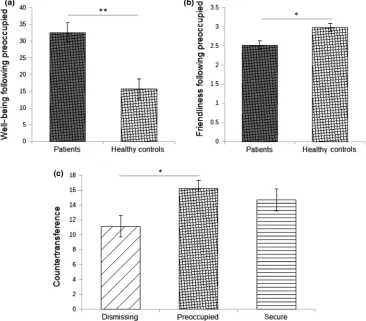
Post-hoc t-tests for each narrative condition between groups revealed a significant effect of the insecure-preoccupied narrative, p = .003, Bonferroni corrected; t(18) = 4.00. Patients showed lower well-being after listening to the insecure-preoccupied narrative (M= 32.57, SD= 11.02) compared with controls (M = 15.69, SD = 7.56; Figure 5A). Interpersonal reactivity showed a significant main effect of narrative,F(2, 36) = 4.24,p= .02, partial eta2 = .19; power(1–b) = 1.Post-hoc Bonfer-roni tests indicated that following the insecure-preoccupied narrative, listeners had a significantly (p = .035) higher tendency for social interaction (M = 16.22,SD= 5.02) than following the insecure-dismissing narrative (M = 11.15,SD= 6.26; Figure 5C).
Friendliness ratings revealed a significant main effect of group, F(1, 18)= 14.54, p = .001, partial eta2 = .45; power(1–b) = 1. In a post-hoc t-test for each narrative condition between groups, there was a significant effect for the insecure-preoccupied narrative,p = .027, Bonferroni corrected;t(18)= 2.93. Patients showed lower friend-liness scores after listening to the insecure-preoccupied narrative (M = 2.52,SD= 0.33) compared with controls (M= 2.98, SD= 0.37; Figure 5B). Tests without significant results are listed in the Supplementary material.
Discussion
Insecure attachment has a high prevalence in clinical populations (e.g., Strauss & Brenk-Franz, 2016), and consequently, exposure to narratives of insecurely attached individuals is one of the interpersonal experiences of clinical practice for both patients (e.g., in group therapy) and psychotherapists. Gaining an idea of the effects on the listener is therefore of interest for a better understanding of interpersonal processes, especially in psychother-apy but also in other medical settings where patient–physician relationships are critical (Strauss & Brenk-Franz, 2016).
Exposure to insecure attachment narratives, particularly insecure-preoccupied content, reduced the subjective feeling of well-being in the (healthy) listener. Neverthe-less, the listeners showed the highest tendency for social interaction with the insecure-preoccupied narrator. This result could be explained by distress and a sense of helplessness being induced in the listener by the affect-laden speech patterns in an insecure-preoccupied narrative, describing conflicts and a grievance-filled desire for closeness with the caregiver, which implicitly might try to elicit caregiving, but also overburdens the listener. The urge to take care of the insecure-preoccupied narrator is reflected by a higher tendency of the listener for social interaction. Listeners were, for example, more inclined to talk to the insecure-preoccupied narrator about her problems. In the secure narrative, challenges in early childhood were also described, but in a reflected, more coherent, and less affect-laden way. As insecure-dismissing speech patterns are characterized by abstract and fragmented speech, it might be more difficult for the listener to access the childhood relationships of the narrator when listening to the insecure-dismissing narrative.
friendliness, following the insecure-preoccupied narrative. Dependency is a core psychopathological feature of depressive symptoms and is characterized by the basic wish for reward in clinging and infantile relationships with dominant others. Blatt, Quinlan, Chevron, McDonald, and Zuroff (1982) discriminated between a dependent (anaclitic) and a critical (introjective) type of depression. While patients with self-critical depression are characterized by feelings of worthlessness and guilt, patients with dependent depression mainly experience feelings of loneliness and helplessness. In primary attachment relationships of dependently depressive patients, experiences of adequate care were insufficient and thus have not been internalized. Accordingly, these individuals continuously seek external support and reassurance and crave being loved and guarded, often eliciting negative and hostile reactions. Separation, rejection, and object loss in turn are potential triggers of depressive resentment. Anxiously attached individuals
are at risk of developing a dependent type of depression (Beutelet al., 2004; Blatt, 1995) and use hyperactivating strategies that involve upregulation of emotions (Mikulincer, Shaver, & Pereg, 2003) resulting in impaired mentalizing. Depressed mood is again hypothesized to lead to higher stress levels, accompanied by dysfunctions in mentalizing (Luyten, Lemma, & Target, 2012), resulting in a lower ability to cope with stress and leading to a ‘vicious cycle of increasingly depressed mood’ (Fischer-Kern & Tmej, 2019, p. 165). Accordingly, individual dependency can explain an increase in emotional responses and reduced well-being following the presentation of narratives with content that might activate the attachment system (in our case, experiences of rejection and disregard), especially in anxiously attached listeners. However, avoidant individuals use downregulation to deal with disturbing emotions (Mikulincer & Shaver, 2005; Nielsenet al., 2017). We further hypothesized that attachment characteristics of the listener would influence the relationship between the perception of the insecure narratives and the individual’s capacity for object regulation, and structural vulnerability of the personality in general. Considering individual differences with regard to the capacity for object regulation, there was a mediation effect particularly of attachment anxiety of the listener on the relationship between the listener’s well-being following the insecure-preoccupied narrative and object regulation. The latter is the main factor for relationship satisfaction and balanced perception of self-interest (OPD, 2014). The negative self-perception and preoccupation with worries about abandonment in relationships characteristic of anxiously attached individuals (Strauß et al., 2018) illustrate this mediating role of attachment anxiety, which is further explained by lower mentalizing capacities (Luyten & Fonagy, 2015). Considering the structural vulnerability of personality in general, individual attachment characteristics mediated the relation-ship between friendliness/interpersonal reactivity following the insecure narratives and the OPD full scale. Generally, high attachment avoidance or anxiety is associated with higher levels of depressive symptoms (Conradi, Kamphuis, & de Jonge, 2018). This interrelation between attachment insecurity and psychopathology illustrates our results regarding the individual reactivity towards the insecure narratives. According to Hankin, Kassel, and Abela (2005), a potential mediating factor of the association between insecure attachment and depressive and/or anxious symptoms is interpersonal stressors. Moreover, in psychotherapeutic relationships a higher attachment security of the therapist was related to a better therapeutic alliance and a better outcome of therapy, particularly in structurally more severely impaired patients (Schauenburget al., 2010).
Apart from the organized attachment styles, a disorganized attachment pattern exists, characterized by a conflict between the attachment system and a survival defence system during interactions with the caregiver, as the attachment figure interrupts caregiving repeatedly with neglect or maltreatment. Accordingly, ‘the caregiver becomes at the same time the source and the solution of the infant’s alarm’ (Main & Hesse, 1990, p. 163). This conflict results in contradictory behaviours (Liotti, 2017). Disorganized attachment plays an important role in the development of psychopathology in general (Liotti, 2011). Since disorganized attachment has a much higher load of disturbed attachment characteristics compared to organized attachment, it would be interesting to investigate its influences on the listener’s emotional state.
Clinical implications
Insecure attachment is a risk factor for mental health (Cassidy, Jones, & Shaver, 2013). This accounts for both patients’ attachment characteristics and those of the patients’ direct environment. Understanding and awareness of attachment-specific schemata can help us gain insights into the course of depression and improve treatment outcome. Attachment-specific interaction patterns are, however, also relevant for the therapeutic alliance. For example, attachment anxiety was positively associated with the number of psychiatrists/ psychologists seen by individuals, while attachment avoidance was negatively associated with beliefs about the efficacy of psychotherapy (Adams, McWilliams, Wrath, Adams, & Souza, 2017). Hyperactivating strategies of anxiously attached individuals can result in exaggerating distress, whereas deactivating strategies of avoidantly attached individuals can, for example, result in trivializing problems and rejecting help (Strauss & Brenk-Franz, 2016; Strauß & Schwark, 2007). Regarding the interaction between patient and therapist attachment styles, there is evidence that patients and therapists with oppositional attachment styles experience the therapeutic alliance as more profitable (Strauss & Petrowski, 2017). The benefit of opposing attachment styles might be explained by natural variations in the preoccupied and dismissing attachment strategies of the therapist, which help him/her to resist the patient’s maladaptive patterns and expectations but respond in a ‘collisional’ way that creates a corrective emotional experience for the patient (Bernier & Dozier, 2002; Bucci, Seymour-Hyde, Harris, & Berry, 2016; Mallinckrodt, 2010). Psychotherapy can address these patterns, and the therapist may support the patient by serving as a ‘secure base’ with his/her mental and emotional abilities and reflections on the patient’s attachment experiences, including attachment experiences with the therapist (Reiner, Bakermans-Kranenburg, Van IJzendoorn, Fremmer-Bombik, & Beutel, 2016). One goal of psychotherapy is to increase the mentalizing capacities of the patient (Allen & Fonagy, 2006; Levyet al., 2006), as poor mentalizing is linked to low executive attention and has been associated with high fluctuations in mental states, which again influence the therapeutic alliance (Levy, Beeney, Wasserman, & Clarkin, 2010). Notably, a differentiated capacity to understand the mind of the other is linked to an improved therapeutic alliance, which in turn predicts clinical outcome (Dimaggio, Maillard, MacBeth, & Kramer, 2019). This suggests that narratives told by individuals with poor theory of mind might have a negative impact on the listener (i.e., therapist), thereby affecting clinical outcome.
capacities (Cologon, Schweitzer, King, & Nolte, 2017; Klasen, Nolte, Moller, & Taubner,€ in press; Schauenburget al., 2010).
As mentioned above, although we know about relationships between patients´(and therapists´) attachment and outcomes, we still do not know the mechanisms playing a role in the complex psychotherapeutic interaction. One element of this interaction probably is the implicit response to patients’ expectations and interpersonal plans (Casparet al., 2016). These are likely to influence the therapist´s responses or–put in psychodynamic terms – countertransference. This in turn might lead to specific reactions that either recapitulate the patients’ experiences or lead to their correction. Accordingly, it is essential to better understand how interpersonal characteristics of patients implicitly influence therapists’ response, as there is some potential for improving psychotherapists’ training in interpersonal competence.
Limitations
First, only behavioural measures were used to assess the influences of listening to different prototypical attachment narratives. Regarding the IMI, only the friendly subscale was used here owing to feasibility constraints of the MRI environment. This subscale was chosen as it had the strongest evidence for discerning differential reactivity patterns in earlier studies investigating attachment narratives (Kirchmann et al., 2011; Martin et al., 2007). Nevertheless, the other subscales should be considered in future experiments. The participants of study 1 were medical students in their early curriculum without clinical experience. This sample is representative of neither the general population nor psychotherapists, and therefore, the results cannot be generalized. Another limitation is the small sample size in study 2. Although power was sufficient to detect medium to large effects, it was too low to detect small effects. Owing to the small sample size, we could not perform rmANCOVA and mediation analysis. Moreover, effects of medication status were not studied. Following our promising findings, this should be addressed in future investigations as, for example, increasing serotonin levels were found to enhance agreeable social behaviour in humans (Young, 2013). Another limitation is that no narrative of disorganized attachment was used. The discourse of disorganized individuals is characterized by trauma, dissociated memory, and prolonged silences. These characteristics are difficult to capture in a 4-min interview excerpt. Nevertheless, the emotional reactivity of listeners following exposure to a disorganized narrative should be investigated, as disorganized attachment is crucial in psychopathology.
Conclusion
listeners as an important but inevitable ‘side effect’. Awareness of these issues could be of use in reflecting underlying (un-)conscious mechanisms in both therapeutic and daily life encounters.
Acknowledgements
We thank Helmut Kirchmann for provision of the attachment narratives; Professor Bernhard Bogerts, the psychiatrists of University Clinic of Magdeburg, Thomas Wendt, Kerstin Mohring,€ and Ilona Wiedenhoft for their help during data acquisition; and all participants for€ participation. MD Anna Linda Leutritz received funding from Otto von Guericke University Magdeburg.
Conflicts of interest
Dr. Walter performed studies as an employe of institutions which received research support from HEEL and from Janssen Pharmaceutical Research unrelated to this investigation. Dr. Walter has not received any personal financial compensation from third parties. Other authors declare no competing financial interests.
Funding information
This work was supported by the German Research Foundation (SFB779/A06 and DFG Wa2673/4-1 to M.W.), the Center for Behavioral Brain Sciences (CBBS NN05 to M.W.) and Leibniz Association (Pakt fur Forschung und Innovation to and DFG Wa2673/4-1 to M.W.),€ the DAAD and a scholarship by the Otto v. Guericke University Magdeburg (to A. L.). L.C. was a Ph.D fellow of the SFB779. T. N. is supported by a Wellcome Trust Principal Investigator Award to P. Read Montague. Peter Fonagy is in receipt of a National Institute for Health Research (NIHR) Senior Investigator Award (NF-SI-0514 -10157). Peter Fonagy was in part supported by the NIHR Collaboration for Leadership in Applied Health Research and Care (CLAHRC) North Thames at Barts Health NHS Trust. The views expressed are those of the authors and not necessarily those of the NHS, the NIHR or the UK Department of Health.
References
Adams, G. C., McWilliams, L. A., Wrath, A. J., Adams, S., & Souza, D. D. (2017). Relationships between patients’ attachment characteristics and views and use of psychiatric treatment. Psychiatry Research,256, 194–201. https://doi.org/10.1016/j.psychres.2017.06.050
Ainsworth, M. D. S., Blehar, M. C., Waters, E., & Wall, S. N. (1978).Patterns of attachment: A psychological study of the strange situation. Oxford, UK: Lawrence Erlbaum. https://doi.org/ 10.1002/1097-0355(198021)1:1<68::AID-IMHJ2280010110>3.0.CO;2-3
Allen, J. G., & P. Fonagy (Eds.) (2006).Handbook of mentalization-based treatment. Hoboken, NJ: John Wiley & Sons Inc. https://doi.org/10.1002/9780470712986
Baron, R. M., & Kenny, D. A. (1986). The moderator-mediator variable distinction in social psychological research: Conceptual, strategic, and statistical considerations. Journal of Personality and Social Psychology,51, 1173–1182. https://doi.org/10.1037/0022-3514.51.6. 1173
Bartholomew, K., & Horowitz, L. M. (1991). Attachment styles among young adults: A test of a four-category model.Journal of Personality and Social Psychology,61, 226–244. https://doi.org/ 10.1037/0022-3514.61.2.226
Bernier, A., & Dozier, M. (2002). Assessing adult attachment: Empirical sophistication and conceptual bases.Attachment & Human Development,4, 171–179. https://doi.org/10.1080/ 14616730210157457
Beutel, M. E., Wiltink, J., Hafner, C., Reiner, I., Bleichner, F., & Blatt, S. (2004). Abh€angigkeit und Selbstkritik als psychologische Dimensionen der Depression – Validierung der deutschsprachigen Version des Depressive Experience Questionnaire (DEQ) [Dependence and self-criticism as a psychological dimension of depression: Validation of the German-language version of the Depressive Experience Questionnaire (DEQ)]. Zeitschrift Fur Klinische€ Psychologie, Psychiatrie Und Psychotherapie,52(1), 1–14.
Blatt, S. J. (1995). The destructiveness of perfectionism: Implications for the treatment of depression.American Psychologist,50(12), 1003–1020. https://doi.org/10.1037/0003-066X. 50.12.1003
Blatt, S. J., D’Afflitti, J. P., & Quinlan, D. M. (1976). Experiences of depression in normal young adults. Journal of Abnormal Psychology,85(4), 383–389. https://doi.org/10.1037/0021-843X.85.4.383 Blatt, S. J., & Homann, E. (1992). Parent-child interaction in the etiology of dependent and self-critical depression.Clinical Psychology Review,12(1), 47–91. https://doi.org/10.1016/0272-7358(92)90091-L
Blatt, S. J., Quinlan, D. M., Chevron, E. S., McDonald, C., & Zuroff, D. (1982). Dependency and self-criticism: Psychological dimensions of depression. Journal of Consulting and Clinical Psychology,50(1), 113–124. https://doi.org/10.1037/0022-006X.50.1.113
Borchardt, V., Surova, G., van der Meer, J., Bola, M., Frommer, J., Leutritz, A. L.,. . .Walter, M. (2018). Exposure to attachment narratives dynamically modulates cortical arousal during the resting state in the listener.Brain and Behavior,8, e01007. https://doi.org/10.1002/brb3.1007 Bourke, C., Douglas, K., & Porter, R. (2010). Processing of facial emotion expression in major
depression: A review. Australian and New Zealand Journal of Psychiatry, 44, 681–696. https://doi.org/10.3109/00048674.2010.496359
Bowlby, J. (1980).Attachment and loss: Vol. 3: Loss: Sadness and depression. New York, NY: Basic Books.
Bowlby, J. (1988).A secure base: Parent–child attachment and healthy human development. New York, NY: Basic Books.
Bucci, S., Seymour-Hyde, A., Harris, A., & Berry, K. (2016). Client and therapist attachment styles and working alliance.Clinical Psychology and Psychotherapy,23(2), 155–165. https://doi.org/10. 1002/cpp.1944
Buchheim, A., Labek, K., Taubner, S., Kessler, H., Pokorny, D., K€achele, H.,. . .Karch, S. (2018). Modulation of gamma band activity and late positive potential in patients with chronic depression after psychodynamic psychotherapy.Psychotherapy and Psychosomatics,87, 252– 254. https://doi.org/10.1159/000488090
Buchheim, A., Strauss, B., & K€achele, H. (2002). The differential relevance of attachment classification for psychological disorders. Psychotherapie, Psychosomatik, medizinische Psychologie,52(03/04), 128–133. https://doi.org/10.1055/s-2002-24958
Buchheim, A., Viviani, R., Kessler, H., K€achele, H., Cierpka, M., Roth, G.,. . .Taubner, S. (2012). Changes in prefrontal-limbic function in major depression after 15 months of long-term psychotherapy.PLoS ONE,7(3), e33745. https://doi.org/10.1371/journal.pone.0033745 Caspar, F. (2003). Das impact message inventory von Kiesler [The Impact Message Inventory by
Kiesler]. In E. Br€ahler, K. Geue, & B. Strauß (Eds.),Diagnostik fur Klinik und Praxis: Vol. 1.€ Diagnostische Verfahren in der Psychotherapie [Diagnostics for clinic and medical practice: Vol. 1. Diagnostic methods in psychotherapy](2nd ed., pp. 214–216). G€ottingen, Germany: Hogrefe.
Cassidy, J., Jones, J. D., & Shaver, P. R. (2013). Contributions of attachment theory and research: A framework for future research, translation, and policy.Development and Psychopathology,25 (4 Pt 2), 1415–1434. https://doi.org/10.1017/S0954579413000692
Cassidy, J., & P. R. Shaver (Eds.) (2008).Handbook of attachment: Theory, research, and clinical applications(2nd ed.). New York, NY: The Guilford Press.
Chung, Y. S., Barch, D., & Strube, M. (2014). A meta-analysis of mentalizing impairments in adults with schizophrenia and autism spectrum disorder. Schizophrenia Bulletin, 40, 602–616. https://doi.org/10.1093/schbul/sbt048
Colli, A., Tanzilli, A., Dimaggio, G., & Lingiardi, V. (2014). Patient personality and therapist response: An empirical investigation.The American Journal of Psychiatry,171(1), 102–108. https://doi. org/10.1176/appi.ajp.2013.13020224
Cologon, J., Schweitzer, R. D., King, R., & Nolte, T. (2017). Therapist reflective functioning, therapist attachment style and therapist effectiveness.Administration and Policy in Mental Health,44, 614–625. https://doi.org/10.1007/s10488-017-0790-5
Conradi, H. J., Kamphuis, J. H., & de Jonge, P. (2018). Adult attachment predicts the seven-year course of recurrent depression in primary care.Journal of Affective Disorders,225, 160–166. https://doi.org/10.1016/j.jad.2017.08.009
Cusi, A. M., Nazarov, A., Holshausen, K., Macqueen, G. M., & McKinnon, M. C. (2012). Systematic review of the neural basis of social cognition in patients with mood disorders.Journal of Psychiatry & Neuroscience,37(3), 154–169. https://doi.org/10.1503/jpn.100179
Dilling, H. (2011).Internationale Klassifikation psychischer Storungen: ICD-10 Kapitel V (F):€ Klinisch-diagnostische Leitlinien [International classification of diseases. 10th rev. Chapter V (F). Clinical Descriptions and Diagnostic Guidelines]. Bern, Switzerland: Huber.
Dimaggio, G., Maillard, P., MacBeth, A., & Kramer, U. (2019). Effects of therapeutic alliance and metacognition on outcome in a brief psychological treatment for borderline personality disorder.Psychiatry,82(2), 143–157. https://doi.org/10.1080/00332747.2019.1610295 Dozier, M., & Bates, B. (2004). Attachment state of mind and the treatment relationship. In L.
Atkinson & S. Goldberg (Eds.),Attachment issues in psychopathology and intervention(pp. 167–180). Mahwah, NJ: Lawrence Erlbaum Associates Publishers.
Ehrenthal, J. C., Dinger, U., Horsch, L., Komo-Lang, M., Klinkerfuss, M., Grande, T., & Schauenburg, H. (2012). Der OPD-Strukturfragebogen (OPD-SF): Erste Ergebnisse zu Reliabilit€at und Validit€at [The OPD Structure Questionnaire (OPD-SQ): First results on reliability and validity]. Psychotherapie, Psychosomatik, Medizinische Psychologie,62(1), 25–32. https://doi.org/10. 1055/s-0031-1295481
Ehrenthal, J. C., Dinger, U., Lamla, A., Funken, B., & Schauenburg, H. (2009). Evaluation of the German version of the attachment questionnaire “Experiences in Close Relationships–Revised” (ECR-RD).Psychotherapie, Psychosomatik, Medizinische Psychologie,59, 215–223. https:// doi.org/10.1055/s-2008-1067425
Faul, F., Erdfelder, E., Lang, A.-G., & Buchner, A. (2007). G*Power 3: A flexible statistical power analysis program for the social, behavioral, and biomedical sciences. Behavior Research Methods,39, 175–191. https://doi.org/10.3758/BF03193146
Fingerle, H. (1998). Der Impact Message Inventory. Deutsche Neukonstruktion [The Impact Message Inventory. German new construction]. Unpublished diplomathesis, Department of Psychology, University of T€ubingen.
Fischer-Kern, M., & Tmej, A. (2019). Mentalization and depression: Theoretical concepts, treatment approaches and empirical studies–An overview.Zeitschrift Fur Psychosomatische Medizin€ Und Psychotherapie,65, 162–177. https://doi.org/10.13109/zptm.2019.65.2.162
Fonagy, P., Gergely, G., Jurist, E. L., & Target, M. (2002).Affect regulation, mentalization, and the development of the self, pp. 23–64. New York, NY: Other Press. https://doi.org/10.4324/ 9780429471643
George, C., Kaplan, N., & Main, M. (1984). Adult attachment interview protocol. Unpublished manuscript. University of California at Berkeley.
George, C., Kaplan, N., & Main, M. (1985). Adult attachment interview protocol (2nd ed.). Unpublished manuscript. University of California at Berkeley.
George, C., Kaplan, N., & Main, M. (1996). Adult attachment interview protocol (3rd ed.). Unpublished manuscript. University of California at Berkeley.
George, C., & West, M. (2001). The development and preliminary validation of a new measure of adult attachment: The Adult Attachment Projective.Attachment & Human Development,3(1), 30–61. https://doi.org/10.1080/14616730010024771
Greenhouse, S. W., & Geisser, S. (1959). On methods in the analysis of profile data.Psychometrika, 24(2), 95–112. https://doi.org/10.1007/BF02289823
Hankin, B. L., Kassel, J. D., & Abela, J. R. Z. (2005). Adult attachment dimensions and specificity of emotional distress symptoms: Prospective investigations of cognitive risk and interpersonal stress generation as mediating mechanisms.Personality and Social Psychology Bulletin,31(1), 136–151. https://doi.org/10.1177/0146167204271324
Hardy, G. E., Stiles, W. B., Barkham, M., & Startup, M. (1998). Therapist responsiveness to client interpersonal styles during time-limited treatments for depression.Journal of Consulting and Clinical Psychology,66, 304–312. https://doi.org/10.1037/0022-006X.66.2.304
Hayes, A. F. (2013).Introduction to mediation, moderation, and conditional process analysis: A regression-based approach(1st ed.). New York, NY: The Guilford Press.
Hayes, A. F., & Preacher, K. J. (2014). Statistical mediation analysis with a multicategorical independent variable.The British Journal of Mathematical and Statistical Psychology, 67, 451–470. https://doi.org/10.1111/bmsp.12028
Hesse, E. (2008). The adult attachment interview: Protocol, method of analysis, and empirical studies. In J Cassidy & P. R. Shaver (Eds.),Handbook of attachment theory, research, and clinical applications(2nd ed., pp. 552–598). New York, NY: The Guilford Press.
Kernberg, O. F. (1975).Borderline conditions and pathological narcissism. New York, NY: Jason Aronson.
Kernberg, O. F. (2007).Countertransference: Recent development and technical implications for the treatment of patients with severe personality disorders. Severe personality disorders: Everyday Issues in Clinical Practice. New Haven, CT: Yale University Press. https://doi.org/10. 1017/cbo9780511544439.004
Kiesler, D. J. (1983). The 1982 Interpersonal Circle: A taxonomy for complementarity in human transactions.Psychological Review,90, 185–214. https://doi.org/10.1037/0033-295X.90.3.185 Kirchmann, H., Thomas, A., Bruderle, E., & Strauß, B. (2011). Zum Einfluss von Bindungsmerkmalen€ auf Gegen€ubertragungsreaktionen [The influence of attachment characteristics on countertransference effects of tape recorded AAI-sequences on emotional well-being, attribution of friendliness and readiness for social interaction of listeners]. Zeitschrift Fur€ Psychiatrie, Psychologie Und Psychotherapie, 59, 123–132. https://doi.org/10.1024/1661-4747/a000062
Klasen, J., Nolte, T., M€oller, H., & Taubner, S. (in press). Adverse childhood experiences, attachment representations and mentalizing capacity of psychotherapists in training. Zeitschrift fur Psychosomatische Medizin und Psychotherapie.
Krause, A. L., Colic, L., Borchardt, V., Li, M., Strauss, B., Buchheim, A.,. . . Walter, M. (2017). Functional connectivity changes following interpersonal reactivity.Human Brain Mapping, 39, 866–879. https://doi.org/10.1002/hbm.23888
Levy, K. N., Beeney, J. E., Wasserman, R. H., & Clarkin, J. F. (2010). Conflict begets conflict: Executive control, mental state vacillations, and the therapeutic alliance in treatment of borderline personality disorder. Psychotherapy Research, 20, 413–422. https://doi.org/10. 1080/10503301003636696
Consulting and Clinical Psychology,74, 1027–1040. https://doi.org/10.1037/0022-006X.74. 6.1027
Liotti, G. (2011). Attachment disorganization and the controlling strategies: An illustration of the contributions of attachment theory to developmental psychopathology and to psychotherapy integration. Journal of Psychotherapy Integration, 21, 232–252. https://doi.org/10.1037/ a0025422
Liotti, G. (2017). The multimotivational approach to attachment-informed psychotherapy: A clinical illustration.Psychoanalytic Inquiry, 37, 319–331. https://doi.org/10.1080/07351690.2017. 1322426
Luyten, P., & Blatt, S. J. (2011). Integrating theory-driven and empirically-derived models of personality development and psychopathology: A proposal for DSM V.Clinical Psychology Review,31(1), 52–68. https://doi.org/10.1016/j.cpr.2010.09.003
Luyten, P., & Fonagy, P. (2015). The neurobiology of mentalizing.Personality Disorders: Theory, Research, and Treatment,6(4), 66–379. https://doi.org/10.1037/per0000117
Luyten, P., Lemma, A., & Target, M. (2012). Mentalizing and depression. In A. Bateman & P. Fonagy (Eds.), Mentalizing in mental health practice (pp. 385–418). Washington, DC: American Psychiatric Publishing Inc.
Main, M., & Hesse, E. (1990). Parents’ unresolved traumatic experiences are related to infant disorganized attachment status: Is frightened and/or frightening parental behavior the linking mechanism? In M. T. Greenberg, D. Cicchetti, & E. M. Cumminngs (Eds.),Attachment in the preschool years: Theory, research, and intervention(pp. 161–182). Chicago, IL: University of Chicago Press.
Mallinckrodt, B. (2010). The psychotherapy relationship as attachment: Evidence and implications. Journal of Social and Personal Relationships, 27, 262–270. https://doi.org/10.1177/ 0265407509360905
Martin, A., Buchheim, A., Berger, U., & Strauss, B. (2007). The impact of attachment organization on potential countertransference reactions.Psychotherapy Research,17(1), 46–58. https://doi. org/10.1080/10503300500485565
Mertens, W. (2005). Grundlagen der psychoanalytischen Therapie [Foundations of psychoanalytic therapy]. In W. Senf & M. Broda (Eds.),Praxis der psychotherapie [Practice of psychotherapy] (3rd ed., pp. 196–237). Stuttgart, Germany: Thieme.
Mikulincer, M., & Shaver, P. R. (2005). Attachment theory and emotions in close relationships: Exploring the attachment-related dynamics of emotional reactions to relational events.Personal Relationships,12, 149–168. https://doi.org/10.1111/j.1350-4126.2005.00108.x
Mikulincer, M., Shaver, P. R., & Pereg, D. (2003). Attachment theory and affect regulation: The dynamics, development, and cognitive consequences of attachment-related strategies. Motivation and Emotion,27(2), 77–102. Retrieved from http://web.b.ebscohost.com.005e 2a0p0ba3.han.med.uni-magdeburg.de/ehost/detail/detail?vxml:id=2&sxml:id=abe530f6-79cb-47b5-8a09-d13747ad77b4%40sessionmgr103&bdata=JnNpdGU9ZWhvc3QtbGl2ZQ%3D% 3D#AN=10676008&db=pbh
Naranjo, C., Kornreich, C., Campanella, S., No€el, X., Vandriette, Y., Gillain, B.,. . .Constant, E. (2011). Major depression is associated with impaired processing of emotion in music as well as in facial and vocal stimuli.Journal of Affective Disorders,128, 243–251. https://doi.org/10.1016/ j.jad.2010.06.039
Nielsen, S. K. K., Lønfeldt, N., Wolitzky-Taylor, K. B., Hageman, I., Vangkilde, S., & Daniel, S. I. F. (2017). Adult attachment style and anxiety–The mediating role of emotion regulation.Journal of Affective Disorders,218, 253–259. https://doi.org/10.1016/j.jad.2017.04.047
Nolte, T., Guiney, J., Fonagy, P., Mayes, L. C., & Luyten, P. (2011). Interpersonal stress regulation and the development of anxiety disorders: An attachment-based developmental framework. Frontiers in Behavioral Neuroscience,5, 55. https://doi.org/10.3389/fnbeh.2011.00055 OPD, T force (Ed.) (2014). Operationalisierte psychodynamische Diagnostik OPD-2
Preacher, K. J., & Kelley, K. (2011). Effect size measures for mediation models: Quantitative strategies for communicating indirect effects.Psychological Methods,16(2), 93–115. https://d oi.org/10.1037/a0022658
Reiner, I., Bakermans-Kranenburg, M. J., Van IJzendoorn, M. H., Fremmer-Bombik, E., & Beutel, M. (2016). Adult attachment representation moderates psychotherapy treatment efficacy in clinically depressed inpatients.Journal of Affective Disorders,195, 163–171. https://doi.org/ 10.1016/j.jad.2016.02.024
Rude, S. S., & Burnham, B. L. (1995). Connectedness and neediness: Factors of the DEQ and SAS dependency scales.Cognitive Therapy and Research,19, 323–340. https://doi.org/10.1007/ BF02230403
Schauenburg, H., Buchheim, A., Beckh, K., Nolte, T., Brenk-, K., Leichsenring, F., & Dinger, U. (2010). The influence of psychodynamically oriented therapists’ attachment representations on outcome and alliance in inpatient psychotherapy.Psychotherapy Research,20(2), 193–202. https://doi.org/10.1080/10503300903204043
Sheehan, D. V., Lecrubier, Y., Sheehan, K. H., Amorim, P., Janavs, J., Weiller, E.,. . .Dunbar, G. C. (1998). The Mini-International Neuropsychiatric Interview (M.I.N.I.): The development and validation of a structured diagnostic psychiatric interview for DSM-IV and ICD-10.The Journal of Clinical Psychiatry,59(Suppl 2), 22–57.
Sibley, C. G. (2007). The association between working models of attachment and personality: Toward an integrative framework operationalizing global relational models.Journal of Research in Personality,41(1), 90–109. https://doi.org/10.1016/j.jrp.2006.03.002
Strauß, B. (2011). Ergebnisse der klinischen Bindungsforschung mit Bedeutung f€ur die Psychotherapie [Results of clinical attachment research of significance for psychotherapy]. PPmP–PsychotherapiePsychosomatikMedizinische Psychologie,61, 436–446. https:// doi.org/10.1055/s-0031-1276914
Strauß, B., Altmann, U., Manes, S., Tholl, A., Koranyi, S., Nolte, T.,. . .Kirchmann, H. (2018). Changes of attachment characteristics during psychotherapy of patients with social anxiety disorder: Results from the SOPHO-Net trial.PLoS ONE,13(3), e0192802. https://doi.org/10.1371/journal. pone.0192802
Strauss, B., & Brenk-Franz, K. (2016). The relevance of attachment theory in medical care. In J. Hunter & R. Maunder (Eds.),Improving patient treatment with attachment theory: A guide for primary care practitioners and specialists (pp. 39–52). Cham, Switzerland: Springer. https://doi.org/10.1007/978-3-319-23300-0_4
Strauss, B., Koranyi, S., Altmann, U., Nolte, T., Beutel, M. E., Wiltink, J.,. . .Kirchmann, H. (2017). Partner-related attachment as a moderator of outcome in patients with social anxiety disorder-a comparison between short-term cognitive-behavioral and psychodynamic therapy. Psychotherapy (Chicago, IL),54, 339–350. https://doi.org/10.1037/pst0000129
Strauss, B. M., & Petrowski, K. (2017). The role of the therapist’s attachment in the process and outcome of psychotherapy. In L. G. Castonguay & C. E. Hill (Eds.),How and why are some therapists better than others?: Understanding therapist effects(pp. 117–138). Washington, DC: American Psychological Association. https://psycnet.apa.org/doi/10.1037/0000034-008 Strauß, B., & Schwark, B. (2007). Die Bindungstheorie und ihre Relevanz fur die Psychotherapie€
[Attachment theory and its relevance for psychotherapy]. Psychotherapeut, 52, 405–425. https://doi.org/10.1007/s00278-007-0565-7
Vrticka, P. (2017). The social neuroscience of attachment. In A. Ibanez, L. Sede~ ~no, & A. Garcıa (Eds.), Neuroscience and social science (pp. 95–119). Cham, Switzerland: Springer International Publishing. https://doi.org/10.1007/978-3-319-68421-5_5
Vrticka, P., & Vuilleumier, P. (2012). Neuroscience of human social interactions and adult attachment style.Frontiers in Human Neuroscience,6(July), 1–17. https://doi.org/10.3389/ fnhum.2012.00212
Young, S. (2013). Single treatments that have lasting effects: Some thoughts on the antidepressant effects of ketamine and botulinum toxin and the anxiolytic effect of psilocybin.Journal of Psychiatry & Neuroscience,38(2), 78–83. https://doi.org/10.1503/jpn.120128
Zerssen, D. V. (1976). Die Befindlichkeits-Skala. Manual [The wellbeing-scale. Manual]. Weinheim, Germany: Beltz-Test.
Zuroff, D. C., Moskowitz, D. S., & Cot^e, S. (1999). Dependency, self-criticism, interpersonal behaviour and affect: Evolutionary perspectives.The British Journal of Clinical Psychology/the British Psychological Society,38(Pt 3), 231–250. https://doi.org/10.1348/014466599162827
Received 26 November 2018; revised version received 21 October 2019
Supporting Information
The following supporting information may be found in the online edition of the article:
Appenxdix S1.Supplementary material.