Evaluation Report
Evolving Science Communication Symposium:
learn, adapt, collaborate
September 2009
Clare Wilkinson and Karen Bultitude
Science Communication Unit
2
Contents
1.
Introduction
3
2.
Evaluation Method
4
3.
Results
5
3.1
Attendee Background
5
3.2
Symposium Content
6
3.3
Symposium Organisation
9
3.4
Future Symposia
12
3.5
Impact
13
4.
Conclusions and Recommendations
17
5.
Appendix
19
List of Tables
Table 1. Attendee Job Roles
5
Table 2. Improvements to Symposium Content
8
Table 3. Symposium Length
9
Table 4. Information Provided in Advance
9
Table 5. Organisation During the Symposium
10
Table 6. Number of Delegates
10
Table 7. Three words to describe the symposium content
13
Table 8. One thing you have taken away from the Evolving Science
Communication Symposium
14
List of Figures
Figure 1. Number of Years Working in Area Related to Science
Communication
6
3
1.
Introduction
In March 2009 the Science Communication Unit (SCU) at the University of the West of England, Bristol (UWE) hosted a symposium to investigate key issues around
transferability and sustainability in science communication and public engagement. The symposium was designed for professionals in the field, specifically aiming to provide a platform for discussion between experts in both the practitioner and academic communities.
The symposium emerged following a major UK-wide project funded by the Wellcome Trust (via an Engaging Science Society Award) entitled Meet the Gene Machine. This project was led by the SCU, working with eight Science & Discovery Centres around the UK to stimulate discussion and debate with over 10,000 young adults on issues around genetic testing. The funding for the project has now ended, however Meet the Gene Machine continues to be delivered in the majority of participating Science & Discovery Centres, and has also been taken up by new partners in other locations. The full evaluation of the Meet the Gene Machine
project is reported elsewhere. Meet the Gene Machine has demonstrated that successful science communication activities can be transferable, collaborative and sustainable. The purpose of the Evolving Science Communication Symposium was to investigate these issues on a broader scale. A programme for the Symposium can be found in the appendix.
4
2. Evaluation Method
A short questionnaire was distributed to all delegates and speakers attending the conference via the online resource Survey Monkey. The questionnaire was distributed electronically on the afternoon of the second day of the symposium with a reminder sent 10 days later. The questionnaire included both closed and open questions on a range of key areas such as delegate background, symposium content, organisation and preferences for future events.
5
3. Results
3.1Attendee Background
Of the 41 attendees who completed the evaluation the majority described themselves as working in a science communication (n=11) or public engagement (n=12) capacity. This was closely followed by science outreach (n=8), science education (n=8) and informal learning (n=7) as is demonstrated in Table 1. Attendees were requested to select a maximum of two descriptions which best described their current role. The majority of attendees selected two (n=24), a good number (n=16) selected only one area and a single delegate selected four of the descriptions as befitting of their current role.
Job Role Number of Delegates
Science Writing 3
Policy Making Organisation 1
Research Council 1
Learned Institution 1
Science Outreach 8
Science Education 8
Science Centre 4
Public Relations 3
Postgraduate Study 3 Public Engagement 12
Evaluation 2
Science Communicator 11 Informal Learning 7
Academic 5
Other (please state) 0
[image:5.595.163.434.296.615.2]Total 69
Table 1. Attendee Job Roles
6
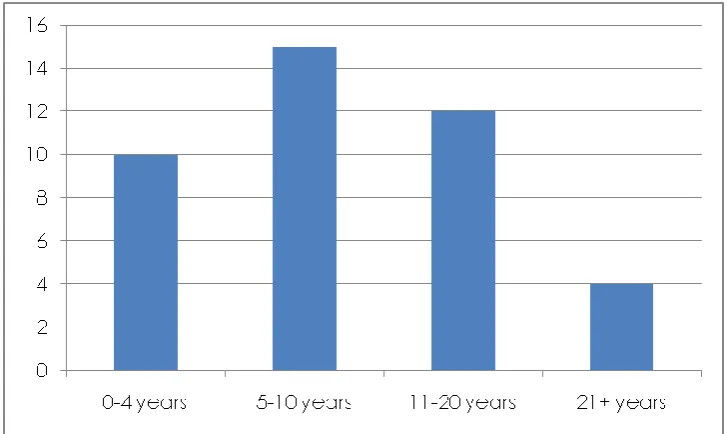
Figure 1. Number of Years Working in Area Related to Science Communication (n=41)
As this was the first symposium of this type organised by the Science Communication Unit we felt it useful to probe attendees on their motivations for attending. For the majority of attendees the ‘opportunity to network’ was central. 30 attendees suggested this had been one of their main motivations for attending. This was closely followed by the opportunity to ‘advance knowledge of practical skills in science communication’ (n=17) and to ‘advance knowledge of theoretical approaches to science communication’ (n=14). Those attending also had a strong motivation for personal reasons such as ‘enjoyment and learning’ (n=12) and were attracted by ‘the reputation of the Science Communication Unit’ (n=12). Following this, the ‘advertised speakers’ (n=9) and professional motivations such as ‘CV or promotion’ (n=8) were also attractive to some. For the 10 delegates who had less than four years experience expectations are likely to have differed to other delegates. Popular responses amongst this group frequently referred to the opportunities to advance knowledge, the named speakers and the reputations of both the Wellcome Trust and Science Communication Unit, suggesting there may have been an expectation of a more traditional conference format amongst these delegates.
3.2Symposium Content
7
large number agreed or strongly agreed that the sessions provided were comprehensive (n=24) and had speakers of relevance (n=32). 21 delegates of 33 responding to a question on the parallel sessions found them useful and a similar number felt they were distinctive in content (n=25). Despite most delegates appearing to like the parallel session format they did not necessarily suggest more should be added and only a limited number (n=12) felt more parallel sessions should be introduced. In some open responses a number of delegates said they had been disappointed to miss other speakers during some parallel sessions. Although most felt the speakers included were of relevance, 23 attendees agreed or strongly agreed that a wider variety of speakers could be included. This could be due to speakers being invited only for this first symposium, which meant that some delegates who might have liked the opportunity to contribute more formally were not able to or relate to the suggestions provided later for other areas of content in future events.
As the symposium was aimed at experienced professionals we were interested to probe delegates on the relevance of the sessions’ content and the format of a number of the sessions. The programme had been designed to allow a considerable time for discussion and during some sessions invited speakers were asked to speak for very short periods or to provide an ‘agitator’ stance to spur a chaired discussion. The majority of delegates responding to a question on the ‘level’ of the sessions suggested it had been appropriate. 27 agreed and 5 strongly agreed that the session content was relevant for experienced science communicators, although small numbers did disagree (n=4) or strongly disagree (n=1). There was also a strong level of agreement that sessions had good opportunities for discussion (n=37), though again for some this was too much and 5 delegates felt the sessions were too discussion based or consensus based:
‘Debates need to be more controversial. Too much agreement. Difficult issues were largely dodged.’
8
‘demonstrating impacts’ (n=20), ‘sustainable futures’ (n=24) and ‘reflections and next steps’ (n=30).
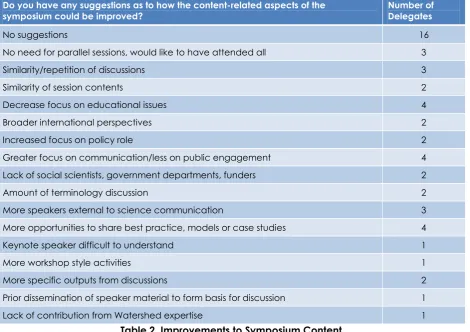
Due to the symposium format being somewhat novel and running for the first time we were very keen to hear how attendees would like to see content aspects changed or developed in the future. 16 delegates made no suggestions but a number of useful and mainly constructive comments were provided. These open responses have been themed in Table 2 below.
Do you have any suggestions as to how the content-related aspects of the
symposium could be improved? Number of Delegates
No suggestions 16
No need for parallel sessions, would like to have attended all 3
Similarity/repetition of discussions 3
Similarity of session contents 2
Decrease focus on educational issues 4
Broader international perspectives 2
Increased focus on policy role 2
Greater focus on communication/less on public engagement 4
Lack of social scientists, government departments, funders 2
Amount of terminology discussion 2
More speakers external to science communication 3
More opportunities to share best practice, models or case studies 4 Keynote speaker difficult to understand 1
More workshop style activities 1
More specific outputs from discussions 2
[image:8.595.66.537.268.600.2]Prior dissemination of speaker material to form basis for discussion 1 Lack of contribution from Watershed expertise 1
Table 2. Improvements to Symposium Content
Common suggestions included increasing the focus on communication, decreasing the focus on educational issues and providing more opportunities for sharing of projects and best practice. These are reiterated in the open comments provided:
‘Overall I enjoyed the conference but I felt the breadth of subjects was not broad enough. More practical tips for communicators would have been more useful’
9
should be given to steer the discussions away from topics that dominate.’
Creating opportunities for speakers to suggest topics themselves and apply for an opportunity to speak at future symposiums may resolve some of these issues.
3.3Symposium Organisation
Organisational aspects of the symposium appeared to meet the majority of
delegate’s requirements.
The symposium was too short Number of Delegates
Strongly Agree 4
Agree 9
Disagree 24
Strongly Disagree 2
Total 39
Table 3. Symposium Length
The symposium appeared to be about the right length for the majority of people, as indicated in Table 3 and by the following comment:
‘2 half days worked really well’
Only two delegates suggested it had been too long and only one delegate made a specifically negative comment on the two half-day format, suggesting this was not an efficient use of time.
An appropriate amount of information was provided in advance Number of Delegates
Strongly Agree 2
Agree 22
Disagree 15
Strongly Disagree 0
[image:9.595.165.434.261.390.2]Total 39
Table 4. Information Provided in Advance
10
comments related to this point. Suggestions included: more information be provided on parallel sessions in advance to aid decisions on what to attend; that the delegate list be distributed in advance to support targeted networking; and that an outline of speakers’ presentations be provided in advance, which could help delegates prepare points and ideas for the discussion. With regards to organisation during the delivery of the symposium itself there appeared to be a high level of satisfaction, although the need for roving microphones was mentioned as a useful addition should the symposium occur again in future.
The symposium was well organised during its delivery Number of Delegates
Strongly Agree 19
Agree 19
Disagree 2
Strongly Disagree 0
Total 40
Table 5. Organisation During the Symposium
The number of delegates was appropriate Number of Delegates
Strongly Agree 14
Agree 25
Disagree 1
Strongly Disagree 0
Total 40
Table 6. Number of Delegates
The number of delegates was deliberately limited by the organisers, in part due to the aim of attracting experienced delegates and to have an appropriate group size for discussion. The total number of delegates appeared very popular with those attending, with only one delegate suggesting it was inappropriate and a number of positive comments were collated in terms of the delegates attending:
‘Great to meet old faces and some new ones too. Good to have small groups to ease discussion.’
‘The sessions were really good but the spaces in between were equally
11
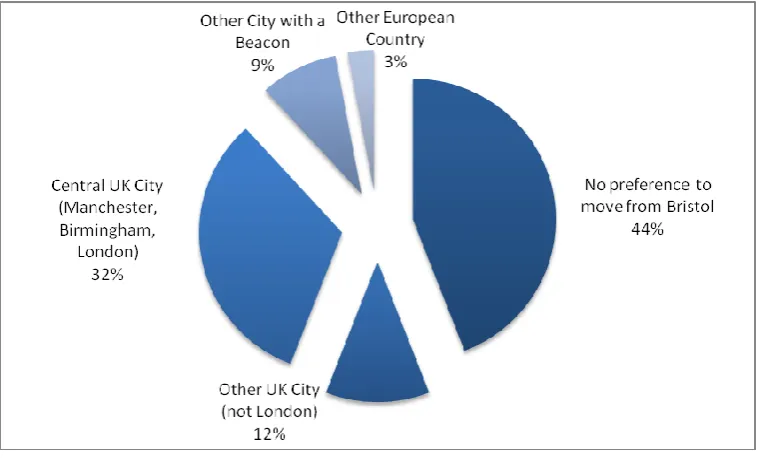
[image:11.595.109.489.223.452.2]Bristol also proved very popular as a location, with many strongly agreeing (n=15) or agreeing (n=23) that it had been a good location. One delegate very usefully mentioned that the location may have deterred or inconvenienced some international attendees, who may have had to arrange additional transportation or travelling time from London-based airports. When asked where they might like future symposiums of this type to be located a number of options were suggested, as demonstrated in Figure 2.
Figure 2. Suggested alternative locations for the symposium (n=34)
44% (n=15) said they had no preference to move it from Bristol, 32% (n=11) suggested it could move to other centrally located cities such as Manchester, Birmingham or London, 12% (n=4) suggested it should move to centrally located cities but specifically not London, 9% (n=3) thought it could move to a different Beacon for Public Engagement location and 3% or one person suggested it move to a different European country.
12
3.4 Future Symposia
Of the 36 who responded to a question on future attendance, 31 attendees said they would attend the symposium again, should it occur in future. 5 people said that they would not. As to how frequently such an event could occur, the majority suggested every other year (n=17), closely followed by annually (n=13). Replicating the generally positive perception of its organisation in 2009, a number of delegates (n=14) suggested the Science Communication Unit, UWE were most appropriate to organise a future symposium:
‘The SCU is well placed, as an academic group they are not tied to one discipline within science and have a good overview of both theory and practice’.
Other organisations recommended included the Wellcome Trust (n=5), The Beacons for Public Engagement or National Coordinating Centre for Public Engagement (n=3), British Science Association (n=2), Kings College London (n=2), Ecsite (n=2) or RCUK (n=2).
13
3.5Impact
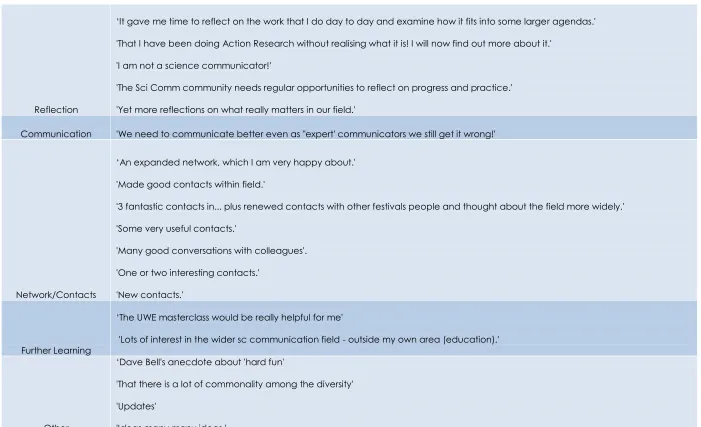
As the symposium was purposefully trying to be innovative and different to other opportunities for shared learning in the field, a series of open questions within the evaluation sought to identify the initial reactions and reflective insights of those involved. Firstly, attendees were asked to list three words they would use to describe the symposium content. Table 7 demonstrates the words provided in terms of popularity. The most frequently occurring words included ‘interesting’, ‘thought-provoking’, ‘challenging’ and ‘relevant’. There were a number of contrasting words provided by different individuals, for example theoretical vs. practical and some which were quite critical of aspects of the content. Overall, the words represent the diversity of expectations and reactions felt by attendees.
Word
Number of Delegates
Interesting 9
Thought-Provoking 7
Challenging 5
Relevant 4
Informative, Stimulating, Provocative, School/student Focussed, 3 Timely, Evaluation, Surprising, Friendly, Useful, Varied, Engaging, Thoughtful, Repetitive 2
Milestone, Imaginative, Important, Relationship Building, Targeted, Discursive, Informed, Topical, Learning, Education, Museums, Public Engagement, Small, High-Level,
Comprehensive, Dynamic, Involving, Well-organised, Theoretical, Uncertainty, Responsibility, Practical, Social, Ben Gammon, Orthodox, Appropriate, Thematic, Familiar, Authoritative, Fresh, Interpretive, Insightful, Diverse, Frustrating, Abstract, Unacademic, Inconclusive,
Non-Controversial, Depressing, Shallow, Light-Weight, Unfocussed, Self-Indulgent, Disjointed. 1
Table 7. Three words used to describe the symposium content
14
Definitions
‘The field is at a turning point and will distil into clear strands of activity, with no person being able to label themselves a "science communicator".'
'That 'science communication' needs to be better defined.'
'Deeper appreciation of views some people hold about what 'science communication/public engagement with science' is and isn't!''
Aims
‘I have a lot of work to do trying to clarify why we are doing what we are doing!'
'That "science communication" has potential to grow down two divergent paths: one which enhances the cultural experience of science, and the other which takes a more political/activist approach. Currently there are practitioners who straddle both camps, but this may become more difficult over time.'
'To clearly define what you are doing & why!'
'That Science Communicators can't define the point of their existence'.
'We are not clear as a professional field when we talk about science communication/public engagement - some sub categories need to be defined to encompass all our motivations.'
Evaluation
Made me go away and reassess how we approach evaluation and what is realistic!'
'The potential usefulness of adopting a common evaluation framework - be that GLOs or something else.'
'The importance of effective evaluation.'
'Evaluation is the biggest problem still, we need to consider techniques and validity of these.'
'Serious consideration of why/how to evaluate.'
Impacts 'That it is difficult to assess the long term impacts of science communication.'
Critique
‘That I should be more critical of my own work and encourage criticism of others'. In a nice way of course!'
15
Reflection
‘It gave me time to reflect on the work that I do day to day and examine how it fits into some larger agendas.'
'That I have been doing Action Research without realising what it is! I will now find out more about it.'
'I am not a science communicator!'
'The Sci Comm community needs regular opportunities to reflect on progress and practice.'
'Yet more reflections on what really matters in our field.'
Communication 'We need to communicate better even as "expert' communicators we still get it wrong!'
Network/Contacts
‘An expanded network, which I am very happy about.'
'Made good contacts within field.'
'3 fantastic contacts in... plus renewed contacts with other festivals people and thought about the field more widely.'
'Some very useful contacts.'
'Many good conversations with colleagues'.
'One or two interesting contacts.'
'New contacts.'
Further Learning
‘The UWE masterclass would be really helpful for me'
'Lots of interest in the wider sc communication field - outside my own area (education).'
Other
‘Dave Bell's anecdote about 'hard fun'
'That there is a lot of commonality among the diversity'
'Updates'
[image:15.842.70.771.68.495.2]'Ideas many many ideas.'
16
Finally, attendees were asked for any general comments on the symposium. In addition to some comments reiterating content or organisational aspects which have been covered elsewhere, a number gave a broader perspective on their experience of the symposium. These were not all positive and suggested for some the symposium did not meet their expectations, but they were often reflective and recognised that the symposium had attempted to achieve something different. A selection of the comments are presented here:
‘This was a landmark meeting and really captured the current moods and thinking with regard to communicating science. It is very different from the BA/RoyalSoc conference and has a unique role in offering critical academic viewpoints and analysis. The participant mix was very good and I certainly had many challenging and thought-provoking ideas. More importantly, I am still chewing over and thinking through the material. The event itself was a model of communication best practice. The variety of session styles worked fantastically well, the frank and open discussions led to real conclusions and it was good that the event was recorded and edited. Location was superb and it was great to take part. Brilliant. Well done.’
‘I would not have attended if I had known the event was geared around public engagement. The terms 'science communication' and 'public engagement' seemed to be used interchangeably, which needs to be addressed. Also, all anyone seemed to want to discuss was evaluating science communication events and pretty much every discussion moved back towards this (whatever the topic of the session).’
‘I felt this was one of the more useful conferences I have attended (in the sense of useful sessions rather than useful for networking). There were some genuinely thoughtful discussions and the standard of contributions was uniformly high.’
‘I left the symposium with a great sense of dismay. A lot of the discussions seemed to end up with very similar themes; have we made any progress in the last 10 years? are we all just wasting our time? However, having reflected on the themes that came up, I now feel much more positive and am really looking forward to tackling the ideas and issues that arose which will hopefully make my own work much more solid and meaningful and remove a lot of vagueness! I think I was hoping to leave with some really good ideas of how to move forwards in our work but I didn't, it felt like I had taken step
17
4. Conclusions and Recommendations
The symposium was designed for professionals in the field and was successful in reaching a majority of delegates with at least five years science communication experience. However, future similar symposiums should be mindful to market and recruit to delegates carefully. Ten delegates had less than four years experience and in some comments there was a sense that their expectations of such an event may not have been met.
The symposium aimed to provide a platform for discussion between experts in both the practitioner and academic communities. Delegates were supportive and appreciative of the opportunities for discussion, both formally within sessions and informally during breaks. However, the speaker and delegate list for future symposiums could represent a greater diversity of fields, both to encourage more shared learning and to avoid discussions or sessions returning to similar subjects.
18
Recommendations
Based on the successes and challenges identified within the 2009 Evolving Science Communication Symposium the following recommendations have been identified for future similar events:
1. Market and recruit delegates with an appropriate level of science communication experience
2. Speakers and delegates to future symposiums should represent a greater diversity of fields
3. Future symposiums should be reactive to the current suggestions and concerns of the science communication community in terms of content 4. The overall success of the event and positive reception of the community
19
5. Appendix:
Evolving Science Communication Symposium ProgrammeThursday 26th March 2009
12.30 Lunch and Registration
13.30 Welcome and Housekeeping
13.45 Keynote Address
Andrea Bandelli
14.30 Collaboration
Paul Cox Karen Bultitude Chair: Gillian Rendle
Demonstrating Impacts
Ben Gammon David Shakespeare
Chair: Ros Mist
15.30 Break
16.00 Evolution
Roland Jackson Derek Bell Chair: Karen Bultitude
17.30 Drinks Reception
Friday 27th March 2009
09.00 Coffee
09.15 Repositories of Knowledge
Sophie Duncan Juliet Upton Chair: Maggie Leggett
Adaptation
Wendy Sadler Jan Riise Chair: Kat Nillson
10.15 Break
10.45 Sustainable Futures
Savita Custead Lesley Patterson Catherine Aldridge
Justin Dillon
Chair: Helen Featherstone
12.15 Summary, reflections and next steps
Frank Burnet Chair: Clare Wilkinson
20
Overview of Session Contents:
Adaptation - within venues, cultures and contexts
A showcase of science communication activities that have successfully moved on from their initial focus by transferring to new venues, cultures and contexts. Speakers will highlight how and why these activities were able to adapt to their new circumstances.
Evolution - exploring public engagement as an evolution of or addition to public understanding of science
This session is a chance to explore the bigger picture of science communication. Speakers will unpick current thinking on the relationships between public understanding of science, science communication, and public engagement with science and technology.
Models of Collaboration - relationships for success including partners, consortia and
contagiousness of ideas and project formats
Speakers in this session will discuss relationships and how they contribute to successful projects. Case studies will be used to demonstrate different relationships and how they affect projects.
Demonstrating Impacts - impact vs. metrics, going beyond evaluation
Evaluation of science communication projects is now the norm, but what does evaluation tell us about the impacts of these activities on participants and deliverers? Speakers in this session will discuss the latest thinking on capturing the impacts of science communication activities and how this links to evaluation.
Repositories of Knowledge - sharing knowledge to avoid reinventing the wheel
How are projects and activities recorded and documented so others can learn from experience? Speakers will examine existing instances of documentation and sharing knowledge whilst looking at how this can be taken forward in the future.
Creating a Sustainable Future for Science Communication - forming partnerships, linking theory and practice
In this discussion session four agitators with controversial or challenging views will stimulate conversations about the future direction of science communication. All delegates will be invited to contribute.
In addition an informal dinner was held on Thursday 26th March to provide an