Science for Environment Policy: Internal Evaluation Report
Clare Wilkinson and Ann Grand
Science Communication Unit, University of the West of England, Bristol
Contents
Contents ... i
Executive Summary ... 1
Evaluation Background ... 4
Evaluation Method... 9
Results – User Survey ... 11
Results – Researchers’ survey ... 22
Summary and Recommendations ... 31
References ... 35
ii Tables:
Table 1 Work profile of users ... 12
Table 2 Services used regularly or occasionally ... 13
Table 3 Access routes by country ... 14
Table 4 Uses for Science for Environment Policy outputs by audience ... 17
Table 5 Uses for SfEP outputs by access route ... 18
Table 6 Contact as a result of research featuring in media ... 25
Table 7 Outcomes of work appearing in media ... 26
Table 8 Comparative table for news services ... 39
Figures: Figure 1 Awareness of services ... 16
Figure 2 Values of Science for Environment Policy ... 19
Figure 3 Country of origin of respondents ... 23
Figure 4 Comparison of researchers' interests and topic coverage ... 24
Figure 6 Opinion of potential outcomes of work appearing in Science for Environment Policy... 27
Figure 7 Change in routes used for dissemination to academic audiences over the last five years ... 29
1
Executive Summary
Science for Environment Policy is a free news and information service, designed to help policy-makers keep up to date with the latest environmental research that supports the design, implementation and regulation of effective policies. It was established in 2005, when it comprised only an emailed bulletin (the ‘News Alert’) and an online archive for News Alert articles. Science for Environment Policy has since expanded to offer a range of outputs including special Thematic Issues, an online database of policy-relevant studies (the ‘Research Repository’), briefing papers on emerging topics (‘Future Briefs’) and In-depth Reports on key policy topics.
Some of these outputs can be accessed via several routes. For example, articles featured in the News Alert can be viewed in the emailed bulletin, on the web site and in RSS feeds. A selection of articles is also posted in a Twitter feed designed to promote Science for Environment Policy. In May 2012, the News Alert had approximately 14,350 subscribers, the Twitter feed had 850 followers and the website, which houses the publications archives and Research Repository, received 70,714 visits.
This report details the key findings of an evaluation to assess: how the Science for Environment Policy service has responded to users’ needs, with particular attention to the effects of new services and access routes introduced in recent years; how the emerging issue of the importance of the impact of academic research has affected researchers whose work has been featured in the service’s publications; and what possible opportunities exist to embed and measure the impact of the Science for Environment Policy service in future. The data for this evaluation were collected via online surveys of users (441 respondents) and researchers (149 respondents) and through desk research.
2
Key conclusions
1) Users value the Science for Environment Policy Service; 95% of respondents are content with the coverage of topics offered.
2) Users are happy with the variety of routes that Science for Environment Policy offers for accessing information and for how it creates varied opportunities for users to connect with research. Seventy-three per cent of respondents use multiple routes to access the service, although the majority still use the weekly emailed News Alert.
3) There are some differences between audiences and the access routes they use; users in industry/business, the media and NGOs tend to use the Twitter feed more than other users; users in government organisations tend to use the emailed News Alert more.
4) There is a good general level of awareness of the different access formats; over a third of respondents are aware of each of the different services offered.
5) Regarding the newer services (Thematic Issues, Future Briefs, Research Repository) and access formats (RSS Feeds and Twitter), respondents were largely positive.
6) Users draw on Science for Environment Policy in a number of ways. The most common use is for general interest and to keep up with developments, but many also use it to find original publications, to convey information to colleagues and as a resource for their own work.
7) Users agreed that the Science for Environment Policy service made it easier to use science in policy-making, helping them understand the scientific aspects of policy issues and keep track of the latest scientific research.
8) Researchers were largely positive about the outcomes of their work being featured in Science for Environment Policy and most positive about outcomes that could increase the impact of their research: bringing it to the attention of people in important organisations, policy-makers, audiences beyond their home country and members of the public.
3
Key recommendations
The Science for Environment Policy service could consider:
1) Maintaining the breadth of content covered to continue to appeal to users, whilst concurrently, taking care to maintain relevant information.
2) Maintaining a variety of access routes, to continue to appeal to different types of users, including policy-makers. Targeted evaluation of different users and the route they are using may continue to refine understanding of how different services meet different user needs.
3) Improving the visibility of newer access formats – for example using conventional Twitter icons and creating a direct link to article archives.
4) New access formats are appealing and have usability for audiences; aspects could be refined as they continue to develop. Consideration needs to be given to whether policy implications are more clearly highlighted in Future Briefs and the range of research in the Repository expanded,
5) Better supporting users and researchers to participate in onward dissemination of articles, for example by providing ready-to-tweet descriptions and offering encouragement to re-purpose published materials.
6) Communicating to researchers the benefits of having their research featured in an article in Science for Environment Policy, for example the connections with policy-makers.
7) Encouraging researchers to disseminate the final Science for Environment policy article through their personal and occupational networks, thus increasing researchers’ engagement with the service and raising awareness of Science for Environment Policy more widely.
4
Evaluation Background
Science for Environment Policy
Science for Environment Policy is a free news and information service published by the Directorate-General for the Environment, European Commission, designed to help the busy policy-maker keep up-to-date with the latest environmental research findings needed to design, implement and regulate effective policies. Managed by an editorial team based at the Science Communication Unit (SCU), in the University of the West of England, Bristol, (UWE) UK, since 2007, its content is produced by staff writers, who consult with scientific advisors to provide the latest in contemporary environmental research.
Science for Environment Policy has expanded over the years to capture a variety of activities and outputs. Information services now provided include:
1) Science for Environment Policy News Alert
A weekly email bulletin with accessible summaries of key studies across a range of environmental topics
2) Thematic Issues
Special issues focussing on a current policy topic, containing accessible summaries of studies and with a guest editorial; introduced in 2008.
3) Future Briefs
Policy briefs exploring the evidence around emerging environmental issues; introduced in 2011.
4) Research Repository
Online database of policy-relevant environmental research results; introduced in 2011.
5) In-depth Reports
5 The service has expanded into areas of social media, for example by including options such as RSS feeds for News Alert articles and Thematic Issues and a Twitter account that draws attention to Science for Environment Policy’s publications as well as to related news stories of interest to its audience.
In May 2012, the Science for Environment Policy News Alert had 14,350 users. Users do not subscribe separately to the various web-based services, such as the Archives and Research Repository, but between March and May 2012, the ‘latest News Alert’ page received 2660 visits, the Research Repository 934 visits and the 2012 Archive of News Alert and Thematic Issue articles page approximately 150 visits.
The Twitter feed had 850 followers in May 2012; no data are currently available for the numbers of users to the RSS feeds. The 33 Thematic Issues so far published since 2008 had collectively been downloaded 10,795 times between March and May 2012 – an average of 328 times each, and the three Future Briefs so far published had been collectively downloaded 11,528 times – an average of approximately 3800 each.1
The In-depth Reports were made publicly available in late May 2012. Between June and July 2012 the three Reports so far published had been collectively downloaded 3373 times, an average of approximately 1100 times each.1
1
6
Previous Evaluations of Science for Environment Policy
Science for Environment Policy has been regularly evaluated since its inception. While under contract to UWE it has been evaluated both internally (2009) and externally by The Evaluation Partnership (2007/2010). Past evaluations have highlighted a variety of outcomes, including:
The service is successful in reaching its target audience (2007)
Levels of satisfaction with the service are high (2009)
The service provides readable and interesting information (2007)
Issues are covered which are internationally relevant (2009)
The service provides new, timely and up-to-date news (2007)
Science for Environment Policy is cited as one of the top three sources of information on environmental issues (2010)
News Alert subscribers recommend the service to others (2007)
The service is marketed via websites, emails and word of mouth (2007/2009)
Users are more concentrated within certain areas of the European Union, mapping to numbers of scientifically-trained staff per capita (2010)
7
Evaluation Context
Research communication and the impact of new technologies are changing the way research conclusions are communicated, at the same time as demands for greater access to information are increasing (Royal Society, 2012). Researchers can use a variety of strategies to disseminate the outputs of their research and audiences and users (such as policy-makers) can access outputs through a variety of routes. As well as traditional media such as newspapers, radio and television, users can access information via open access academic journals, disciplinary repositories, institutional repositories and personal websites (Harley, et al., 2010). In addition, social media offer opportunities for more immediate communication and discussion.
This multiplicity of routes, while making a wider range of research available to policy-makers, could also lead to users being overloaded with information, unsure of the veracity or validity of the content, or whether the information has been scrutinised by professional reviewers and editors (Keen, 2008). Previous evaluations of the Science for Environment Policy service have shown that the filtering and digesting of information offered is a highly valued aspect of the service, especially by policy-makers and non-academic audiences. Researchers also value the link the service makes between their research and policy-makers (The Evaluation Partnership, 2010; Wilkinson & Weitkamp, 2009).
The ‘impact’ agenda, whereby researchers are under increasing pressure to demonstrate the economic and social implications of their work (HEFCE, 2010; Research Councils UK, n.d.) has evolved during the lifetime of the Science for Environment Policy service. This increases opportunities for services such as Science for Environment Policy to assess the impact their service is having on their users. To effectively and efficiently serve their users, services must develop measures that enable them to answer the questions of who are the people who are engaging with the service, whether the service’s engagement with its users is effective, if the service is meeting the users’ needs and if the service’s content development strategy is effective.
8 diversified and responded to user needs via the introduction of a series of new formats, in addition to considering the issue of impact. In the context of this evaluation, impact is considered in terms of the uses, actions and implications that the service has for both users and researchers.
Aims and Objectives of the Evaluation
The aims of this evaluation were:
to assess how Science for Environment Policy has diversified and responded to users’ needs, with reference to the introduction of a new access formats
to assess how Science for Environment Policy is meeting researchers’ needs to reach and have an impact on policymakers
The objectives of the evaluation were:
to assess the current impact of Science for Environment Policy on users, particularly those engaging with different areas of the service (e.g. News Alert, Thematic Issues, Research Repository, via new media) via an online survey
to assess the current impact of Science for Environment Policy on researchers featured since 2011, via an online survey
9
Evaluation Method
We collected data through two online surveys; one aimed at current users of the service, the other at researchers whose work has been featured in the service. We chose the online survey approach as a way to maximise the number of respondents. While the use of online surveys has some limitations, there is evidence to suggest that it is effective in eliciting rapid, detailed and honest responses from participants, with good data reliability (Rowe & Gammack, 2004; Ritter, et al., 2004). Online surveys are also effective in recruiting multi-national participants.
The data were analysed using SPSS19. The evaluation had ethical approval from the UWE Research and Governance system.
The surveys were written in English, using SurveyMonkey® software, and comprised a mixture of closed and open questions. (Copies of both questionnaires are included as Appendix 3.) Informal testing suggested that the surveys would take around ten minutes (users) and fifteen minutes (researchers) to complete.
We promoted the users’ survey to subscribers to the News Alert, Thematic Issues, RSS feeds and Twitter feed, and online to users of the Archive (of articles, Future Briefs, In-depth Reports and Thematic Issues) and the Research Repository. It was mentioned in four consecutive issues of the News Alert, in two consecutive Thematic Issues, linked from key pages on the website (home page, latest News Alert, Thematic Issues, Research Repository and Future Briefs), announced in an RSS feed (twice) and posted on Twitter (three times). We sent a reminder email to News Alert subscribers after approximately two weeks, with a direct link to the survey. The survey was launched in mid-May 2012 and remained open for four weeks, until early June 2012. This survey did not cover In-depth Reports, as they were not publicly available at the time of the survey design.
10 included brief details of the purpose of the survey. We sent a reminder email in mid-July and the survey remained open until late mid-July.
11
Results – User Survey
In total, we received 458 responses from service users. Of these, 17 were removed from the dataset before analysis because none of the questions had been answered. This left 441 responses for analysis. At the time, Science for Environment Policy had just over 14,000 subscribers; a response rate of approximately 3.1%.
Response rates to surveys are affected by a number of factors, including the topic of the survey, the target population and the length of the questionnaire (Bethlehem, 2009). While for web-based surveys, response rates are known to be highly variable, ranging from 1 to 80% (Deutskens, et al., 2004; Ray, 2008), in small-scale research, surveys involving between 30 and 250 respondents are frequently accepted (Denscombe, 2005).
Overall, users valued the Science for Environment Policy service and would like to see it extended into other areas:
Great and highly valuable service. Many thanks and keep on going! (User 260)
I could not work without the Science for Environmental polisy! Thank you very
much! (User 72)
It would be really useful to provide the identical e-mail services in other fields.
(User 29)
Demographics and coverage
12
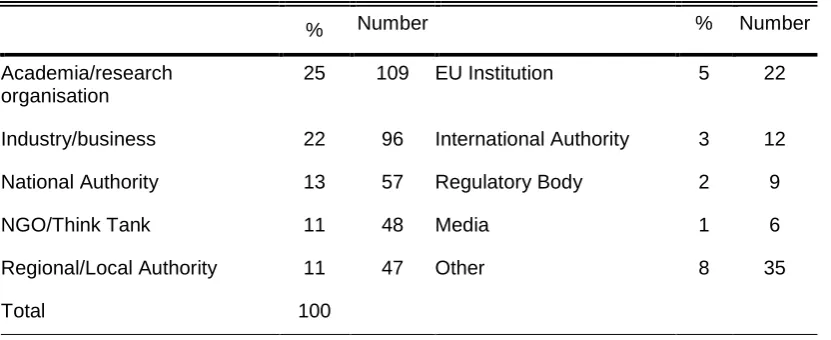
Table 1 Work profile of users
% Number % Number
Academia/research organisation
25 109 EU Institution 5 22
Industry/business 22 96 International Authority 3 12
National Authority 13 57 Regulatory Body 2 9
NGO/Think Tank 11 48 Media 1 6
Regional/Local Authority 11 47 Other 8 35
Total 100
Also as in 2010, the majority of respondents (84%, n=371) worked in EU Member States. The single largest group of respondents (23%) came from the UK, with the next largest single-country group coming from Belgium (13%). A relatively large percentage (16%) of respondents, spread across 23 countries, worked outside the EU.
Users were largely (95%, n=411) content with the coverage of topics offered by Science for Environment Policy. This was true whichever routes for access they used. However, a significant minority, (44%, n=180) considered that the service only occasionally provided relevant information. A small number (n=27) of users offered suggestions for topics they felt were overlooked; for example, more policy-related themes, including public engagement in science and environmental policy and the impact of policy implementation (n=5), biodiversity (n=2), air quality (n=3), links between environment & health (n=2), climate change (n=2), environmental management (n=5) and future energy technology (for example fracking, hydrogen cells and fuel cells) (n=3)).
Accessing the service
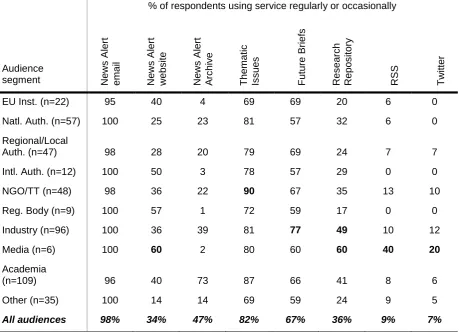
13 By far the most common means by which users accessed the service (see Table 2) was through the News Alert; 98% (n=414) of respondents regularly or occasionally accessed the service via this route. The Thematic Issues and Future Briefs are also well-used by all audiences.
Table 2 Services used regularly or occasionally
% of respondents using service regularly or occasionally
Audience
segment News
A lert em a il News A lert webs it e News A lert A rc hi v e T he ma ti c Is s ue s F utu re B ri efs Res ea rc h Repo s itory RS S T wi tte r
EU Inst. (n=22) 95 40 4 69 69 20 6 0
Natl. Auth. (n=57) 100 25 23 81 57 32 6 0
Regional/Local
Auth. (n=47) 98 28 20 79 69 24 7 7
Intl. Auth. (n=12) 100 50 3 78 57 29 0 0
NGO/TT (n=48) 98 36 22 90 67 35 13 10
Reg. Body (n=9) 100 57 1 72 59 17 0 0
Industry (n=96) 100 36 39 81 77 49 10 12
Media (n=6) 100 60 2 80 60 60 40 20
Academia
(n=109) 96 40 73 87 66 41 8 6
Other (n=35) 100 14 14 69 59 24 9 5
All audiences 98% 34% 47% 82% 67% 36% 9% 7%
NB Respondents could select as many answers as appropriate
There are differences among the access routes used by different audiences. Those in civil society (industry and media users) use the Research Repository much more than other audiences. They are also (alongside users from non-governmental organisations (NGOs)) the strongest users of the ‘new’ formats (RSS feeds and Twitter), which are little used by audiences in government2 or academia. For media users, this is aligned with low levels of use of the Archive, suggesting that for some users (media, industry and NGOs) the new formats are meeting their need for access to timely updates on current research.
2
14 However, users in certain types of organisation may well be prevented from using social media software, which should be borne in mind:
Don’t use twitter and rss feeds because work IT system doesn't allow access
(User 48)
Whilst we would find it useful our organisational policy prohibits us from using
[image:18.595.76.531.248.549.2]RSS feeds, twitter etc. (User 434)
Table 3 Access routes by country
Only the ten highest-responding countries, plus the ‘other’ block, are shown
% of respondents regularly or occasionally using different access routes
News A lert em a il News A lert webs it e News A lert A rc hi v e T he ma ti c Is s ue s F utu re B ri efs Res ea rc h Repo s itory RS S T wi tte r
Sweden (n=10) 100 10 30 90 60 30 10 10
Greece (n=13) 100 23 54 69 54 46 15 0
Portugal (n=13) 85 23 38 77 54 31 0 0
France (n=16) 100 6 19 44 38 13 13 0
Spain (n=23) 100 17 43 61 26 13 4 9
Italy (n=24) 96 29 25 54 42 21 4 8
Netherlands (n=26) 96 19 27 69 54 19 4 4
Germany (n=26) 100 15 31 62 35 27 12 8
Belgium (n=55) 95 33 27 69 45 13 4 0
UK (n=97) 97 21 26 59 52 19 2 6
Other (n=67)* 96 16 36 58 49 27 6 1
NB (i) respondents could select as many options as appropriate
(ii) respondents who selected no access routes were excluded
*Excludes respondents who gave an EU country and an ‘other’ country
15 The pattern is similar if we compare access routes by country (see Table 3). Again, access via the email alert is the most common route across all countries, followed by access via the Thematic Issues. Access via Twitter is consistently lowest.
Awareness
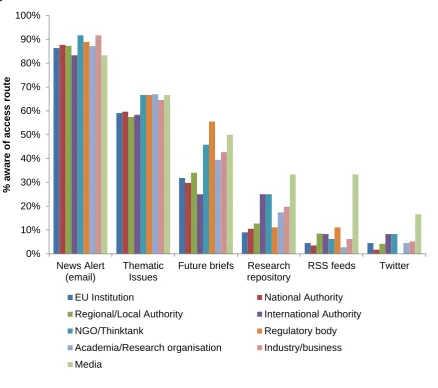
There was a good level of awareness of all the access routes offered by Science for Environment Policy; no service had an awareness level of below 40%. There was particularly high awareness of the emailed News Alert at 94% (n=399) and Thematic Issues at 75% (n=323). Over half of respondents (57%, n=243) were aware of the Future Briefs. However, awareness of the other newer services was somewhat lower: RSS feeds (49%, n=212), Research Repository (42%, n=183) and Twitter (42%, n=177). For the Twitter stream, this may be due to low visibility, given that the link is text, rather than the more conventional icon:
Consider yourself followed on Twitter! Would have done so earlier if I had
known! (User 262)
16
Figure 1 Awareness of services
Uses of information
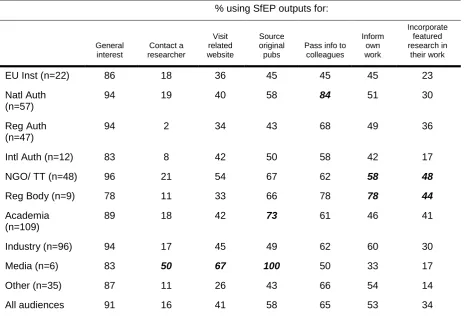
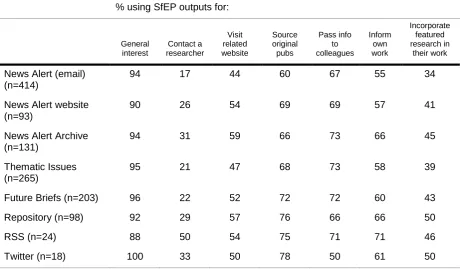
Across all audiences, by far the most common use for the Science for Environment Policy service was for general interest and to keep up with developments. High percentages also used the service to find original publications (58%), to convey information to colleagues (65%) and as a resource for their own work (53%).
There are some differences between audiences. Users working in the media were the most likely to use the services as a route to access research and to gather background information – to access original publications (100%), contact researchers (50%), or visit a related website (67%). However, it should be borne in mind that this group of users was very small (n=6). Those working in academia or research were also likely to use the service to access publications (73%). Those working in national authorities made use of the outputs to pass information to their colleagues (84%). Users in policy-oriented audiences (regulatory bodies and
0% 10% 20% 30% 40% 50% 60% 70% 80% 90% 100%
News Alert (email)
Thematic Issues
Future briefs Research repository
RSS feeds Twitter
%
aw
ar
e
o
f
ac
ce
ss
r
o
u
te
EU Institution National Authority
Regional/Local Authority International Authority
NGO/Thinktank Regulatory body
Academia/Research organisation Industry/business
17 NGOs/think tanks) were more oriented to re-purposing outputs, by using them within their work or to support it. See Table 4.
Table 4 Uses for Science for Environment Policy outputs by audience
% using SfEP outputs for:
General interest
Contact a researcher
Visit related website
Source original pubs
Pass info to colleagues
Inform own work
Incorporate featured research in
their work
EU Inst (n=22) 86 18 36 45 45 45 23
Natl Auth (n=57)
94 19 40 58 84 51 30
Reg Auth (n=47)
94 2 34 43 68 49 36
Intl Auth (n=12) 83 8 42 50 58 42 17
NGO/ TT (n=48) 96 21 54 67 62 58 48
Reg Body (n=9) 78 11 33 66 78 78 44
Academia (n=109)
89 18 42 73 61 46 41
Industry (n=96) 94 17 45 49 62 60 30
Media (n=6) 83 50 67 100 50 33 17
Other (n=35) 87 11 26 43 66 54 14
All audiences 91 16 41 58 65 53 34
NB Respondents could select as many answers as appropriate
A small number of users (n=35) offered a range of further uses to which they had put the service’s outputs, including using it as background material for grant applications, for teaching, in internal and external policy development and for re-posting on social media services.
18
Table 5 Uses for SfEP outputs by access route
% using SfEP outputs for:
General interest
Contact a researcher
Visit related website
Source original pubs
Pass info to colleagues
Inform own work
Incorporate featured research in
their work
News Alert (email) (n=414)
94 17 44 60 67 55 34
News Alert website (n=93)
90 26 54 69 69 57 41
News Alert Archive (n=131)
94 31 59 66 73 66 45
Thematic Issues (n=265)
95 21 47 68 73 58 39
Future Briefs (n=203) 96 22 52 72 72 60 43
Repository (n=98) 92 29 57 76 66 66 50
RSS (n=24) 88 50 54 75 71 71 46
Twitter (n=18) 100 33 50 78 50 61 50
NB Respondents could select as many answers as appropriate
A small number of users would like to see even greater access to actual publications:
If an article is cited in research, it would be very good if that article could be
available for free. (User 209)
If I read a summary of research that is relevant to my work, I would like to have
full access to the original article. (User 81)
19
Value of the service
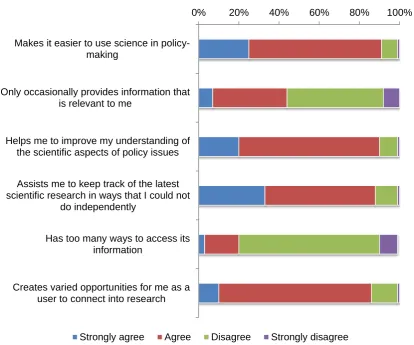
[image:23.595.78.493.246.591.2]Across all audiences, respondents valued the Science for Environment Policy service (see Figure 2). There was agreement that the service made it easier to use science in policy-making (91%, n=359); helps understanding of the scientific aspects of policy issues (90%, n=362); helps keep track of the latest scientific research in ways that are not possible independently (88%, n=359) and creates varied opportunities to connect into research (86%, n=327).
Figure 2 Values of Science for Environment Policy
Respondents did not feel the service offered too many ways to access information (79%, n=305).
However, their opinion on the relevance of the information provided by the service was more finely balanced. Given the range of audiences for the service (see Table 1) it is also possible that the response to ‘relevance’ reflects occupational relevance, rather than general interest. While 44% (n=180) agreed that the service only occasionally provided personally relevant information, 56% (n=226) disagreed with
0% 20% 40% 60% 80% 100%
Makes it easier to use science in policy-making
Only occasionally provides information that is relevant to me
Helps me to improve my understanding of the scientific aspects of policy issues
Assists me to keep track of the latest scientific research in ways that I could not
do independently
Has too many ways to access its information
Creates varied opportunities for me as a user to connect into research
20 this statement, suggesting that the service often offered them relevant information. This breadth of coverage can be seen as a strength of the service; 95% (n=411) of users were happy with the range of topics offered.
Views on individual services
Weekly News Alert via email
Over 90% (n=395) of respondents were aware of the weekly emailed News Alert service. However, this high figure must be seen in light of the fact that almost all the respondents (98%, n=432) were subscribers to the News Alert and therefore were likely to be aware of the News Alert. Of those who received the email alerts, almost all (97%, n=370) agreed this format was a convenient way to access research. Most respondents (90%, n=341) used the Alert selectively, reading fewer than half of the articles in full. Most (97%, n=369) agreed the variety of topics covered was relevant to policy-making and only 20% (n=75) wanted the issues to be covered in more depth.
Thematic Issues
Seventy-five per cent of respondents (n=323) were aware of the existence of Thematic Issues. Of those who had read an issue, 98% (n=265) agreed that they found the single-topic focus helpful. Eighty-five per cent (n=225) agreed that the Thematic Issues could usefully include more general articles and overviews of issues. Eighty-eight per cent (n=228) agreed that the independent editorials were interesting and only 14% (n=36) felt the Thematic Issues lacked depth.
Future Briefs
Fewer respondents (56%, n=243) were aware of Future Briefs. Almost all those who read the Future Briefs (97%, n=166) agreed they covered relevant emerging issues and were written at the right level (92%, n=153). Respondents felt they would be improved by including more consideration of policy implications (91%, n=151) and more references (72%, n=116).
Research Repository
21 many (69%, n=45) would like a wider range of topics. Although many (75%, n=51) felt that the cost of accessing original research was a barrier, none the less, 91% (n=60) felt that the quality of the research should be the deciding factor in its inclusion.
RSS Feeds
Respondents were equally divided between those who were (51%, n=212) and were not (49%, n=208) aware of the RSS Feeds service. Of the small number (n=18) of respondents who used this service, 84% (n=15) felt the themes were appropriate to enable them to select items of interest. Most (64%, n=11) would welcome the inclusion of a wider range of material. Although 64% (n=11) found RSS Feeds the most convenient way to access material, only 28% (n=5) used the RSS Feeds in preference to the emailed News Alert.
22
Results – Researchers’ survey
We sent an email request to participate in the survey to all first or corresponding authors whose papers had featured in News Alerts in 2011 (217) and between January–June 2012 (166). Where email addresses could be found, a request to participate in the survey was sent to all first or corresponding authors of research included in Future Briefs published in 2011 and through April 2012 (43) and In-depth Reports published in November 2011 and March 2012 (155). This means that 67% of requests were sent to researchers whose work had featured in News Alerts and 23% to researchers whose work had featured in Future Briefs or In-depth Reports. Fifty emails were returned as undeliverable and 27 as ‘out of office’, meaning the email was received by 504 researchers.
In total, we received 149 valid responses, with no incomplete responses; an overall response rate of 29%. Approximately 70% of the responses (n=105) were received from researchers whose work had featured in News Alerts and approximately 30% (n=44) from those featured in Future Briefs or In-depth Reports.
Like users, most researchers had a positive opinion about the value of Science for Environment Policy:
Good publication. All members of our Department read it. (Researcher 107)
Great service, I like that the articles are short and to the point to provide a quick
overview (Researcher 106)
Demographics
Most researchers (70%, n=105) were aware that their research had been featured in the Science for Environment Policy service before they received the invitation to participate in the survey, although rather fewer (17%, n=25) had heard of the service before their work was featured.
23
Figure 3 Country of origin of respondents
This pattern of respondents matches reasonably well with the geographical distribution of researchers whose work has featured in the News Alert. Data obtained from Science for Environment Policy show that approximately 67% of the (lead) researchers whose work was featured in the News Alert between November 2010 and December 2011 were from EU countries (25% of that group came from the UK and 10% from Spain) and 33% from 14 non-EU countries (50% of this group from the USA).
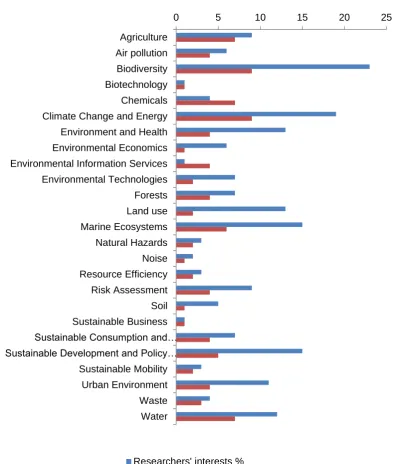
Respondents worked in a variety of research areas. The biggest single grouping was researchers in the general area of ‘biodiversity’ (see Figure 4).
Other 25%
Austria 5%
Belgium 1% Denmark
3% Finland
1% France
5% Germany
8%
Greece 1% Hungary
1% Italy
9%
Lithuania 1% Netherlands
5% Poland
1% Portugal
2% Romania
1%
Spain 13% Sweden
4%
24
Figure 4 Comparison of researchers' interests and topic coverage
NB Respondents could select up to three areas of research interest
0 5 10 15 20 25
Agriculture Air pollution
Biodiversity
Biotechnology
Chemicals Climate Change and Energy
Environment and Health
Environmental Economics
Environmental Information Services Environmental Technologies
Forests
Land use
Marine Ecosystems Natural Hazards
Noise
Resource Efficiency
Risk Assessment Soil
Sustainable Business Sustainable Consumption and… Sustainable Development and Policy…
Sustainable Mobility
Urban Environment
Waste
Water
Researchers' interests %
25
Impact of Science for Environment Policy
To assess the current impact of the service, we asked the researchers if, as a result of their work appearing in Science for Environment Policy, they had been contacted, for example, by policy-makers or members of the public (see Table 6). Approximately two-thirds of researchers (63%, n=146) had been contacted. There was no appreciable difference in figures for those whose work had appeared in any Science for Environment Policy publication (including the News Alert) compared to those whose work had appeared in the News Alert.
[image:29.595.70.536.445.638.2]For comparison, we also asked if they had been contacted by anyone as a result of their work featuring in other media. All respondents were asked if they had personally sought coverage of their work in traditional media,3 or personally used social media,4 as a means to disseminate their work. Of those who said they had sought coverage in traditional media (n=76), 93% (n=71) had had at least one contact as a result of their work appearing there. Of those who said they had personally used social media (n=36), 69% (n=25) had had at least one contact.
Table 6 Contact as a result of research featuring in media
SfEP (all publications)
% (n=146)
SfEP (News Alert)
% (n=105)
Traditional media
% (n=76)
Social media
% (n=36)
Researcher 44 42 32 11
Policy-maker 24 24 18 5
Member of the public 4 5 28 7
Journalist 9 10 40 6
Yes, but I'm not sure of their identity 11 10 1 3
Other 8 8 3 2
No, no one has contacted me 38 38 3 7
NB: Respondents could select more than one answer
3
For example newspapers, magazines, television and radio broadcasts
4
26 Thus, although the audience size for the Science for Environment Policy service is considerably smaller than the potential audiences for traditional or social media, and researchers will have featured only once, in comparison to other media where they may feature more regularly, it is relatively more effective at generating contacts and specifically, more effective at generating researcher–researcher and researcher– policy-maker contacts.
[image:30.595.81.526.327.628.2]In terms of other outcomes of research being featured in different media, the patterns for different routes are broadly similar, although use of social media routes is currently modest. Comparing Science for Environment Policy with traditional and social media, the most likely outcome of research featuring in any of these media is discussion with other researchers (see Table 7).
Table 7 Outcomes of work appearing in media
SfEP % (n=145)
Traditional media % (n=76)
Social media % (n=36)
Any outcome 48 88 64
invited to participate in a conference 11 26 7
discussed research with policy-makers 13 22 5
discussed research with other researchers 21 28 11
discussed work with members of the public 7 28 8
invited to write an article for a newspaper or magazine
7 21 5
invited to write an article for a website 3 18 5
research mentioned in social media 19 26 5
other 8 2 0
No, there have been no outcomes 50 6 9
NB: Respondents could select more than one answer
27
Science for environment policy touch a large audience of policy-makers and
more directly than other mass media or social networks (Researcher 25)
[image:31.595.82.473.284.531.2]Researchers were largely positive about the outcomes of their work being featured in Science for Environment Policy (see Figure 5). Respondents were most positive about outcomes that could increase the impact of their research, that is bring their research to the attention of people in important organisations (79%, n=118), help their work to reach policy-makers (78%, n=116) and members of the public (74%, n=111) and reach audiences beyond their home country (77%, n=115).
Figure 5 Opinion of potential outcomes of work appearing in Science for Environment Policy
Figure Note – Science for Environment Policy could:
Links – help create links between scientists and people working in business and industry Policy-makers – help my research to reach policy-makers
Public – enable members of the public to learn about my research Impact – increase the academic impact of my research
Funding – help me obtain funding
Organisations – bring my research to the attention of people in important organisations Audiences – help my research reach an audience beyond my home country / region Access – provide a route for access to my original publications (where this is possible) Emails – increase the number of irrelevant emails that I receive
Lobbyists – make it more likely that I will be contacted by lobbyists
Criticism (public) – open my research to criticism from members of the public / other scientists Criticism (policy) – open my research to criticism from policy-makers
Profile – increase my personal profile as a researcher
The only two outcomes that showed a negative view (although still not a majority) were that the featuring of research in Science for Environment Policy might lead to
0 20 40 60 80 100
Links
Policy-makers
Public
Impact
Funding
Organisations
Audiences
Publications
Emails
Lobbyists Criticism… Criticism…
Profile
number (n=139)
Very positive
Somewhat postive
Neither
Somewhat negative
28 an increase in receiving irrelevant emails (36%, n=44) and increased contacts from lobbying organisations (14%, n=20).
Dissemination
As noted above, and as one of the respondents to the users’ survey described, the Science for Environment Policy service is of particular utility to policy-makers:
It's a fantastic service especially for policy-makers. They just don't have the
time to scour journals in the hope of picking up useful stuff. This service
provides policy-makers with a rational intellectual structure for reviewing
research implications, offers valuable syntheses across big topics, and
selective access to a very wide range of articles - with a valuable user-friendly
summary. It's an excellent service and long may it continue - and grow in its
use. (User 246)
As well as supporting this direct and valuable link between their research and science-based policy, for researchers, there are additional uses for the Science for Environment Policy publications. Researchers had, for example, sent the publication to colleagues or contacts (n=16), used it in presentations (n=4), linked to it from another website (n=4), posted on social media (n=2), used in job applications (n=2), used to support funding bids or research proposals (n=2), used in press releases, printed and distributed at a public meeting, and used in an impact statement (n=1). The more routes that researchers find and uses to which they put their Science for Environment Policy publications, the more awareness of the service is likely to increase.
29
[image:33.595.95.512.109.341.2]Figure 6 Change in routes used for dissemination to academic audiences over the last five years
Figure 7 Change in routes used for dissemination to non-academic audiences over the last five years
Researchers are slowly changing the routes they use for disseminating their work both to academic and non-academic audiences. Most believed the routes they used for dissemination had changed over the last five years (see Figures 7 and 8). For academic audiences (leaving aside journal publications), use of specialist news services has increased most (25%, n=37), while use of older-style routes, such as newspapers, television and radio, email lists and policy briefs have the largest values
0% 20% 40% 60% 80% 100%
Face-to-face
Use press office
Academic journals
Blogs
Email lists
Policy briefs
Forums
Mass journals
Newspapers
TV & radio
Specialist news…
Use more
Use about the same
Use less
Never use
0% 20% 40% 60% 80% 100%
Face-to-face
Use press office
Academic journals
Blogs
Email lists
Policy briefs
Forums
Mass journals
Newspapers
TV & radio
Specialist news…
Use more
Use about the same
Use less
[image:33.595.85.495.394.625.2]30 for being used less (10–12%). Researchers are slightly more likely to use social media for communicating with non-academic than with academic audiences.
31
Summary and Recommendations
The following section documents the key findings of this evaluation, grouped by its two key aims. In addition it offers a series of recommendations with regard to the future development of Science for Environment Policy.
1) How the Science for Environment Policy News Alert service has diversified
and responded to users’ needs, with reference to the introduction of a new
access formats
Users value the Science for Environment Policy Service and 95% of users are content with the coverage of topics offered, despite it only occasionally providing relevant information for 44% of users.
Recommendation: Maintaining the breadth of content covered will continue to appeal to users, whilst concurrently, care should be taken to maintain relevant information. Users are happy with the variety of routes that Science for Environment Policy offers them for accessing information and for how it creates varied opportunities for them to connect with research. 73% of users use multiple routes to access the service, although the majority still use the News Alert. There are some differences between users and the access routes they use; users in industry/business, the media and NGOs tend to use the Twitter feed more than other users and users in government organisations tend to use the News Alert more.
Recommendation: Maintaining a variety of access routes will continue to appeal to different types of users, including policy-makers. Targeted evaluation of different users and the route they are using may continue to refine how different services meet different user needs.
32 some difference in levels of awareness among different audiences – users in civil society tend to be most aware of new access formats, such as Twitter and the Research Repository.
Recommendation: Science for Environment Policy could improve the visibility of newer access formats – for example using a conventional ‘follow on Twitter’ icon and creating a direct link to the Articles Archive, so that users can find them more easily. Regarding the new services and access formats, users were largely positive. The Thematic Issues had a good approval rating for their single-topic focus and the Future Briefs were thought to cover relevant emerging issues at the right level, although users felt they needed more consideration of policy implications. Most thought the Research Repository covered a good range of research but would like it to have an even wider coverage. Although many users used the service to obtain complete publications, they did not want the Repository only to include open access material. The small numbers of users who used the RSS feeds felt the themes were helpful in enabling them to select items of interest but wanted the feeds to include a greater range of material. A small group of users used the Twitter feed, mostly to find items of interest.
Recommendation: New access formats are appealing and have usability for users; they could be refined as they continue to develop. Consideration needs to be given to whether policy implications are more clearly highlighted in Future Briefs and the range of research in the Repository expanded,
Users draw on Science for Environment Policy in a number of ways. The most common use is for general interest and to keep up with developments but many also use it to find original publications, to convey information to colleagues and as a resource for their own work. Users who access the service via the ‘traditional’
33 Recommendation: Users could be better supported to participate in onward dissemination for example by providing ready-to-tweet descriptions and offering encouragement to re-purpose published materials (although budgetary and time constraints will need to be taken into account).
Users agreed that the Science for Environment Policy service made it easier to use science in policy-making, helping them understand the scientific aspects of policy issues and keep track of the latest scientific research.
2) To assess how Science for Environment Policy is meeting researchers needs
to reach and impact on policymakers
63% of researchers had been contacted as a result of their work featuring in the Science for Environment Policy outputs. The level of contact was rather less than when their work appears in traditional media, but on a par with contact as a result of work appearing in social media. The Science for Environment Policy service is at its strongest in supporting the dissemination of research into social media and enabling discussion with policy-makers.
Recommendation: Communicating to researchers the benefits of having their research featured in Science for Environment Policy, for example the connections with policy-makers.
Recommendation: Encouraging researchers to disseminate the final Science for Environment Policy articles through their personal and occupational networks (thus increasing engagement and raising awareness of the service more widely).
A minority of researchers had used the Science for Environment Policy publication as a means to disseminate their work. This is on a par with those who had used social media for dissemination but lower than those who had sought coverage for their work in traditional media.
34 migrate articles, publications and other material across social platforms. (See Appendix 1 for further detail.)
Recommendation: Encouraging users and researchers to share publicly-available outputs (for example by providing links to publications in open archives) with the service and gathering and publishing measures of Science for Environment Policy’s metrics for impact, engagement and user activity, to enhance users and researchers’ appreciation of the potential impact of the service.
35
References
Bethlehem, J., (2009). Applied survey methods: a statistical perspective. Hoboken, NJ: John Wiley & Sons.
Cothrel, J., (2000). Measuring the success of an online community. Strategy & Leadership, 28(2), p. 17.
Denscombe, M., (2005). The good research guide for small-scale social research projects. 2nd ed. Maidenhead: Open University Press.
Deutskens, E., Deruyter, K., Wetzels, M. & Oosterveld, P., (2004). Response Rate and Response Quality of Internet-Based Surveys: An Experimental Study. Marketing Letters, 15(1), p. 21.
Finch, J., (2012). Accessibility, sustainability, excellence: how to expand access to research publications (The Finch Report), London: Research Information Network. Harley, D. et al., (2010). Assessing the Future Landscape of Scholarly
Communication, Berkeley, CA: Center for Studies in Higher Education, UC Berkeley. HEFCE, (2010). Research Excellence Framework impact pilot exercise: Findings of the expert panels. [Online] Available at:
http://www.ref.ac.uk/pubs/refimpactpilotexercisefindingsoftheexpertpanels [Accessed July 2012].
Keen, A., (2008). The cult of the amateur. 2nd ed. London: Nicholas Brealey Publishing.
Meho, L., (2007). The rise and rise of citation analysis. Physics World, 29(1), p. 32. OpenAIRE, (2011). Open Access in FP7 (Seventh Research Framework
Programme). [Online] Available at: http://www.openaire.eu/en/open-access/open-access-in-fp7 [Accessed January 2012].
Ray, A., (2008). Practical Surveys: Typical response rates. [Online]
36 Research Councils UK, (2009). Research and funding - open access. [Online]
Available at: http://www.rcuk.ac.uk/research/Pages/outputs.aspx [Accessed May 2010].
Research Councils UK, (n.d.). Knowledge exchange and impact. [Online] Available at: http://www.rcuk.ac.uk/kei/Pages/home.aspx [Accessed July 2012].
Research Information Network, (2010). If you build it, will they come? How
researchers perceive and use Web 2.0. [Online] Available at: www.rin.ac.uk/web-20-researchers [Accessed October 2010].
Ritter, P., Lorig, K., Laur, D. & Matthews, K., (2004). Internet Versus Mailed
Questionnaires: A Randomized Comparison. Journal of Internet Medical Research,
15 September , 6(3), p. e29.
Rowe, G. & Gammack, J., (2004). Promise and perils of electronic public engagement. Science and public policy, 31(1), p. 39.
Royal Society, (2012). Science as an open enterprise, London: The Royal Society. The Evaluation Partnership, (2010). Evaluation of DG Environment’s ‘Science for
Environment Policy’ News Alert Service: Final Report. [Online] Available at:
http://ec.europa.eu/environment/integration/research/newsalert/pdf/Evaluation_report .pdf [Accessed June 2012].
Wellcome Trust, (n.d.). Open Access Policy. [Online] Available at: http://www.wellcome.ac.uk/About-us/Policy/Policy-and-position-statements/WTD002766.htm [Accessed March 2012].
37
Appendices
Appendix 1 – Embedding and measuring impact
Previous evaluations (The Evaluation Partnership, 2010; Wilkinson & Weitkamp, 2009) of the Science for Environment Policy service raised points around the information the service collects when users subscribe, both the kinds of information collected and the value that was being gained from the information once collected. To enable comparison with the Science for Environment Policy service, this evaluation therefore compared a number of services and magazines offering news services (see Appendix 2) to ascertain (where information was available) what information the services collected about users’ visits to their websites and (where possible) the use they made of that information.
In terms of the information collected, for free subscriptions, all the services asked for an email address. A small number asked for a name and an even smaller number asked for further demographic information, such as location and occupation. The Science for Environment Policy site collects broadly comparable data to other freely-available services but is unusual in asking for user’s name and (optionally) some basic demographic information. It is not clear, however, whether this limits uptake of the service. Those few services that offered paid-for subscriptions collected more detailed information, including location, business or occupation and interests. These more detailed data were typically used to control logging in to access particular parts of the service and to offer tailored resources, such as targeted advertising.
38 uses to which the information was put. Science for Environment Policy links to the European Commission’s legal notification on data protection, which is a general policy covering the EU’s institutional websites.
Other activity data can be collected automatically as the user logs in and moves around the website. Cothrel (2000) suggested that such activity measures, which include numbers of unique visitors, page views, dwell time, numbers of subscribers, numbers of repeat visitors and numbers of frequent visitors can be an integral part of the management of news services. Social media tools offer the potential for similar monitoring, asking questions such as: what is the reach of the product into other media; who is engaging with the product; how effective is the product; what is the composition of the audience? However, effective social media measurement is a relatively immature technology (Murdough, 2009).
39
Appendix 2 – Comparative table for news services
Table 8 Comparative table for news services
Visitor information collected Free subs Paid-for subscriptions Services Social media
T yp e S ite u rl B u sine ss m o d e l Cou n tr y P e rso n a l inf o . o th e r d e m o g ra p h ic inf o . d a te & t im e o f visit IP a d d re ss d o m a in n a m e & co u n tr y p a g e s vie wed d well tim e B ro wser t yp e Op e ra tin g syst e m u rl o f re fe rr in g site d e stin a tio n u rl e m a il a d d re ss Nam e Dem o g ra p h ic inf o Nam e L o ca tio n d e ta ils B u sine ss/o rg a n isa tio n Occu p a tio n In te n d e d u se In te re sts e m a il a ler ts n e wsl e tt e r a rch ive in -d e p th r e p o rts n e ws/co m m e n ta ry b log s vide o /p o d ca sts T wi tt e r F a ce b o o k Go o g le+ RS S F e e d s L inke d In F likr Y o u T u b e V im e o F o ru m Govern
mental UN News Centre Un.org/news UN USA – – – – – – – – – – – x x x x x x x
Science
Inside Science insidescience.org Private
company USA x x x x x x x x x x x x x x
EurekAlert eurekalert.org AAAS USA x x x x x x x x x x x x x x
The Scientist The-scientist.com Private
company USA
x
* x x x x x x x x x x x x x x x x
Wellcome News wellcome.ac.uk Charitable
trust UK
x
* x x x x x x x x x x
New Scientist Newscientist.com Private
company UK
x
* x x x x x x x x x x x x x
Phys Org phys.org/ Private
company UK x x x x x x x x x x x x x x x
Sci tech daily scitechdaily.com/ Private
company USA – – – – – – – – – – – x x x x x
Science Daily Sciencedaily.com Private
company USA x x x x x x x x x
Science News sciencenews.org
Society for Science & the Public
USA x x x x x x x x x x x x x x
Environ mental
Environment
News Service ens-newswire.com
Private
company USA – – – – – – – – – – – x x x x x
ENDS Europe endseurope.com Private
company UK x x x x x x x x x x x x x x x x
Environmental
News Network enn.com
Private
company USA – – – – – – – – – – – x x x x x x
Envirolink envirolink.org Non-profit
organisation USA – – – – – – – – – – – x x x
Environmental
Health News
environmentalhealth
news.org Grant-funded USA – – – – – – – – – – – x x x x x x
Science for Environment Policy
Ec.europa.eu EU-funded UK – – – – – – – – – – – x x x x x x x x x
Climate Climate Service
Center climate-service-center.de Government-funded Germ
any – – – – – – – – – – – x x x x x
IPS News ipsnews.net Non-profit Italy – – – – – – – – – – – x x x x x x x x x
40
Appendix 3 – surveys
Users’ survey
1. What type of institution do you currently work for?
EU Institution Regulatory Body National Authority Academia/research organisation Regional/Local Authority Industry/business International Authority Media
Other (please specify)
2. What country do you currently work in?
Austria, Belgium, Bulgaria, Cyprus, The Czech Republic, Denmark, Estonia, Finland, France, Germany, Greece, Hungary, Ireland, Italia, Latvia, Lithuania, Luxembourg, Malta, Netherlands, Poland, Portugal, Romania, Slovakia, Slovenia, Spain, Sweden, UK
Other (please specify)
3. What are the main languages you use at work?
4. How did you find out about Science for Environment Policy?
Someone recommended it Search engine results (e.g. Google) Social media (e.g. Twitter/LinkedIn) Promotional email
Advertisement News article
European Commission website Other website Conference/event
Other (please specify)
5. Does Science for Environment Policy cover an appropriate range of topics?
yes no
If you answered 'no', could you suggest areas you feel should feature more prominently?
6. How do you use Science for Environment Policy?
Regularly Occasionally Never
Weekly News Alert accessed via email Weekly News Alert accessed via the website News Alert Archive
Thematic Issues (e.g. Payments for Ecosystem Services, Arctic Science)
Future Briefs (e.g. Biodiversity and Health, Offshore Exploration and Exploitation in the Mediterranean)
Research Repository RSS Feeds
Follow on Twitter
7. In which of the following ways do you use information provided by Science for Environment Policy? (Please tick all that apply)
General interest/keep up to date with developments Contact a researcher
Visit a related website
Source original publications (e.g. go to the original journal that featured the research) Pass on information to colleagues
Inform own work
41
8. Are you aware of the Thematic Issues (e.g. Payments for Ecosystem Services, Arctic Science)?
yes (Q9)
yes but I don't read them (Q10) no (Q10)
9. Regarding the Thematic Issues, please indicate your agreement or disagreement with the following statements.
Strongly agree Agree Disagree Strongly disagree I find the single topic focus helpful
I would like Thematic Issues to include more general review articles that help give an overview of a topic, as well as articles that focus on specific studies and present new findings
I find the independent editorials interesting
I find the Thematic Issues lack sufficient depth to be useful I find the Thematic Issues easy to use
10. Are you aware of Future Briefs (e.g. Biodiversity and Health, Offshore Exploration and Exploitation in the Mediterranean)?
yes (Q11)
yes but I don't read them (Q12) no (Q12)
11. Regarding Future Briefs, please indicate your agreement or disagreement with the following statements.
Strongly agree Agree Disagree Strongly disagree I find the anticipation of new and emerging issues relevant
More links to policy implications would be helpful
Future Briefs are written at the right level, without too much jargon Future Briefs could include a greater list of references
I find Future Briefs easy to use
12. Are you aware that Science for Environment Policy has a Research Repository?
yes (Q13)
yes but I haven’t used it (Q14) no (Q14)
13. Regarding the Research Repository, please indicate your agreement or disagreement with the following statements
Strongly agree Agree Disagree Strongly disagree The categorisation of material is a practical way to search for information
The Research Repository has a good range of studies
The Research Repository should cover a wider range of topics
The Research Repository should only include links to studies which are free to access The quality of research should be the deciding factor in its inclusion, not cost to access Cost of accessing the original studies is a barrier for me
14. Are you aware that Science for Environment Policy has RSS Feeds?
yes (Q15)
42
15. Regarding the RSS Feeds, please indicate your agreement or disagreement with the following statements.
Strongly agree Agree Disagree Strongly disagree The themes within the RSS feeds allow me to select items of interest to me
I would like the RSS feeds to offer a greater range of material beyond articles published in the News Alert
RSS Feeds are the most convenient way for me to access the information provided by the service I use the RSS Feed rather than subscribe to the email News Alert
16. Are you aware that Science for Environment Policy uses Twitter?
yes (Q17)
yes but I don't follow it (Q18) no (Q18)
17. Regarding the use of Twitter, please indicate your agreement or disagreement with the following statements.
Strongly agree Agree Disagree Strongly disagree I use tweets about the service to find items of interest to me in other areas of Science for Environment Policy service
I use Twitter to find out about the latest articles published by Science for Environment Policy, rather than subscribe to the email News Alert
Seeing people retweeting information from the Science for Environment Policy service encourages me that it is relevant
I find the lack of detail in tweets unhelpful
I would like the Science for Environment Policy service to post more information via Twitter
18. Are you aware that Science for Environment Policy offers a weekly, emailed News Alert Service?
yes (Q19)
yes but I don't receive them (Q20) no (Q20)
19. Regarding the weekly News Alert Service, please indicate your agreement or disagreement with the following statements.
Strongly agree Agree Disagree Strongly disagree I find the variety and types of topics covered relevant to policymaking
I find the articles superficial and would like to see issues covered in more depth I find the email format of the News Alert a convenient way to access the latest research I read the News Alert selectively, reading under half of the articles in full
20. How useful do you find each of the Science for Environment Policy services in your work?
Very useful Useful Somewhat useful Not useful Don't use at all Didn’t know about this service Weekly News Alert accessed via email
Weekly News Alert accessed via the website News Alert Archive
Thematic Issues (e.g. Payments for Ecosystem Services, Arctic Science)
Future Briefs (e.g. Biodiversity and Health, Offshore Exploration and Exploitation in the Mediterranean)
Research Repository RSS Feeds